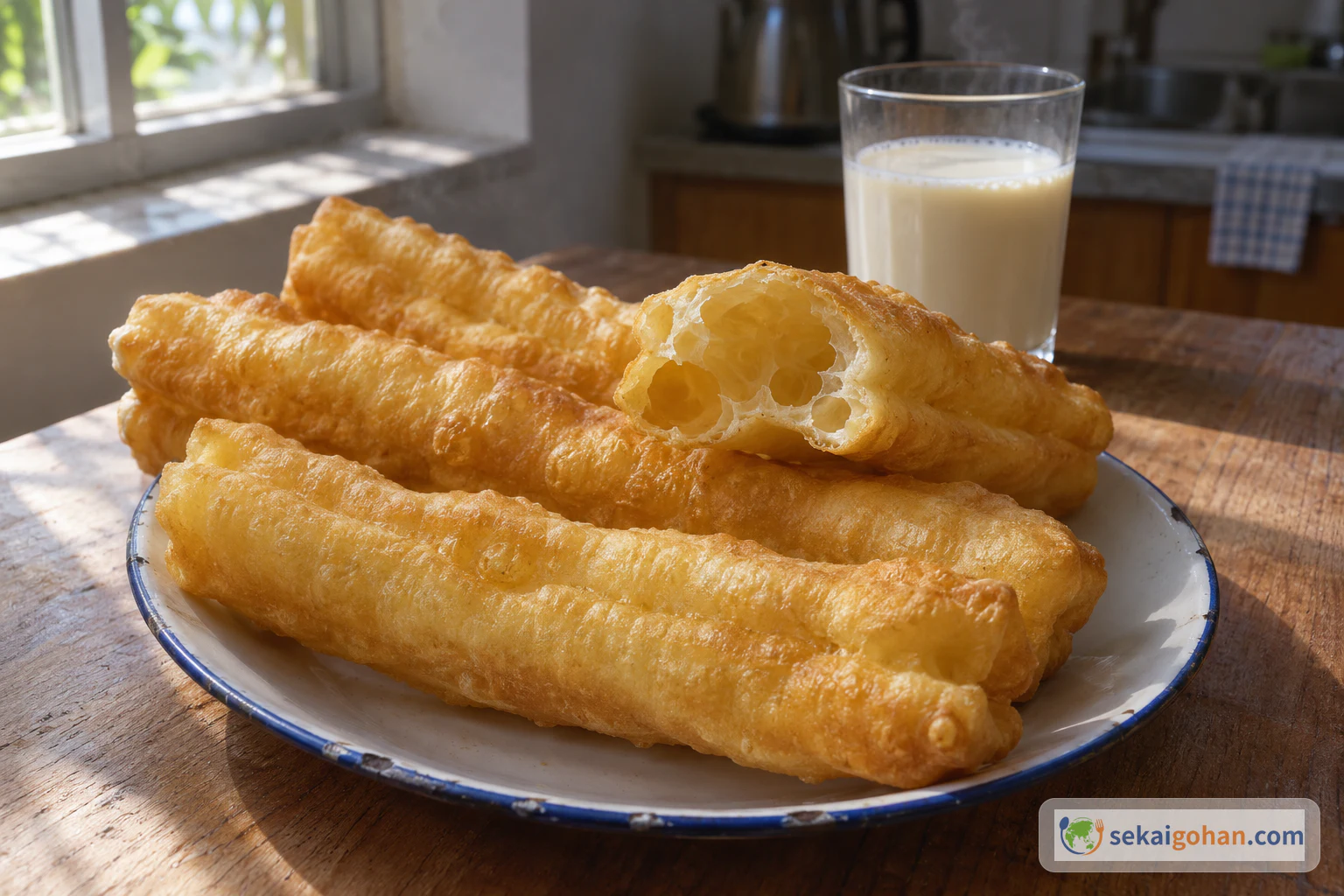
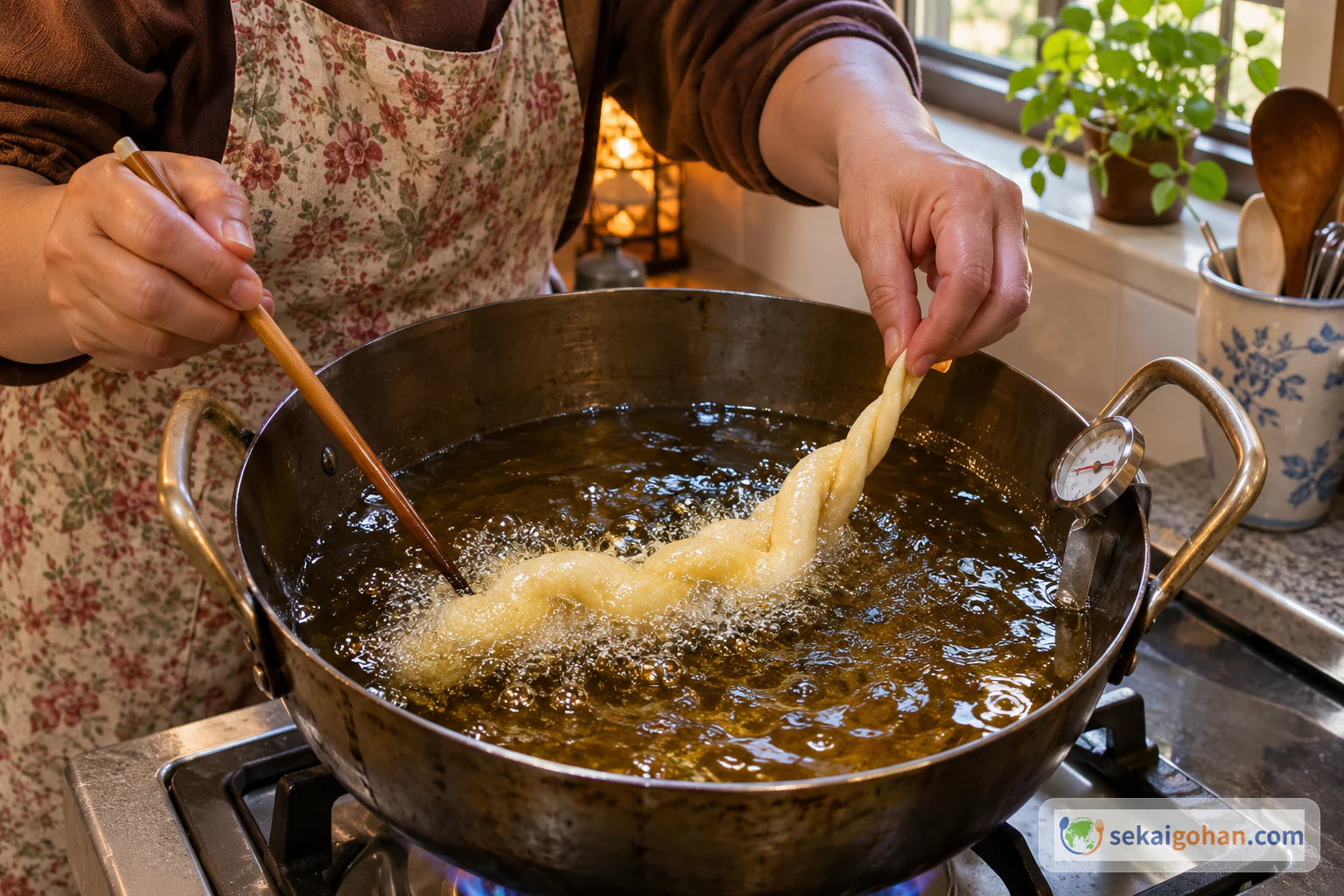
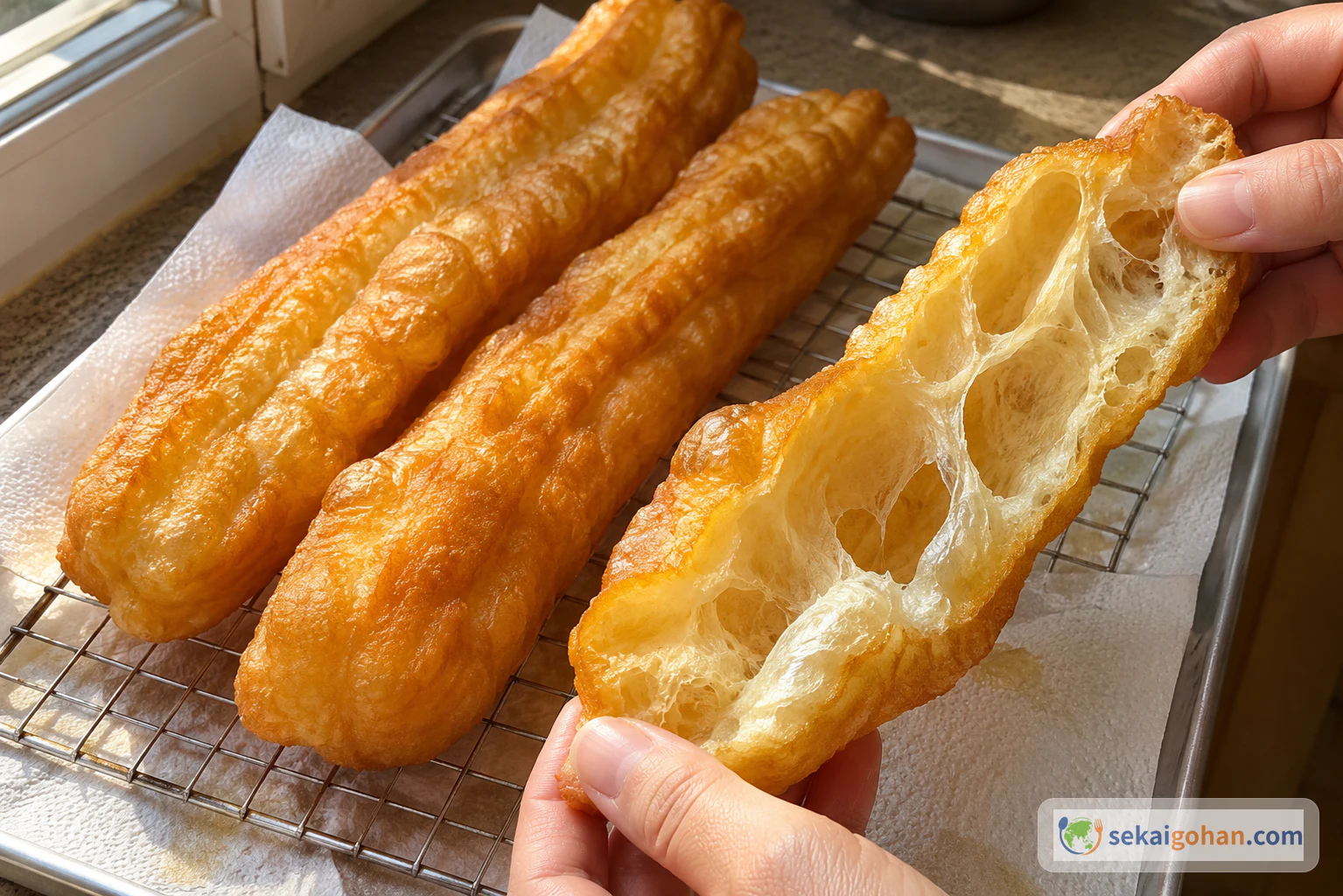
Hold the pale strip by both ends, pull it long with a slight twist, and lay it into the hot oil. It sinks for a breath, then rises, and as you roll it with chopsticks it swells to about twice its size and turns the color of a fox's coat. That is you tiao, the long fried dough stick eaten across China in the morning, torn into a bowl of congee or dipped into warm sweetened soy milk. The crust is thin and crackly, the inside mostly air, and the flavor is plain wheat with a little salt, which is exactly why it soaks up whatever it is dunked in. The dough is mixed the night before and fried the next morning, so the morning work is only rolling, shaping and frying.
A Morning Bread With Two Names and a Grudge
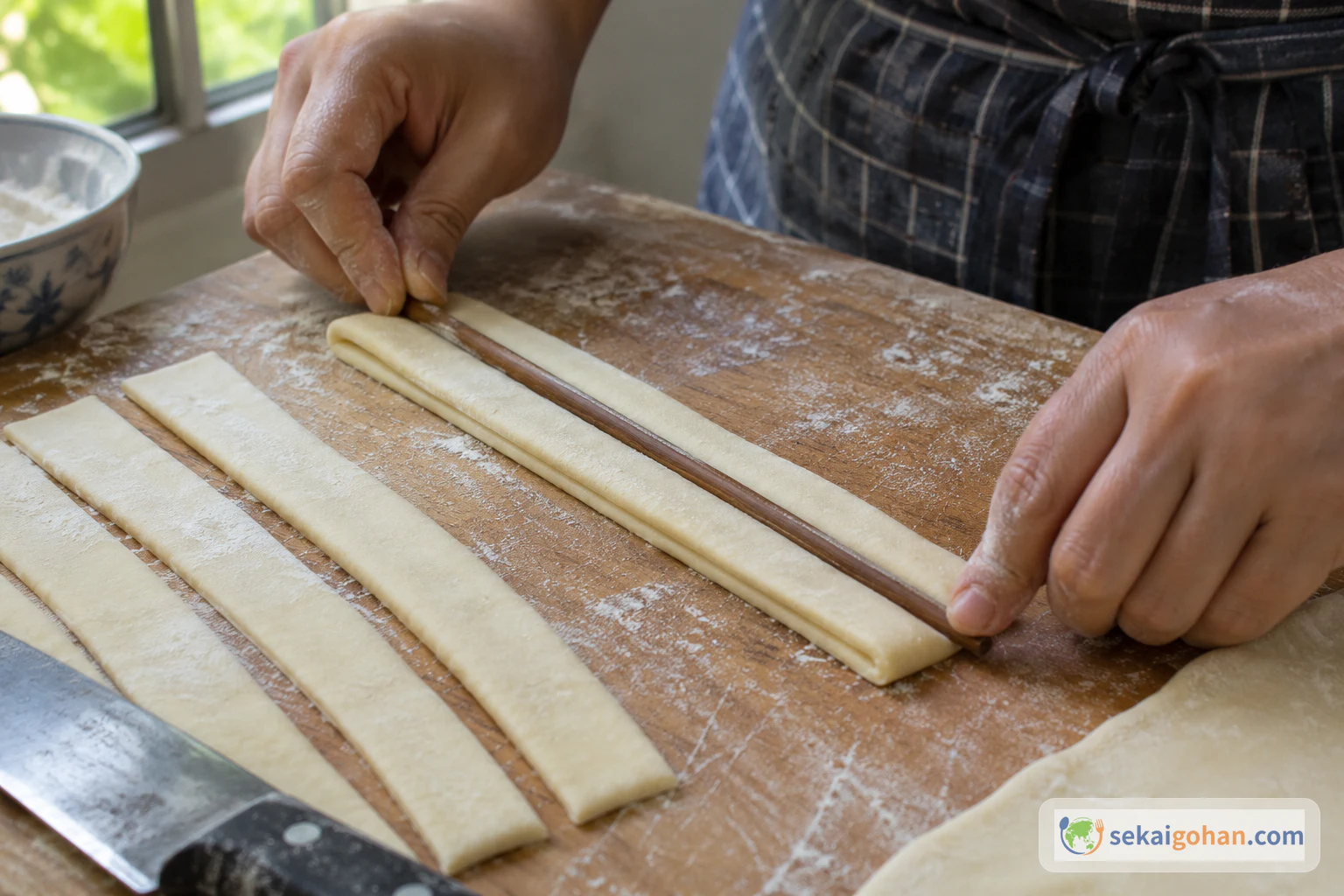
You tiao (油条, yóutiáo) is a breakfast staple across China, eaten with congee and warm soy milk while it is still hot. Each stick is two strips of dough pressed together down the middle and fried as one, so they puff side by side and can be pulled apart at the table. The dough has no yeast. It rises in the oil on baking powder and baking soda alone, after a long cold rest in the refrigerator.
In Cantonese the stick is called yau ja gwai (油炸鬼), "oil-fried ghost," and the name carries a story. During the Southern Song, the tale goes, the official Qin Hui and his wife plotted the downfall of the general Yue Fei. A cook who was furious about it shaped two pieces of dough to stand for the couple, threw them into hot oil, and called out for everyone to come and see Qin Hui fried. The snack became 油炸檜, "oil-fried Hui," and over time the name was simplified to 油炸鬼, since 鬼 (ghost) sounds like 檜 in Cantonese. It is a legend, told and retold, and where the dish actually began is not settled. It is also the story told to explain why two strips are fried together.
From mainland breakfast to Taiwan and Southeast Asia
Taiwan treats you tiao as both side and filling. It goes folded inside a flaky sesame flatbread as shaobing jia youtiao, rolled into a sticky-rice fantuan, or fried a second time until rock-crisp as lao youtiao and dropped into a numbing mala hotpot. It sits on the same morning round as Taiwanese danbing, the egg crepe. Farther south it becomes a soup companion, torn into bak kut teh in Malaysia and scattered over bubur ayam congee in Indonesia, where it goes by cakwe. In Vietnam the same kind of fried dough is quẩy.
The mix changes from house to house and stall to stall. Some versions use only bread flour with a little sugar and oil in the dough, some use all-purpose flour with egg and milk, and some fry hotter. This one keeps the dough lean, with a half cake flour, half bread flour base and no egg, dairy, sugar or fat. Street-stall you tiao often contains alum for extra crunch. At home, baking powder and soda do the lifting. For more dishes from the same table, see our Chinese recipes.
In mainland China it is written 油条; in Taiwan and Hong Kong, 油條. English menus spell it you tiao or youtiao. In Japanese it is yūtiao or yujō. It looks a little like Japanese abura-fu, the fried wheat-gluten stick, but you tiao is a firmer, bready dough.
Ingredients
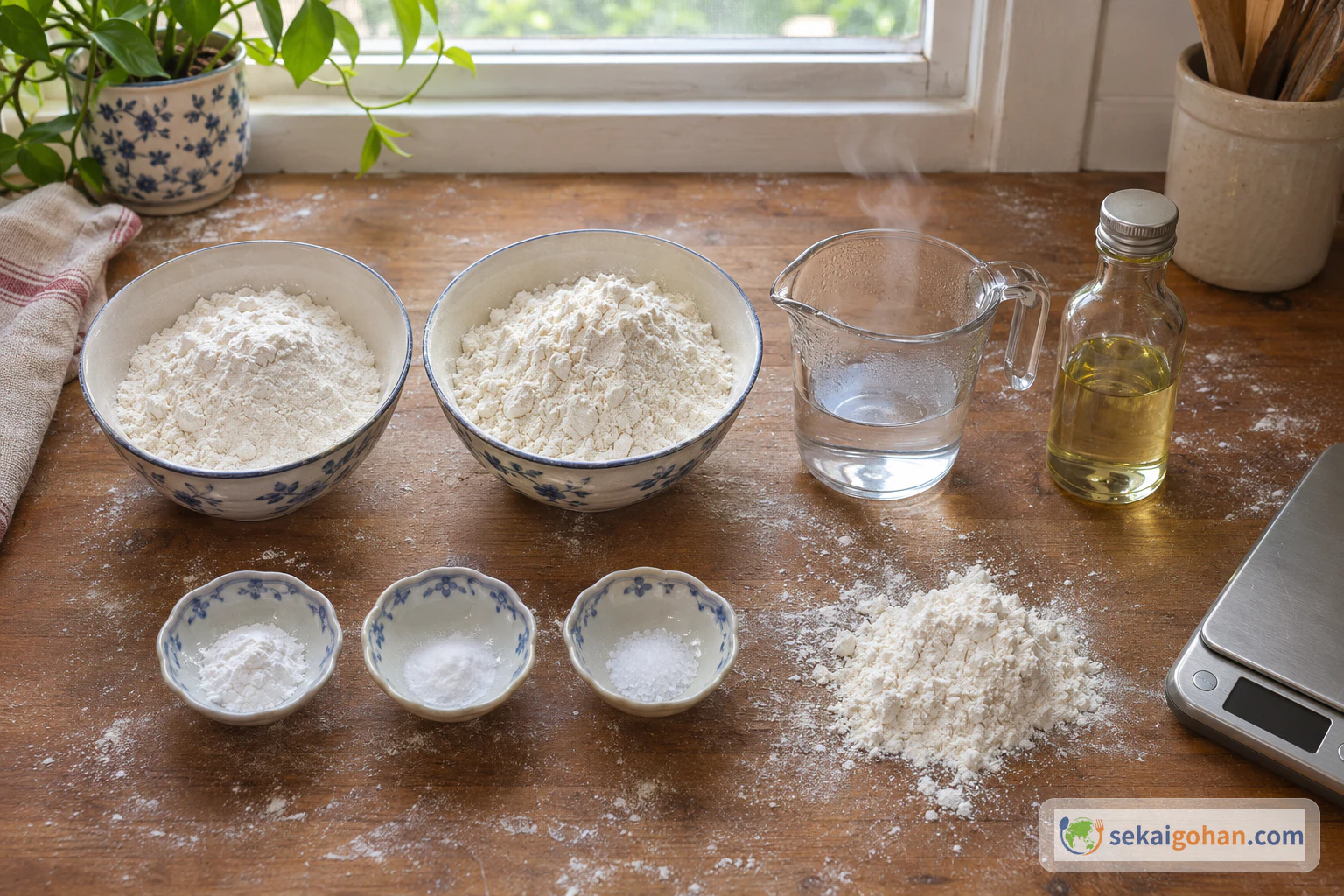
This makes 7 sticks. The leavening amounts are small enough that a digital scale that reads in 0.5 g steps is the way to measure them.
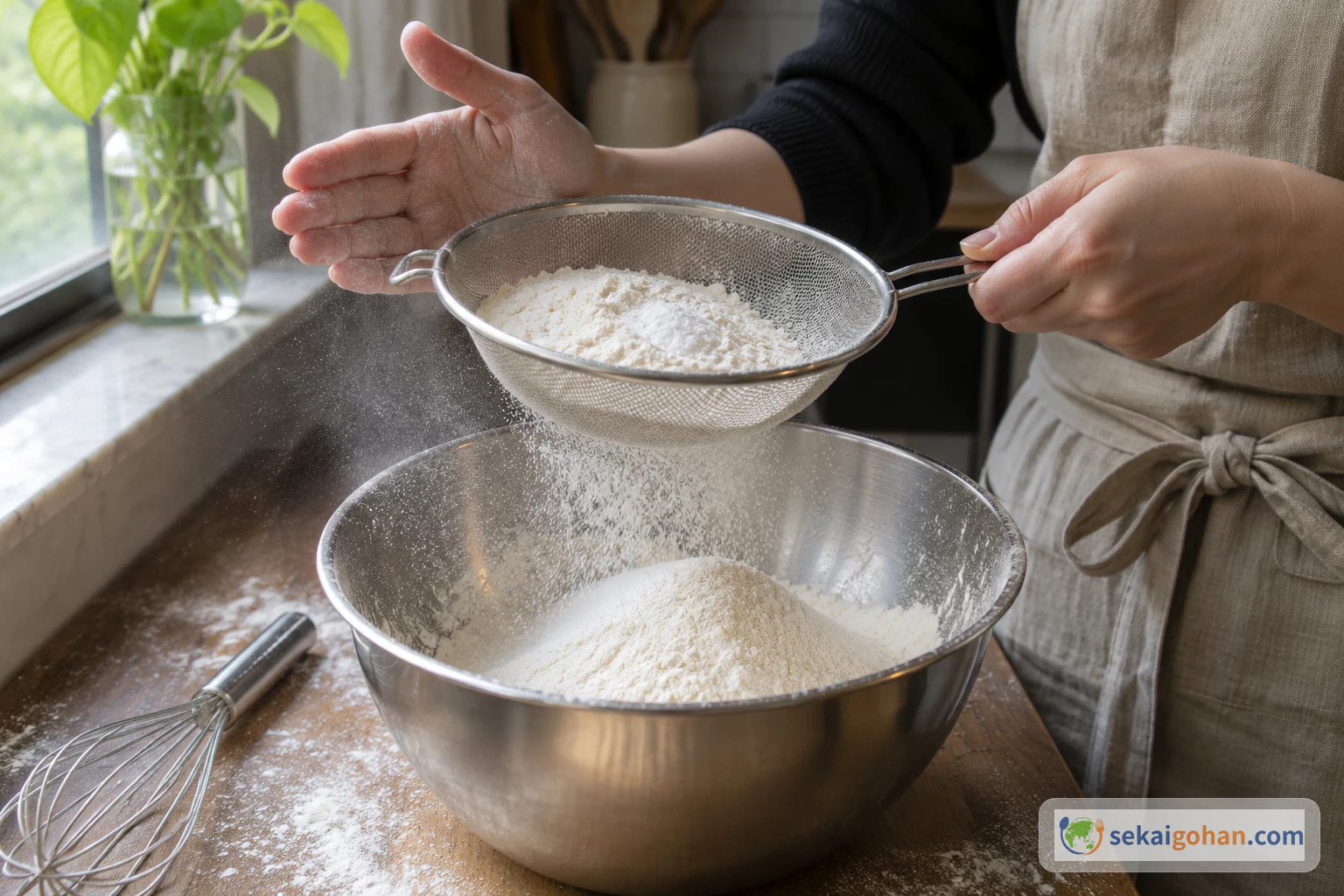
With only 100 g of flour, a fraction of a gram of baking powder or soda shifts the balance. Weigh both on the scale, and sift the baking powder in with the flour so no specks remain.
Contains wheat. The dough has no egg or dairy. Check the labels on your baking powder and frying oil, since ingredients differ between products.
Equipment
- Digital kitchen scale that reads small gram amounts
- Deep-fry thermometer
- 2 mixing bowls
- Fine-mesh sieve
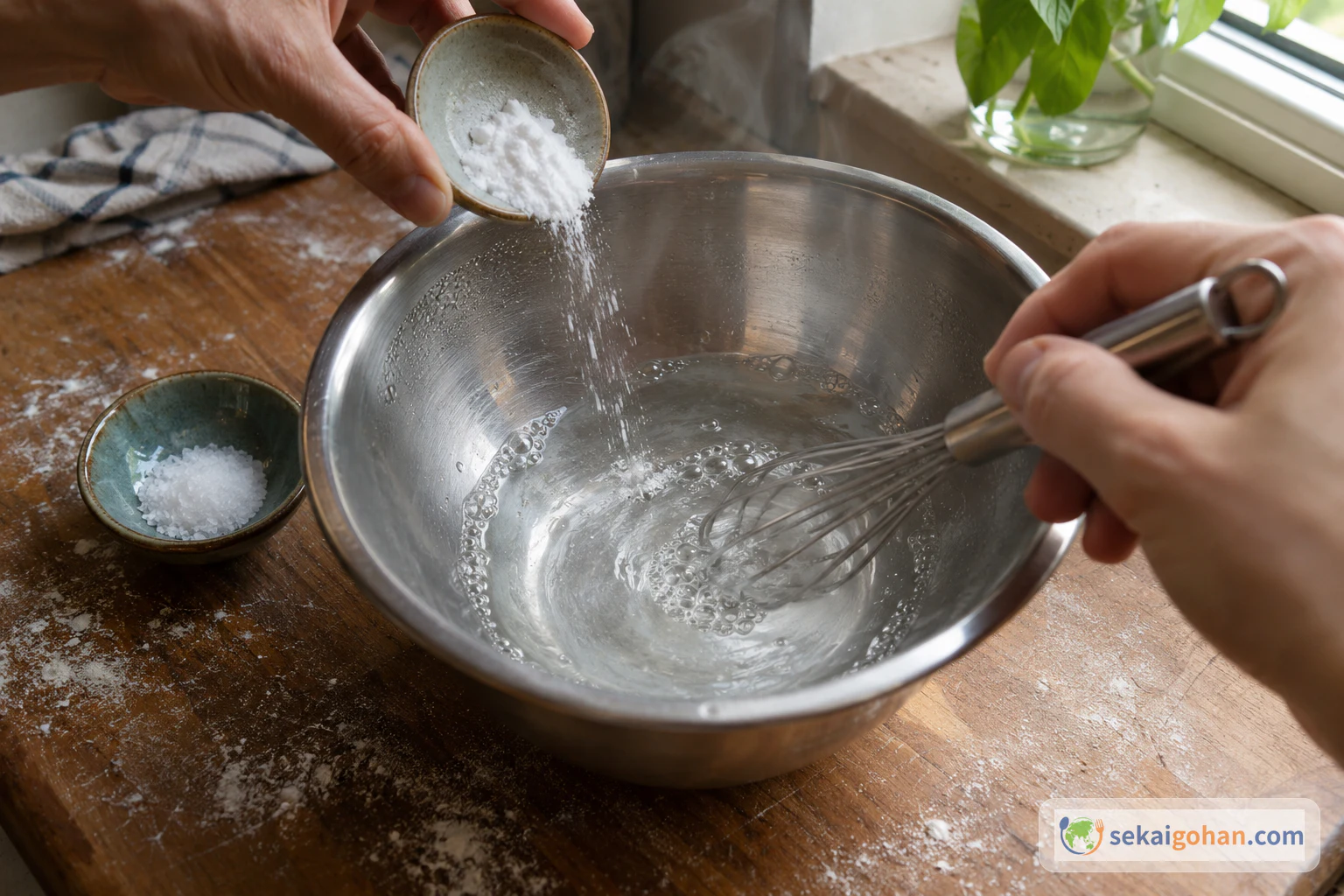
- Whisk
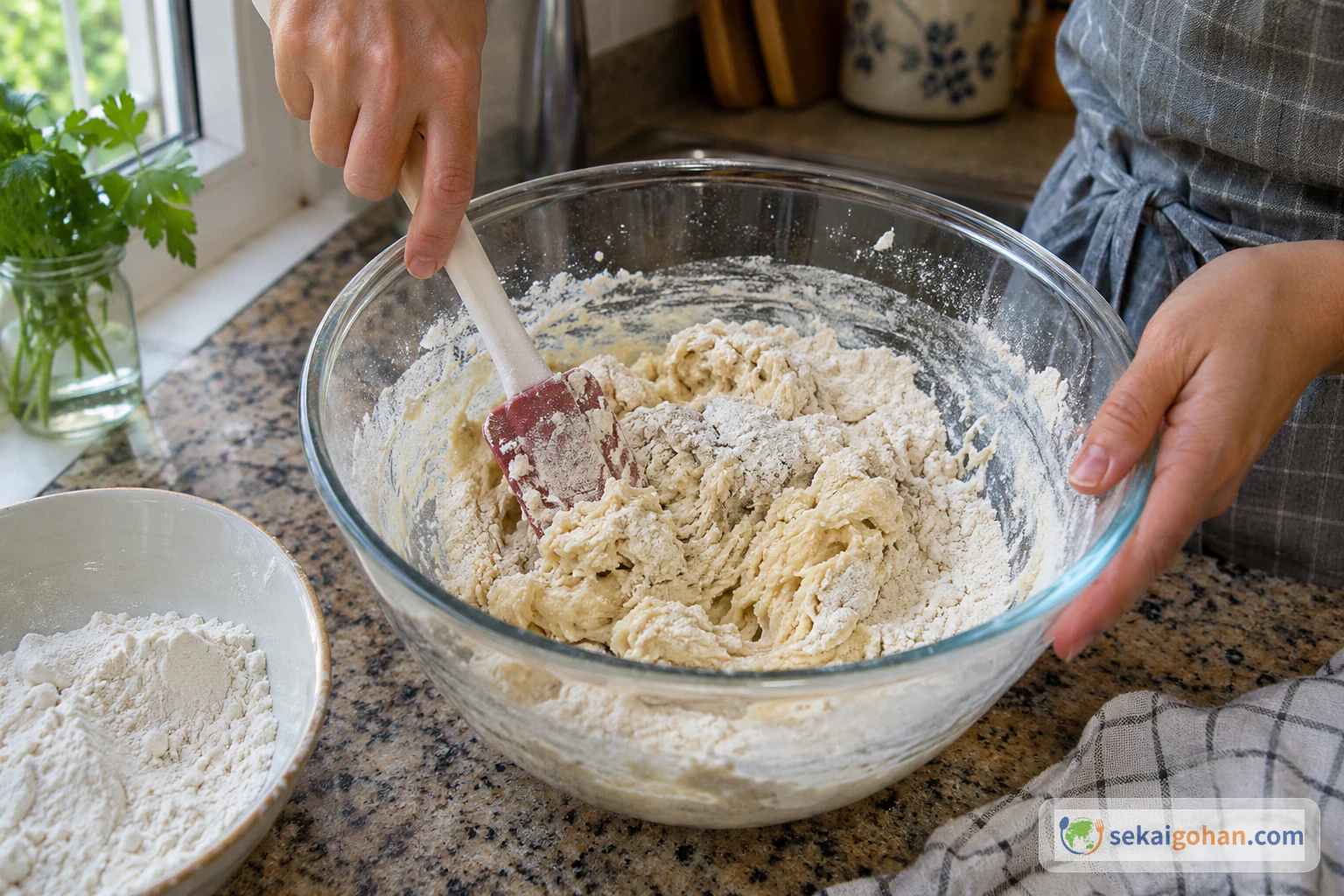
- Rubber spatula
- Rolling pin
- Knife
- Plastic wrap
- Lidded food container that fits the folded dough
- Long cooking chopsticks
- Deep frying pan or pot
- Wire rack set over a tray
Choosing and Substituting
Everything here comes from an ordinary supermarket baking shelf. Keep the two flours in equal weight, 50 g of each.
Buy baking powder labeled aluminum-free and read the ingredient list to confirm it. Many traditional stalls use alum, an aluminum-containing additive, for crispness, and the general rule for home cooking is to cut aluminum additives down or replace them where you can. Baking powder does the same job here.
For frying, use any neutral, flavorless vegetable oil, enough to let the sticks float and roll freely in a deep pan. Leave out the egg, milk and sugar some versions add; they belong to different recipes with their own mixes and oil heat.
Method
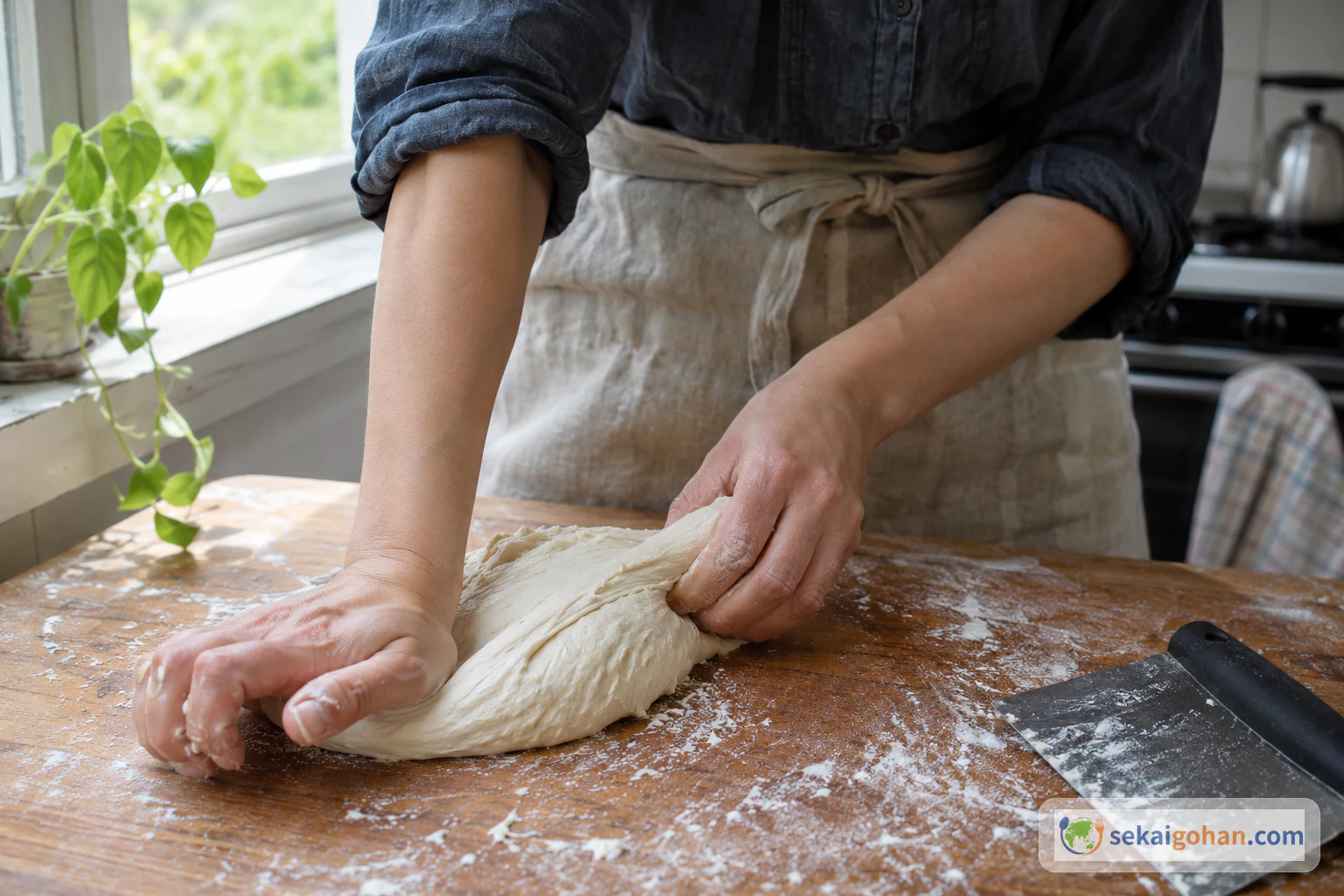
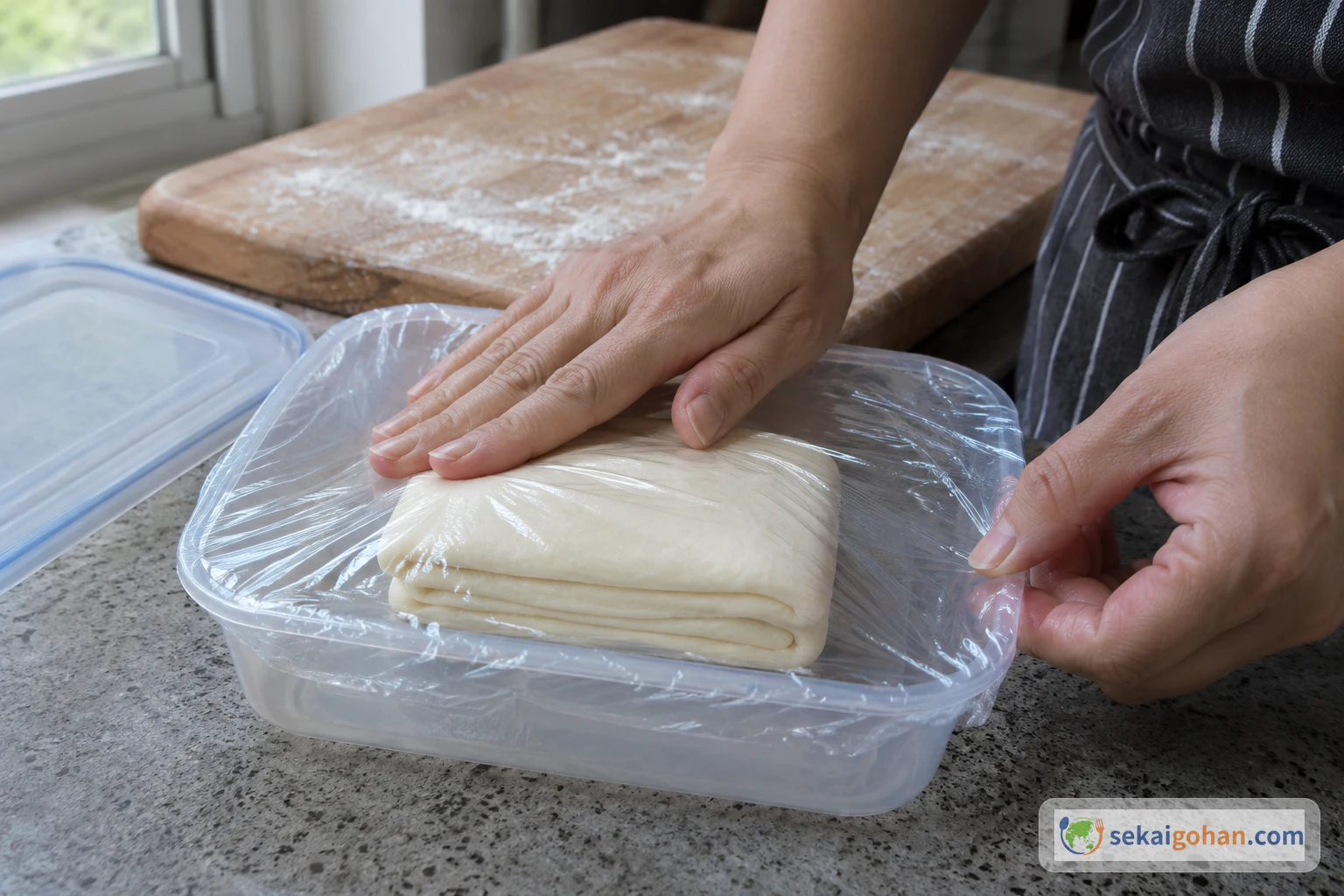
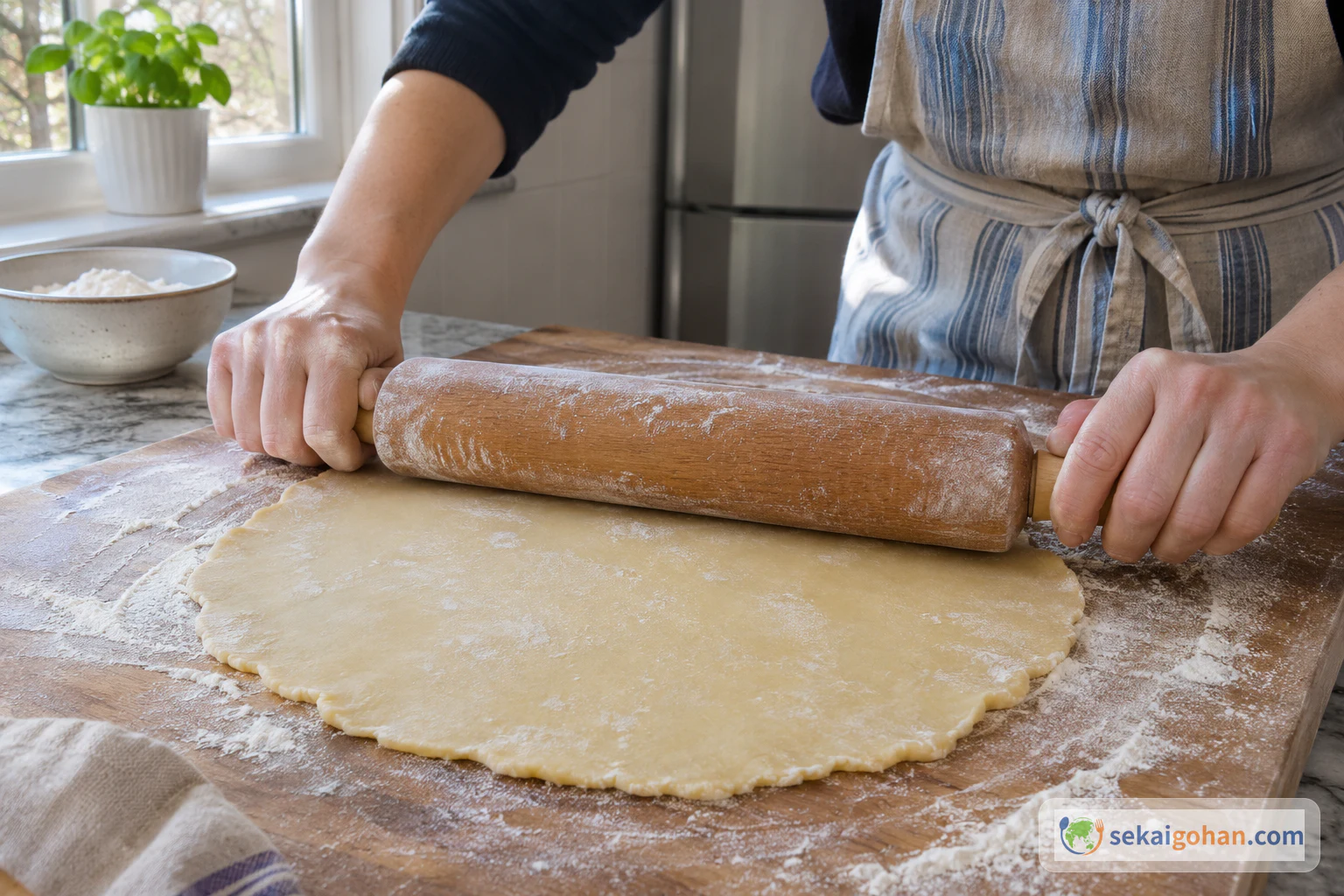
The work splits into two short sessions. The night before, about 20 minutes of mixing and kneading ends with the dough wrapped in the refrigerator for 8 hours to overnight, which is all hands-off. In the morning, about 15 minutes covers rolling, shaping and frying. Set the scale, the thermometer and the wire rack out before the oil goes on, because once frying starts you will not want to leave the stove.
Frying oil is normally used around 345°F (175°C). Left heating, it keeps climbing and can ignite on its own at about 700°F (370°C). Stay at the stove the whole time, and turn off the heat if you must step away. Keep anything flammable clear of the burner, and use a stove with overheat protection if you have one. If the oil catches fire, never pour water on it. Shut off the gas, aim a fire extinguisher to cover the surface of the oil, then put a lid over the pan to cut off air and leave it until the oil cools, since it can reignite while still hot.
Flour between the strips stops them from bonding, and a pair that separates in the oil fries as two thin, flat sticks. Dust just enough to keep the sheet off the board, and brush the top clean before stacking.
When It Goes Wrong
| What you see | Why | What to do |
|---|---|---|
| Sticks stay small and dense | Oil too cool, so the surface sets before the dough can swell | Bring the oil back to 340–355°F (170–180°C) before the next stick |
| Dough is stiff and hard to roll | Still cold from the refrigerator | Leave it out until it softens and rolls easily |
| The two strips come apart | Center pressed too lightly, or too much dusting flour | Press firmly along the full length, and brush off loose flour before stacking |
| Sticks taste greasy and heavy | Oil temperature dropped from frying too fast | Fry one at a time and let the oil recover between sticks |
| Dark outside before the stick has doubled | Oil too hot | Lower the heat and wait for the thermometer to come back into range |
| Dough too soft to knead by hand | Warm kitchen | Knead in the bowl, or put the dough in a plastic bag and knead through the bag |
Serving, Variations and Storage
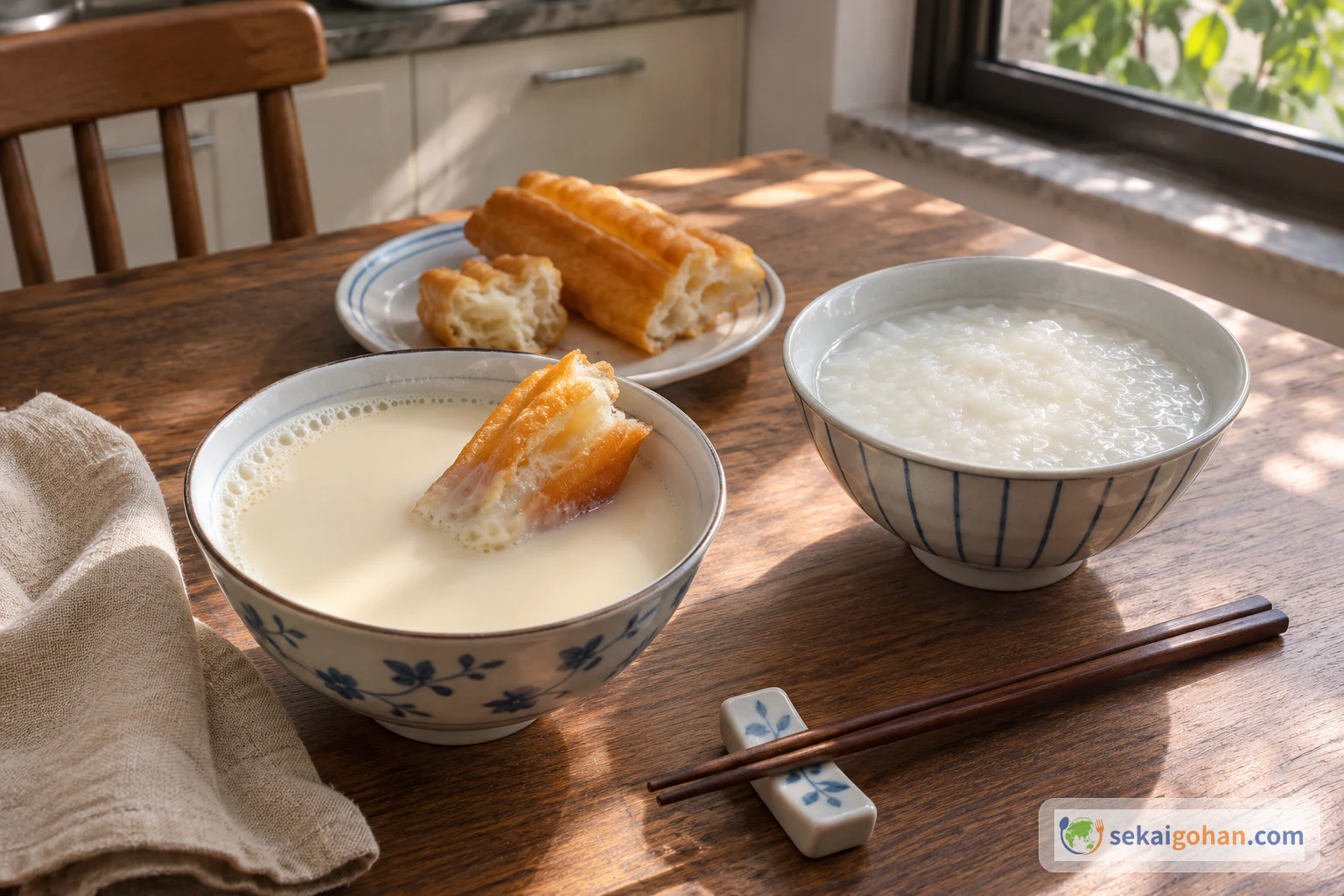
You tiao is at its best within minutes of leaving the oil, when the shell still crackles. The classic breakfast puts it next to a bowl of plain congee and a bowl of warm sweetened soy milk. Tear off a piece and drop it into the congee, where the crust softens and the airy inside soaks up the rice, or dunk it in the soy milk and eat it dripping.
Variations
- Sugared: roll the hot sticks in sugar for a sweet snack that sits closer to a doughnut.
- In soup: tear them into a meaty broth such as bak kut teh, where the soft layers drink up the soup.
- As a filling, Taiwan style: fold a stick inside a sesame flatbread or roll it into a sticky-rice ball, where the crunch plays against the soft wrapper.
- Lao youtiao: fry already-fried sticks a second time until hard and crisp, then drop them into a mala hotpot.
Storage and reheating
Let the sticks cool completely, then keep them at room temperature for up to 2 days. To freeze, seal them airtight and keep for up to 1 month. To soften, microwave about 5 seconds per stick. For a crisp outside again, warm them in a skillet over low heat or in a toaster oven.
Frequently Asked Questions
Why does street-stall you tiao taste crunchier?
Many stalls add alum, an aluminum-containing leavening, which gives a sharper crunch. Mainland China caps aluminum in fried flour products at 100 mg per kg, as aluminum on a dry-weight basis. Health effects at ordinary intakes are considered unlikely, though they cannot be ruled out for people who eat a lot of aluminum-containing foods. Aluminum-free baking powder at home keeps you well clear of the question.
Can I make the dough and fry it later the same day?
Give the dough the full 8 hours to overnight in the refrigerator. Mix it after dinner and fry at breakfast. The cold rest is what makes the dough roll out cleanly in the morning.
Can I fry two or three sticks at once?
Fry one at a time. Each stick needs room to roll and double, and every new piece of cold dough pulls the oil temperature down. Seven sticks go quickly once the oil is at temperature.
How do I know the oil is ready without a thermometer?
Drop in a small scrap of dough. It should sink briefly, then float up quickly with steady bubbles. A thermometer is still the surest way to hold 340–355°F (170–180°C) through all seven sticks.