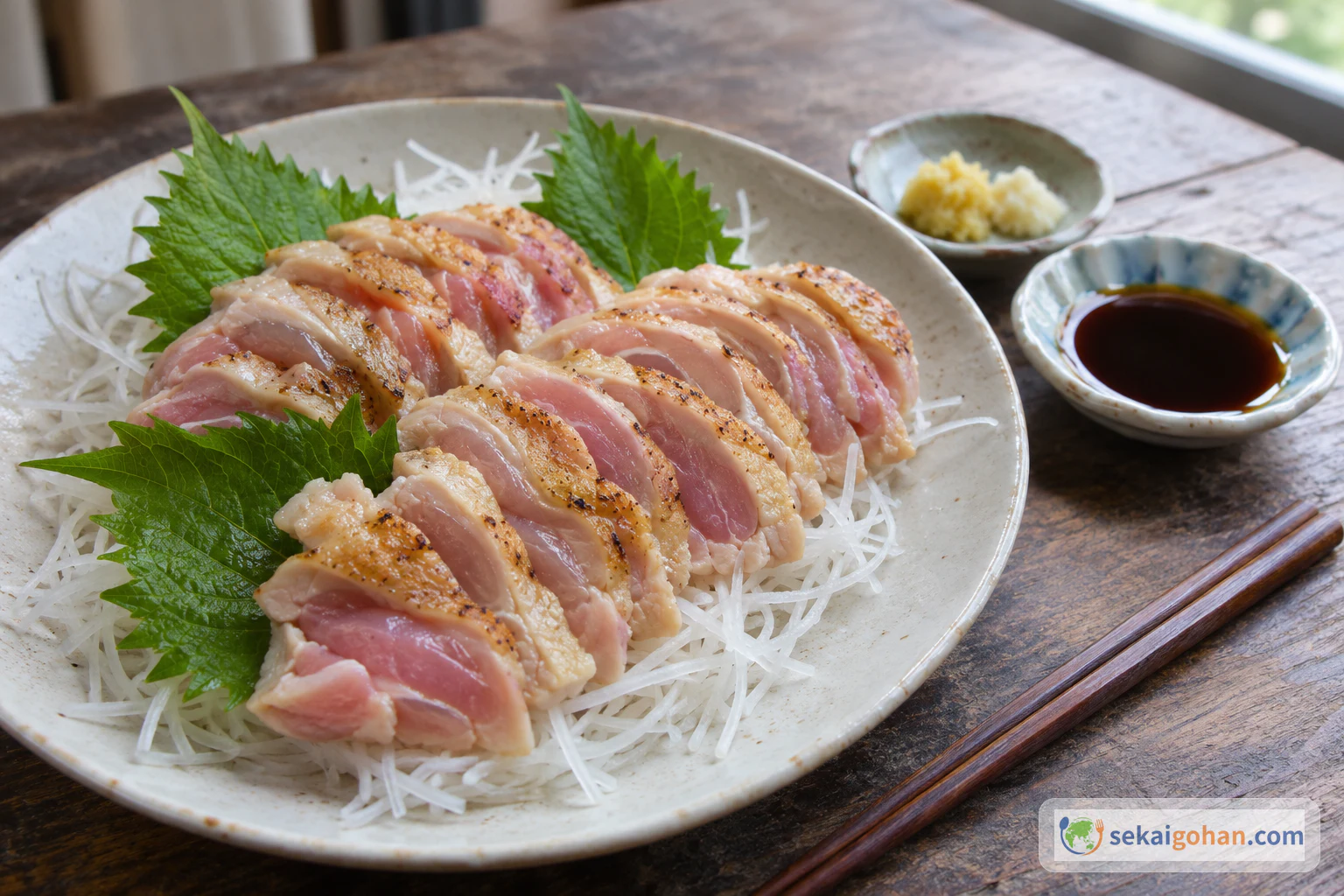
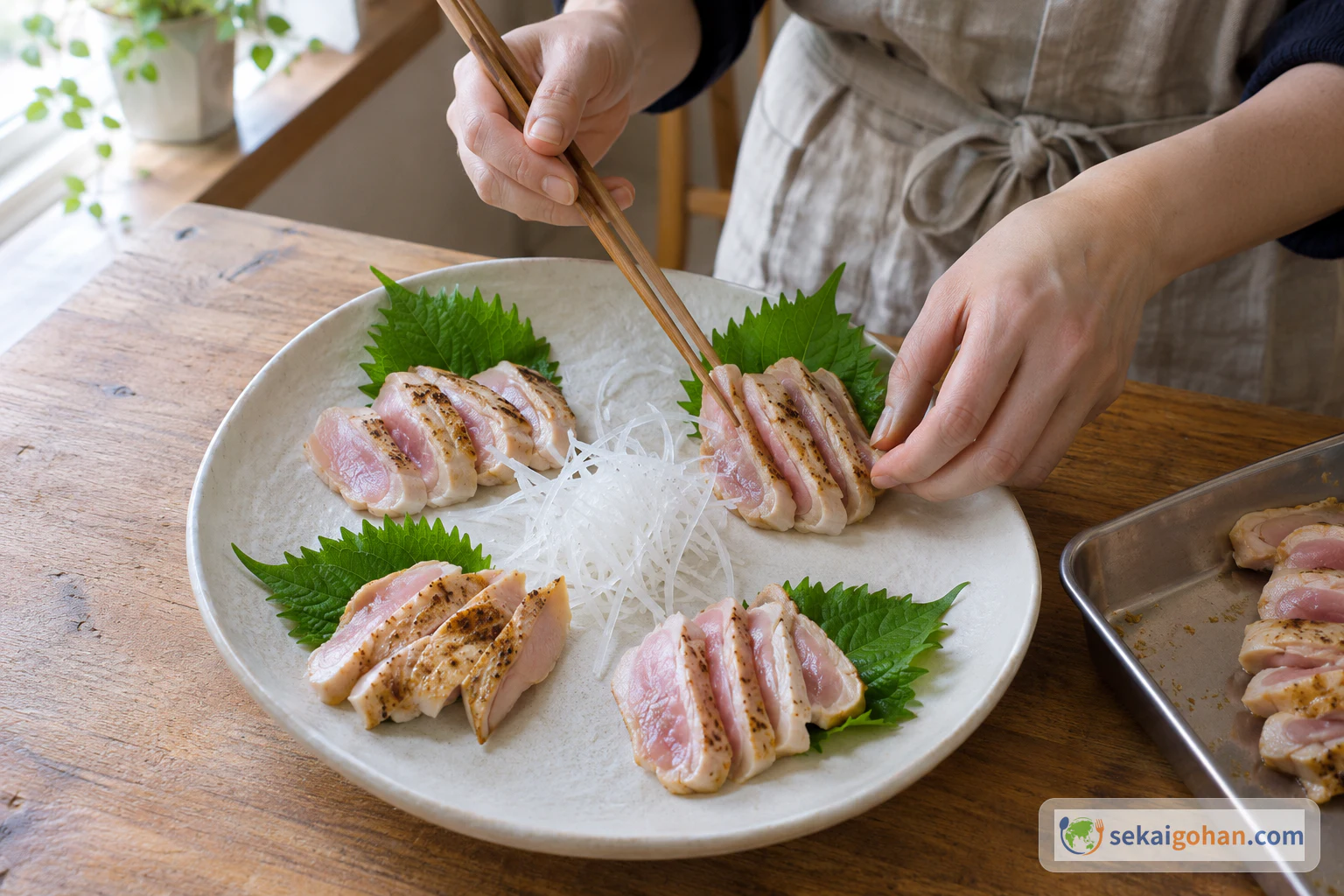
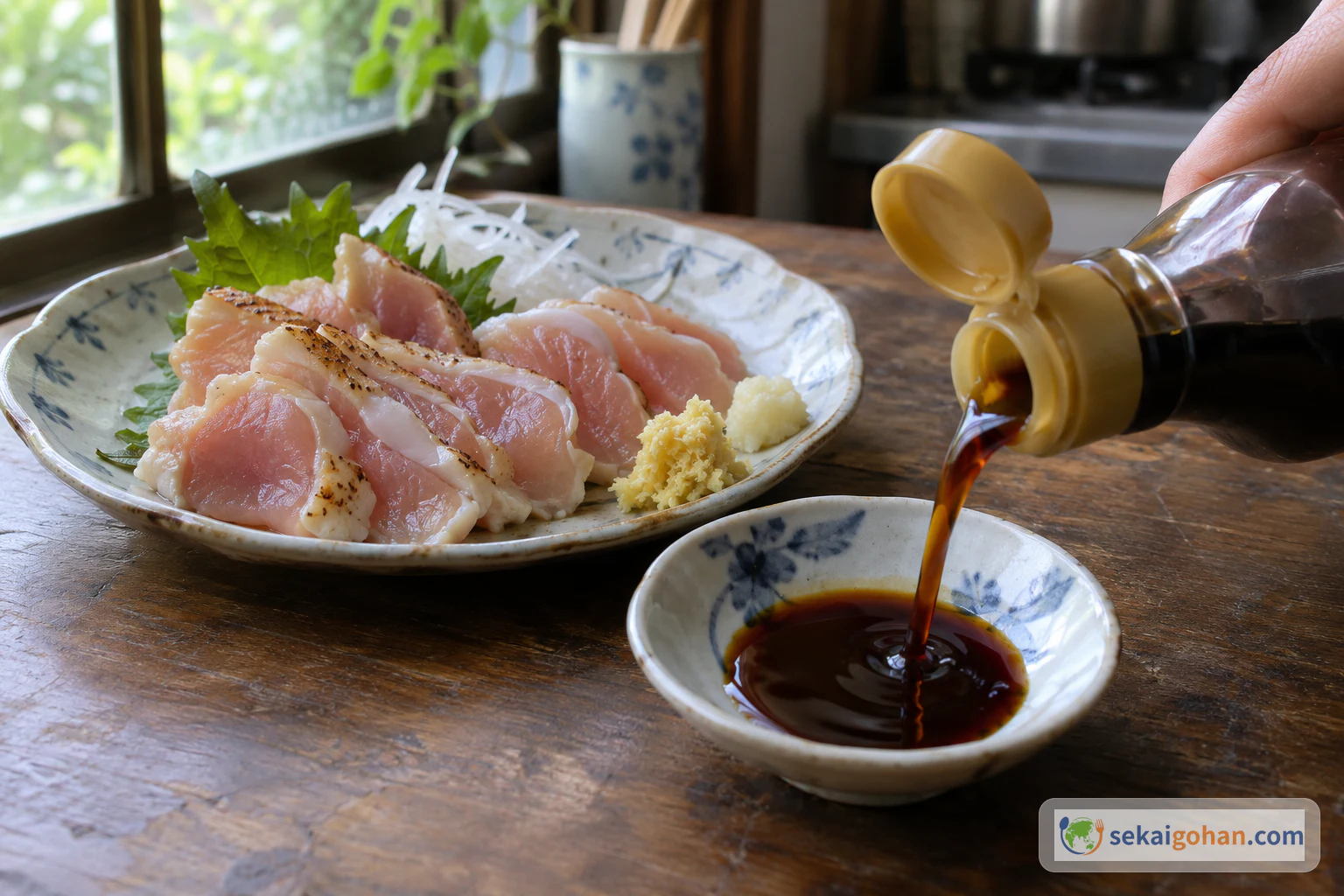
The plate comes to the table cold. Fine threads of daikon lie under a few flat shiso leaves, and thin slices of chicken are laid across them by cut, the skin edge seared pale gold. On the rim sit two small mounds, grated ginger and grated garlic, and next to the plate a little dish of dark, glossy, sweet soy sauce waits for each slice. This is torisashi, chicken cut like sashimi, and in Kagoshima it is eaten raw. The sweet soy rounds off the salt, the garlic pulls out the sweetness of the meat, and the daikon gives crunch and a clean, watery bite between slices.
At home you cook the chicken through and keep everything else the way Kagoshima serves it: the same cut, the same aromatics, the same sweet soy.
Raw Chicken in Kagoshima: Cockfights, Celebration Tables and a Strict Standard
Kagoshima has a long list of chicken dishes, including satsuma-jiru, keihan, simmered dishes and yakitori, and torisashi belongs to that list across the whole prefecture. It has no season. It is eaten all year round. Eating chicken raw as sashimi is a habit found in Japan only within Kagoshima and part of Miyazaki, which makes it unusual even among the many regional foods of Japan. Because the hygiene is hard to manage, people in Kagoshima eat it more often at restaurants than at home, and the torisashi sold in shops is prepared at facilities that meet the prefecture's hygiene standard.
The dish is written 鶏刺し or 鳥刺し, and sometimes とり刺し. All three are torisashi, the same plate of sliced chicken with aromatics and sweet soy.
From the cockfighting ring to the guest's plate
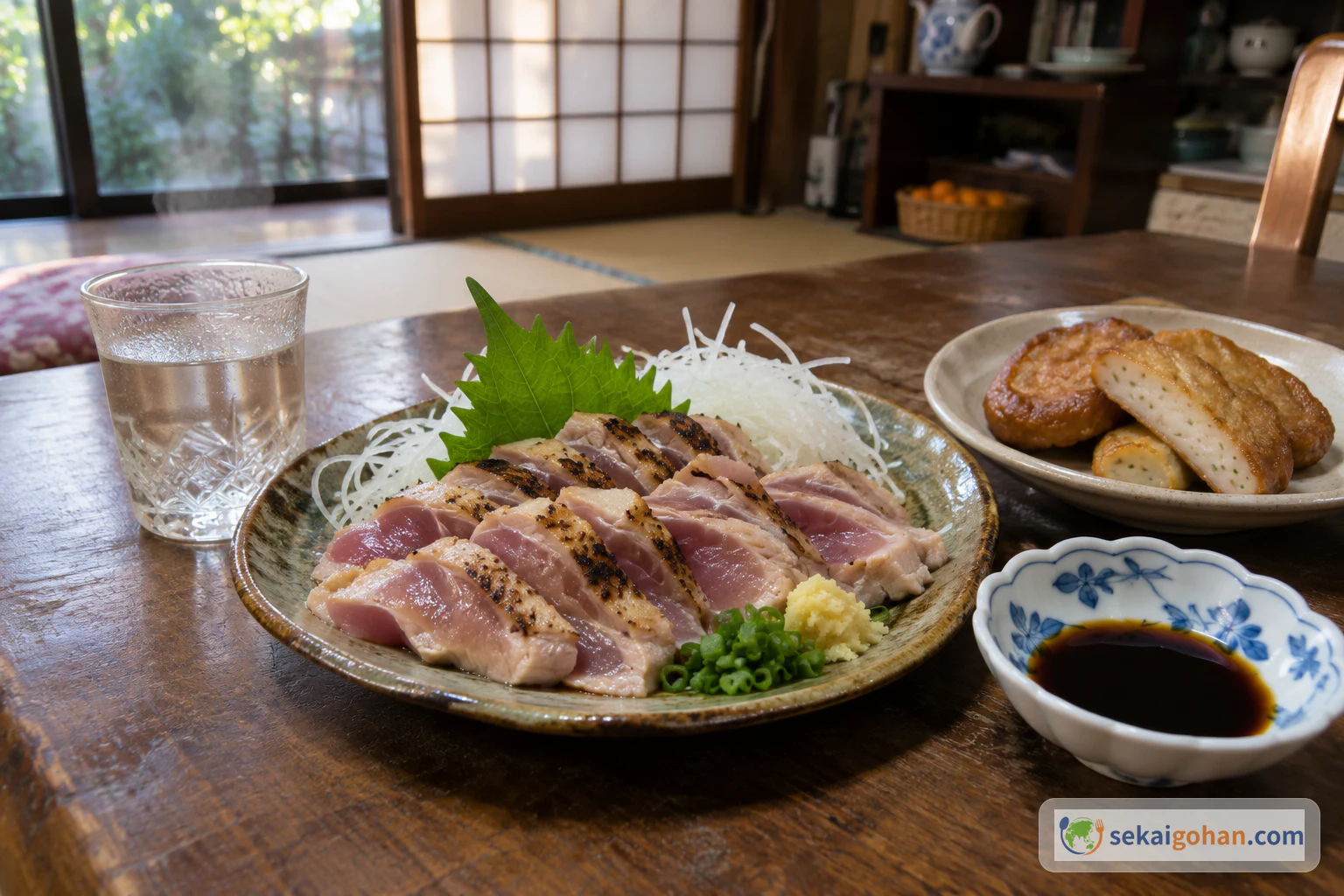
When torisashi first appeared is not settled. The story usually told goes back to the Edo period, when Satsuma samurai staged cockfights to keep their fighting spirit sharp, and there is a record of the losing bird being killed and eaten on the spot. After cockfighting was banned, households went on keeping chickens and killed one when guests came or when there was something to celebrate. An old local account says that among rural samurai and farmers, a chicken was killed for festive occasions, the tenderloin became sashimi, and it was enjoyed with sweet-potato shochu, though even that account says only that this "seems" to have been the case.
The birds themselves are part of the pride. Satsuma jidori, bred from the old Satsuma chicken, is counted among Japan's three great jidori alongside Hinai jidori and Nagoya Cochin. Brand chickens such as Satsuma Wakashamo and Kuro Satsuma-dori are raised in the prefecture too.
How Kagoshima kitchens cut it
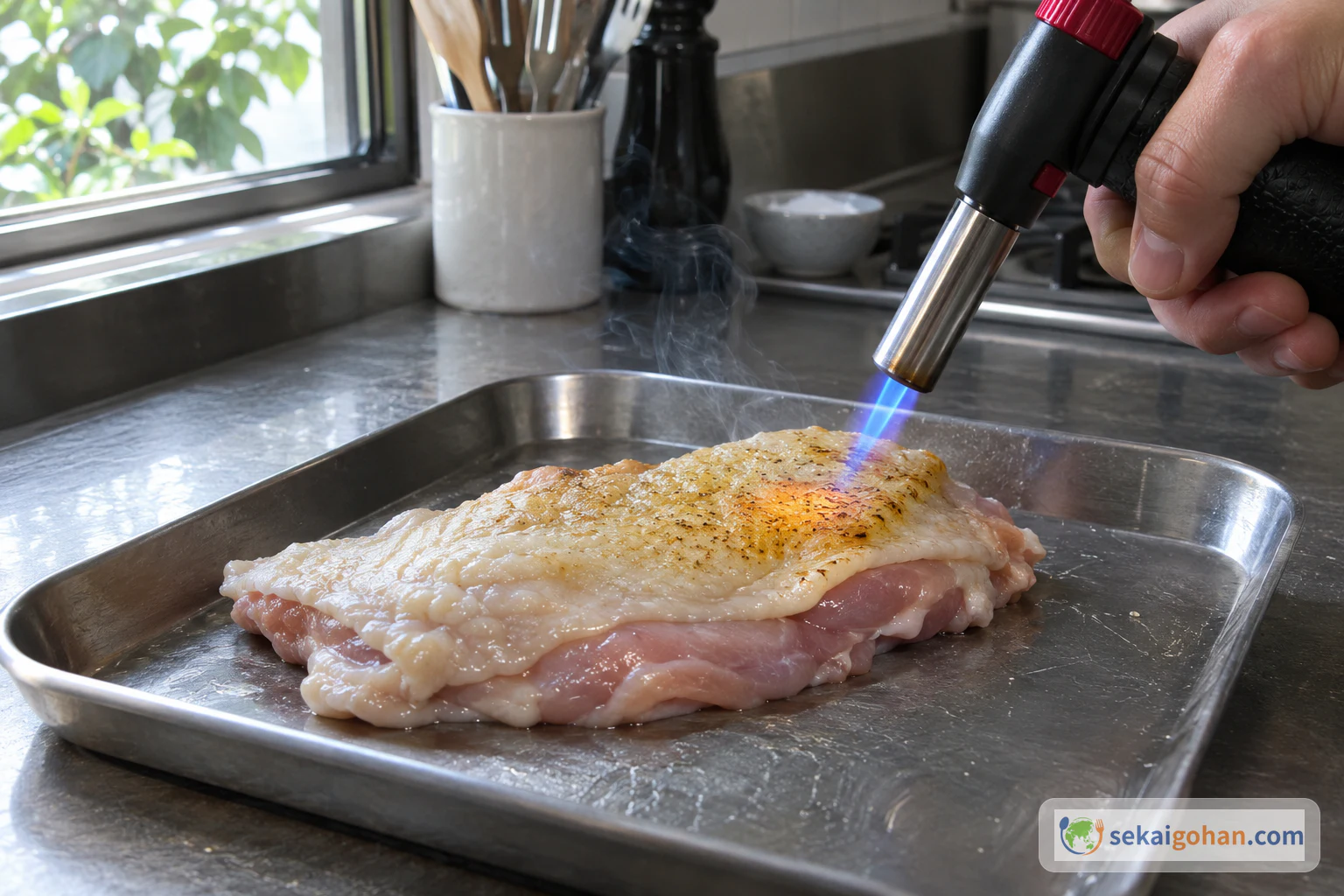
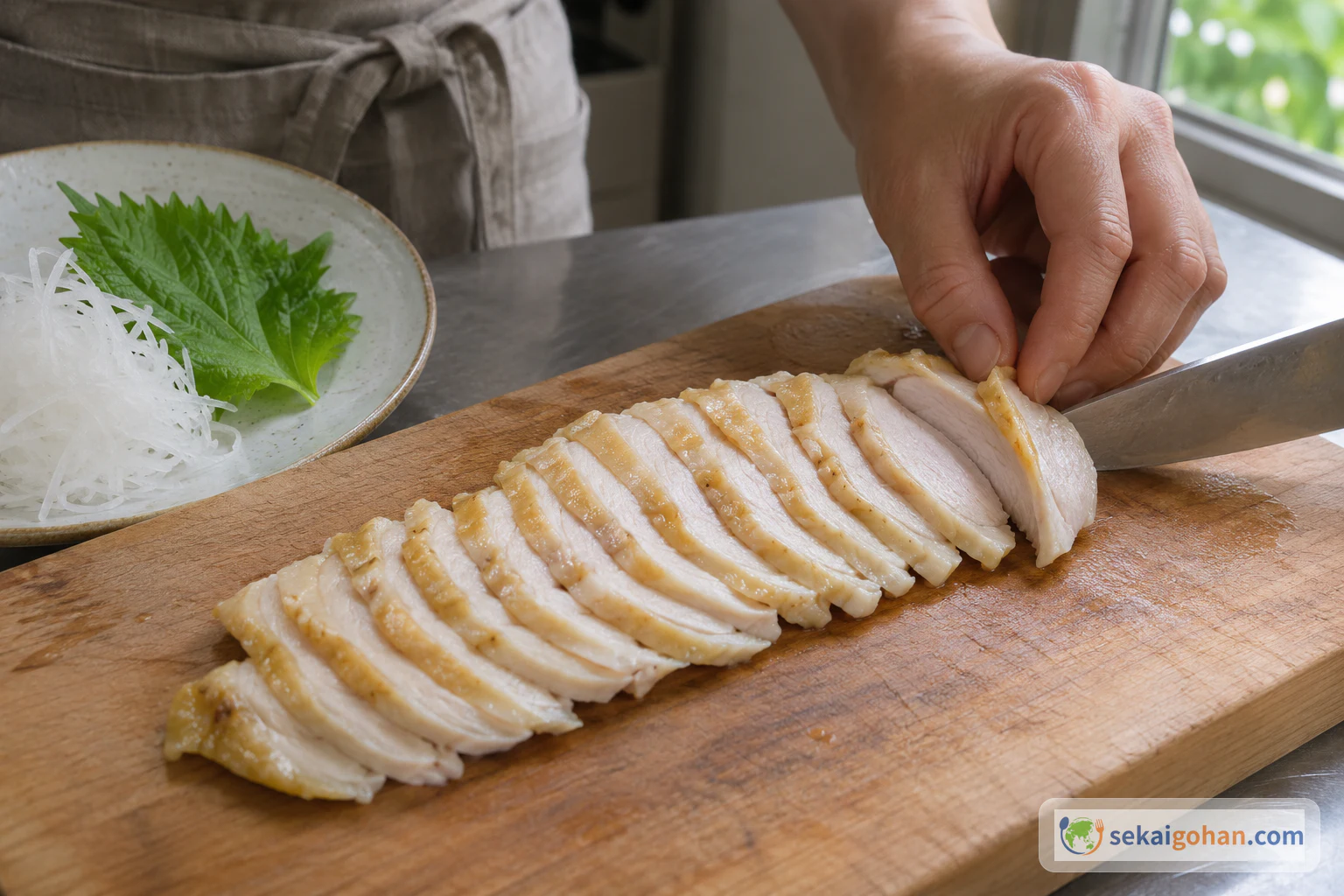
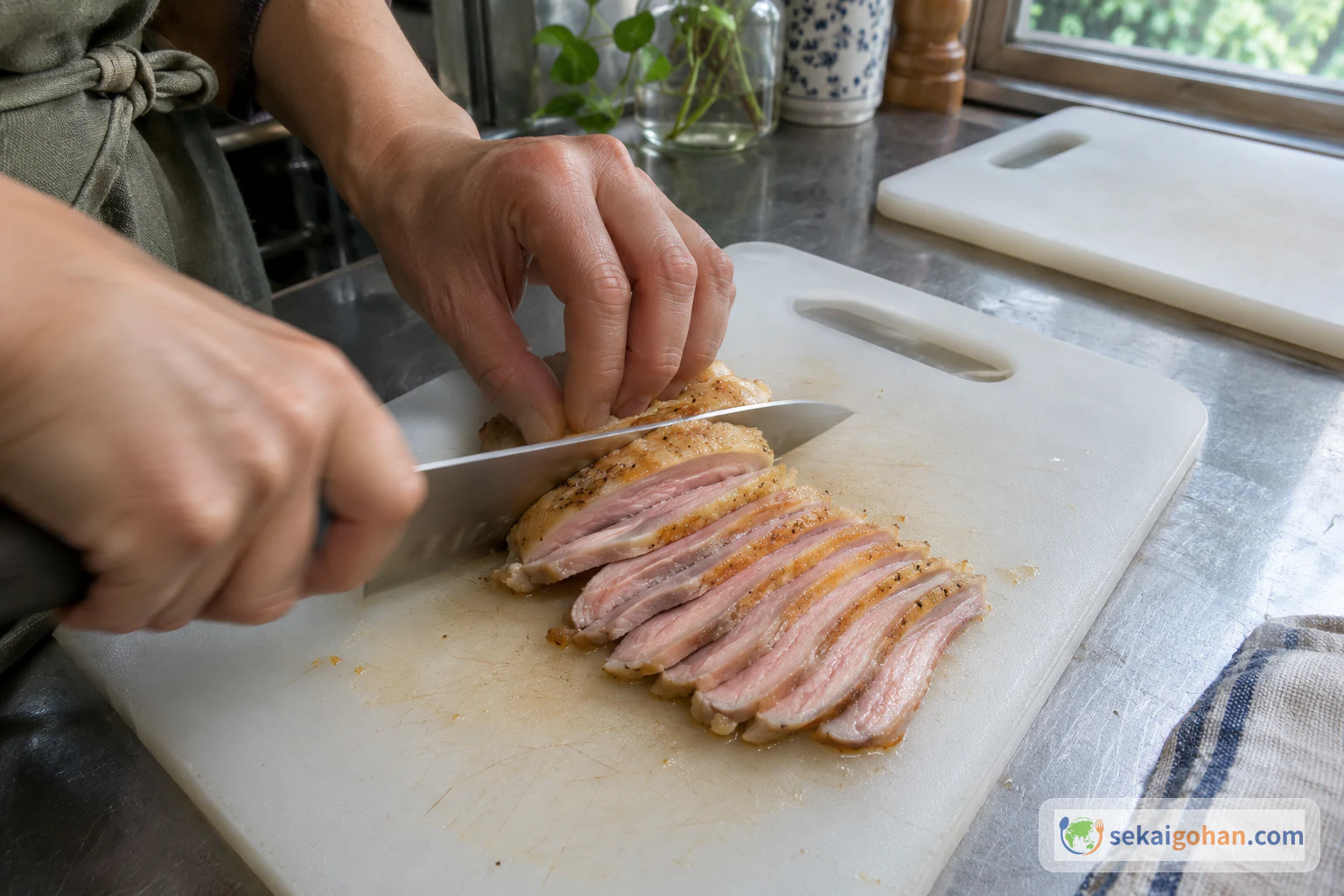
In the Kagoshima style, the chicken keeps its skin. A torch passes over the skin side and stops as soon as the surface changes colour, so the inside stays raw. The meat is then sliced from the skin side about ⅛ inch (3 mm) thick, cutting across the grain so each slice is short-fibred and easy to bite through. Thigh, breast and tenderloin are arranged in separate groups on the plate, and gizzard has long been a familiar cut too.
Torisashi, tataki and toriwasa
Three names get mixed up. Torisashi is the sliced chicken itself, seared on the skin or not. Tataki is chicken seared on the outside and left raw inside, and in Miyazaki, especially around Miyakonojo, tataki is the everyday name. Toriwasa is a different dish, chicken eaten with wasabi and soy sauce, and it belongs with the half-raw chicken dishes rather than with Kagoshima's plate.
Kagoshima and Miyakonojo, two chicken towns
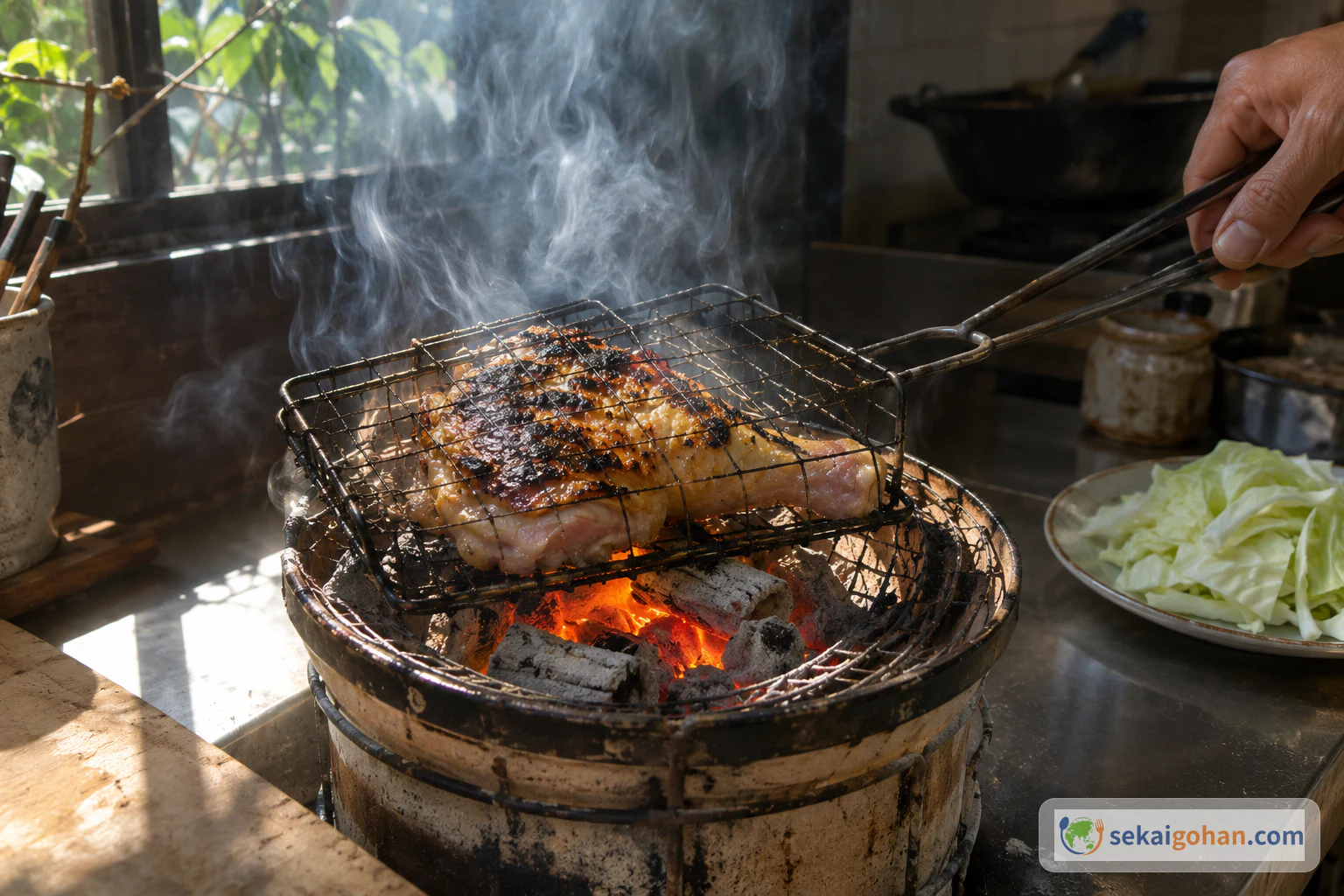
Miyakonojo, in Miyazaki, grew up under the old Satsuma domain and built its own chicken culture. People there love momo-yaki, grilled thigh, and they eat raw chicken as tataki and sashi as well. In momo tataki the thigh is only lightly seared on the surface and the meat is almost raw. Supermarkets and farm stands sell packs labelled "chicken tataki (for raw consumption)". Miyazaki raises its own jidori too: Miyazaki Jitokko, a breed designated a national natural monument in 1943. In Kagoshima, torisashi is mostly something you go out to eat; in Miyakonojo, tataki is something you pick up at the supermarket and take home.
Where the Line Between Raw and Cooked Is Drawn
Kagoshima set its own hygiene standard for chicken sold for raw eating in February 2000 and revised it in May 2018, based on microbial testing. The standard sets four targets that must test negative: fecal coliforms, Salmonella, Campylobacter and Staphylococcus aureus. At the processing plant, the body cavity is washed under running water and drained, then the surface is sterilized with flame. Cutting is done on dedicated boards and benches made of non-absorbent material, tools are sanitized with water at 182°F (83°C) or hotter, and hands are washed with disinfectant. The meat is kept at 50°F (10°C) or below, ideally 39°F (4°C) or below, and frozen at 5°F (−15°C) or below, ideally 0°F (−18°C) or below.
The package label is meant to show three things: that the chicken is for raw consumption, the names and prefecture of every facility that slaughtered, processed and packed it, and a plain statement of the risk of eating meat raw. In the 2018 revision, gizzard and liver were removed from the standard altogether. Organ meat is easily contaminated when the bird is dressed, Campylobacter is found in it often, and microbial control is not yet possible. Raw gizzard and raw liver are outside the standard.
The standard is a target, not a legal requirement. It is written for slaughterhouses, meat processing plants and restaurants, not for a home kitchen. Japan's food hygiene law does not regulate eating chicken raw at all, and in July 2026 a plan to draw up the first national guideline for processing chicken for raw eating was announced. Its content and start date have not been published.
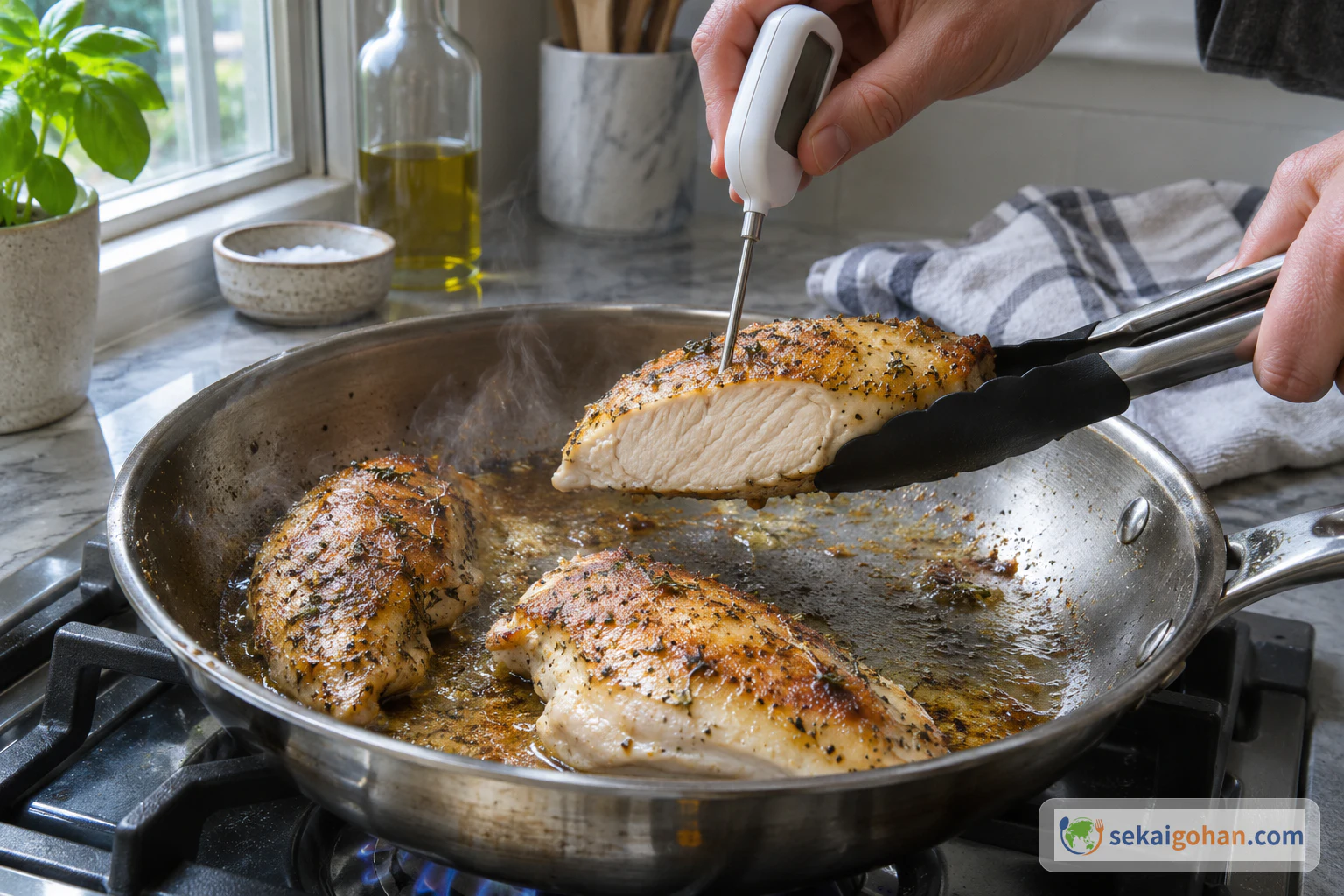
Healthy chickens carry food-poisoning bacteria, and even the most hygienic slaughter and dressing cannot keep microbes off the meat. Campylobacter infects with just a few hundred bacteria. In 2025 there were 220 Campylobacter outbreaks in Japan with 1,226 patients, and the foods suspected included chicken liver and tenderloin sashimi, chicken tataki and toriwasa. More than three-quarters of Campylobacter outbreaks overall start at restaurants. At home, cook the chicken until the center reaches 167°F (75°C) for at least 1 minute.
Ingredients (serves 4)
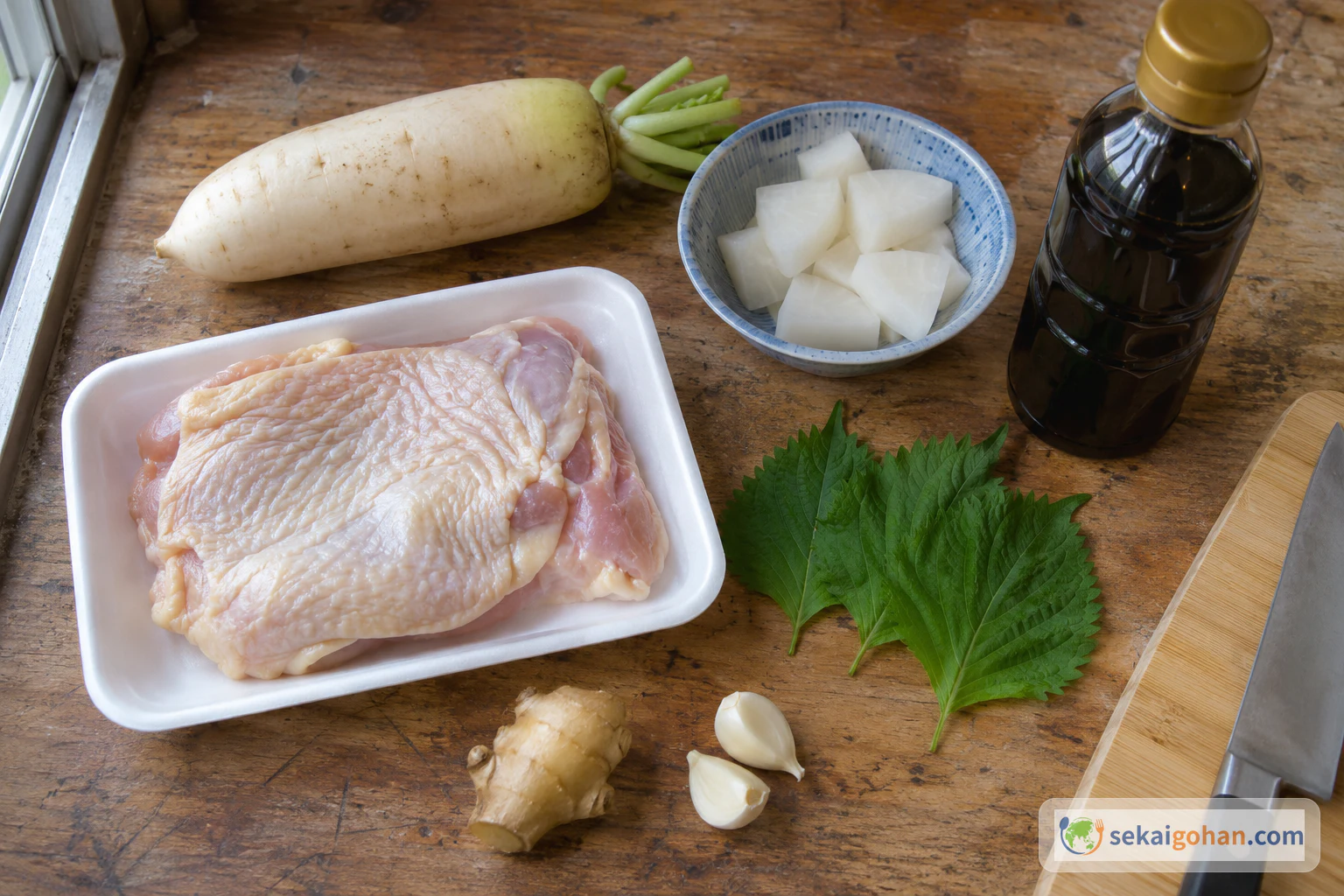
Chicken is the main ingredient. Soy sauce contains soy and wheat. Ponzu, if you use it, contains citrus. Leave out the ginger or garlic for anyone who reacts to them.
Equipment
- A cutting board and knife kept for raw chicken only
- A second, clean board for vegetables and for slicing the cooked chicken
- Frying pan and tongs
- Probe thermometer
- Bowl for ice water
- Paper towels
- Grater
- Kettle for boiling water
- Shallow serving plate and small dishes for soy sauce
- Clean storage container with a lid
Choosing and Substituting
Sweet soy sauce is what makes the plate taste of Kagoshima. Kagoshima's sweet soy sauce, sold as amakuchi shoyu at Japanese grocers and online, gives the right rounded sweetness, and sashimi soy sauce is the closest swap from a regular shop. There is no single mixing ratio; the sweetness varies from house to house and shop to shop, so choose a bottle you like straight from the dish. Ponzu works too and makes the plate lighter with its acidity, but the sweetness drops away.
Cooked chicken loses some of the springy bite of the raw slices, and its savouriness feels a little more closed in. That is why the aromatics stay: ginger, garlic and shiso together fill the gap, and the sweet soy pulls them into one flavor. Shiso can be left out, though the plate loses a layer of fragrance. Thinly sliced onion and scallion cut into small rings add sharpness and bite, and they go on as extras alongside the daikon, never in its place.
In Kagoshima and Miyakonojo shops, chicken for raw eating is sold in packs that carry the raw-consumption statement, the facility names and prefecture, and a risk notice. Any chicken without that label gets cooked, every time.
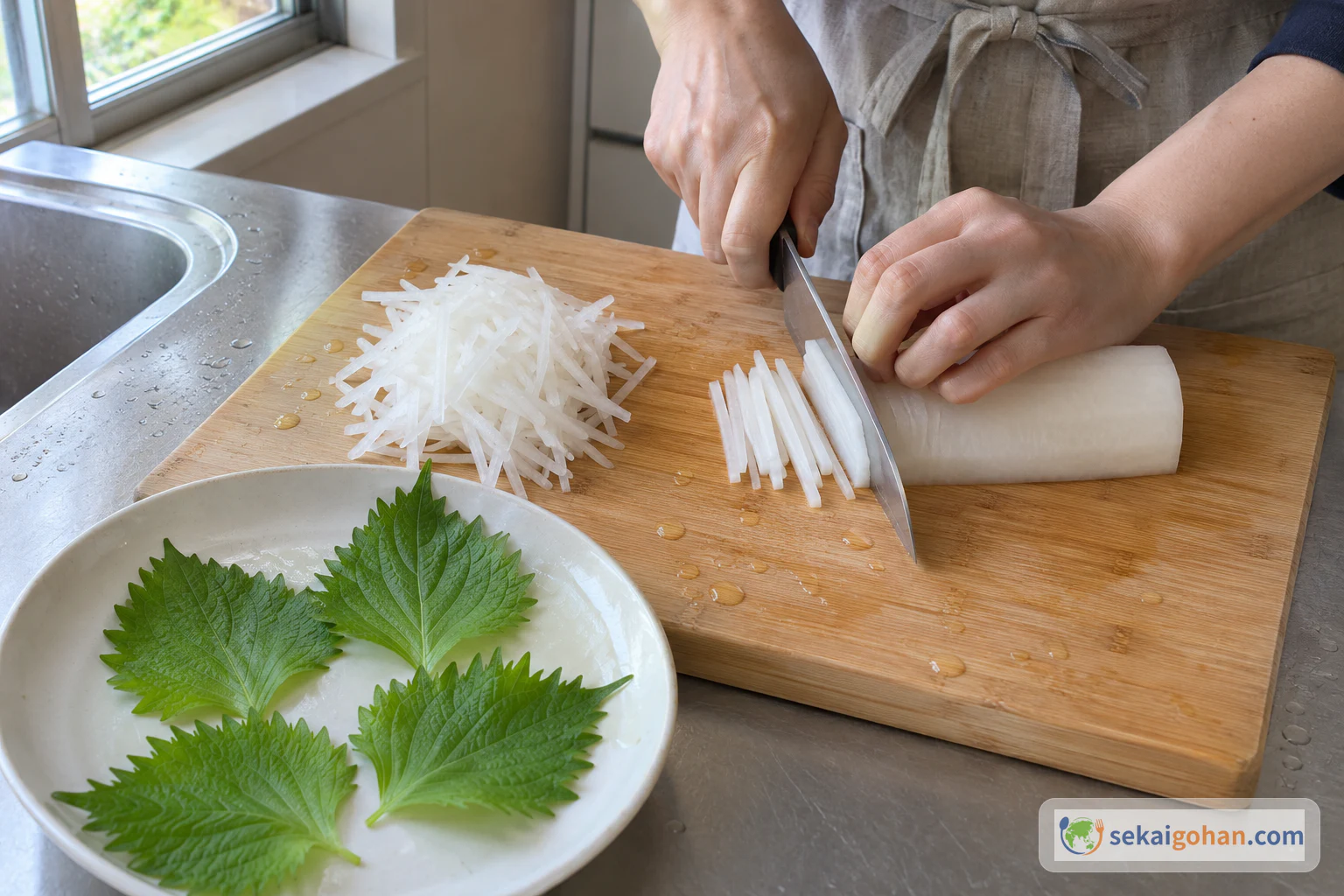
Daikon is sold in very different sizes. Weigh out 3½ oz (100 g) so the bed under the chicken stays light and crisp rather than a wet mound.
Method: Vegetables First, Then the Chicken
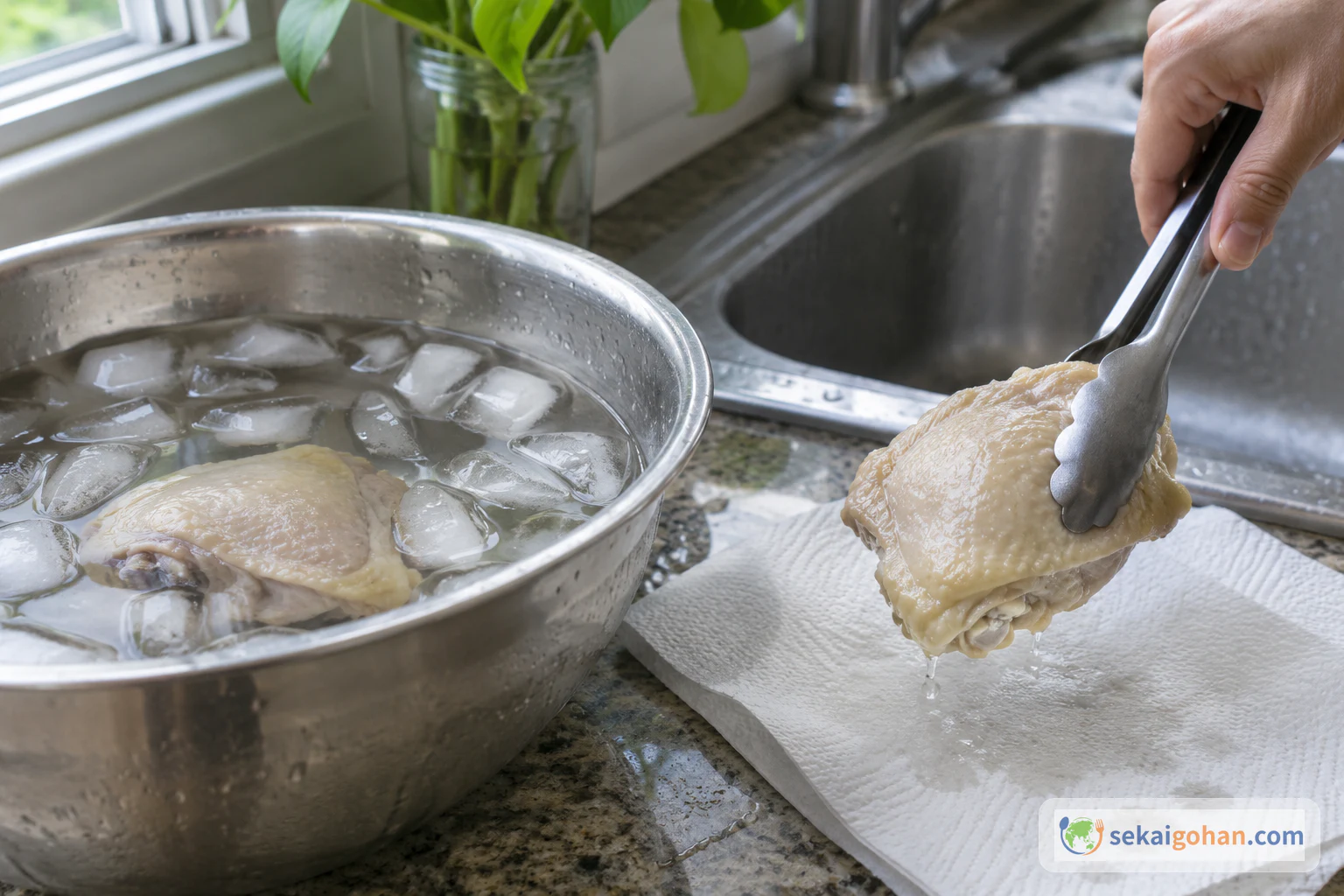
The order matters more than the speed. Cut the daikon and set out the shiso before raw chicken comes out of the fridge, so nothing that goes on the plate ever shares a board with raw meat. The chicken then cooks, chills in ice water and gets sliced on a clean board, and the aromatics go on last, just before eating.
One board and knife are for raw chicken only. The vegetables and the cooked chicken go on a second, clean board. This one habit does more for safety at home than anything else in the recipe.
When It Goes Wrong
| What you see | Why | What to do |
|---|---|---|
| Slices are stringy and hard to bite through | They were cut along the grain | Turn the piece and cut across the fibres at a right angle, keeping to ⅛ inch (3 mm) |
| Pink or soft at the center of a thick piece | The thermometer went into a thinner piece, or the minute at temperature was cut short | Return it to the pan and cook until the thickest center holds 167°F (75°C) for 1 minute |
| A pool of water on the plate | Wet daikon, or aromatics grated too early | Squeeze the daikon just before plating and grate the ginger and garlic at the last moment |
| A faint raw smell | Too little ginger and garlic, or slices cut long before serving | Add fresh ginger and garlic right before eating and slice the chicken close to serving time |
| Unsure whether a pack can be eaten raw | No raw-consumption label | Cook it to 167°F (75°C) for at least 1 minute |
| Vegetables touched the raw-chicken board | One board used for everything | Discard what touched it, wash the board, pour boiling water over it and cut fresh vegetables on the clean board |
Serving, Variations, Storage and Cleaning Up
At the table
Torisashi is a plate for picking at slowly, slice by slice, with sweet-potato shochu or another drink and a few other small dishes on the table. It has been food for guests and celebrations in Kagoshima for generations, and the cooked version means children and older relatives can share the same plate.
Variations
- Ponzu instead of sweet soy. Citrus acidity makes the plate brighter and lighter, though the rounded sweetness of Kagoshima soy is gone.
- Onion and scallion on the side. Thin onion slices and small scallion rings, set out next to the daikon, add sharp heat and extra crunch.
Storage
Cool leftover cooked torisashi, then refrigerate it promptly in a clean, covered container. Before eating it again, heat it until the center reaches 167°F (75°C) for 1 minute. Chicken sold for raw eating stays at 50°F (10°C) or below, ideally 39°F (4°C) or below, and frozen at 5°F (−15°C) or below, ideally 0°F (−18°C) or below; follow the use-by date and storage instructions on the pack, and do not slice it ahead of time.
Cleaning up
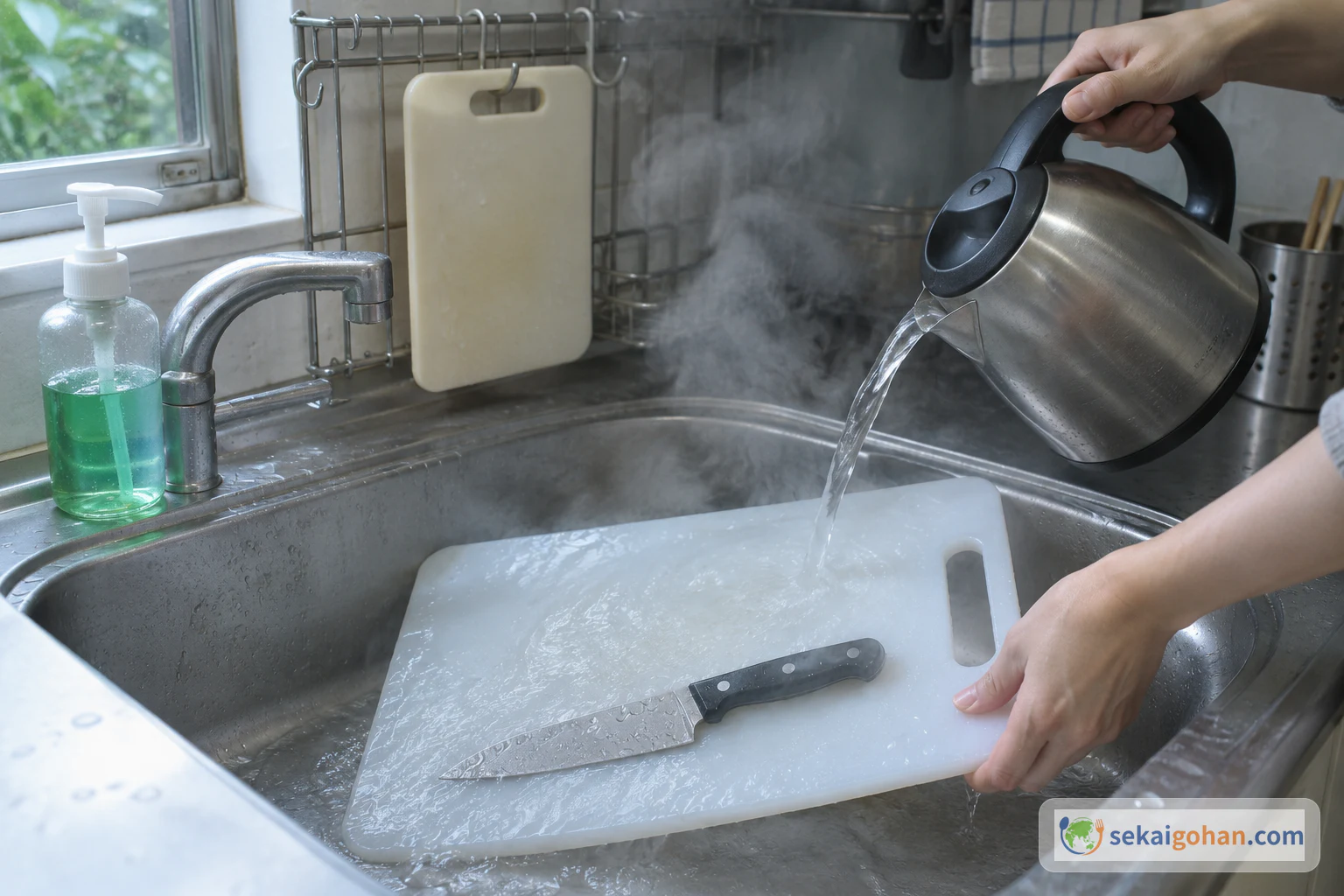
Wash the raw-chicken board and knife with detergent, then pour boiling water over them or sanitize them with chlorine bleach. Wash your hands before touching the vegetables, the cooked chicken or the serving plate. Keep raw chicken and its juices away from every other food on the counter and in the fridge.
Frequently Asked Questions
If the chicken is very fresh, is it safe to eat raw?
No. Healthy birds carry food-poisoning bacteria, so freshness says nothing about whether the meat is free of them. Freshness and microbial safety are two separate things. Chicken without a raw-consumption label gets cooked to 167°F (75°C) for at least 1 minute.
Does searing the skin with a torch make raw chicken safe?
No. The torch stops when the surface changes colour, and the inside stays raw. Even chicken processed and labelled for raw eating carries more risk than cooked chicken.
Can children and older family members eat torisashi?
They can eat the cooked version. The labels on chicken sold for raw eating ask children, older people and anyone with weaker resistance to food poisoning to refrain from eating it raw. These are also the people most likely to become seriously ill from Campylobacter.
What does Campylobacter food poisoning look like?
The usual signs are diarrhoea, abdominal pain and fever, appearing one to seven days after eating. In some cases Guillain-Barré syndrome develops several weeks later. Infants, older people and those with weaker resistance face the greatest risk of severe illness.