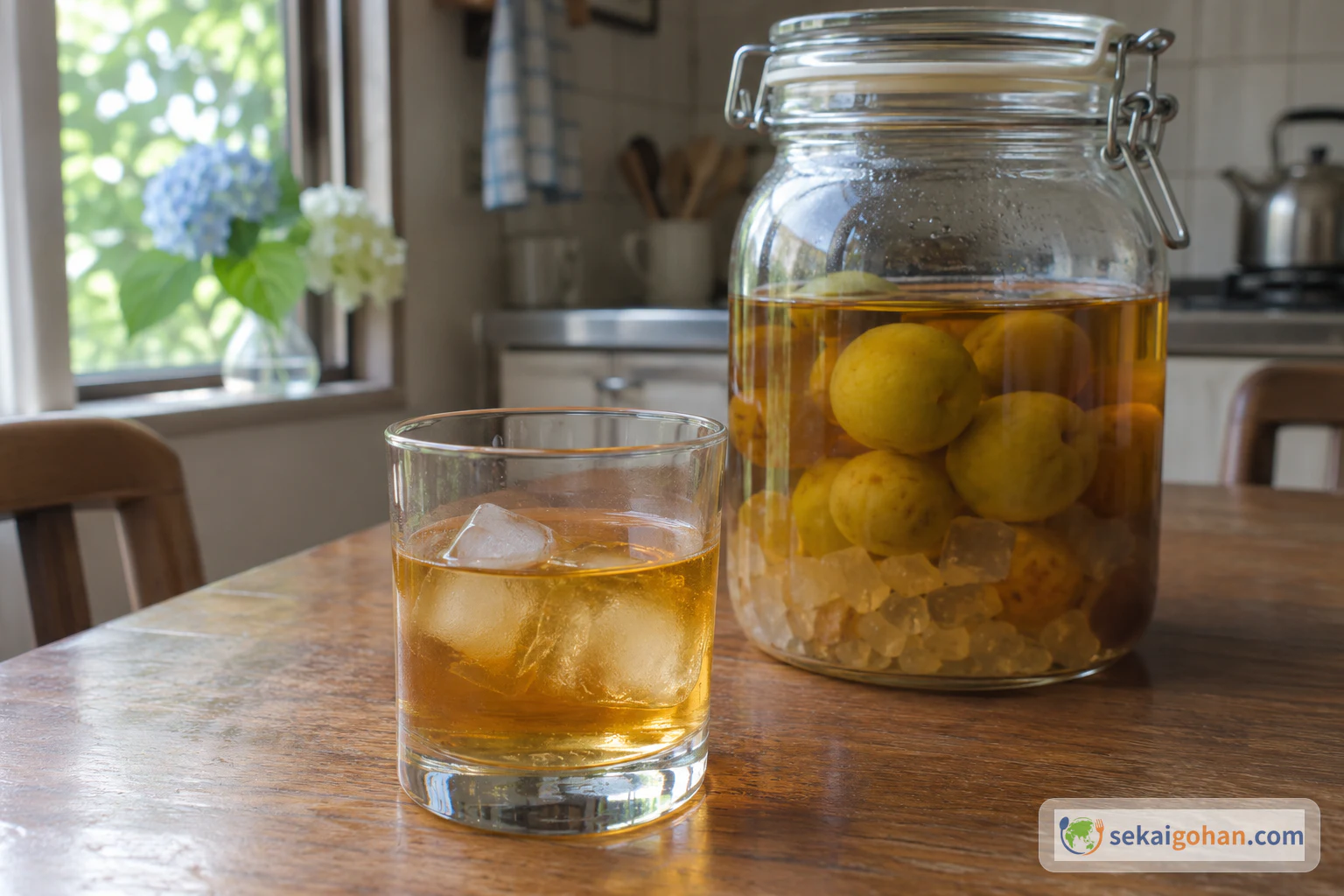
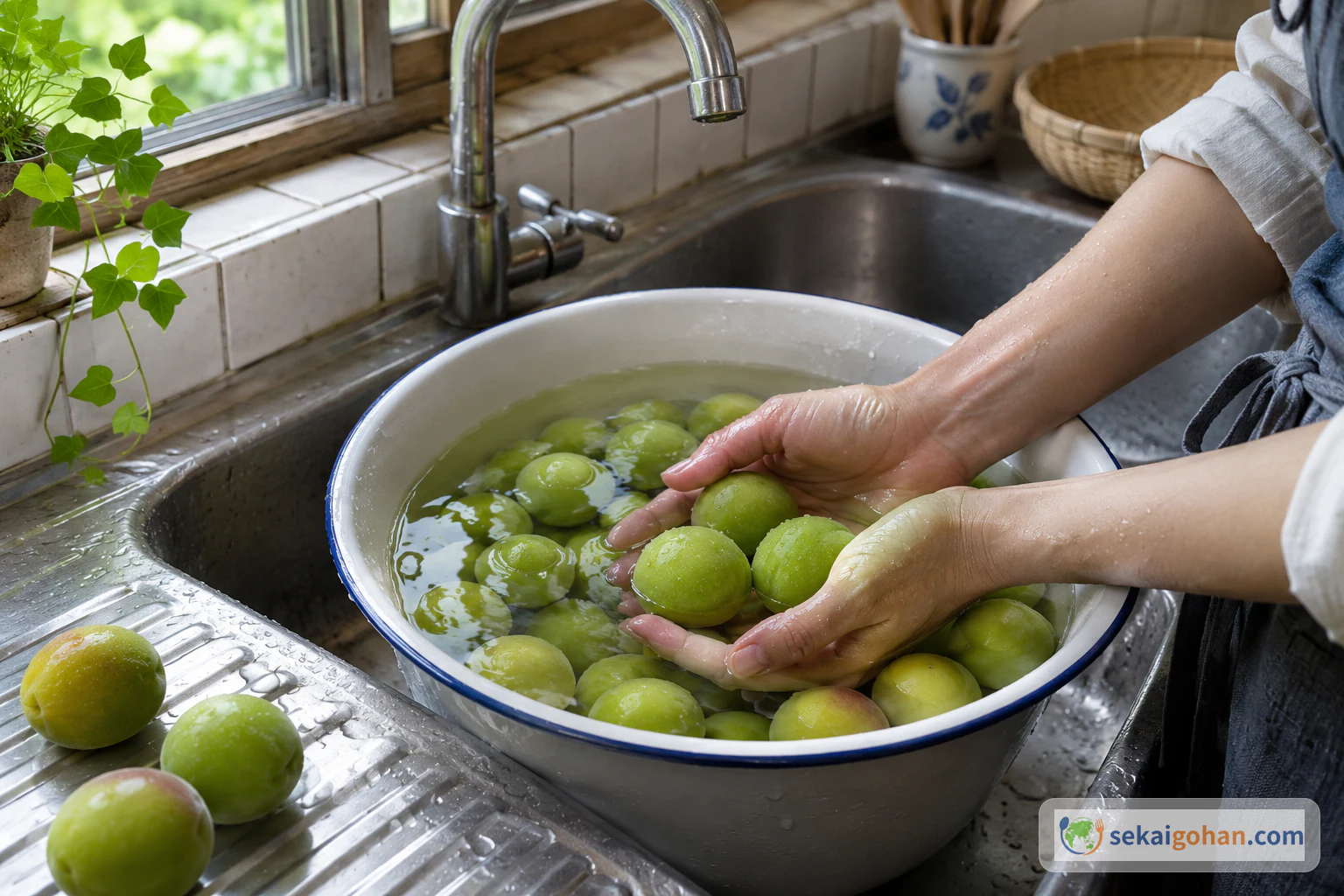
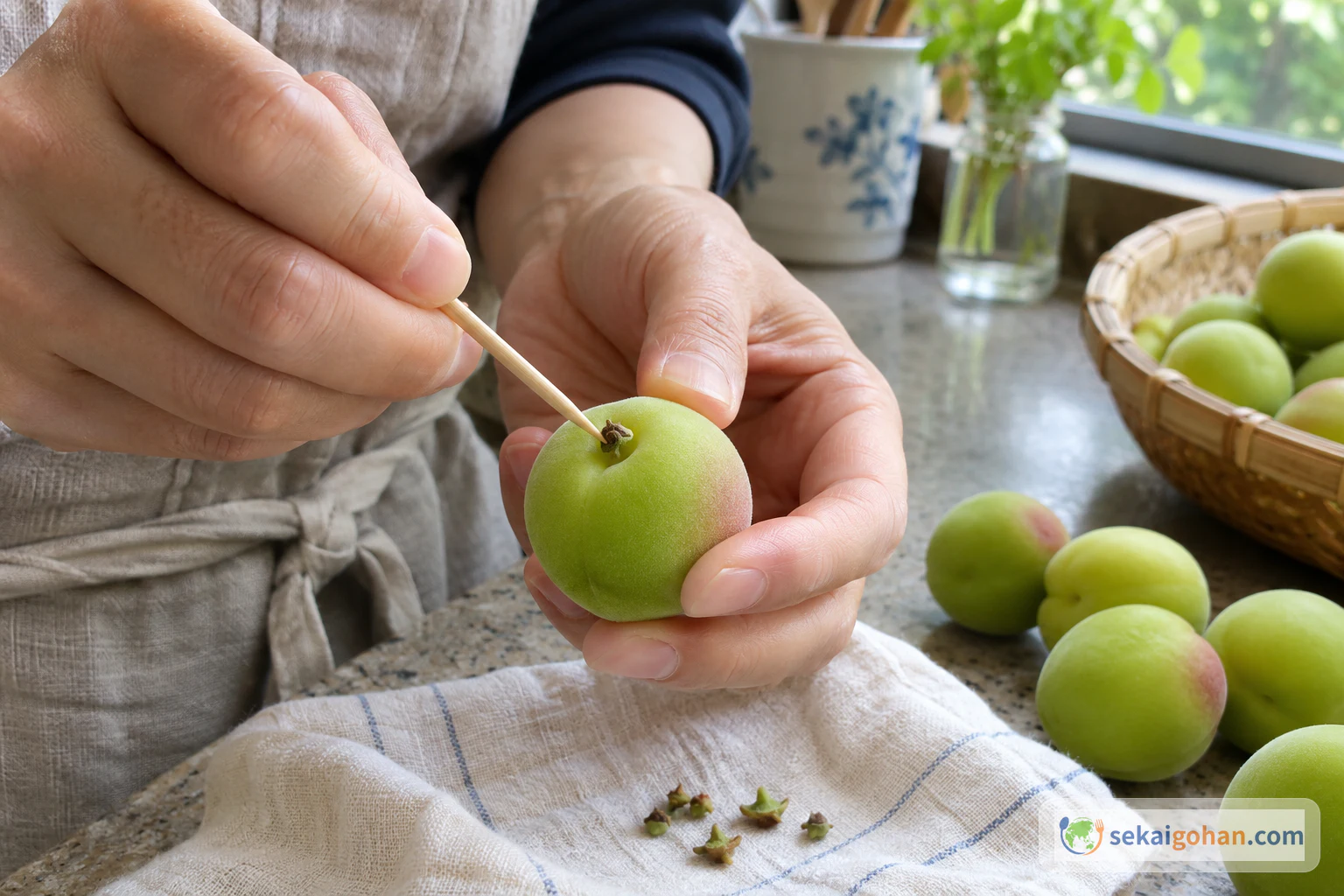
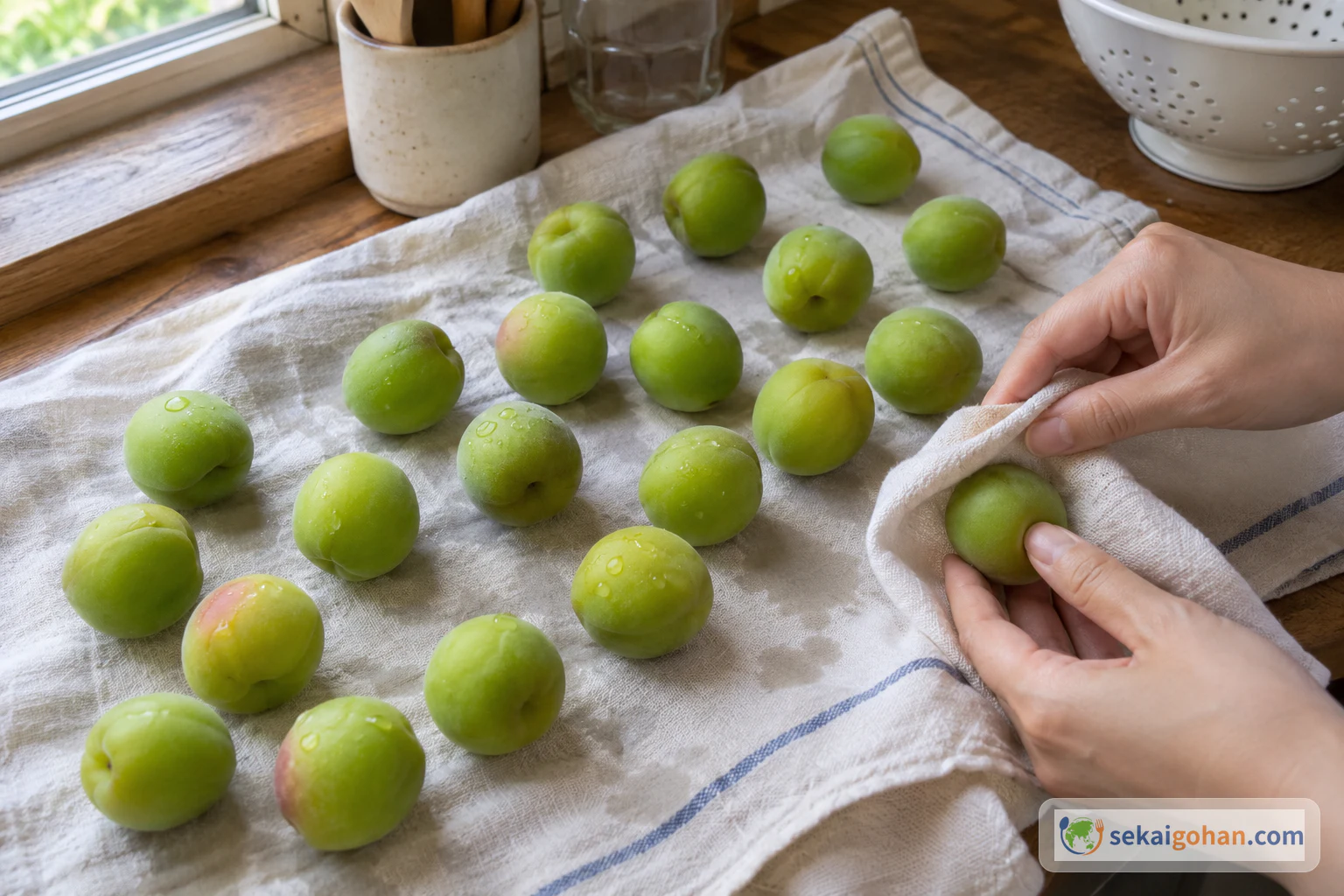
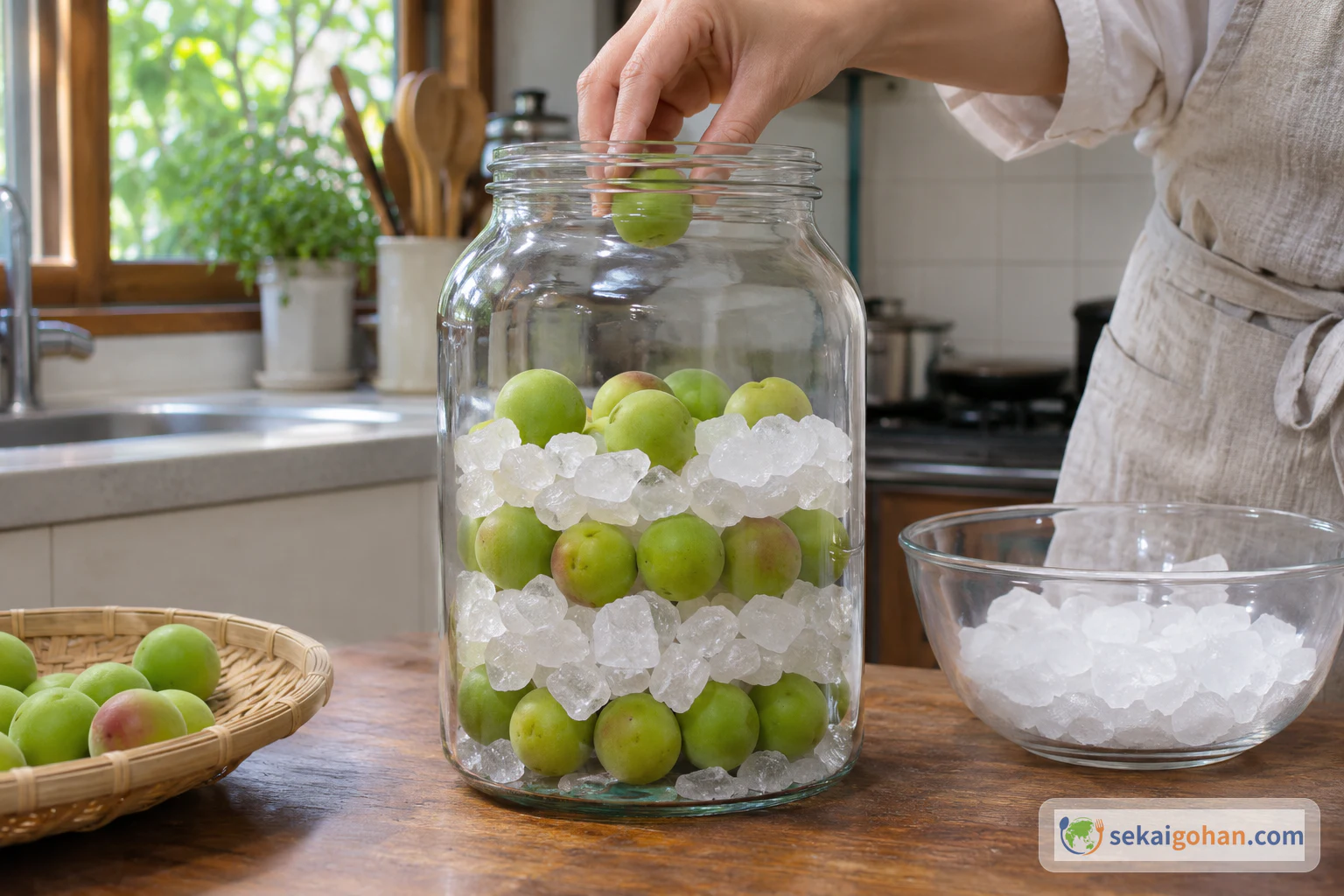
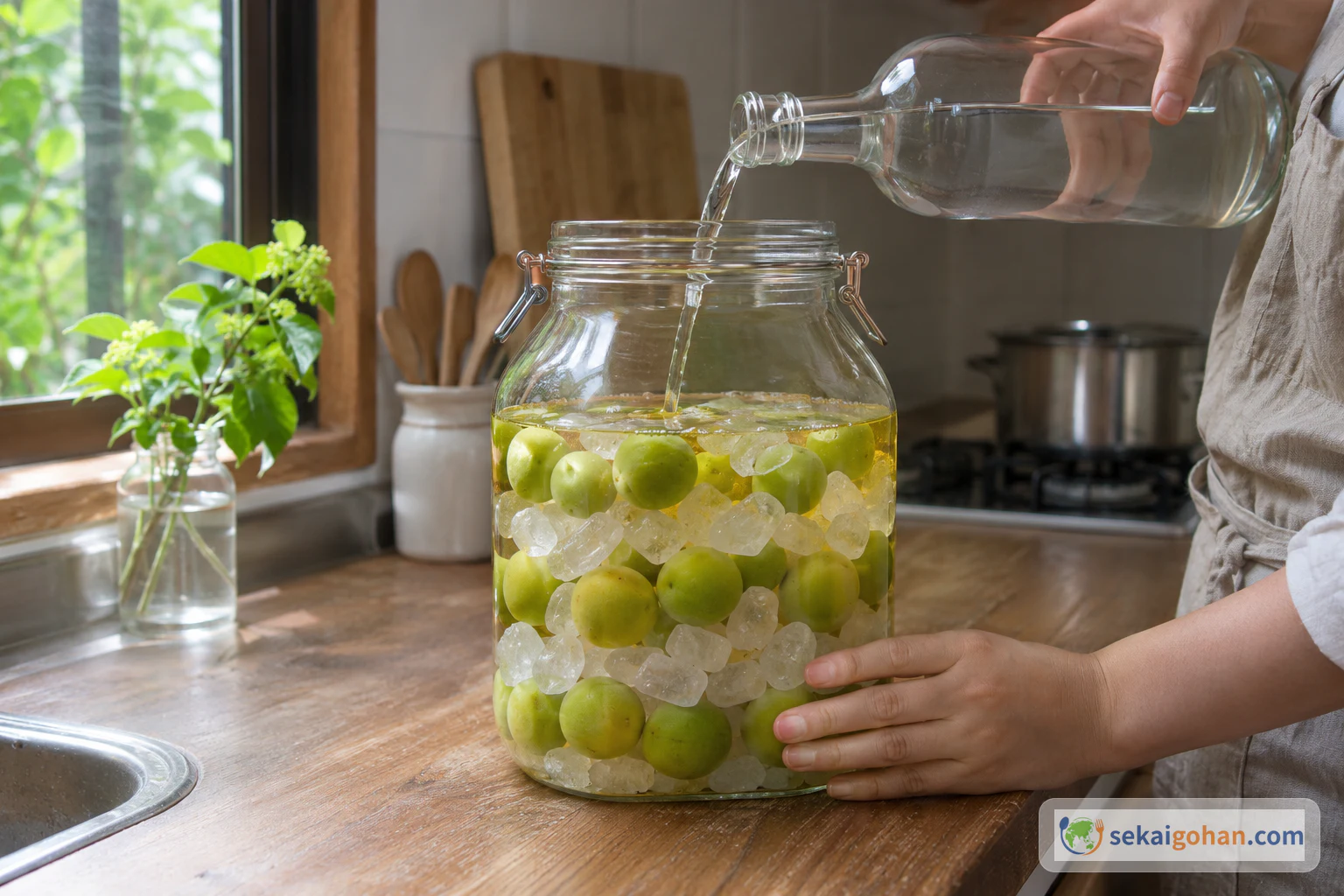
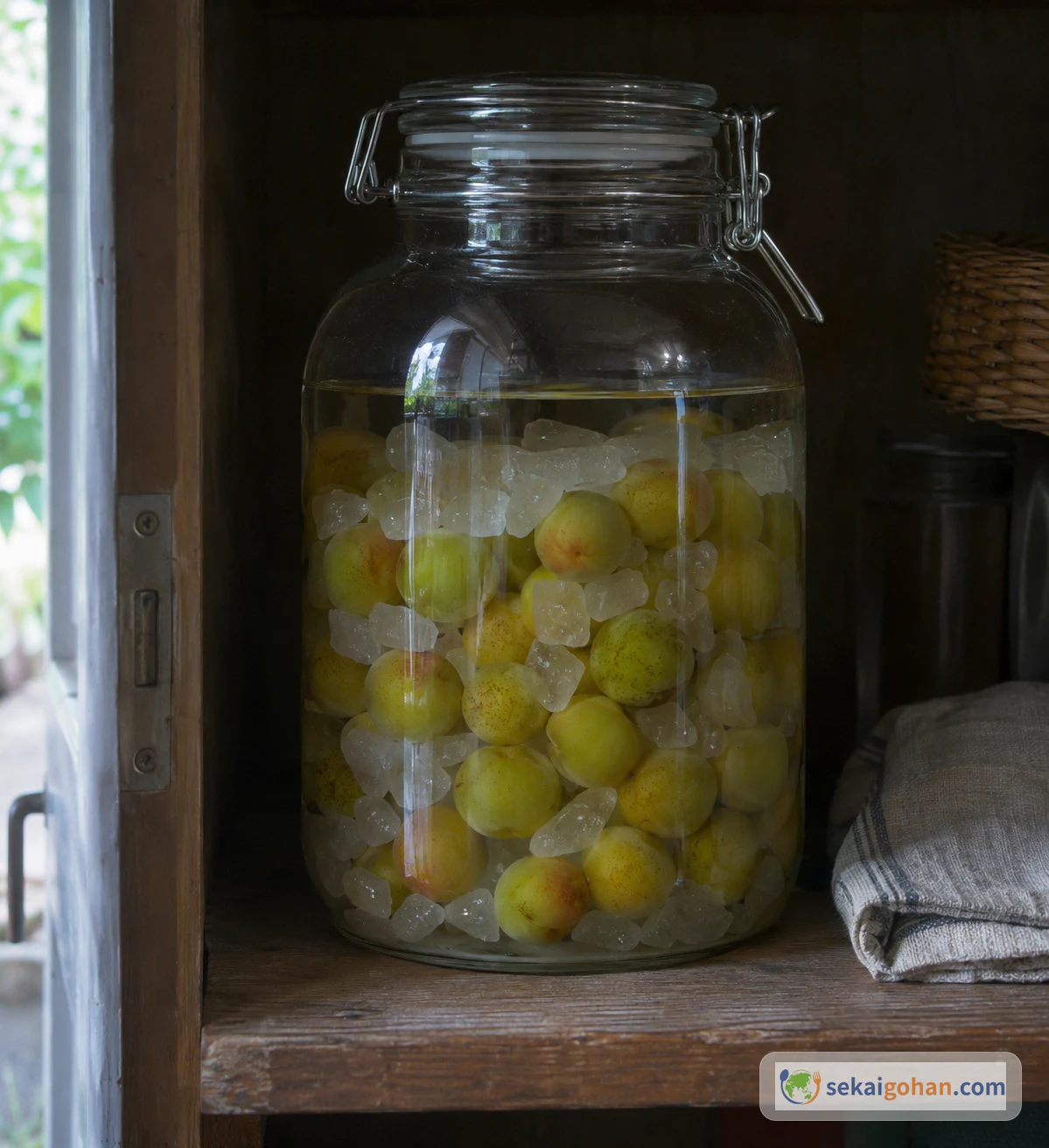
In early summer the green ume go into a bowl of cold water, hard and bright, and come out one by one to have their tiny stems flicked away with a bamboo skewer. Then the jar fills in layers: plums, a clatter of rock sugar, more plums. The clear liquor runs slowly down the inside of the glass, and within minutes the first faint gold shows at the skins of the fruit. Umeshu is what Japanese households make from that jar: green ume plums steeped in a distilled spirit with rock sugar, left on a dark shelf until the liquid turns amber. Green fruit gives it a clean, refreshing sourness, and the sugar and the weight of the spirit carry that sourness and the plum's aroma. The counter work is short; the real ingredient is the months of waiting.
Plum Work in the Rainy Season
The jar and its neighbours
Every year, as the rainy season arrives, Japanese kitchens turn to ume. Umeshu is one jar in that family, and the others are easy to mix up with it. Ume syrup uses the same fruit and sugar with no alcohol at all, and the sugar alone pulls out the juice for a non-alcoholic drink. Ume sour is a drink made by diluting that syrup-style base. Umeshu works by steeping: the spirit draws flavour out of the fruit over months, and no yeast is involved. Umeboshi belongs to the same season and is something else again, a salted and dried preserve.
The whole drink comes from three ingredients, yet four choices decide how it tastes: how ripe the plums are, which spirit you use, how much sugar goes in, and how many months you wait. Most of the effort happens in front of a dark cupboard, checking on a jar.
From Edo texts to the home shelf
Umeshu has a long written trail. The Honchō Shokkan, a text from the Edo period written about 300 years ago, already describes how to make it. Sugar was a luxury then, so it was likely a drink for a small circle of people. A late-Edo farming manual, the Kōeki Kokusankō, gives a section to planting ume for farm income, recommending that households grow, process and sell the fruit as a side business beyond eating it.
Choya, the umeshu maker, explains that a 1962 change in Japan's liquor tax law allowed households to make umeshu, which set off a boom in homemade fruit liqueurs. Today the jar on the shelf is a fixture of early summer for many families, put up during the rains and opened once autumn has passed.
June 11 is marked as Umeshu Day, set on the calendar day for the start of the rainy season, when green ume reach the shops. In leap years it falls on June 10.
Green fruit or ripe, and how households differ
The ume harvest runs for only about a month, from young green fruit to ripe, yellow-tinged plums. Green ume make a clean, refreshing umeshu; fully ripe ume make a fruity, mellow one by the same method. Fruit picked well outside the right window, either very unripe or overripe, is a poor choice.
Each household tunes the jar its own way. Sugar runs from a full kilo per kilo of fruit down to about half that. Some cooks soak the washed plums in water for one to four hours before drying them, and some keep the jar in a cool spot where the temperature barely moves. This jar takes a gentle wash only, a full measure of rock sugar, and a cool, dark shelf.
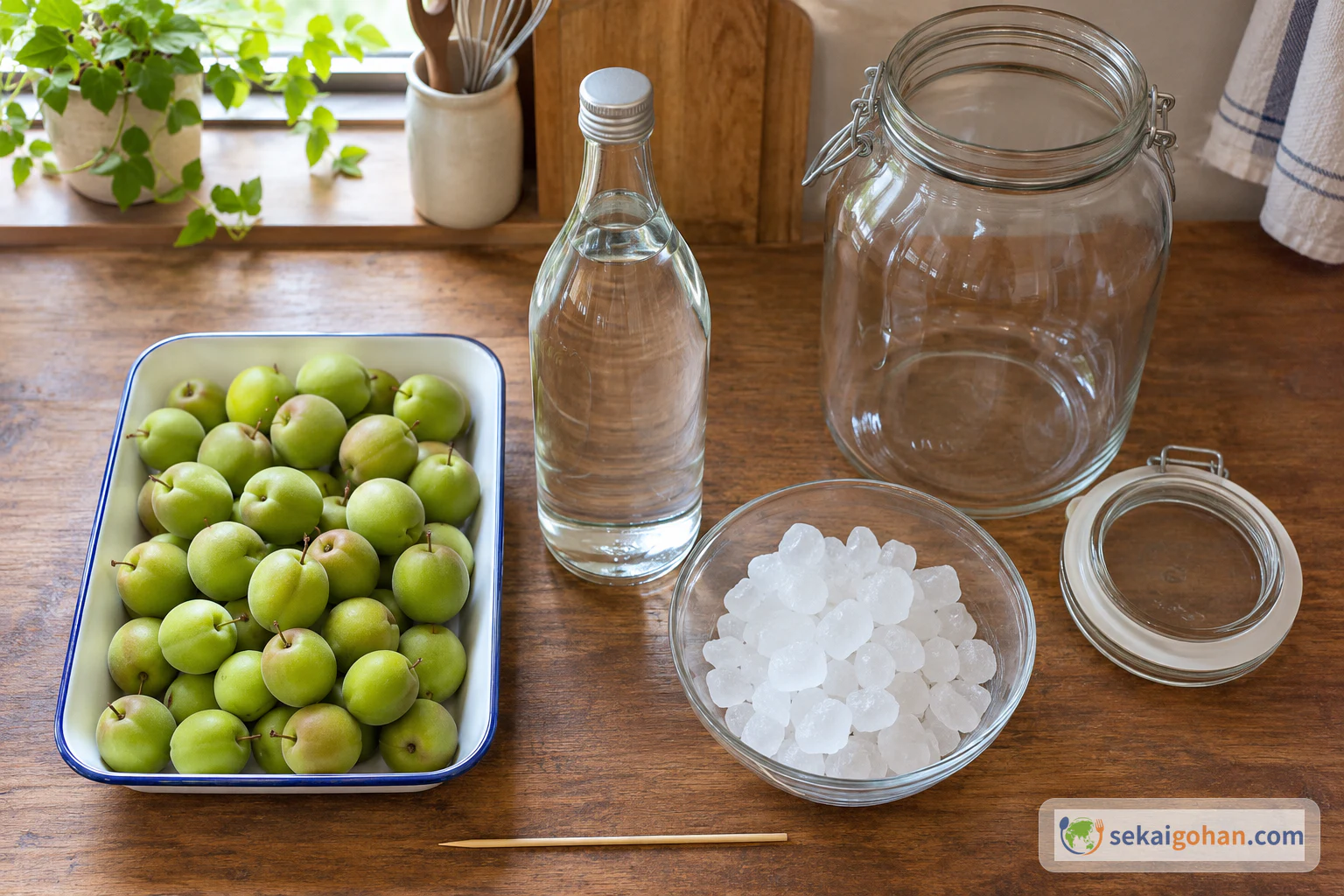
Ingredients
Never eat raw green ume. The unripe fruit and its pit contain a natural cyanide compound (amygdalin), and a large amount can cause poisoning. Do not crush the pits, and if you bite through one by accident, do not swallow it. Steep only in liquor of 20% alcohol or more. In Japan, putting fruit into liquor in a way that changes its character counts as making new liquor, with one exception: steeping for your own drinking in liquor of 20% or more on which liquor tax has already been paid. Homemade umeshu must never be sold. Keep the jar out of children's reach so no one drinks the alcohol or eats the plums by mistake. No one under 20 should drink it, and avoid alcohol during pregnancy and while breastfeeding.
White liquor at 35% is the spirit for a jar you plan to age past a year. Liquor below 20% draws the plum out poorly and leaves the batch open to mold.
Equipment
- A 4.2-quart (4 L) glass jar with a tight lid
- A bamboo skewer
- Clean, dry cotton cloths
- Food-grade ethanol, or a little extra 35% white liquor, for wiping the jar
- A kitchen scale
- A wide bowl for washing
- A funnel, for pouring
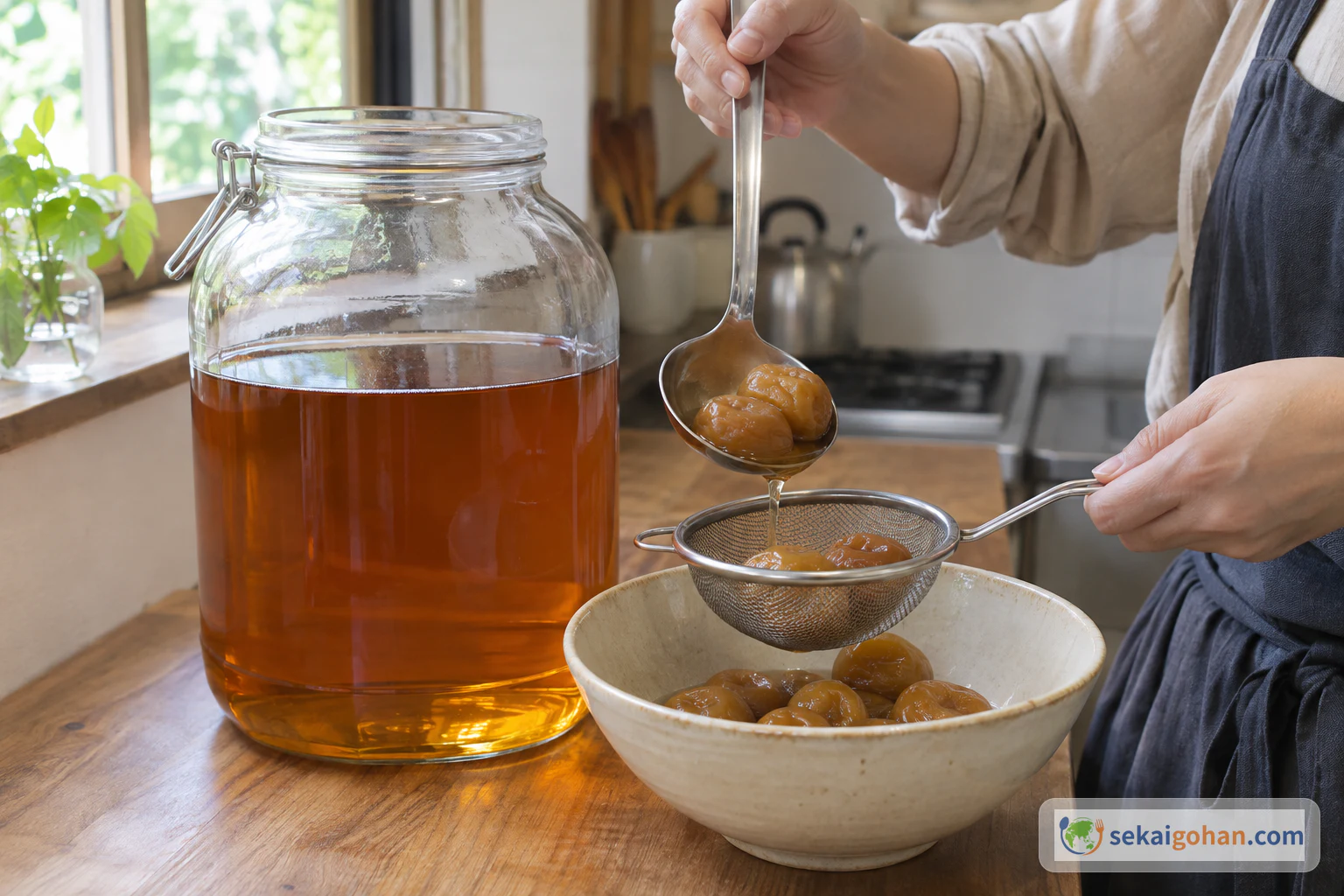
- A clean ladle and a sieve, for lifting out the fruit later
Buying Plums, Liquor and the Jar
Buy the plums in early summer, during their short season, and pick firm, green fruit with few blemishes and a fresh smell. In Japan, Nankō and Beni-Nankō from Minabe in Wakayama Prefecture are well-known growing names. Ripe, yellow-tinged ume make a different, fruitier jar and bruise easily, so handle them with extra care if you choose them.
White liquor is a clear spirit distilled many times until it is close to neutral, so the fruit comes through. It is the standard choice for fruit liqueurs in Japan, sold at 35%. Barley shochu at 25% also works for a jar you will drink within half a year to a year, but it is a poor fit for long aging. Rock sugar is very pure, and it dissolves slowly, which keeps the sugar in step with the plum as it steeps.
The 4 L jar holds everything, but only just. A 5.3-quart (5 L) jar leaves room to pour without spilling and is the easier buy if you are choosing one new. Whatever size you pick, it needs a lid that closes firmly and a mouth wide enough to wash and dry the inside by hand.
Method
Clean and dry the jar first, so it is ready the moment the plums are. The plums then pass through three gentle steps (washing, stemming and drying) before they go into the jar with the sugar and liquor. After that the work is done, and the hands-off time is measured in months.
When It Goes Wrong
| What you see | Why | What to do |
|---|---|---|
| The finished umeshu is heavy and syrupy | The full measure of rock sugar suits a sweet style | Next batch, cut the sugar to 14–28 oz (400–800 g) and keep the plums and liquor the same |
| The liquid is darker and thicker at the bottom | The jar sat unswirled while the sugar dissolved | Swirl the jar gently now and then until the colour is even |
| A harsh, astringent edge | Stems or calyx bits were left on the fruit | Clean every stem dimple with the skewer next time |
| Water is still on the fruit or glass when the liquor is ready | Drying was rushed, and water and germs invite mold | Stop and dry again before any liquor goes in |
| The plum barely comes through and the jar feels vulnerable | The liquor was under 20% | Use 35% white liquor |
| The liquor nearly overflows during the pour | 4 L is a tight fit for this batch | Pour through a funnel; next time use a 5 L jar |
Pouring, Varying and the Long Wait
The first glass
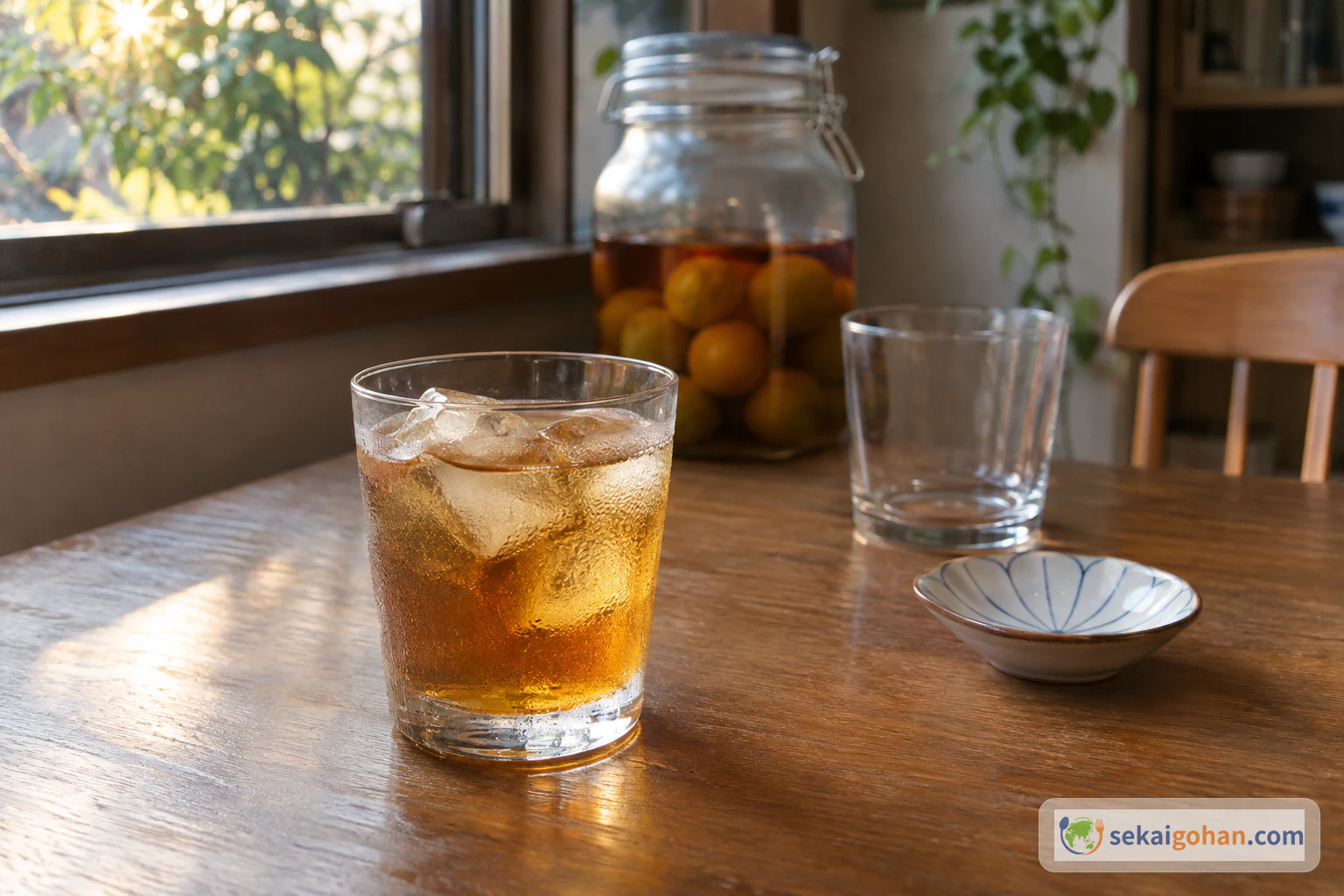
The jar goes up in the rains of early summer, and by the time autumn has passed it is ready for a first taste. Open it, ladle out what you want with a clean ladle, and close it again straight away so the rest keeps aging in the dark. A year-old jar pours deep amber-gold, and a small glass is enough to taste the plum's sourness under the sweetness and the warmth of the spirit.
Variations
- Drier umeshu. Use 14–28 oz (400–800 g) of rock sugar and keep everything else the same. The plum's sourness comes forward and the finish is lighter.
- Brandy umeshu. Replace the white liquor with brandy. The spirit's own flavour joins the plum, so the jar tastes of both.
- Honey or kokutō. Use honey at 1.2 times the weight of the sugar, or kokutō (Okinawan black sugar) at 1.1 times. Kokutō is less sweet and brings a distinct, deeper character.
- Ripe ume. Make it the same way with fully ripe, yellow-tinged plums for a fruity, mellow umeshu. Ripe fruit is softer than green fruit, so wash and dry it with extra care.
Frequently Asked Questions
Can I eat the plums from the jar?
Steeping and aging are known to reduce the amygdalin in green ume, and at normal amounts the health risk is considered low. Eat the plums only after they have been through that steeping and aging, never fresh from the bag. Do not crush the pit, and if you bite into one by accident, do not swallow it.
Can I make umeshu with no sugar at all?
Yes. Without sugar the pull between the fruit and the liquid changes, and the plum takes longer to come out into the spirit. Expect a sharper, drier drink and give the jar extra months.
Can I drink it before six months?
Some households start drinking at three months, when the umeshu is light and fresh. The plum flavour fills out with time, so it is worth holding most of the jar until six months and longer.
What does "honkaku umeshu" on a shop bottle mean?
Since January 23, 2015, a bottle may be labelled honkaku umeshu only when it is made from plums, sugar and liquor alone, with no acidulants, colourings or flavourings. Bottles with those additives are sold simply as umeshu. The label describes commercial products; a jar made at home from these three ingredients is the same kind of drink.
More dishes from the same country are gathered on the Japan page.