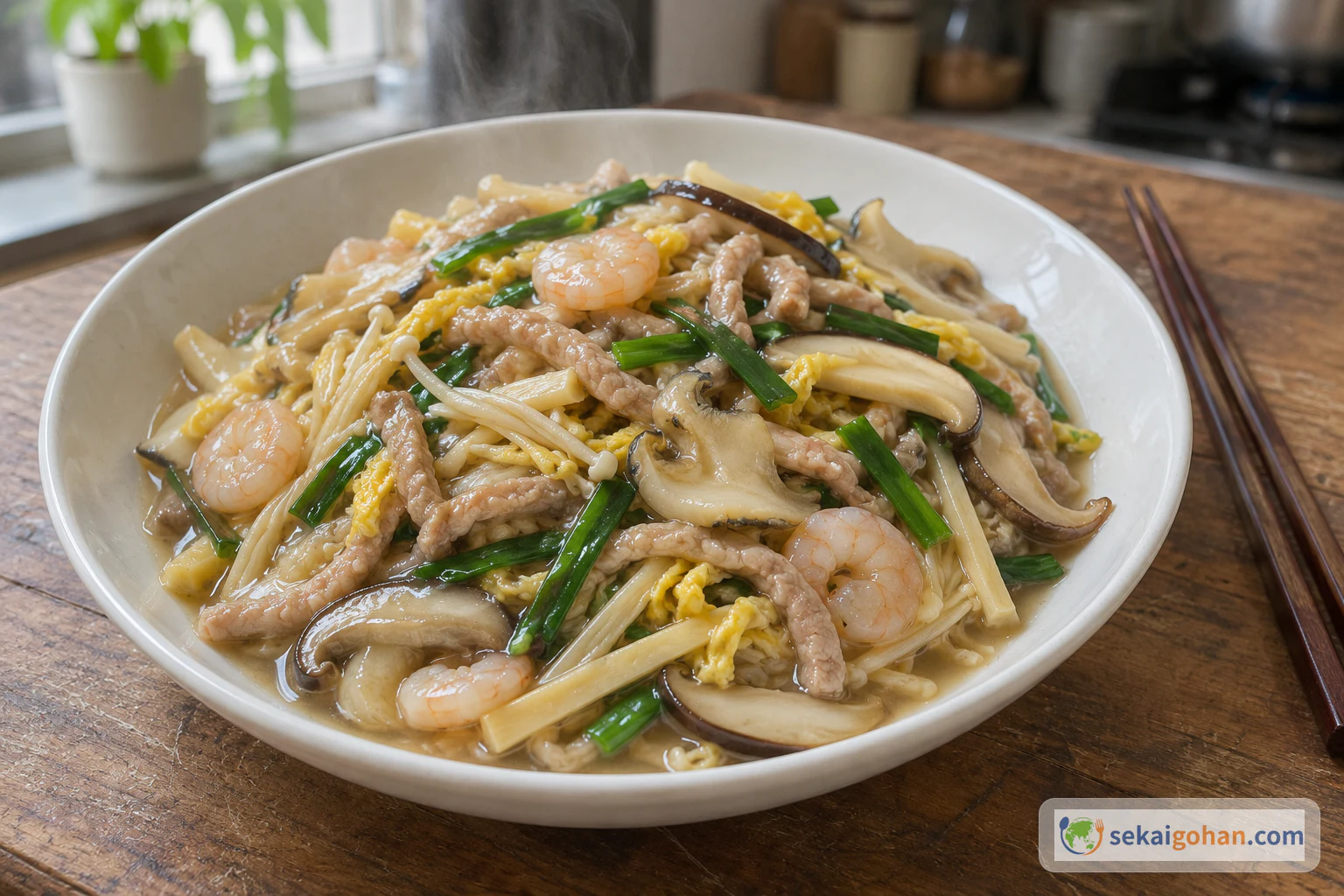
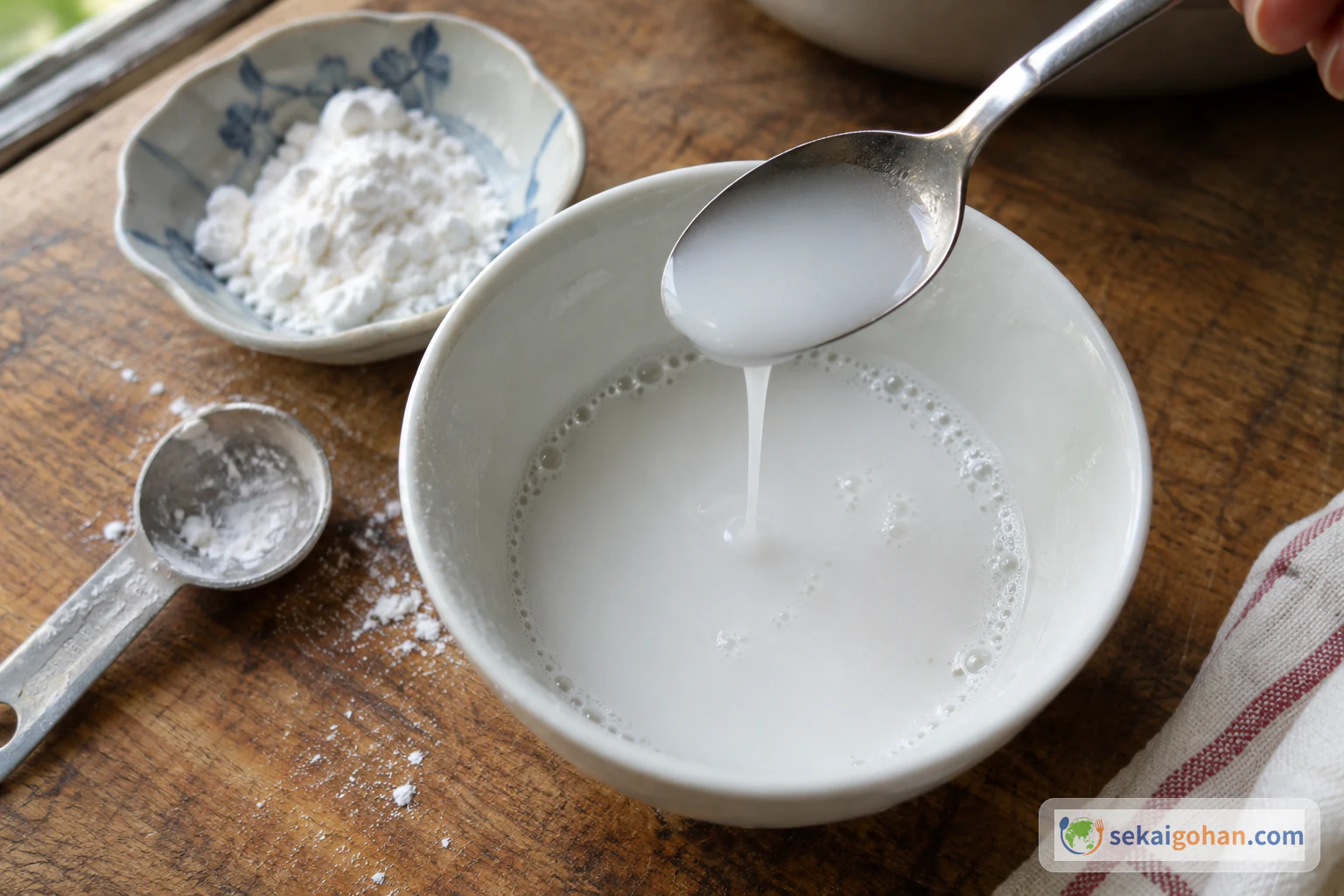
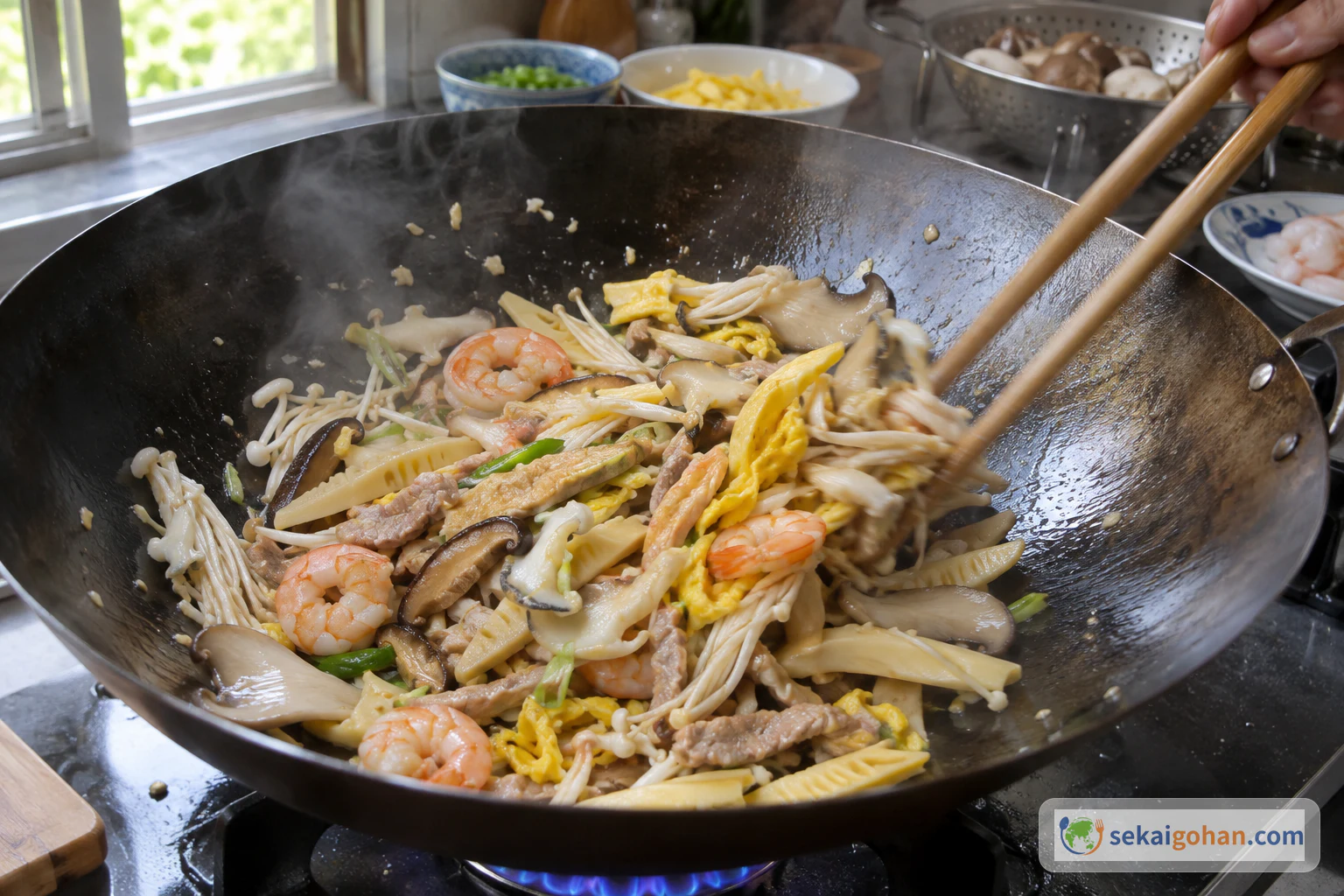
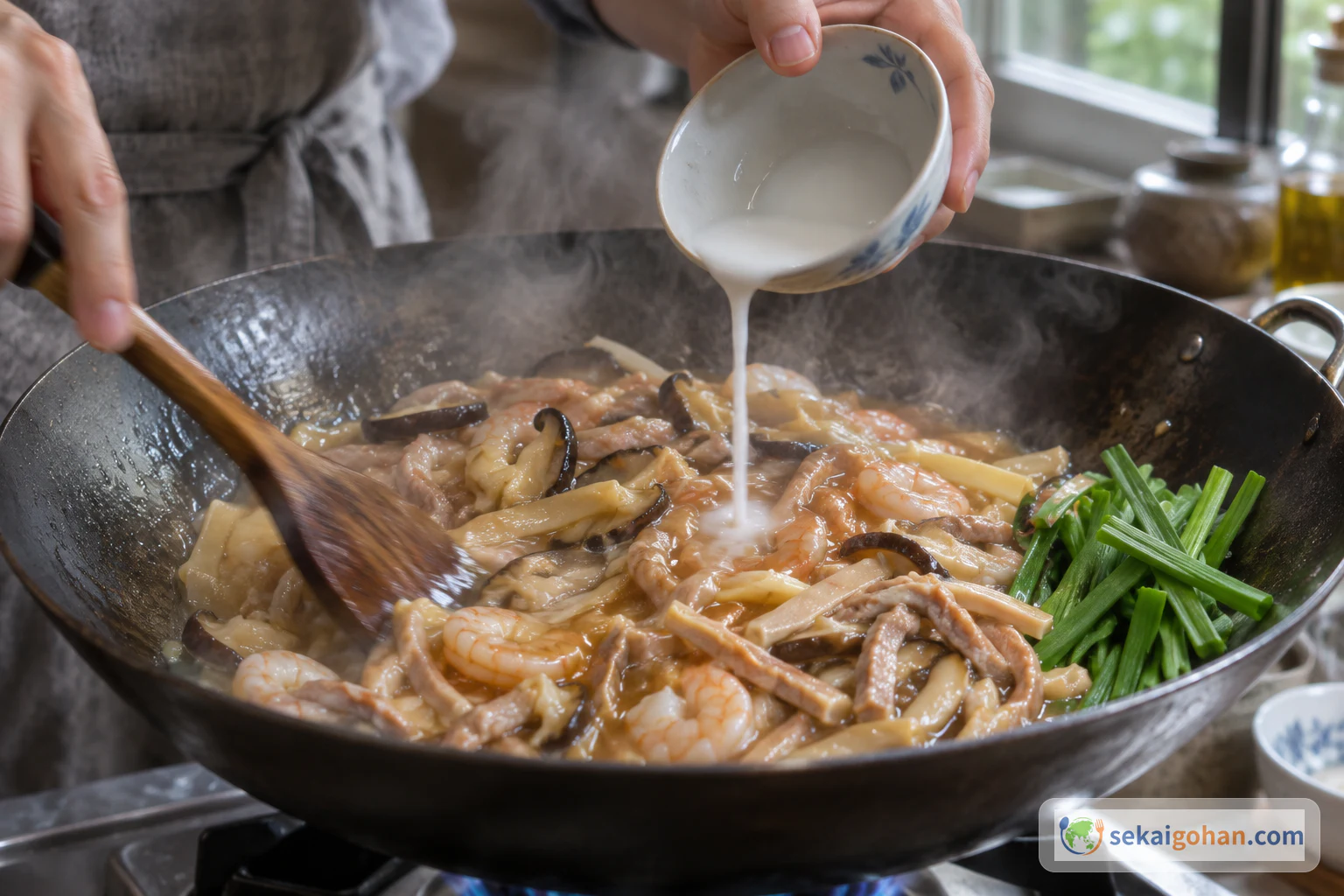
The moment that decides yusanseul comes at the very end. A thin stream of starch slurry runs into the hot sauce, and within a few stirs the cloudy liquid in the wok turns clear, glossy and pale amber, clinging to every strand of pork, shrimp and bamboo shoot. Then the garlic chives go in, still bright green, and a spoonful of sesame oil sends its smell up with the steam. Yusanseul is a stir-fry from the Chinese restaurants of Korea, where meat, seafood and vegetables are all cut into thin strands and coated in a light, savory gloss of oyster sauce and chicken stock. It is gentle and pale, with pepper as its only heat, and it is eaten from a shared plate or spooned over a bowl of rice.
Three Strands Under a Glossy Sauce
The name spells out the dish. In 溜三絲, liu (류, written 유 in Korean) is the technique of pouring starch dissolved in water over stir-fried food so it turns thick and glossy. San (산) means three, for the three kinds of ingredient: vegetables, meat and seafood. Seul (슬) means thin strands, and that is the rule every cook follows. Everything is cut fine, from the pork to the mushrooms. The usual fillings are bamboo shoot, shiitake, shrimp, pork and sea cucumber.
The name is usually traced to sansi yuchi (三絲魚翅), a dish of shark fin with three shredded ingredients. With the costly shark fin taken out, the three strands finished in the liu style became 溜三絲, read in Korean as ryusanseul; Korean's initial-sound rule then softened the opening r into the yusanseul on menus today.
From Shandong to Korea's Chinese restaurants
The liu technique belongs to Shandong cooking, and its home is the port city of Yantai. Cooks from Yantai ran kitchens in Beijing, Tianjin and Dalian, and when Korea's ports opened, they came to Incheon and other Korean cities too. The dish that grew out of that line is hard to find under the same name in mainland China today, and in Korea it is often described as a Chinese dish that survives only there.
How it reached its present form is not settled, but the likely path runs through the 1960s, when Chinese restaurants in Korea became everyday places to eat. Shark fin dropped out. Pork took the place of chicken thigh, canned bamboo shoot replaced winter bamboo, and dried sea cucumber shrank to a little or was swapped for something else. Squid, shrimp, dried shiitake and enoki filled the plate back out. That range still shows: grander kitchens cook it with sea cucumber or abalone, and everyday ones with shrimp, squid and mushrooms. At home, a whelk or other sea snail does the sea cucumber's job, giving the firm, chewy bite that sets yusanseul apart from a plain vegetable stir-fry.
Yusanseul and palbochae
On the same menu you will often find palbochae (팔보채), which uses similar ingredients and a similar method. Palbochae cuts everything into large pieces and is cooked with chili oil, so it comes out red. Yusanseul keeps its strands fine and its sauce pale amber, so the color of each ingredient shows through. It is served as a dish on its own, and just as often over rice as yusanseul-bap, a rice bowl. If you want to build a whole Korean meal around it, there are more dishes to explore under Korea.
Ingredients (serves 2)
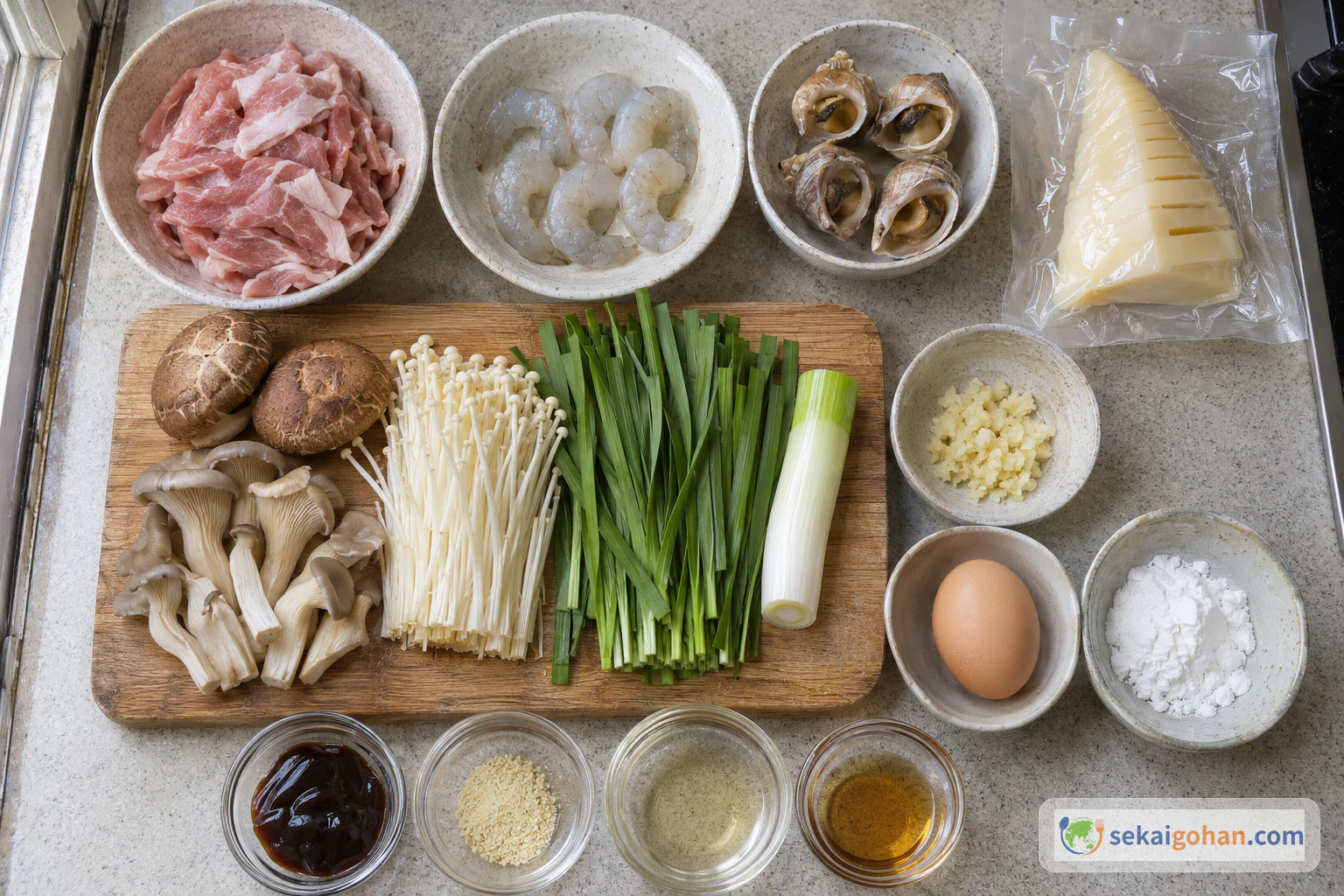
Yusanseul contains crustaceans (shrimp), mollusks (whelk, and oyster extract in the oyster sauce), egg and sesame. Oyster sauce and chicken stock powder often contain soy, and some oyster sauces contain wheat. Read the labels on every sauce and stock powder you buy.
Equipment
- Wok, or a deep skillet 10–11 inches (26–28 cm) across
- Saucepan for blanching
- Colander or wire strainer
- Small nonstick pan for the egg
- Small bowls for the slurry, the sauce and each prepared ingredient
- Measuring spoons and a kitchen scale
- Two cutting boards, one for raw meat and seafood and one for vegetables
- Long chopsticks or a spatula
Choosing and Substituting
The pantry half of this dish comes from an Asian grocer or online: oyster sauce, chicken stock powder, potato starch and boiled bamboo shoot, which keeps all year in vacuum packs and cans. Korean potato starch (감자전분) and other potato starches can differ in fineness, so use your bag the same way and follow its label. The pork, shrimp, mushrooms, chives, onion, garlic and egg are supermarket shopping.
The whelk is the ingredient readers most often cannot find. It is already a substitute, standing in for dried sea cucumber, and dried sea cucumber or abalone can take its place. Frozen shelled whelk or turban shell meat keeps the firm chew closest. Steamed abalone gives a richer, denser bite. Scallops are the easiest swap to find and turn the texture softer and sweeter. If you use dried sea cucumber, rehydrate it following the package directions before you cut it.
Chicken stock powders differ in salt. Start with the same amount and save the salt for the final tasting. Half a tablespoon of ground pepper in the sauce gives a clear peppery edge; if you prefer it softer, mix in part of it and add the rest after tasting. Thin pork leg slices sold for stir-frying work as they are, since they cut easily into strands.
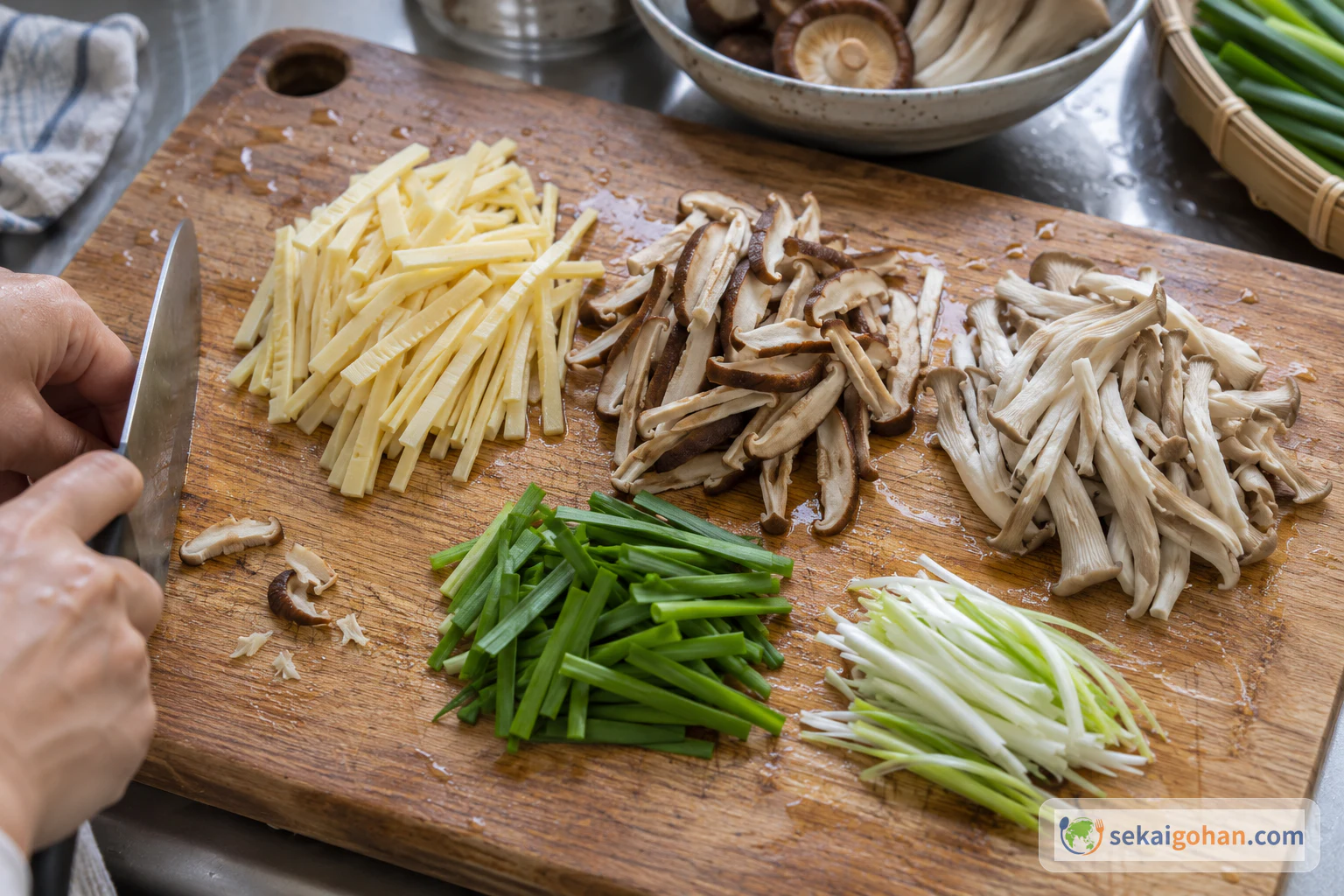
The strands are what make this yusanseul. Cut the whelk, bamboo shoot, shiitake, oyster mushrooms and green onion to the same thin size; uneven pieces cook unevenly, and the thick ones stay raw while the thin ones go limp.
Method
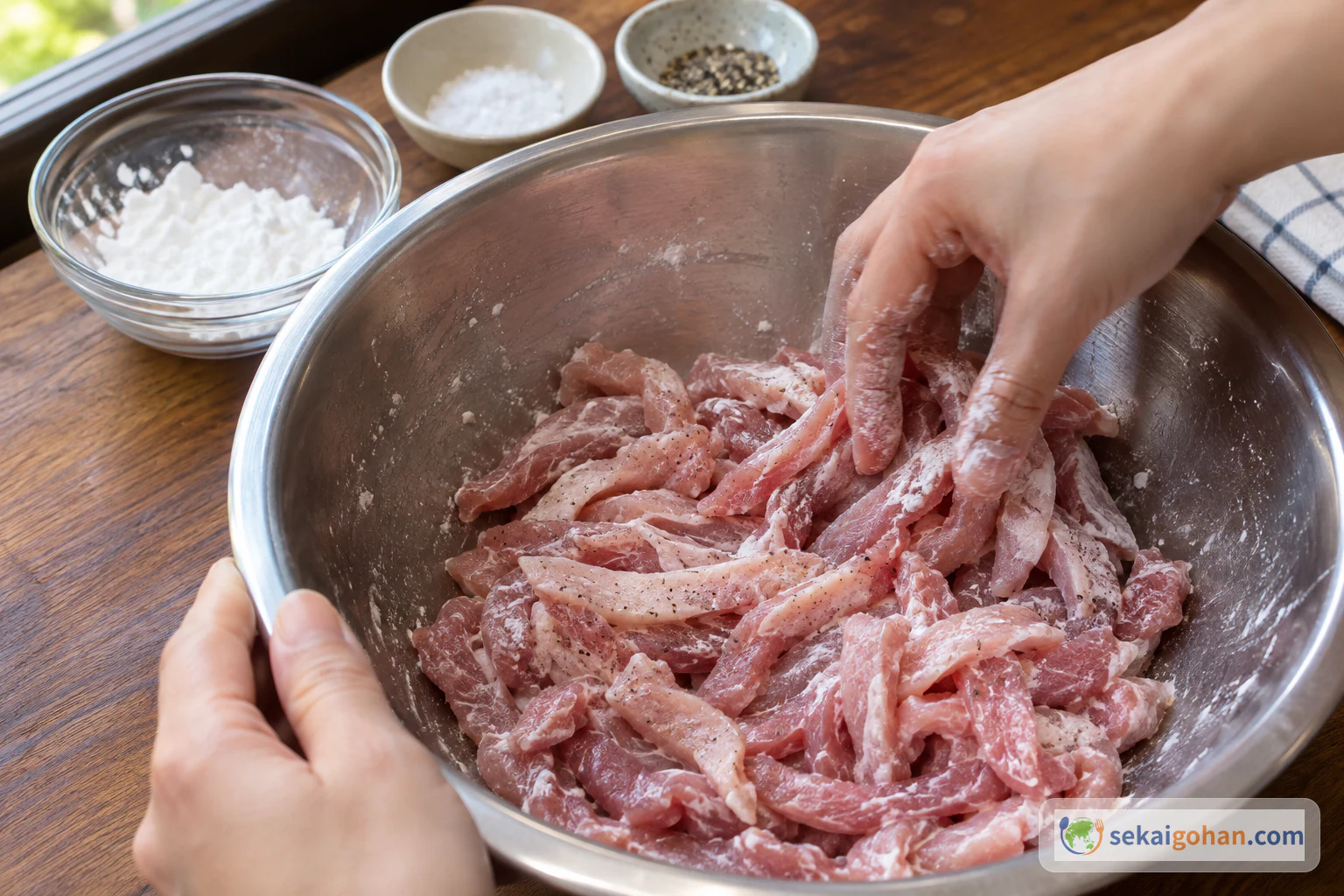
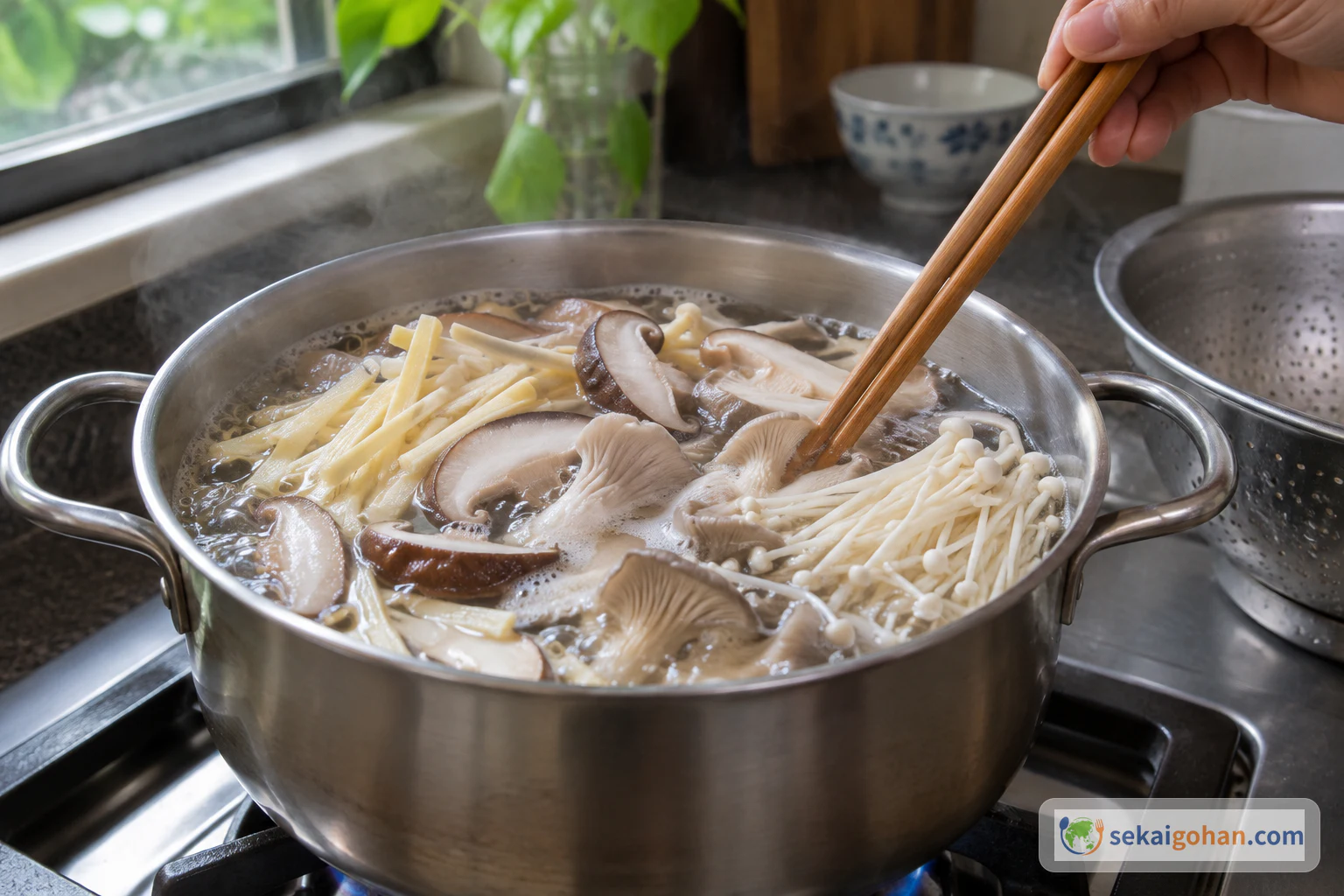
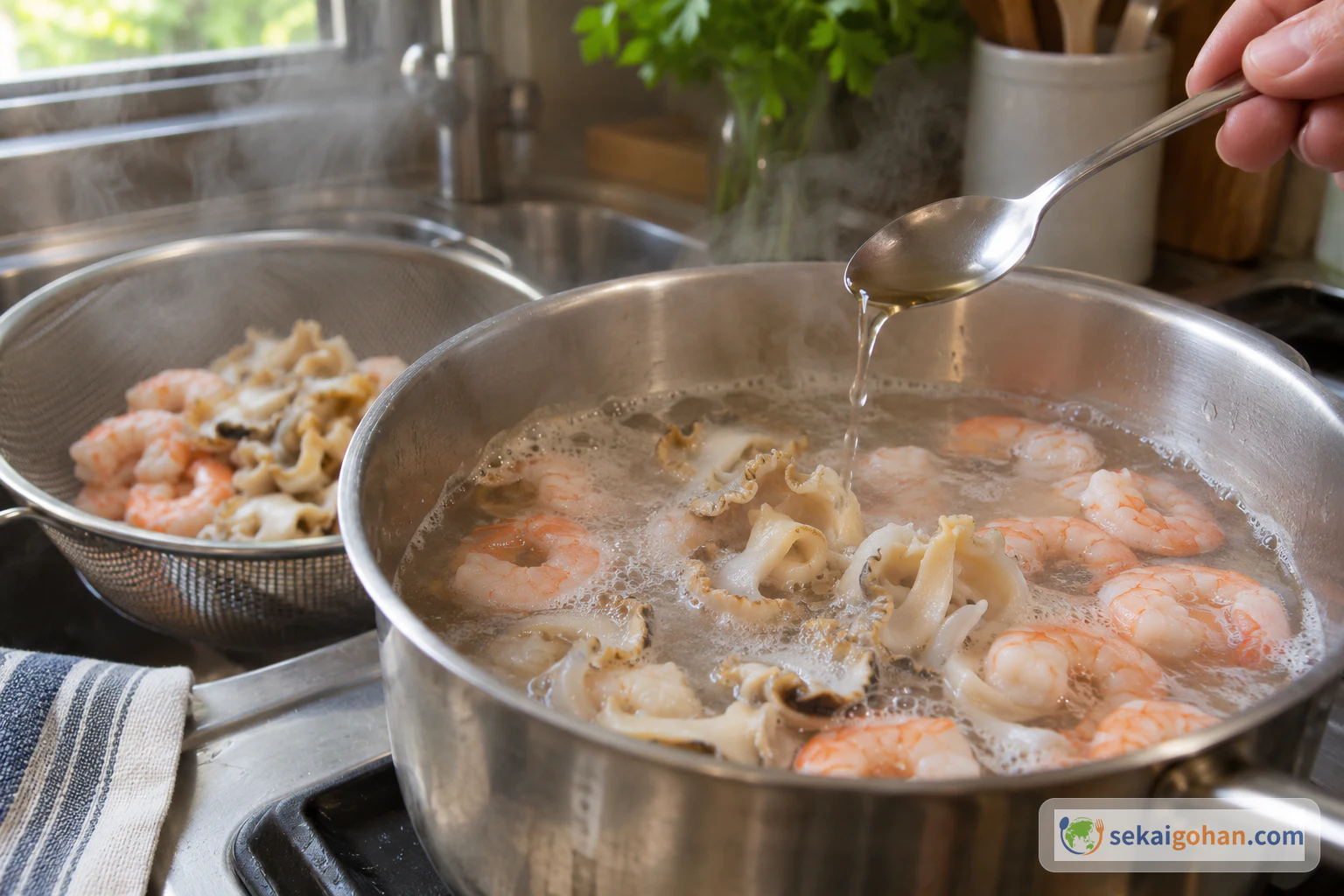
All the knife work, the pork marinade, the slurry and the sauce come first, each in its own small bowl. One pot of boiling water handles both blanching rounds, vegetables first and seafood second in the same water. Once the wok is hot, the dish comes together in a few minutes, so have everything within reach before you start the aromatics.
Use separate boards and knives for raw meat or seafood and for vegetables, and disinfect them after cooking. Wash your hands with soap for at least 30 seconds before you start, and do not cook for others if you have diarrhea. The blanching is preparation, and the cooking is finished in the wok: meat, seafood and shellfish need to reach 167°F (75°C) at the center, and 185°F (85°C) for seafood, for at least 1 minute. Shrimp and whelk always go in cooked.
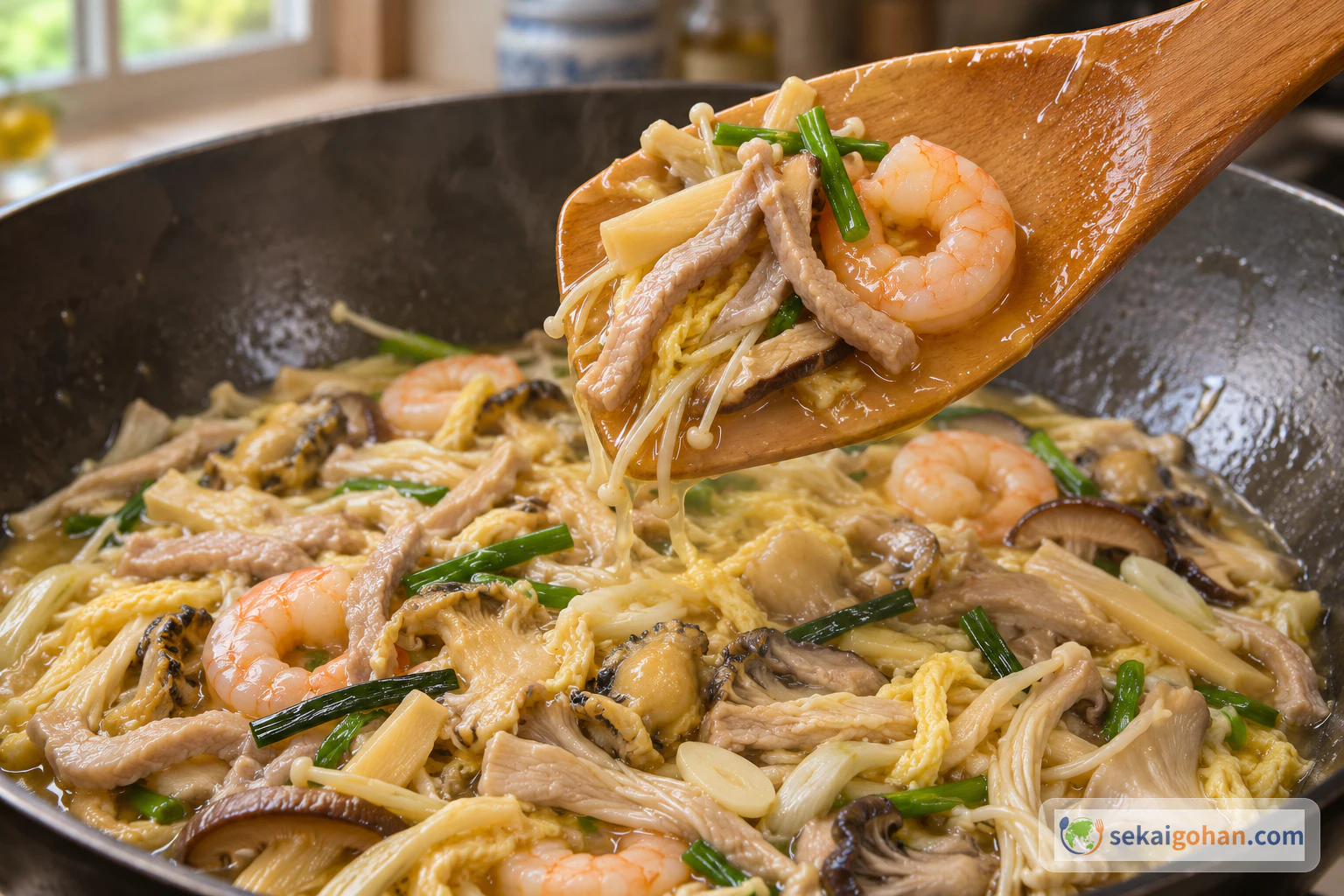
Three salty ingredients meet in the wok, so taste after the hot water goes in and only then decide on salt. The chives get one minute and nothing more; any longer and they lose the color and fragrance they bring to the plate.
When It Goes Wrong
| What you see | Why | What to do |
|---|---|---|
| Lumps of clear jelly in the sauce | Slurry poured in all at once, or settled starch went in as a paste | Stir the slurry from the bottom, add it a little at a time, and stir after each addition |
| Sauce thin and watery | Too much hot water diluted the starch | Pour water only until it reaches the level of the ingredients, then add slurry gradually until the sauce coats a spatula |
| Too salty | Oyster sauce, stock powder and salt all stacked up | Hold back the salt until after tasting; with a saltier stock powder, the salt may not be needed at all |
| Shrimp and whelk tough and rubbery | Blanched past 1 minute, or left in the wok too long | Keep the blanch to 1 minute and finish over high heat quickly |
| Vegetables limp, chives dull | Blanched too long, or chives added early | Keep the blanch to 30–50 seconds, skip the chives in the pot, and give them 1 minute at the end |
| Pork dry or stuck to the pan | Pan not hot enough, or starch left off the meat | Heat the pan well before the oil goes in and keep the starch coating in the marinade |
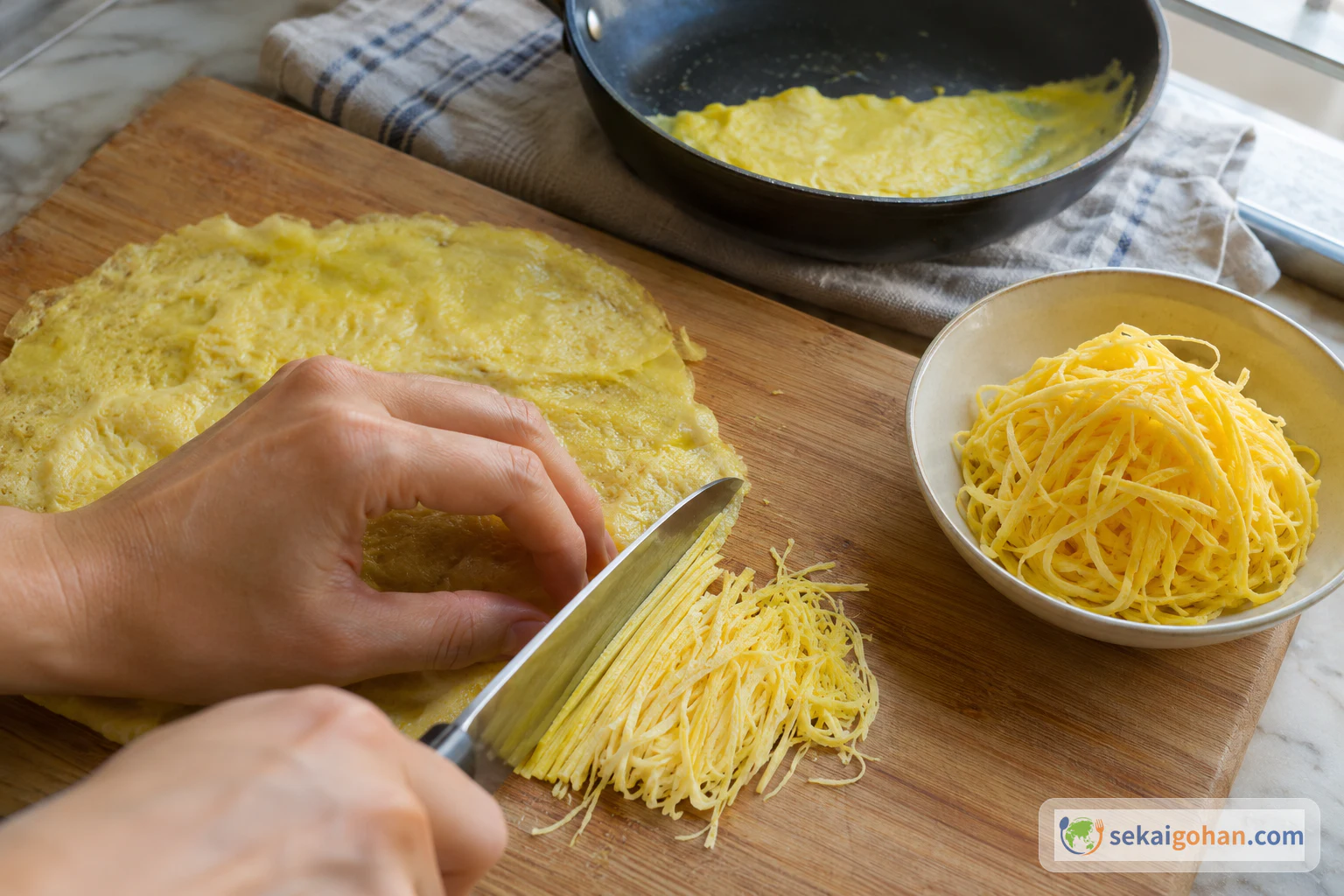
| Egg strands break apart | Sheet too thick, or cut while hot | Fry a thin, even sheet and let it cool before cutting |
When the dish tastes flat, the aromatics were rushed. Giving the garlic and onion time to flavor the oil before anything else goes in is what makes it smell like a restaurant wok.
Serving, Variations and Storage
At the table
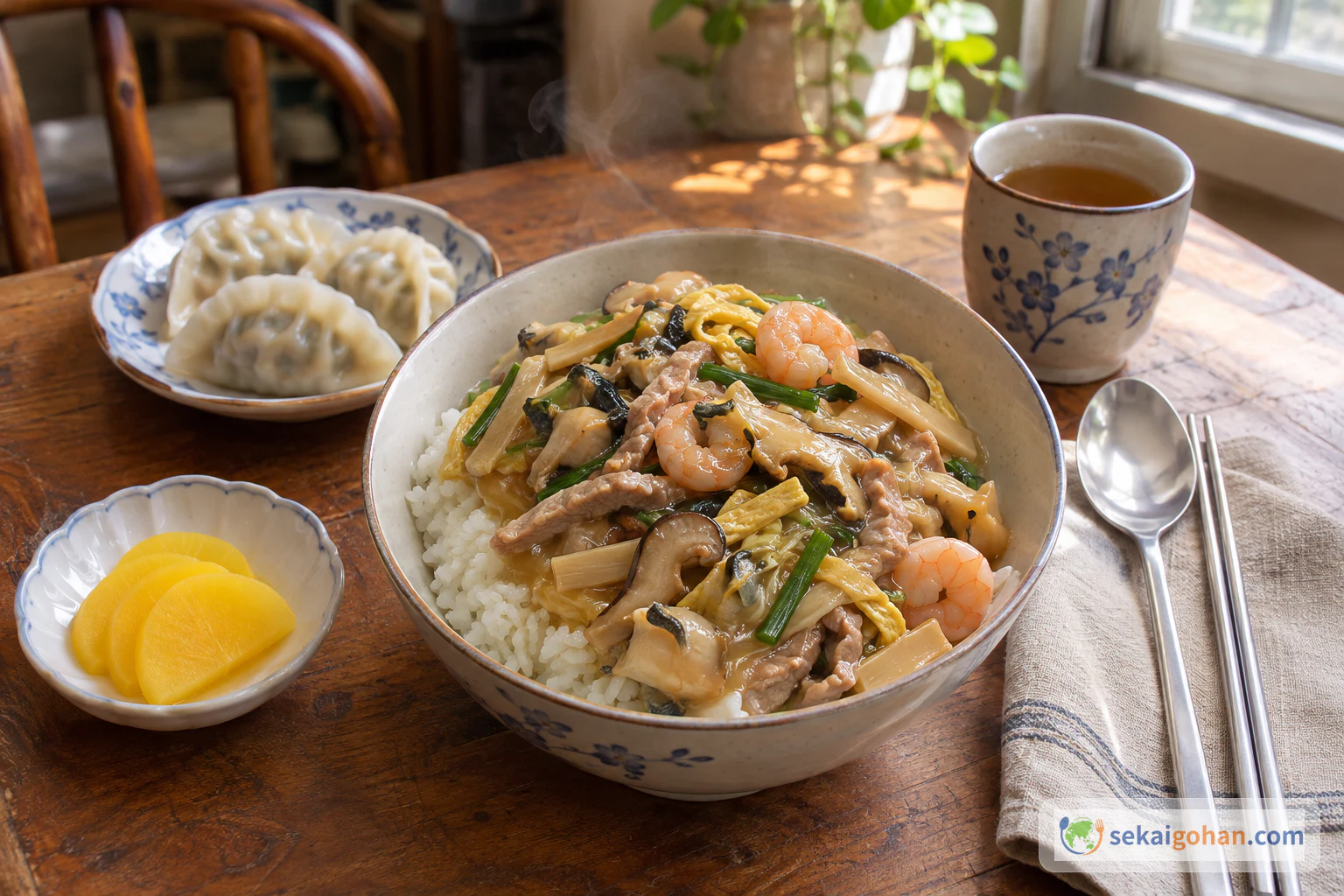
Bring yusanseul to the middle of the table on one plate and let everyone take from it, or serve it as yusanseul-bap over hot white rice. For a rice bowl, leave a little more sauce instead of cooking it down tight, so it seeps into the rice. Steamed dumplings and yellow pickled radish go well with it, as they do with most Korean-Chinese dishes.
Variations
- Sea cucumber or abalone. Use rehydrated dried sea cucumber or abalone in place of the whelk for the grander restaurant version; the bite becomes richer and more luxurious.
- Chicken stock in place of water. Use chicken stock for the hot water and the sauce tastes fuller. Stock powder raises the salt, so cut back on the salt at the end.
- A soy sauce version. One simpler home style skips the bamboo shoot and sea cucumber and seasons with 3 tbsp soy sauce, 1 tbsp sugar, 1 tbsp cooking wine, 1 tbsp sesame oil and a scant ½ cup (100 ml) water. It turns darker and saltier; start with half the soy sauce and cook it as its own dish rather than mixing it with the oyster sauce mix above.
- Bok choy. Add bok choy at the end with the chives, since it cooks just as fast. It brings more green and more volume.
Storage and reheating
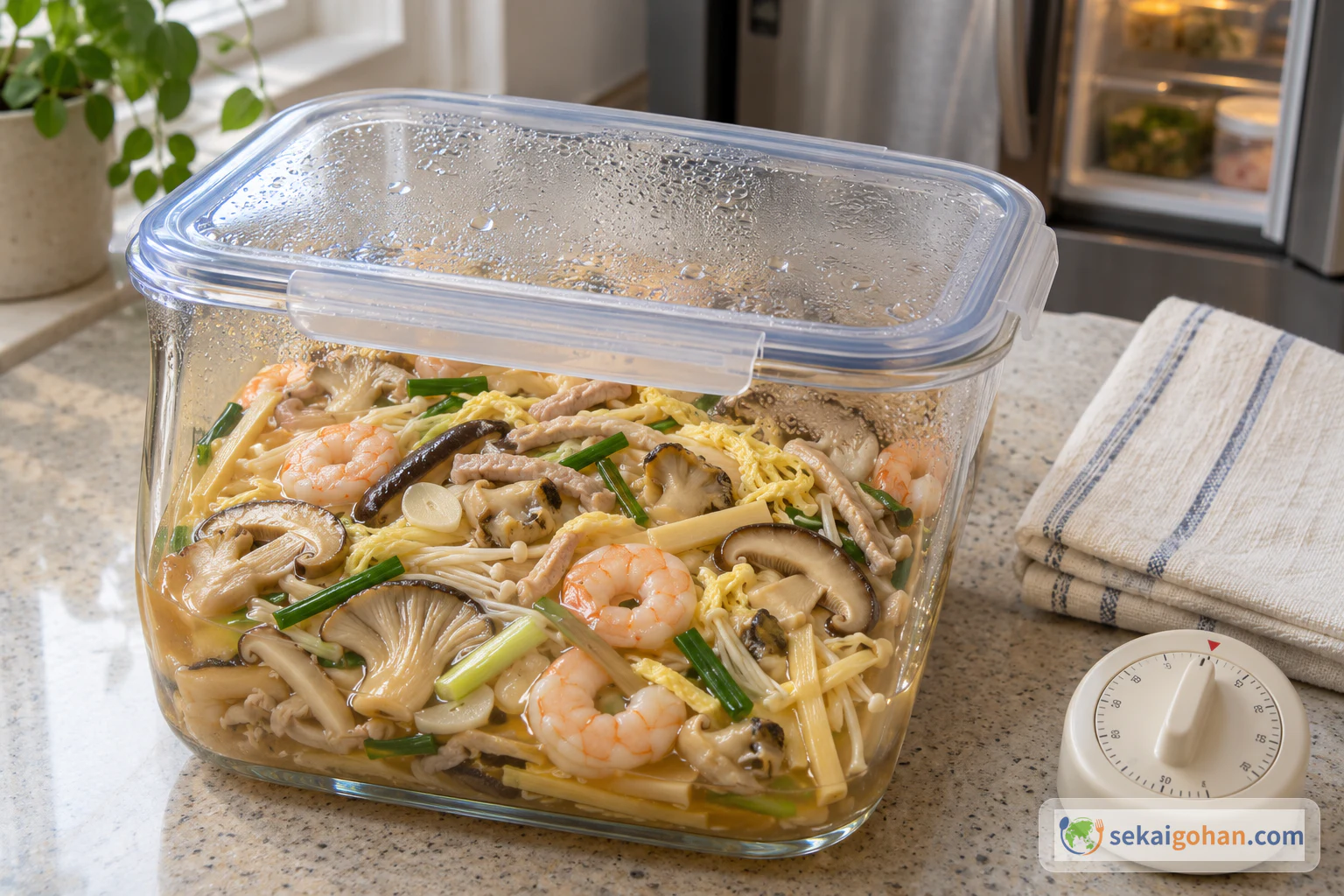
Meat, seafood and shellfish spoil quickly, so never leave yusanseul at room temperature for 2 hours or more. Let it cool briefly, then move it to a clean covered container and refrigerate promptly; eat it by the next day. The starch sauce sets firm in the cold, so take out only what you will eat. Reheat it in a pan with a little hot water to loosen the sauce and keep it from catching, until it is hot through to 185°F (85°C) at the center for at least 1 minute.
Frequently asked questions
Can I make it without bamboo shoots?
Yes. Home cooks in Korea also make a simpler version without bamboo shoots or sea cucumber, using pork, shrimp, onion and mushrooms. You lose the crunch the bamboo gives, so cut the mushrooms and onion thin to keep the strand texture.
Do I need a wok?
A deep skillet 10–11 inches (26–28 cm) across works well. The depth keeps the sauce and hot water from splashing when you stir in the slurry. A wok handles high heat and tossing better, but on a home burner it can be harder to manage.
Is it suitable for children?
There is no chili or chili oil, so the only heat comes from the pepper, which you can reduce. It does contain shrimp, shellfish, egg and sesame, and possibly wheat and soy in the sauces, so leave it out for children with any of those allergies.