Coq au Vin: A Pot of Red Wine, Thyme and Slowly Braised Chicken
Chicken that is tender and cooked through to the bone, a red wine sauce reduced until it clings, and pearl onions and mushrooms cooked on their own so they keep their shape.
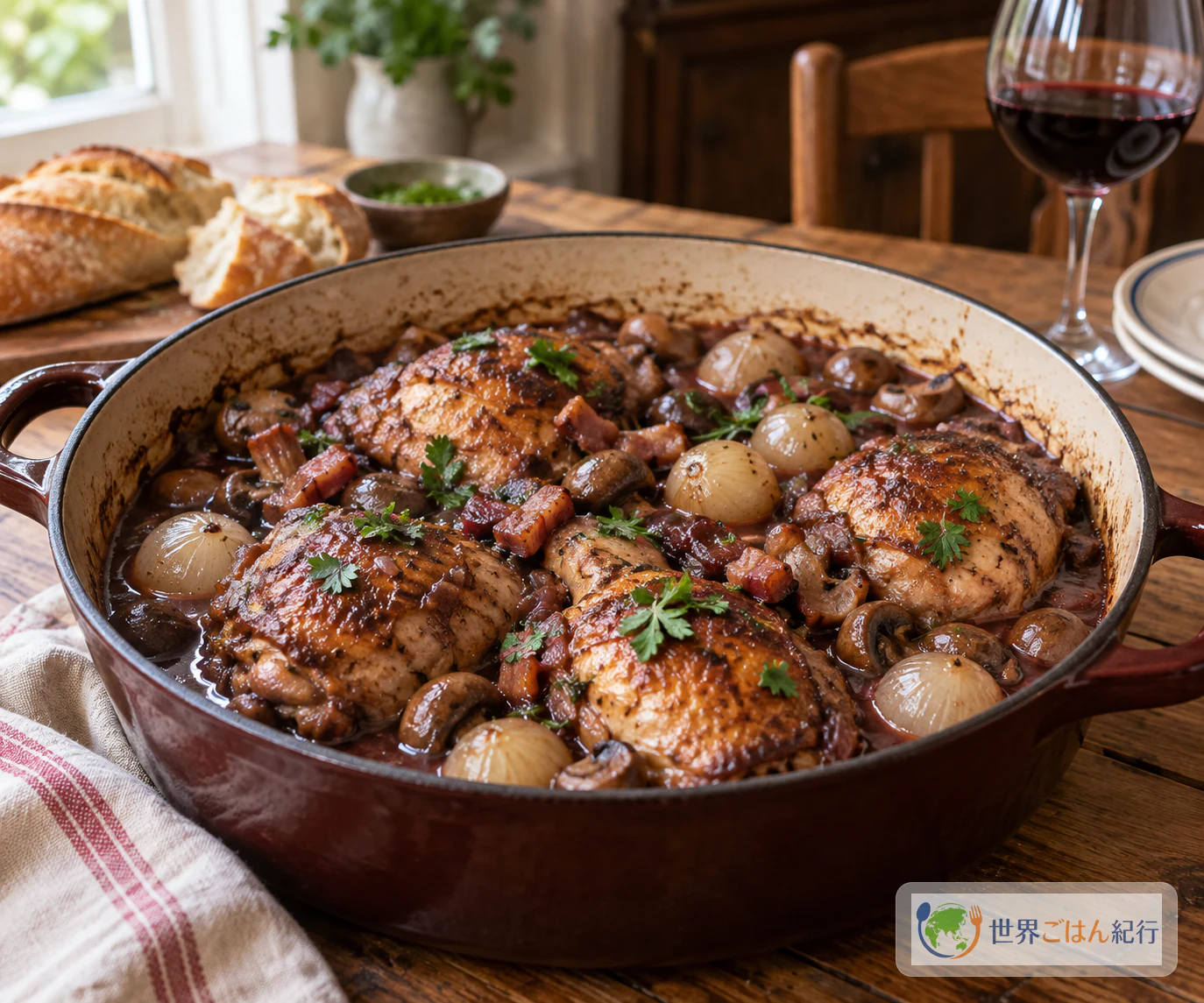
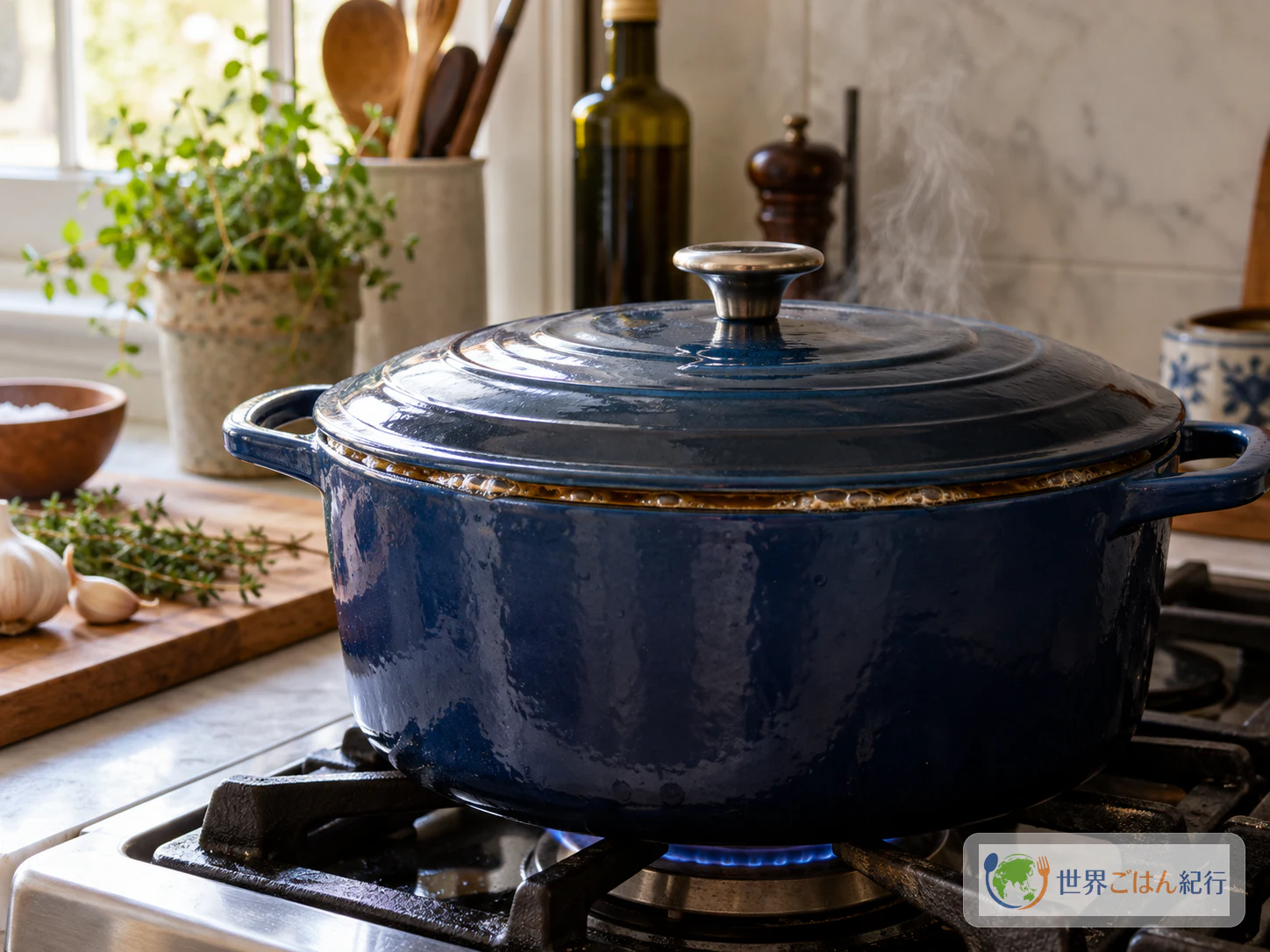
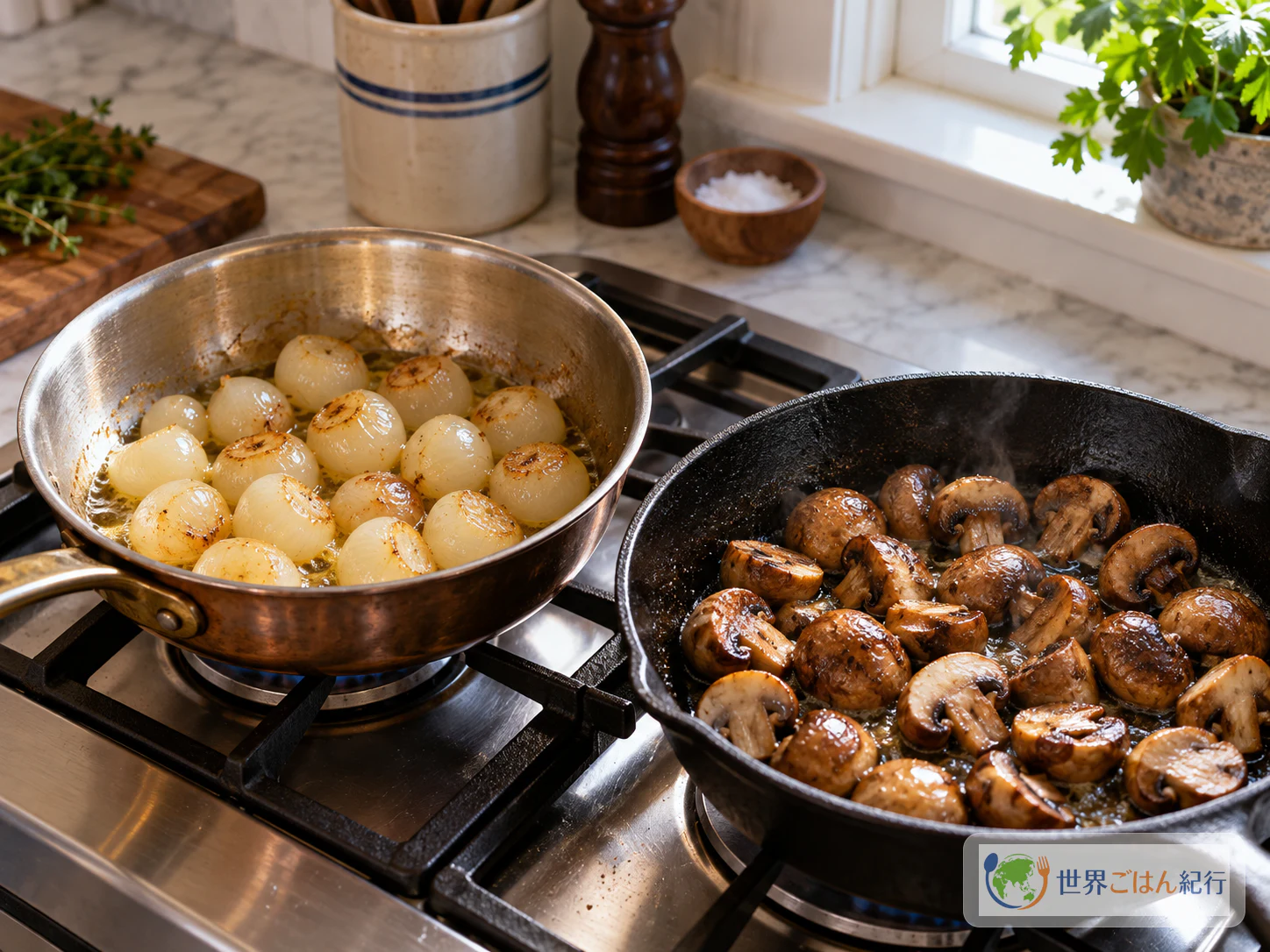
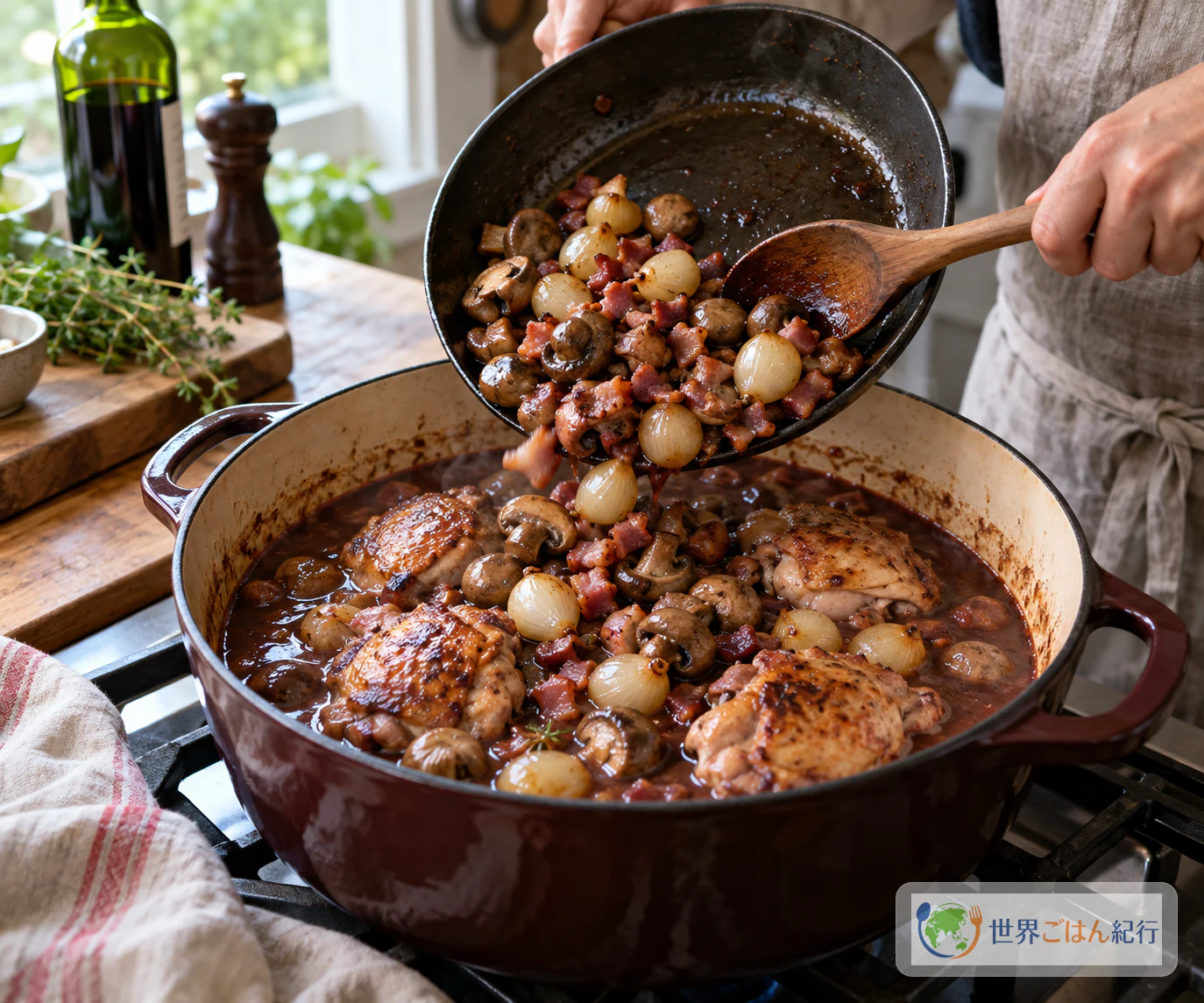
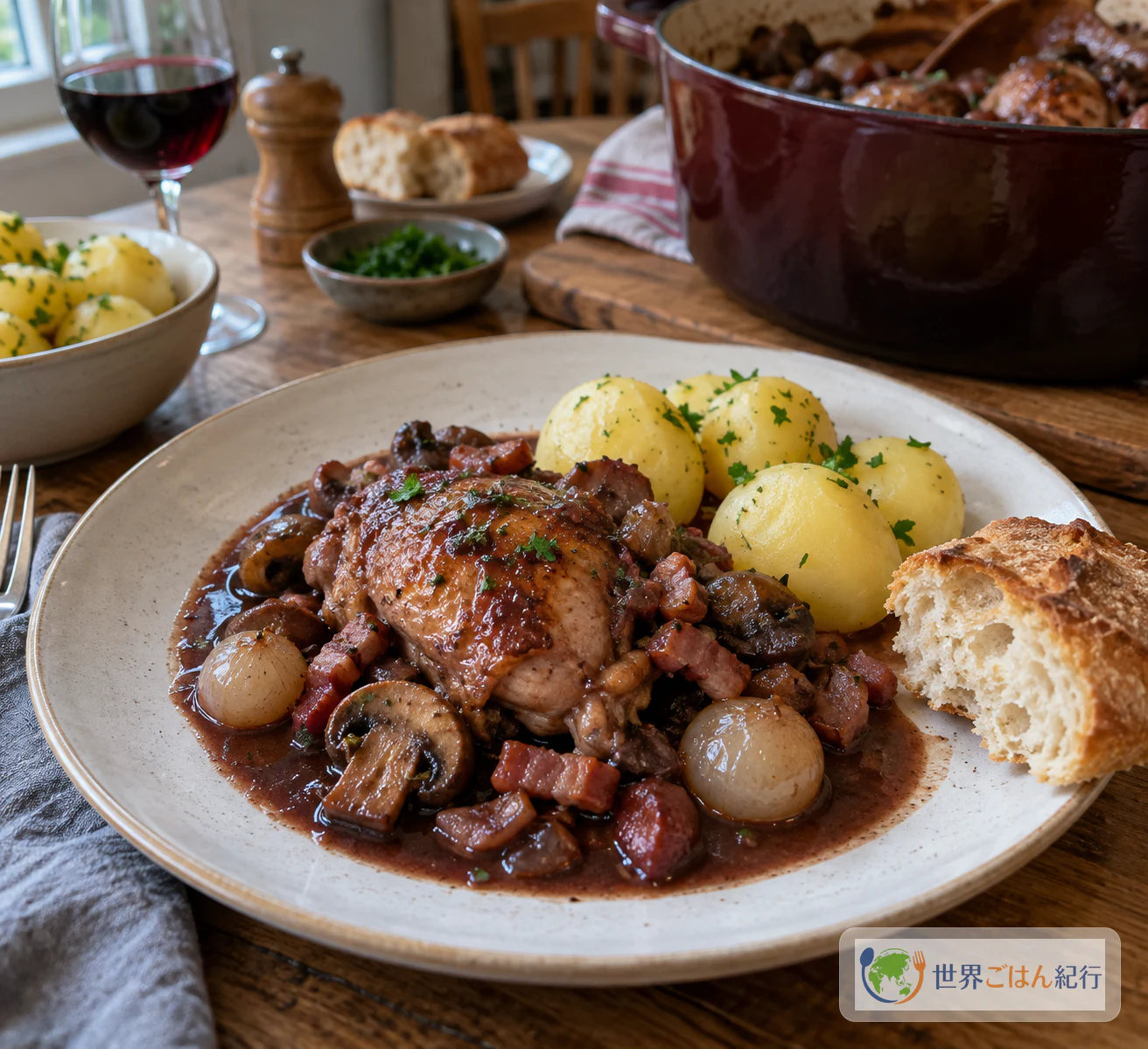
On a cold evening, the lid comes off a heavy pot and the smell of red wine, thyme and bacon rises with the steam. Inside, browned chicken sits in a deep red sauce, and at the very end, pearl onions glazed in butter and mushrooms browned in a separate pan are folded in, giving the sauce a glossy finish. That is coq au vin, the dish from France of chicken braised in wine.
It can sound heavy, or like a dish that needs special ingredients. In practice, the core is short: chicken, red wine, bacon, a few aromatic vegetables, and pearl onions and mushrooms for the finish. Bone-in chicken thighs, thick-cut bacon and button mushrooms from an ordinary supermarket will carry it. This recipe takes the Burgundy-style red wine version as its model and scales it for a home pot.
The amounts here are a home version put together by comparing published recipes, not a copy of any one of them. Recipes for this dish vary widely: Le Cordon Bleu London's version uses 1.2kg of chicken with 1L of red wine and 500ml of stock, while an archived BBC Food recipe by James Martin uses 2kg of chicken with 500ml of red wine. Read the liquid level and the doneness of the chicken in your own pot rather than trusting any single number.
Why a Rooster? The Name, the Story and Burgundy
Coq means rooster and vin means wine: Le Cordon Bleu translates the name literally as "rooster in wine." The dish is told as a way of handling the tough meat of an older bird with long, slow cooking in wine, but Le Cordon Bleu also notes that modern French home cooks use young chicken. You don't need a rooster; chicken thighs work well.
That a hard bird can become tender in a wine braise is part of the appeal, but whether the dish began as thrifty farmhouse cooking is not something the sources here establish. Côte-d'Or Tourism's long cooking times also describe an old rooster, so they shouldn't be applied to the young chicken used in this recipe.
A story is often told that the Gaulish chief Vercingetorix sent a rooster to Julius Caesar, and that the dish was born from it. According to Côte-d'Or Tourism, there is no support for this in ancient sources. The same regional source says that a related recipe for chicken cooked in wine appears in a cookbook from 1864, that today's dish became established as 19th-century bourgeois cooking, and that Julia Child's 1961 book and her television program helped spread it in the United States.
Burgundy's red wine version, traditionally made with Pinot Noir, is the one most often presented as representative, but it is one model rather than the only correct one. Côte-d'Or Tourism also mentions a Riesling version in Alsace, a Jura version with vin jaune and morels, and versions in Auvergne and the Lyonnais made with local wine. The idea that links them is cooking the bird in the wine of the place; the details of each regional version are beyond what this recipe covers. For another regional French table, Alsace also gives tarte flambée, and for a different slow-cooked pot, compare pot-au-feu or the beans and meat of southwestern cassoulet.
Ingredients (for 4)
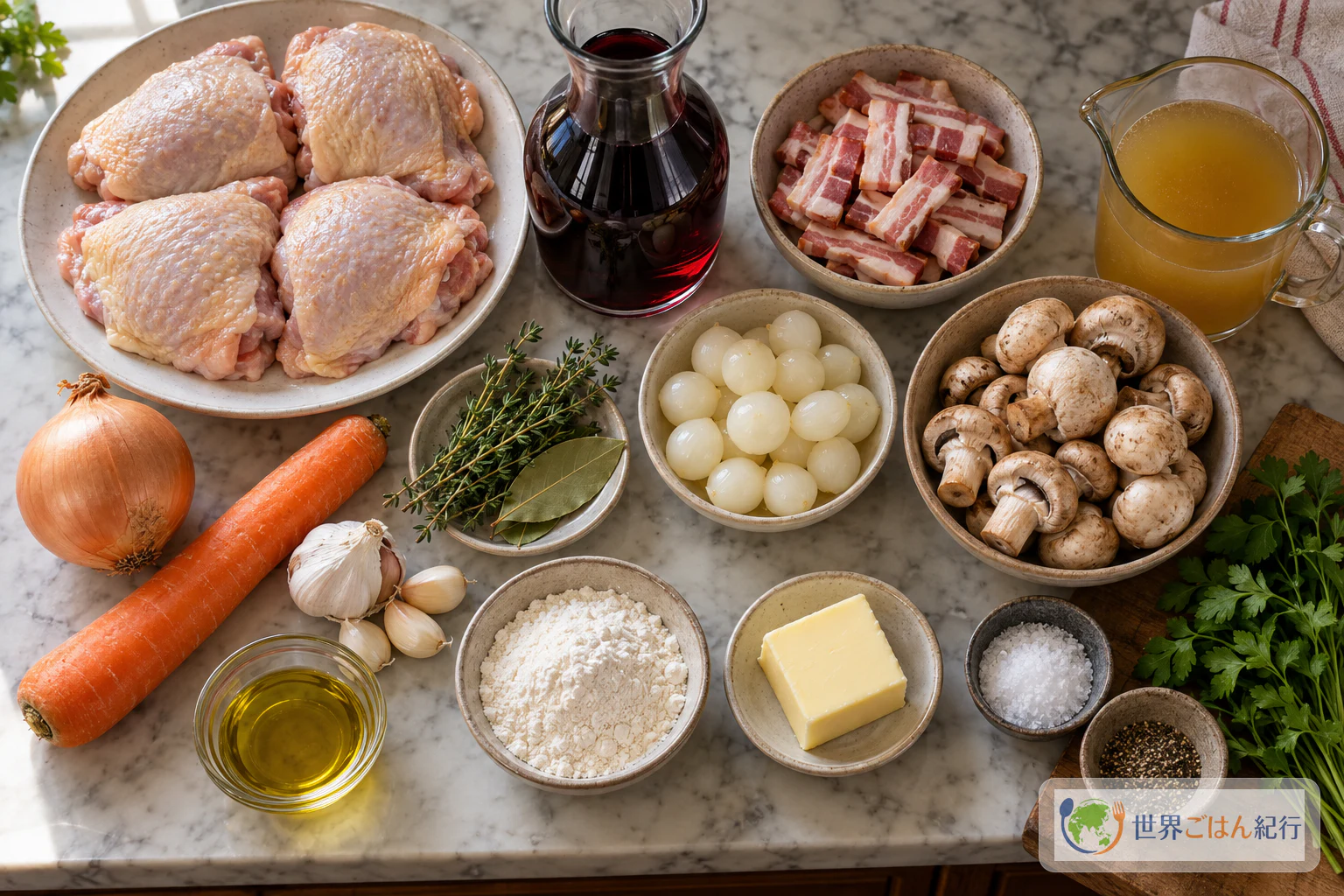
These amounts are a home proposal informed by school and cookbook recipes, with the liquid adjusted for a home pot. Adjust the salt at the end, after you know how salty your bacon and stock are.
This recipe contains wheat (flour) and milk (butter). Bacon, stock and other processed products can contain other allergens, so check their ingredient labels too.
Equipment
- A heavy pot with a lid (a cocotte or casserole); helpful for keeping a gentle simmer, but any heavy-bottomed lidded pot works
- A small pan with a lid, for the pearl onions
- A skillet, for the mushrooms
- A strainer, for the marinade or the aromatics in the sauce
- A meat thermometer, for checking doneness
- A covered, refrigerator-safe container, if you marinate
Choosing and Substituting
Choose a dry red wine that isn't too tannic, and one you'd be happy to drink. Côte-d'Or Tourism advises that you don't need an expensive wine for the pot; save a fine, aged bottle for the glass.
Red wine. Burgundy Pinot Noir is the regional anchor. If you can't get it, a dry red without heavy tannins keeps the dish heading in the right direction, though the aroma and sense of place will change. Inexpensive cooking wines vary in acidity, sweetness and added flavorings; check the label, and don't treat one as an equivalent to wine.
Bacon. French lardons are salt-cured pork; thick-cut bacon brings more smoke and a different saltiness. Hold back on salt until the end.
Chicken. Bone-in thighs give the sauce more body. Boneless thighs are easier to eat but cook faster and can fall apart, so start checking earlier (see step 4). A whole chicken of 1.2–1.4kg cut into pieces also works.
Pearl onions. If you can't find them, use the smallest onions available. A regular onion cut into large pieces will work, but the texture will be different.
Mushrooms. Brown (cremini) mushrooms are fine; they have a stronger aroma and a darker color.
Stock. If you use a salted stock powder or cube, reduce the final salt.
Thyme. If you only have dried, about 1/3 tsp is a reasonable amount; the aroma will be milder.
Butter. Oil can replace it for the garnishes, but the dairy richness will be lighter.
Flour. To avoid gluten, leave it out and thicken the sauce by reducing it.
The Optional Day-Before Marinade
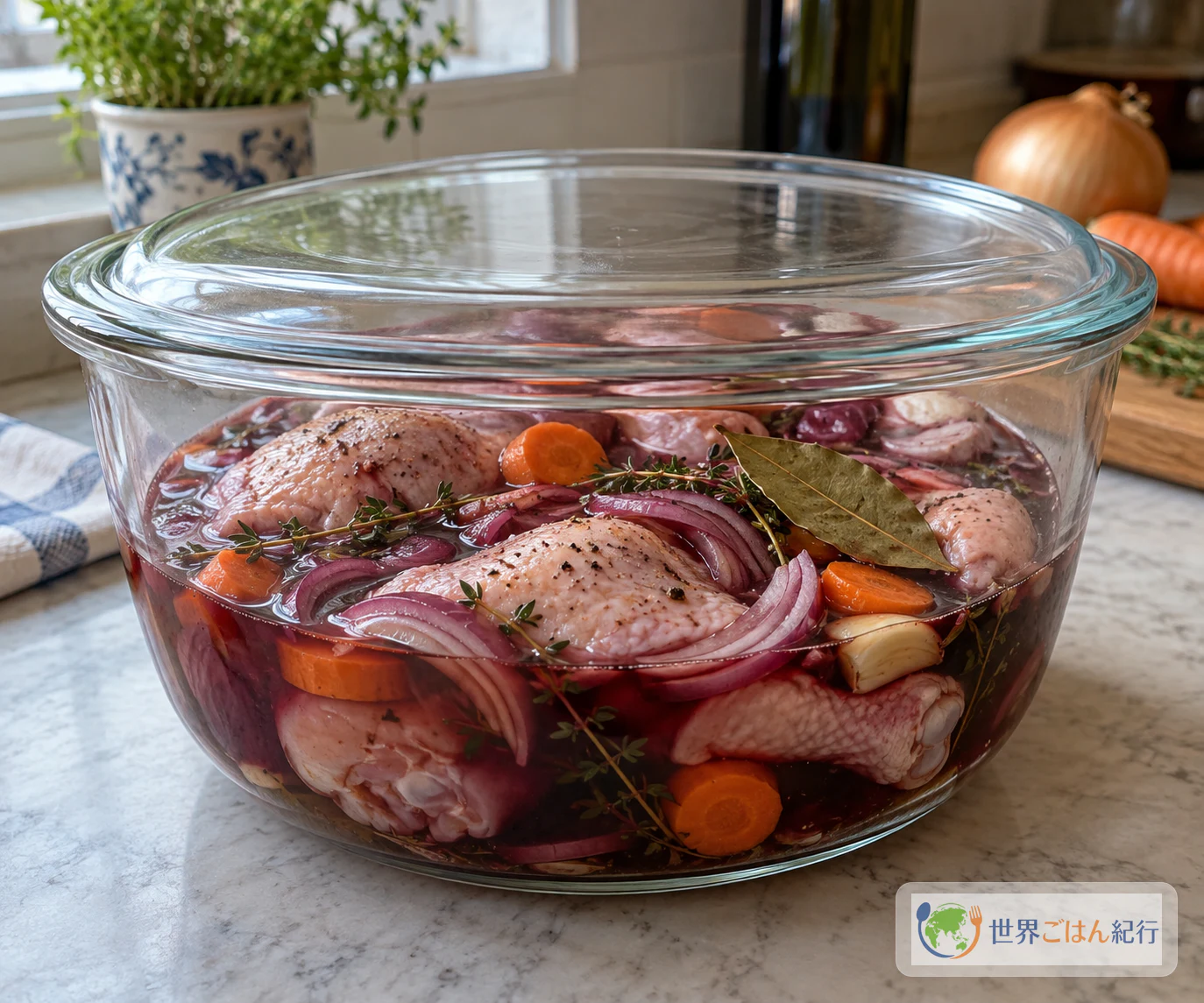
Representative recipes marinate the chicken overnight. Le Cordon Bleu marinates for 12 hours, and Côte-d'Or Tourism describes 12–24 hours. Many home recipes skip it. The method below works without a marinade; if you have time the day before, this is how to add one.
Put the chicken, with no flour on it, into a covered container with part of the red wine, the onion, carrot, garlic, thyme and bay leaf. Refrigerate for 6–12 hours. Never leave raw chicken standing at room temperature.
When you're ready to cook, lift the chicken out of the wine and pat it dry. Flour goes on only just before browning; never put floured chicken back into the wine. Keep the marinade if you plan to use it in the pot, and bring it to a full boil when you do (step 3). Wash anything that touched the raw chicken.
Method: Brown, Braise Gently, Finish Separately
This home version makes the marinade optional, dusts the chicken itself with flour, and braises on the stovetop.
When Things Go Wrong
| Problem | Likely cause | What to do |
|---|---|---|
| The skin won't brown | Chicken wet, or pot crowded | Pat dry thoroughly and brown in batches |
| The meat is tight or falling apart | Braise boiling too hard | Keep the lid on and the heat low enough for small bubbles only |
| Onions and mushrooms are mushy, sauce is watery | Garnishes added to the braise too early | Cook them separately and add only at the end |
| The sauce is thin | Liquid not reduced enough | Take the solids out and reduce the sauce; don't add extra flour |
| Too salty | Salty bacon or salted stock | Season only at the end, and use less salt with salted stock |
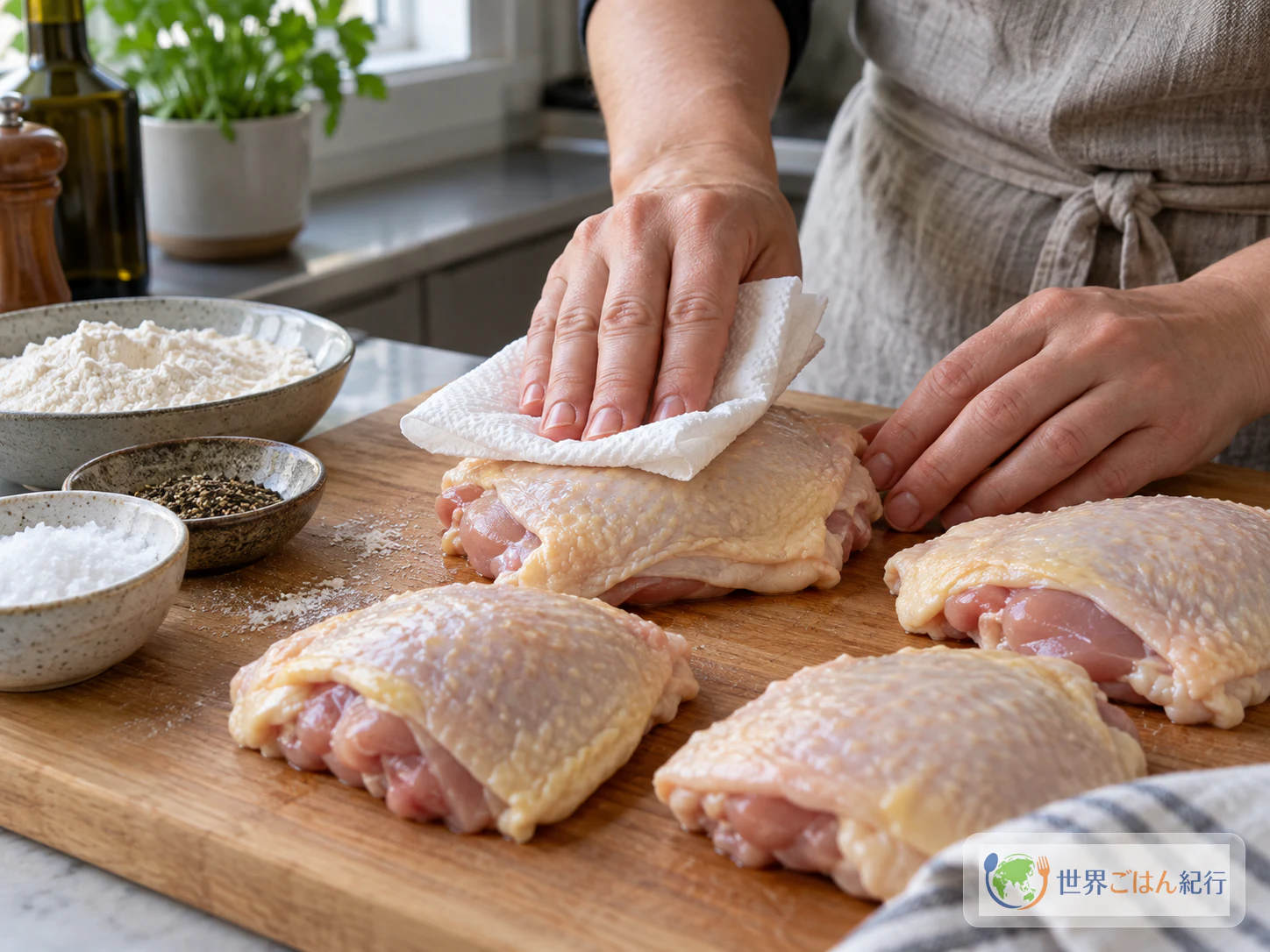
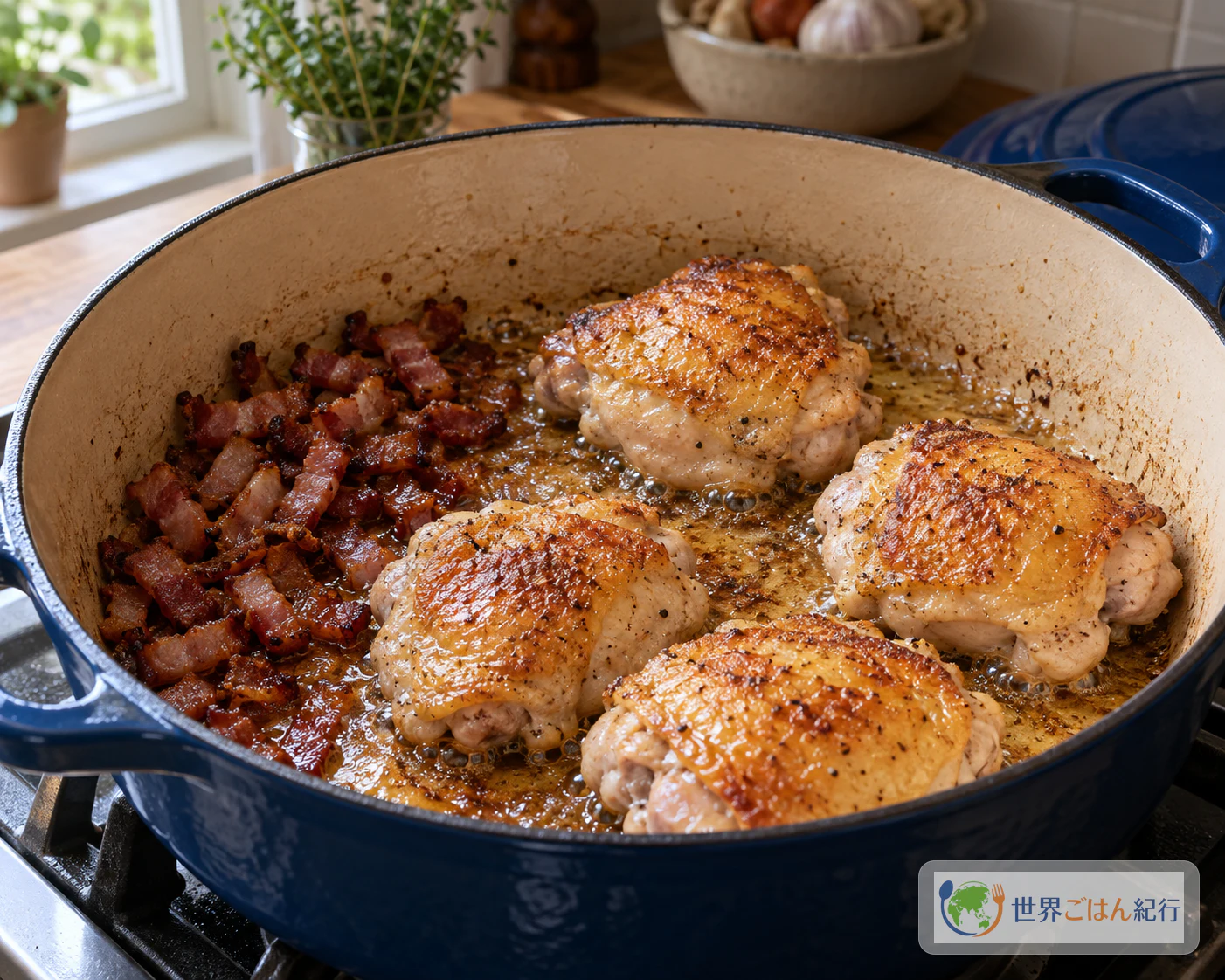
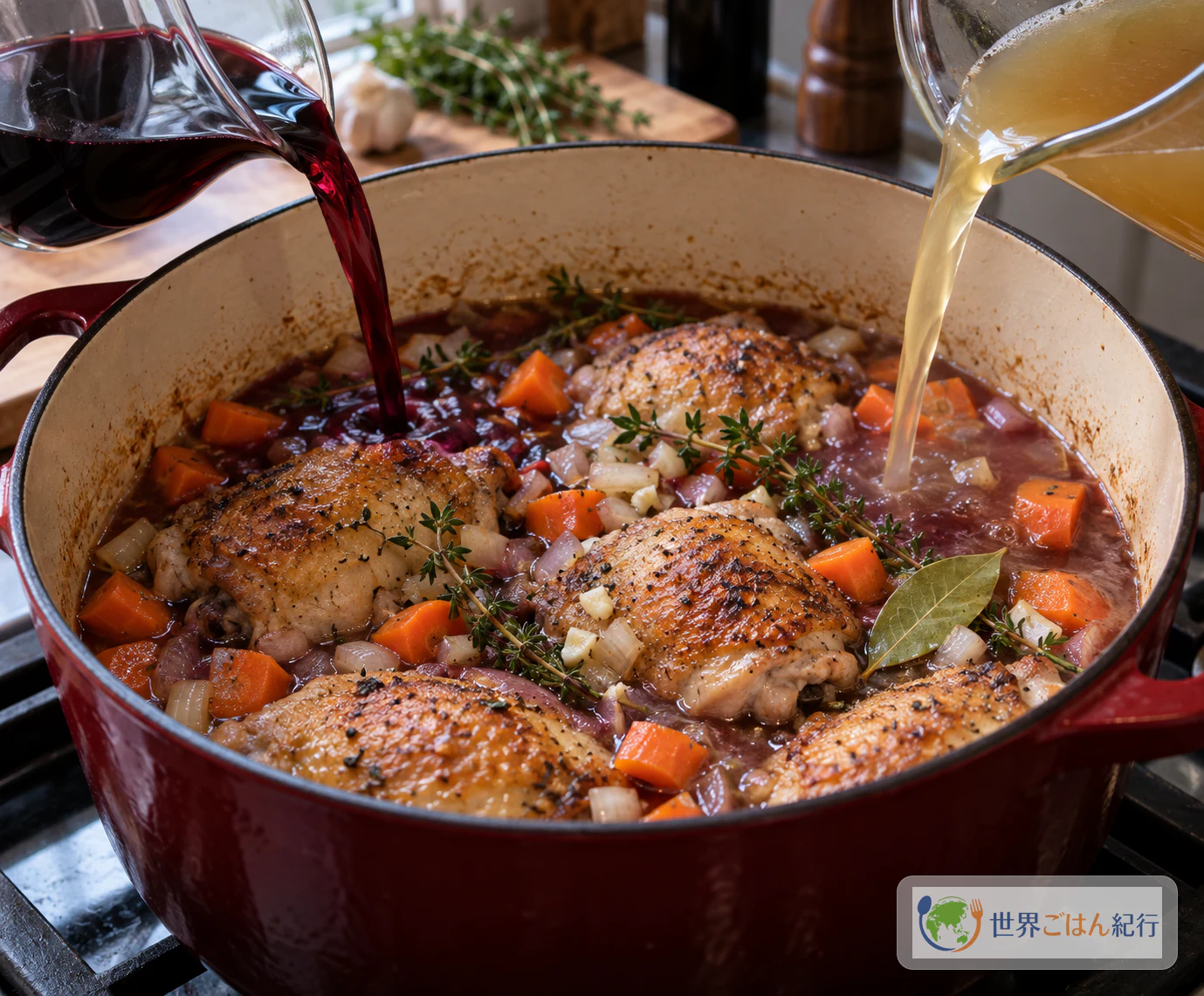
Most of the dish's texture is decided by heat. The browning step wants a dry surface and space in the pot; the braise wants the opposite, a low, steady heat under a lid. Keeping the garnishes out until the end lets the sauce reduce cleanly without breaking them down.
Leftovers and the Next Day
Côte-d'Or Tourism suggests that coq au vin is good eaten the next day. If you plan for that, or have leftovers, separate the solids and the sauce into shallow containers, cool them quickly and refrigerate. When reheating, heat everything thoroughly until hot at the center. No specific keeping time is given here, so eat leftovers soon.
Variations
- Less wine, more stock: lighter, but the wine's aroma and color weaken. Don't assume the same braising time applies when you change the liquid; judge by tenderness and the thermometer.
- Boneless thighs: easier to eat and quicker to cook, but with less body in the sauce. Start checking at around 40 minutes.
- Brown mushrooms instead of button mushrooms: stronger aroma and a darker color.
- Less bacon: less smoke and salt, so the chicken and wine come forward.
- Morels instead of button mushrooms: an expensive dried mushroom that evokes the Jura, but this is not the same thing as the Jura's coq au vin jaune made with vin jaune.
Frequently Asked Questions
Do I need a rooster?
No. The name refers to a rooster, but Le Cordon Bleu notes that modern French home cooks use young chicken. Bone-in chicken thighs work well.
Is the marinade required?
No. Representative recipes include an overnight marinade, but many home recipes skip it. Treat it as optional day-before prep. If you do marinate, keep it refrigerated, flour the chicken only after drying it, and bring the marinade to a full boil when you use it.
Can I use wine other than Burgundy?
Yes. A dry red that isn't too tannic will keep the dish on course, but the aroma and the sense of the region will change.
Does the alcohol cook off?
Cooking alone can't be guaranteed to remove all the alcohol in the wine. Keep this in mind when deciding who will eat it.
What should I serve with it?
Something to carry the sauce: steamed or boiled potatoes, mashed potatoes, tagliatelle or other noodles, or bread.
Sources
- Le Cordon Bleu London, "Coq au Vin Recipe." The meaning of the name, traditional old roosters versus modern young chicken, the basics of a red wine braise, the overnight marinade and the garnish structure. A school recipe, not a standard for every Burgundian home. https://www.cordonbleu.edu/news/coq-au-vin-recipe/en
- Côte-d'Or Tourism / Trésors de Côte-d'Or, "Coq au vin: technique and history of a Burgundy dish." The lack of ancient support for the Gallic War origin story, the 1864 cookbook recipe, Julia Child's 1961 book, the Burgundy red wine version and regional variations, marinating, browning in bacon fat, adding onions and mushrooms late, and serving with potatoes or tagliatelle. Historical points are this regional source's account. https://tresorsdecotedor.fr/en/manger-boire/coq-au-vin/
- BBC Food, "Classic coq au vin," recipe by James Martin (archived copy, not the current official BBC page). One home recipe example: chicken, red wine, bacon and aromatics braised for about an hour until cooked to the bone, with onions and mushrooms fried separately and added later, served with potatoes. Not used for history or regional tradition. https://git.macropus.org/bbc-food/www.bbc.co.uk/food/recipes/classic_coq_au_vin_52046.html
- Ministry of Health, Labour and Welfare (Japan), "Six points for preventing food poisoning at home" (家庭でできる食中毒予防の6つのポイント). Heating to 75°C at the center for at least 1 minute, cooling in shallow containers, thorough reheating, and handling utensils. Gives no times or storage periods specific to coq au vin. https://www.mhlw.go.jp/stf/seisakunitsuite/bunya/kenkou_iryou/shokuhin/syokuchu/01_00006.html