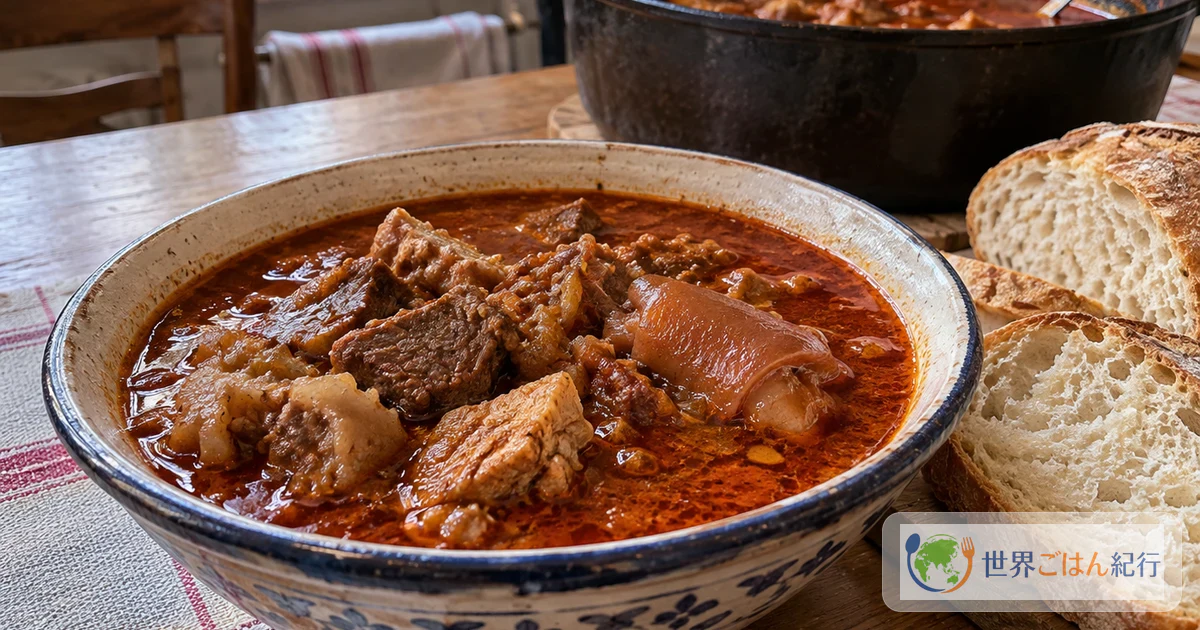
The soul dish Norway chose by public vote
Norway once held a vote to pick its national dish. In 1972 a Norwegian newspaper ran a reader poll, and Fårikål won by a wide margin. The name means "mutton in cabbage": får (sheep) plus kål (cabbage).
There are only three ingredients: lamb, cabbage and black pepper, with water and salt. Simmer it for two and a half hours. That is all. There is almost no technique involved: you layer everything in a pot and put it on the heat. Yet the stew that results is full of deep savor. The lamb fat soaks into the cabbage and the black pepper pulls everything together.
Also written "Fårikål" in Norwegian: får = sheep, i = in, kål = cabbage. It was chosen as Norway's national dish in a 1972 reader poll by the newspaper Aftenposten. The last Thursday of September each year is Fårikålens dag (Fårikål Day). Across Norway it is the dish that announces the arrival of autumn.
If Hungarian goulash is the representative stew of Central Europe, fårikål is the essence of the Nordic stew, and it is strikingly simple. Where goulash is a complex layering of paprika and spices, fårikål is only lamb, cabbage and black pepper. That restraint is what has captured the Norwegian heart.
Ingredients (serves 6)
Main ingredients
Lamb can be hard to find in some supermarkets. Look at butchers, halal shops and large wholesale stores, where bone-in lamb shoulder is usually available, or order frozen lamb online. Thin slices meant for grilling melt away when simmered, so choose thick cuts or a block of meat. If you truly cannot get lamb, a block of pork shoulder can stand in, though the flavor changes a great deal.
This dish uses lamb. Because flour is used for thickening, it also contains wheat. To make it gluten-free, replace the flour with 2 tbsp of potato starch or cornstarch. If you substitute pork, mind any religious dietary restrictions.

Cooking tips
The core of fårikål's flavor is whole black peppercorns. Never use ground pepper. Simmered whole, the pepper releases its flavor slowly over two and a half hours. Ground pepper gives up all its heat in the first 10 minutes and leaves only bitterness afterward. Larger peppercorns release flavor more slowly, which gives more depth to the finished stew.
More than half of the savor of fårikål comes from the lamb fat. Remove the fat and the stew turns watery and bland. Some people worry about the smell of lamb, but over two and a half hours the cabbage absorbs and neutralizes it. If it still bothers you, skim off the fat that floats on the surface of the finished stew with a spoon.
In Norwegian households it is said that fårikål tastes best the next day. Leave it in the refrigerator overnight and reheat it the next day, and the flavor deepens markedly. This happens with stews in general: as they cool, the meat fibers absorb the cooking liquid and the gelatin from the collagen gives the liquid body. It is best to make plenty and eat it from the next day on.
A heavy cast iron pot (Le Creuset, Staub and the like) is best. Cast iron holds heat well and warms the whole pot evenly even on low heat. In a thin stainless steel pot only the bottom gets hot, which raises the risk of scorching. If you do not have a cast iron pot, putting a heatproof plate on the bottom of a stainless pot helps prevent scorching.
Variations
Yuzu kosho version (a Japanese-style twist)
At the end, stir in 2 tsp yuzu kosho (a Japanese citrus and chile paste). The citrus aroma of the yuzu kosho joins the heat of the black pepper and adds depth. Add the yuzu kosho after turning off the heat, because heating drives off its aroma. It is a surprising combination, but lamb with yuzu kosho is a pairing already proven in Japanese grilled lamb dishes. The sweetness of the cabbage mediates between the two kinds of heat. It is a method like Tunisian chakchouka (in Japanese), where you add an accent of heat to an existing dish.
Beer-braised version
Use 300 ml of pale ale (or lager) instead of the 300 ml of water. The bitterness of the hops tightens the lamb fat and gives a crisper taste. Belgian carbonnade is also a classic beer stew, and shows how well beer works in braises. The alcohol evaporates completely during the simmer, so it is fine for children.
Curry-flavored version
Sprinkle 1/2 tsp curry powder over each layer, about 3 tsp in total. It goes well with the black pepper and gives a spicy, exotic taste.
Pork shoulder version (an easy one with everyday ingredients)
Use 1.5 kg of pork shoulder in a block instead of lamb. The distinctive flavor of lamb is lost, but the sweetness of pork fat goes well with cabbage. It is an entry version made with ingredients available at nearly any supermarket. Adding 1 tsp cumin seeds to each layer gives an "exotic" note close to lamb.
White wine version
Use 300 ml of dry white wine instead of the water. The acidity of the wine cuts the lamb fat and gives an elegant result. A high-acid type such as Sauvignon Blanc suits it.
Background of the dish

A sheep-farming tradition from the Viking age
Sheep keeping in Norway goes back to the Viking age (793–1066). Like Georgian khinkali (in Japanese) and Greek moussaka (in Japanese), fårikål is a dish born of pastoral culture. The steep land along Norway's fjords is poorly suited to farming, but sheep graze even on rugged rocky slopes. Sheep thrive where cattle cannot be raised, so Norwegians have relied on them.
Norway still has about 2 million sheep, in a country of about 5.5 million people. In summer the sheep are sent to mountain pastures (seter), and they come back in September. The day "the sheep come down from the mountain" marks the start of the autumn fårikål season.
Fårikål Day
The last Thursday of September each year is Fårikålens dag (Fårikål Day). On this day fårikål is served in homes, restaurants and school canteens across Norway.
Why three ingredients were enough to make a national dish
The greatness of fårikål lies in its aesthetic of subtraction. No herbs, no spices (apart from pepper), no wine. No garlic, no onion, no tomato. Just lamb, cabbage and black pepper. How does so little produce such deep flavor? The answer is time. Two and a half hours on low heat turns the lamb's collagen to gelatin, lets the fat soak into the cabbage, and spreads the pepper's pungent compound (piperine) through the whole broth. It is a dish where time is the best seasoning.
Portuguese caldo verde (in Japanese) also earned national-dish status with just three elements: potato, kale and chouriço. Great national dishes the world over share this idea of subtraction.
Norwegian autumn and fårikål
In Norway the temperature drops sharply in September and the days grow short. It is the signal that a long dark winter is beginning. At this turn of the season the family gathers in the kitchen and sets a big pot of fårikål going. For two and a half hours the smell of lamb and cabbage drifts through the house, while outside the window the wind turns cold. For Norwegians, fårikål is a dish tied to the memory of the seasons.
Nutrition (per serving, from a recipe for 6)
About 420 kcal per serving of fårikål. Rich in the collagen and gelatin that melt out of the bone-in lamb and in the vitamins C and K of cabbage. Add potatoes and the carbohydrate is covered too, making it a well-balanced main dish.
| Nutrient | Amount |
|---|---|
| Calories | 420 kcal |
| Protein | 32 g |
| Fat | 22 g |
| Carbohydrate | 18 g |
| Fiber | 4 g |
| Sodium | 650 mg |
Boiled potatoes on the side
Boiled potatoes are essential with fårikål. For Norwegians, fårikål without potatoes feels as wrong as sushi without wasabi.
Boil waxy potatoes whole in their skins. Start them in cold water over medium heat and cook for 20 minutes after it boils. They are done when a skewer goes in easily. Serve them unpeeled, and eat them with the fårikål cooking liquid spooned over.
Pick a waxy variety that holds its shape. Floury potatoes break down easily and are not suitable. A potato with a creamy texture and a nutty flavor pairs very well with the cooking liquid of fårikål.
Dishes to make alongside
- How to make carbonnade - Uses similar ingredients and aromas from the same region.
- How to make waterzooi (in Japanese) - Uses similar ingredients and aromas from the same region.
- How to make pasticada (in Japanese) - Uses similar ingredients and aromas from the same region.
Frequently asked questions
Questions from people making fårikål for the first time.
Q1. I am worried about the smell of lamb. Is there a way to get rid of it?
Over two and a half hours of simmering, the cabbage absorbs and neutralizes most of the smell. If it still bothers you, add 1 tbsp vinegar to the 300 ml of water. Young lamb (under 12 months old) from New Zealand or Australia has less smell, so choose that if it is your first time.
Q2. Can I save time with a pressure cooker?
Yes. In a pressure cooker it is done in 40 minutes at high pressure. Norwegian cooks, however, tend to say the essence of fårikål is the slow two and a half hours of simmering, and that a pressure cooker does not give the flavors enough time to meld. If you are short of time, cook it in a pressure cooker and let it rest, covered, for 30 minutes or more after turning off the heat. The flavor comes to about 80% of a standard simmer. On days when you are not in a hurry, do try the traditional two and a half hour simmer.
Q3. How do I store leftover fårikål?
It keeps for 4 days in the refrigerator and 1 month in the freezer. To freeze, remove the bones and put it in a zip-top bag. Reheat slowly over low heat. A microwave is not recommended because it toughens the lamb. As noted, fårikål is said in Norway to be best the next day. Like Moroccan tagine and Egyptian koshari, stews come into their own the next day. The smart way is to make extra and keep some for the next day.
Q4. Can I use napa cabbage instead of cabbage?
You can, but the texture changes a great deal. Napa cabbage has more water than cabbage (95% versus 92%) and melts easily when simmered. If you use it, shorten the simmer to 1 hour 30 minutes and cut it in large pieces. It still comes out delicious, but a Norwegian would not call it fårikål.
Q5. What drink goes with fårikål?
In Norway aquavit is the standard. It is a spirit flavored with caraway seeds and dill, and it washes away the lamb fat. If you cannot find it, wine with firm tannins such as Pinot Noir or Syrah pairs well. For beer, brown ale or amber ale is recommended, as the malt sweetness harmonizes with the richness of the lamb.
Related stews from around the world
Here are stews from around the world that, like fårikål, achieve deep flavor with few ingredients.
European stews
- Goulash: Hungarian stew of beef and paprika. In contrast to fårikål, spices play the lead
- Caldo verde (in Japanese): Portuguese soup of potato and kale. Shares fårikål's aesthetic of subtraction
- Cepelinai (in Japanese): Lithuanian potato dumplings. A simple home dish from the Baltic coast
Stews from outside Europe
- Doro wot: Ethiopian chicken stew. The spice paste berbere gives it its complex flavor
- Feijoada: Brazilian stew of beans and meat
Sources
- Hahnemann, Trina. The Nordic Cookbook. Phaidon Press, 2015. https://www.phaidon.com/store/food/the-nordic-cookbook-9780714868721/ (a comprehensive collection of Nordic recipes, including regional variations of fårikål)
- Notaker, Henry. Food Culture in Scandinavia. Greenwood Press, 2009. https://www.bloomsbury.com/us/food-culture-in-scandinavia-9780313349225/ (a history of Nordic food culture)
- McGee, Harold. On Food and Cooking: The Science and Lore of the Kitchen. Scribner, 2004. (a classic of food science, on the science of collagen and gelatin in braising)