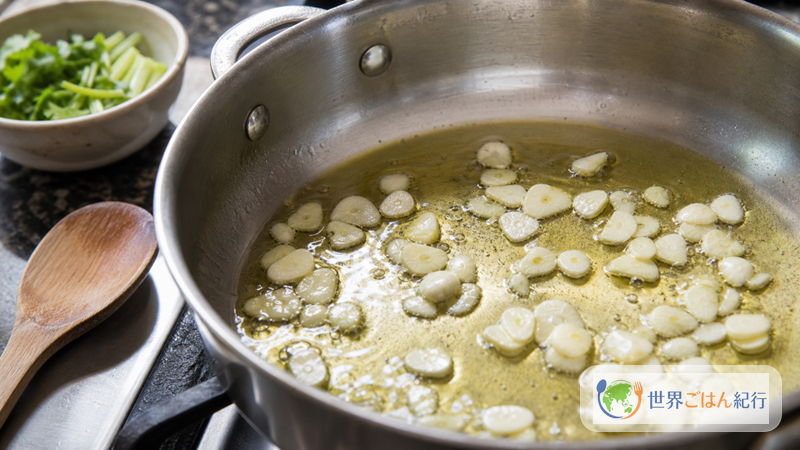
Start where the garlic throws off its first small bubbles
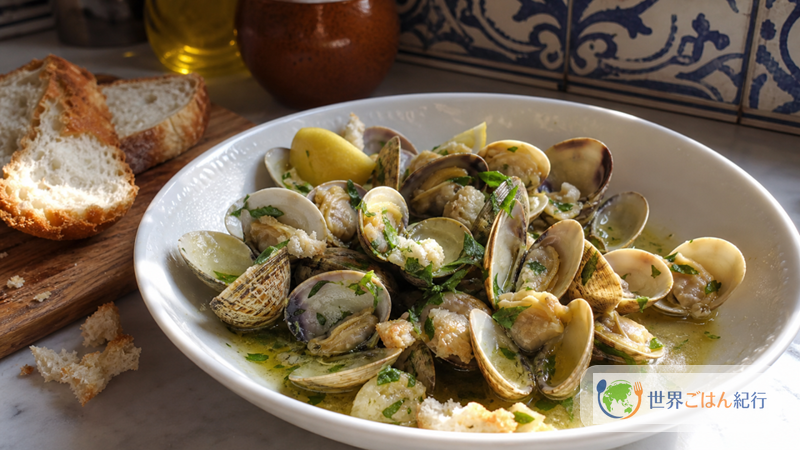
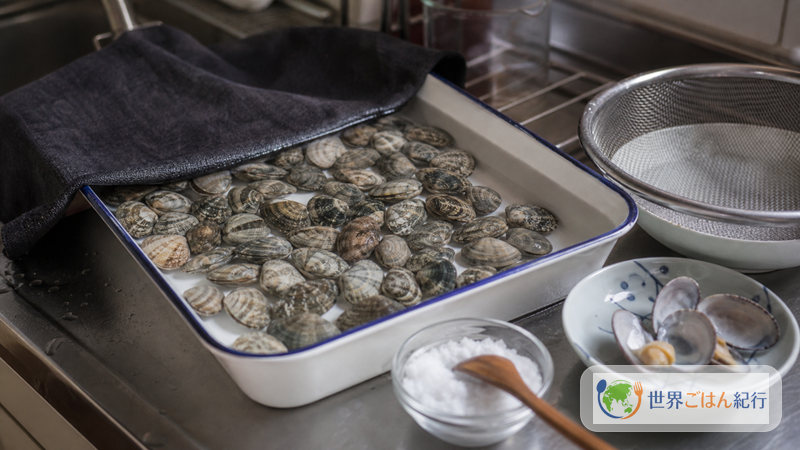
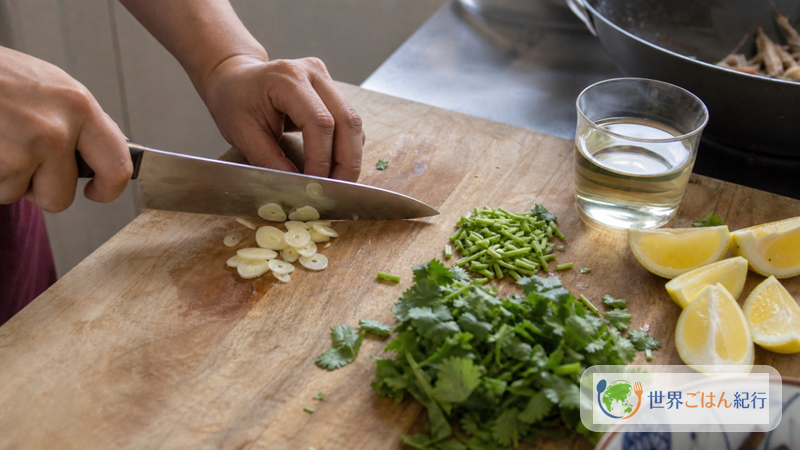
Bring clams home and your kitchen gains a tiny sea. Fill a bowl with salted water, keep it dark, and leave it for a while. While you listen to the faint shifting of shells, slice the garlic thin and separate the coriander stems from the leaves. Amêijoas à Bulhão Pato is a dish where this quiet preparation decides most of the flavor.
In Portuguese it is Amêijoas à Bulhão Pato. In Lisbon's casual restaurants and in seaside towns it appears as a starter or a petisco. What stays in the bottom of the dish is a pale broth of garlic, olive oil, white wine, coriander and lemon. The dish includes the moment after the clams are gone, when you scoop that broth up with bread.
VisitPortugal's traditional recipe page also introduces it as clams finished in a garlic and coriander sauce. Nothing you need is expensive. Three things matter: choose fresh clams, never scorch the garlic, and do not cook the clams for long once they open.
The same garlic and coriander, but with hot broth soaked into bread instead of clam juices left in the dish, takes you toward the southern Portuguese Açorda. Once you feel how the bread scoops up the juices in amêijoas, the açorda idea of making bread the star is easier to grasp.
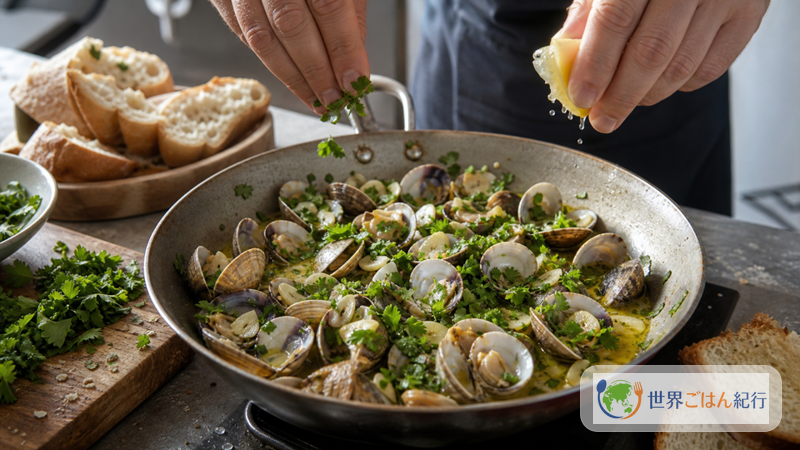
The clams should be plump, the garlic sweet and unburnt, and the broth just rich enough for bread to catch. Coriander is not a garnish: cook the stems to release aroma, and add the leaves at the end to keep the green fragrance.
What is Amêijoas à Bulhão Pato?
"Amêijoas" is Portuguese for clams and other small bivalves. "Bulhão Pato" is a name tied to the 19th-century poet Raimundo António de Bulhão Pato. Whether the poet himself invented the dish or a cook borrowed his name is uncertain, but in Portugal it has settled in as the dish's name.
Comparing it with similar shellfish dishes makes its direction clear.
| Dish | Main aromatics | Liquid | How it is eaten |
|---|---|---|---|
| Amêijoas à Bulhão Pato | Garlic, coriander, lemon | Olive oil, white wine, clam juices | Scoop the broth with bread |
| Spanish clams in white wine | Garlic, parsley | Plenty of white wine | Small plate as tapas |
| Japanese sake-steamed clams | Sake, ginger, scallion | Sake, clam juices | Enjoyed closer to a soup |
| Italian vongole | Garlic, parsley, chile | Olive oil, white wine | Tossed with pasta |
What makes it Portuguese is the way coriander is used. Scattering the leaves only at the end leaves them as a green decoration. Chop the stems into the garlic oil, and the green scent moves into the oil, so that when lemon is squeezed in the sweetness of the clams comes forward. Just as Caldo Verde (in Japanese) uses the greenness of kale to tighten the sweetness of potato, coriander here lightens the smell of the sea.
You will see "Amêijoas à Bulhão Pato", "Ameijoas a Bulhao Pato" and other spellings. This article uses "Amêijoas à Bulhão Pato" throughout for readability.
Origin of the name and regional differences
The Bulhão Pato in the name is a 19th-century poet who comes up often when people talk about the food culture around Lisbon. Rather than settling on who first made the dish, it is more useful in the kitchen to see it as a plate so familiar in city restaurants and home starters that a poet's name came to be attached to it. Knowing that, you can build it as more than clams steamed in white wine: a small Portuguese plate that includes garlic, coriander, lemon and bread.
There are regional differences too. In Lisbon restaurants it tends to come out in a small portion, a plate that starts a meal with bread and white wine, while in coastal towns you also see big servings of clams with plenty of juices left in the bottom of the dish. Households vary: some go easy on the wine, some add a little chile, some use a lot more coriander. What they share is that the clam juices are not thrown away but caught with bread.
When recreating it outside Portugal, rather than chasing the local clam species, put your effort into not shrinking ordinary supermarket clams. Even without large clams, steam them briefly in a wide pan and take out the ones that have opened, and what remains in the dish is a broth that is not too cloudy. If your household does not like coriander, before swapping all of it for parsley, try putting just a small amount of stems into the oil; that keeps the green aroma that tastes Portuguese.
Ingredients (serves 4) and substitutes
Ordinary fresh clams from a supermarket or fish counter work well. Even without the large clams found locally, it comes out very good if you do not overcook. Live clams in the shell come first; frozen clams are treated as a shortcut version.
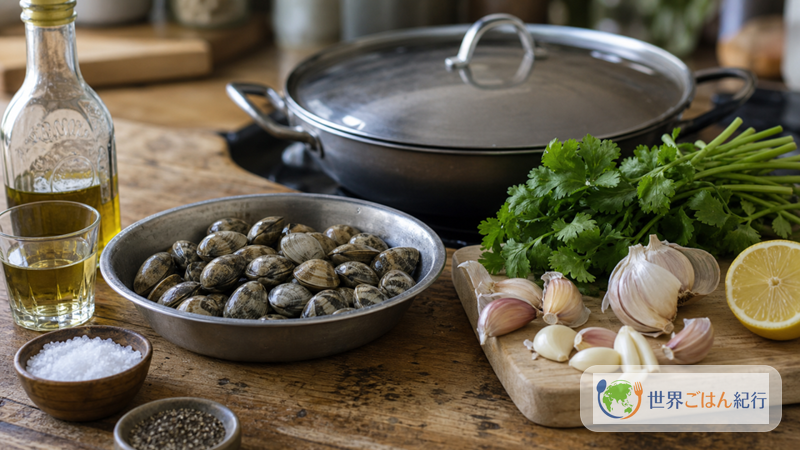
Choose clams whose shells are not cracked, that have no off smell, and that close when lightly tapped. Do not use clams with chipped shells and dried-out flesh, or any that smell strongly before cooking. The U.S. FDA's seafood safety guidance likewise says to avoid shellfish with cracked shells or that will not close, and not to eat shellfish that do not open after cooking.
Shellfish toxins are not destroyed by cooking. If you use clams you dug yourself or were given, check the harvest-area closures and local authority advisories for where they were gathered. Even clams sold in shops should be refrigerated after purchase and cooked soon.
Shopping notes
Clams, garlic, lemon and coriander are best found at a nearby supermarket. The things worth a little attention are the olive oil that forms the base of the flavor, the acidity you need when cooking without white wine, and a pan wide enough to steam in.
The reason for a wide pan is to avoid stacking the clams. Packed into a deep small pot, only the bottom clams cook, and by the time the top ones open, the bottom ones have shrunk. A deep skillet of about 28cm lets you steam 800g of clams in one go.
Nutrition guide
It changes with the saltiness of the clams and the amount of bread. The figures below are per serving, for 800g of clams, 4 tbsp of olive oil and the baguette served separately.
| Item | Guide |
|---|---|
| Energy | about 210kcal |
| Protein | about 14g |
| Fat | about 12g |
| Carbohydrate | about 8g |
| Fiber | about 1g |
| Salt equivalent | about 1.9g |
Adding plenty of bread raises the carbohydrate and salt. The broth is delicious, but rather than drinking all of it, scooping a little with bread keeps the whole meal in better balance.
How to make it: do not keep opened clams waiting
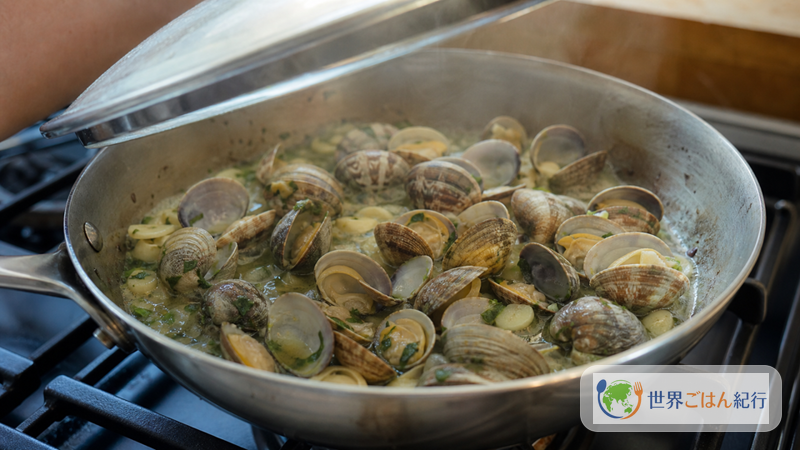
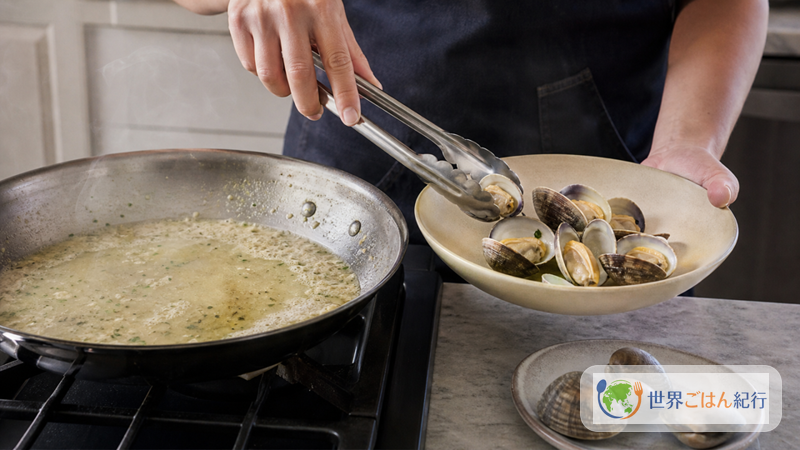
Once the heat is on, this dish is quick. Prepare the purging, the garlic, the coriander, the lemon and the bread first, then light the burner.
Like the way you stop the egg with residual heat in Bacalhau à Brás, the decision to turn off the heat is the flavor in amêijoas too. The more you keep simmering "just in case" after the clams open, the more the flesh shrinks and the more salty only the broth becomes.
Where it goes wrong
Failures with clam dishes tend to mix ingredient problems with heat problems. Separate the causes and you can correct a lot the next time.
| Problem | Cause | Fix |
|---|---|---|
| Sand remains | Purging time too short, or a deep container left clams piled up | Spread them in a shallow container and rest them in 3% salt water in the dark |
| Bitter garlic | Oil too hot, or minced garlic burned | Start from cold oil over low heat and bring out the aroma slowly with sliced garlic |
| Clams shrink | Kept cooking after they opened | Take them out as they open and return them to the broth at the end |
| Broth too salty | The clams were very salty, or the broth was reduced too far | Add 2 tbsp water and balance with lemon and bread |
| Herb turns black | Leaves were heated too long | Add only the stems first and add the leaves after turning off the heat |
| Some clams do not open | They were dead or past their freshness | If they still do not open after 30 seconds more, discard them without eating |
If you make it without white wine, water alone turns out a little flat. Mixing 1 tsp white wine vinegar into 80ml water adds a rounded acidity that lemon alone does not give, although the aroma is different. Using sake moves it toward steamed-in-sake clams, but adding coriander and lemon at the end brings it back toward Portugal.
If you do not like coriander, you may use flat-leaf parsley. But swapping in mitsuba or shiso makes it a different dish. Shiso is strongly aromatic and pulls the clam broth toward Japanese. To get closer to the local taste, mixing in even a little coriander is the shortcut.
How it is eaten locally and what to serve with it
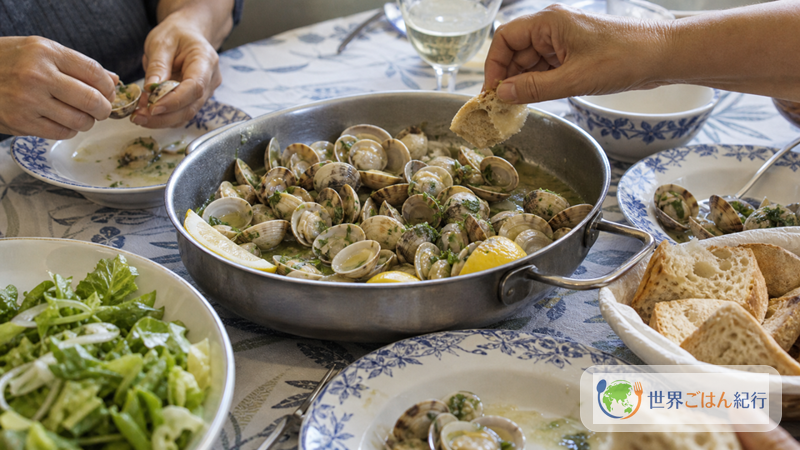
In Portugal, amêijoas is more often a dish placed at the start of a meal than a main course on a large platter. You do not tidy it up with knife and fork. You pick up the shells with your fingers, tear the bread, and scoop the broth from the bottom of the dish. It is not a dish meant to look refined, but one that loosens the table conversation a little.
Even in a local-style version using white wine and coriander, such as Makro Portugal's recipe, the steps are short and the cooking of the clams is not long. You make the aroma with garlic and oil, and finish once the clams open. That brevity is why a restaurant can send out many plates.
To build a meal, it holds together better with a green salad, a soup and bread than with a heavy meat dish beside it. When you serve it with Piri-Piri Chicken, make the chicken the star and keep the amêijoas to a small starter. On a day you want to continue with the scent of the sea, comparing it with Spain's Fideuà shows the lightness of seafood without rice or noodles.
| Occasion | Pair with | Why |
|---|---|---|
| Weeknight dinner | Baguette, leafy salad, sparkling water | The table comes together quickly and bread catches the broth |
| Weekend Portuguese menu | Caldo Verde (in Japanese), Bacalhau à Brás | A soup, an egg dish and a shellfish dish connect a Portuguese kitchen |
| A day you open wine | Olives, bread, light white wine | Saltiness and acidity work as a starter |
| Eating with children | Replace the wine with water and vinegar, no chile | Keeps the aroma while avoiding alcohol and heat |
Storage and reheating
It is best freshly made. Left a long time in the shell, the flesh toughens and the broth clouds. If there are leftovers, take the meat out of the shells right after eating, move it with the broth to a shallow container and refrigerate. The guide is until the next day.
When reheating, rather than heating it hard in a microwave, warm it over low heat in a small pot or skillet. Turn off the heat just before the broth bubbles, return the meat and warm it for only 30 seconds, and it shrinks less. Do not eat anything left at room temperature for a long time, anything with an off smell, or anything mixed with clams that did not open.
I do not recommend freezing. The clam meat toughens and the coriander aroma fades. If you want to make ahead, stop at the purging and the prepping of the aromatics, and steam just before eating; it will be much better.
Frequently asked questions
Can I make it with ordinary supermarket clams?
Yes. Even if they are smaller than the local clams, they come out delicious as long as you do not overcook. Because the meat is small, the key is to take them out early once they open.
Can I make it without white wine?
Yes. Substitute 80ml water and 1 tsp white wine vinegar. Sake also works, but the aroma moves toward sake-steamed clams, so make the final lemon and coriander a little stronger.
What if I do not like coriander?
You can substitute flat-leaf parsley. The local character, though, lies in the green scent of coriander. Even if you dislike it, put a small amount of stems into the oil and use parsley for the leaves, and it becomes easier to eat.
Can I eat clams that did not open?
No. Discard any that do not open after 30 more seconds during cooking. Prying them open makes it impossible to tell which clams were not fresh.
Can I make it with frozen clams?
Frozen clams in the shell work. Put them in the pan without thawing and raise the white wine slightly to 120ml. Frozen shucked clams give a weaker broth, so it is more reasonable to think of that as a garlic-flavored small plate than as a clam dish.
Sources
- VisitPortugal - Traditional Portuguese Recipes: Amêijoas à Bulhão Pato
- Makro Portugal - Amêijoas à Bulhão Pato
- U.S. FDA - Selecting and Serving Fresh and Frozen Seafood Safely
- Ministry of Agriculture, Forestry and Fisheries of Japan - Information on shellfish toxins
- Wikipedia - Amêijoas à Bulhão Pato