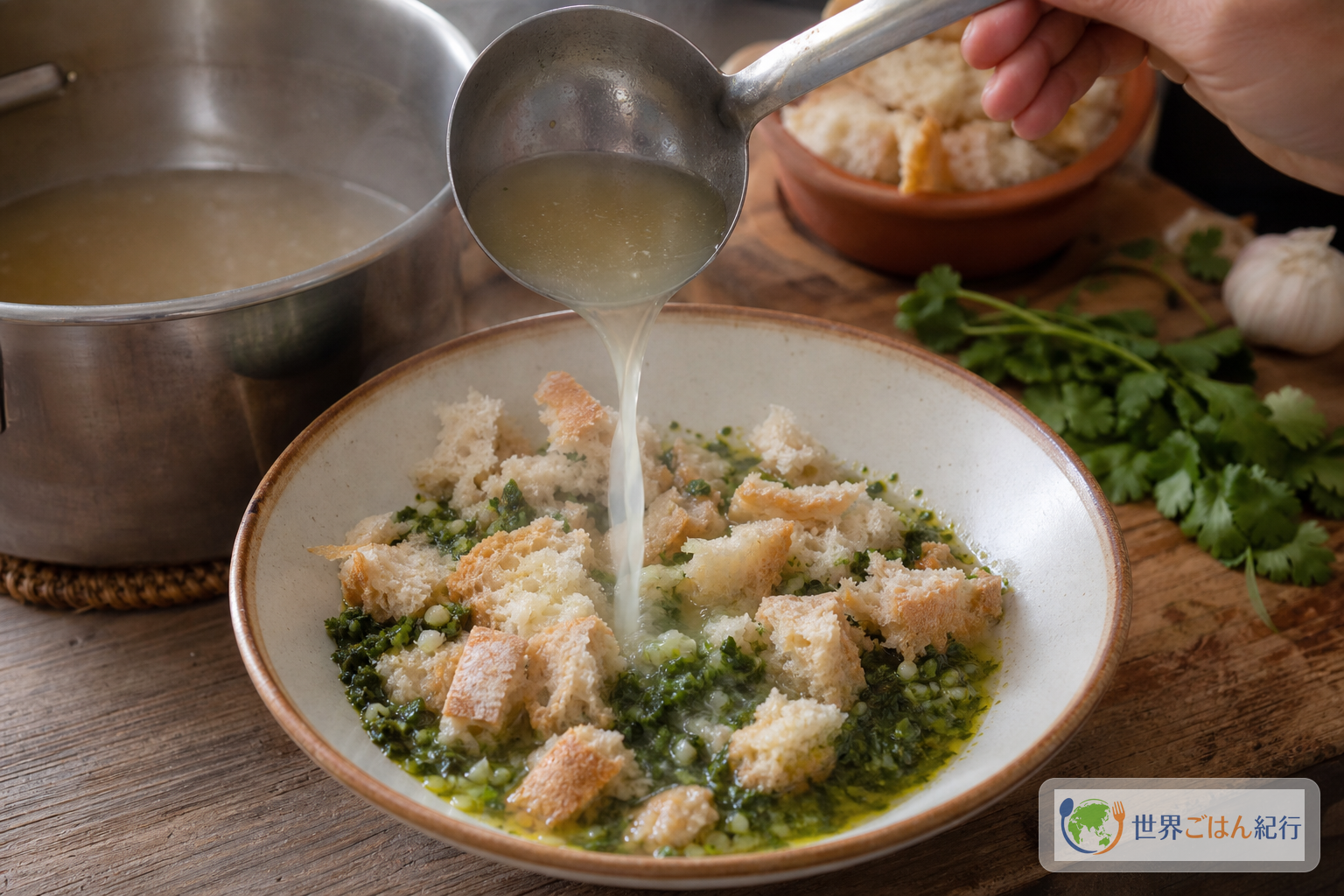
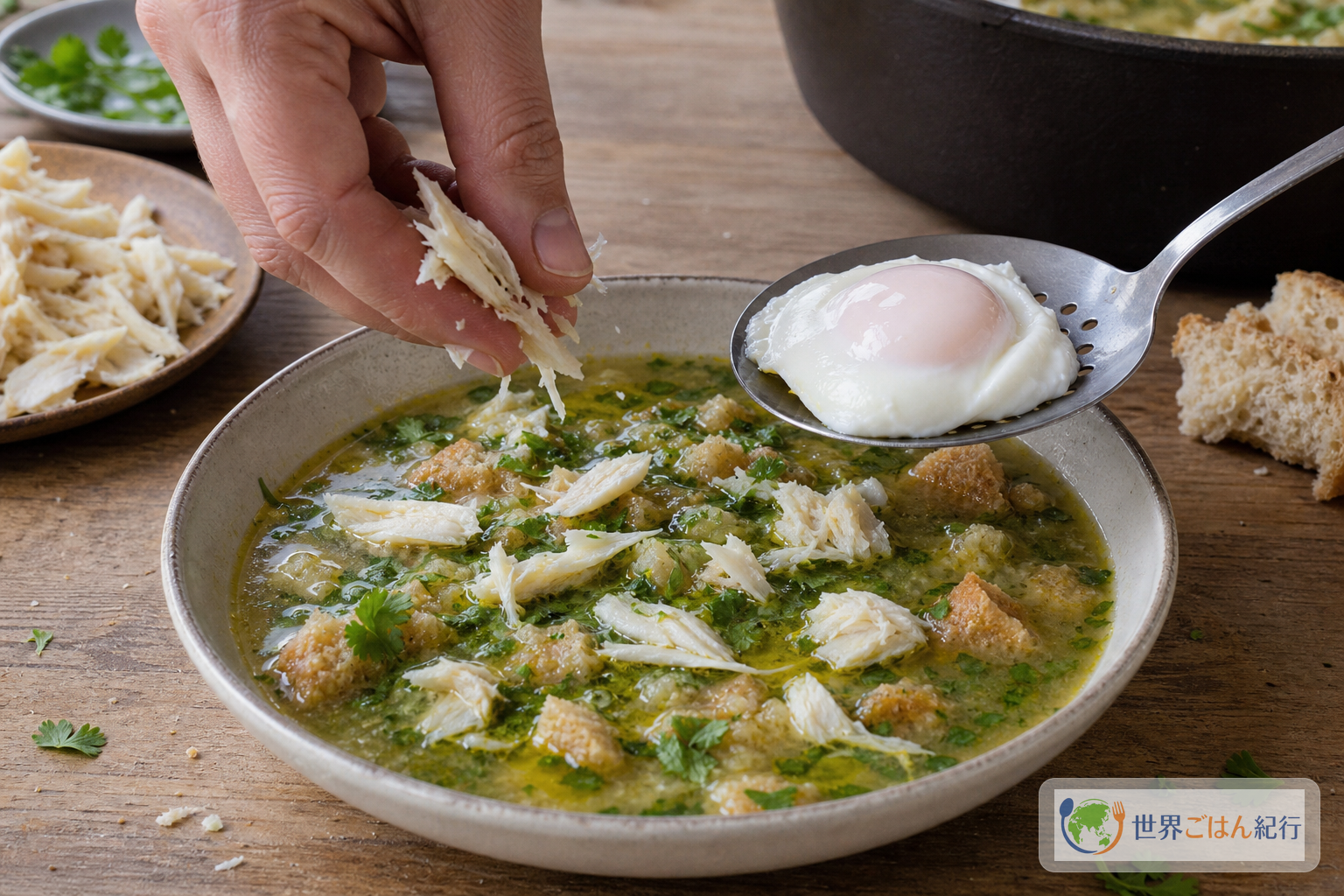
Bringing hot fragrance back to stale bread
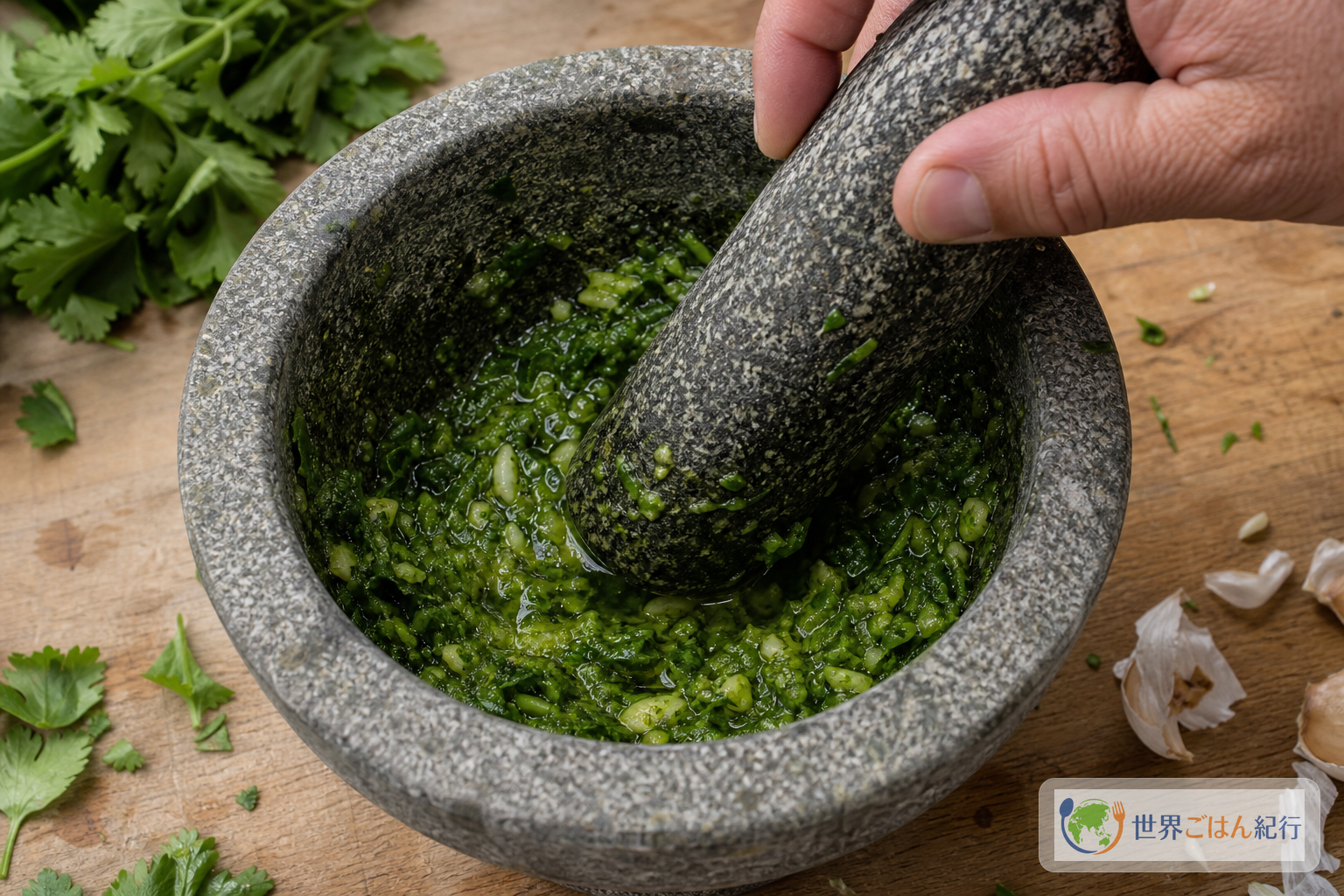
Tear yesterday's bread by hand and the white crumb inside is just a little dry, leaving a fine dust on your fingers. Then comes the sound of garlic and coarse salt being crushed in a mortar. The moment the cilantro goes in, a green aroma rises, and olive oil glistens slowly at the bottom of the stone. The cooking happens not in the pot but in the bowl. That feeling is what makes açorda so interesting.
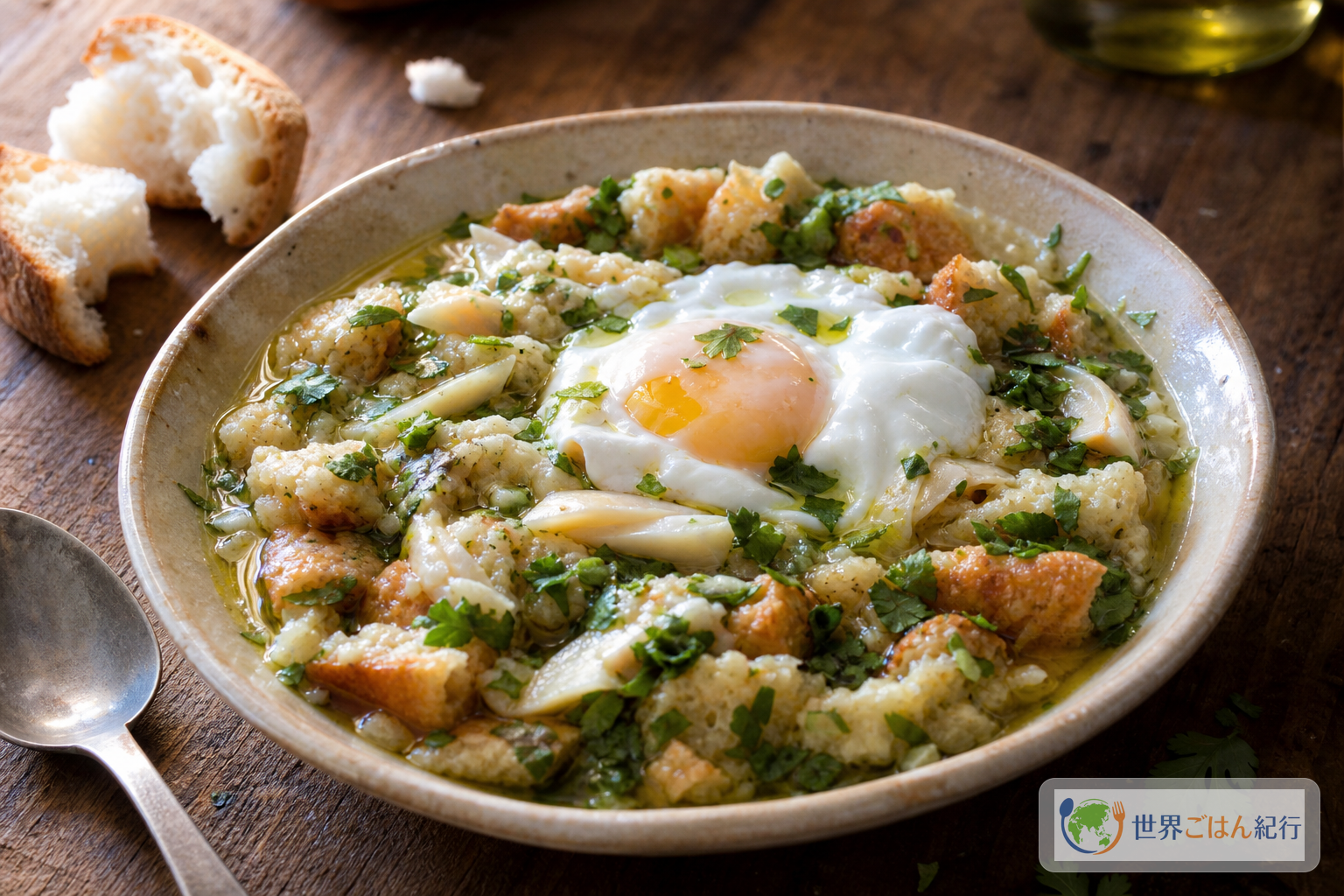
Açorda is a Portuguese dish in which hot broth is poured over that fragrant paste, bringing stale bread back to the table. Açorda à alentejana, from the Alentejo region in particular, is less a bread porridge stewed to mush in a pot than a soup in which the bread soaks up broth right in the bowl. Some edges of the bread remain, the aromas of garlic, cilantro and olive oil arrive first, and finally salt cod and egg add the weight of a proper meal.
Among Portuguese dishes, caldo verde (in Japanese), with its potatoes and kale, is a soup made in the pot, while bacalhau à Brás (in Japanese), salt cod scrambled with eggs, is a plated dish. Açorda sits somewhere in between: heat made in the pot is carried to the bowl on the table, where the dish is finished.
When you make it in a home kitchen, what matters more than finding Portuguese bread is not rushing the bread. Pour hot broth all at once over soft, freshly baked bread and it turns gluey before the aroma has a chance to come through. Slightly dry bread, coarsely crushed garlic, broth that is hot but not boiling. Layer them in that order, and although it looks humble, the fish aroma rises from the bottom as soon as your spoon goes in.
Don't dissolve the bread completely. Aim for bread that softens as it absorbs the hot broth while keeping some edges here and there. Cilantro defines the Alentejo style, so even if you're not a fan, don't swap all of it for parsley; try using half the cilantro and the regional character will still come through.
Background: the Alentejo table and regional variations
What makes açorda interesting is not luxurious ingredients but how it handles leftover bread. The Alentejo is a largely inland region of southern Portugal, often associated with olive groves, wheat fields and cork oaks. Unlike the coast, where seafood takes center stage, everyday meals here rest on things that keep well: bread, olive oil, garlic and herbs. Rather than throwing out stale bread, reviving it with hot water or broth is not only thrift; it's kitchen wisdom that respects bread as the staple.
The version known locally as açorda à alentejana is built not on stewing bread down in a pot but on placing bread in a bowl and pouring hot water or broth over garlic, cilantro, coarse salt and olive oil crushed in a mortar. Some households add an egg, and some tables pair it with salt cod. Cilantro is pronounced in the Alentejo, while elsewhere in Portugal and in restaurants it can become a more seafaring dish like açorda de marisco, with a rich broth of shrimp, clams and other shellfish. Migas (in Japanese), a bread dish found in Spain and Portugal, is usually bread fried or crumbled and eaten more like a side; açorda differs in that the bread soaks up hot liquid.
The beauty of this dish is that it keeps a few ingredients from looking like a meager meal. Bread alone is dry. Garlic alone is harsh. Cilantro alone is too green. Add hot broth and oil, let the egg yolk run a little, and what comes forward is warmth rather than austerity. Dishes that use stale bread exist all over the world, but açorda doesn't hide the old bread; it returns it to the center of the table by letting it soak, letting it perfume, and letting it break down just a little.
To recreate it at home, start by choosing the bread. Rather than sweet sandwich bread, a baguette, pain de campagne or a salty, crusty loaf works best. If you can find bacalhau (salt cod), the aroma will be closer, but desalting times are hard to predict, so for a first attempt pre-desalted bacalhau, lightly salted cod, or fresh cod with added salt is fine. The things to protect: perfuming the garlic and herbs in oil, reviving the bread with hot broth, and not boiling the eggs hard. Keep those three, and you'll get close to the character of an Alentejo table without having to collect every imported ingredient.
Portion sizes shift a little when you bring a Portuguese tavern dish to a home dinner table. In the Alentejo, one serving can fill a large deep plate, but at home 60 g of bread per person is plenty for a main and about 40 g for a light starter. On days you use salty fish, don't fill the bowl with broth all the way up; stop when the top half of the bread still looks a little dry as you start eating, and it won't feel heavy by the end.
| Local name | What's on the plate | How to approach it at home |
|---|---|---|
| Açorda à alentejana | Centered on garlic, cilantro, bread and egg | Start with this one. Don't over-pour the broth |
| Açorda de bacalhau | Adds the salt and aroma of salt cod | Adjust saltiness with pre-desalted, lightly salted or fresh cod |
| Açorda de marisco | Shrimp and shellfish broth comes forward | Good for using broth left from a shellfish dish the day before |
| Simple home version | Stale bread revived in hot water | Rather than adding more toppings, take care with the paste |
What gives açorda its character
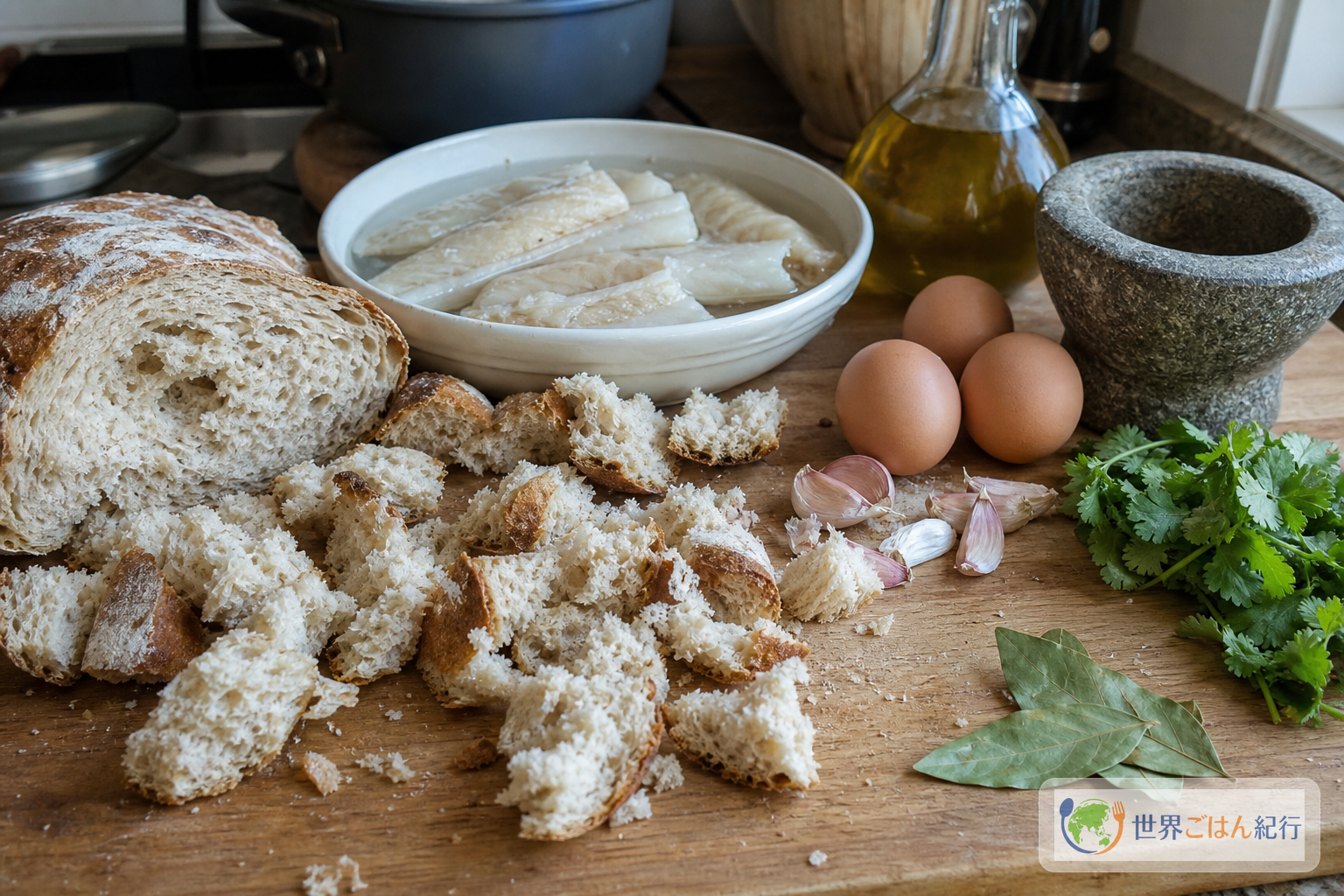
Because açorda uses so few ingredients, it's easy to see which one, if left out, turns it into a different dish. Rather than chasing Portuguese ingredient names, it's more reliable to keep the roles of bread, aromatics, oil, broth and egg, and substitute within them.
| Role | Traditional core | Practical choice |
|---|---|---|
| Bread | Country bread at least a day old and firm | Baguette or pain de campagne. Sweet sandwich bread is a last resort |
| Aromatics | Garlic, cilantro, coarse salt | If you dislike cilantro, swap half for flat-leaf parsley |
| Oil | Fragrant olive oil | It's also used to finish, so don't use a cheap cooking-only oil |
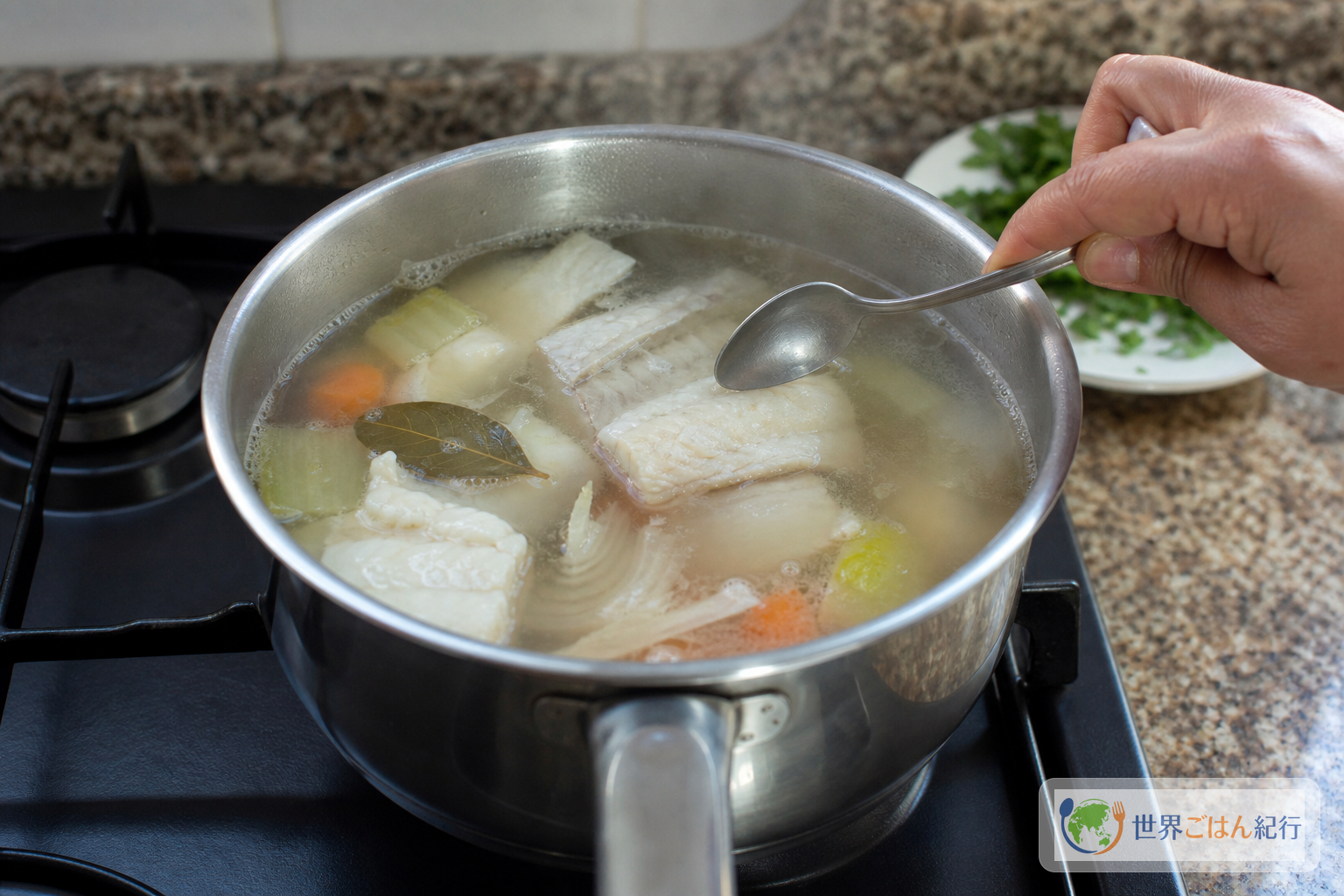
| Broth | Water, fish broth, salt cod cooking liquid | Liquid from poaching lightly salted cod works. If it's thin, adjust with salt |
| Protein | Egg, salt cod, seafood | Egg and cod are plenty for a first try. Adding shrimp makes it more seafaring |
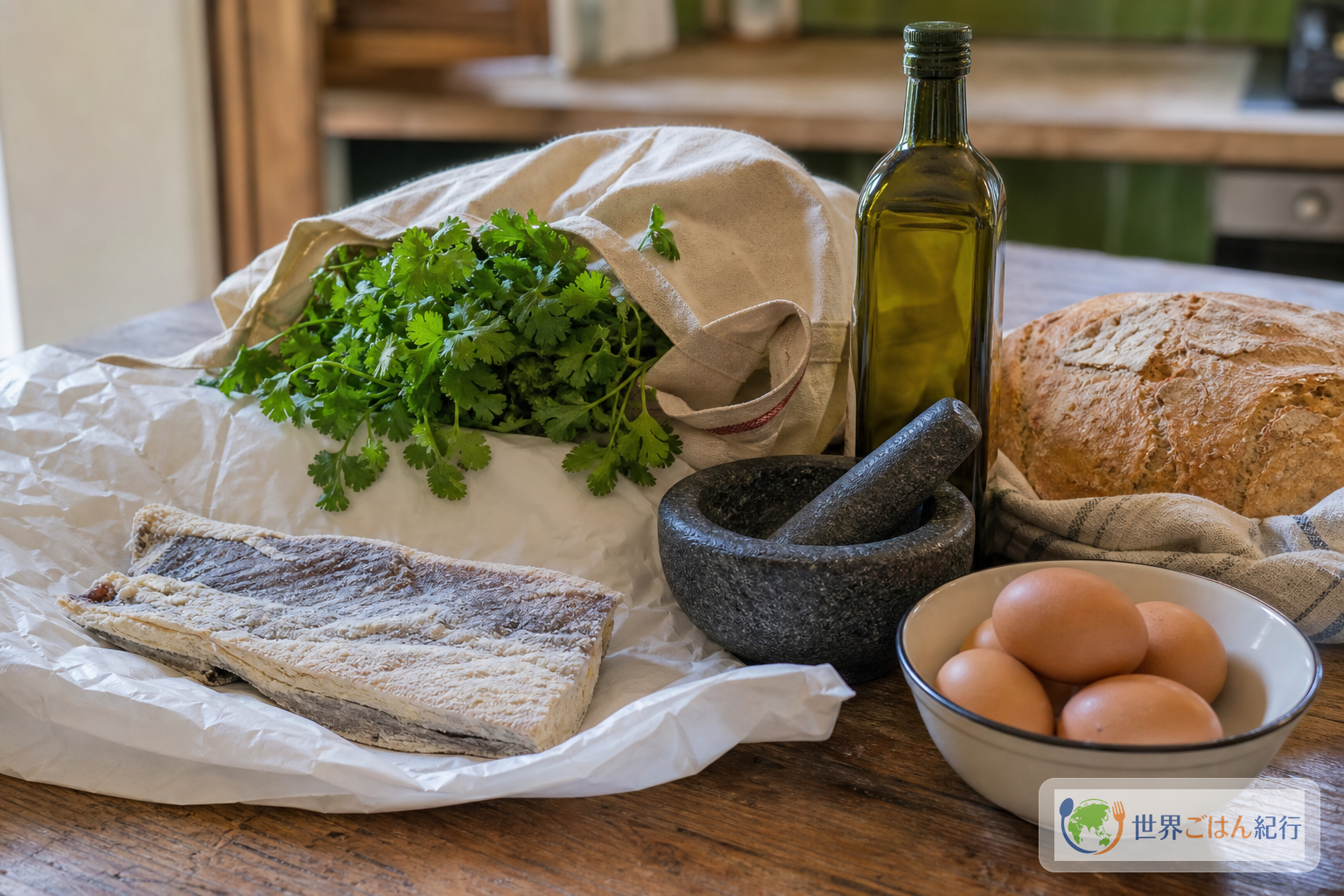
Slightly dry bread is easier to work with than fresh. With soft, freshly baked bread, the moment hot broth goes in it turns gluey and the green aroma of the paste goes flat. If you're making it the day you buy the bread, slice it and leave it at room temperature for about 1 hour, or dry it in a 150°C (300°F) oven for about 8 minutes before using.
Decisions to make before you start
Rather than collecting everything exactly by the ingredient list, açorda is less likely to fail if you decide on a few branches to suit your kitchen that day. The questions are how dry the bread is, how salty the fish is, and how strong the cilantro should be. Leave them vague and the same quantities can fail in three different ways: "the bread dissolved," "it's too salty," or "all I taste is herbs."
For bread, a day-old baguette is the easiest. The crust is a little hard, and when torn the crumb still has some white spring. If it's dried all the way to a rusk, the center stays hard even after soaking up broth; freshly baked bread, on the other hand, turns to porridge at once. If you're making it the day you buy the bread, cut it thick and dry it lightly, letting only the surface moisture escape.
For fish, the approach changes with pre-desalted bacalhau, lightly salted cod or fresh cod. Bacalhau gives the aroma of dried fish but tends to make the broth salty. Lightly salted cod is easy to handle but lighter in savory depth. Fresh cod makes salt easy to control, but the lingering dried-fish note that feels so Portuguese is weaker. If you're planning to make bacalhau à Brás (in Japanese), try pre-desalted cod once and you'll see how much salt cod underpins Portuguese cooking.
Tasting once right after poaching the fish isn't enough. Take about 1 tsp of the broth alone, let it cool a little, and taste. Hot liquid dulls your sense of salt, so if it tastes "just right" over the pot, it tends to come out strong once the bread soaks it up. Aim for broth that's a touch too thin to drink on its own but seems like it will balance once the bread and egg are added.
| Option | Good for | How to adjust |
|---|---|---|
| Pre-desalted bacalhau | Wanting the aroma of dried fish | Always taste after making the broth, and don't add salt until the very end |
| Lightly salted cod | Reducing the risk of failure on a first try | Soak in water for 20 minutes. If the broth is light, reduce it for just 5 minutes |
| Fresh cod | Keeping salt down | Start with 1/2 tsp salt in 900 ml water and adjust at the end |
| Half the cilantro | Family members who dislike herbs | Use 10 g in the paste and add parsley to finish to keep the green note |
| Drying the bread | Using freshly bought bread | 150°C (300°F) for 8 minutes. Don't brown it; just remove moisture |
Cilantro divides people. But swap all of it for parsley and açorda suddenly drifts toward "bread soup in fish broth." For a first try, keep half, crush the stems with the garlic and salt, and scatter a few leaves on top to finish. That's a good compromise. Sealing the strongest-smelling parts into the paste softens the green bite when you chew a leaf at the table.
Where it sits on the table: a dish of bread, not soup
Described in English, açorda tends to become "bread porridge" or "bread soup," but eating it isn't just about the liquid. There's broth at the bottom of the bowl. Still, the star is bread softened by heat. Rather than spooning up soup, you let garlic, cilantro, salty fish and egg yolk soak little by little into the white crumb. Understand that first, and you're less likely to pour in too much broth and end up with something like rice porridge.
The Alentejo-style açorda à alentejana is a dish close to field work and the home kitchen. Stale bread, herbs, garlic and olive oil come first; egg and fish add substance to make it a meal. The seafood açordas found in Lisbon and seaside restaurants, by contrast, put shrimp and shellfish broth forward and sometimes blend the bread more fully in the pot. Rather than asking which is correct, it's easier to see it as an inland bread dish and a coastal seafood dish showing different faces under the same name.
| Style | Center of gravity | How to approach it at home |
|---|---|---|
| Alentejo style | Bread, garlic, cilantro, egg | Don't over-pour the broth; keep some edges on the bread |
| With salt cod | Bread, salty fish, egg | Taste the desalting first and don't add salt until the end |
| Seafood style | Shrimp, shellfish, rich broth | Make use of shellfish juices, as in amêijoas (in Japanese) |
| Quick home style | Lightly salted cod, baguette, herbs | Don't chase bacalhau too hard; protect the bread's dryness and the broth temperature |
On a menu, açorda is more filling than a pot soup like caldo verde (in Japanese), yet not as heavy as bacalhau à Brás (in Japanese) with its eggs and potatoes. If you start with shellfish, serve açorda in smaller bowls; if it's the main, put a salad alongside. To add meat, keep piri-piri chicken (in Japanese) to a small portion so bread and oil don't pile up. Especially when you want a whole Portuguese spread in one evening, treat açorda not as "a small plate to use up bread" but as the dish that sets the warmth of the table.
The last-minute sequence makes the dish
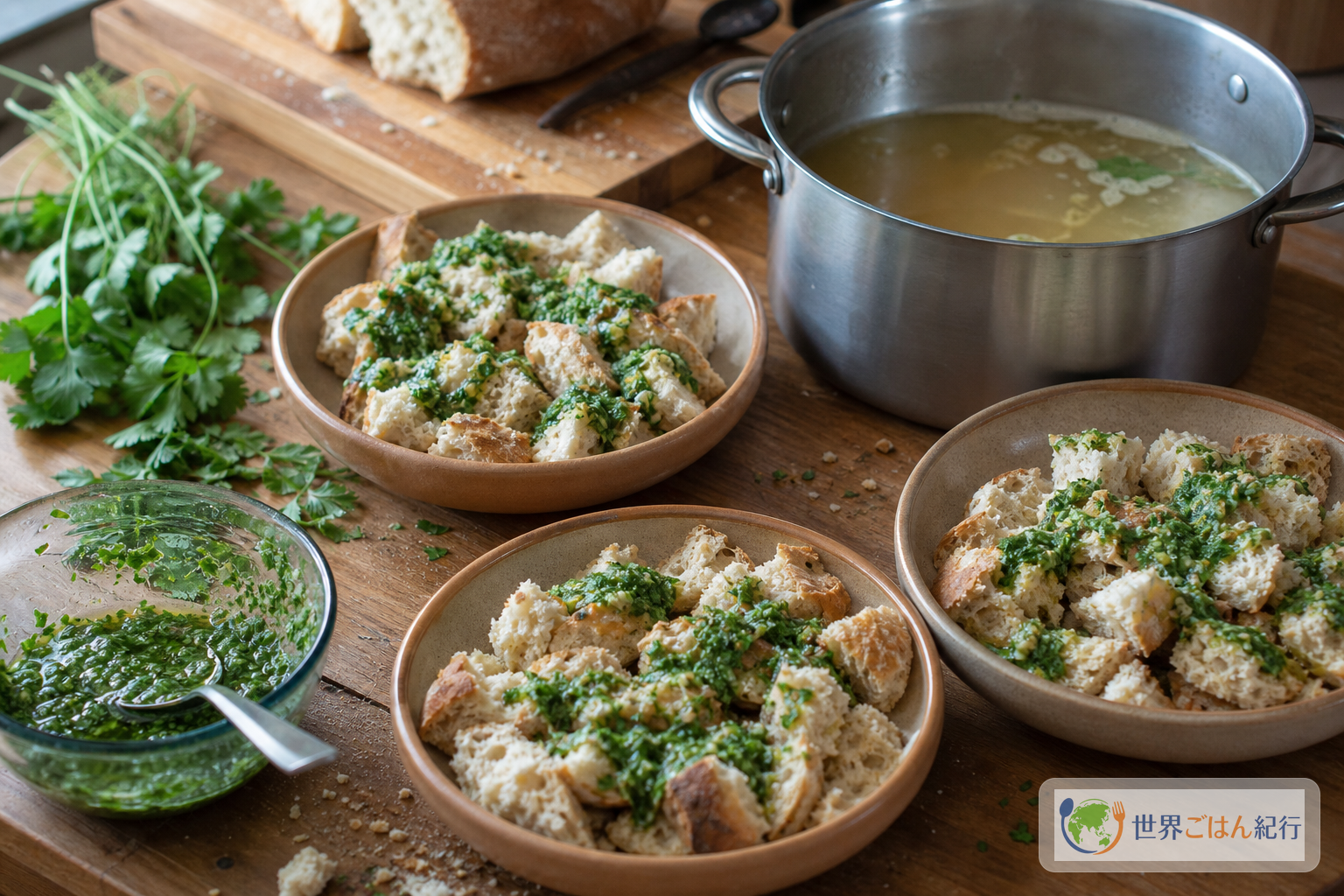
Açorda isn't a make-ahead pot dish; it's finished in the bowl just before eating. So in the kitchen, don't bring everything together at once. Hold the broth, bread, paste and eggs each one step short of done. Three minutes before serving, reheat the broth, put the paste on the bread, pour in the hot broth, then top with egg and fish. That short sequence keeps the edges of the bread and the aroma of the herbs.
If you're unsure of the timing, warming the bowls first makes it easier. Fill deep bowls with boiling water, leave for 1 minute, pour it out, then add the bread. If the bowls are cold, the temperature drops the moment the broth goes in and the center of the bread tends to stay hard. On the other hand, pouring in furiously boiling broth drives off the green of the cilantro and tightens the eggs. Aim for around 90°C (194°F): steaming, but with a calm surface.
On days when your family's taste in herbs differs, don't make the paste all in one batch; make half of it more concentrated. Bowls for herb lovers get more paste; for those who don't like herbs, put garlic and olive oil in first and scatter just a few leaves on top. Rather than forcing the same greenness on everyone, keep the broth and bread consistent and adjust the herbs bowl by bowl.
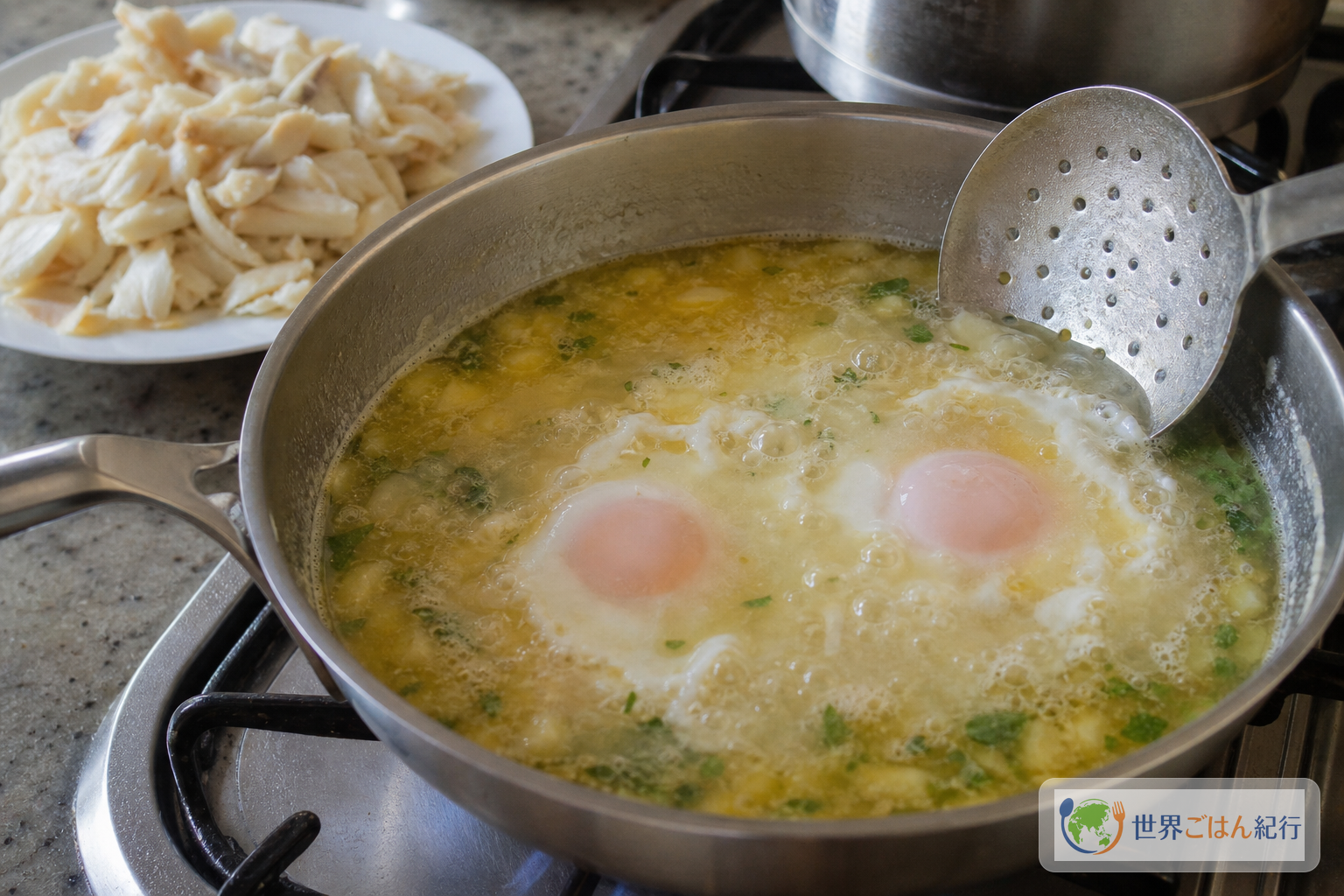
Eggs dropped in straight from the refrigerator lower the broth temperature and the whites tend to spread. Leave them at room temperature for just 10 minutes, crack each into a small dish and slide it into the pot, and the yolks stay in place more easily. On days you don't want to risk it, you can poach the eggs in a separate pot and place them on top. It's a little removed from the rustic original, but you still get the pleasure of breaking the yolk at the table.
| Last-minute check | Signs it's going well | How to fix it |
|---|---|---|
| Warming the bowls | The bowl feels faintly warm to the touch | If it cools, refill with boiling water and wait 30 seconds |
| Broth temperature | Steam rises but the surface is calm | If it boils, turn off the heat and wait 1 minute |
| Amount of bread | The top pieces poke out a little | If there's too much bread, add broth 1 tbsp at a time |
| Amount of herbs | A green aroma rises just before eating | If it's too strong, add a little bread rather than lemon |
| Egg firmness | Whites set, yolk wobbles when pressed | If it's set, don't break the yolk; add a few drops of lemon to lighten it |
Ingredients (serves 4) and substitutes
This dish contains wheat, eggs and fish. Salt content in salt cod and lightly salted cod varies widely by product, so always taste the broth after making it and adjust the salt at the end. If you are on a sodium-restricted diet, follow the advice of your doctor or dietitian.
Shopping: focus on salt cod, oil and a mortar
Bread, eggs, garlic and herbs are easy to find at any supermarket, and the ingredient list says all you need. If you're shopping further afield, focus only on what changes the character of the dish. For açorda, that means bacalhau, a fragrant olive oil, and a mortar for crushing garlic and herbs.
Salt cod gives a savory depth of dried fish rather than a plain white-fish soup. Choosing pre-desalted cod makes the saltiness of the broth easier to read, even on a first try.
Olive oil here isn't a cooking oil but an aromatic seasoning. Since it's drizzled on at the end, choose one with a green aroma and a little peppery bite, and the bread won't feel heavy.
A mortar isn't essential, but for açorda, crushing garlic and salt against stone gives a fuller aroma than simply chopping the herbs. A Japanese suribachi (grinding bowl) also works.
Making the most of what you bought
Bacalhau, a fragrant olive oil and a mortar can seem like a lot to buy just for açorda. But if you plan to keep cooking Portuguese food, they earn their place in the weekend kitchen. After using salt cod for broth, the flaked flesh can go into egg dishes or cold salads. The olive oil is a seasoning for adding aroma just before eating, not a frying oil. The mortar, a tool for crushing garlic, herbs and coarse salt, is just as useful in Spanish and North African cooking as in Portuguese.
You don't need to buy everything in large sizes the first time. Choose a small pack of pre-desalted bacalhau, use half for açorda and the rest for bacalhau à Brás (in Japanese), and you can practice reading the saltiness in the same week. For olive oil, choose one whose bitterness or pepperiness doesn't bother you when poured straight onto bread. The mortar can be small, as long as it's wide enough to crush three cloves of garlic and the herbs.
What açorda teaches is not just diluting the salt of the cod with water but absorbing it with bread, egg and oil. Once you have that feel, the same salt cod can go in different directions. Round it out with eggs and potatoes and you have bacalhau à Brás; make it cold and bright with tomato and peppers and you have Catalan esqueixada (in Japanese); scoop up shellfish juices and garlic with bread and you're close to amêijoas à Bulhão Pato (in Japanese). Trying one ingredient with different cooking methods turns what you bought from "a one-off curiosity" into something that carries naturally into the next meal.
| What you bought | Easy next dishes | How to use it up |
|---|---|---|
| Pre-desalted bacalhau | Bacalhau à Brás (in Japanese), esqueixada (in Japanese) | Try it simmered, then sautéed, then dressed cold |
| Olive oil | Amêijoas (in Japanese), pan bagnat (in Japanese) | Judge it by its aroma as a finishing oil rather than for cooking |
| Mortar | Moroccan zaalouk (in Japanese), calçotada (in Japanese) | Use it to coarsely crush garlic, herbs and nuts |
| Stale bread | Another round of açorda, the bottom of a shellfish dish | Don't soak it in broth ahead; save it dry for the next day |
Common pitfalls
| Problem | Why it happens | Fix |
|---|---|---|
| The bread turns into dumpling-like lumps | Soft bread cut too small | Tear crusty bread into larger pieces and pour the broth gradually |
| The garlic tastes harsh | Not crushed enough, or too much | Remove the germ and crush it first with coarse salt |
| The eggs are hard | The broth boiled | Keep the heat low and lift the eggs out as soon as the whites set |
| Too salty | The bacalhau wasn't desalted enough | Dilute the broth with water and don't add salt until the end |
| The aroma falls flat | Cilantro heated too early | Add it in two stages: in the paste and to finish |
The most common mistake at home is simmering the bread like a rice porridge. Açorda isn't finished in the pot; it's a dish in which the bowl receives hot broth. Putting the bread in the pot and simmering it seems easy, but the aroma of garlic and cilantro is lost and the texture turns monotonous. For your first try, place the bread in the bowl and pour the broth over it.
If you use lightly salted cod instead of bacalhau, the broth will be lighter. Rather than compensating heavily with bouillon granules, use a slightly better olive oil and reduce the broth over low heat for just 5 minutes after poaching the fish; that keeps the rustic weight of Portuguese cooking.
Storage and serving
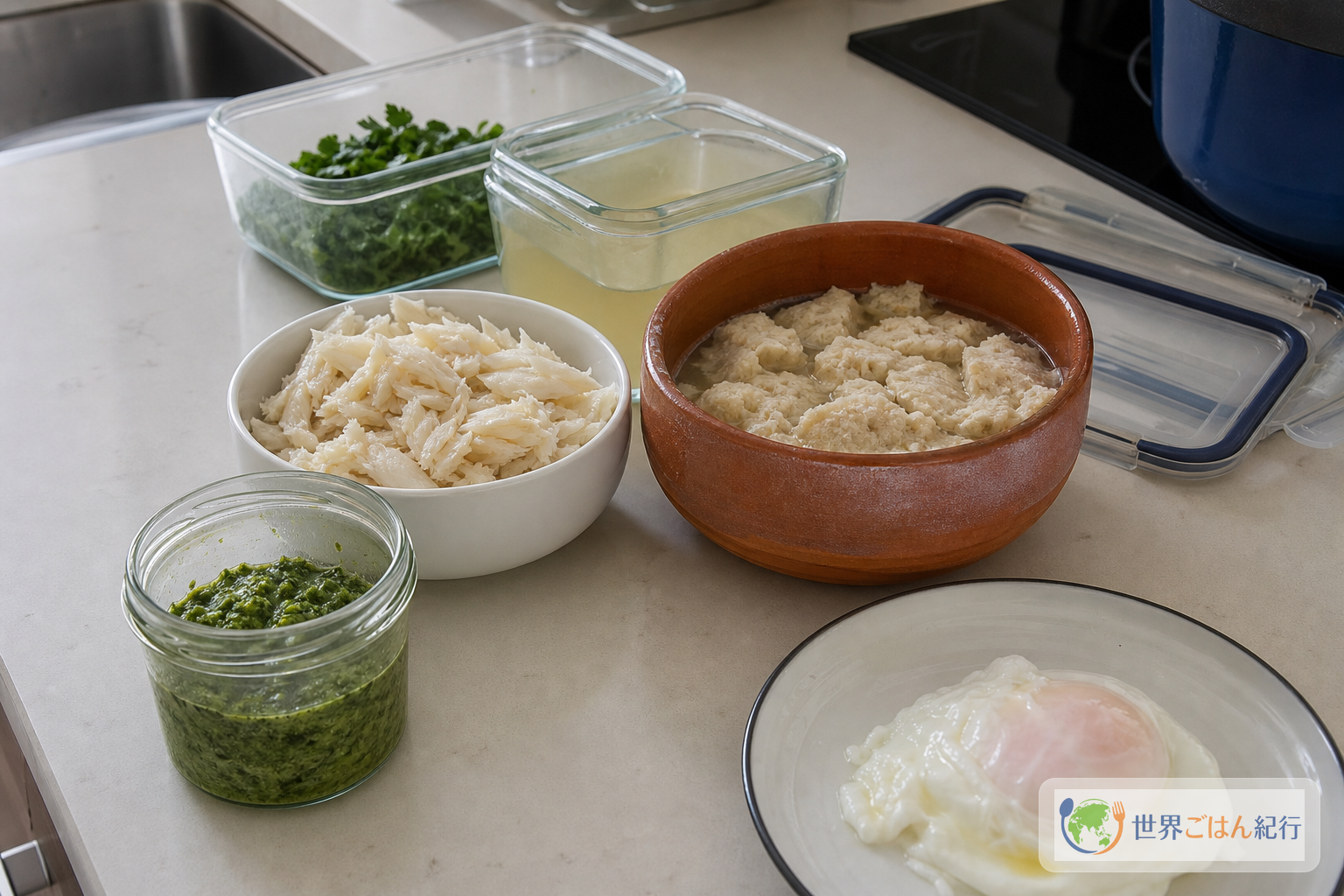
Açorda is best right after it's made. The bread keeps absorbing broth, so if you refrigerate it already assembled in the bowl, by the next day it's more gluey than fragrant. If you make it ahead, keep the broth and fish, the paste, and the bread separate, refrigerated, for up to 1 day.
To reheat, warm only the broth in a pot over low heat and turn it off once it simmers. Put the bread and paste in a bowl, pour over the hot broth, then add the fish. Don't store the eggs; poaching them just before eating is safer and keeps the yolks runny.
Keep the fish broth refrigerated for about 1 day. If the aroma is weak the next day, add a few fresh cilantro stems to the reheated broth, turn off the heat, let it sit for 1 minute and strain. A garlic paste made ahead turns sharp, so crush it just before eating if you can.
If you're saving leftover bread for the next day, keep it sliced but not soaked, in a paper bag or a basket. If it dries out too much, mist just the surface lightly right before using and warm it in a 150°C (300°F) oven for 3 minutes. Soaking it through makes it gluey when the broth goes in, so only the surface needs reviving.
When eating, don't mix everything at the start; break the egg a little and spoon up the bread where the yolk has run. The flavor changes from the garlicky top, to the broth-soaked bottom, to the salty fish in the middle, so it's more fun not to stir it uniformly like a rice bowl. Rather than serving rice alongside, a tangy salad of tomato, cucumber and onion cleanly cuts through the weight of the bread and oil.
At the table, a shellfish dish like amêijoas à Bulhão Pato (in Japanese) connects through the same cilantro and garlic. If you want a meat dish too, piri-piri chicken (in Japanese), sharp with chili and lemon, goes well. For something cold and vegetable-based, a small glass of a tangy soup like Spanish gazpacho (in Japanese) cuts through the richness of the bread and oil.
FAQ
Can I make it if I don't like cilantro?
Yes. But swapping it all for parsley takes it well away from the Alentejo aroma. For a first try, use 10 g cilantro and 15 g flat-leaf parsley, and use only parsley leaves for the finish; it's easier to eat that way.
What can I use if I can't find bacalhau?
Lightly salted cod is the easiest substitute. If it's very salty, soak it in water for about 20 minutes before using. With fresh cod, add 1/2 tsp salt to the broth and taste and adjust at the end.
Can I use sandwich bread?
You can, but it tends to be sweeter and softer, and açorda's rustic character weakens. If you use it, keep the crusts, dry it in a 150°C (300°F) oven for 8 minutes, then cut it into 3 cm cubes so it holds together when it absorbs the broth.
What if I don't have a mortar?
Finely chop the garlic and cilantro with a knife, add the salt, and crush it on the cutting board with the flat of the blade. Then mix with the olive oil in a bowl. A blender also works, but it gets too smooth, so pulse a few seconds at a time to keep some texture.
Can I make a seafood açorda?
Yes. If using shrimp or clams, make broth from the shells first and return the meat at the end. The seafood aroma gets stronger, so use a little more cilantro, and a few drops of lemon keep it from feeling heavy.