A dish that waits for the moment the egg just barely sets
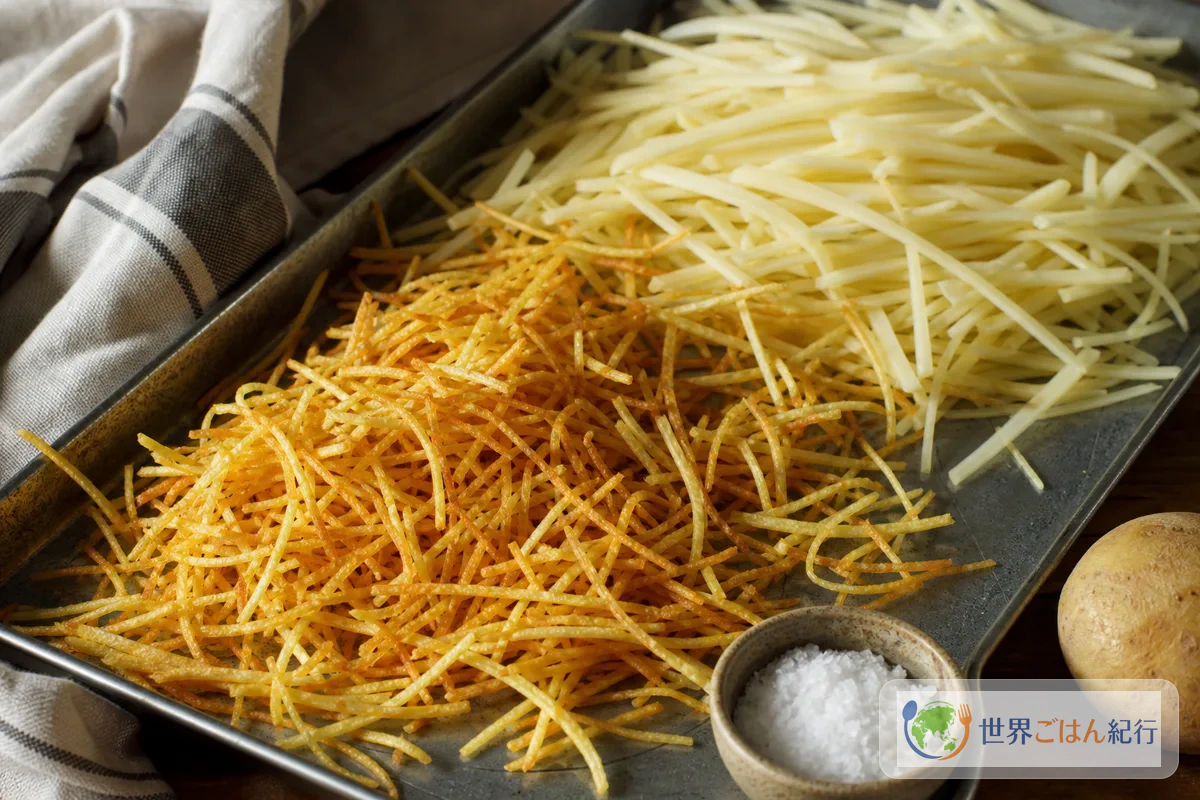
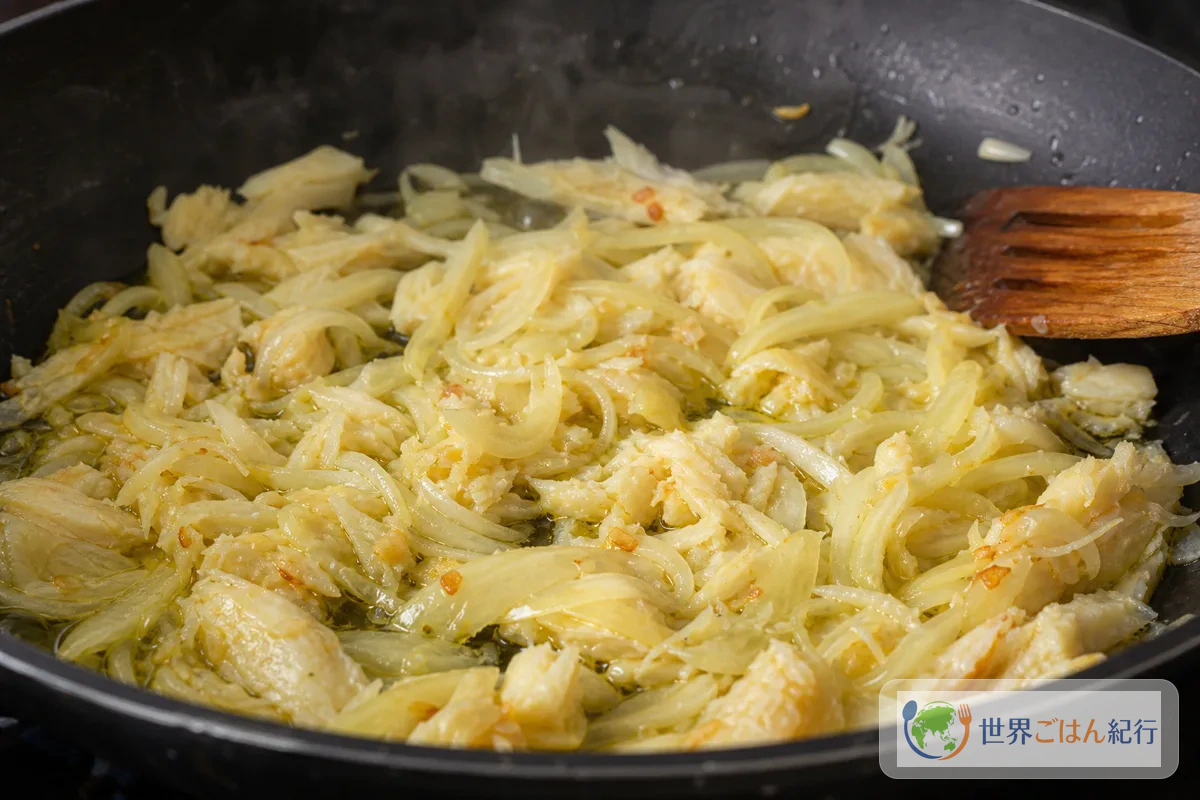
The sound of cutting potatoes thin gets finer on the board bit by bit. Slowly cook onions in olive oil and a sweet aroma rises in the kitchen. Then shred in desalted salt cod, and the smell of dried sea, unlike grilled or simmered fish, returns in a breath.
Bacalhau à Brás (Bacalhau a Bras) is, among Portugal's salt cod dishes, one that is easy to recreate in a home kitchen. Desalted salt cod, matchstick potatoes, onion, eggs. The ingredients look plain, but depending on where you stop the egg at the end, it becomes a restaurant flavor or a hard scramble.
If Caldo Verde (in Japanese) is the soup that warms a cold Portuguese night, bacalhau à Brás is a dish you set in the middle of the table and pick at with bread, salad and white wine. Though it shares the egg-and-potato pairing of Spain's Tortilla Española, the savor of salt cod and the saltiness of olives bring it much closer to Lisbon. On a day you want to try the aroma of Portugal with meat rather than fish, moving on to Piri-Piri Chicken, grilled with chili and lemon, gives a completely different energy at the same country's table.
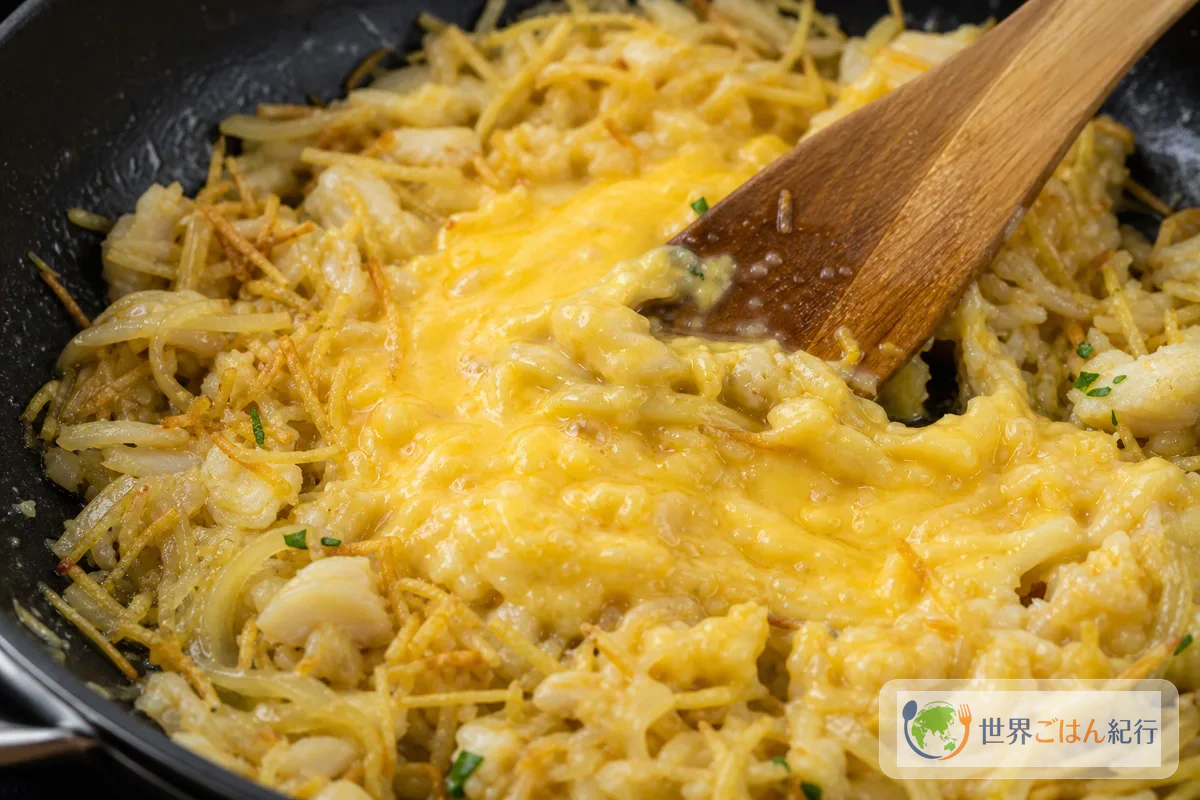
The egg is not set completely. Turn off the heat just before it is soft-cooked and finish so that the eggs thinly bind the potato and salt cod. The Portuguese "a Brás" is said to come from the name of Brás or Braz, a 19th-century Lisbon tavern keeper.
What is bacalhau à Brás?
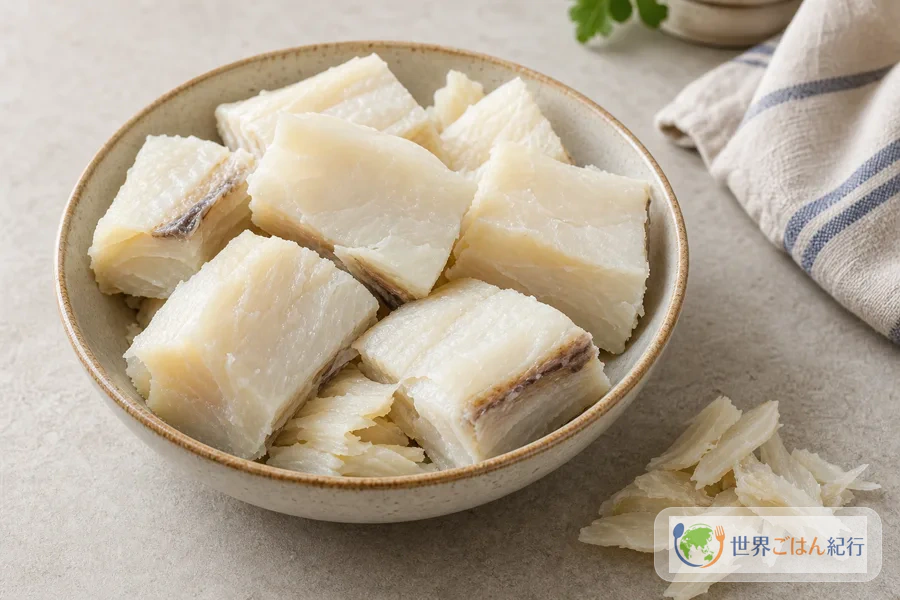
Bacalhau (bacalhau) is the Portuguese word for dried cod, especially salted and dried cod. In Portuguese home cooking, bacalhau is not an ingredient only for special days. It is desalted and then boiled, grilled, fried or combined with egg. It is an ingredient that crossed the sea as preserved food and took root in home kitchens.
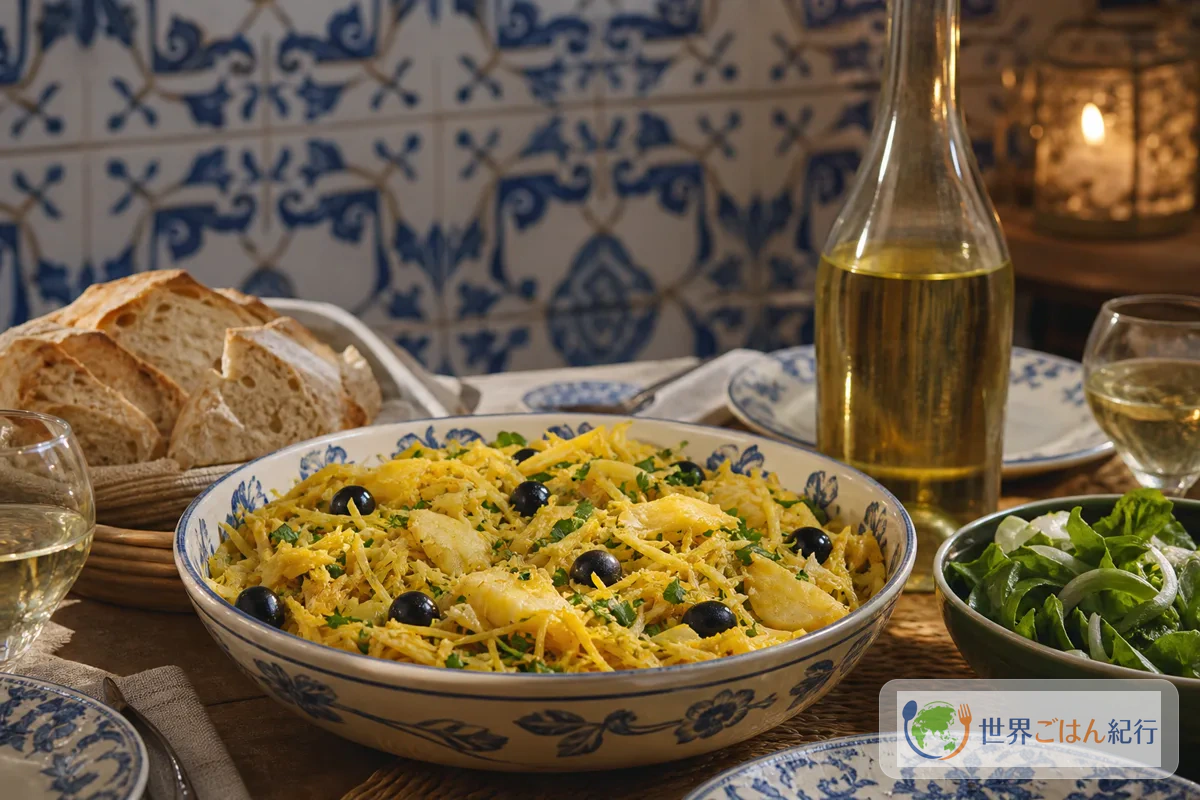
Bacalhau à Brás is a dish in which that salt cod is shredded fine, sautéed with onion, and bound with fried matchstick potatoes and egg. It is finished with black olives and parsley. It is yellow to look at, with white salt cod and black olives showing here and there, so it is plain yet brightens the plate. It is an unpretentious feast that might come out at a Portuguese tasca, a neighborhood eatery.
It is easy to confuse with similar dishes, so setting out the differences first makes it easier to cook.
| Dish | Main ingredients | Finish | Home-cooking note |
|---|---|---|---|
| Bacalhau à Brás | Salt cod, egg, matchstick potatoes | Everything bound with soft-leaning egg | Don't set the egg too hard |
| Bacalhau com Natas | Salt cod, potatoes, cream | Baked like a gratin | Heavy easily from the cream |
| Pataniscas de Bacalhau | Salt cod, flour, egg | A fried dish close to fritters | Heavy if the oil temperature is low |
| Tortilla Española | Egg, potatoes, onion | A thick omelet | No salt cod savor |
Portugal's salt cod culture is a food culture where northern fish, Portuguese salt and seafaring preservation technology came together. Cod caught in northern seas is preserved in salt to make it into a form that can be carried far. In kitchens in Lisbon and Porto, that ingredient met olive oil, egg and potatoes. The reason it has depth without flashy spices is that the salt cod itself has strong savor.
In the original Portuguese, it is sometimes written Bacalhau a Bras or Bacalhau a Braz. In other languages you see variants such as "Bacalhau à Brás." This article unifies on "Bacalhau à Brás" for readability.
Ingredients (serves 4) and substitutes
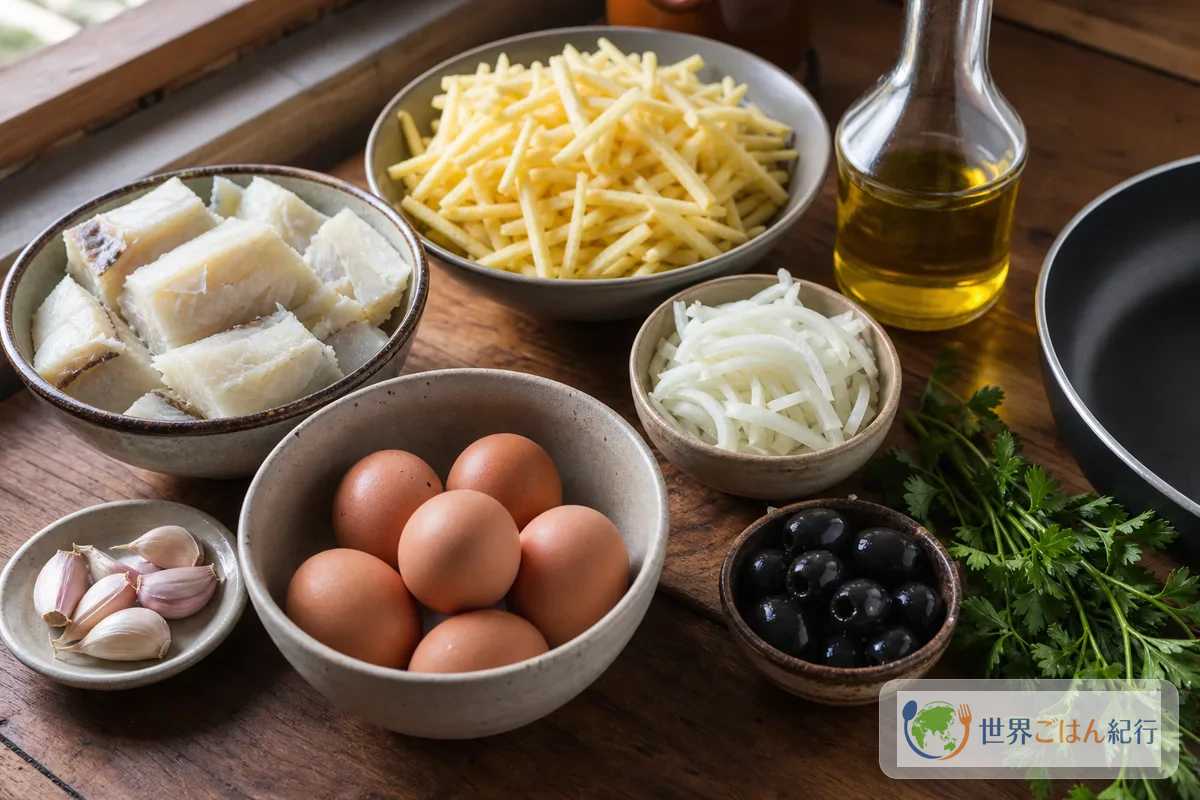
Real salted dried cod is best if you can get it, but many supermarkets outside Portugal rarely stock it. Looking in import food shops, Portuguese food retailers online, or the dried-seafood section of large stores is realistic. If it is hard, use lightly salted cod, salt cod, frozen cod or canned cod to bring it to a home version.
The biggest fork when buying bacalhau is "already desalted, or dried and salted." The dried type is soaked in water for roughly 12 to 36 hours depending on thickness, with the water changed several times. In a home kitchen, first tear off a small piece after 12 hours and taste. If it is a little milder than salted salmon, it can be used. Completely unsalting it blurs the whole dish.
For potatoes, Portugal often uses fine fried potatoes called batata palha. Elsewhere you can either cut potatoes into matchsticks yourself and shallow-fry them, or use store-bought matchstick potatoes. On busy days a store-bought one is fine. But the flavored snack type is too salty, and the egg loses.
This dish contains egg. The saltiness of salt cod, black olives and store-bought matchstick potatoes differs greatly by product. If you have salt restrictions, such as for high blood pressure, follow your doctor's or dietitian's instructions and always taste after desalting before using.
Salt cod, matchstick potatoes and olive oil are the foundation of the flavor. If you can find desalted fish and store-bought batata palha, you can concentrate on cooking the egg.
How to make it: stop the egg with residual heat
Bacalhau à Brás is decided in the last 3 minutes. Prepare all the ingredients before lighting the fire. If you go looking for the parsley after the eggs are in, the eggs will set in the meantime. Looking at it in the order of desalting, potatoes, onion and egg leaves few places to panic.
Just as with Paella Valenciana (in Japanese) from Spain, touching the rice or eggs too much destroys the texture. Fold few times and finish after turning off the heat. This restraint is the shortcut to a soft bacalhau à Brás.
Causes of hard eggs, saltiness and sogginess
With few ingredients, the causes of failure are clear. Just reviewing these three, egg, salt and potatoes, brings you much closer to the restaurant flavor.
| Failure | Cause | How to fix it |
|---|---|---|
| Eggs are hard | Eggs were added over high heat | Lower to low heat and turn off when half set |
| Whole dish is salty | Both the salt cod and the potatoes are salty | Taste after desalting and choose lightly salted store-bought potatoes |
| Soggy | Moisture remained in the potatoes | Wipe them dry after cutting |
| Fishy smell is strong | Desalting water not changed | Change the water at least twice |
| Flavor is vague | Desalted too much | Tighten at the end with black olives, parsley and olive oil |
When making it with lightly salted cod, you don't get the dried savor of bacalhau. Instead, the flesh is soft and settles easily at the table. If making it with fresh cod, sprinkling a thin 1/2 tsp salt over the whole fish the night before and refrigerating it to draw out water gives a firmer texture a little closer to salt cod.
When using store-bought matchstick potatoes, always check whether they are salted. If they are very salty, raise the eggs to 6 or add a little boiled potato to dilute the density. As with watching the stickiness of rice and turning off the heat in the basics of risotto (in Japanese), put the state of the pan before the minutes in the recipe at the end.
The egg continues cooking from the residual heat of the skillet too. In the one minute from turning off the heat to plating, it changes from soft to firm. Even when making it for guests, stop just before the eggs go in and finish right before eating.
Background of the dish: Lisbon taverns and salt cod culture
Following Portuguese cooking, you keep coming back to salt cod. Why salt cod, rather than fresh fish, in a country of the sea? The answer is preservation and sailing. Cod caught in distant seas, salted and dried, can be carried on long voyages and to inland towns. In the days before refrigerators, salt cod was a kitchen's insurance.
The origin of bacalhau à Brás is told in connection with taverns around the Bairro Alto in Lisbon. A well-known theory is that a man named Brás or Braz served a dish combining salt cod, matchstick potatoes and egg. The exact records waver, but the rationality of a tavern dish remains on the plate. Salty fish, cheap potatoes, eggs, olive oil. It can be served within a short time after the order, and goes with both wine and bread.
This sense of "bringing leftovers back to the center of the plate" is shared by European home cooking. Belgium's Carbonnade stews beef in beer, France's Pot-au-Feu (in Japanese) shares meat and vegetables from a big pot, and the fish-and-potato Plokkfiskur mashes fish and potatoes into a warm whole. All are the wisdom of eating up well what can be preserved, rather than lavish ingredients.
Bacalhau à Brás eaten locally is a dish at a distance close enough to appear at a home dinner and at a tasca lunch. It is heaped on a white plate, black olives sit like dots, and a lettuce and tomato salad is placed alongside. Depending on the place, the potatoes are finished lightly with thin store-bought ones, and at home, yesterday's bacalhau is sometimes shredded in. It is as everyday as scrambling leftover grilled fish with egg, but with salt cod and olive oil going in, the air of the table opens a little outward.
What makes bacalhau à Brás convenient on a Portuguese table is that it sits on the border between main and side. It is not as heavy as a meat dish. A salad alone is not enough. The egg and potatoes give staying power. So it can be served at both lunch and dinner. Unlike a cold vegetable dish like Gazpacho or a stew like Cocido Madrileño (in Japanese), it has the lightness of heading straight to the table with one skillet.
To lean toward the local version elsewhere, protect not the fish itself but the "dried savor," the "fine potatoes" and the "stopping point of the egg." Even with lightly salted cod, if you sprinkle a little salt the night before and draw out the water, you get a firmer flavor than plain sautéed white fish. If you cut the potatoes thick, you get a fullness closer to the Spanish tortilla. The finer you cut them, the more they slip between the salt cod and egg, bringing the lightness of a Portuguese tavern dish.
| Local element | Why to keep it | Range you can swap |
|---|---|---|
| Saltiness of salt cod | Egg and potatoes alone leave the flavor flat | Lightly salted cod, salt-cured fresh cod, desalted frozen fish |
| Fine potatoes | Lightly bind the egg and fish without weighing down the plate | Store-bought matchstick potatoes, frozen shoestring potatoes |
| Olive oil | Rounds the sweetness of onion and the aroma of fish | Use a fragrant imported oil only for finishing |
| Black olives and parsley | Add salt and greenness to a yellow egg dish | Green olives are fine. Parsley alone is fine for the herb |
What to keep is the savor from the salt cod, the fine potatoes, and not setting the egg too hard. What you may swap is the type of fish, how the potatoes are cooked, and the kind of parsley. Even if you can't get bacalhau itself, if you keep the idea of desalting and the cooking of the egg, you get a table very close to it.
Storage and building a menu
It is best freshly made, but leftovers are guided to be eaten by the next day refrigerated. Because it contains egg, avoid leaving it at room temperature. When the heat has gone off, move it to a shallow container and refrigerate. To reheat, a skillet is better than a microwave. Add 1 tsp olive oil and warm gently over low heat, and the egg is less likely to harden.
We do not recommend freezing. The egg turns crumbly and the potatoes watery. If you must make ahead, refrigerate up to the point where the onion and salt cod are sautéed, and combine the potatoes and egg right before eating. At this stage the flavor keeps well even the next day, and the fish and onion actually meld.
For a menu, adding a little bitterness and acidity rounds it out. Arugula, lettuce, cucumber and onion dressed with olive oil and vinegar are enough. A hard baguette or country loaf goes well with it. For a Nordic-leaning enjoyment, rye bread like that of Smørrebrød is interesting too. A gentle combination of fish and potatoes shows better as the star with a light salad than placed before or after a rich dish such as Greece's Moussaka (in Japanese) or Sweden's Köttbullar.
Build the table not by the number of people but by "how much energy you have to make anything else." Bacalhau à Brás itself contains egg, fish and potatoes, so the tip is not to make the other dish too heavy.
| Occasion | Pair with | Reason |
|---|---|---|
| Weekday dinner | Leafy salad, bread, sparkling water | Doesn't add more cooked dishes, and meets the saltiness with acidity |
| A weekend Portuguese menu | Caldo Verde (in Japanese), baguette, white wine | Soup and egg dish don't overlap too much, and the national context connects |
| A day to line up fish dishes | Waterzooi (in Japanese), green salad | Compared with a creamy fish dish, the lightness of egg and salt cod shows |
| A day to pass leftovers to the next morning | Toast, tomato, lemon | Dilutes the saltiness for breakfast and the bread takes the richness of the egg |
Leftover bacalhau à Brás becomes breakfast piled on toast with a little lemon squeezed over. If it is very salty, adding chopped tomato and cucumber makes it easier to eat.
Frequently asked questions
This is a dish where many people hesitate over desalting the salt cod, cooking the egg and using store-bought potatoes. Reading this first keeps you from panicking while cooking.
What can I use if I have no salt cod?
The easiest to use is lightly salted cod. Remove the bones, lightly grill or boil it, then shred. If using fresh cod, sprinkle a thin layer of salt the night before and refrigerate it to draw out excess water. You can also make it with canned tuna, but it lacks the fibrous texture and aroma of salt cod, so it is more natural to think of it as a different egg-and-potato dish.
How many hours of desalting are needed?
For thick dried bacalhau, 24 to 36 hours, and for thin fillets 12 to 24 hours is the guide. Change the water at least twice. But products vary greatly, so in the end tear off a small piece and taste. A little milder than salted salmon is easiest to use.
Can I make it with store-bought french fries or potato sticks?
Frozen shoestring potatoes can be used. Fry them in oil or lightly bake them in the oven before adding. Snack-type potato sticks have strong flavorings and salt, and hide the taste of the egg and salt cod, so they are not suitable. If you really use them, add no salt at all and dilute with more egg.
Is it safe to leave the egg soft?
If you are concerned about handling eggs, cook until moist and just set rather than soft. When serving small children, older people, pregnant women or people with weakened immunity, it is safer to cook it thoroughly through. The texture changes a little, but you can make up the aroma with parsley and olive oil.
What drinks go with it?
A light white wine, vinho verde, sparkling water, or water with lemon goes well. Egg and potato round out the mouth, so a drink with acidity makes it easier to keep eating. On days without alcohol, just squeezing lemon into unsweetened sparkling water is enough.
Sources
Cooking and desalting times vary with the thickness of the salt cod and the saltiness of the product. In the text we referred to several overseas recipes and explanations of Portuguese cooking, and adjusted the steps for home cooks.
- TasteAtlas. "Bacalhau a Bras." https://www.tasteatlas.com/bacalhau-a-bras (accessed 2026)
- 196 flavors. "Bacalhau a Bras." https://www.196flavors.com/portugal-bacalhau-a-bras/ (accessed 2026)
- Leite's Culinaria. "Bacalhau a Bras." https://leitesculinaria.com/7642/recipes-bacalhau-a-bras.html (accessed 2026)
- Pingo Doce. "Bacalhau a Bras." https://www.pingodoce.pt/receitas/bacalhau-a-bras/ (accessed 2026)
- History of Bacalhau Interpretation Center. "The History of Codfish." https://historiabacalhau.pt/en/history-of-codfish/ (accessed 2026)