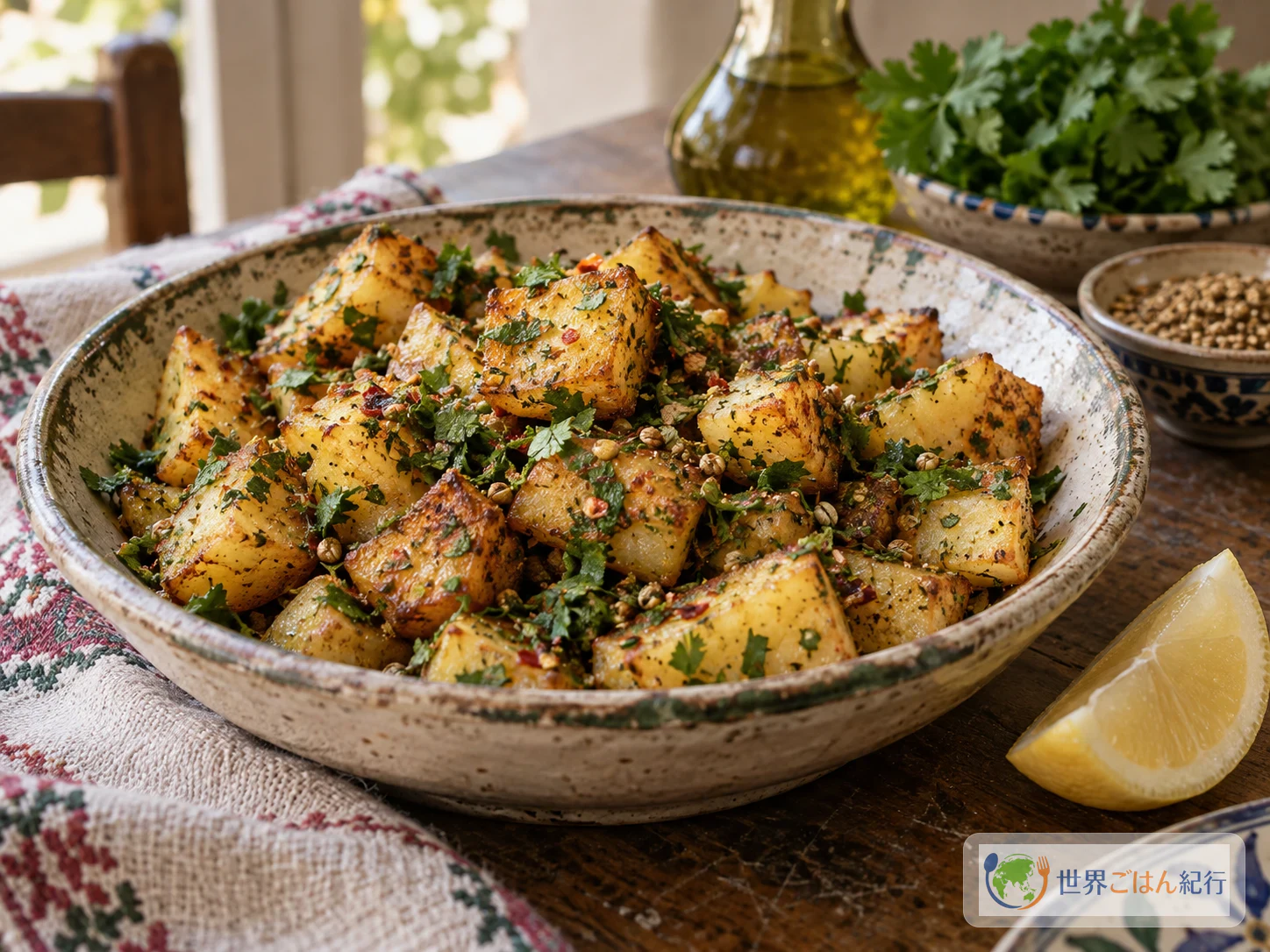
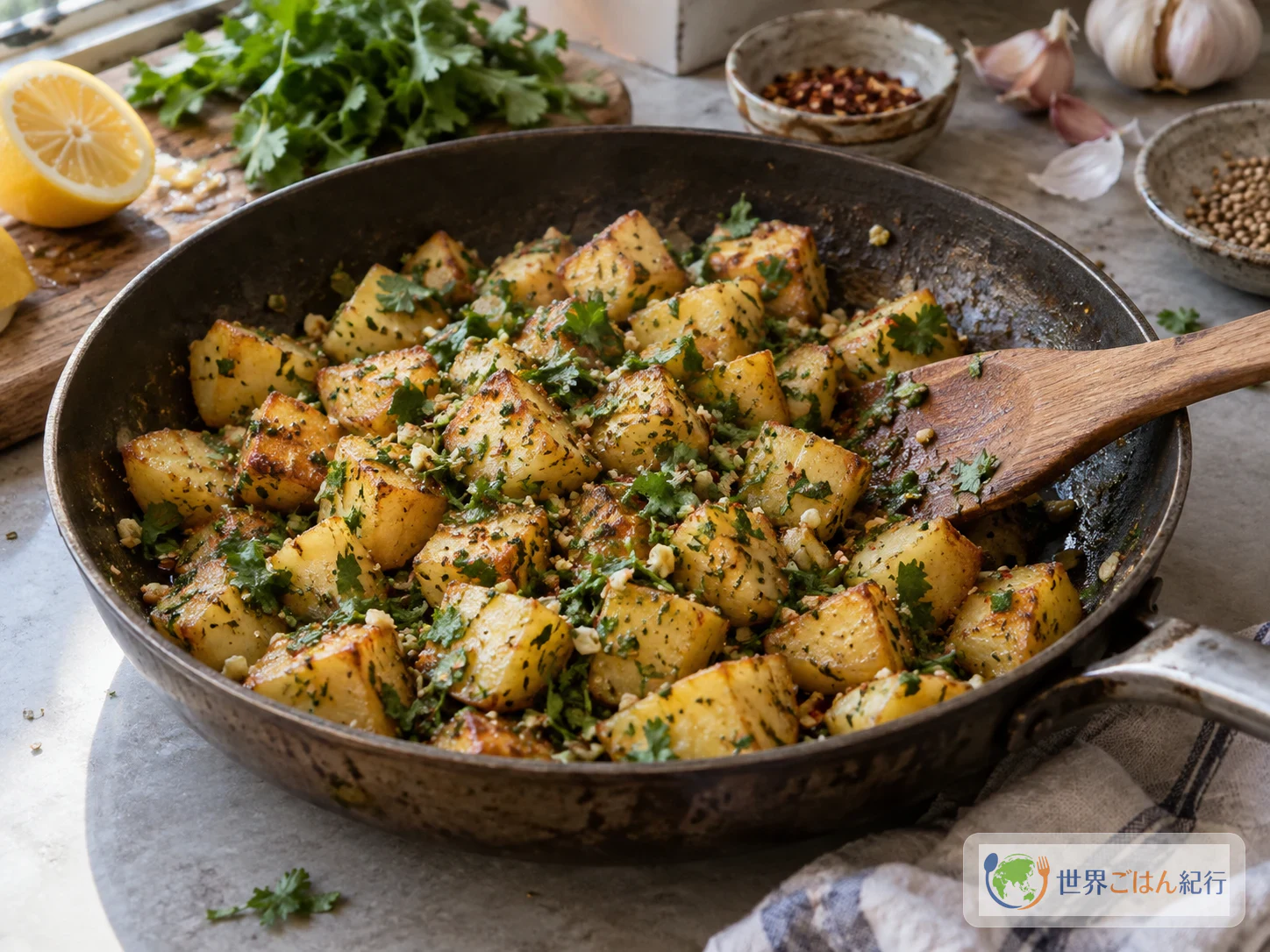
A plate of hot potatoes lands on a Lebanese mezze table already crowded with small dishes. The golden cubes are scattered with chopped green cilantro, and cut lemon sits at the side of the plate. Squeeze it over the potatoes just before eating and a sour aroma rises softly with the steam. Lemon squeezed over hot potatoes is the best moment of this dish. Batata harra is browned outside and soft and fluffy inside, and its flavor comes from garlic, cilantro, chile and lemon.
About batata harra
In Arabic the dish is written "بطاطا حرة," in English "Batata Harra," meaning "spicy potatoes." Even so, some cooks leave out the chile, and there's no single right level of heat. Think of it as heat you can adjust and tune it to your taste. Lemon brings sourness, the fresh leaves bring their green aroma, and garlic gives the whole thing presence.
Batata harra is one of the mezze, the small plates served as starters, where moving among several dishes is part of the pleasure. It sits happily beside warm and cold plates such as hummus and leafy salads. In northern Lebanon these potatoes are served with fried fish, and at home they work just as well next to grilled fish, which makes them a side for fish.
Fried or baked batata harra
Cooks' versions fall into three methods. One returns fried potatoes to a separately made flavored oil, another fries parboiled potatoes and adds garlic and cilantro in the last minute, and the third bakes them in the oven.
| Method | Result for the potatoes and cooking differences | When to choose it at home |
|---|---|---|
| Parboil, then fry | Potatoes are fried and the aromatics are added near the end | When you can handle frying oil and the cleanup |
| Return fried potatoes to flavored oil | Cooking of the potatoes and flavored oil is separated | When you want to check the color of the garlic separately |
| Parboil, then bake in the oven | Spread in one layer on a baking sheet for browning | When you don't want to prepare a lot of frying oil |
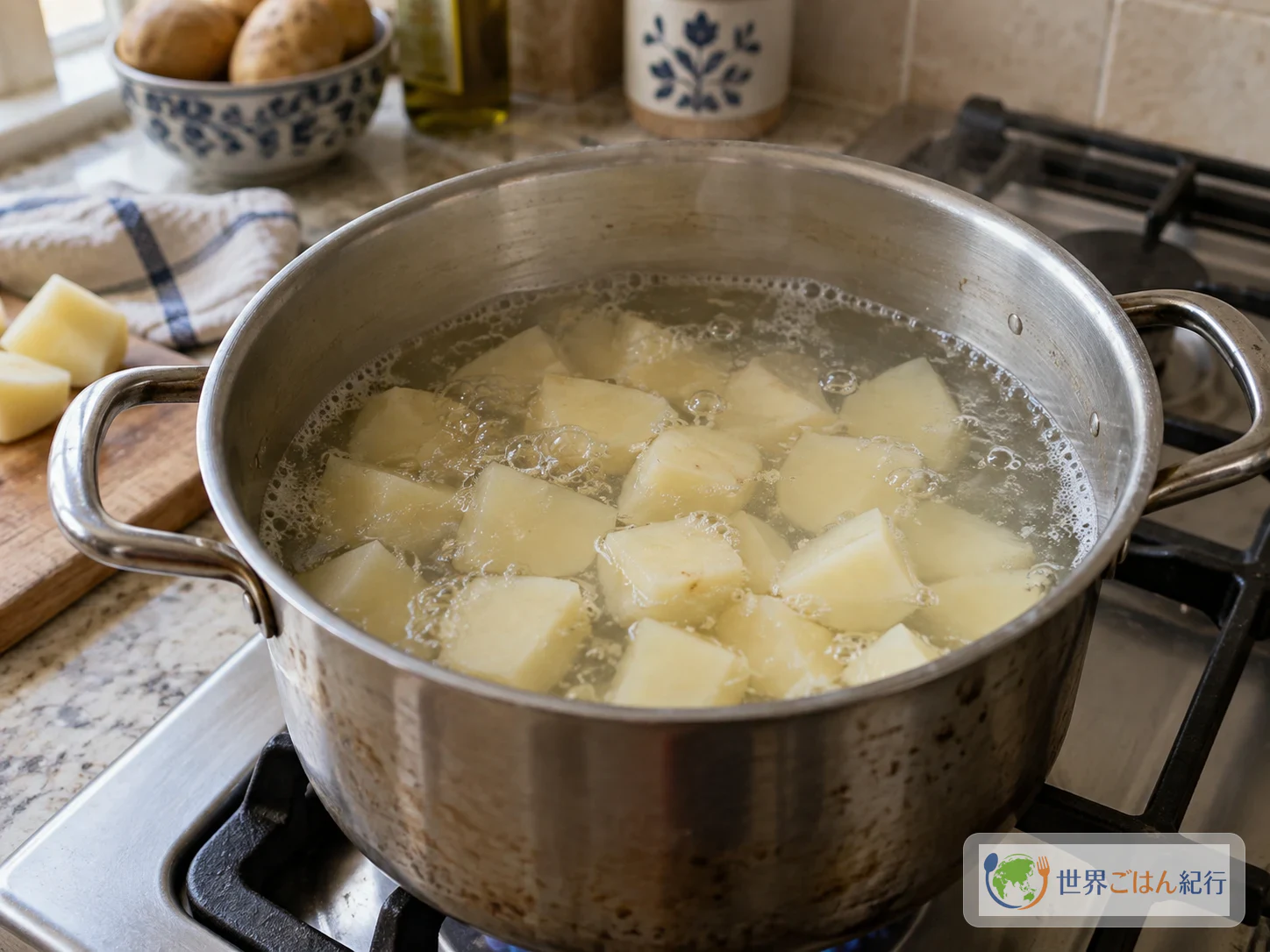
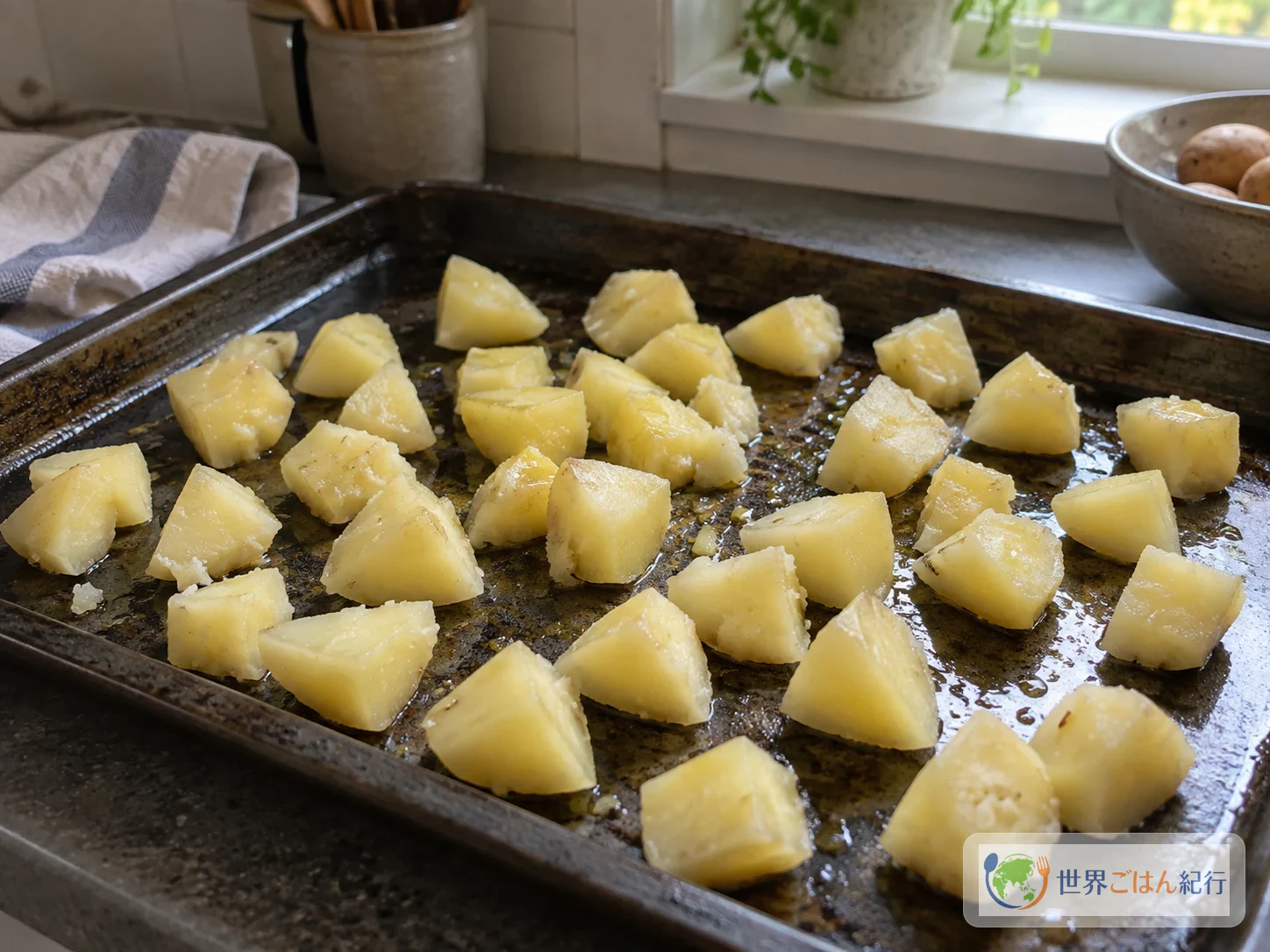
Here, only the parboiled potatoes go in the oven, and the flavored oil is made in a separate skillet. Garlic left in a 425°F (220°C) oven as long as the potatoes bake would burn, so making the flavored oil separately is the key to this method.
Herbs and fats vary too. Besides versions built around fresh cilantro, some oven versions use coriander seed or ghee, and others add dill, parsley, tomato paste and turmeric. Since formulas differ from home to home, it's easy to tune this one to your own kitchen.
Ingredients (serves 4)
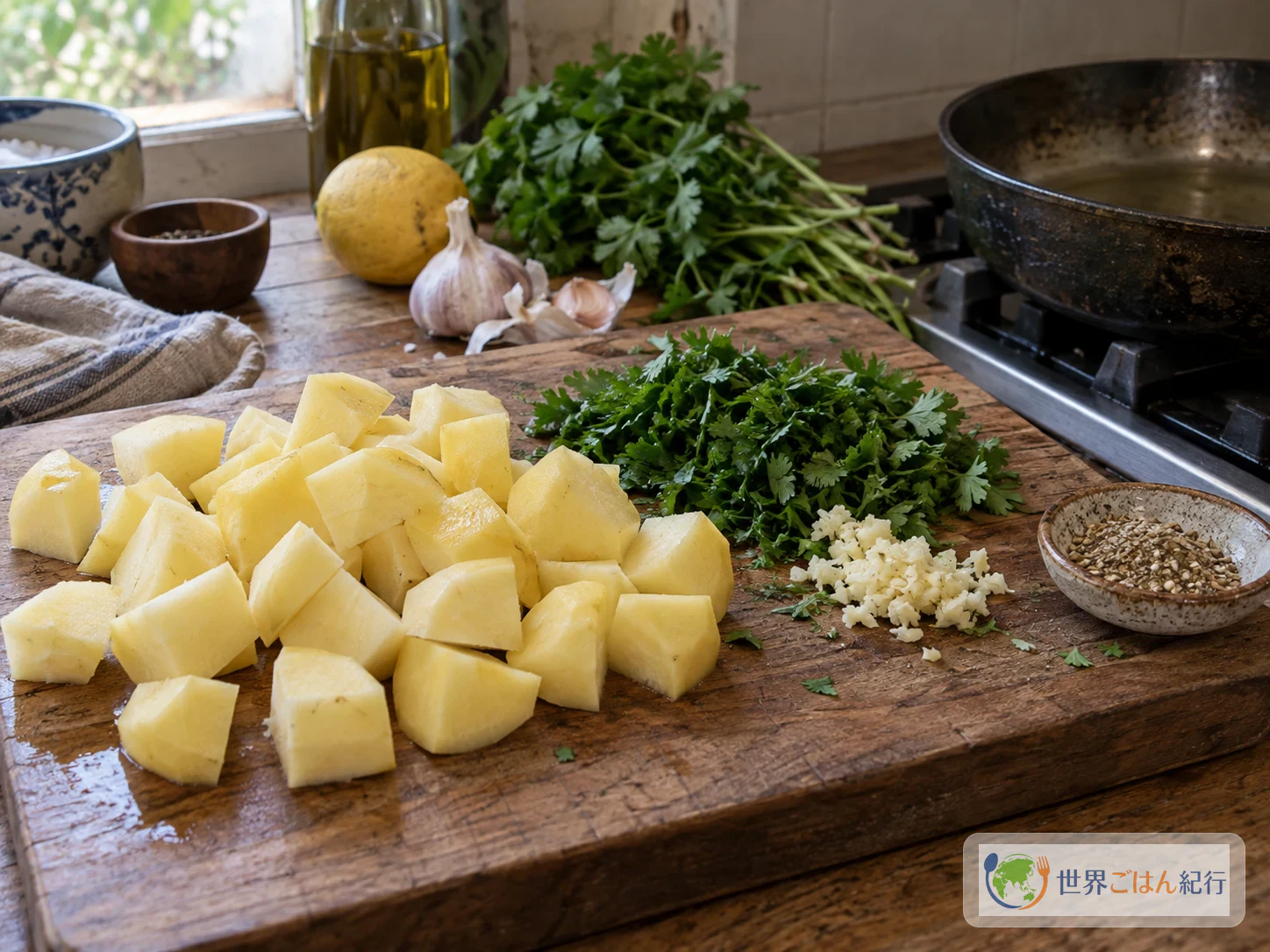
For 4 servings as a side dish, prepare 900 g potatoes, weighed before peeling. Preheat the oven to 220°C (430°F). You need only a baking sheet, a pot, a colander, a skillet and a knife; no special Middle Eastern equipment is needed. Either starchy or waxy potatoes work. Starchy ones break up more easily, so check the parboiling early. Don't decide cooking time by variety alone. 900 g for 4 side servings.
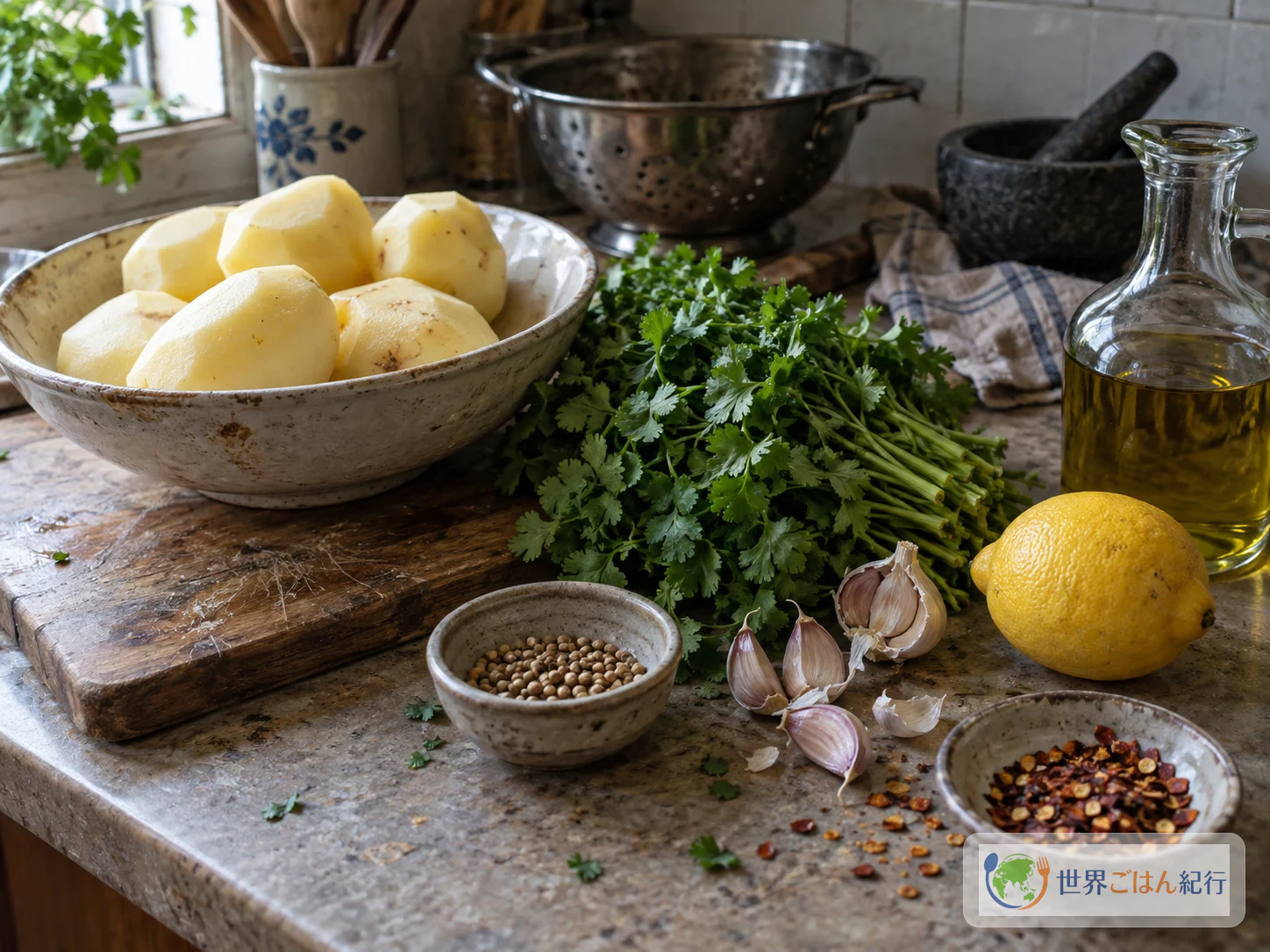
Prepare cilantro as fresh leaves. Coriander seed is a dried spice and a completely different thing. When shopping, check whether the package says leaves or seed. Not mixing up fresh leaves and seed is the shortcut to getting the aroma you intend. The dried seed can be handled whole until just before crushing, and its aroma moves into the oil. A sturdy food-safe bag and a rolling pin make a good way to crush it. If you substitute ground, use 1/2 tsp and add it near the end since it burns easily. It won't have the same grain as whole seed.
Put 1 tsp of coriander seed in a sturdy food-safe bag and press with a rolling pin to crush coarsely. You don't need to destroy every grain's shape; it is enough if the husks are cracked. You needn't make a fine powder, but if you dislike biting a hard round grain, crush it a little finer.
Choosing ingredients and substitutes for batata harra
Cilantro, coriander leaf and fresh coriander all name the same herb. Coriander seed is the seed of the same plant, used as a spice. The crushed seed has a citrus-like aroma, while the fresh leaves are greener, so one can't stand in for the other. If you dislike the fresh leaves, try the seed on its own, and the reverse too.
If you dislike fresh cilantro, swap 20 g cilantro for 20 g flat-leaf parsley. The green aroma specific to cilantro will be gone, so take parsley as a change of flavor. The coriander seed still works with either leaf, and if you dislike the seed too, leave it out and enjoy garlic-and-lemon potatoes. Dried leaves aren't a one-for-one swap for fresh, since the water and texture differ.
For the chile, choose flakes of red chile only. Blended chile mixes add other aromas, and some chili powders are mixed seasonings, so check the label. Choosing red chile only keeps the garlic and fresh leaves in front. To go milder, use 1/4 tsp or none; to add heat, sprinkle in a little at a time after plating rather than remaking the oil.
The 3 tbsp (45 ml) of lemon juice can be replaced with unsweetened bottled juice, but the lemon for serving should be fresh fruit.
| Home adjustment | Change for 4 servings | What changes from the basic dish |
|---|---|---|
| Less heat | Chile 1/4 tsp or 0 | Garlic, leaves and lemon remain |
| Make it with parsley | Replace 20 g cilantro with 20 g parsley | The kind of green aroma changes |
| Use ground coriander | Replace 1 tsp seed with 1/2 tsp ground | Loses the grain, burns easily, so add near the end |
| Add the color of paprika | Add 1/2 tsp sweet paprika powder near the end | Adds color and flavor rather than heat |
| Serve the lemon on the side | Omit the 2 tbsp (30 ml) for the flavored oil and split the total 3 tbsp (45 ml) at the table | Diners choose when to wet the surface |
Paprika isn't part of the basic recipe, though some cooks add it.
Instructions
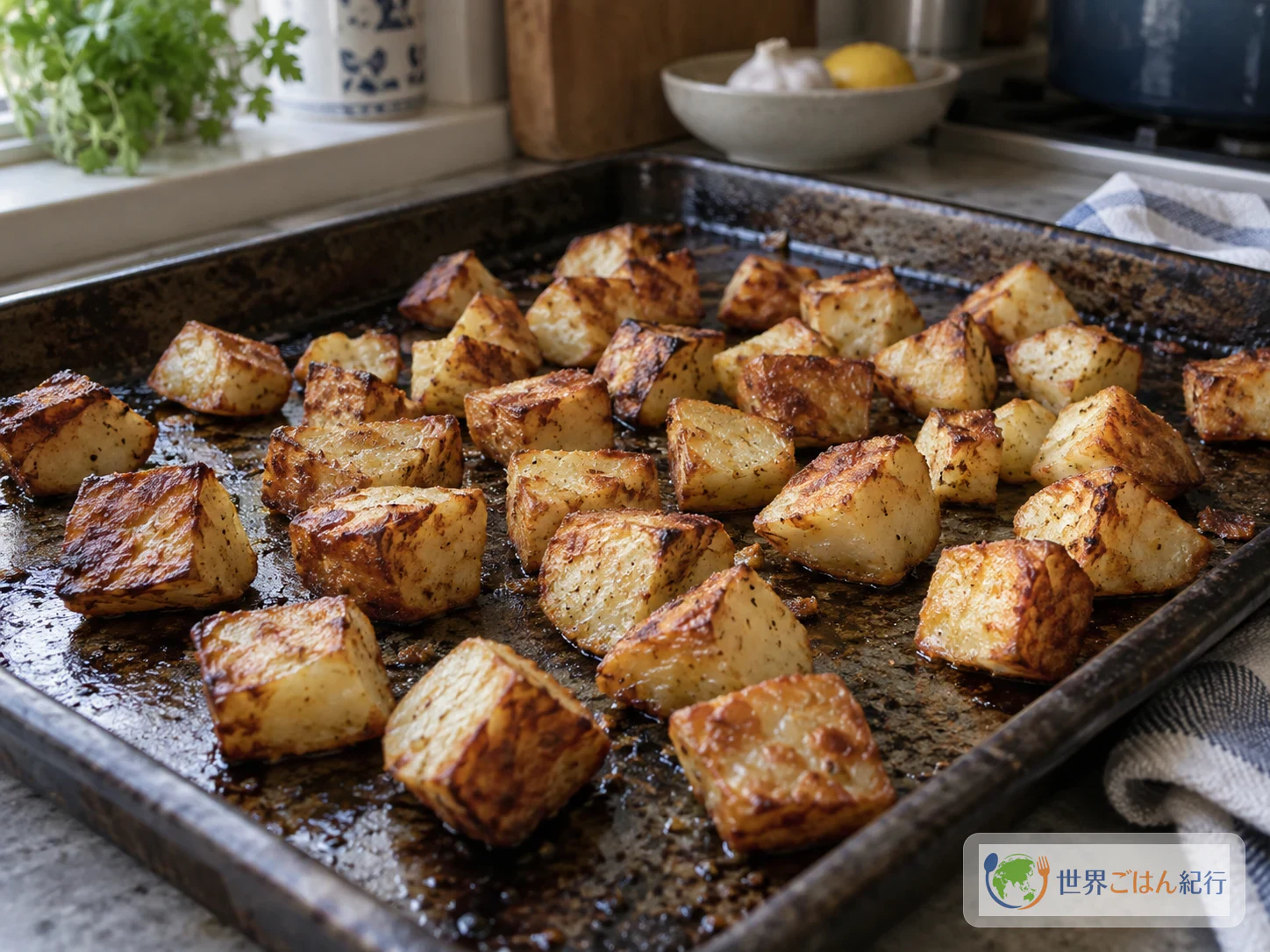
Check the parboil and the browning separately. Parboil 8–10 minutes, dry 3 minutes, bake 20 minutes at 220°C (430°F), turn and bake 8–15 minutes more, then make the flavored oil in 30–45 seconds and finish in about 1 minute. The total is about 60 minutes if you overlap preheating and prep. Oven size and potato type change the timing, so go by the browning. Watch the center of the potato rather than the clock. Remember to spread the potatoes in one layer on the baking sheet.
If the surface of the potatoes is still white, return them to the baking sheet before combining with the flavored oil and bake at 220°C (430°F) 5 minutes at a time. Each time, check the center and the browning. Baking at high heat for a long time after adding the herbs makes both garlic and leaves burn easily. Finish checking doneness at the potatoes-only stage.
If the garlic has turned dark brown or black and smells burnt, don't add that oil and aromatics to the potatoes. Wash the skillet, prepare 2 tbsp (30 ml) fresh oil and new aromatics, and make it again leaning toward lower heat. Adding lemon does not remove the burnt taste.
Serving batata harra
Carry batata harra to the table as soon as the flavored oil and potatoes are combined. Toss and serve hot is the promise of this dish. Set lemon wedges alongside so people can add sourness as they eat, and offer chile at the table too, so everyone can season to taste.
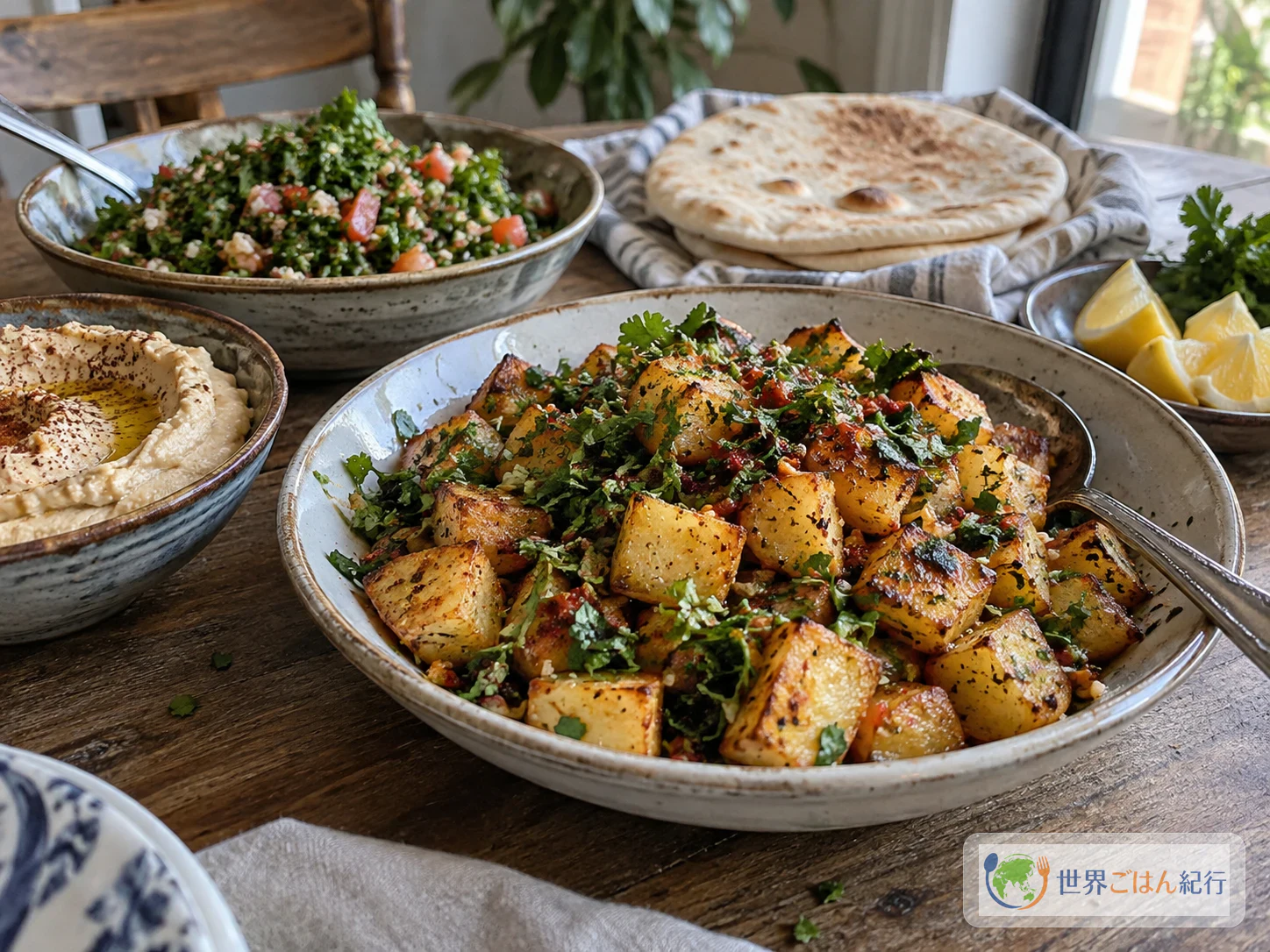
Hummus and tabbouleh are good mezze partners. A smooth bean paste and a leafy salad next to the warm potatoes set off the contrast of textures nicely.
- For a smooth bean dish alongside, hummus.
- To add the sourness of leafy greens, tabbouleh.
- To go with a warm meat dish, shawarma.
The potatoes also make a side for grilled fish or roast chicken. Adjust the rice or bread to the appetites at the table, and serve the lemon on the side.
Nutrition estimate
A per-serving estimate is about 220 kcal, 4 g protein, 10.5 g fat and 1.25 oz (36.4 g) carbohydrate. The calculation uses 1.75 lb (810 g) edible portion from 2 lb (900 g) potatoes, assuming 10% waste, all of the 3 tbsp (45 ml) oil taken as about 1.5 oz (41 g), and 20 g garlic divided into 4. This is an estimate from the main ingredients, without herbs, lemon and small amounts of seasoning. Side dishes are not included, so count hummus and bread separately.
Common failures, and what to do with leftovers
Why do the potatoes fall apart, or fail to brown?
These are opposite failures, even with the same potatoes. Parboiling until too soft, or shaking too hard, breaks the shape, so stop when a skewer meets a little resistance at the center and coat with oil gently. Too much water or potatoes overlapping on the baking sheet makes browning difficult: dry them well, spread them in one layer, and if they need longer, bake them at the potatoes-only stage. Broken potatoes can't go back to cubes, so serve them as a softer dish and remember the cue for next time: reduce water and overlap.
Can I rescue it if I made it too spicy?
Chile mixed through the oil is hard to remove. For a first try, start with the milder amount, 1/4 tsp. If it comes out too strong, you can stretch it with separately cooked unseasoned potatoes, though that means more work and more food; extra lemon won't take the heat away. For children or anyone who dislikes spice, use 0 chile and let them add it at the table.
What about making ahead and reheating?
For a same-day menu, bake the potatoes ahead, then make the flavored oil and toss just before serving; made fully ahead, it loses the freshly baked texture. Refrigerate promptly in shallow containers. Divide leftovers into clean containers and eat them within 1–2 days.
To reheat, start with 5–10 minutes in a 200°C (390°F) oven, adjusting to the quantity, and watch that it doesn't burn while heating through to the center. In a microwave, check that the center reaches 74°C (165°F) or more. Stored potatoes lose some texture, so add 5 g fresh cilantro and 15 ml lemon just before serving.
Wash fresh cilantro and lemon under running water. Don't share a knife or cutting board used on raw meat or fish without washing it. Refrigerate cooked food within 2 hours; within 1 hour if the surroundings exceed 32°C (90°F). Keep the refrigerator at 4°C (40°F) or below, and don't leave food at room temperature for long to cool. Leftovers kept beyond these conditions do not become safe by reheating. Discard them without eating.
What if I have allergies?
The basic formula contains neither ghee nor butter, but check the labels on your oil and seasonings for allergens. Adding ghee or yogurt brings in dairy. Hummus contains tahini (sesame) and bread contains wheat, so check side dishes too. Plant-based dishes can still cause allergies, and shared utensils can carry contamination.