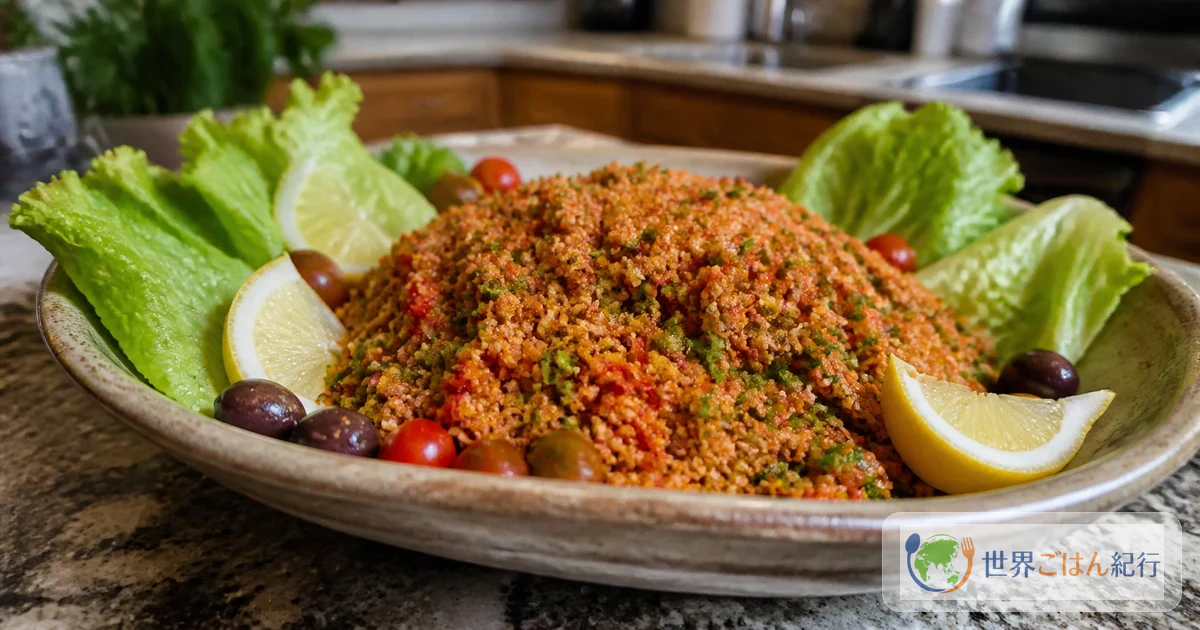
Background: red onion oil soaking into the bread
Slice red onions, pour in olive oil, and set them on medium-low heat. The onions, white at first, slowly turn translucent, and the moment you add sumac the oil turns a reddish purple. Musakhan is a dish in which bread takes up that oil and those onions. A sour aroma, chicken fat, and the smell of toasted wheat layer into one piece, and in the end your hands move more naturally than a knife.
Musakhan (Musakhan / مسخّن) is a Palestinian chicken dish. The Palestinian Heritage Trail's description presents it as a celebratory farmers' dish of northern Palestine, eaten during the olive harvest. Chicken is baked in a clay oven called a taboon and combined with onions soaked in olive oil.
It is hard to explain musakhan without talking about olives. The virtual museum of Palestine's Ministry of Tourism and Antiquities explains that olive cultivation and oil are pillars of the agricultural economy, and that the harvest season is also the festive season of each year. Letting oil and onions soak into the bread in musakhan is a little different from serving chicken with a sauce. It is built so that the bread itself becomes the meal.
Home versions vary. In Asif's recipe article, contributor Nadir Abu-Seif presents musakhan as a signature dish of Palestine and notes that it is made routinely in villages. The bread, the cut of chicken, and how far the onions are cooked change by household and region. So I set the proportions for a home oven so that you can tell by sight: "the onions are not browned, the bread is moist in the center and light at the edge."
Even if you cannot recreate the taboon itself, a plate with the dry sourness of sumac and fragrant olive oil, onions that hold the oil, and flatbread that drinks the juices will be recognizably musakhan. You may change the type of bread and the cut of chicken to what you can get. Adjust the baking time and texture by that much.

The difficulty in a home kitchen is not the number of unusual ingredients but moving the onions and the bread in the same direction. Burn the onions and bitterness comes first; cut the oil too far and the bread is dry. Bake it back too long and the center turns hard. The guides are the color of the onions, how dry the bread is, and the internal temperature of the chicken. For each step I write down when to stop.
Ingredients and shopping: secure the sumac first

This dish uses chicken, wheat, and nuts. If you have a nut allergy, leave out the pine nuts and almonds, and make up for the toastiness with 2 tsp of white sesame seeds. To avoid wheat you can make it with rice-flour tortillas, but the texture of bread soaking up oil changes.
Ingredients and tools for this dish
Sumac and olive oil decide the flavor of musakhan. Rather than cutting either, using boneless chicken or swapping pine nuts for almonds keeps the direction of the flavor intact. If it is your first time, look for the sumac first. Buy more olive oil and allspice only if the aroma of what you have at home is weak. For chicken and onions, use what is available nearby.
The condition for buying sumac is if you also want sourness for tabbouleh, hummus, and roasted vegetables beyond musakhan. If you are trying this only once, you could pass on it using lemon you already have, but the aroma and color will be different. When you look for it, check that the product is named "sumac." Prices and stock change, so they are not fixed in the text.
Use the cooking guideline of Japan's Ministry of Health, Labour and Welfare: hold the center of the thickest part at 75°C for at least 1 minute. Wash knives, cutting boards, and hands that touched raw chicken before touching the cooked chicken or the bread. The basis for the guideline is also in the Ministry's Campylobacter food poisoning Q&A (in Japanese).
Branches for a home kitchen
Choosing bread on a day with no taboon
Taboon is not the name of a bread but of the oven in which flatbread is baked. In a home kitchen, choose a bread that takes color and does not tear after soaking up oil and juices. Thick pita, naan, and lavash are easiest to handle, in that order, and thin tortillas tear easily once they take up oil. If you use them, double them up and keep the bake-back short at 180°C. Sweet naan or bread with a lot of butter dulls the sourness of the sumac.
Bone-in versus boneless
Bone-in chicken thighs take longer to cook, so the skin is more toasty and the pan juices that fall onto the bread are richer. Boneless thighs are easy to eat and suit a weeknight dinner. But there are fewer pan juices, so increase the oil going on the bread by 1 tsp. For chicken breast, open it to an even thickness and cook at 200°C, not 220°C, for 18 to 20 minutes. Take it out as soon as the center reaches 75°C and it will be less likely to dry out.
How far you can substitute for sumac
Sumac is a sour spice made by drying red berries and grinding them. Replacing it with lemon juice alone gives sourness but loses the red color and the dry aroma. On a day when you cannot get any, mixing 2 tbsp of lemon juice with 1/2 tsp of paprika brings the mood closer. But it is a different thing. If you make musakhan even once, sumac alone is worth buying.
Whether to buy allspice depends on what you will use it for
Allspice adds, in a small amount, a rounded aroma reminiscent of cinnamon, clove, and nutmeg. If you have none at home, cinnamon and nutmeg can substitute, but if you will also use it in chicken dishes and meatballs, it is an ingredient you are unlikely to leave unused. Check that the name is allspice. If the mixed spices you have are already strongly scented, or if you are making musakhan only once, do not force an extra purchase; the substitute is fine.
With olive oil, judge a replacement by aroma, not quantity
In this dish the oil cooks the onions and soaks into the bread. If all you have at home is a mild oil, a place name alone does not make it taste Palestinian. Still, an oil with fruitiness and a light bitterness, such as one from Kalamata in Greece, is an easy option to pair with the sour sumac. If you already have a fragrant extra-virgin olive oil, or are trying this once to see the difference in taste, skip it. Check the origin and the product name.
Serving, storage, and frequently asked questions

Musakhan is a dish to eat by tearing the bread, rather than cutting neatly with a knife. Serve it on a large platter with yogurt, cucumber, olives, greens, and pickles beside it, and even an oily dish does not feel heavy. On a day when you want layered sourness, use more lemon. If you want heat, adding a little more black pepper rather than chili will not break the aroma of the sumac.
If you make it ahead, separate the chicken, sumac onions, and bread, and refrigerate once the heat has dissipated. As a guide, the chicken and onions keep within 2 days and the bread within the day. The next day, warm the onions in a frying pan over low heat for 5 minutes and the chicken in a 180°C oven until the thick part reaches 75°C and holds it for at least 1 minute, then layer it onto the bread at the end. If you store everything together, the bread soaks up all the oil and gets heavy.
To continue a Middle Eastern menu: if you want to add rice, go to Saudi Arabia's kabsa; if you want the sourness of yogurt, Jordan's mansaf. If you want to flip a platter with rice and chicken as the stars, there is the Palestinian maqluba. For starters, put out hummus or tabbouleh, and on a day when you want to add meaty aroma, setting it beside Turkey's kofte shows how sumac and herbs are used.
Common failures
The onions are bitter
The heat is too high. The onions in musakhan are not browned, caramelized onions. Start on medium-low, lower to low once they soften, and think of it as simmering in oil for 25 minutes. If burnt specks appear, add 2 tbsp of water to lower the temperature.
The bread is soggy and heavy
The oil from the onions is necessary, but the bake-back being too short makes it heavy. Doing it in two stages, spreading the onions on the bread alone and warming at 200°C for 3 minutes and then setting the chicken on top and baking 8 to 10 minutes, keeps the edge light and the center moist. When storing, always keep the bread separate.
The chicken is dry
This failure happens easily with boneless meat or breast. As a guide, bone-in is 25 to 30 minutes at 220°C, boneless thigh 20 to 23 minutes, breast 18 to 20 minutes at 200°C, and stop at an internal temperature of 75°C. Do not put it on the bread right after roasting; rest it for 5 minutes so the juices settle.
The sourness of the sumac is weak
Old sumac loses its aroma. After opening, keep it airtight in a cool, dark place and use it up soon to hold the aroma. Sprinkling a little extra beyond the stated amount at the end restores sourness lost to heating. Only increasing the lemon juice makes the whole dish watery, so be careful.
Frequently asked questions
Can I make it without a taboon?
You can. Use thick pita or naan, warm the bread alone at 200°C for 3 minutes first, and then layer on the chicken. If all you have is thin tortillas, double them up. You will not get the toastiness of the taboon, but if the bread is thick enough to take up the onion oil, it will be eaten the musakhan way.
Can I replace sumac with just lemon juice?
For sourness alone, yes, but the reddish-purple color and the aroma of dried fruit do not return. Think of a substitute mixing lemon juice and paprika as "musakhan-style." If you will keep making tabbouleh and roasted vegetables, buy sumac; if you are trying it once, it is reasonable to substitute and pass.
Should I choose bone-in or boneless?
If you want the bread to soak up juices, bone-in; if you value ease of eating and baking time, boneless thigh. Boneless has fewer pan juices, so make up what goes on the bread with 1 tsp of olive oil. In either case, check the internal temperature and do not take it out by time alone.
What do I do without pine nuts?
Swap in sliced almonds or leave out the nuts. The presence of nuts is a difference of toastiness; the combination of sumac onions and bread, the axis of musakhan, remains. If there is an allergy, check the ingredients and manufacturing line labeling of the substitute.
To make it or to pass
If you can spend around 90 minutes on cooking and like sour spices and bread that has soaked up oil, it is worth making for 4 servings. The first thing to buy is only the sumac. Start with bread and chicken that are familiar, and add allspice or a fragrant oil only if you plan to use them for the next dish too.
Conversely, it is not suited to someone cooking for one in under 30 minutes, or looking for a dish with little oil. In that case, pass on musakhan and go to kofte or hummus, with less shopping and less risk of failure.
Sources
- Palestinian Heritage Trail: Palestinian cuisine (explanation of musakhan, taboon, and the olive harvest season)
- Palestinian Virtual Museum: The Olive Trees and The Olive Press in Palestine (the cultural background of olive cultivation and the harvest season)
- Asif: Musakhan, Palestinian chicken with flatbread (ingredient makeup, the bake-back step, the contributor's explanation)
- Palestine in a Dish: Chicken Musakhan (a summary of ingredients, taboon, sumac, and nuts)
- Food Heritage Foundation: Palestinian chicken musakhan (a farmers' dish; bread substitutes when there is no taboon)
- Bon Appétit: Musakhan (comparison of the onion braise and the structure in which the bread takes up the juices)
- Ministry of Health, Labour and Welfare (Japan): Preventing Campylobacter food poisoning (Q&A) (cooking guideline for chicken and cross-contamination prevention)