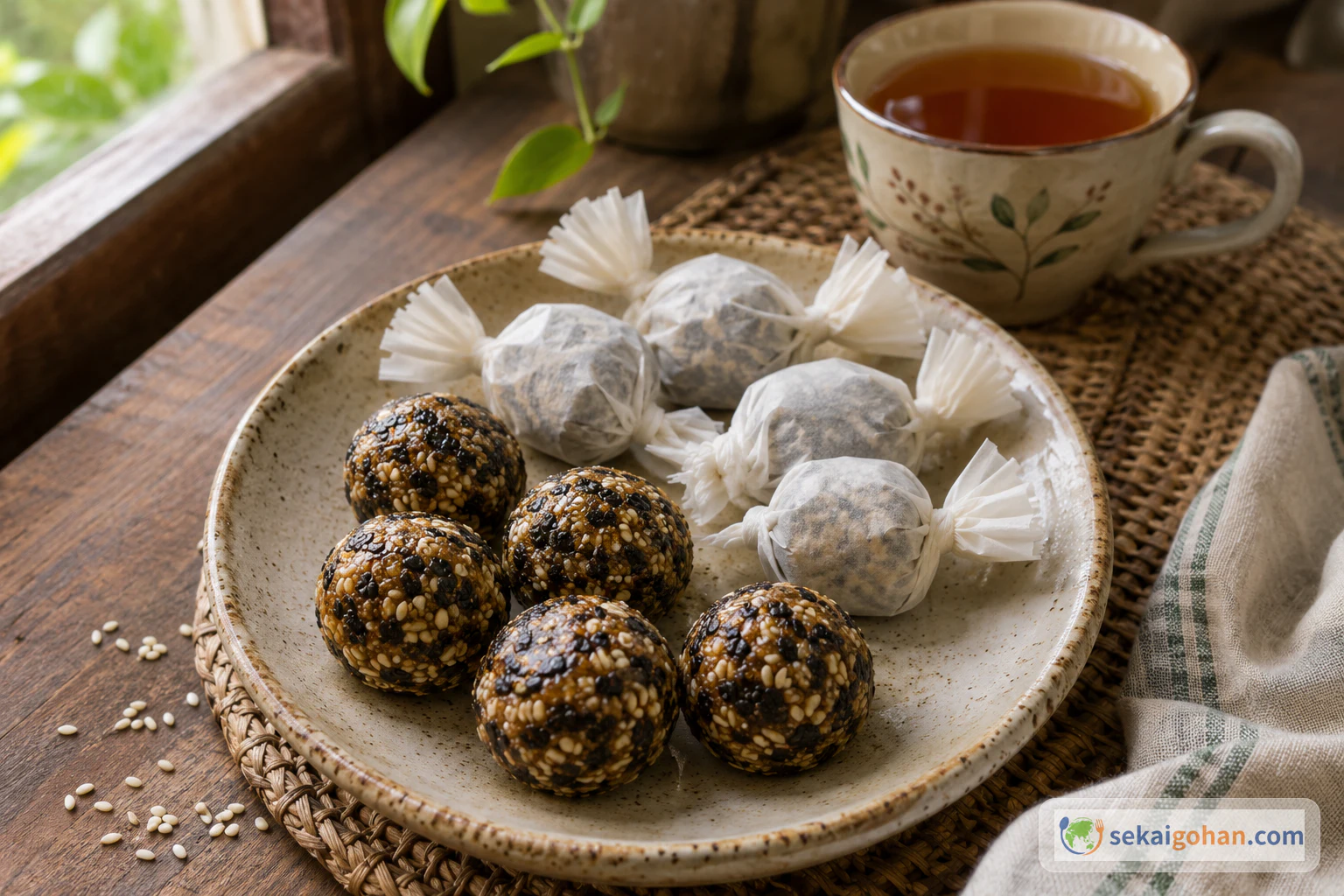
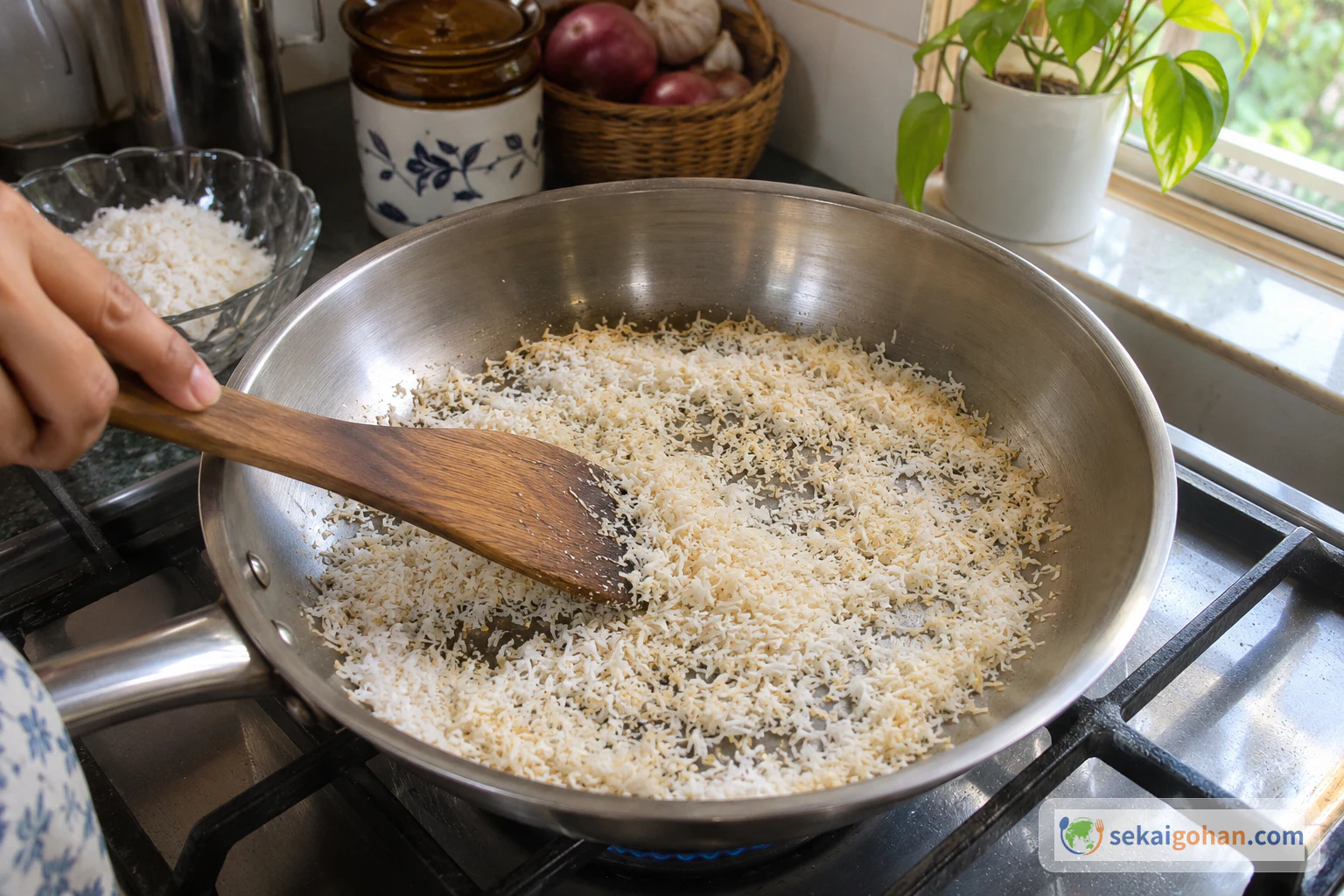
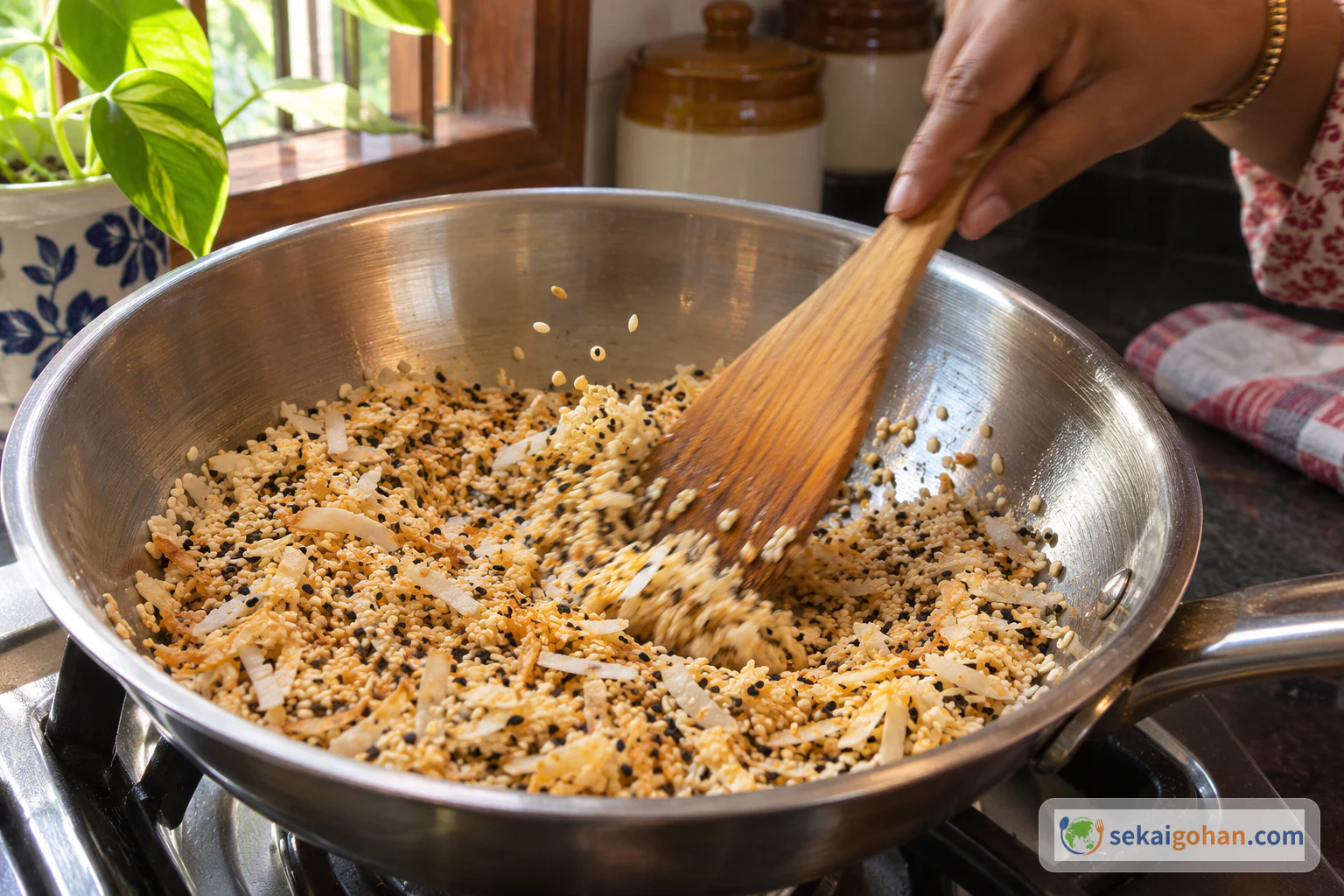
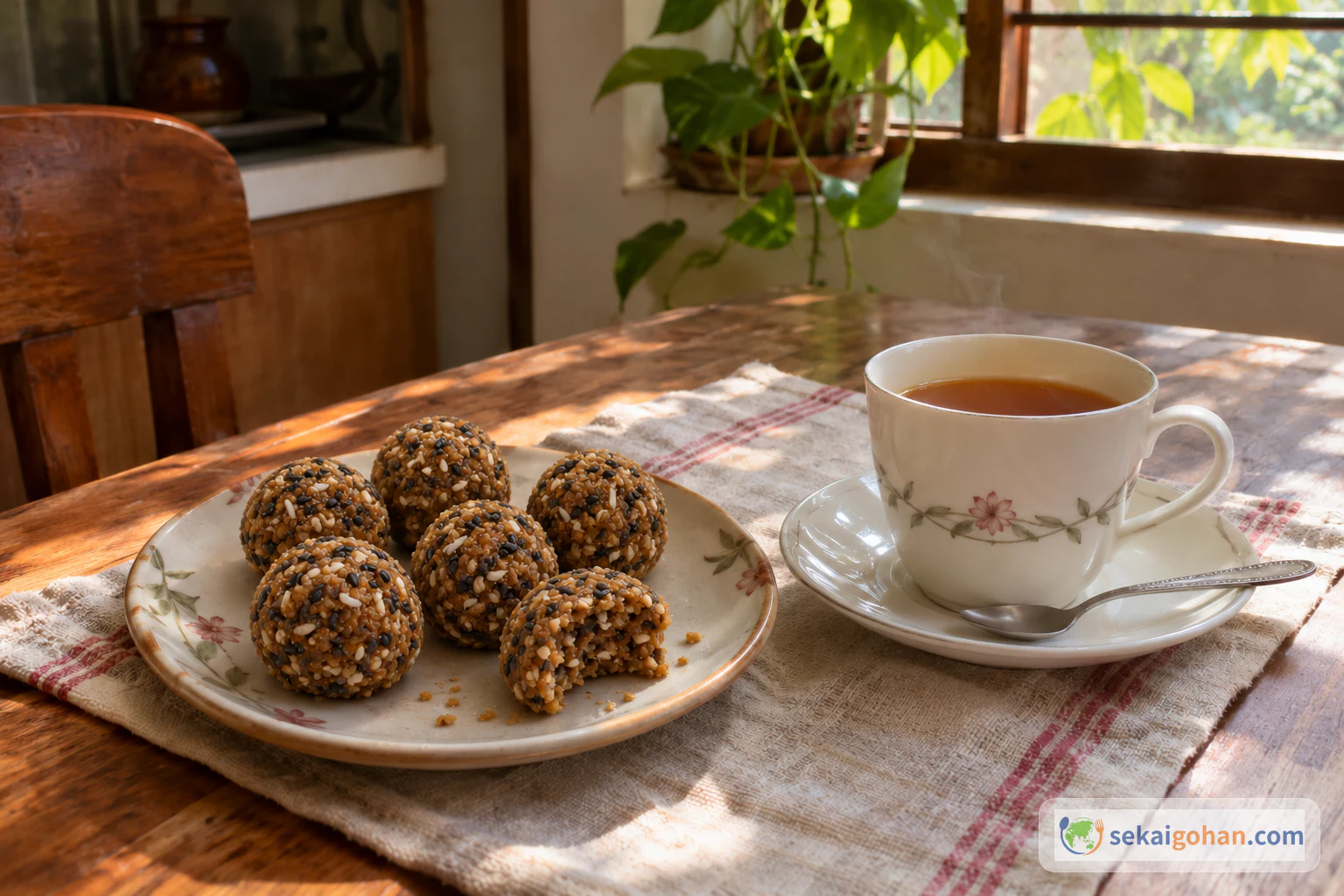
The sesame seeds go quiet in the pan for a while, rolling over the toasted coconut. Then the first one pops, then a few more, and the kitchen fills with a nutty smell. That sound is the moment to switch off the heat. Thala guli are small Sri Lankan sweets of toasted sesame and coconut, crushed with dark palm jaggery and a pinch of salt, then rolled by hand while still warm. They taste roasted and deep, with a caramel sweetness, a little salt at the edge, and a crumbly chew that holds together because the crushed sesame binds itself with its own oil.
Sesame Held Together by Its Own Oil
Thala guli use heat only once. The coconut and seeds are toasted in a dry pan, and everything after that is crushing and rolling. There is no baking, frying or syrup boiling in this version. When you crush the warm seeds, they release oil. That oil and the sticky jaggery are all that hold each ball together, so the whole recipe turns on two judgments: how far you toast and how far you crush.
The name and its shapes
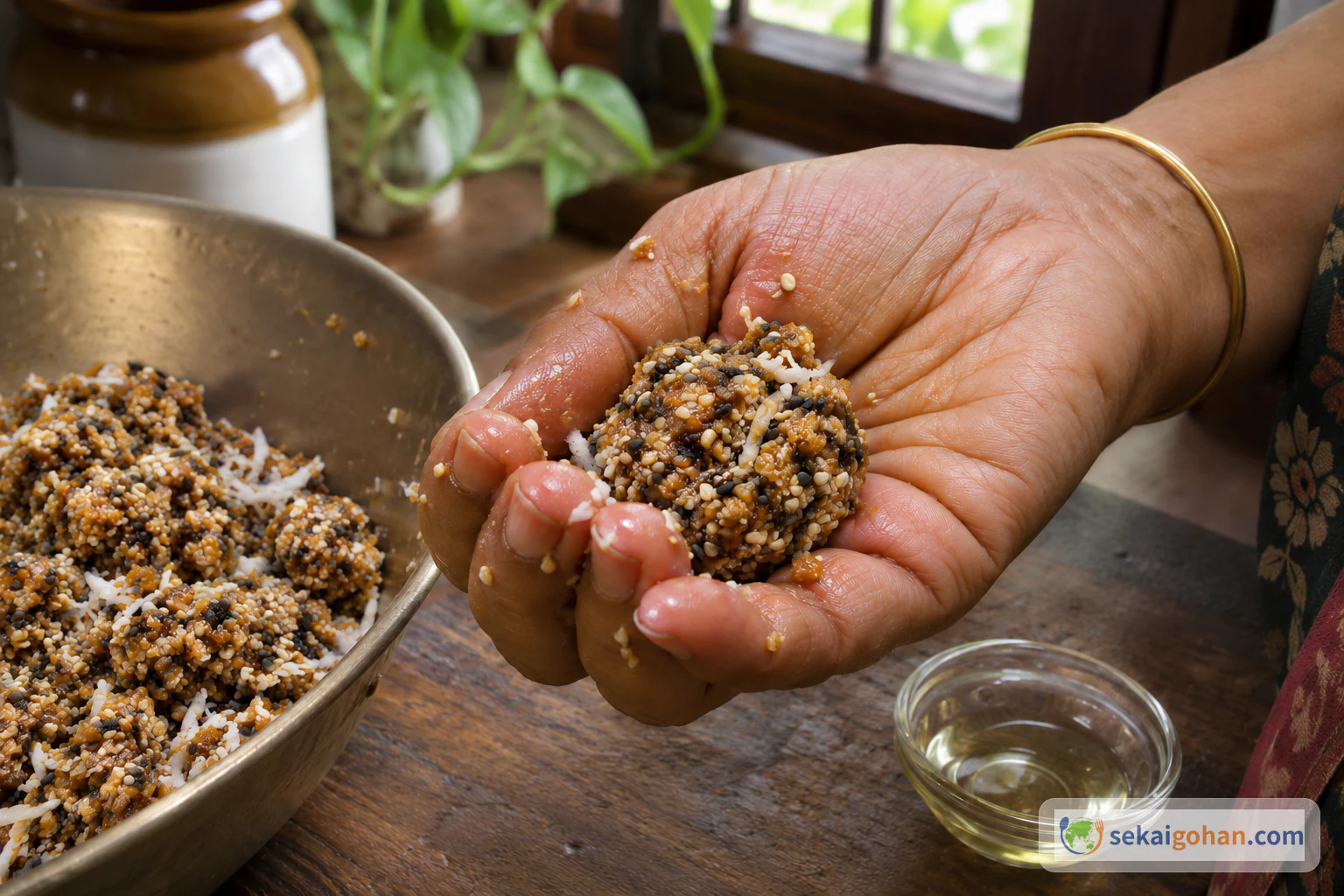
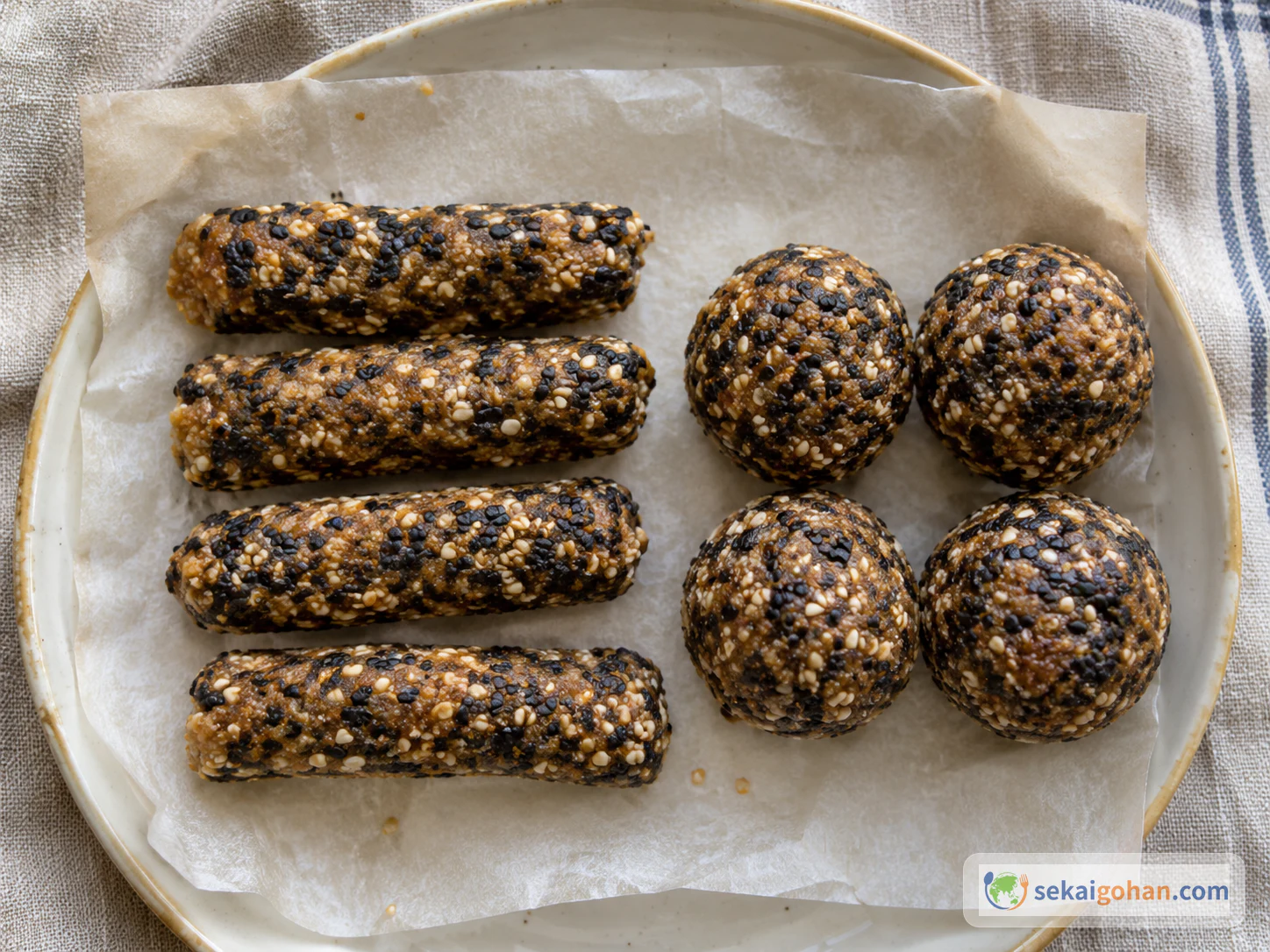
In Sinhala the sweet is තල ගුලි, thala guli. Thala means sesame and guli means ball. The same mixture is also rolled into short sticks, and in that shape it goes by thala bola. You will also see thala kerali, gingelly balls and gingelly rolls. All of these names point to one sweet. In the Tamil-speaking north and east, the same sweet is ellu urundai.
Thala guli (ball), thala bola (short stick), thala kerali, gingelly balls or rolls, and in Tamil, ellu urundai. Ball and stick use the same mixture; only the hands change.
The sweetness of kithul
The jaggery that gives thala guli its colour comes from kithul, the palm Caryota urens. Sap is drawn from the flower stalk and boiled down into a brown, caramel-scented syrup called treacle, and kithul jaggery belongs to the same family of sweeteners. The same sweetness runs through other Sri Lankan sweets, such as kalu dodol and the baked coconut-and-jaggery bibikkan. Jaggery also has a place at the Sinhala and Tamil New Year, Avurudu, when hakuru is poured into carved moulds to set in decorative shapes. Old wooden moulds of this kind, many of them dated to the Kandyan period, survive in a museum collection in Colombo. Thala guli are rolled by hand rather than moulded, but they share that same dark sugar.
On the table and in paper
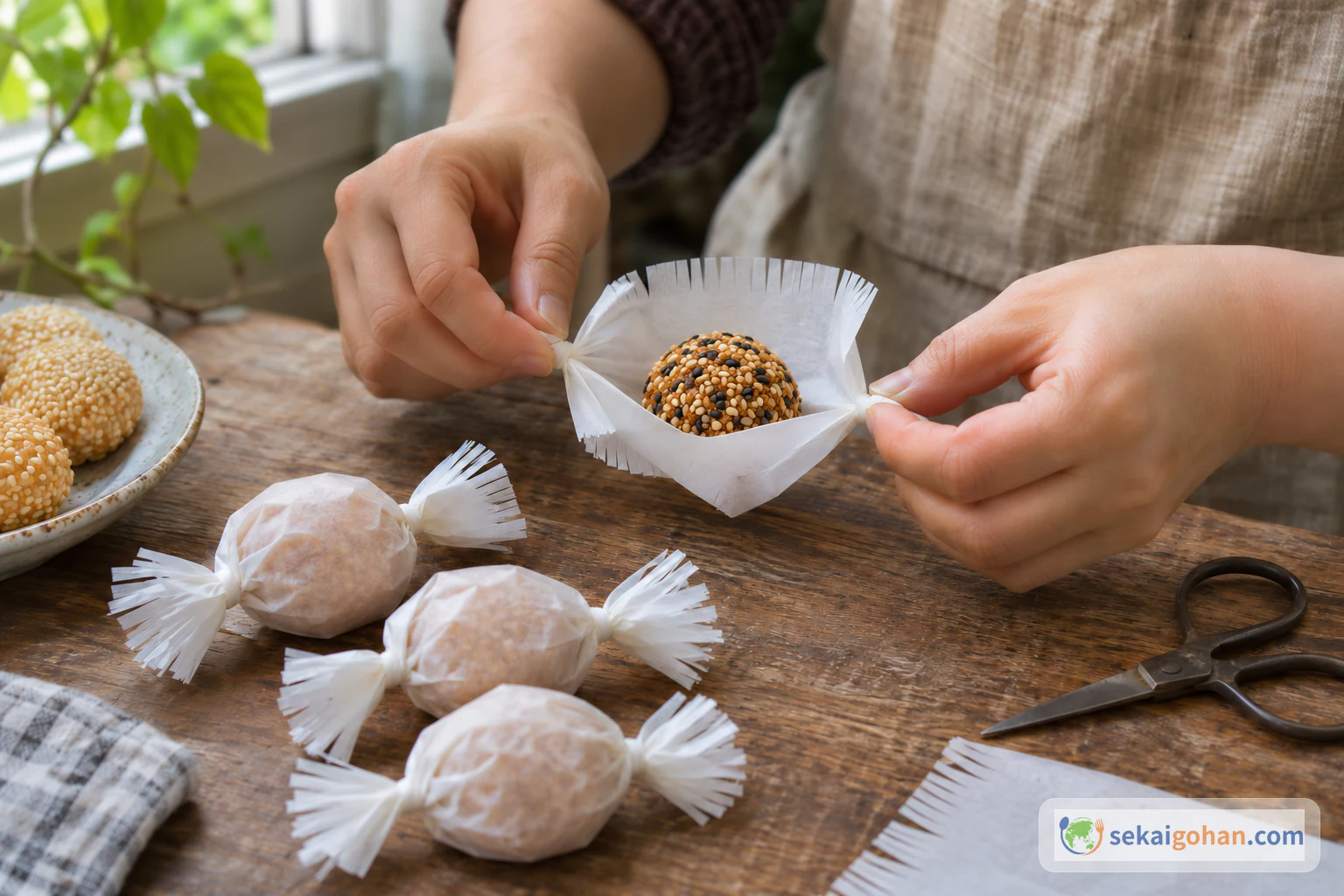
Thala guli are listed among Sri Lanka's festive sweets, and they appear just as easily as an afternoon snack or a sweet after a meal, with a cup of tea or coffee. At shop counters and on celebration tables, each ball is often wrapped in a strip of white crepe paper with finely cut fringes, twisted shut at both ends like a bonbon. Next to aasmi, the fried and syrup-drizzled rice-flour lace of festive tables, they look plain. That plainness is the point: roasted seed, palm sugar, salt.
From house to house
Every household balances the mixture differently. Some use only white sesame, some mix white and black, and the share of coconut and jaggery moves around. The toasting order changes too. Here the coconut goes in first and the seeds follow in the same pan. Other cooks toast seeds and coconut together for a few short minutes, and others toast them separately until each is coloured. Some versions bind the mixture with boiled kithul treacle instead of crushed jaggery, which makes a different, syrup-bound sweet. Around Jaffna, the sweet can be just sesame and jaggery, and some cooks have bound it with rice flour and water. India has close cousins in its sesame-and-jaggery sweets. Sesame ladoo come near, but the taste and method differ a little. Japanese goma dango are a different thing altogether, a fried glutinous rice dough. For more dishes from the island, see the Sri Lanka country page.
Ingredients (makes 18–20)
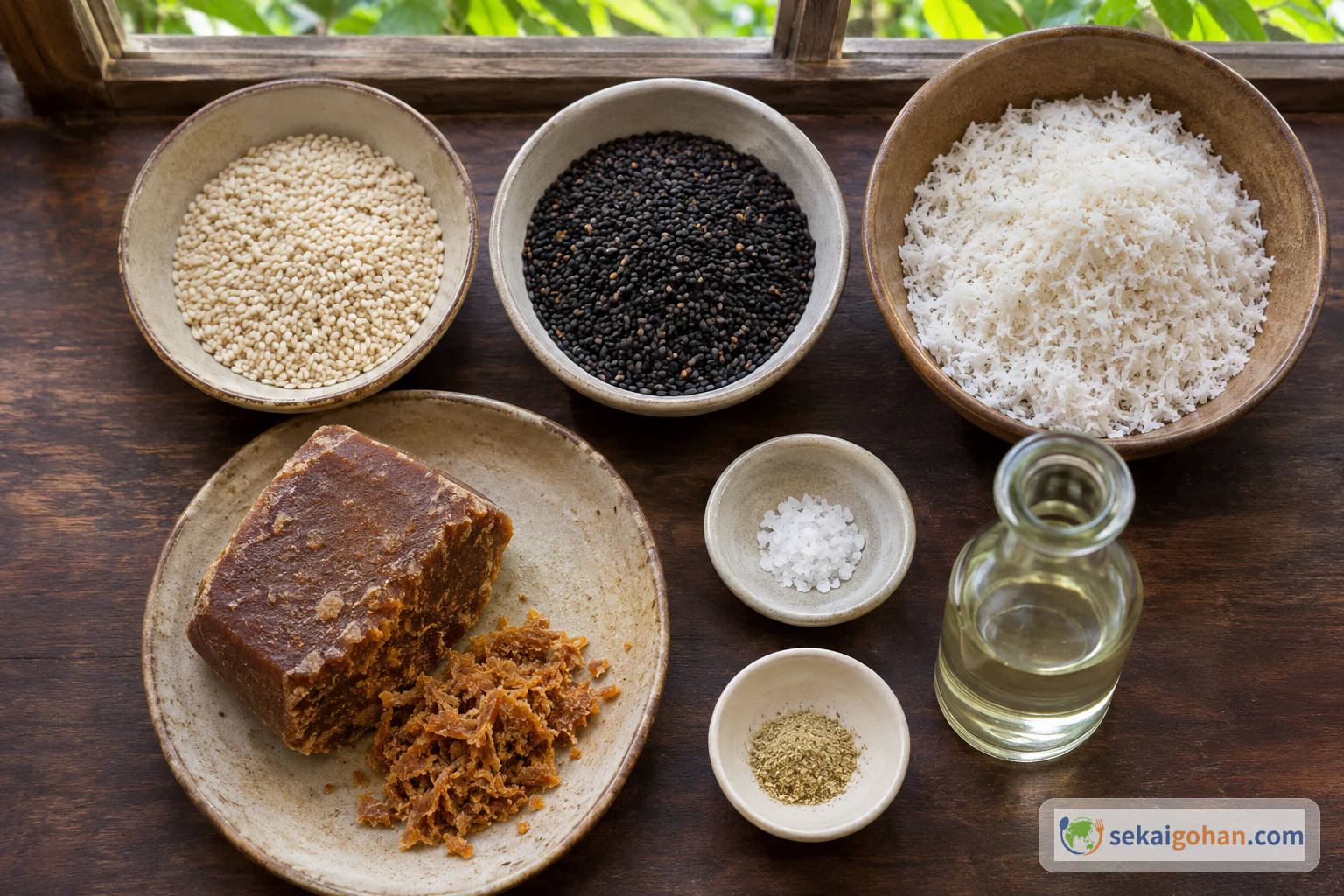
Look for raw (untoasted) sesame. Pre-toasted seeds go bitter fast in a second round of heat.
Sesame is a common allergen, and in Japan it is on the list of allergens recommended for labeling. Sesame oil, ground sesame and sesame paste carry the same allergy. Anyone allergic to sesame should not eat thala guli. Give a first taste in a small amount, especially to children. Read the labels on packaged coconut and palm sugar as well.
Equipment
- Heavy frying pan
- Wooden spatula
- Plate or tray for spreading the toasted mixture
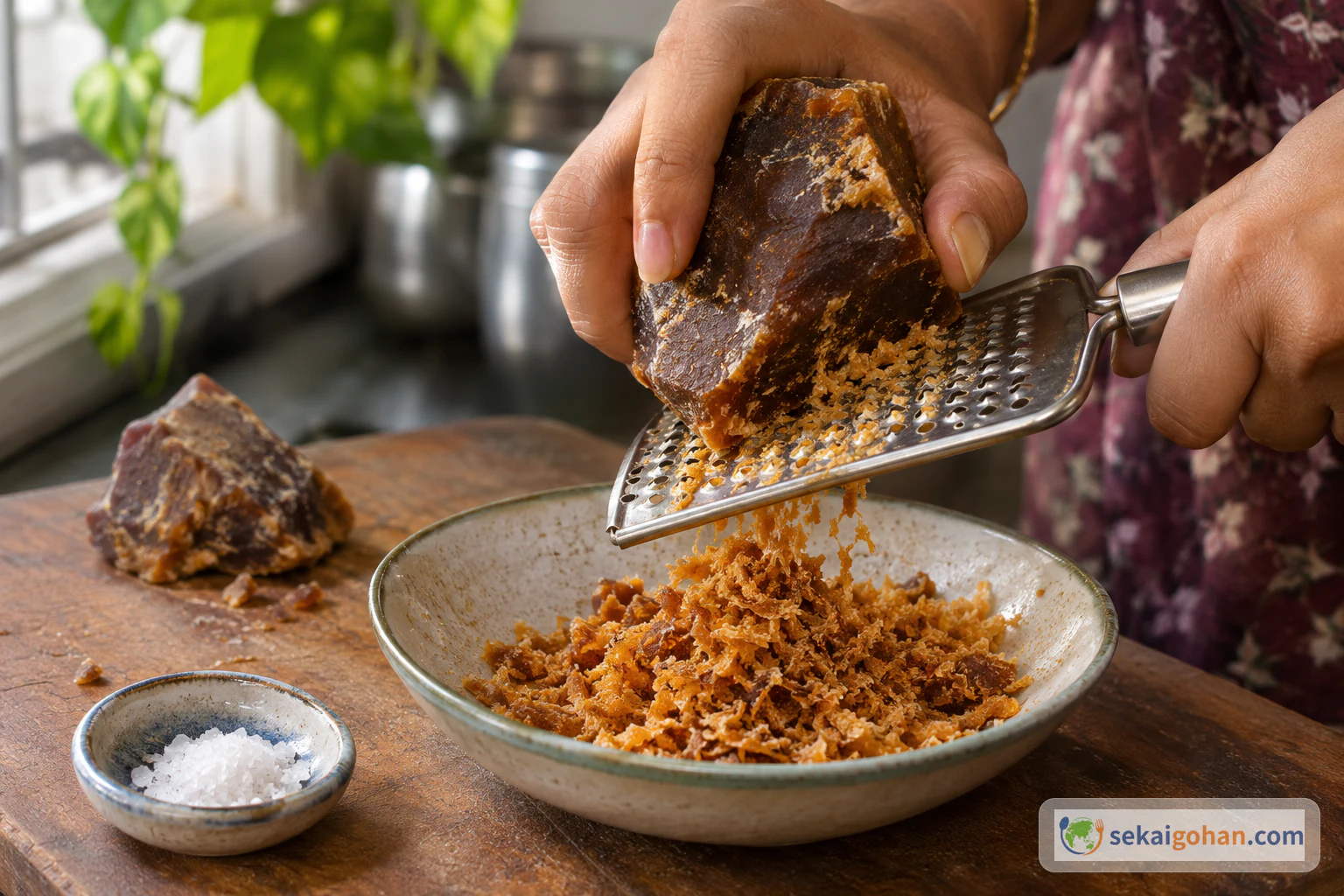
- Grater or sharp knife for the jaggery
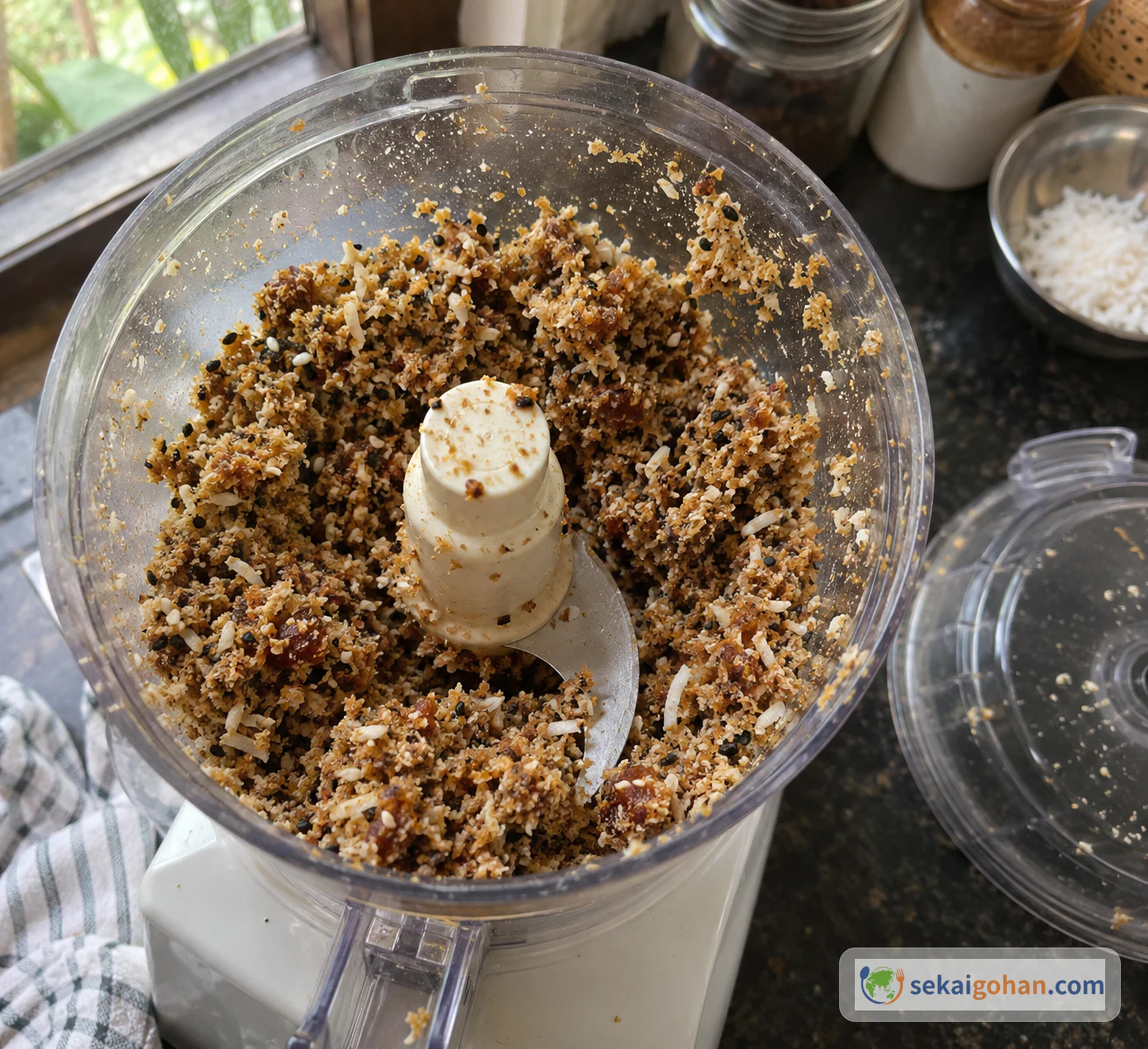
- Food processor with a pulse setting
- Small bowl
- Parchment paper
- Airtight container
- White crepe paper and small scissors (optional, for wrapping)
Choosing and Substituting
Kithul jaggery is the taste of Sri Lanka here. It is dark and caramel-scented, and you will find it at South Asian grocers or online. Palm sugar in the same weight is the closest swap and keeps the result very close. Japanese black sugar (kokuto) also works. It brings a stronger aroma and more moisture, so the mixture tends to bind less readily, and a few drops of coconut oil bring it back. It will not taste quite the same.
Freshly grated coconut and unsweetened desiccated coconut both work at the same weight. Desiccated coconut is drier, so it toasts faster, and sweets made with it keep better. Avoid sweetened flaked coconut, which changes the sweetness of the whole batch.
White and black sesame in equal parts give the mottled look and a slightly bitter, deeper roast. White sesame alone makes a paler sweet in which the brown of the jaggery shows, with the same roasted flavour and a softer edge. The cardamom is a choice, not a requirement; without it, the sweet tastes of seed and palm sugar alone.
Method
The work moves quickly once the pan is hot, so grate the jaggery and set out the processor before you start toasting. The coconut goes into the pan first, the seeds follow, and the moment they pop the pan comes off the heat. After a short cooling, everything is crushed and rolled while the mixture is still warm.
When It Goes Wrong
| What you see | Why | What to do |
|---|---|---|
| The mixture crumbles and won't roll | Not crushed enough to release oil, too little jaggery, or it has gone cold | Warm it again, add a little palm sugar or a few drops of coconut oil, and squeeze again |
| Balls are heavy and greasy | Crushed into paste, or too much oil added | Roll them anyway, chill them, and bring them back to room temperature before eating. Next time, pulse for less |
| The sweets taste bitter | Sesame toasted too long; black seeds hide it | Next time switch off at the first pops and spread the seeds on a plate at once |
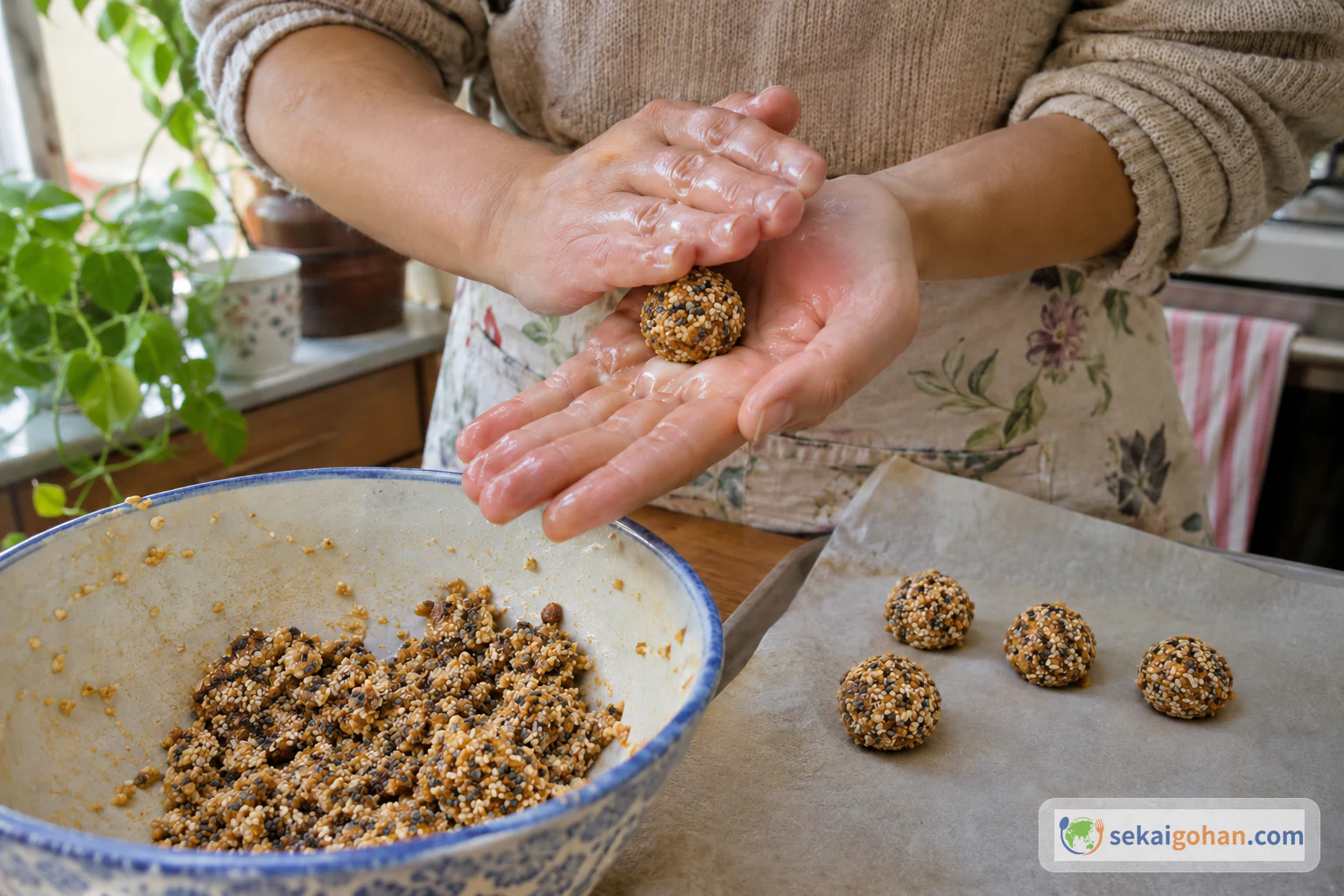
| Jaggery melts and turns sticky | Overmixed while hot, or warm hands | Cool your hands and roll small amounts at a time |
| The coconut scorched | Heat too high before the moisture was gone | Start again; the burnt taste stays. Keep the heat low and keep stirring |
Serving, Variations and Storage
At the table
Thala guli belong next to a cup of Ceylon tea, black and hot, or a coffee. They come out after a meal or in the lull of an afternoon, a few on a small plate for everyone to share. For guests or a celebration, wrap them in white fringed paper, which is how they look on Sri Lankan shop counters and festive tables. Snip fine fringes into both short ends of a paper strip, roll the ball in the middle, and twist each end.
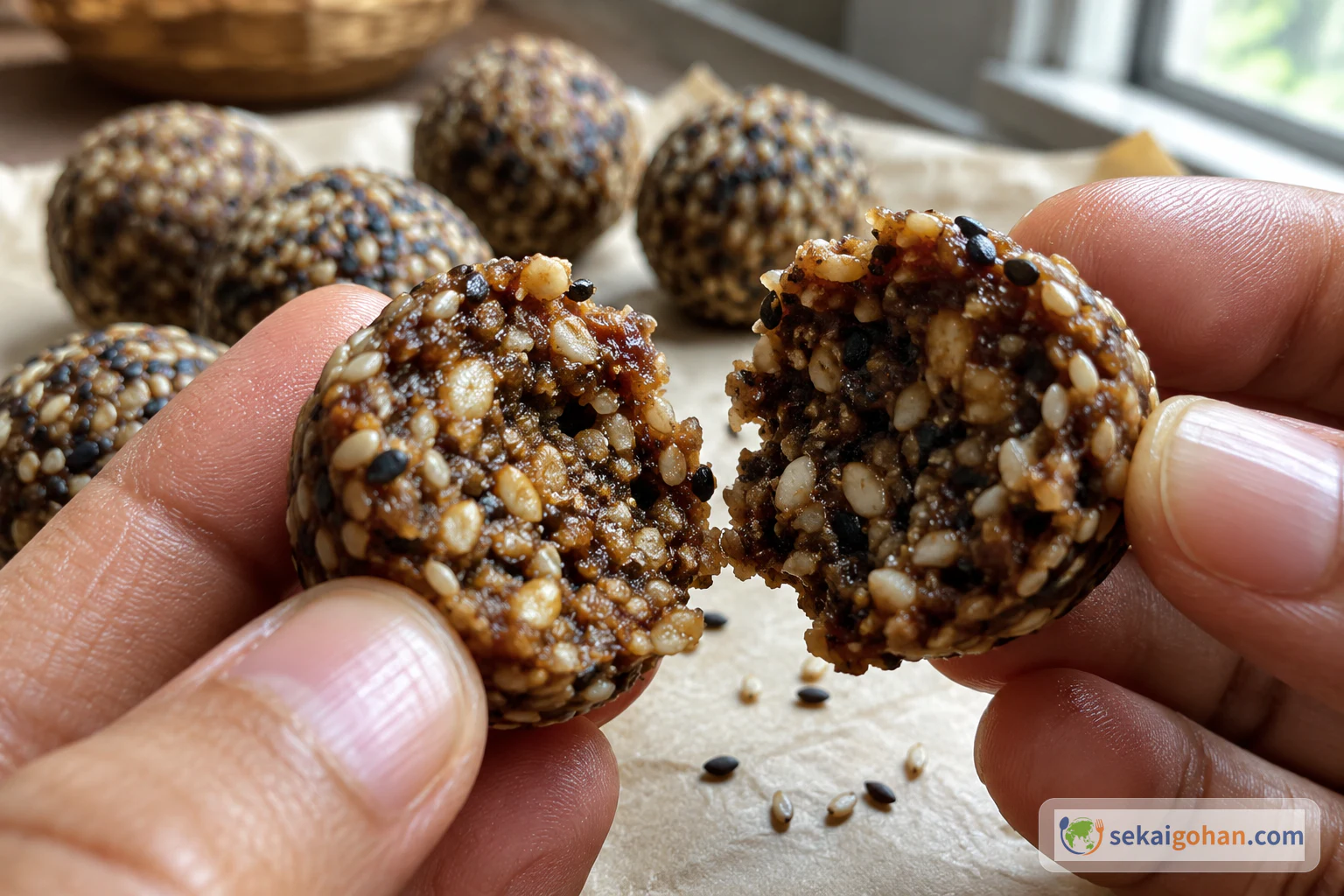
Break one open and you see the whole recipe at once. Inside are dense, coarse seed fragments, dark flecks of jaggery, and small glossy patches where the oil holds the grains together.
Variations
- Thala bola, the stick shape. Use the same mixture and roll it into short cylinders instead of balls. The taste stays the same; the stick is easier to wrap and to bite.
- All white sesame. Use white seeds for the full amount. The sweet comes out paler, with an even colour and a softer, less bitter edge.
- A pinch of cardamom. Add it with the jaggery. Its perfume comes forward, so pair it with a lighter, unsweetened tea.
- Japanese black sugar instead of jaggery. The aroma gets deeper and darker. The mixture binds less easily, so have coconut oil ready a few drops at a time.
Storage and hygiene
Shaping is done by hand and nothing is cooked afterwards, so wash your hands well, make sure the processor, bowls and containers are completely dry, and store the sweets in a clean container. Keep them in an airtight container in a cool, dark place, and move them to the refrigerator in hot, humid weather. Sweets made with desiccated coconut keep better than those made with fresh coconut, which holds more moisture. If you use fresh coconut, toasting it until it is no longer moist is essential.
The toasted seeds and coconut come off the pan hot. Let them cool until you can hold a handful comfortably before processing and rolling, but keep them warm enough to shape.
Frequently Asked Questions
I don't have a food processor. What can I use?
A mortar and pestle is the traditional tool. Pound the warm seeds, coconut and jaggery together in batches until the seeds are broken and the mixture clumps when pressed, then do the squeeze test. It takes more effort, and the texture comes out pleasantly rough.
Can I make them smoother?
Yes. Pulse a little longer for a finer crumb, but stop while the mixture still looks grainy rather than glossy. Past that point the sesame oil floods out, and the balls turn heavy and slump instead of holding a round shape.
Can I bind the mixture with kithul treacle instead?
That is a different sweet. Treacle-bound thala guli are made by boiling the syrup and folding it into the seeds, with its own proportions throughout. Adding treacle to these amounts would upset the balance of the mixture. For this version, bind with jaggery or palm sugar and a few drops of coconut oil.