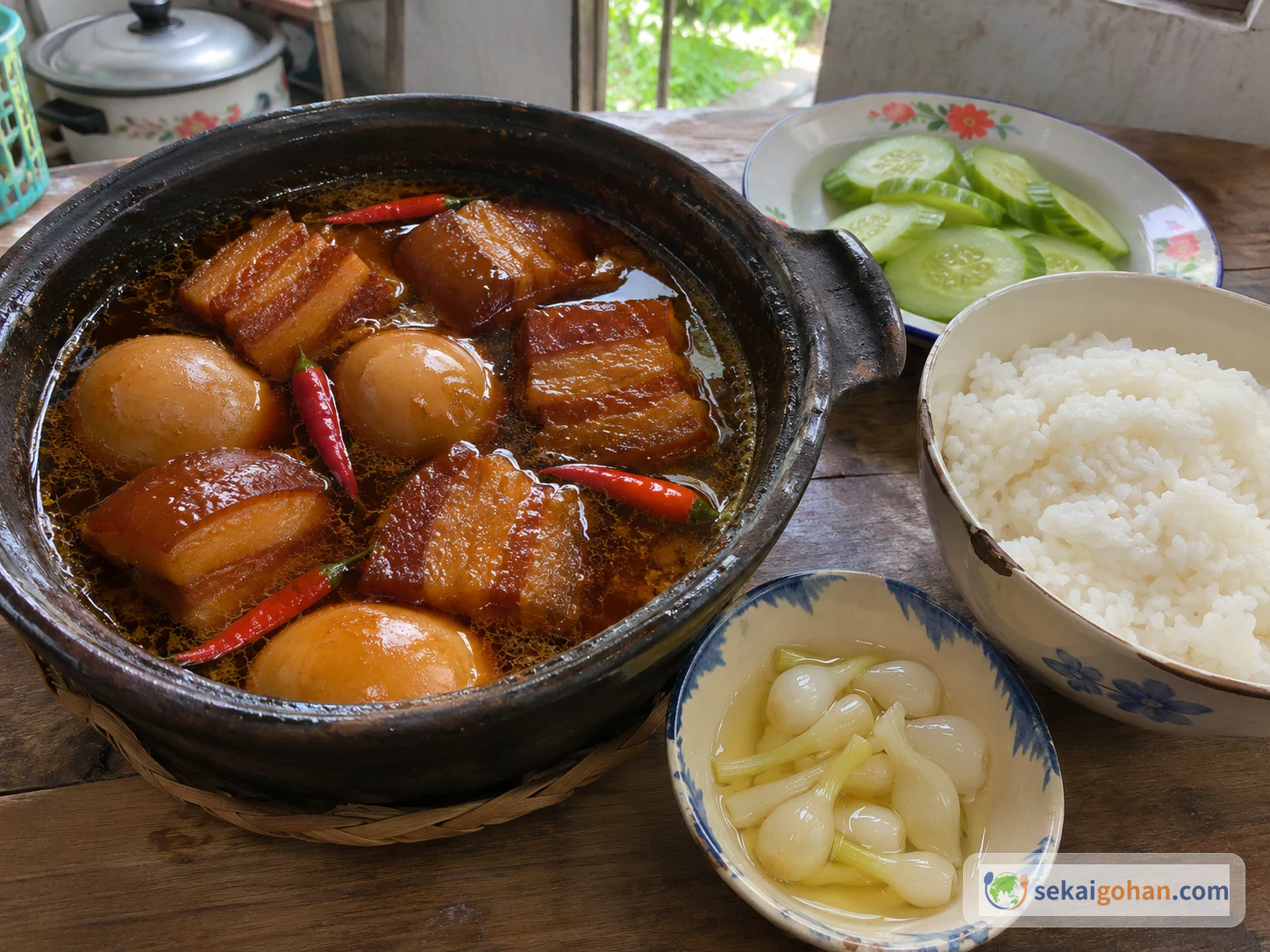
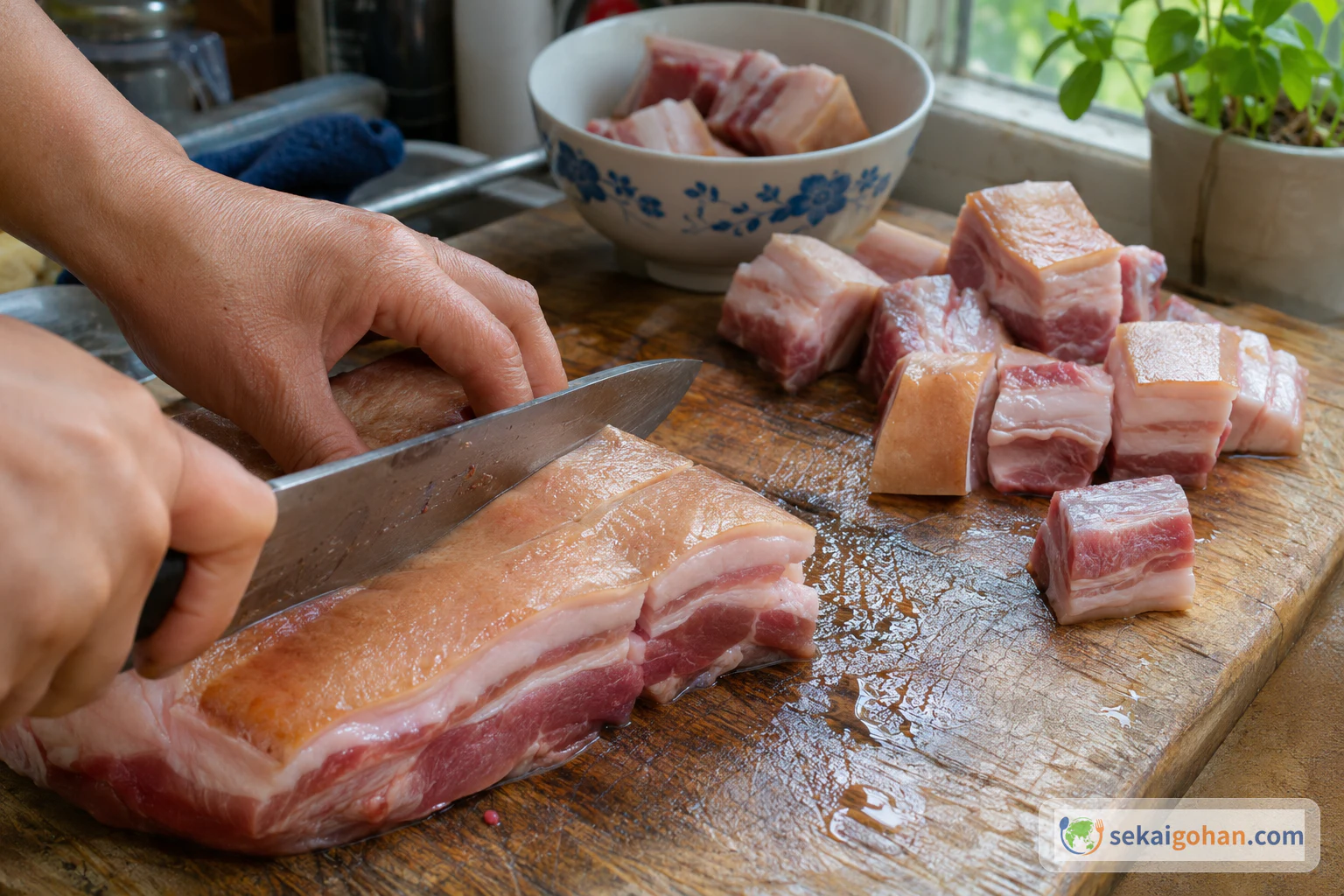
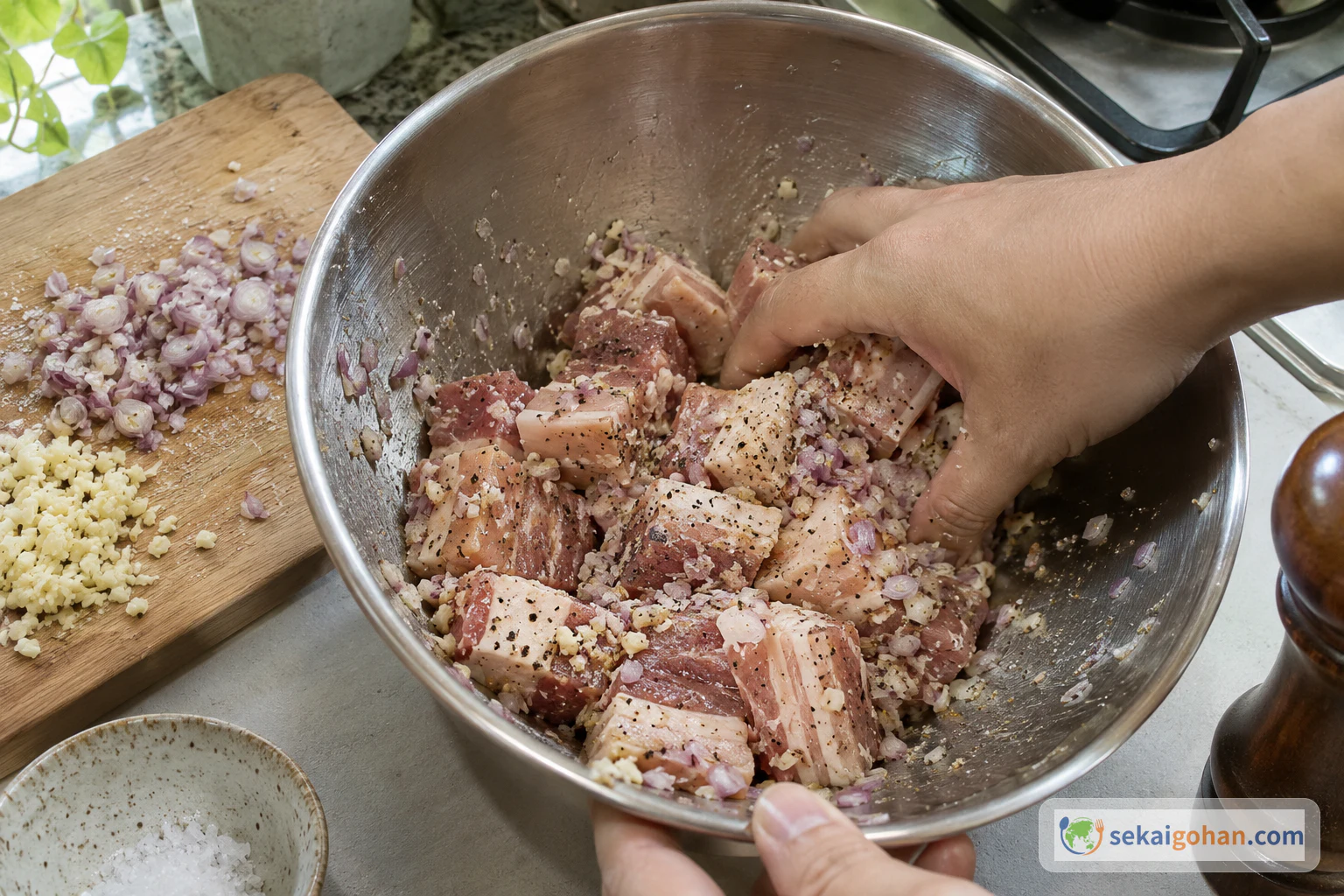
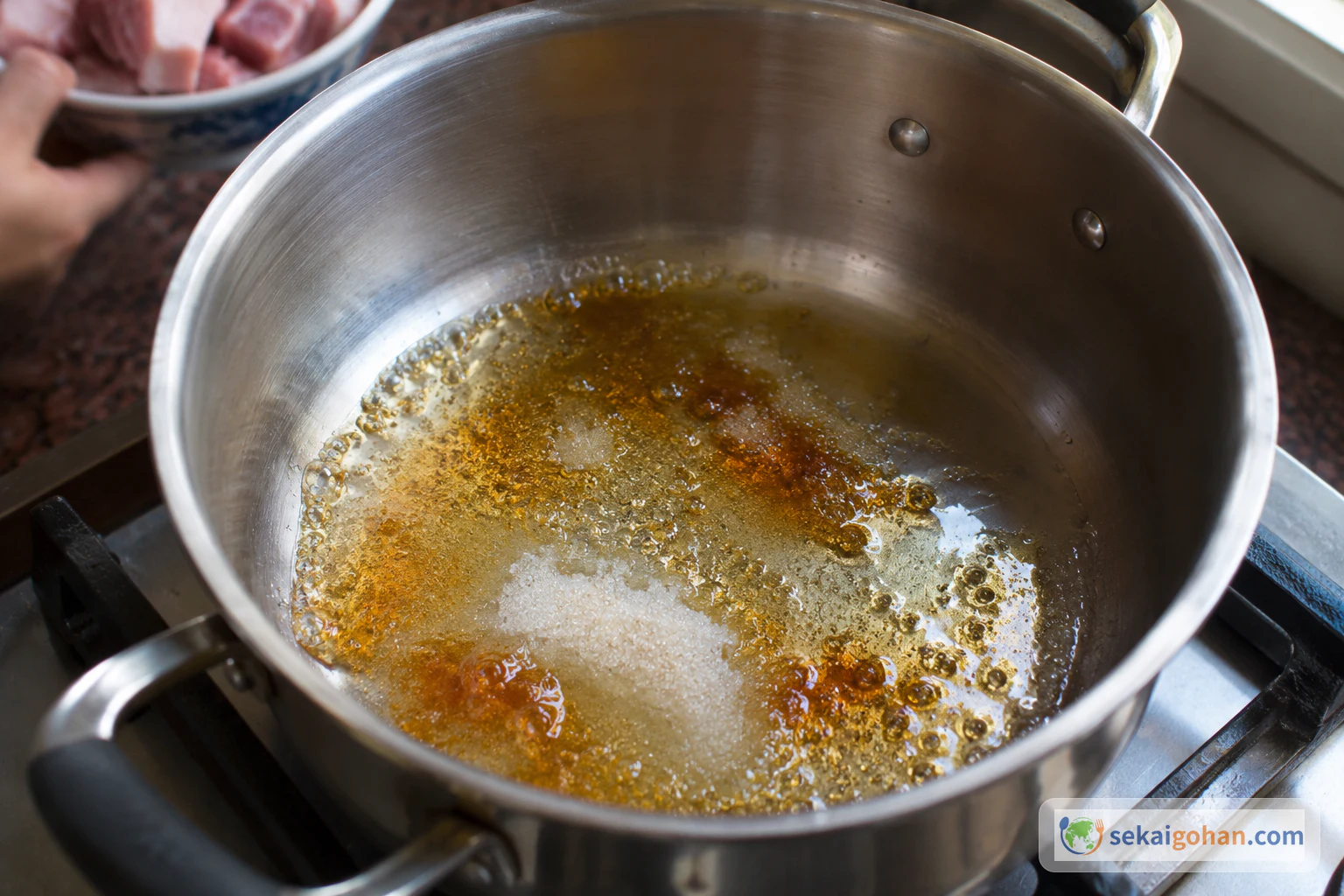
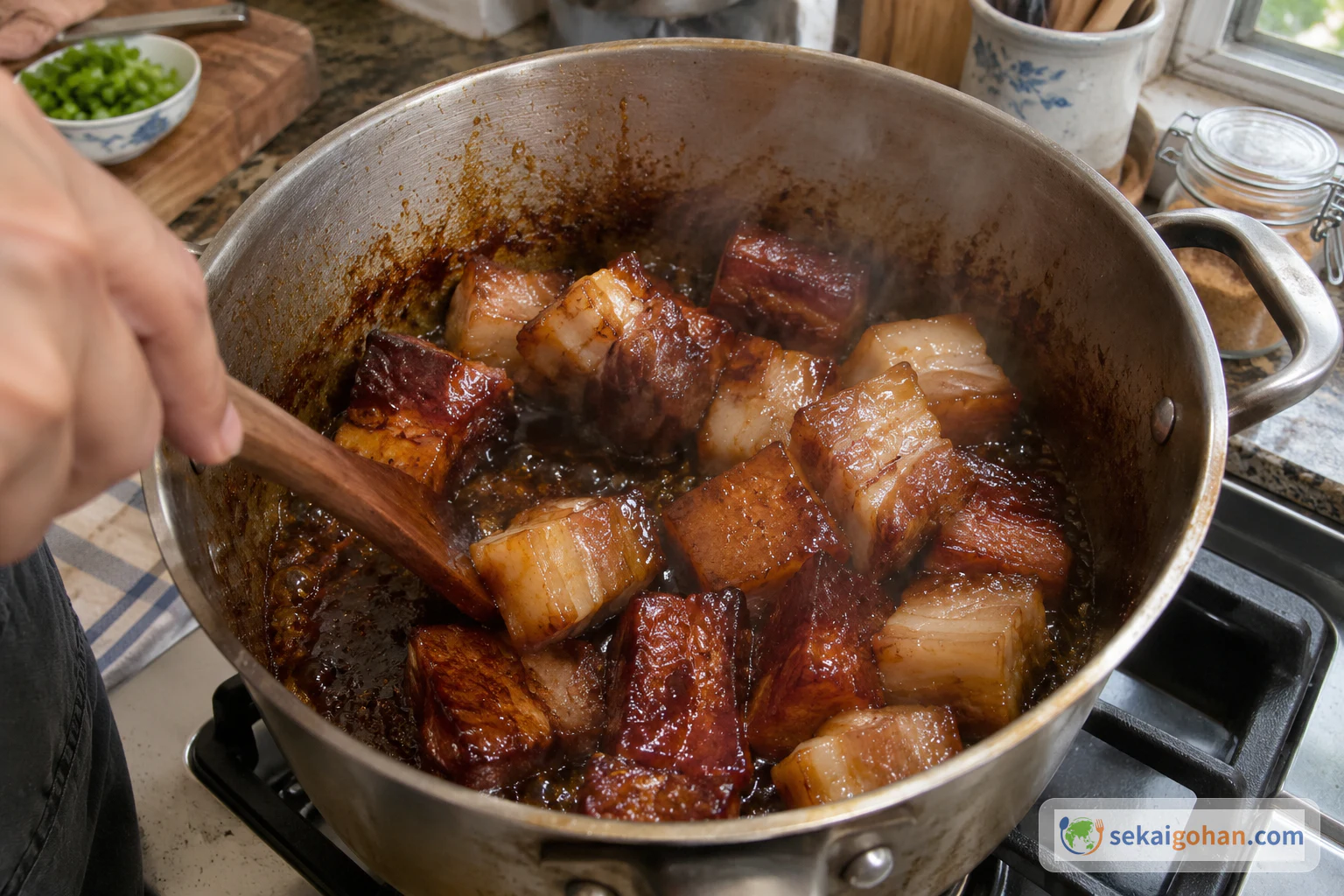
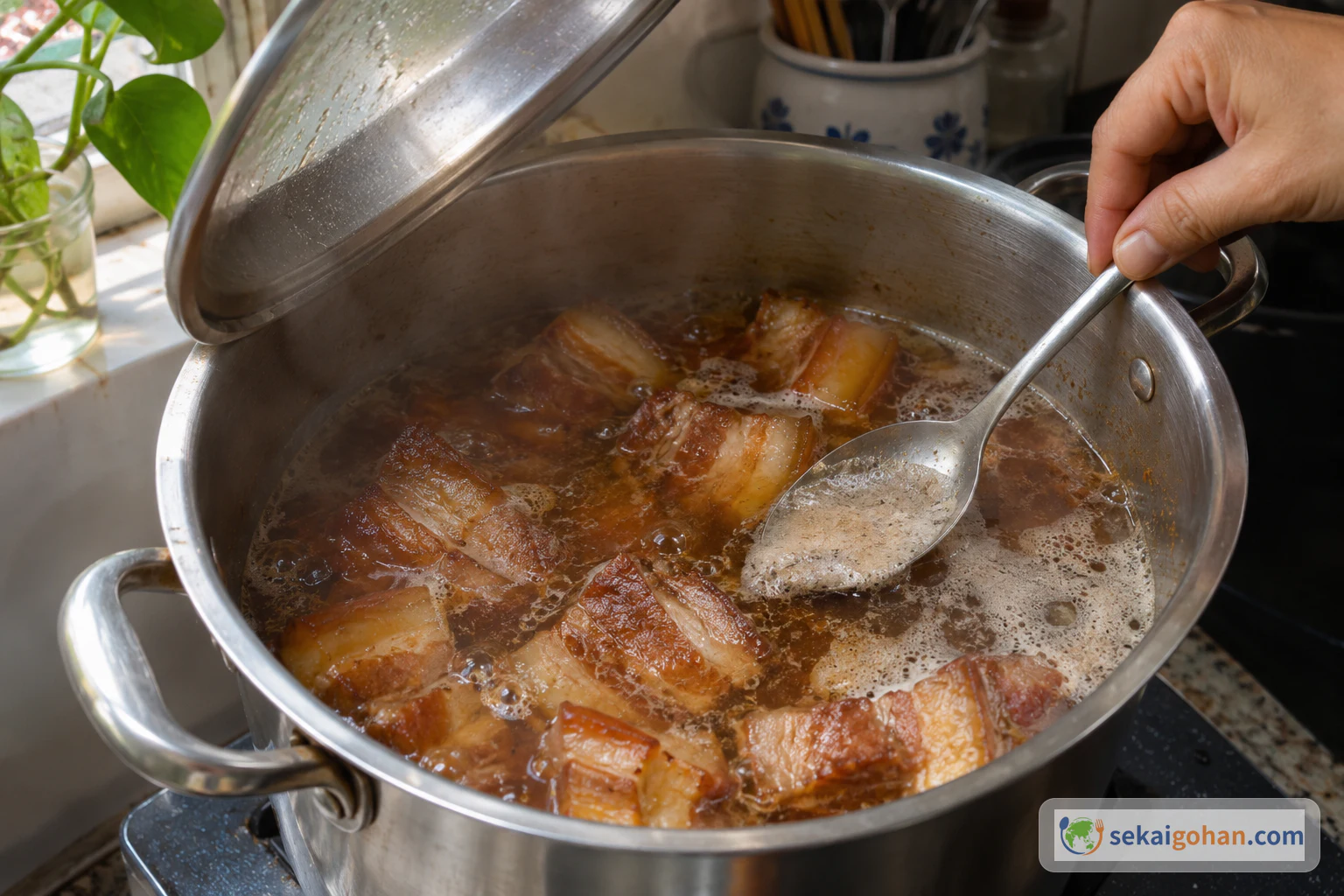
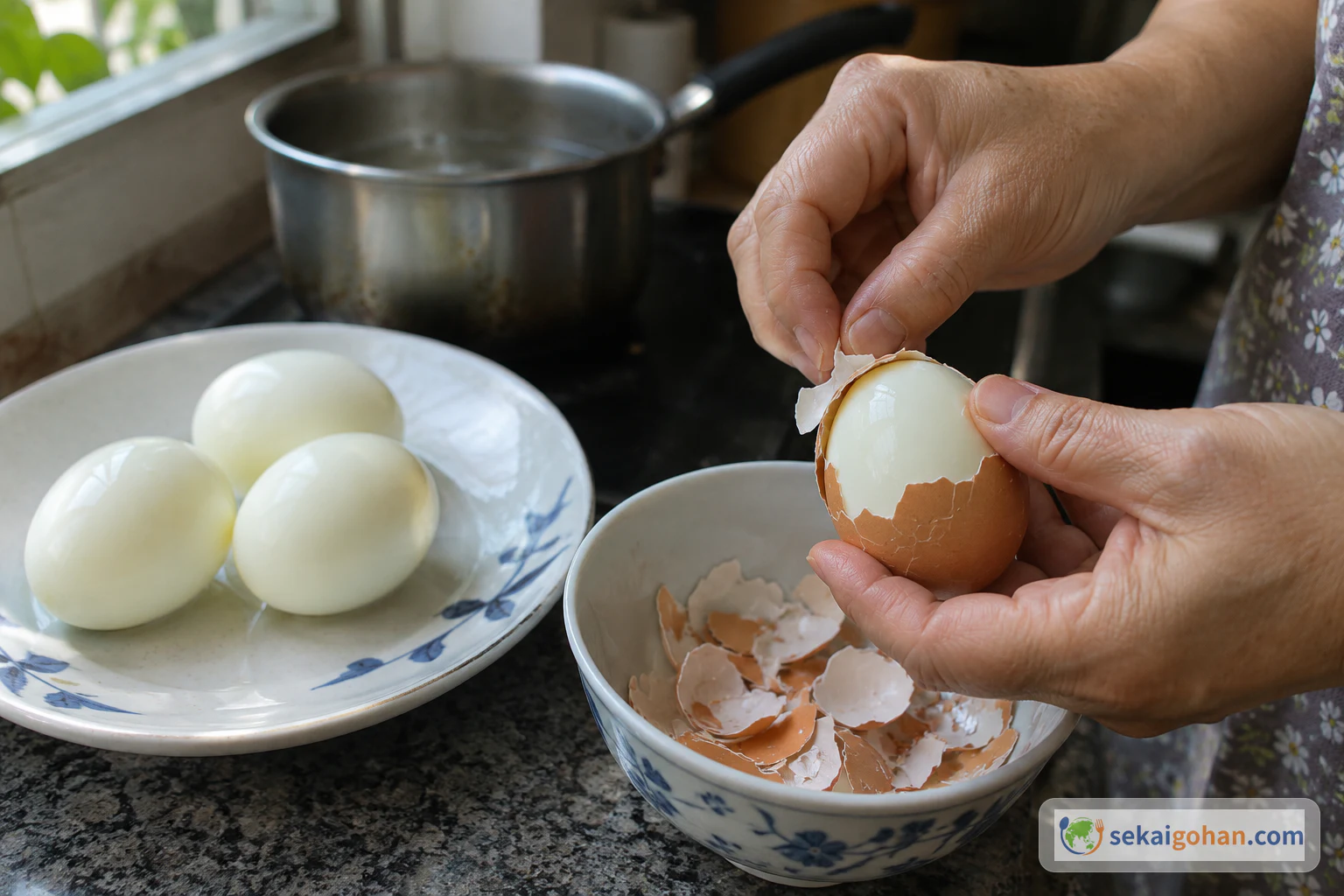
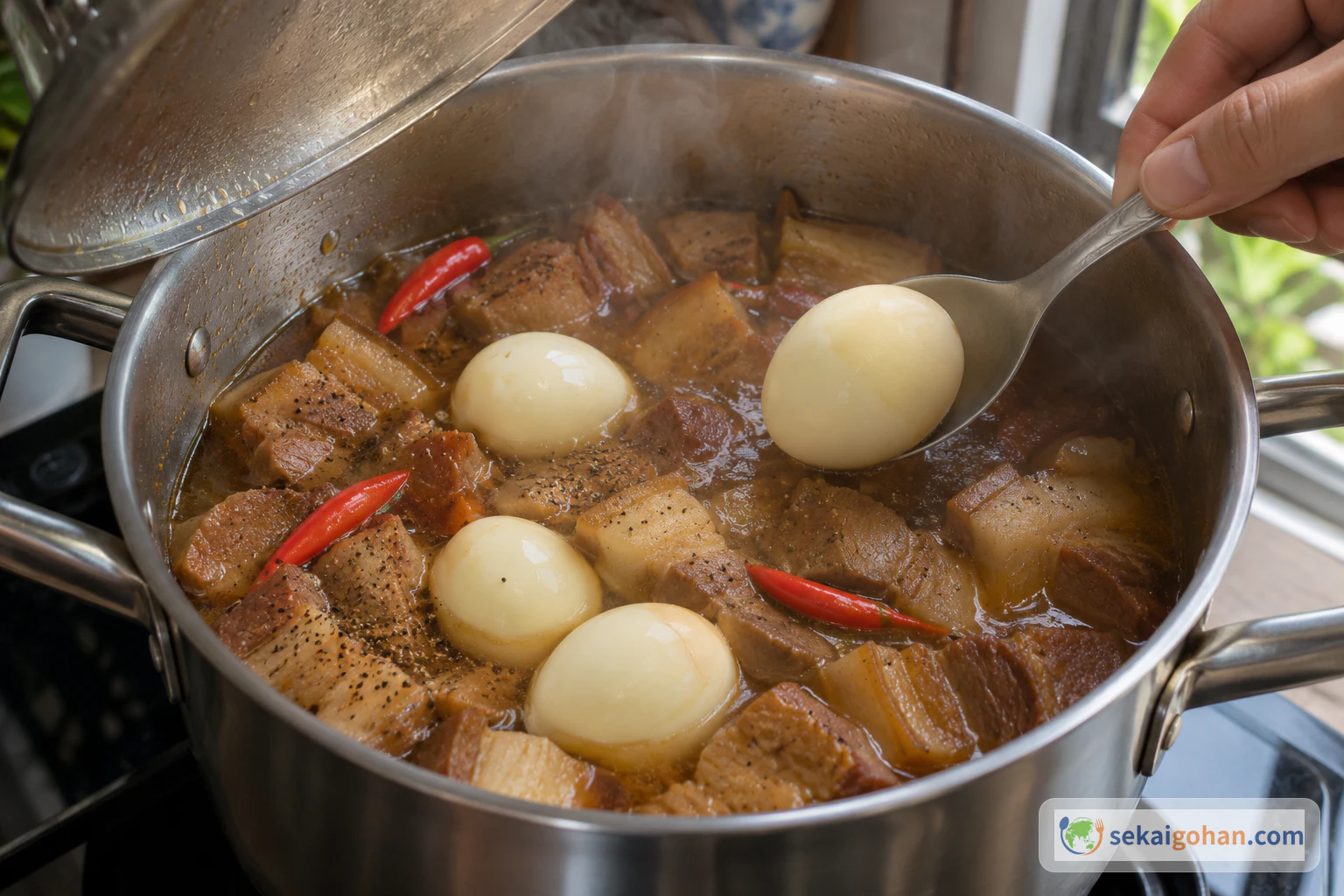
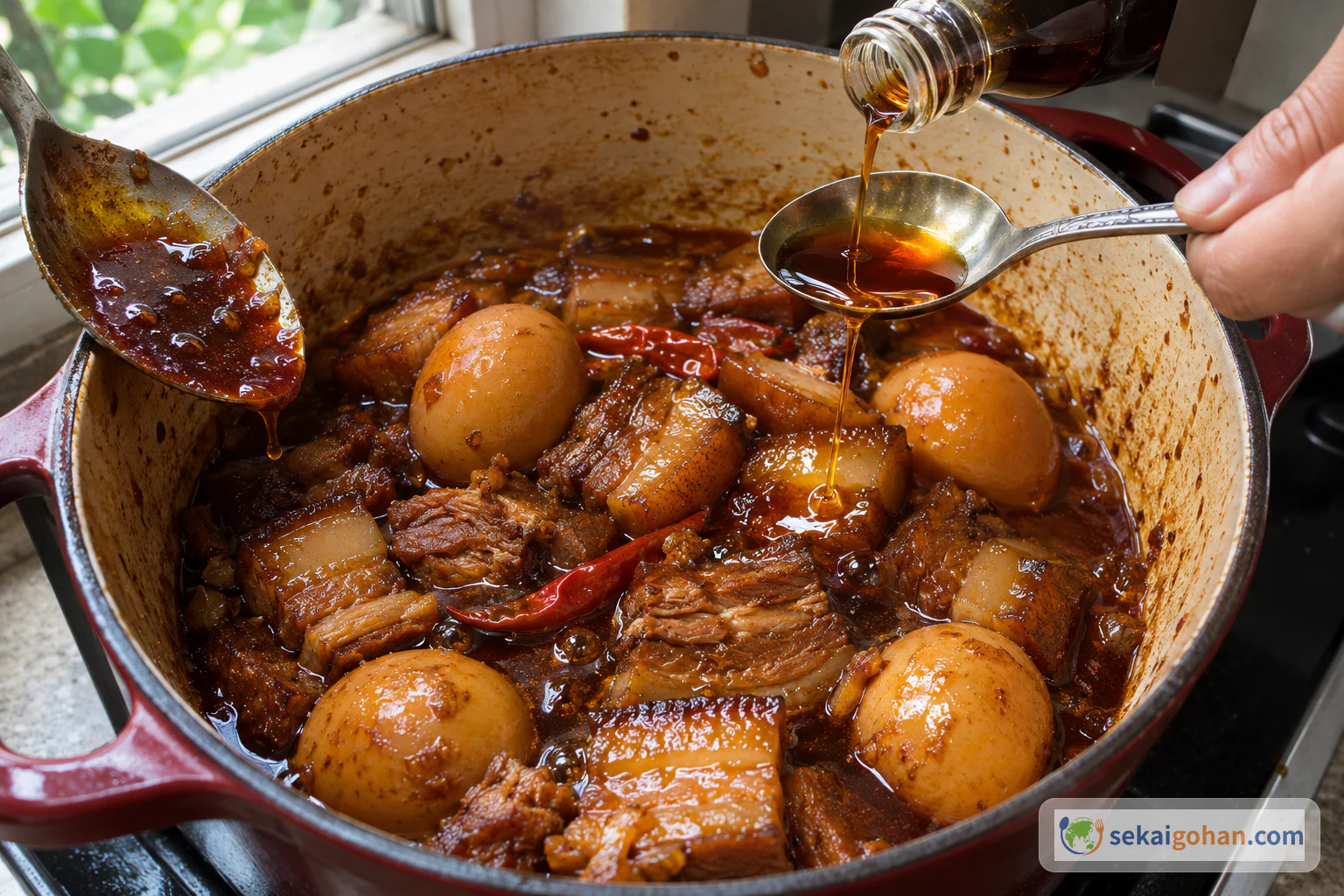
Start with the sugar. It sits in hot oil and you leave it alone until the edges go gold, then amber. Cubes of skin-on pork belly go in and hiss, and the caramel moves onto the meat as a deep brown crust. Clear coconut water goes in next, then whole peeled eggs, and the pot sits on a low flame for two hours. By the end the eggs are stained tan right through and the skin has gone soft and sticky.
Thịt kho tàu is pork and eggs braised in coconut water, and southern Vietnam makes it for Tết, the lunar new year. It tastes salty and sweet together. The sweetness comes from two places, the sugar caramel and the coconut water, and fish sauce added at the end sets the salt against them. The eggs are there because people want them. On many plates an egg is the first thing someone reaches for.
A Pot Made to Last Through Tết
Thịt kho tàu is made with leftovers in mind. In southern Vietnam families cook a big pot before the new year and eat from it over several days, so nobody has to stand at the stove during the holiday. The flavour improves after a few days. The pork takes in more of the liquid, and the eggs darken from the outside in.
Kho is the name of the technique. It braises, poaches, steams and slow-cooks all at once in one pot, traditionally a clay pot, until the food has taken in a salty-sweet liquid. Vietnamese cooks use it for fish, tofu and vegetables as well as pork. Thịt kho tàu is the festive pork version, and you will also hear it called thịt kho trứng (braised pork with eggs) or thịt kho nước dừa (braised pork in coconut water). Made with duck eggs, it becomes thịt kho hột vịt. Compare it with bò kho, the other well-known Vietnamese braise. Bò kho is beef perfumed with lemongrass, star anise and five-spice. Thịt kho tàu has no spice-cabinet aromas at all. It relies on pork, coconut water, eggs and fish sauce, and it is the dish people make ahead for the holiday.
Every household's own pot
Families agree on the name, and the method changes from kitchen to kitchen. Some cooks make a sugar caramel for colour, as this recipe does. Others leave out the sugar and let long-cooked coconut water bring the colour. Some cook the eggs as they are, and others fry them briefly first to give them a darker skin. Some households braise in two rounds. The first round cooks the liquid down by half, the pot cools, and the eggs go in for a second round until little liquid is left. Restaurant cooks sometimes blanch the pork and marinate it for hours. Pork shoulder sometimes replaces belly. Nobody treats any of these as the one correct way.
Nobody agrees on where the name comes from. One story says the dish was cooked aboard deep-sea fishing boats (tàu) and eaten with eggs on long voyages. Another says that in the Mekong Delta tàu describes a gentle salty-sweet taste. That fits coconut water and fish sauce well, and the word turns up in delta place names such as Cái Tàu and the Lòng Tàu river. Both stories are still told. For more of the country's food, see our guide to Vietnam.
Ingredients (serves 4 to 6)
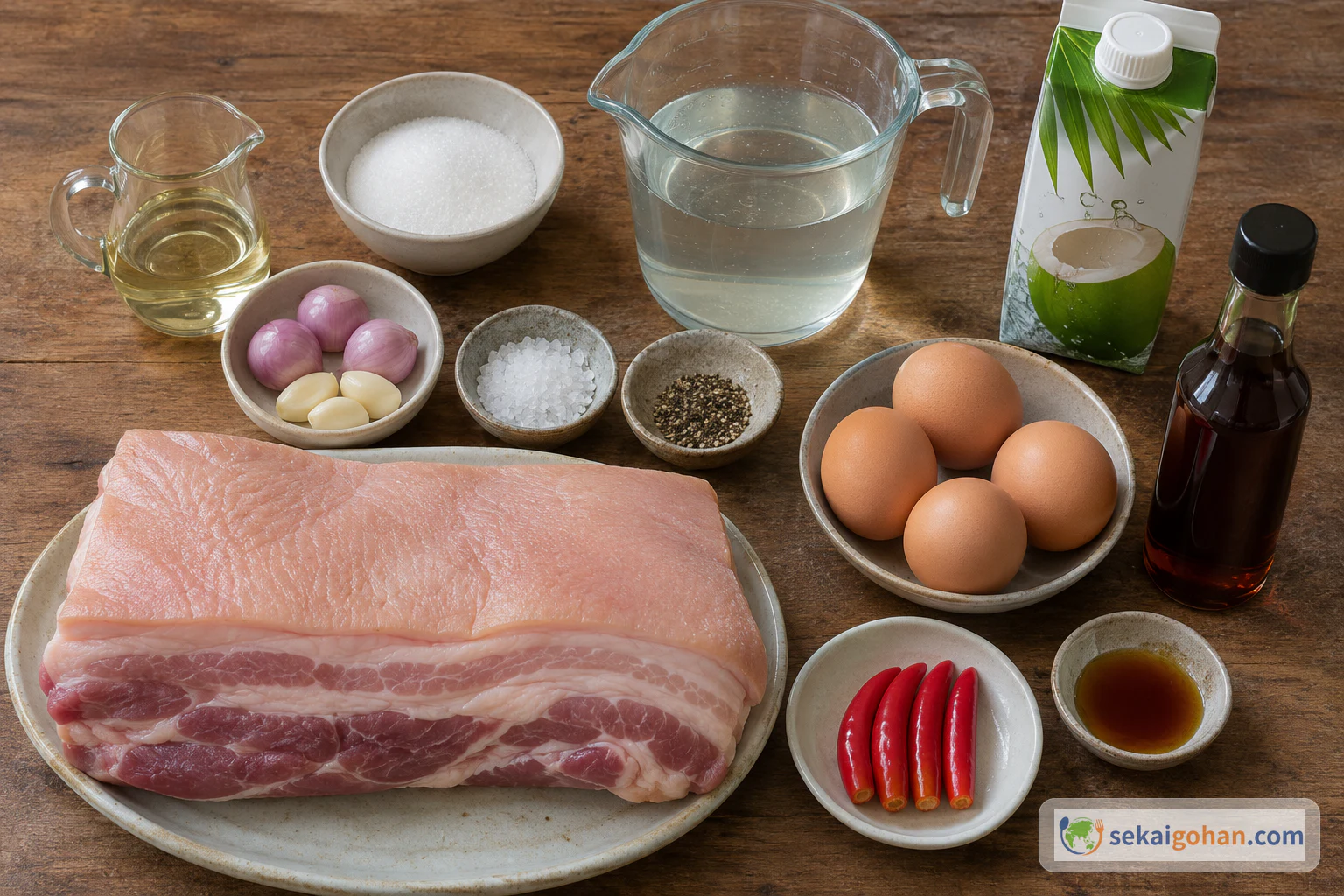
This dish contains egg, and fish in the fish sauce. If you serve raw herbs or vegetables alongside, cut them on a different board from the one used for raw pork.
Equipment
- A heavy, wide pot, about 9½ inches (24 cm), with a lid, big enough for the pork and the coconut water
- Chef's knife and cutting board
- Mixing bowl
- Small saucepan for boiling the eggs
- Shallow spoon for skimming
- Measuring spoons
- A drop lid or a sheet of parchment, for when the liquid reduces too fast
- A kitchen thermometer (useful when reheating, optional)
Choosing and Substituting
The coconut water and fish sauce give the dish its taste, so those are the two to get right. Buy unsweetened coconut water, not coconut milk. Coconut milk is thick and white and makes a creamy curry-like sauce. Coconut water is thin and clear, and it braises the pork in sweetness without turning the liquid cloudy. If you cannot find it, use water and add a little extra sweetness at the end. Cider or lemonade also works and brings its own tang. Look for nước mắm at an Asian grocer. Thai fish sauce can stand in, though its aroma and saltiness are different, and fish sauces vary a lot in salt from bottle to bottle. That is why it goes in at the end, in stages.
Swaps for the rest:
- Skinless pork belly. It can work, but expect a thinner, less sticky liquid, because the skin is what gives it body.
- Boneless pork leg. It has less fat and braises firmer and leaner.
- Red onion or regular onion for shallots. Use half a small red onion or a quarter of a regular onion. The aroma is a little weaker.
- Regular white sugar for superfine sugar. It is fine, but it can colour faster, so keep the heat a touch lower. Brown or dark sugars change both the colour and the flavour of the caramel.
- Dried chillies for fresh bird's eye. They change the fragrance and the texture.
- Sugar for coconut syrup. Sugar works perfectly well for the final sweetening.
Method
Cut and season the pork first, and measure the caramel ingredients before you light the burner, because the sugar moves fast once it starts to colour. Once the coconut water is in, everything slows down. Boil the eggs while the pot comes to a simmer, and after that the long braise needs only a stir now and then.
When It Goes Wrong
| What you see | Why | What to do |
|---|---|---|
| The caramel tastes bitter or smells burnt | The sugar went past amber, often because the heat was raised to hurry it | Start again with fresh oil and sugar. The braise will not cook the bitterness out |
| The sugar went grainy and lumpy | It was stirred while melting | Next time scatter it evenly and leave it alone for the full 3½ to 4 minutes |
| The pork is tough | The pot boiled hard, or it did not braise long enough | Lower the heat to a bare simmer and keep going. Do not cut the braise below 2 hours |
| The liquid is too salty | Too much fish sauce went in at once | Add a little coconut water or water to bring the liquid back, then simmer briefly |
| The liquid reduces too fast | Too much steam escapes around the lid | Lay a drop lid or a sheet of parchment directly on the surface under the lid |
| The eggs split or the yolk shows | The whites tore during peeling, or the eggs were stirred hard | Peel under running water, lower the eggs in gently, and only turn them during the braise |
Serving, Variations and Leftovers
At the table
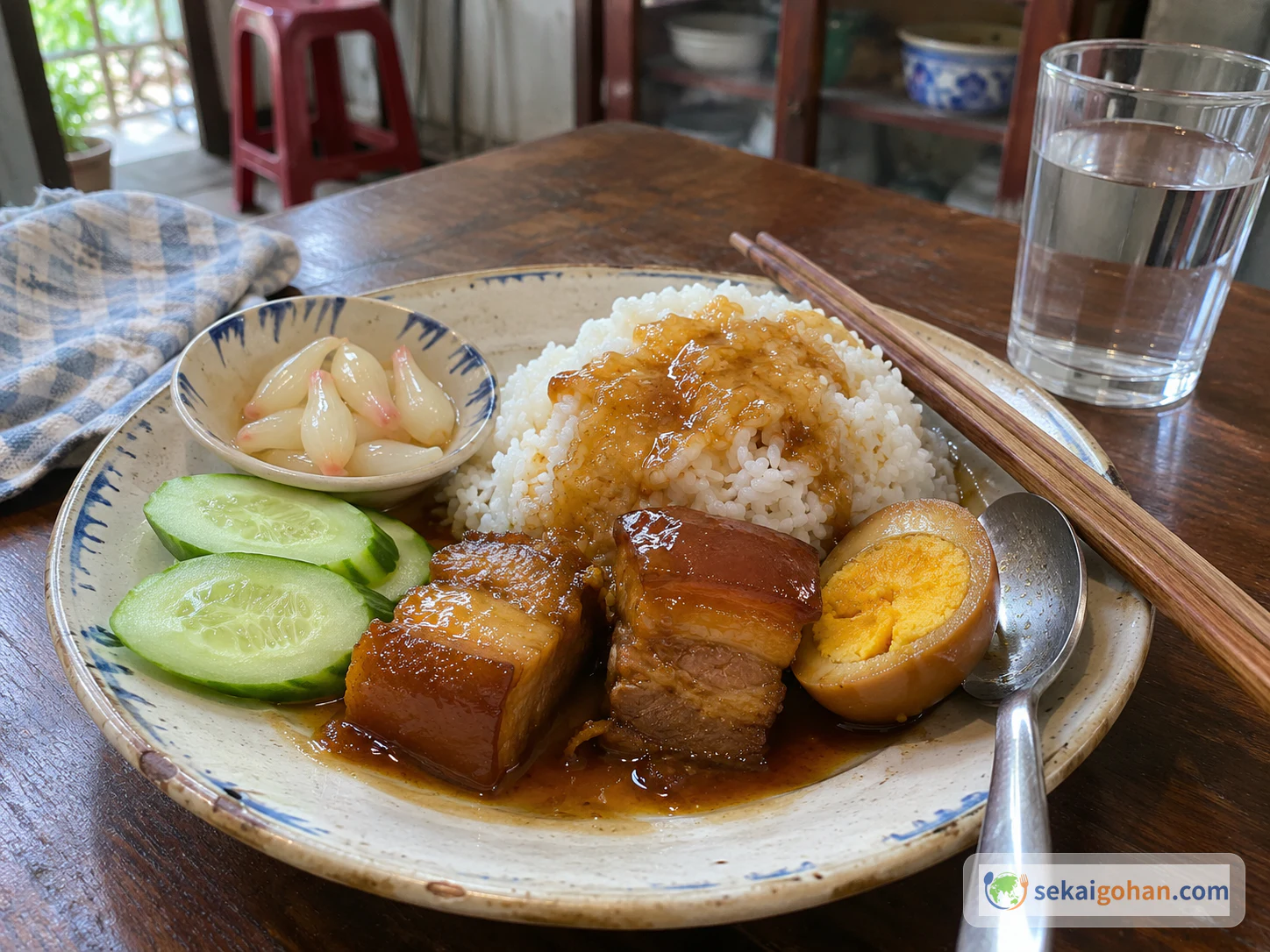
Serve thịt kho tàu over steamed white rice with plenty of the liquid poured over. Southern tables put sharp pickles beside it to cut the richness. The usual ones are củ kiệu (pickled scallion bulbs), dưa ghém (sweet-sour pickled vegetables), cải chua (pickled mustard greens) and pickled bean sprouts. Another way to eat it is to wrap a piece of pork with fresh vegetables in bánh tráng rice paper. Outside Vietnam, sweet pickled shallots or scallions and some salted sliced cucumber come close to the same contrast.
Variations
- Quail eggs. Use 12 quail eggs instead of the hens' eggs, or mix the two. Each one is a single bite and easy to share out to children's plates.
- Half batch. Halve every ingredient by the same factor of ½: 1.1 lb (500 g) pork, ¼ tsp each of salt and pepper, 1½ tbsp each of oil and sugar, and so on. This suits a smaller pot.
- Milder heat. Use 2 chillies instead of 4. Leave them whole as before.
- Lighter the next day. After a night in the fridge the fat sets white on top. Lift it off before reheating. The flavour stays just as deep and the dish eats lighter.
Keeping it
Pork must reach 167°F (75°C) at the centre for at least 1 minute. The long simmer takes it well past that. Let the pot cool briefly, then divide it into shallow containers so it chills fast, cover it, and refrigerate it at 50°F (10°C) or below. Do not leave it out at room temperature overnight. Reheat only what you will eat, with its liquid, to 167°F (75°C) or above. On the stove, heat it until it is just about to boil. In the microwave, stir once partway through because it heats unevenly. Eat it up soon, and throw out anything that has been kept too long.
Frequently Asked Questions
Do I need to blanch the pork first?
No. Some restaurant versions blanch the pork before marinating it, but this recipe skips that. Skimming once the coconut water goes in keeps the liquid clear without it.
Can I keep the egg yolks soft?
Not in this dish. The eggs are hard-boiled and then braised for the full two hours, so the yolks are firm and the liquid soaks deep into the whites. That stained, firm egg is what people come back for.
Is it very sweet?
It tastes salty and sweet in balance, not sugary. The caramel and coconut water bring the sweetness, and the fish sauce at the end pulls it back. If it leans sweet, add fish sauce a little at a time. If it leans salty, add more of the coconut syrup or sugar.
Can I make it in a clay pot?
Yes. Kho is traditionally cooked in a clay pot, and a heavy pot that holds heat evenly is what you want for the long, low braise. Make the caramel over medium heat so the sugar colours evenly, and keep the braise at a bare simmer.