You can tell by the stickiness at the bottom of the pot: a staple of the Sahel
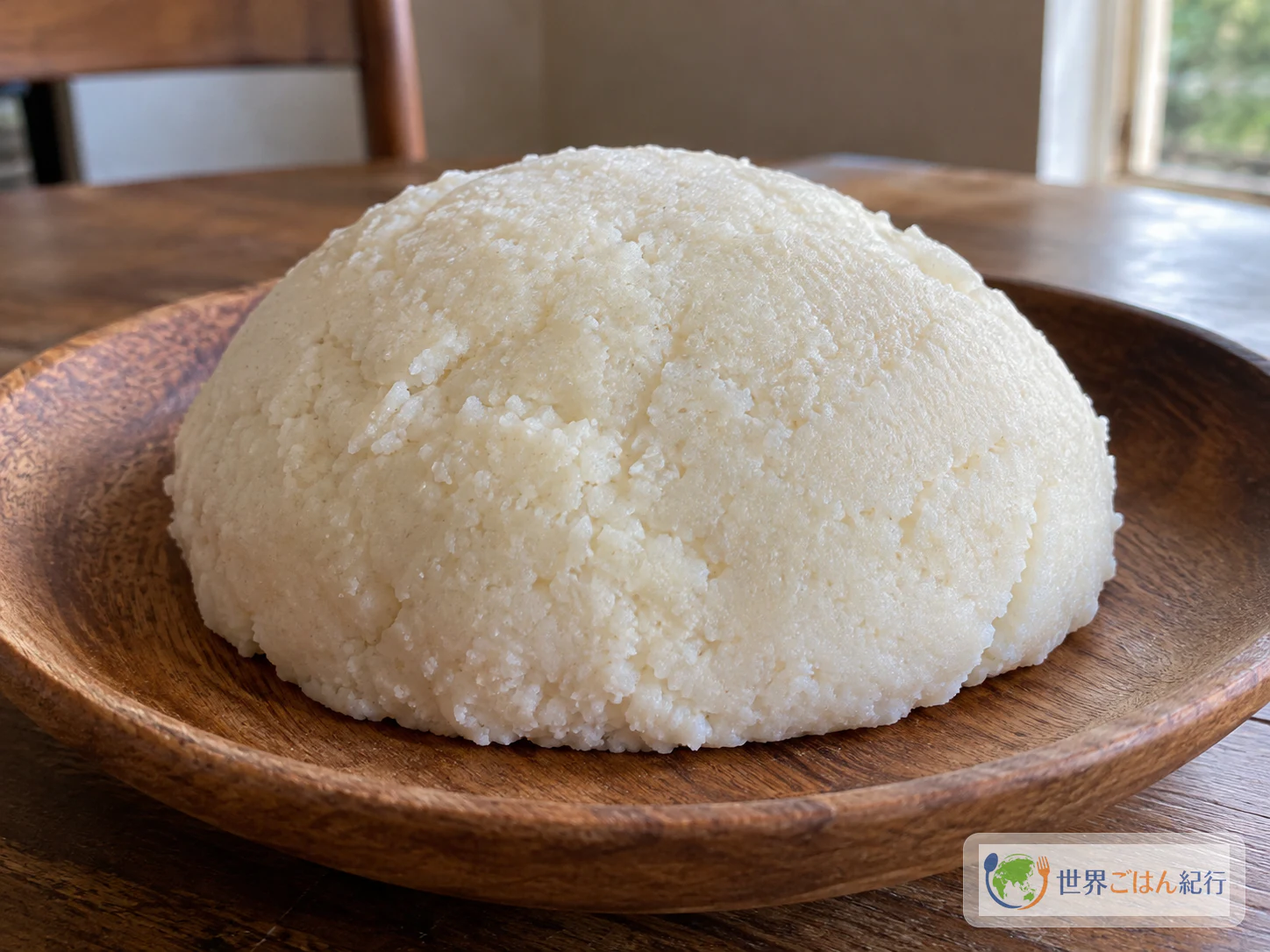
The white liquid of flour stirred into water is thin when it first goes into the pot. A few minutes later, the tip of the wooden spoon suddenly turns heavy and the sound of scraping the bottom drops lower. This is where making esh gets interesting. As you work it over low heat, pushing back against the pot, the porridge becomes a single mass and turns into a soft dumpling that can take sauce.
Esh is a stiff staple made from millet or sorghum, eaten in Chad. English-language sources introduce the name Esh as "boiled millet flour" eaten by the Arab population in the north. In French-speaking Chad, the same kind of grain ball is often described as boule de mil or simply boule, and it is more natural to understand it at home as a flour-based staple eaten with sauce.

The hard part outside Chad is less the ingredient names than the heat. Sorghum flour does not hold together with elasticity like wheat flour, and its aroma is stronger than a porridge of cornmeal alone. With too little water it crumbles; with too much it spreads on the plate. This recipe is built around sorghum flour with a little millet flour, mixing a slurry first and then cooking it in the pot. The sauce leans toward the okra, tomato and peanut combination often seen at Chadian tables, and separates what you can buy nearby from what is worth looking for online.
Get the flow before you start

On esh day, it is calmer to make the sauce first. Once you begin stirring a grain dumpling you can't leave it. If you stir the flour while simmering okra sauce beside it, one of them will burn. For home cooks, it works best to simmer the okra and tomato, build body with peanuts, get it to a state where it can be kept warm over low heat, and then move on to the esh itself.
| Stage | Kitchen guide | Key to avoiding failure |
|---|---|---|
| Mix flour into water | 10 minutes, no heat | Get rid of the big lumps here |
| Simmer the sauce | 30 minutes, medium to low heat | Chop the okra first and loosen the peanuts separately |
| Stir the esh | 20 minutes over low heat | Don't add the remaining flour all at once |
| Serve | 5 minutes, while warm | Wet the bowl with water to shape it |
Among similar stirred staples, Tanzanian ugali is led by the white elasticity of cornmeal, and Burkina Faso's tô pairs the aroma of sorghum with okra sauce. Esh is close to both, but it is a dish that strongly treats the grain dumpling as a vessel for sauce, as is characteristic of the Chadian table.
Ingredients

This uses peanuts and fish. If you have allergies, don't make this recipe as written; build a different dish by replacing the peanuts with white sesame paste and the dried fish with kombu stock. The esh itself contains no wheat, but some flours may be contaminated with wheat on the production line, so check the label if you must avoid gluten strictly.
What is worth looking for when shopping

Okra, tomatoes, onion, garlic, meat and dried fish are things to buy nearby; an ordinary supermarket is enough. What is worth looking for specialty are three things: sorghum flour, unsweetened peanut butter and a heavy pot. A sweet peanut cream makes the sauce too sweet to rescue, and a thin pot sets only at the bottom when you stir flour.
Sorghum flour creates the grain character of esh. Using all cornmeal moves it toward ugali or polenta rather than Chadian esh.
Peanuts create aroma and body at once. Choose an unsweetened type, not the sweet spread made for bread.
Esh tends to stick to the bottom of the pot while you stir. A pot with a thick base that does not move when you put force on the wooden spoon is better than a thin saucepan.
Method
You use two pots: a small pot or frying pan for the sauce and a heavy pot for the esh. Once you start stirring the esh, there is no time to touch your phone. Light the heat only after you have water, flour, a wooden spoon and a wet small bowl all within reach.
What to keep and what to replace in an outside kitchen

Esh is a "stirred flour staple," so by appearance alone you could make it with all sorts of flours. But substituting anything dilutes what makes it Chadian. What to preserve is the aroma of the sorghum and millet widely used in the Sahel, the firmness that you can tear by hand, and the way of eating it with a sticky sauce.
| Element | Local thinking | Where to land at home |
|---|---|---|
| Grain | Millet or sorghum stirred into a staple | Center on white sorghum flour with a little millet flour |
| Sauce | Boule or esh is always eaten with sauce | Build stickiness and richness with okra, tomato and peanuts |
| Fish umami | A little dried fish or meat umami goes in | Use dried small fish; halve it if too strong |
| How to eat | Tear by hand and scoop up sauce | A spoon is fine at home, but use hand-eating as the standard for firmness |
Frozen okra is fine to use. But because frozen okra releases water, don't put it into the pot frozen; spread it on a colander and brush off the frost on the surface first. The finer the chop, the stronger the stickiness. Cut 5 mm wide on days you want a looser sauce and coarsely chop on days you want it to cling.
If you can't find millet flour, you can use 300 g white sorghum flour. The aroma is not exactly the same, but it doesn't stray far from esh. Making it from wheat flour only, potato starch only or rice flour only, on the other hand, changes both the stickiness and the aroma. To keep it realistic in an outside kitchen, keep at least the sorghum flour.
The most common failure is adding all the flour at once after you start stirring. The flour floats on the surface and lumps, and the inside stays raw. Always add the remaining flour in 4 portions and stir until it completely disappears each time. If the bottom of the pot scorches, don't scrape it up and mix it in; the burnt smell will spread through everything. It is better to move only the clean upper part to another pot, add 2 tbsp hot water and bring it back over low heat.
How to eat, menu, and storage

It is easier to eat if you place the esh in the center of the plate and pour the sauce from the side. Mixing everything from the start loses the texture of the grain dumpling. If eating by hand, make a hollow with your thumb and scoop up the sauce. At a regular table, simply cutting bite-sized pieces with a spoon and coating them in sauce is enough.
For a menu, a sour tomato salad on the side keeps it from getting too heavy. When you want to add greens, a sauté like Kenya's sukuma wiki goes well. If you want to compare stirred staples, move on to Botswana's bogobe jwa lerotse or Ghana's banku and the differences in flour, fermentation and sauce become visible.
For storage, keep esh and sauce apart. Put esh in a shallow container to cool, press plastic wrap against the surface, and refrigerate for up to 2 days. The sauce also keeps up to 2 days in the refrigerator. To reheat, sprinkle 2 tbsp of water over one serving of esh, microwave at 600 W for 1 minute 30 seconds and then stir. If it is still hard, add 30 seconds at a time. To reheat in a pot, use low heat and add hot water 1 tbsp at a time while stirring.
You can freeze it, but a grainy texture tends to appear after thawing. If you freeze, cut it into bite-sized pieces and drop them into soup or leftover okra sauce to eat. Frozen as finished hemispheres, the surface tends to crack when thawed.
Frequently asked questions
Are esh, tô and ugali the same dish?
They are close, but not quite the same. All are staples of stirred grain flour, but ugali centers on cornmeal, tô is a more West African staple of sorghum or millet eaten with sauce, and esh is a stirred ball of millet or sorghum discussed in the Chadian context. At home, make the difference through the type of flour and the sauce you pair it with.
Can I make it without millet flour?
Yes. Proceed with 300 g white sorghum flour and 850 ml water. Leaving out millet flour makes the aroma a little more one-note, but the method of stirring and the structure of the sauce are preserved. Water needs differ by product, so adjust at the end with 2 tbsp of hot water at a time.
I don't like the sliminess of okra
Slicing the okra into 5 mm rounds and simmering uncovered keeps the sliminess modest. Coarsely chopping and covering increases it. Since esh is a dish that takes sauce, it is easier to eat if you leave some stickiness, so that it falls slowly from the wooden spoon, rather than making it completely thin.
Can I use sweetened peanut butter?
Better not to. Sweetened peanut cream makes the tomato and okra sauce sweet, and salt or chile can hardly bring it back. If you have no unsweetened type, coarsely crush 80 g of unsalted roasted peanuts in a mortar or food processor and loosen with hot cooking liquid.
Can I make it without meat?
Yes. Leave out the beef and increase the dried small fish to 30 g to keep the umami. If you want to avoid fish as well, rehydrate 8 g of dried shiitake and use the soaking liquid as part of the water. In that case it is more natural to enjoy it as a vegetarian version of grain dumpling with okra-peanut sauce than as the exact taste of Chad.