The aroma that begins before you open the lotus leaf
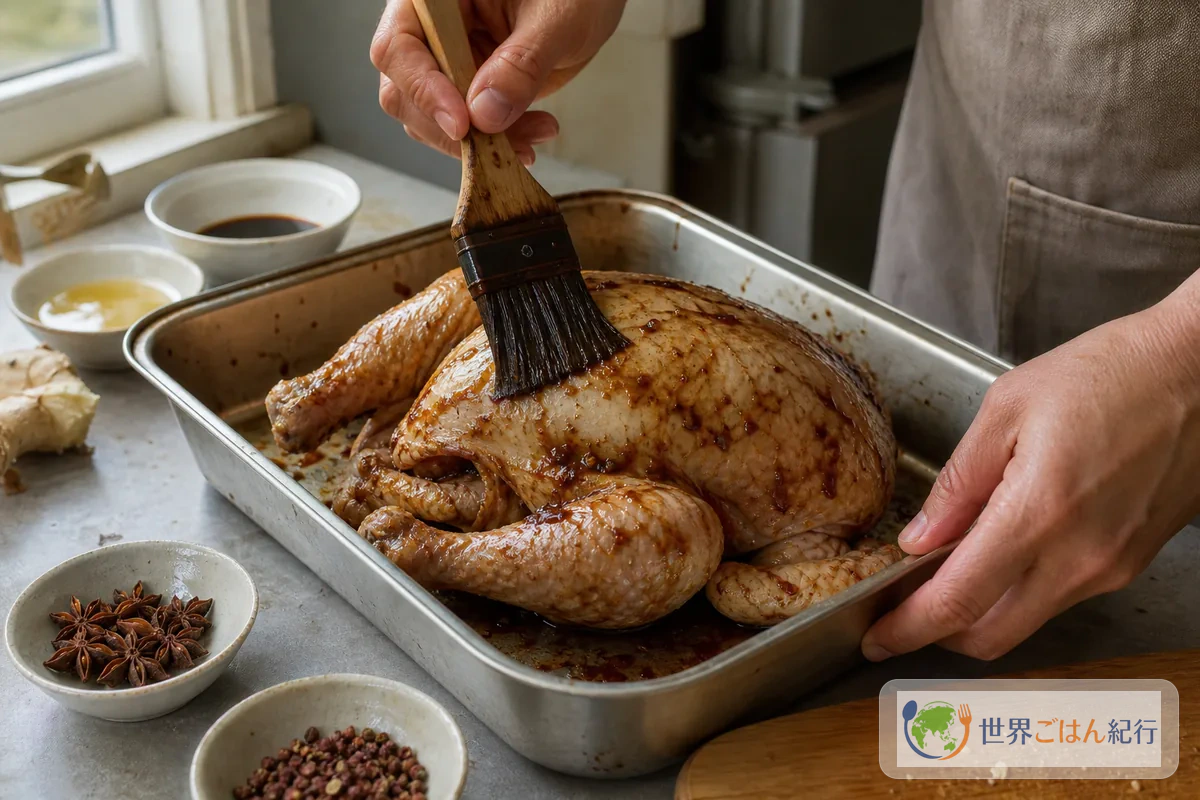
On a day you roast a whole chicken, the air in the kitchen slows down a little. You grate ginger, brush dark soy sauce on the skin, and unfold lotus leaves with the sweet scent of star anise still on your fingertips. Beggar's chicken is a feast from the wrapping, before it even goes into the oven. If all you wanted was cooked meat there are plenty of faster ways, but wrapping it in leaf and dough locks the aroma in until the moment you open it.
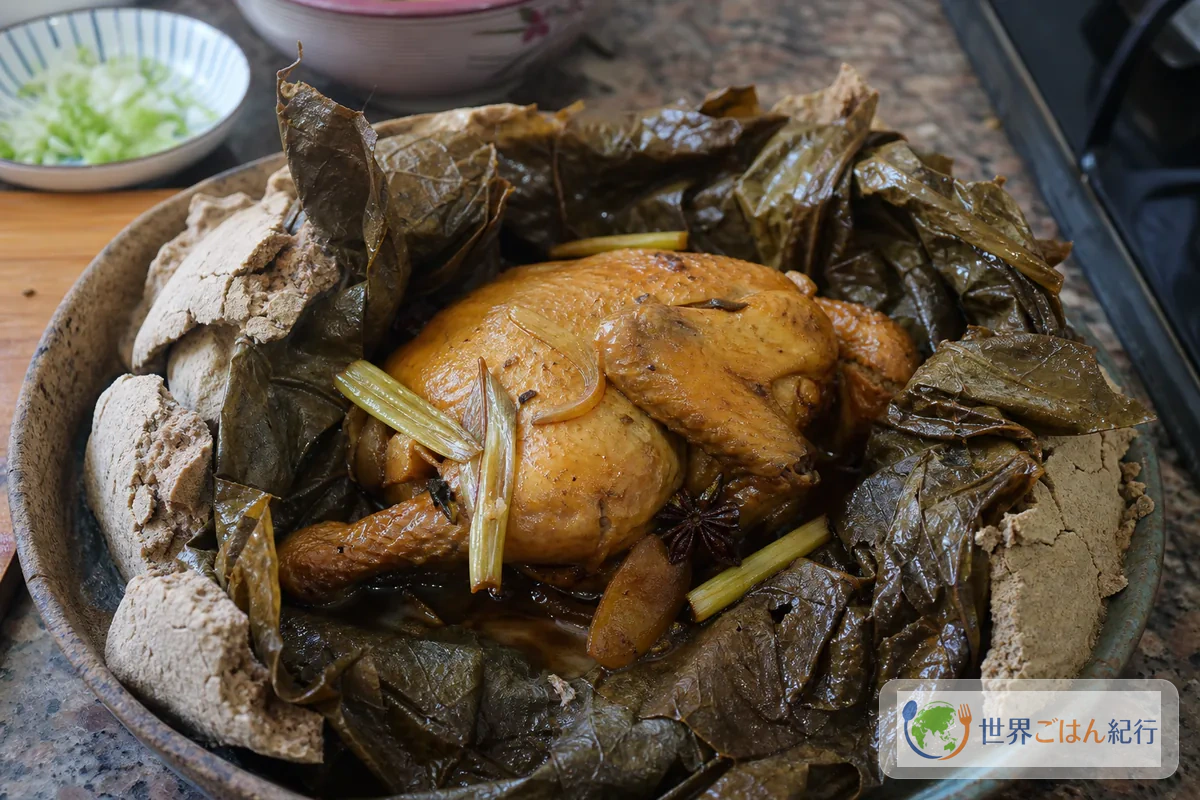
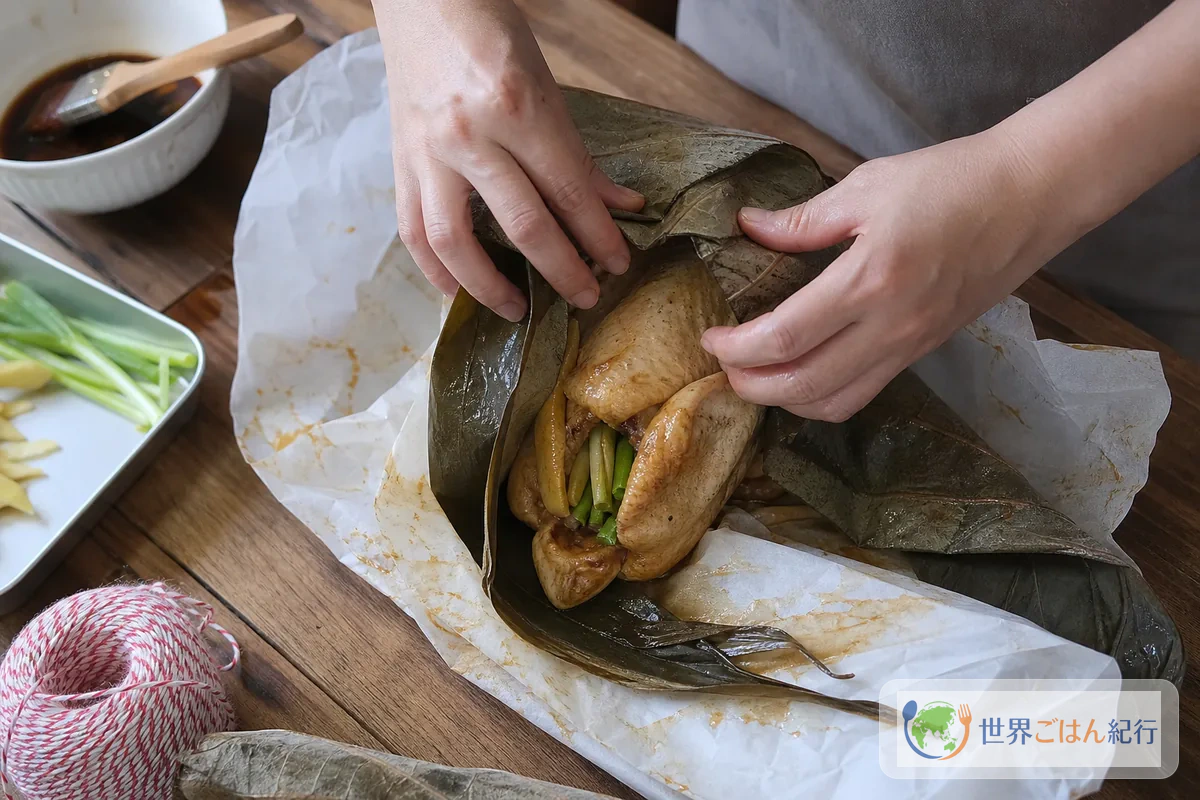
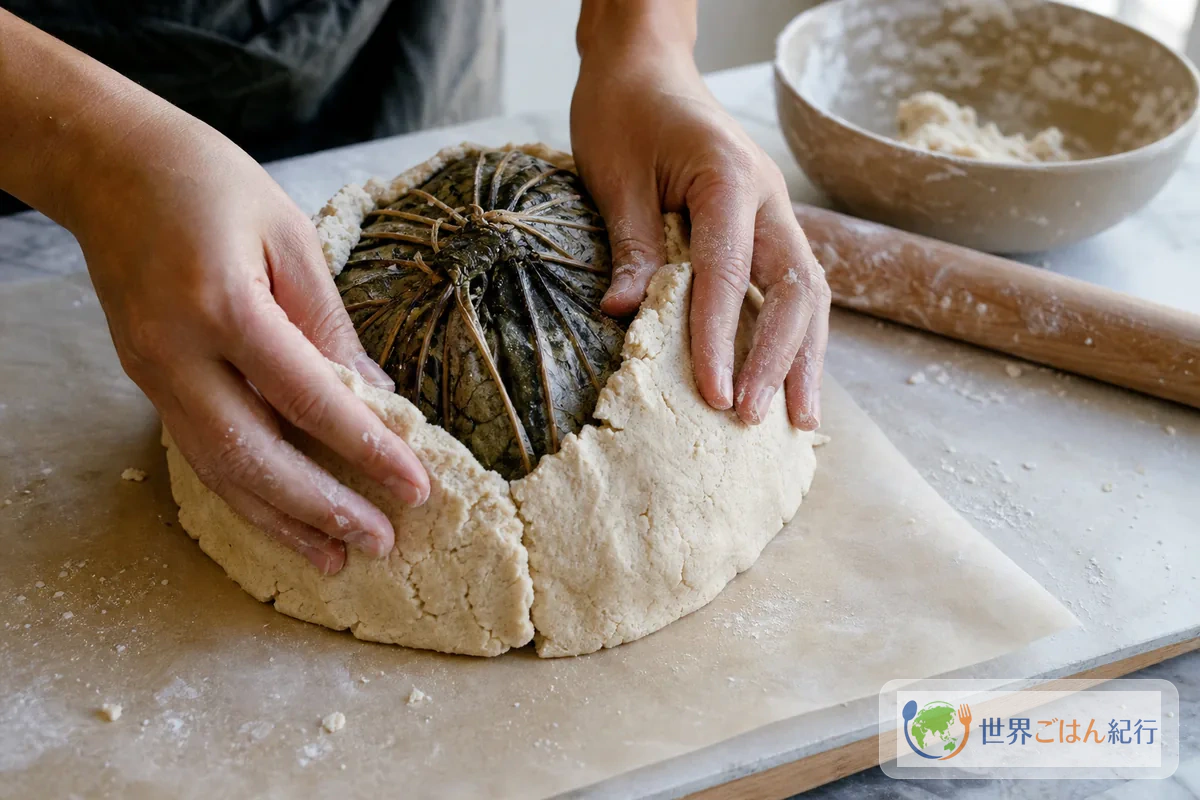
Beggar's chicken (叫花鸡 / 叫化鸡 / jiao hua ji) is a whole chicken baked in a wrapping, known as a specialty of the Jiangnan region of China, especially Hangzhou. Traditional accounts describe a seasoned chicken wrapped in lotus leaf, then covered in mud or clay and baked. A modern home cook has no need for real mud. Using food-safe lotus leaf, parchment paper, aluminum foil and a salt dough, you can reproduce the idea of sealing it and steam-roasting it.
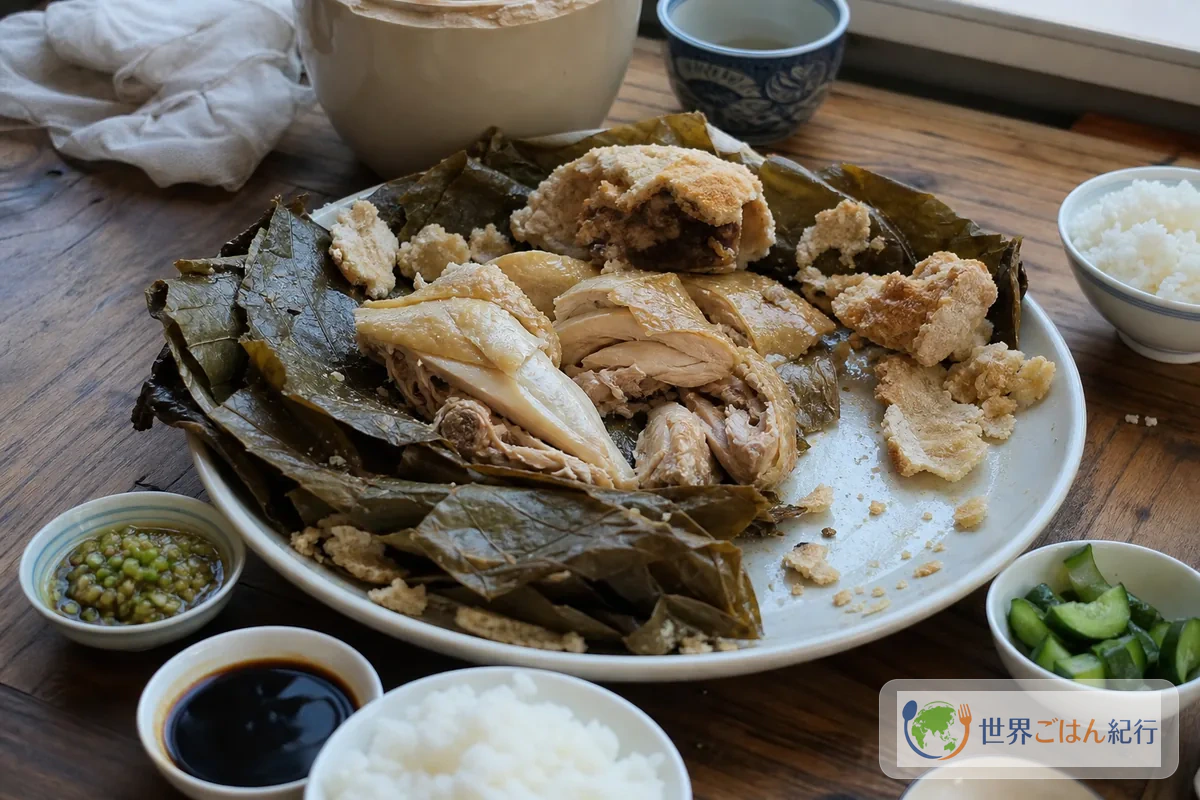
The hard part of making it at home is temperature control rather than lotus leaf. Once it's wrapped, you can't see inside. Browning alone can't tell you whether it's cooked, so use a smallish whole chicken of around 1.2 kg (about 2 3/4 lb) and measure the internal temperature after baking. Confirm that the center of the meat and of the stuffing has reached at least 74°C (165°F) before resting, and you get both the moist texture of a wrapped bake and safety.
Among Chinese dishes it's the opposite of those eaten for the aroma of fierce heat, such as chow mein, or those that push fermented spiciness to the front, such as mapo tofu (in Japanese). Beggar's chicken is a dish that locks things in. The aroma is not scattered outward but returned to the inside of the chicken, the leaf and the dough. Feel that difference in your kitchen and the range of Chinese cooking suddenly widens.
In Chinese it is written 叫花鸡 or 叫化鸡. In Japanese it appears as 叫化鶏 or 乞食鶏; this article uses 叫化鶏 throughout as an easy-to-read dish name. "Beggar's Chicken" is its common name in English.
Background: a wrapped-and-baked dish refined in Hangzhou
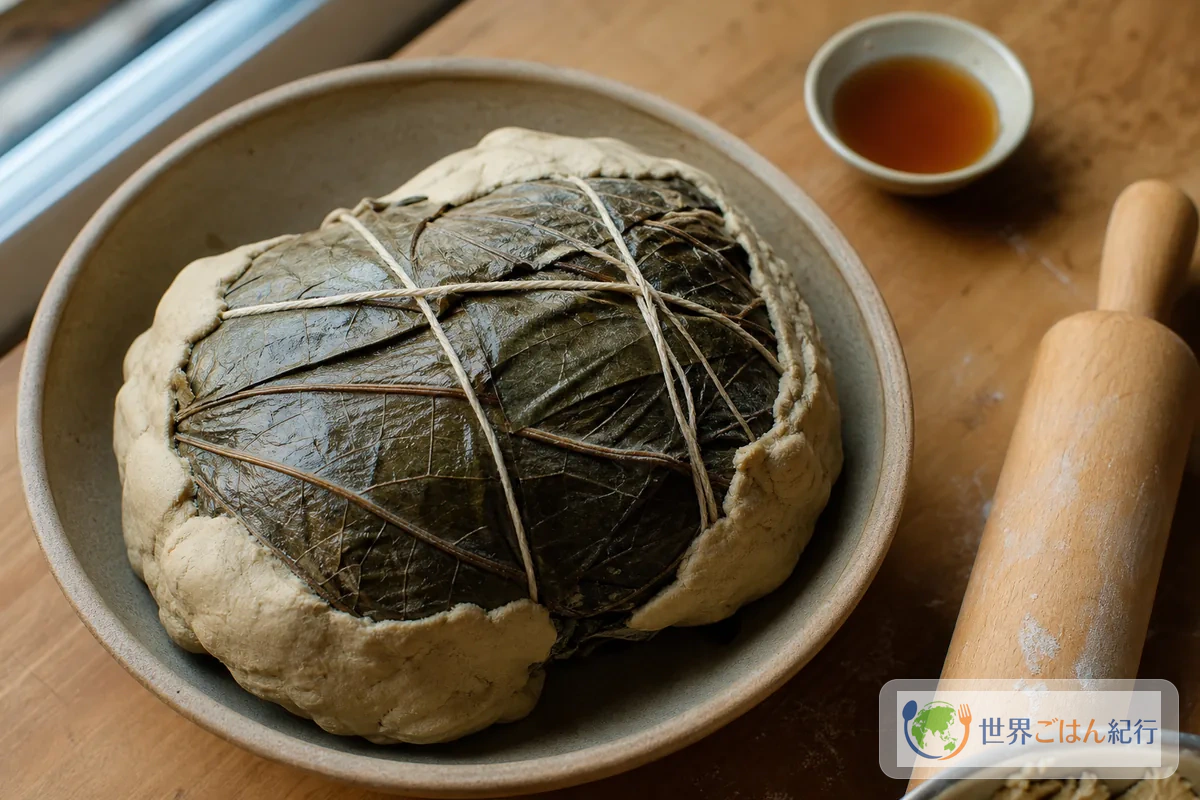
There is a legend that a poor traveler or beggar wrapped a stolen chicken in mud and cooked it in a fire. Such stories are often told as the dish's origin, but it's more natural to read them not as historical fact with a settled date and person but as a tale conveying the dish's idea: wrapping hides the smell and at the same time locks in the savoriness.
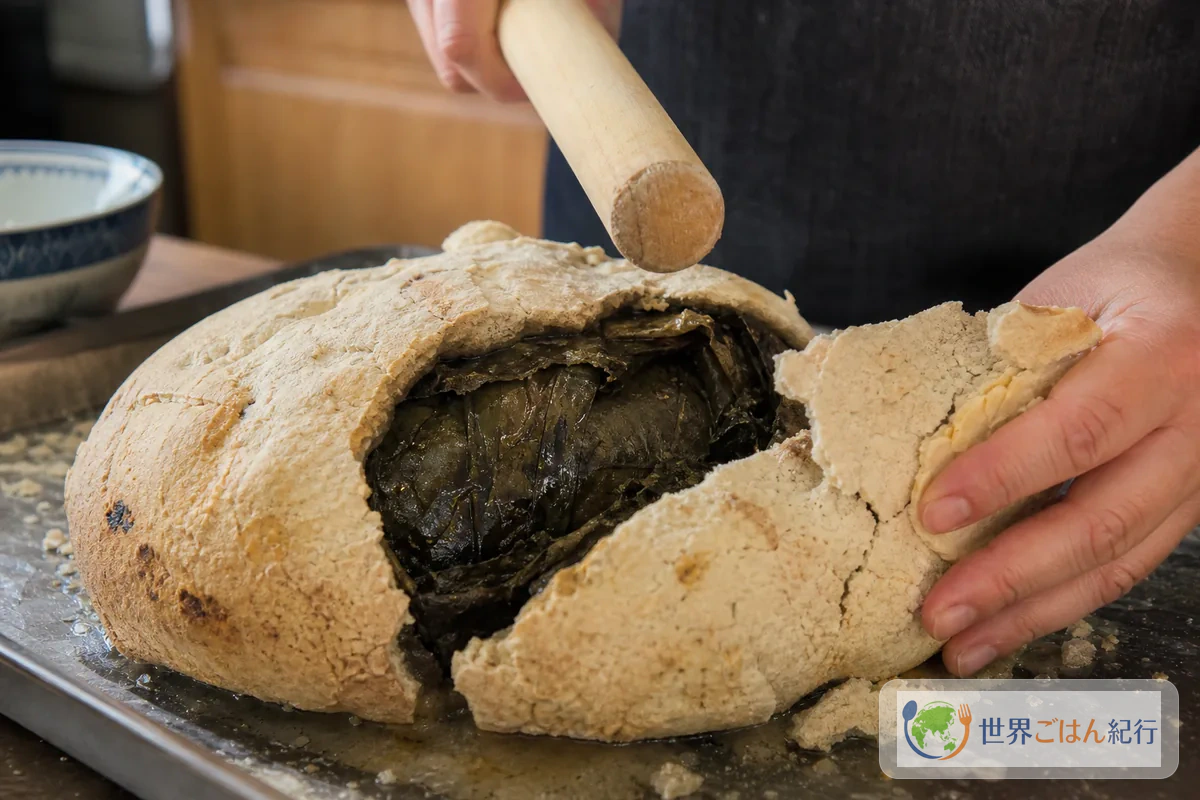
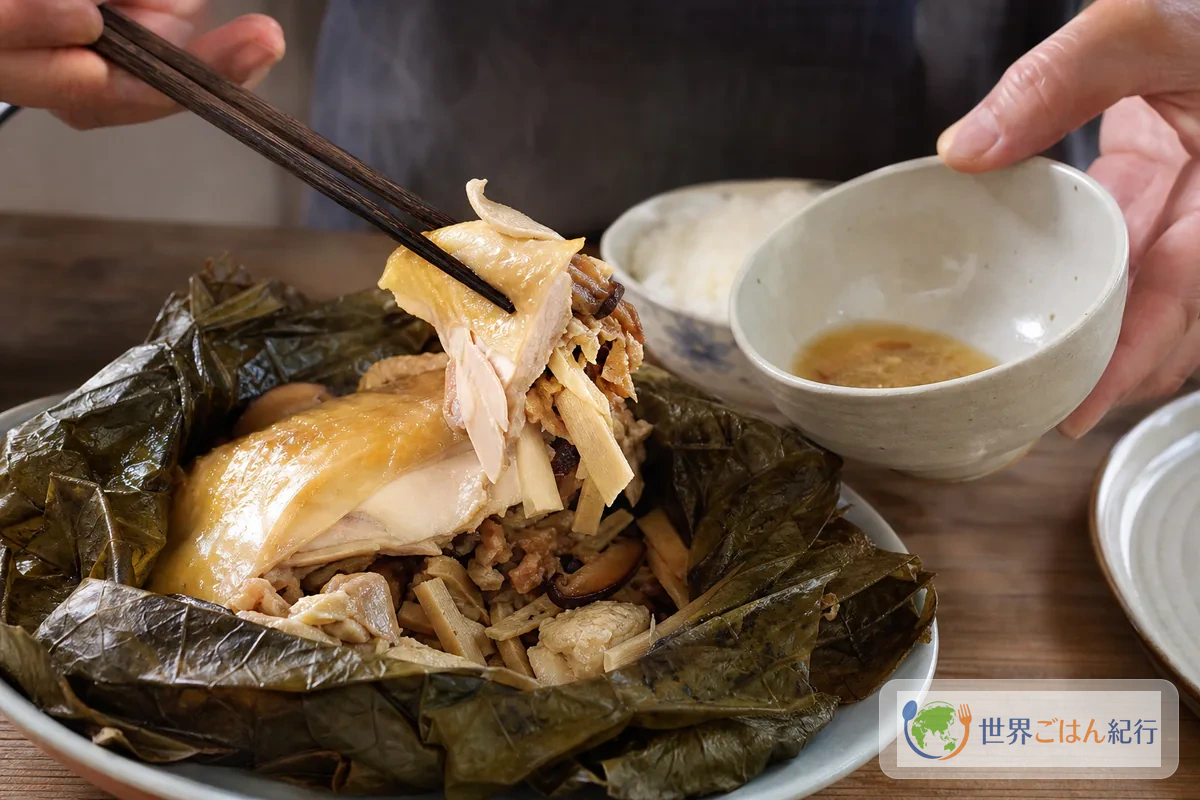
Hangzhou tourism information presents beggar's chicken as a local specialty wrapped in lotus leaf and clay and baked. The lotus leaf adds fragrance and also serves as an edible barrier between the chicken and the outer earth or dough. When the shell is cracked after baking, the chicken steamed inside the leaf appears, and the skin is not crisp like roast chicken but moist and tender, closer to steam-roasted.
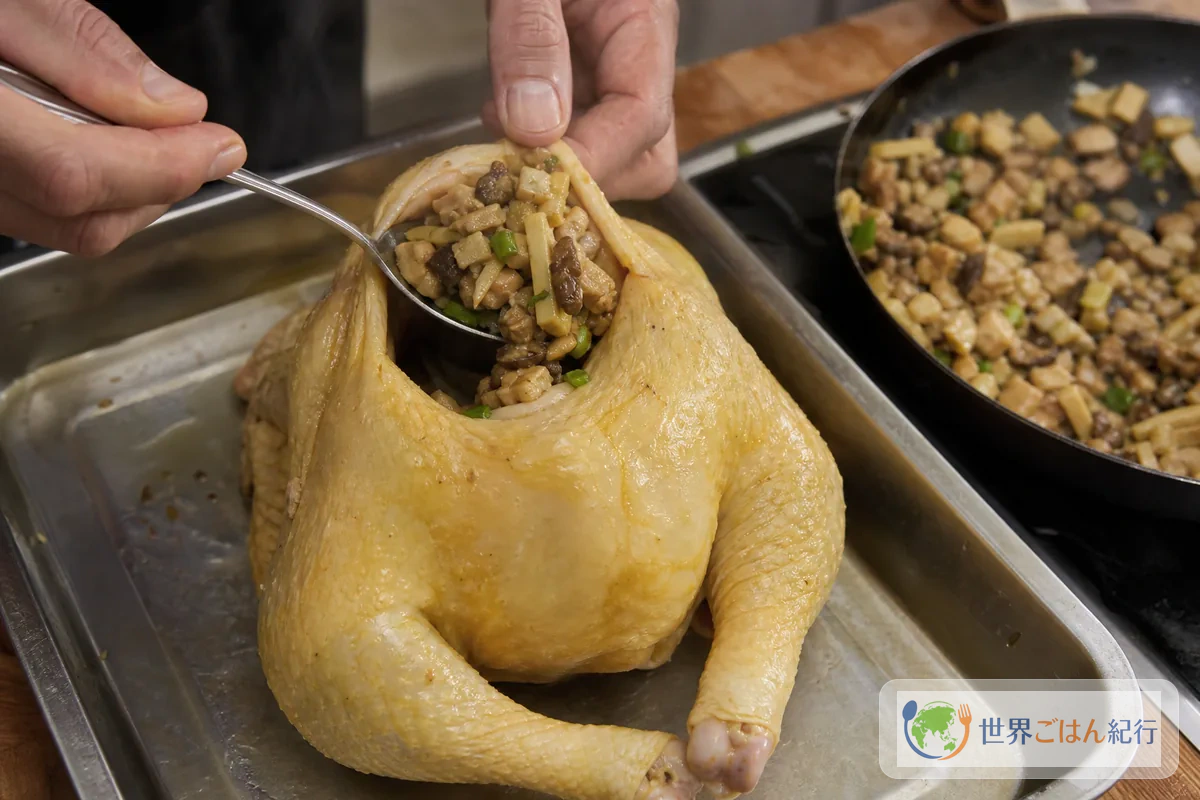
At high-end restaurants there, the cavity may be filled with shiitake, pork, ham, scallion, ginger and Shaoxing wine. Add that many ingredients at home and the stuffing tends to overshadow the chicken, so this recipe centers on dried shiitake, bamboo shoots, ginger and scallion. The aromatic backbone is regular soy sauce, dark soy sauce, Shaoxing wine (or sake), star anise and a little Sichuan peppercorn.
Depending on the region and the restaurant, some versions make the outside a truly hard shell, some push the lotus-leaf aroma forward, and some stuff the cavity with ham or pork for a more festive feel. In a home version, putting priority on three things (the size of the chicken, lotus leaf, and an instant-read thermometer) improves reproducibility more than adding salty ham. Rather than making the flavor lavish, aim for the chicken's steam and the leaf's aroma rising together when you open the package.
| Local element | Role | Realistic home solution |
|---|---|---|
| Lotus leaf | Grassy aroma and wrapping | Rehydrate dried lotus leaf. If you have none, retain moisture with parchment and accept a little less aroma |
| Clay shell | Conducts heat slowly and seals in aroma | Use a salt dough for the outside, which never touches the food |
| Shaoxing wine | Rounds off the chicken's smell | Shaoxing wine is ideal. Otherwise sake with a little brown sugar |
| Dark soy sauce | Color and savory depth of the skin | A small amount of dark soy sauce helps the color |
| Whole chicken | The ritual of opening and the juices | A small whole chicken of 1.1 to 1.3 kg suits a home oven |
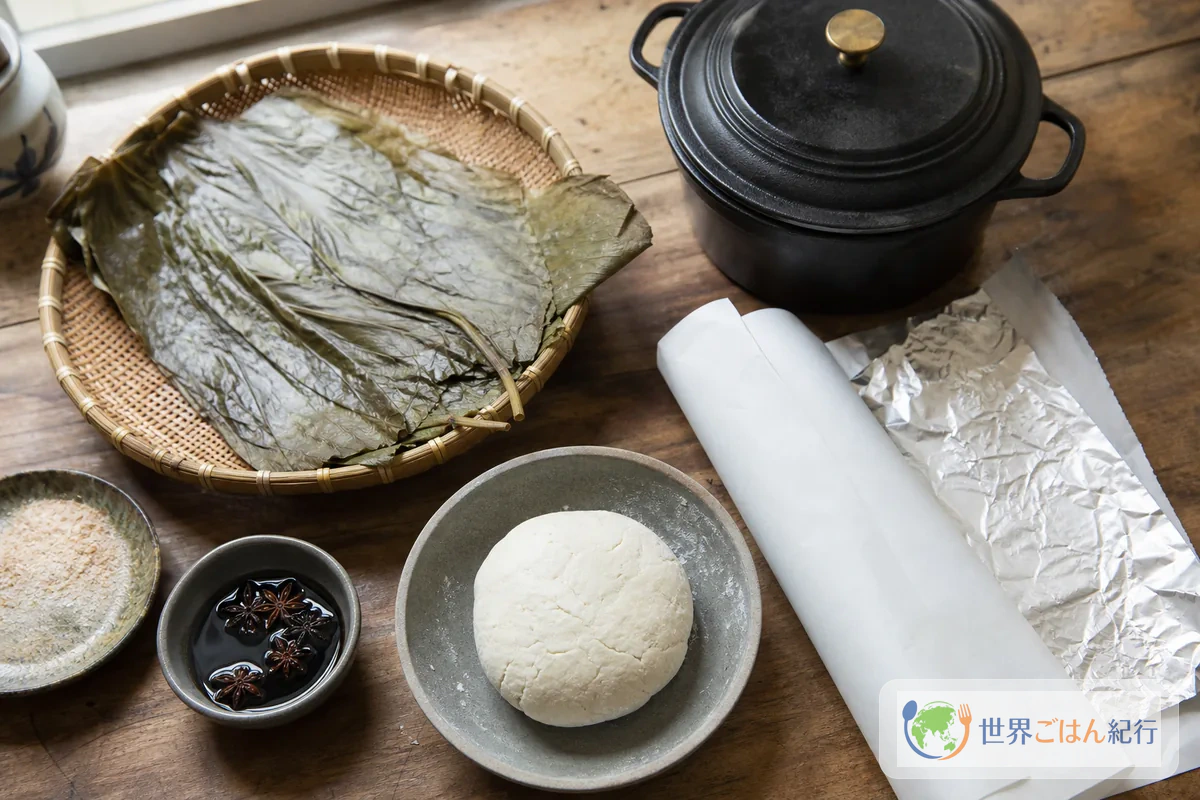
Avoid using garden soil or pottery clay near food. At home, wrap the chicken in lotus leaf and parchment, then cover the outside with aluminum foil and salt dough. Only food-grade leaf and paper should touch the part you eat.
Ingredients: separate what wraps the chicken from what flavors it
Serves 4. Aim for a whole chicken of 1.1 to 1.3 kg. With a large bird close to 2 kg (4 1/2 lb), a home oven needs a long time to cook it through, and only the salt dough dries out too much. A smaller bird is more likely to succeed on a first try.
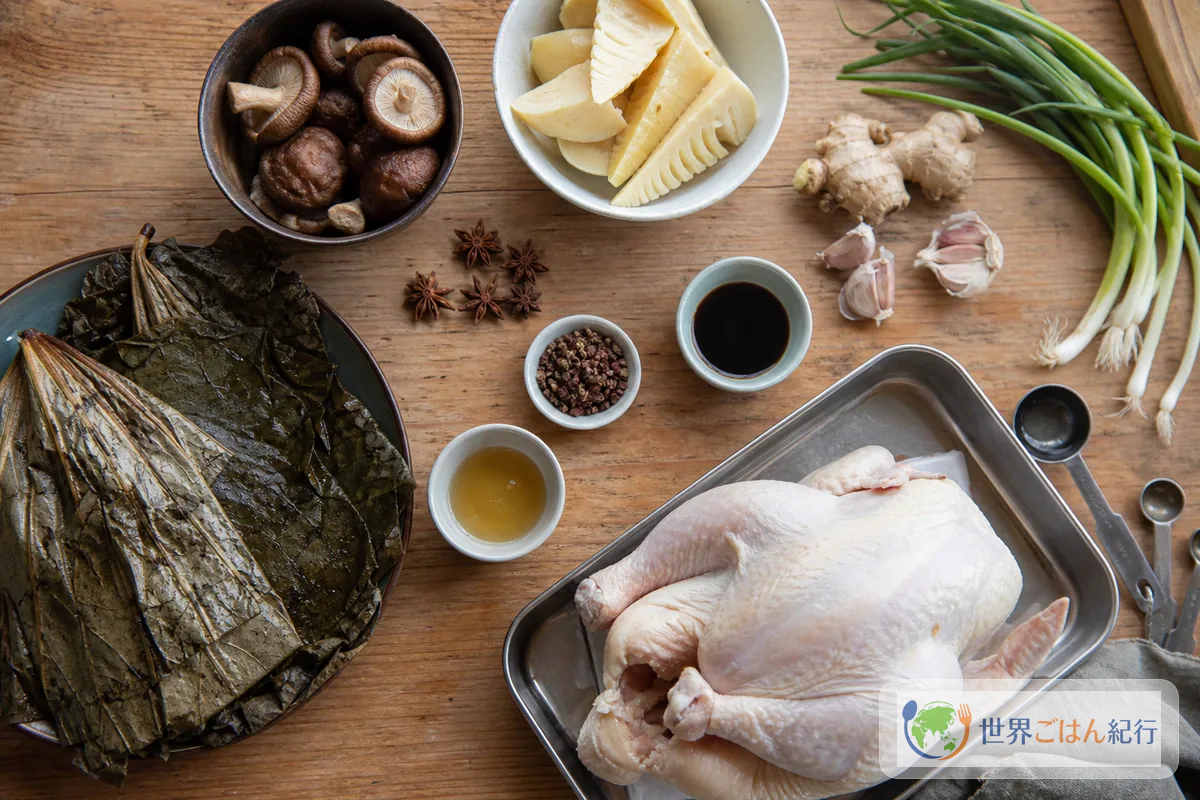
This dish contains chicken, wheat, soy and sesame. Dark soy sauce and Shaoxing wine may contain wheat depending on the product. If you need to avoid wheat, skip the salt dough and wrap the chicken twice with parchment and aluminum foil.
Shopping: separate the ordinary chicken from the aromatics worth seeking out
For the whole chicken, a butcher, a large supermarket or a frozen gutted bird is enough. Keeping to the size matters more than seeking out a branded bird. Around 1.2 kg takes the seasoning easily and cooks through in a home oven. A chicken over 2 kg looks impressive but is hard to handle for a first beggar's chicken.
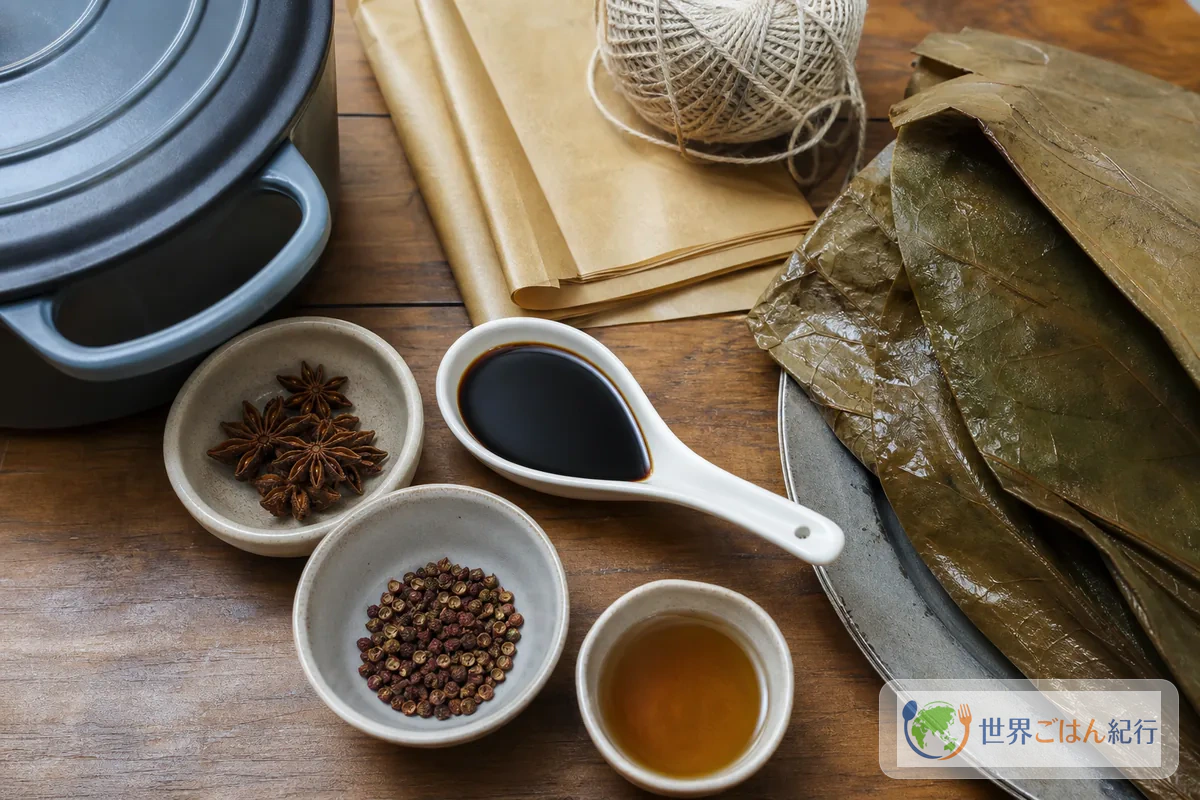
The items worth seeking out at Asian grocers or online are lotus leaf, dark soy sauce, star anise and a thick pot suitable for wrapped baking. Without lotus leaf you can still cook it, but you lose some aroma. Dark soy sauce is for color, so you won't use a lot, but you can use it in chow mein and in Hainanese chicken rice too. A little star anise goes a long way, and leftovers work in bak kut teh and bò kho (in Japanese).
| What to buy | Priority | Why |
|---|---|---|
| Dried lotus leaf | High | Creates the green aroma characteristic of beggar's chicken |
| Dark soy sauce | Medium | Gives the skin a deep color and supplements the soy aroma |
| Star anise | Medium | Gives a sweet Chinese aroma in small amounts |
| Instant-read thermometer | High | Confirms doneness of a wrapped bake |
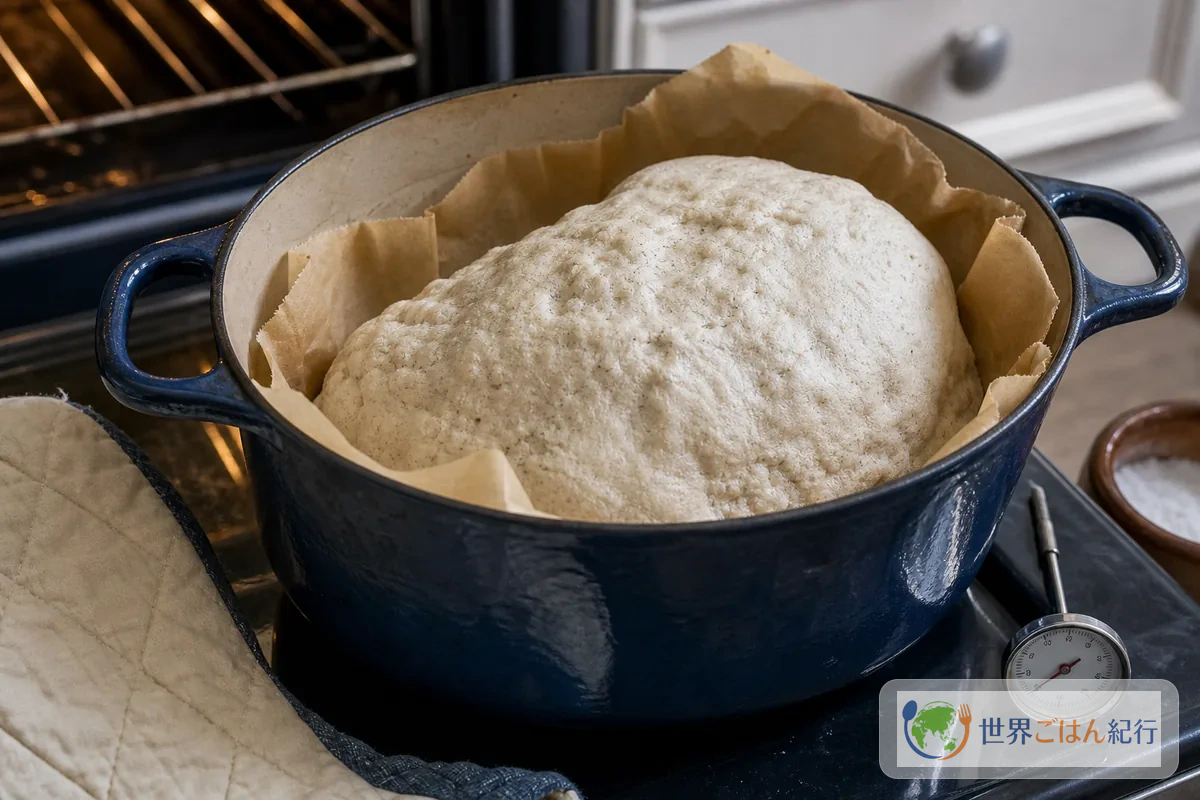
| Dutch oven or deep ovenproof pot | Medium | More stable in temperature than setting the salt dough directly on a baking sheet |
Method: wrap it and bake it at moderate heat
Season the day before or the morning of, and begin the wrapping preparations 2 hours before baking. Bake a whole chicken straight from the refrigerator and only the outside of the package gets hot while the center lags behind. Don't leave it at room temperature for long; let it sit for just 30 minutes to take off the chill, then wrap it.
A decision table for getting closer to the original in a home kitchen
If you try to make everything match the local way, beggar's chicken is a dish where you tend to stall. No lotus leaf, a chicken that's too big, no thermometer, no Shaoxing wine: all of these happen. What matters is separating where to hold the line so the dish keeps its character from where it's fine to adapt for home.
| Where you hesitate | Direction to keep | Realistic home solution | Direction to avoid |
|---|---|---|---|
| Lotus leaf | Green aroma and the ritual of wrapping | Dried lotus leaf. Otherwise paper and foil to keep moisture in | Roasting it bare |
| Clay shell | Sealing and gentle heating | Salt dough, or double foil wrap | Using garden soil or pottery clay near food |
| Chicken size | Cooking through to the center | A whole chicken of 1.1 to 1.3 kg | Baking one over 2 kg for the same time |
| Alcohol | Rounding off the smell | Shaoxing wine, or sake with a little brown sugar | Moving toward Western flavors with white wine |
| Color | Depth from dark soy sauce | A small amount of dark soy sauce | Burning sugar alone for color |
Without lotus leaf, the atmosphere of the dish thins out a little. Even so, wrap it in parchment, retain moisture with aluminum foil, and stabilize the heat with salt dough or a thick pot, and you can still make a perfectly tasty, moist wrapped-and-baked whole chicken. Start with the idea of comparing the difference in aroma when you do get leaves.
Without a thermometer, a whole-chicken dish leaves you uneasy. A wrapped bake can't be seen from outside, so here we assume an instant-read thermometer. Especially when stuffing, the center of the stuffing needs a temperature reading, not just the meat. On a day with no thermometer, it's safer to stir-fry the stuffing separately and put only ginger and scallion in the cavity.
Why it fails: undercooked, weak aroma, torn skin
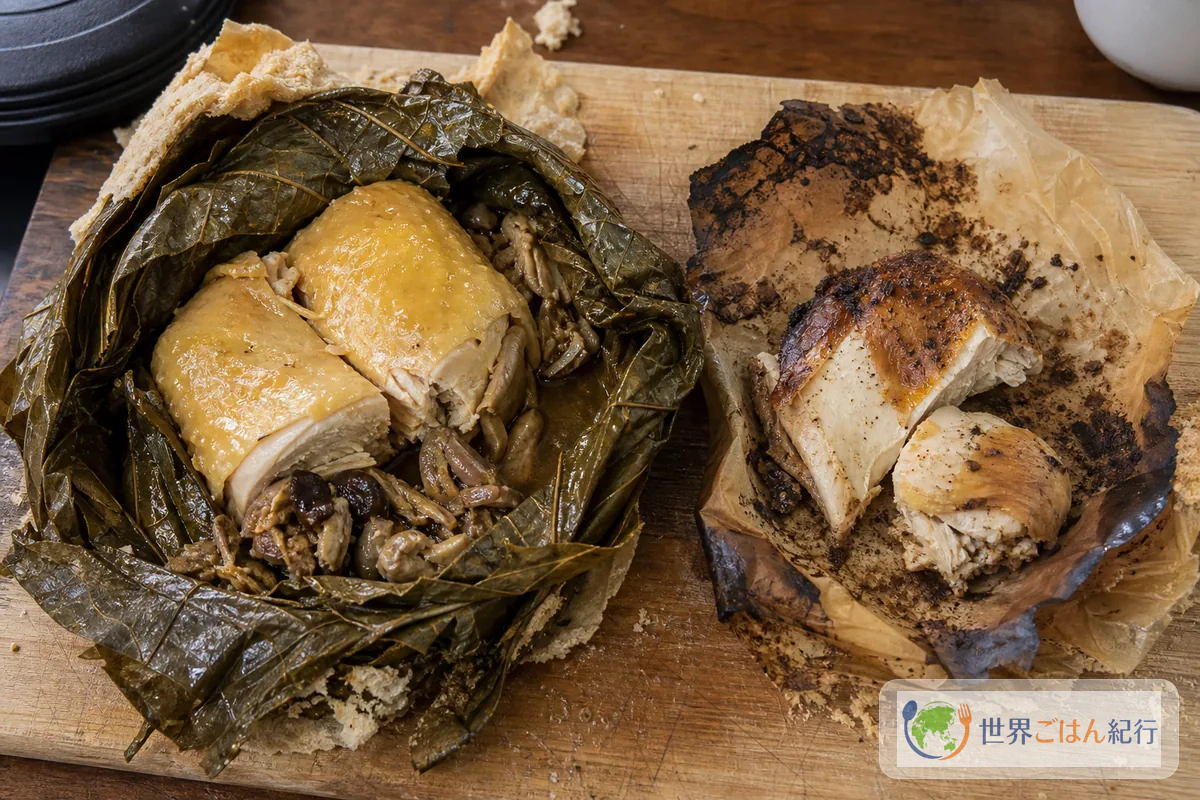
The failure to avoid most is undercooking. A wrapped bake is hard to judge by looks, so make temperature, not time, the final standard. Even with a 1.2 kg bird, the time stretches if it's straight from the refrigerator, heavily stuffed, the oven preheat was weak or the salt dough is too thick. If the center doesn't reach 74°C (165°F), keep cooking even after opening.
When the aroma is weak, the seasoning time was too short or the lotus leaf stayed dry. Always rehydrate lotus leaf and wipe off the water before using. Marinate at least 6 hours, ideally overnight. Even in a hurry, put the seasoning inside the cavity as well as on the skin, and use plenty of ginger and scallion in the stuffing to bring out the aroma.
The skin tears when the leaf and paper are wrapped too tight. Beggar's chicken isn't a dish that shows off crisp skin, so there's no need to pull things taut to tidy the look. Overlap the leaves a little, support with paper and close the outside with the salt dough. It works if you think of the inner wrap as loose and the outer shell as the seal.
| Problem | Cause | Fix |
|---|---|---|
| Internal temperature too low | Chicken too big, preheat too short, too much stuffing | Cover with leaf and paper and add 15 minutes at 170°C (340°F) at a time |
| Meat dried out | Overbaked, or opened without resting | Add 2 tbsp hot water to the juices and spoon over the slices |
| Weak aroma | Not enough seasoning, lotus leaf not rehydrated enough | Add chopped scallion, ginger and a little black vinegar to the juices |
| Salt dough cracked | Too little water, rolled too thin | Cover with foil to prevent drying and bake it through |
| Too salty | Seasoning too strong, too much juice poured on | Pair with rice, cucumber and blanched greens |
The moment you open the package is the climax of beggar's chicken, but you can still fine-tune the flavor afterward. If the juices are too strong, add hot water; if the aroma is weak, add chopped scallion and ginger. Rather than trying to make it perfect in the pot, adjust in a small bowl at the table, and failures stay small.
Storage and eating it: divide it while it's hot
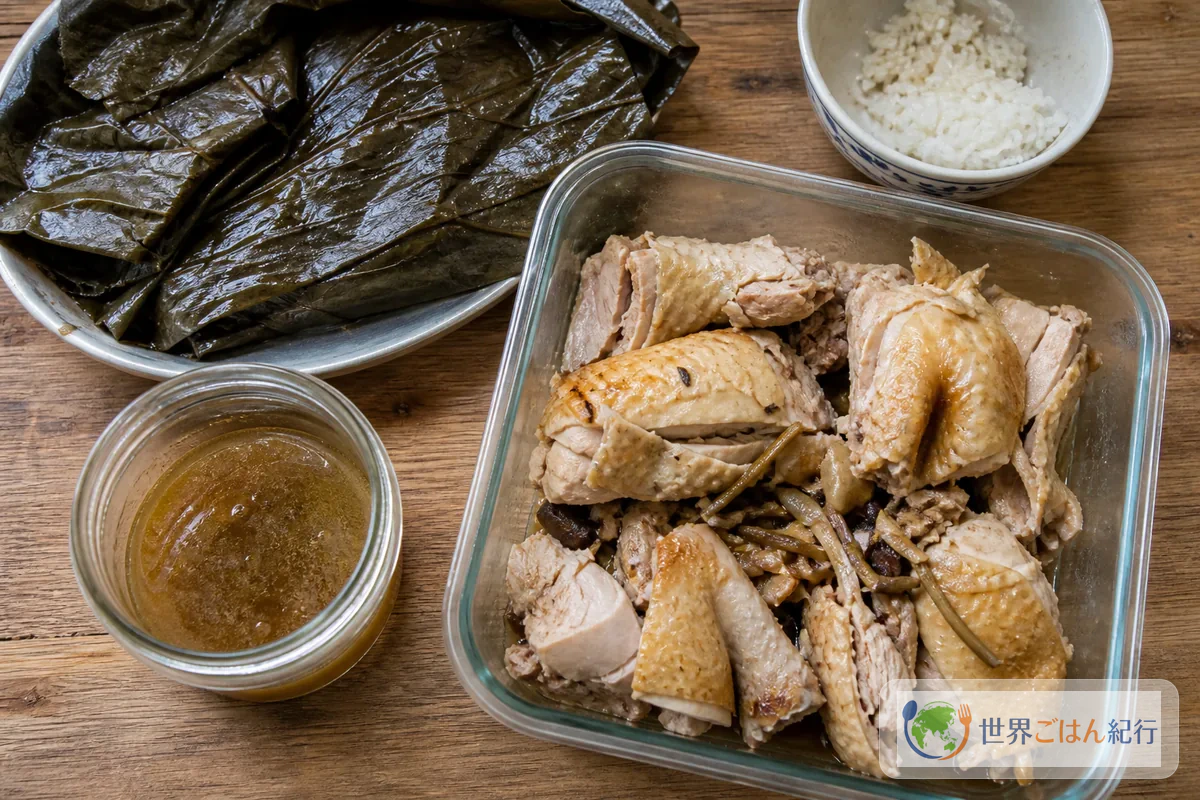
Beggar's chicken is best freshly opened. The aroma that the lotus leaf and salt dough were holding in escapes from the moment of opening. Once it's on the table, first carve the meat into large pieces and move the juices into a small bowl. Shredding everything fine makes it cool quickly, so cut only what you'll eat and store the rest in large pieces.
Store the meat and juices separately. Once cooled slightly, put them into clean containers within 2 hours and eat within 2 days in the refrigerator. The stuffing absorbs moisture easily, so eat it by the next day. If freezing, divide only the boned meat into small portions and freeze the juices separately. Lotus leaf loses its aroma, so don't use it for storage.
To reheat, warm the juices in a small pot over low heat for 3 minutes first, add the cut chicken, cover and warm over low heat for 4 to 5 minutes. In a microwave, spoon 1 tbsp of juices over the meat, cover loosely with plastic wrap and heat at 600 W for 1 minute, turn it and heat another 40 seconds as a guide. Since this isn't a dish aiming for crisp skin, bringing it back with the juices is more natural.
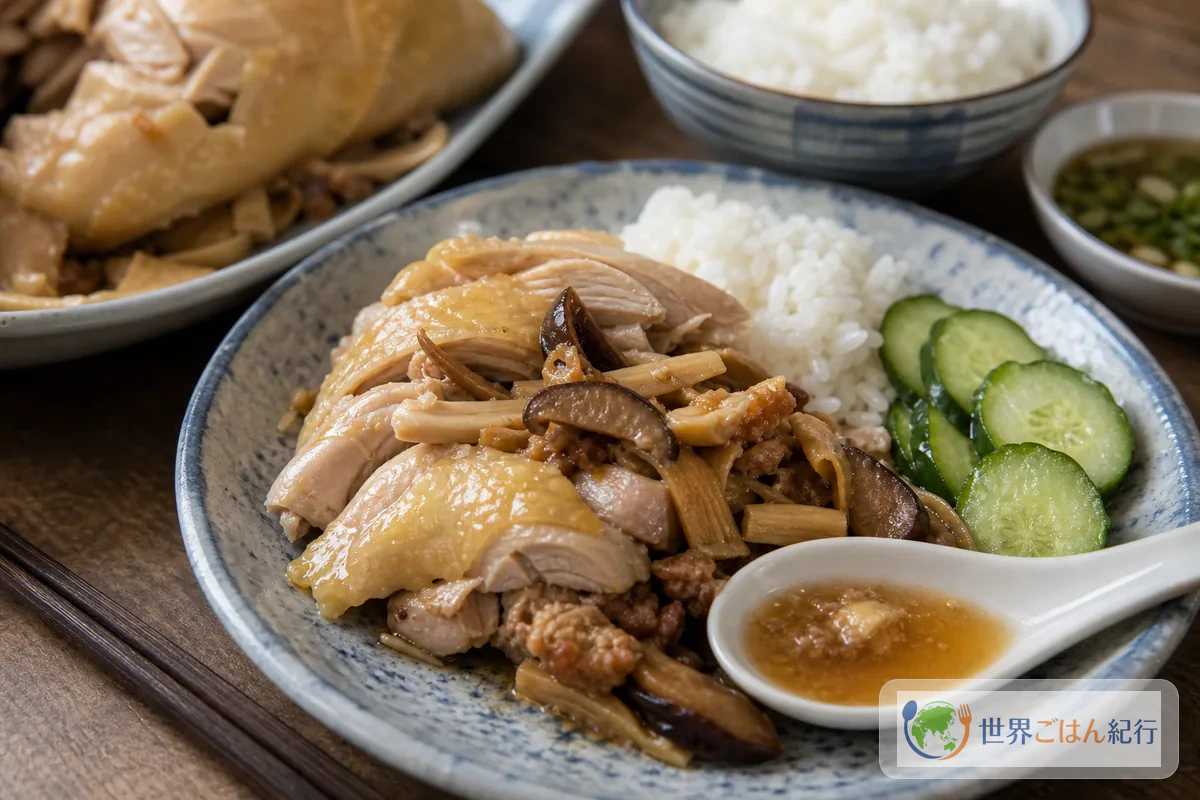
For the next day, putting it over rice is easiest. Shred the meat, mix in the juices, chopped scallion and 1 tsp black vinegar and spoon it over rice. If you like strong flavors, you may want to add aromatic oil as in mapo tofu (in Japanese), but beggar's chicken is about the aroma of leaf and chicken. If you add heat, limit it to a few drops of chile oil.
FAQ
Is it still beggar's chicken without lotus leaf?
As a home version, you can make it. But the green aroma of lotus leaf won't come through. Wrapped in parchment, covered double in aluminum foil and steam-roasted in salt dough or a thick pot, you'll get a moist wrapped bake. It's fine to make it with substitutes the first time and try lotus leaf next.
Can I make it with chicken thighs instead of a whole chicken?
Yes. Use 4 bone-in chicken thighs, or 4 large boneless thighs, with the same seasoning. Stir-fry the stuffing separately and wrap it in the leaf together with the meat. As a guide, bake at 200°C (400°F) for 20 minutes and then 170°C (340°F) for 35 to 45 minutes, and check that the center is at least 74°C (165°F). It has less of a sense of occasion, but it suits weeknight practice.
Can I eat the salt dough?
No. It's an outer shell made of salt and flour for holding in heat and aroma. Only the lotus leaf and parchment touch the part you eat. Dispose of the cracked salt dough after it cools. It is very salty and has absorbed the chicken's juices, so don't reuse it.
What can I use if I don't have Shaoxing wine?
Mixing 1/2 tsp brown sugar into 2 tbsp sake makes up a little of the sweet aroma. White wine tends to bring a Western aroma, so sake is easier to work with in this dish. If you want to avoid alcohol, substitute a mix of 2 tbsp water, 1/2 tsp brown sugar and 1 tsp ginger juice.
Can I make it safely without a thermometer?
Because it's a wrapped bake, I don't recommend doing it without a thermometer. The state of the outer dough or leaf doesn't tell you how cooked the center is. On a day you really have no thermometer, make it with chicken thighs rather than a whole chicken, in a form where you can cut in and check the color and juices at the center. If you stuff a whole chicken, assume you'll use an instant-read thermometer.
More Chinese and East Asian dishes to cook
Beggar's chicken is a wrapped-and-baked main dish, so putting a few dishes with different aromas on the table makes it more fun. Pairing a little of a high-heat dish, a vegetarian simmered dish and a spicy tofu dish shows the differences within Chinese cooking: sealing in, stir-frying and simmering.
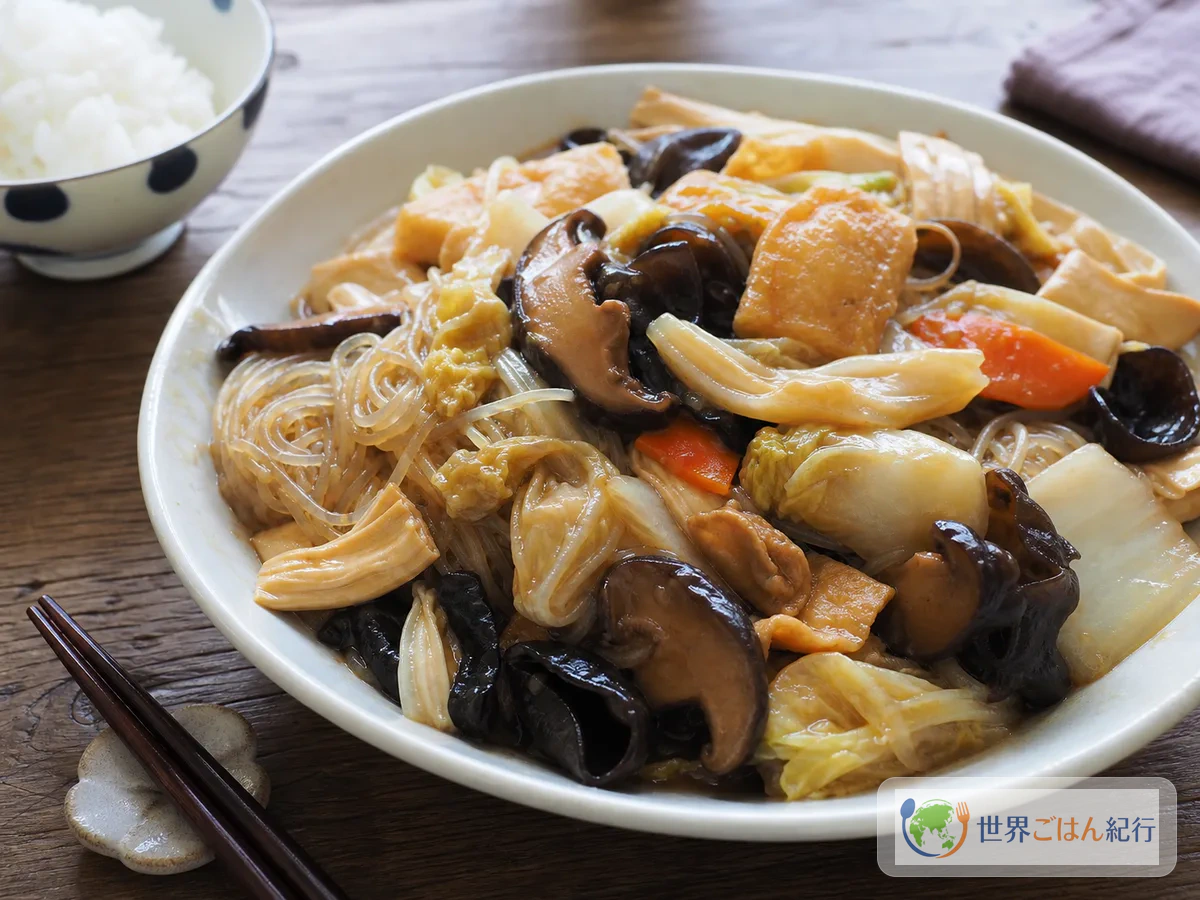
- Buddha's delight (luohan zhai) (in Japanese): even within Chinese cooking, a vegetarian braise that builds quiet savoriness from dried goods and fermented tofu.
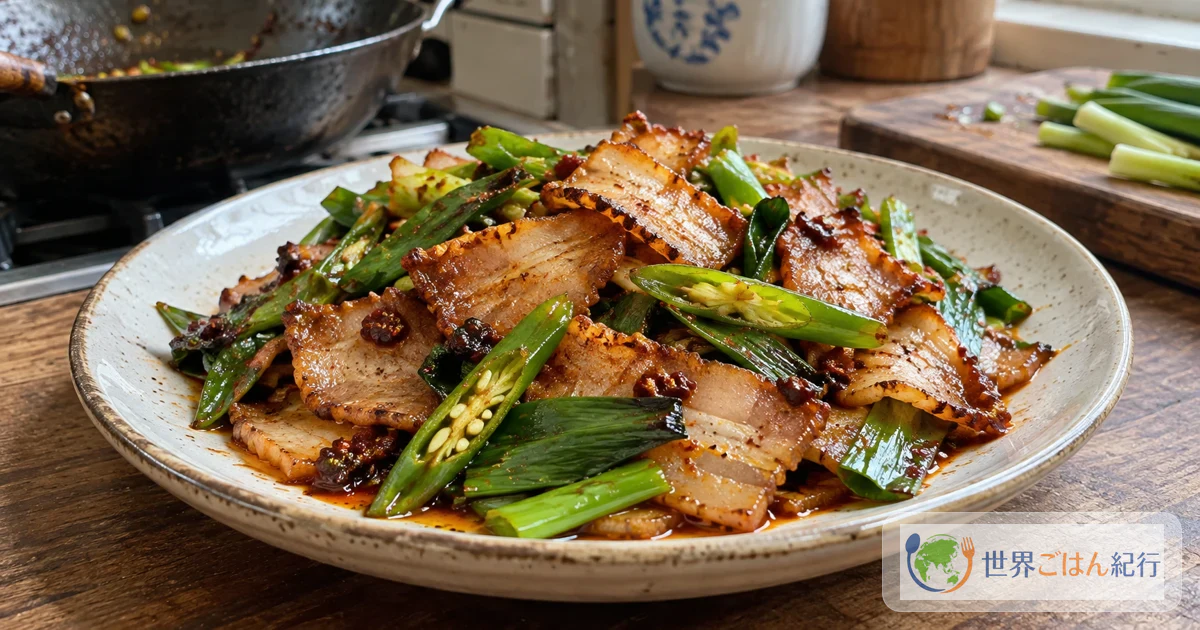
- Chow mein: a dish where the aroma rises outward over the fierce heat of a wok, in contrast to beggar's chicken.
- Mapo tofu (in Japanese): a little heat and fermented aroma on the side sets off the gentleness of the wrapped bake.
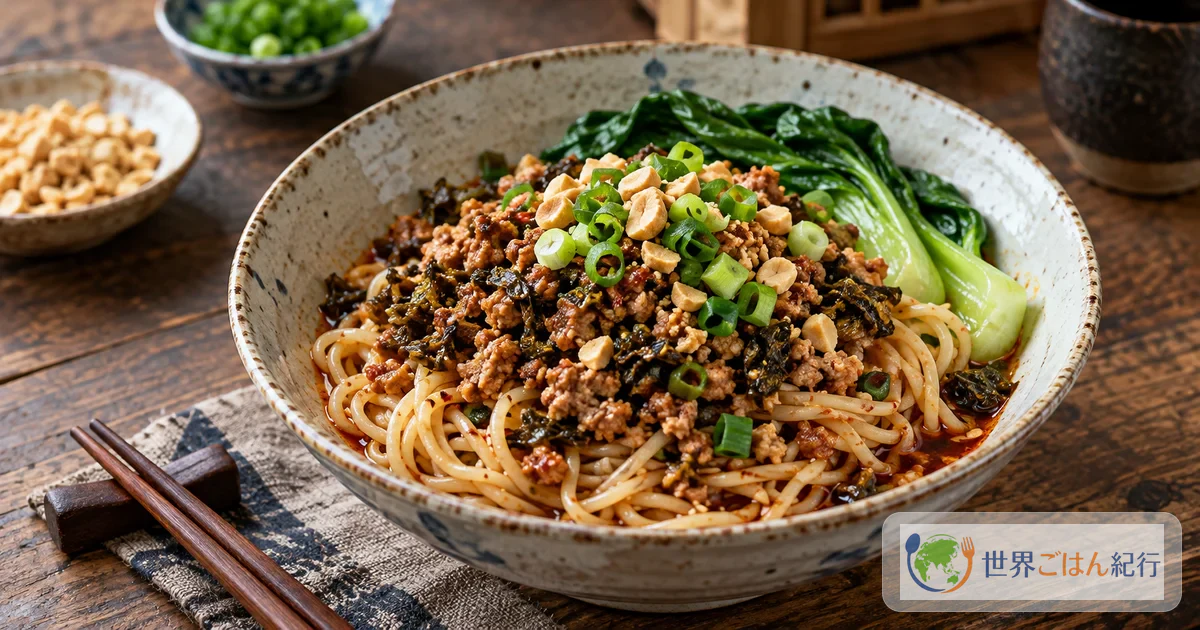
- Biangbiang noodles (in Japanese): compare how wheat is handled in a wrapping dough versus hand-pulled noodles.
- Samgyetang: another East Asian take on stuffing a whole chicken, to compare the thinking about cooking.
Overseas and local sources consulted
Hangzhou's official tourism information introduces beggar's chicken as a specialty wrapped in lotus leaf and clay and baked. Wikipedia and TasteAtlas were consulted to confirm the English-language name, the legend and the dish's place in Hangzhou cuisine. The Hammer Museum recipe was a reference for a home-friendly procedure wrapping in leaf, paper and an outer shell, and for food safety the U.S. FoodSafety.gov safe internal temperature for poultry was checked.