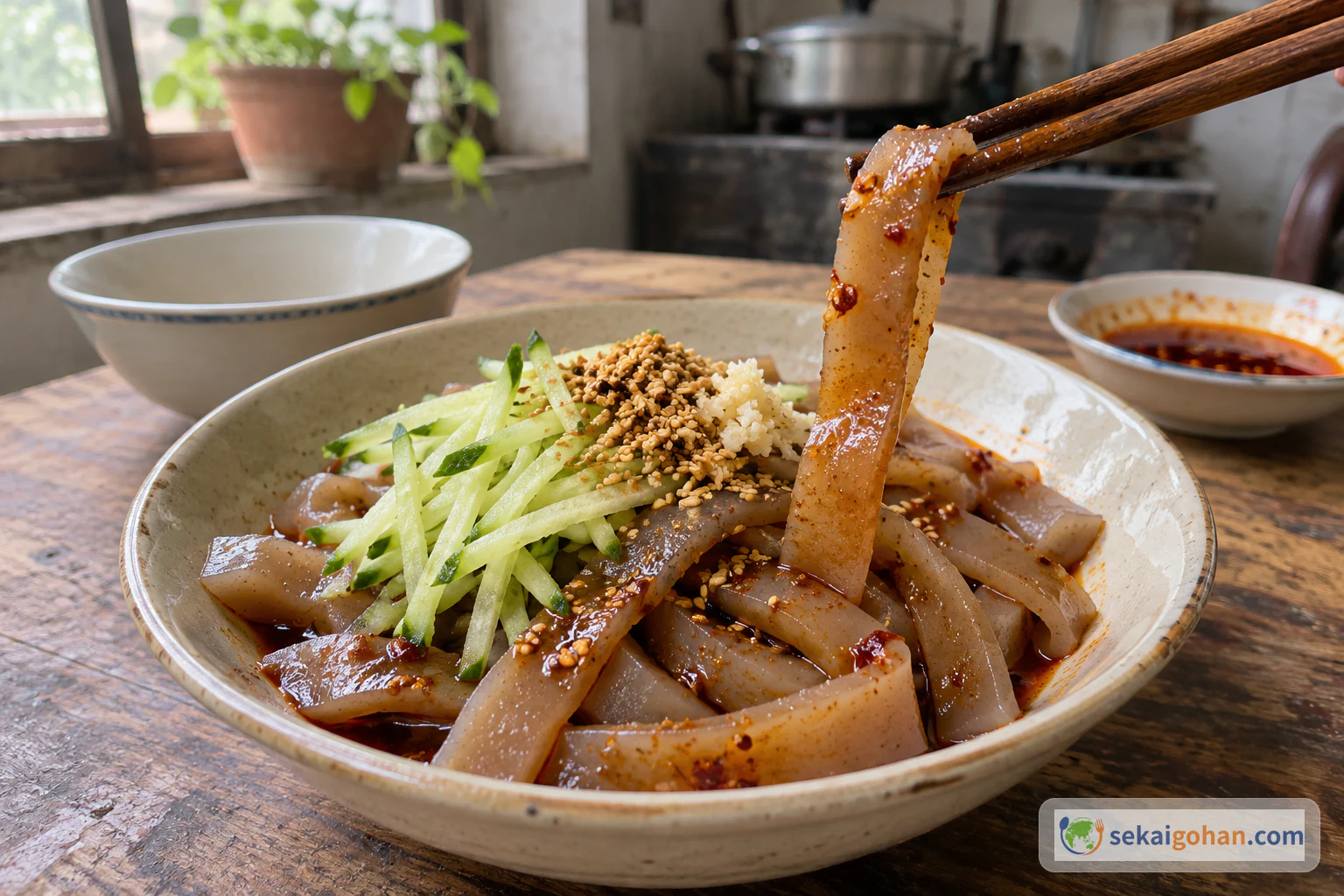
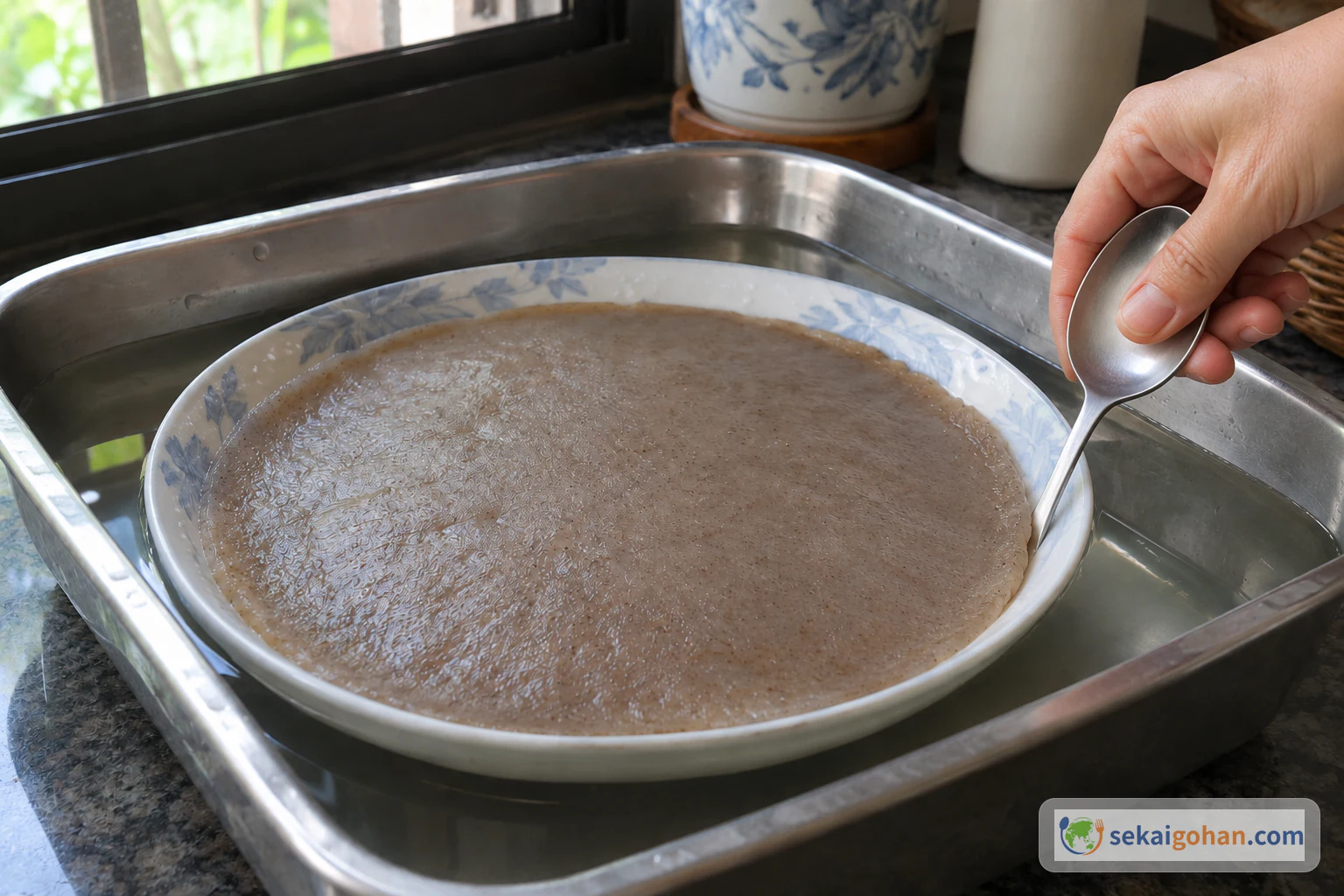
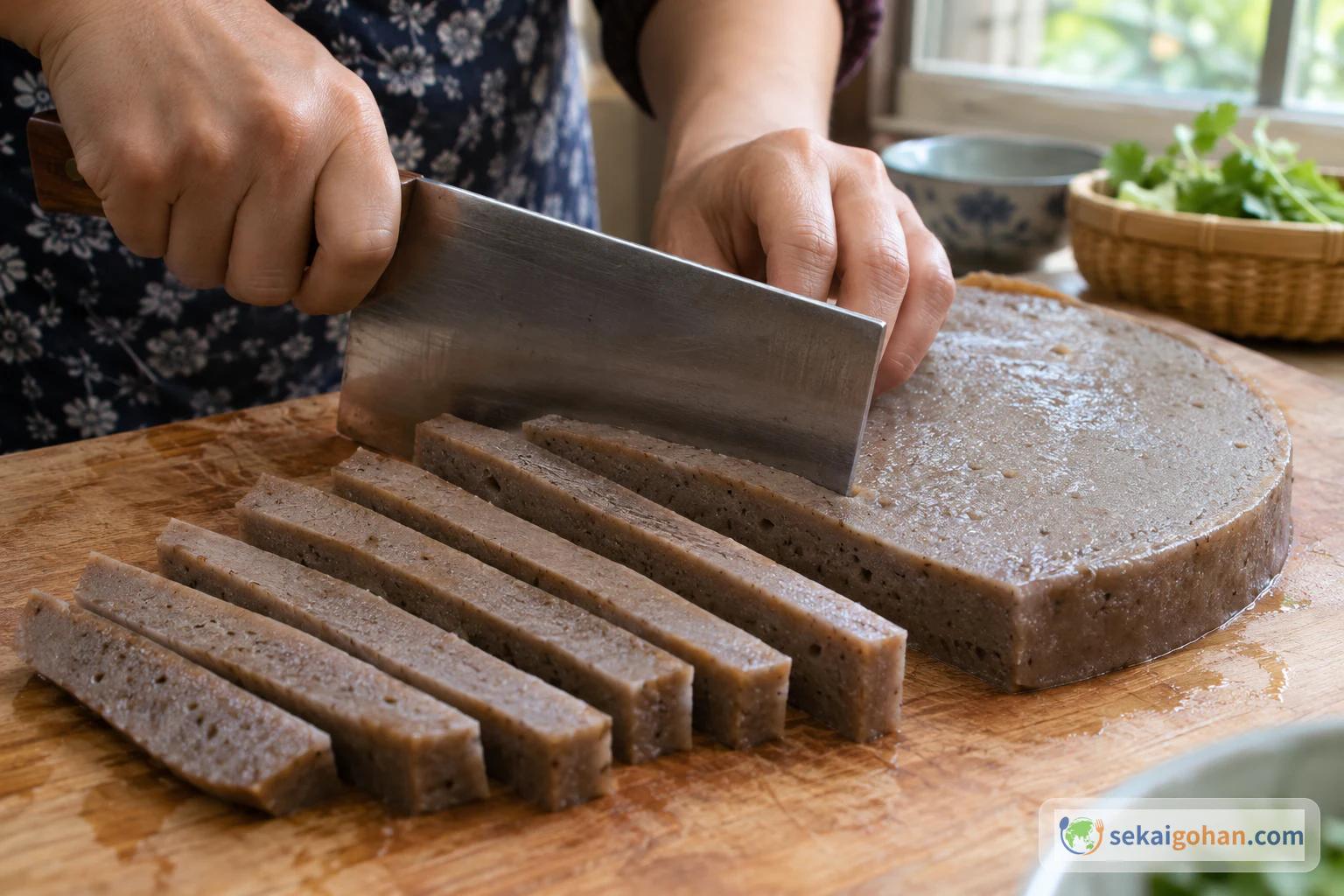
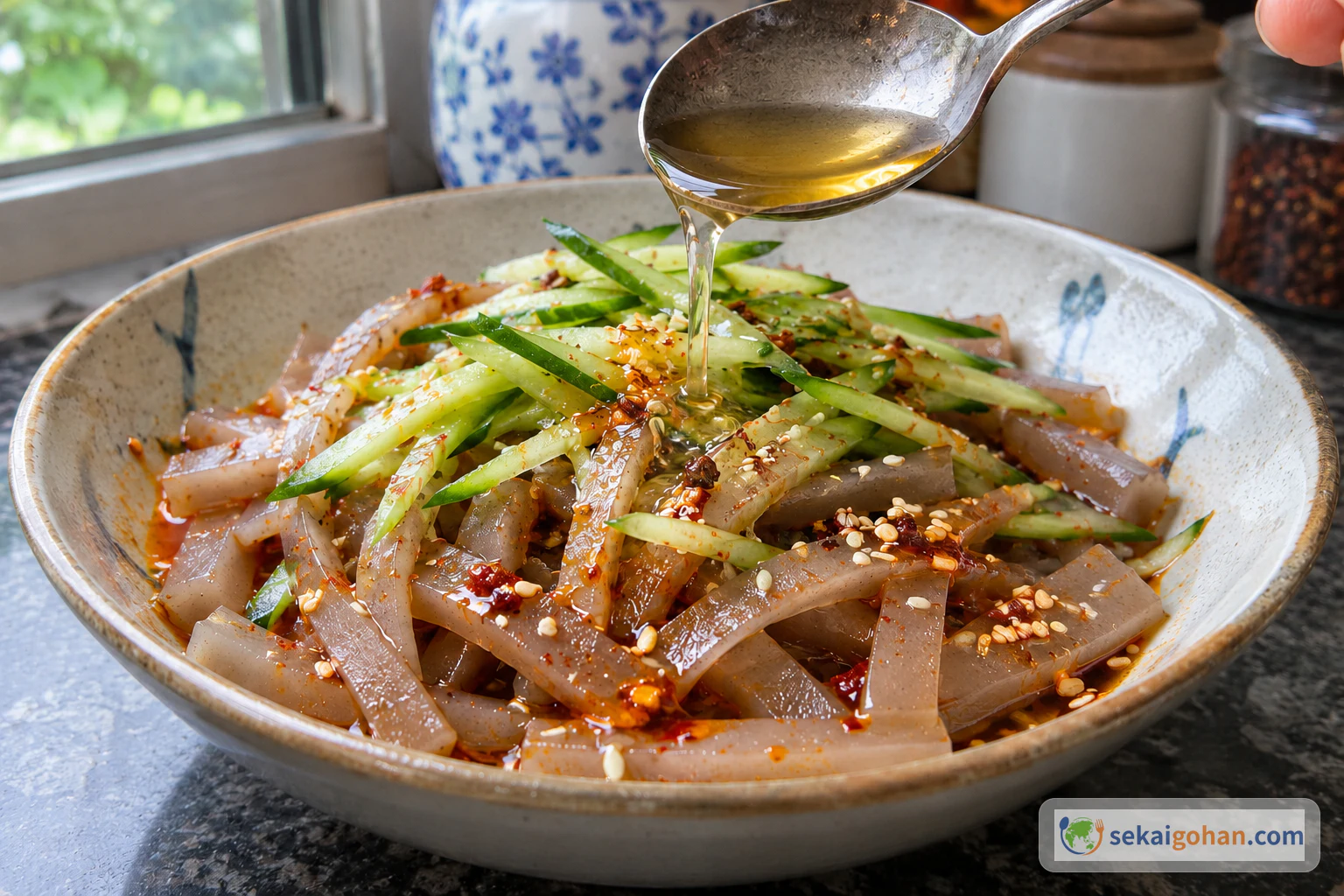
In a Liulin street shop, coarse pottery bowls stand stacked by the counter, each holding a round, grey-brown cake of steamed buckwheat that has set firm as it cooled. The diner takes a small knife, scores the cake right in the bowl, and spoons dark vinegar and red chili oil into the cuts. Wantuo is that cake: buckwheat flour stirred with water into a batter, steamed, chilled until it holds its shape, then cut and dressed. It belongs to Shanxi Province in northern China, and it eats chewy and springy, sour and hot, with the earthy smell of buckwheat underneath the garlic.
A Cake That Comes Out of the Bowl
The name describes the moment the cake is done. The batter is steamed in a small bowl, and once it has cooled it slips free of the bowl, which is what the name points to. In the Liulin dialect the syllables tuan, tuo and tu sound close to one another, so the same food is written several ways: 碗托, 碗脱, 碗团 and 碗秃. In northern Shaanxi it is called 碗坨. The round bowl gives a round cake, and people read that roundness as a wish for the family to be together.
In the bowl method, the cook spreads the still-soft surface out toward the rim while it is hot. The finished cake ends up thin at the edge and thick at the center, a shape that comes straight from that move. A bowl cake steams for about 20 minutes; the shallow-plate version below sets much faster.
Shi Le's congealed porridge
Liulin tells an old story about where wantuo began. At the end of the Western Jin dynasty, Liu Yuan raised troops at Lishi, and the general Shi Le camped at Sanlangbao in Liulin. Buckwheat porridge left standing in the soldiers' camp set solid, and they cut it into strips and ate it with salt, date vinegar and garlic. It is a legend, and even the year attached to it varies: one telling puts it in 280, another in 304. What is better settled is the change in method. The first wantuo was batter cooked in a pot and left to set in a bowl. Steaming raw batter in small bowls came later, and it suited shops that needed to turn out many cakes at once.
Same name, different flour
Drive east to Pingyao, the old town in Jinzhong, and wantuo is sold all along the streets, but there it is made with white wheat flour, warm salted water and vegetable oil, mixed to a smooth paste and steamed in five-inch dishes. Pingyao credits its version to Dong Xuan, a Qing-dynasty cook, roughly a century ago. It is eaten cold with vinegar, garlic, sesame and sesame oil, or stir-fried hot with shredded Chinese yam. The buckwheat cake of Liulin and Lishi and the wheat cake of Pingyao share a name and a way of eating, and neither town needs the other's flour to call its cake wantuo. This recipe follows the buckwheat line. For more dishes from the country, see the China page.
At the stall and at home
Wantuo is mostly eaten cold, cut into strips or scored in the bowl with a knife. In Lishi the small knives are ground down from hacksaw blades, and the knife habit is often linked to missionaries who came to Liulin and brought knife-and-fork manners with them. The standard dressing is garlic paste, chili, good aged vinegar, ginger and sesame oil, and the chili is a thick paste: first-crop peppers, dried and ground, then hit with scallion oil that has been heated until it sizzles. In deep winter the cold cake turns into a hot dish, stir-fried with bean sprouts or with lamb offal. Liulin wantuo is now a provincial-level intangible cultural heritage item, and vacuum packs carry it far from the pottery-bowl shops where it started.
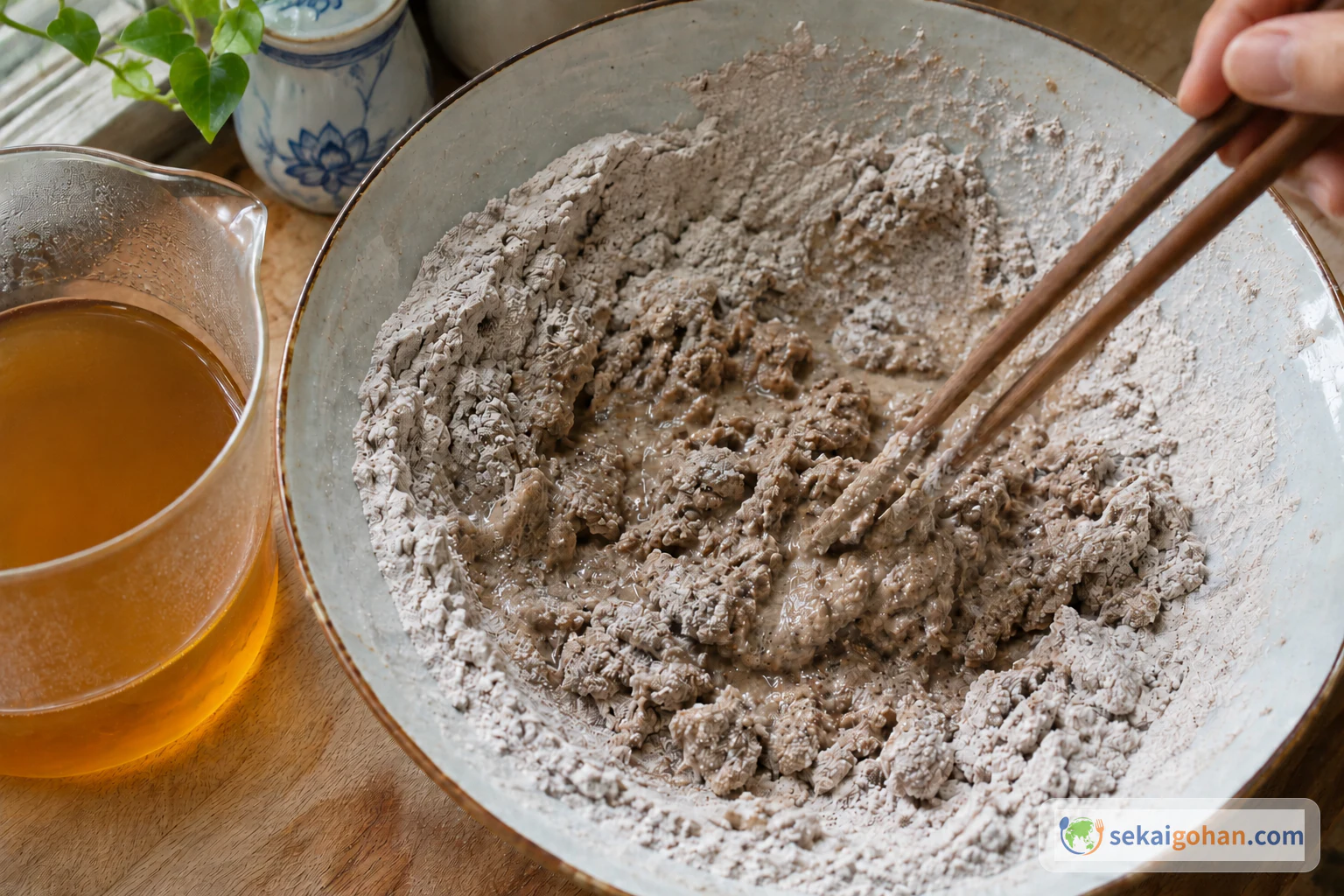
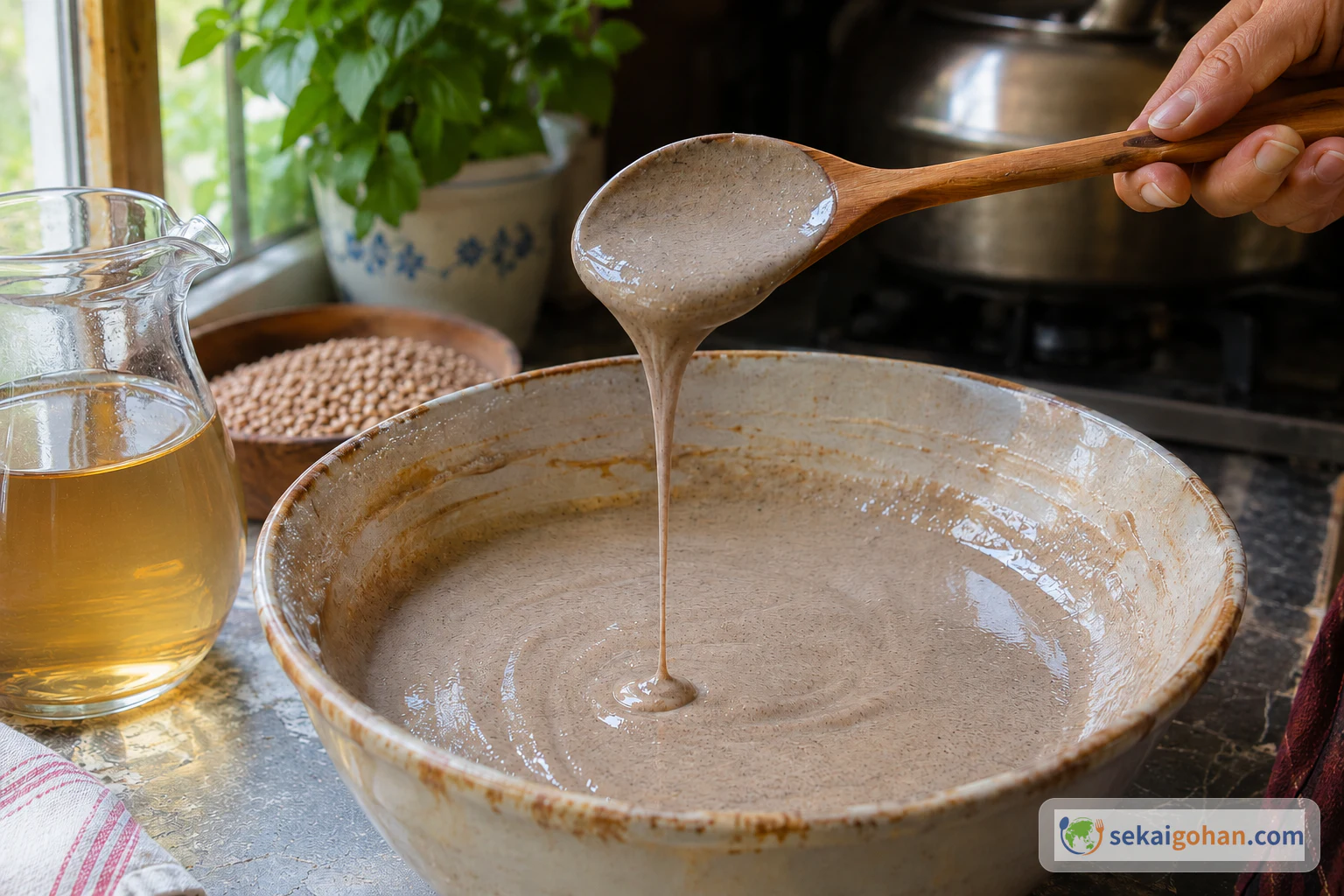
Liulin makers sum up the work in six steps: sift, stir, rest, steam, twist, press smooth. The home method below keeps the stir, the rest and the steam at its center.
Ingredients
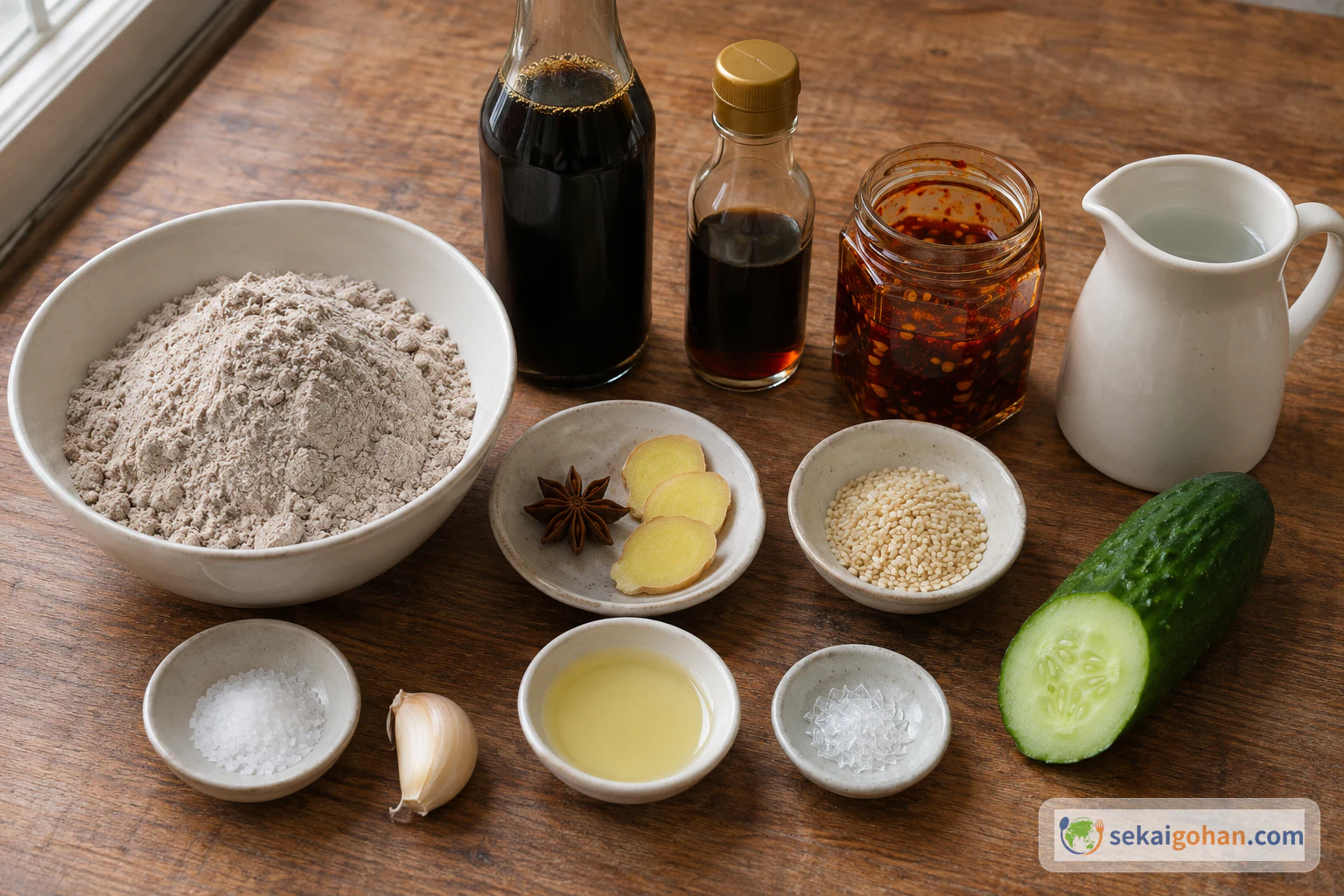
This makes two shallow plates of cake.
Wantuo is made with buckwheat, a serious allergen; anyone with a buckwheat allergy should not eat it. The dressing contains sesame. The cake has no wheat flour, but check the labels of the soy sauce, vinegar and chili oil for wheat and other allergens.
Equipment
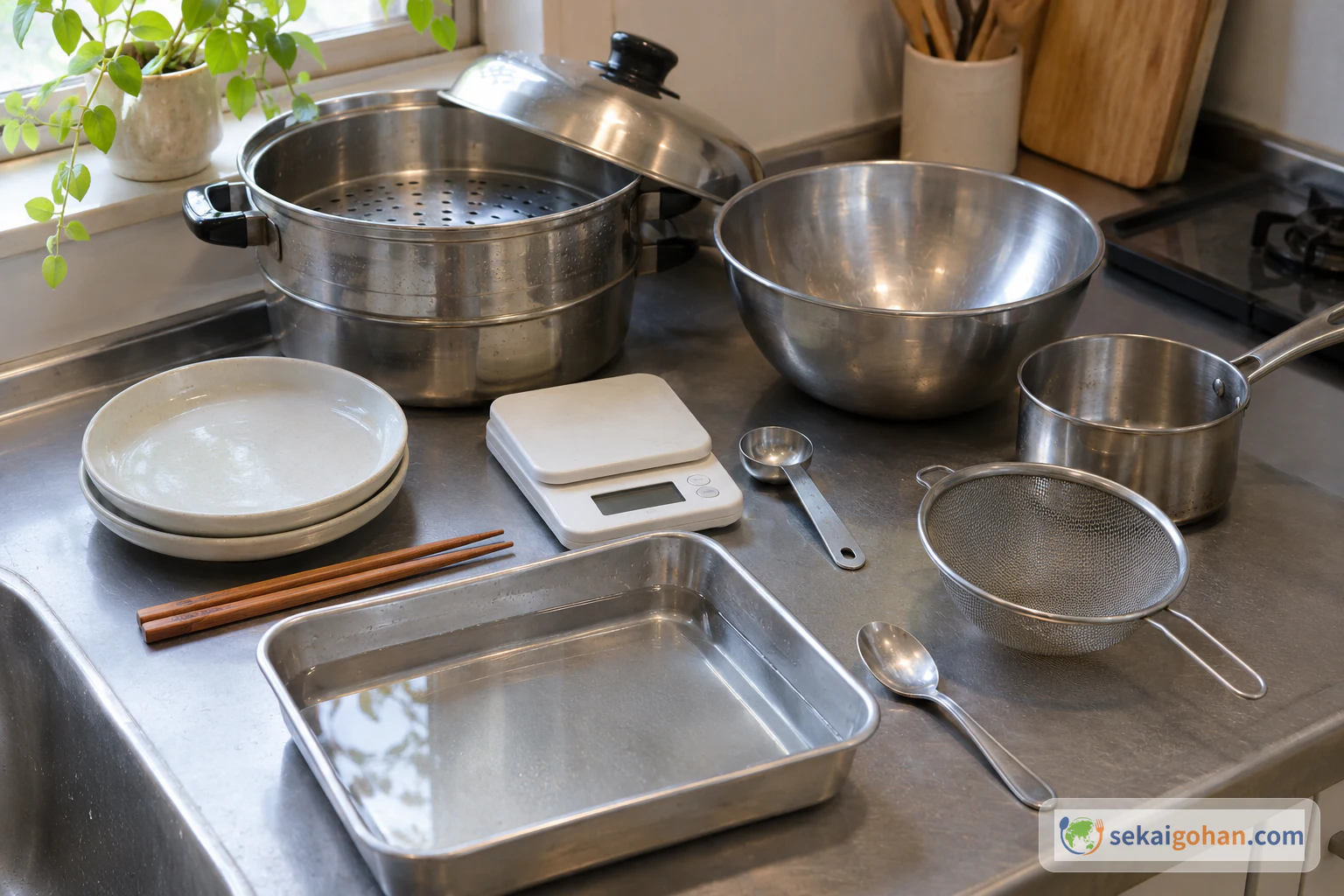
- Steamer with a lid (bamboo or stainless steel), large enough for the plates
- 2 shallow heatproof plates, about 8 inches (20 cm) across
- Large mixing bowl
- Chopsticks or a whisk
- Kitchen scale and measuring spoons
- Small saucepan and a fine-mesh strainer
- Plastic wrap
- A tray or basin of cold water big enough to hold a plate
- A spoon, for spreading the batter and loosening the edge with its handle
- Knife and cutting board
- Mortar and pestle, for the sesame
Choosing and Substituting
The flavor of wantuo rests on four things: buckwheat aroma, the sourness of dark vinegar, the heat of chili oil and the bite of raw garlic. Keep all four, and the cake tastes of Shanxi even made far away. Rounding it off with sesame oil or sugar pulls it toward something else.
| Ingredient | What to buy | What a swap does |
|---|---|---|
| Buckwheat flour | Chinese 荞麦面粉 from an Asian grocer, or any plain buckwheat flour | Chinese flour is often greyer and a little coarser; other buckwheat flours change the color and smell of the cake slightly |
| Shanxi aged vinegar | Bottles labeled 山西老陈醋 | Chinese black vinegar such as Zhenjiang is the closest swap; Japanese kurozu is much sweeter and should not replace it spoon for spoon |
| Light soy sauce | Chinese 生抽 | Japanese light soy is a different sauce in color and salt; use half the amount of all-purpose soy sauce and make up the salt with a pinch of salt |
| Chili oil | Chinese chili oil with plenty of flakes | You can make it by pouring hot neutral oil over chili flakes, close to the scallion-oil method used in Liulin |
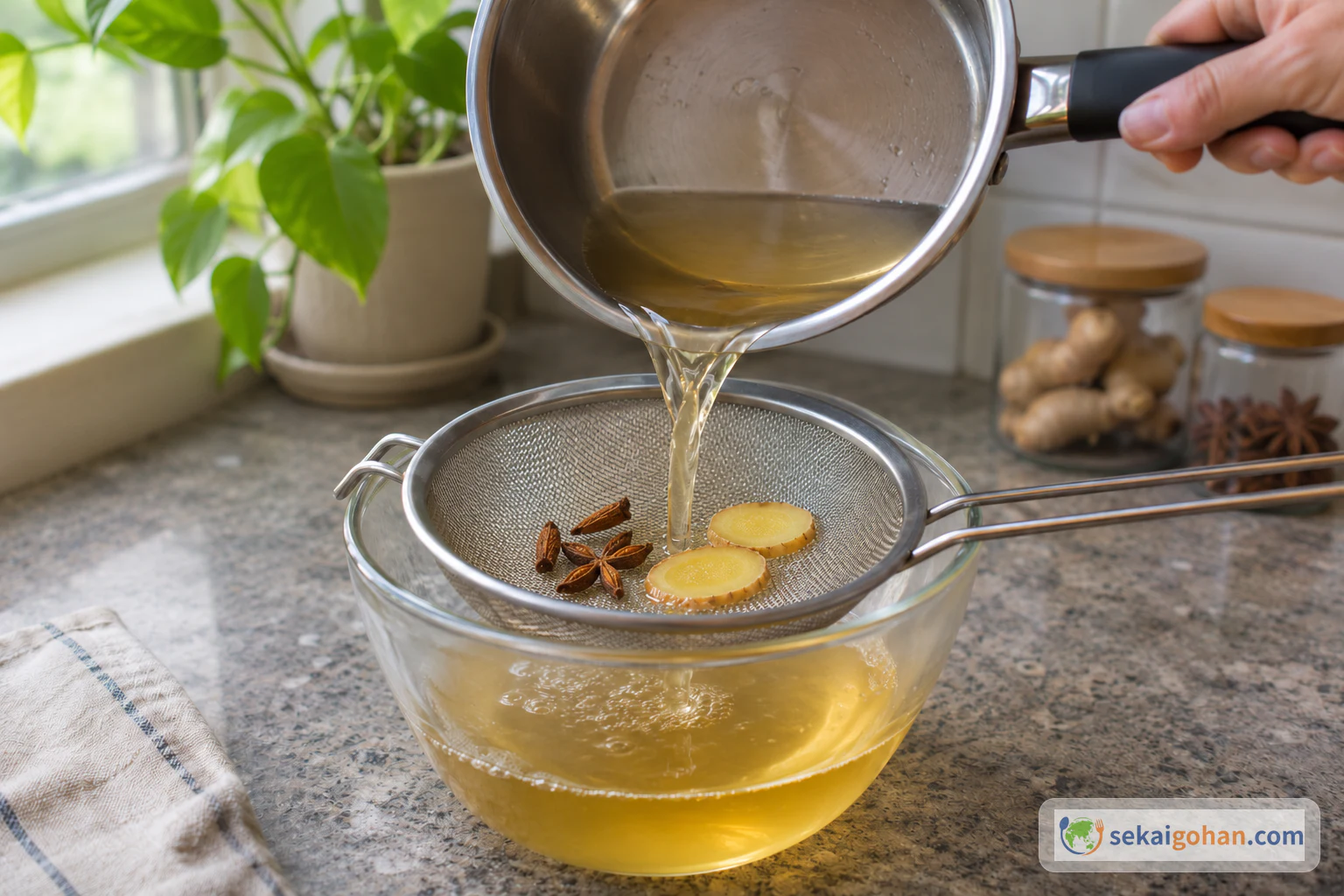
| Star anise | Whole pods | Leaving it out still gives a cake, but the spiced water loses its warm, licorice edge |
Freshness matters more for the flour than for anything else. Liulin makers keep their flour on a short leash: used within 5 to 10 days of milling in summer and within 15 days in winter. At home, buy from a shop that sells it quickly, and smell it; fresh buckwheat smells nutty and slightly sweet.
Leave out potato starch and cornstarch. The cake sets on buckwheat alone, and added starch pushes it toward a wobbly jelly. Use plain neutral oil on the plates, since sesame oil would perfume the cake.
Method
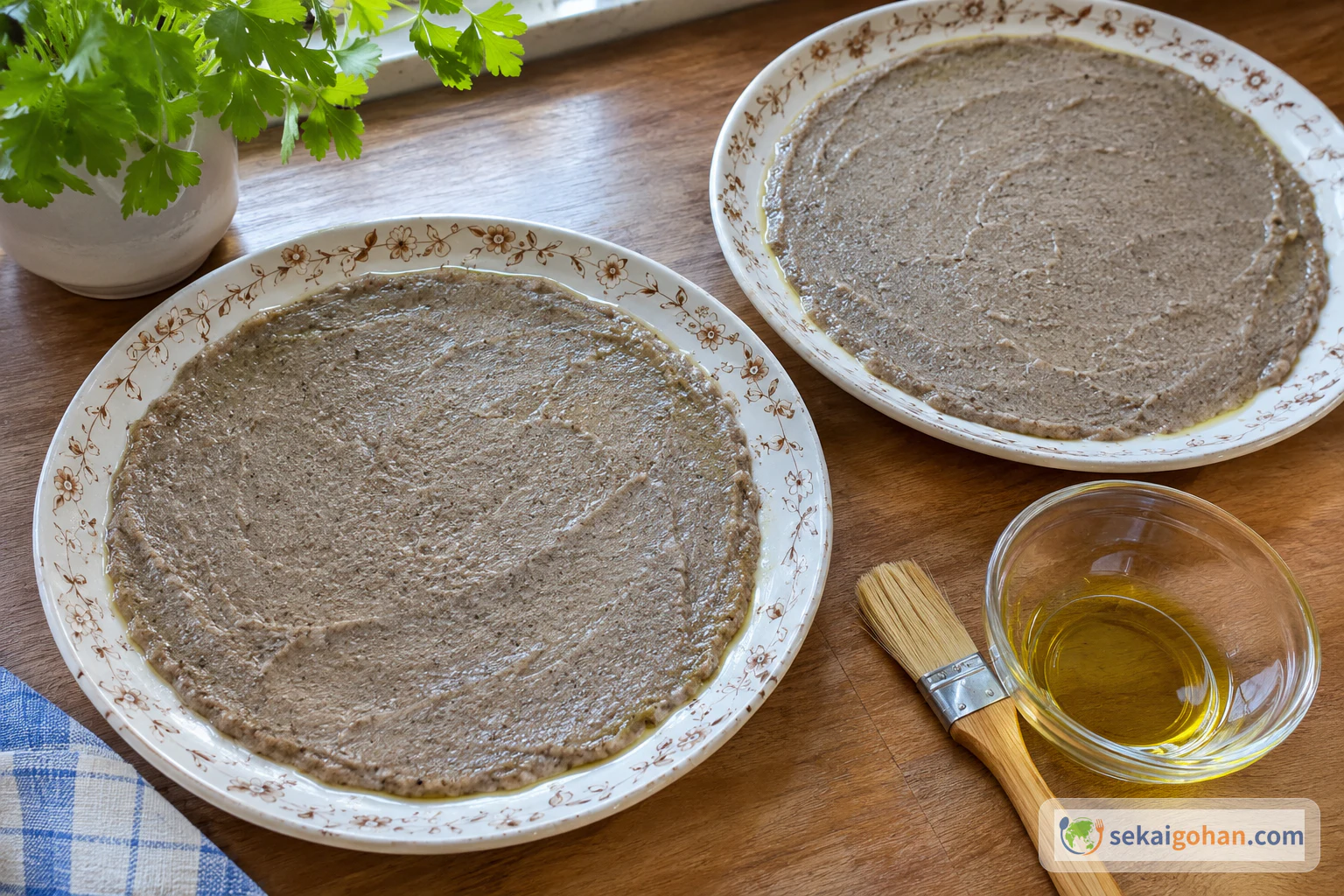
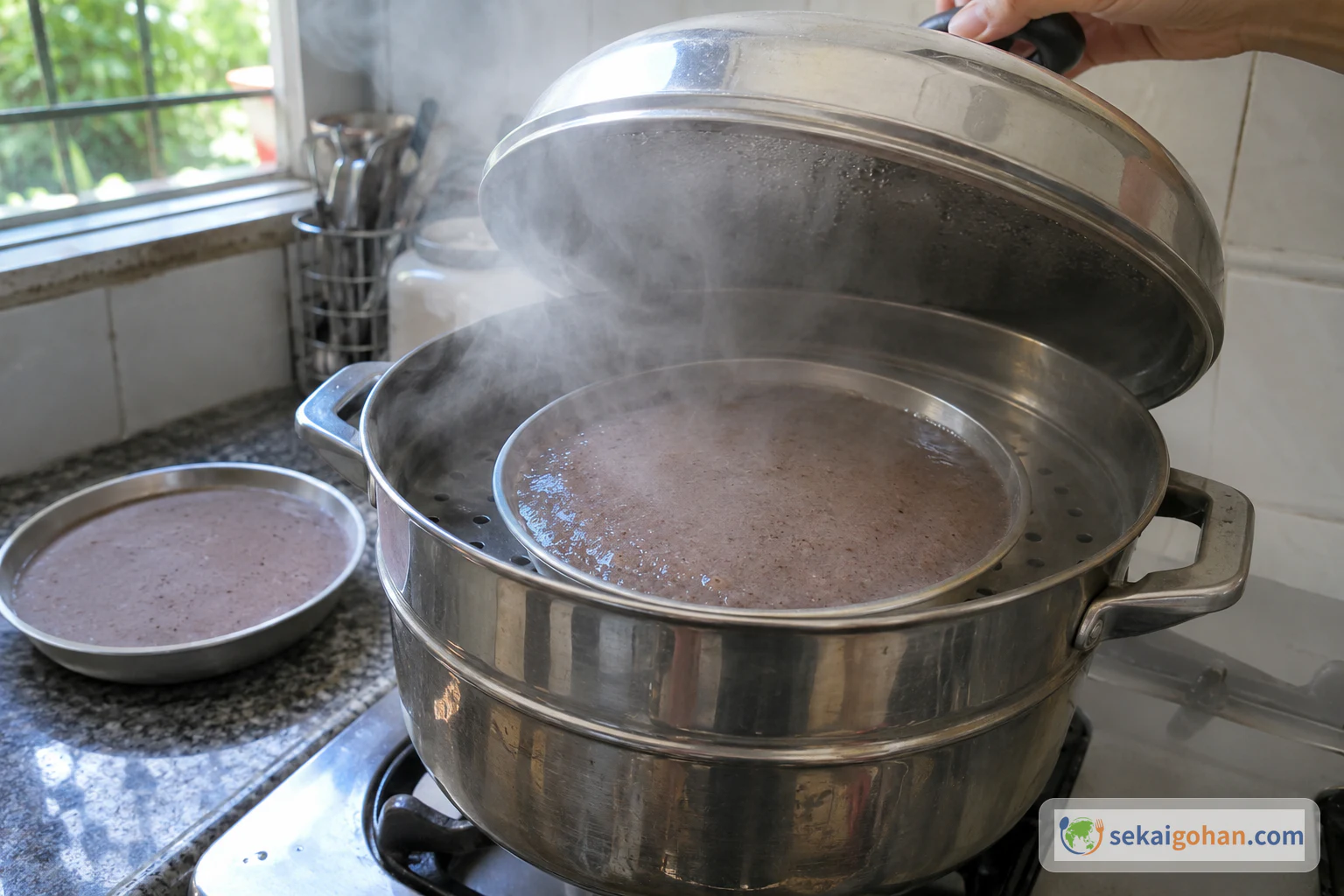
Make the spiced water first, because it has to cool before it touches the flour. The stirring is the real work: ten minutes or more of steady effort in one direction. Then comes the hands-off stretch, a 30-minute rest, which is the time to set the steamer water on the stove and oil the plates. After a short steam, the cake cools in cold water and is cut and dressed.
When It Goes Wrong
| What you see | Why | What to do |
|---|---|---|
| Lumps or a floury batter | Water added all at once, or the spiced water was too hot | Add water in small splashes, stirring in one direction; cool the spiced water first |
| Batter runs thin across the plate | Too much water | Stop at 12½ oz (350 g); add more only if the ribbon will not form |
| Raw batter in the center after steaming | Batter spread too thick, or not enough time | Spread to about ¼ inch (5 mm) and steam 2–3 minutes more at a time |
| Cracked surface | Overcooked and drying out | Stop as soon as the cake is set; keep condensation from dripping |
| Cake sticks to the plate | No oil, or not cold yet | Oil the plates thinly; chill fully before loosening |
| Strips break when cut | Cut while still warm | Chill in cold water until cold through |
| Flat, dull taste | Too little sourness or salt | Add more vinegar and garlic water; a splash of soy for salt |
| Too hot | Too much chili oil | Use 1 tbsp chili oil and keep the rest of the dressing the same |
Serving, Variations and Storage
At the table
Serve wantuo cold, as soon as it is dressed, in shallow bowls with chopsticks. It is a snack and a light meal on its own, and the sharp vinegar and raw garlic wake up a hot day.
Variations
- Bowl-steamed: Steam the batter in small bowls for about 20 minutes, spreading the soft surface toward the rim while hot. The cake comes out round, thick in the middle and thin at the edge, ready to score in the bowl with a knife.
- Winter bean sprout stir-fry: Fry scallion in oil, cook bean sprouts until mostly done, then add strips of wantuo with garlic, vinegar, chili, salt and ginger. The cake turns hot, soft-edged and glossy with sauce.
- Lamb offal stir-fry: In Liulin the strips are also stir-fried with lamb offal, which makes a rich, meaty winter dish.
- Milder dressing: Cut back the chili oil and let the vinegar and garlic water carry the flavor. The cake's buckwheat taste comes forward.
Storage
Wantuo is best eaten the same day, and it should not sit at room temperature for long. For leftovers, divide them into shallow containers, cool them quickly, and refrigerate at 50°F (10°C) or below. Do not eat leftovers cold the next day. Heat them until the center reaches 167°F (75°C) or above before eating; the bean sprout stir-fry is the natural way to do it.
Frequently Asked Questions
Can I use ordinary buckwheat flour instead of Chinese flour?
Yes. Plain buckwheat flour makes a good wantuo. Chinese 荞麦面粉 tends to be greyer and coarser, so the color and aroma of the cake shift a little with other flours. Fresh flour matters more than where it was milled.
Do I add potato starch or cornstarch to help it set?
No. Buckwheat flour and spiced water set on their own once stirred and steamed. Starch makes the cake jellylike instead of springy.
Can I eat it warm?
Cold is how it is eaten in Liulin and at stalls. When you want it hot, stir-fry the strips with bean sprouts or other vegetables, the way Shanxi kitchens do in winter.
I don't have a steamer. What can I use?
A deep pan or wok with a rack and a tight lid works. Keep the water at a strong boil and use the doneness cues from step 5: a glossy, set surface, a springy press and a clean skewer.