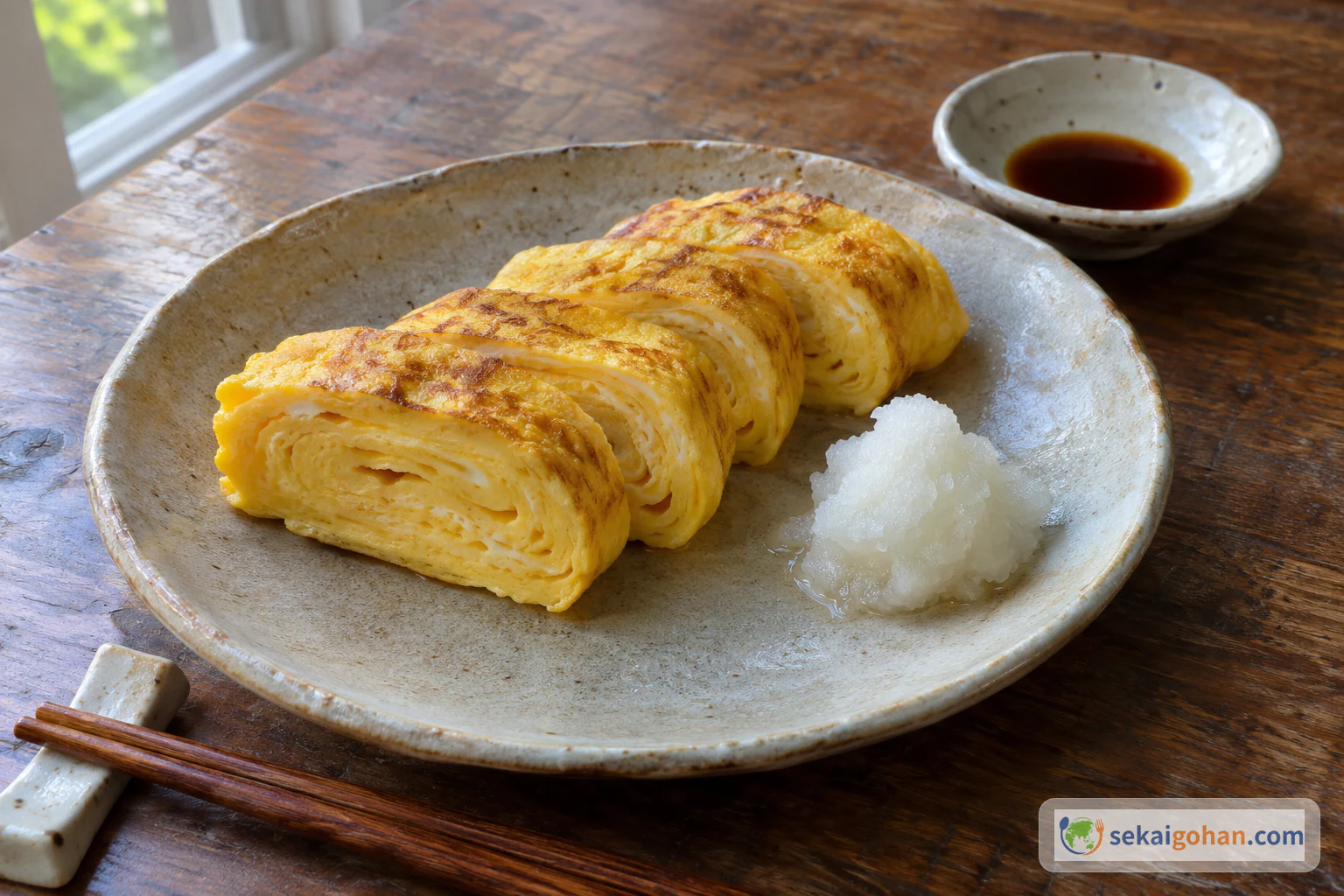
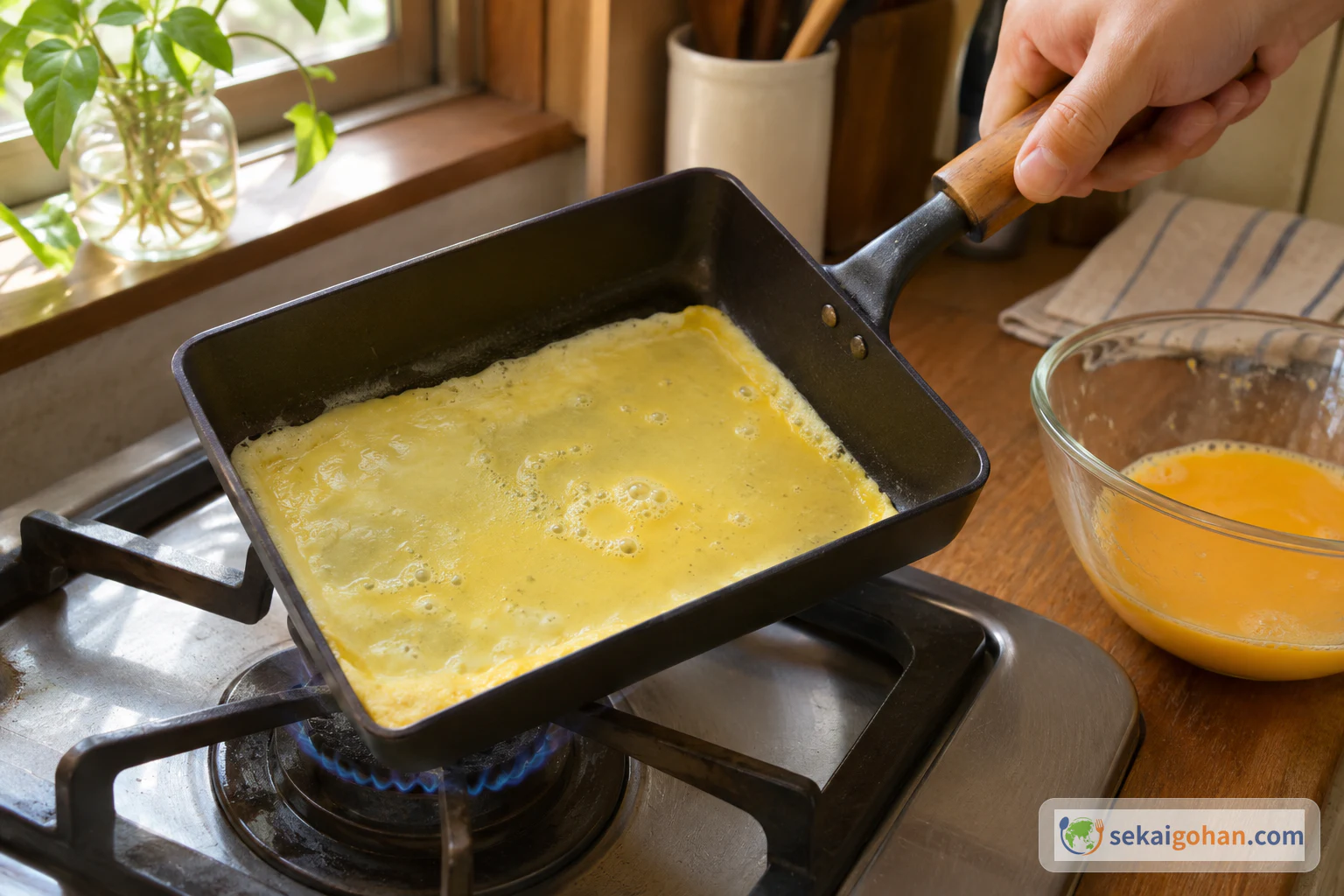
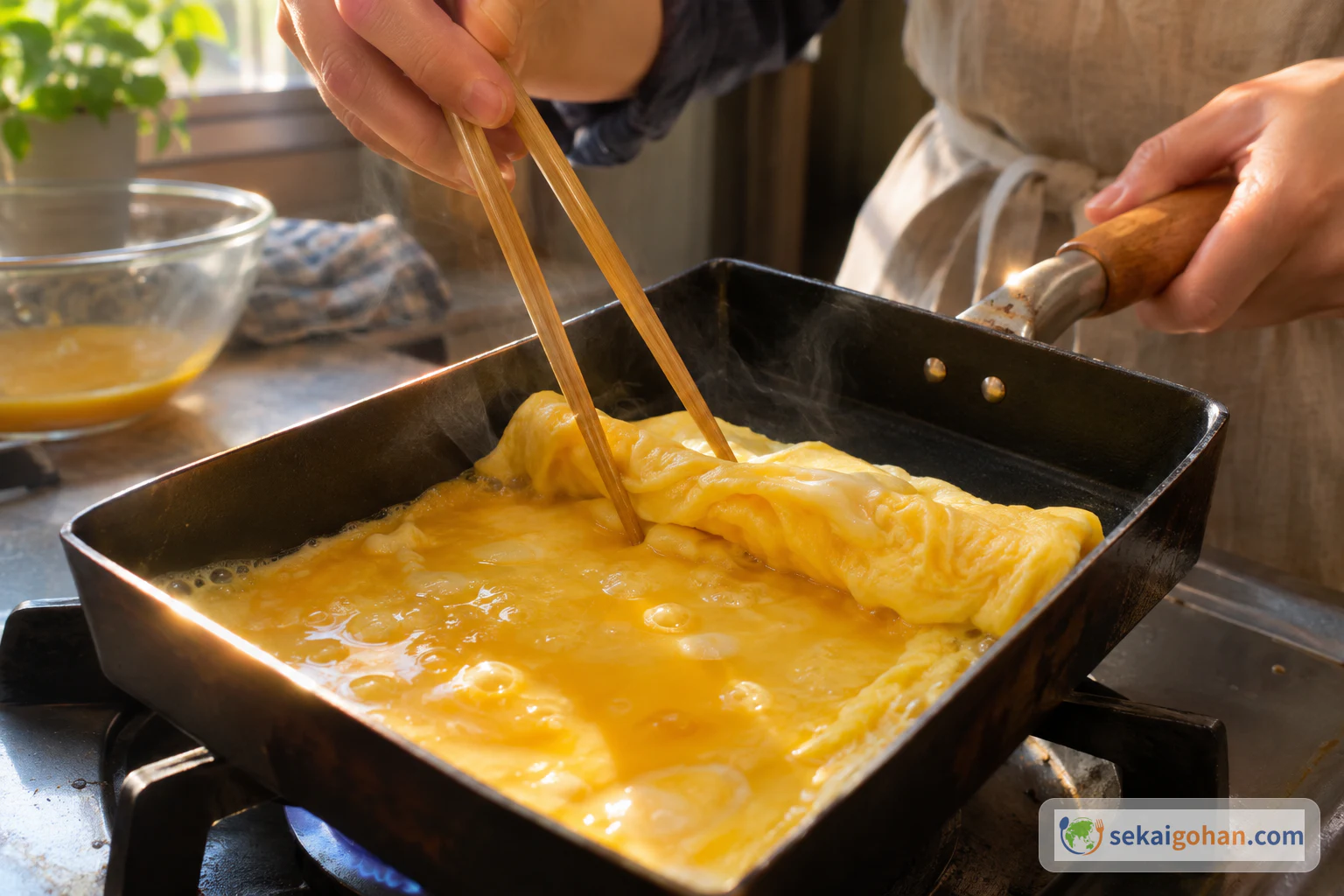
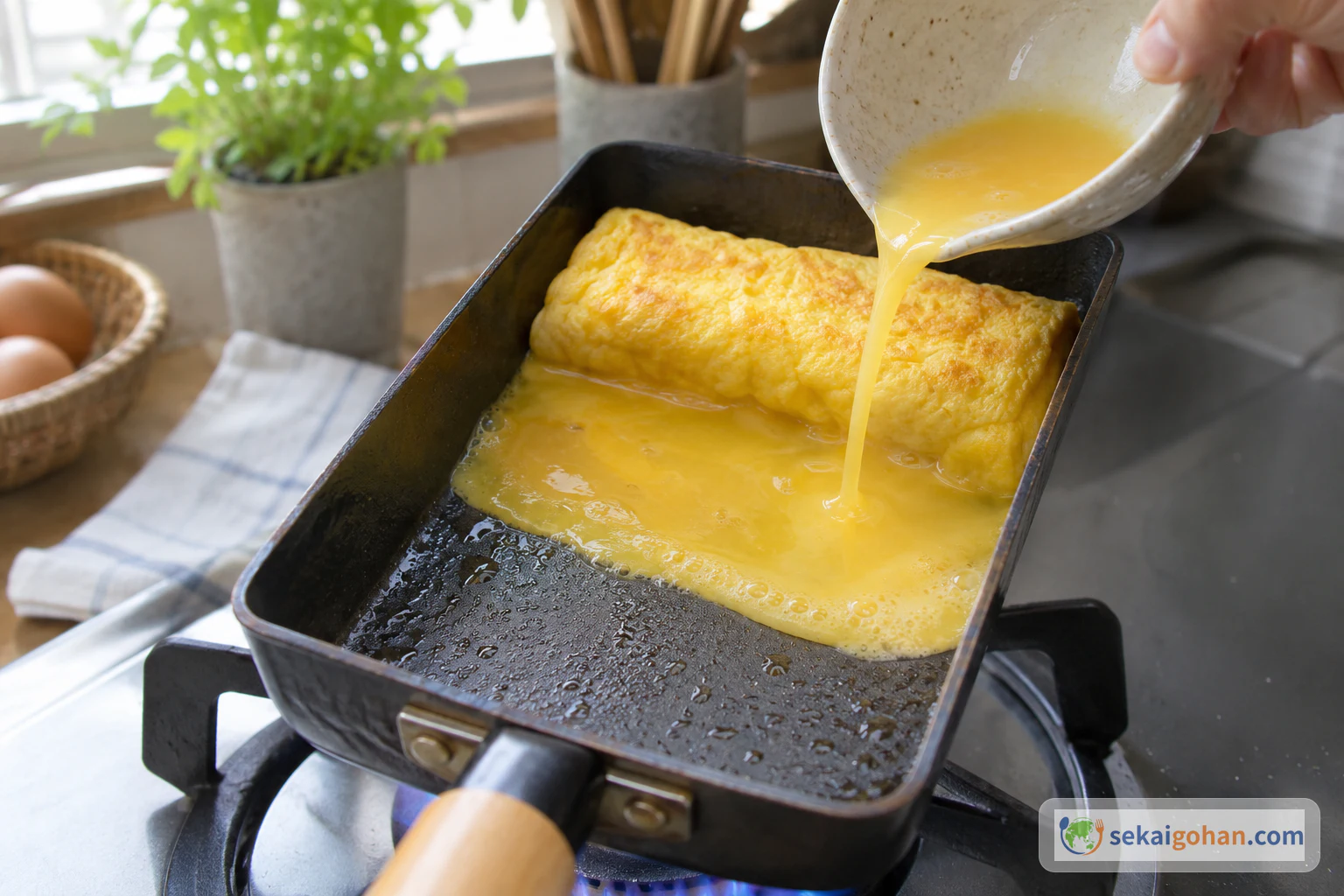
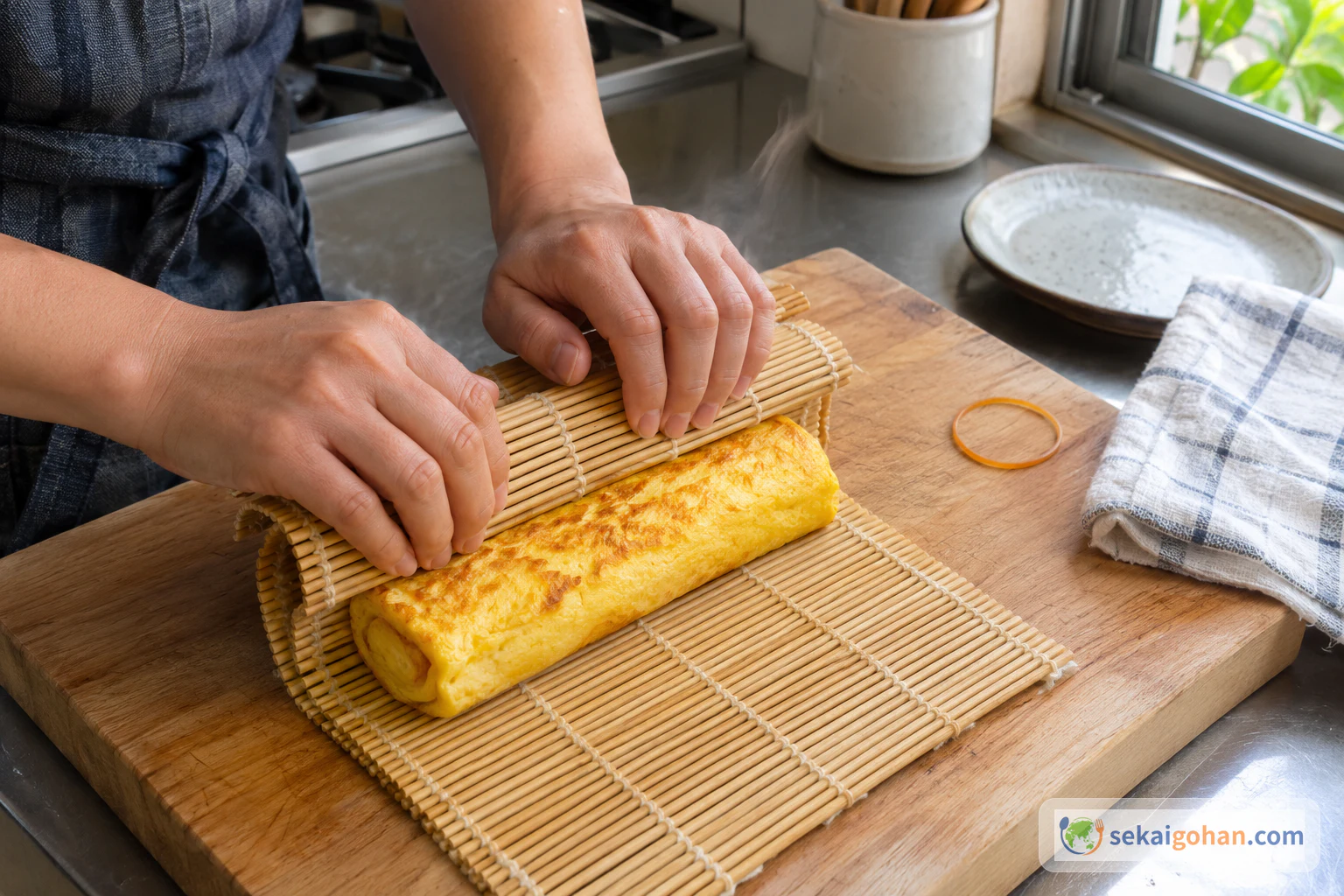
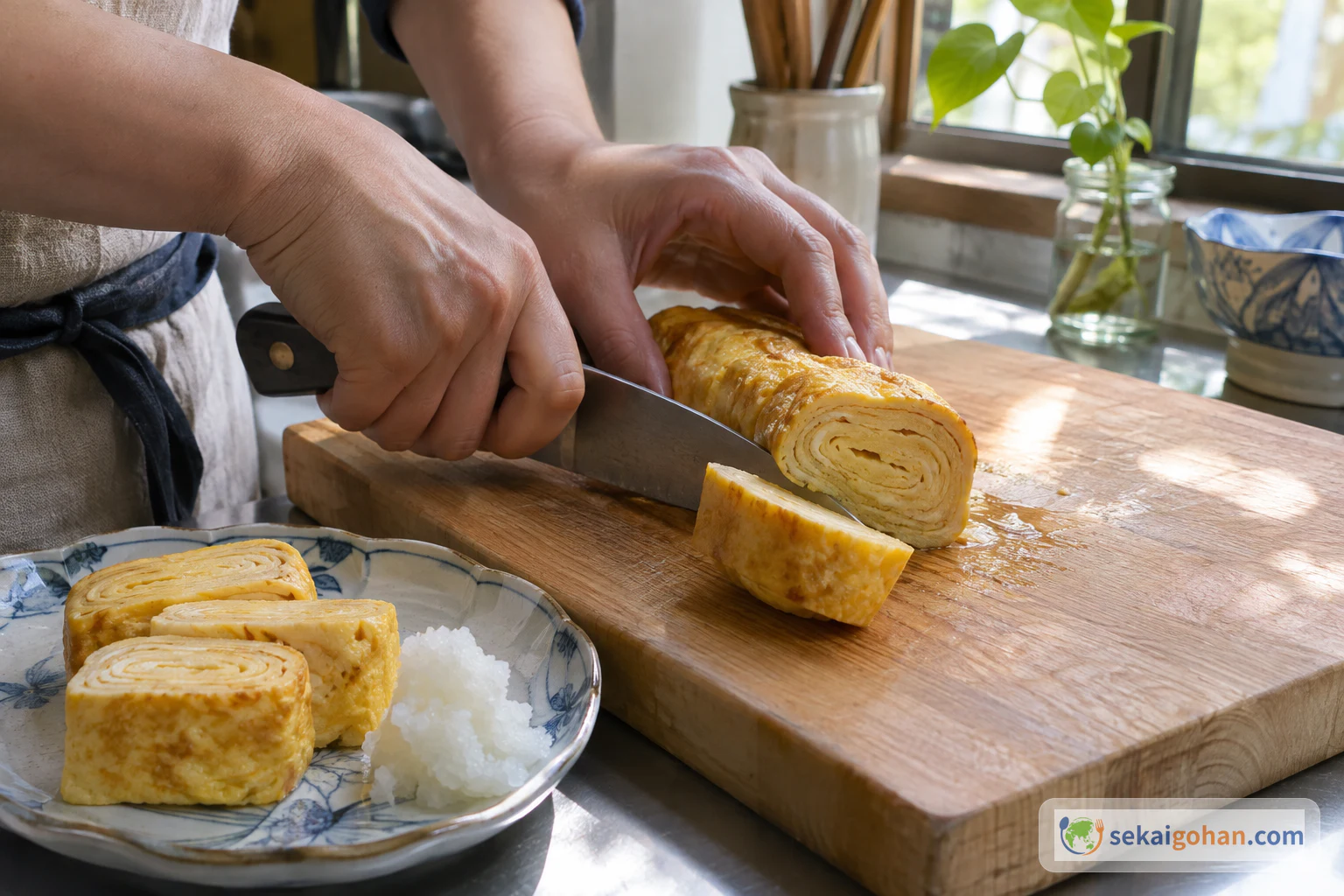
The egg liquid hits the hot square pan with a soft sizzle, and within seconds small bubbles push up through the thin yellow sheet. You pop them with the tips of your chopsticks, and while the top is still glossy you start folding the sheet from the far side toward you, one turn after another, until a soft log sits at the front of the pan. Two more pours and two more rolls later, you have tamagoyaki: a layered omelette, sweet from sugar and mirin, savory from soy sauce, with dashi running through every fold. This version adds a little potato starch, which holds the dashi in the egg and keeps the slices moist even after they cool in a lunch box. The cooking itself takes about ten minutes.
East and West, Edo and the Lunch Box
Two names for one pan
Ask for tamagoyaki in Tokyo and in Osaka and you get two different slices. In the Kanto region around Tokyo, it usually means atsuyaki tamago: seasoned on the sweet side with sugar and dark soy sauce, cooked until a little brown shows on the outside, and springy when you bite it. In the Kansai region around Osaka and Kyoto, it usually means dashimaki tamago: rich in dashi, cooked without browning and served with grated daikon. One Kansai way leaves out sugar entirely and seasons with light soy sauce, mirin and salt, so the roll stays a bright clear yellow. The split follows the broth habits of each side, with dark soy sauce and bonito dashi in the east, and light soy sauce and kombu dashi in the west.
Which name belongs to which style shifts from region to region and shop to shop. In Kyoto, specialist shops roll seasonal fillings such as eel or Kujo green onions into the egg. The roll here sits between the two camps. Sugar and soy sauce pull it toward the sweet eastern style, while the dashi, the potato starch and the grated daikon on the plate lean west.
Rolling from the front of the pan toward the back is called Kyo-maki, Kyoto rolling. Rolling from the back toward you is called Osaka-maki. This roll goes from the far side toward you, though how firmly these names are fixed is not settled.
From a rare food to a street specialty
Eggs were kept off the Japanese table for a long time. The ban was lifted in the early Edo period, and eggs came into the diet partly through Nanban trade, yet they stayed expensive. A favorite treat of Edo townspeople, tamago fuwafuwa, was beaten egg poured into boiling dashi and steamed. It is usually named as the forerunner of tamagoyaki.
The Edo style that grew from it had a sweet, rich taste carried by bonito dashi and a firm, springy bite. Ōji Ōgiya, which appears in the rakugo story Ōji no Kitsune and in Hiroshige's prints of celebrated Edo restaurants, still hand-cooks and sells tamagoyaki today and dates its founding to 1648. At Tsukiji, three specialists, Marutake, Daisada and Sushitama Aoki, sell tamagoyaki as their trade.
The bento staple
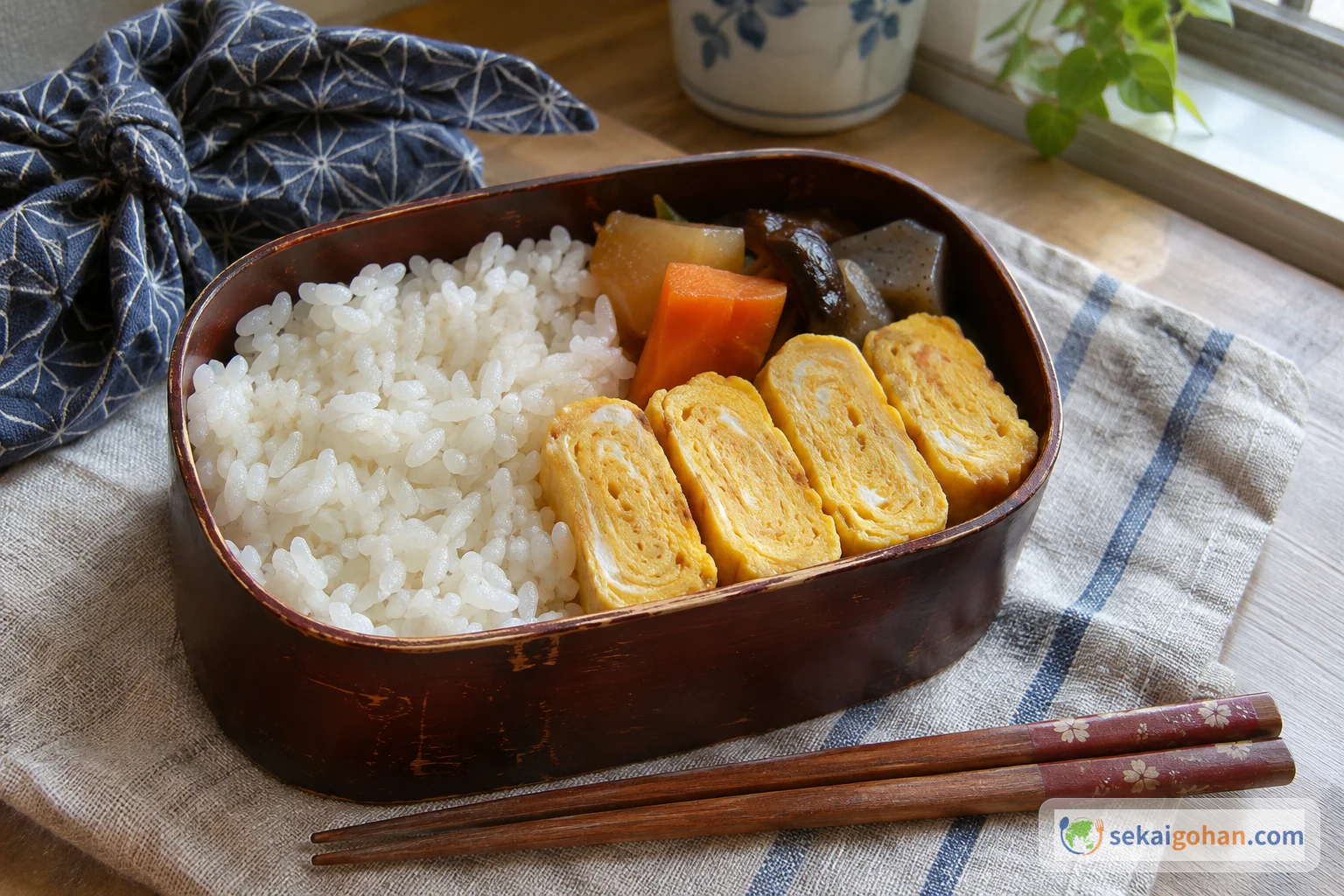
At home, tamagoyaki became a fixture of the bento box. Square nonstick pans made it easy for home cooks to roll a neat log at home, and a few yellow slices beside the rice are now part of what a packed lunch looks like across Japan. The potato starch in this recipe suits that job well, since it keeps the slices moist after they have cooled.
Ingredients (serves 2)
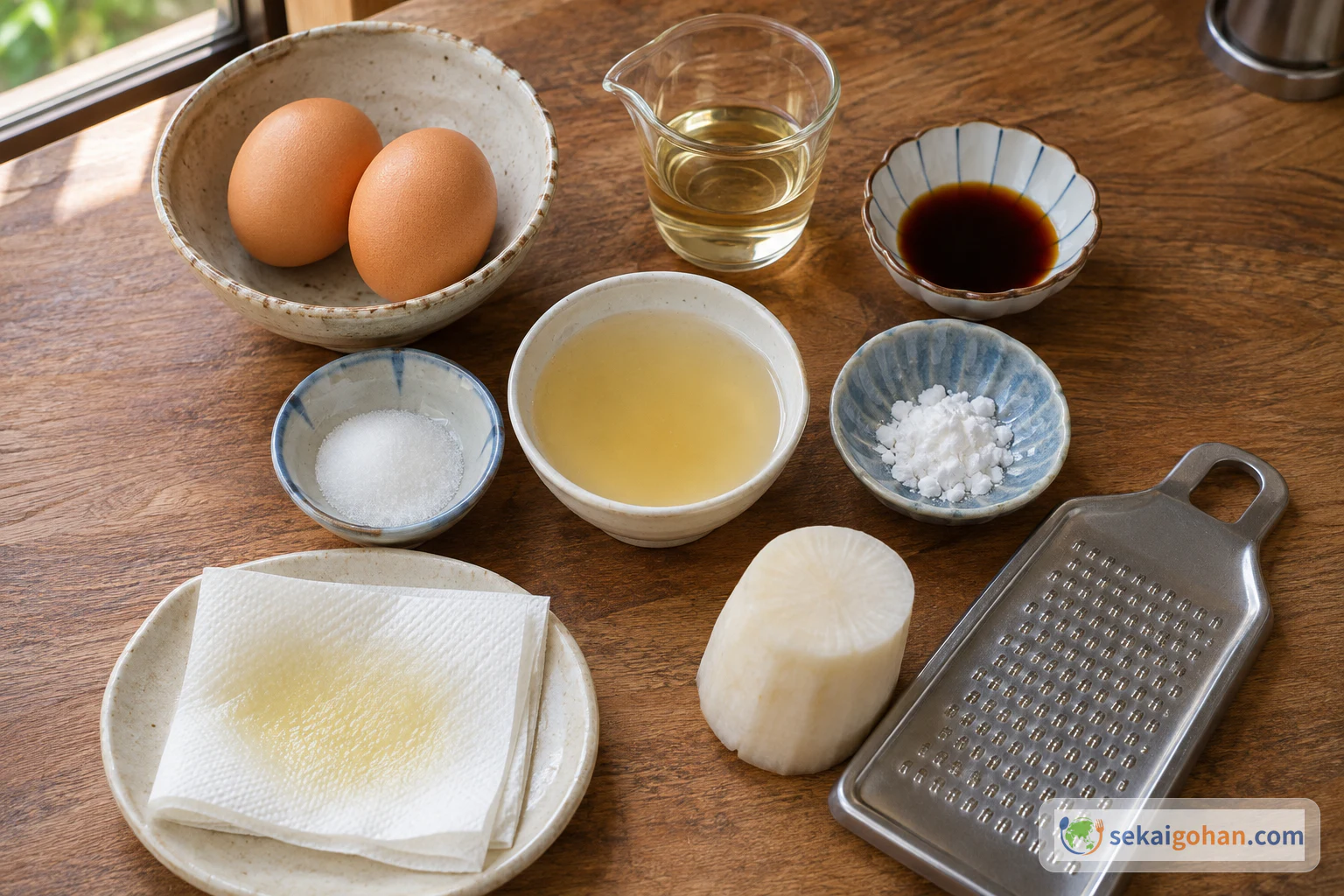
Six of these go into the bowl together. The oil is only for wiping the pan, and the daikon goes on the plate. Egg size decides how thick the finished roll is.
This dish contains egg and soy (soy sauce). Mirin contains alcohol. Cooking reduces it, but some can remain. Dashi is made from bonito, kombu or other ingredients, so check the label of the dashi product you use. Fillings such as mentaiko add fish roe.
Equipment
- Rectangular tamagoyaki pan (square-cornered omelette pan)
- Mixing bowl
- Long cooking chopsticks
- Measuring spoons
- Paper towel
- Bamboo rolling mat (makisu) and a rubber band
- Knife and cutting board
- Daikon grater
Choosing the Mirin, Dashi and Starch
Mirin comes in two kinds. Hon-mirin is true mirin, and mirin-style seasoning is a separate product. They differ in sweetness and in alcohol content, so swapping one for the other changes how sweet the roll tastes. Japanese and Asian grocers carry both, and the label tells you which one you are holding.
For dashi, granules, dashi packs, or a first dashi made from kombu and katsuobushi all work. Their salt levels differ widely, so dilute instant products exactly as the label directs. Two tablespoons is a small amount, which makes this a good recipe for using up broth left from another dish.
Either katakuriko (sold in Japan as potato starch) or kuzuko (kudzu starch) works here. Buy fresh eggs, keep them in the refrigerator, and use them soon. Grate the daikon close to serving time so it stays juicy and sharp.
How to Make Tamagoyaki
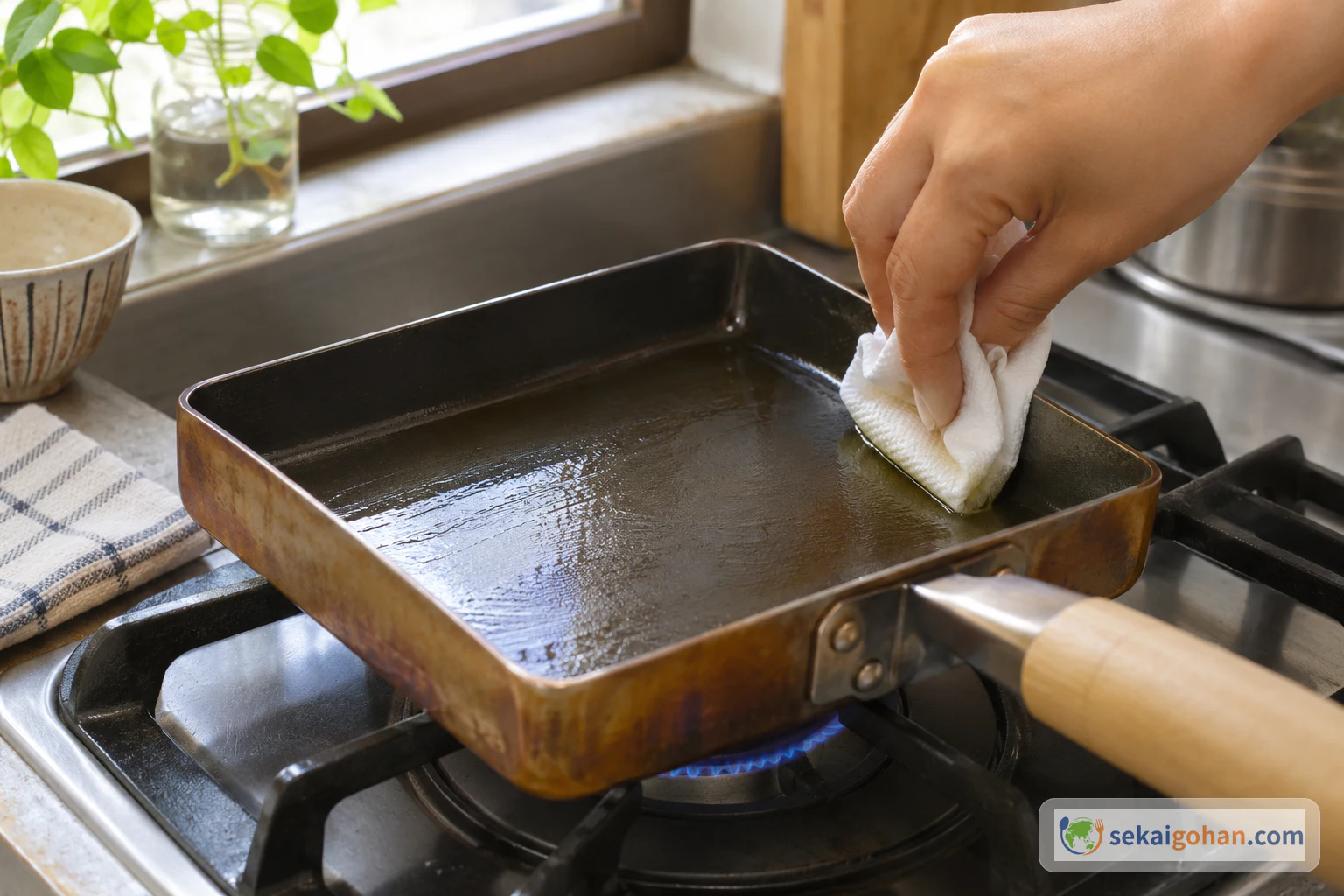
Get everything within reach before the pan goes on the heat. Once the first pour hits the pan, the work runs without a pause. Fold the oil-soaked paper towel and set it on a small plate, and loop the rubber band around the rolled-up bamboo mat. The egg goes in as three pours of one third each, and each pour is rolled before the next. Crack the eggs just before mixing and use them at once. Wash your hands after touching raw egg, and wash the bowl and chopsticks afterward, then pour boiling water over them.
Each layer is rolled while its top is still moist, so the finished roll must be cooked until no raw egg runs from the cut face. For small children, older people, anyone pregnant and anyone with weakened immunity, let each layer set further before rolling so the whole roll is firm through the center. Never serve undercooked egg to infants or older people.
When It Goes Wrong
| What you see | Why | What to do |
|---|---|---|
| The egg sticks and tears when you roll | The pan was not hot enough, or the oil missed spots | Wipe oil into every corner again and heat until a drop of egg sets at once |
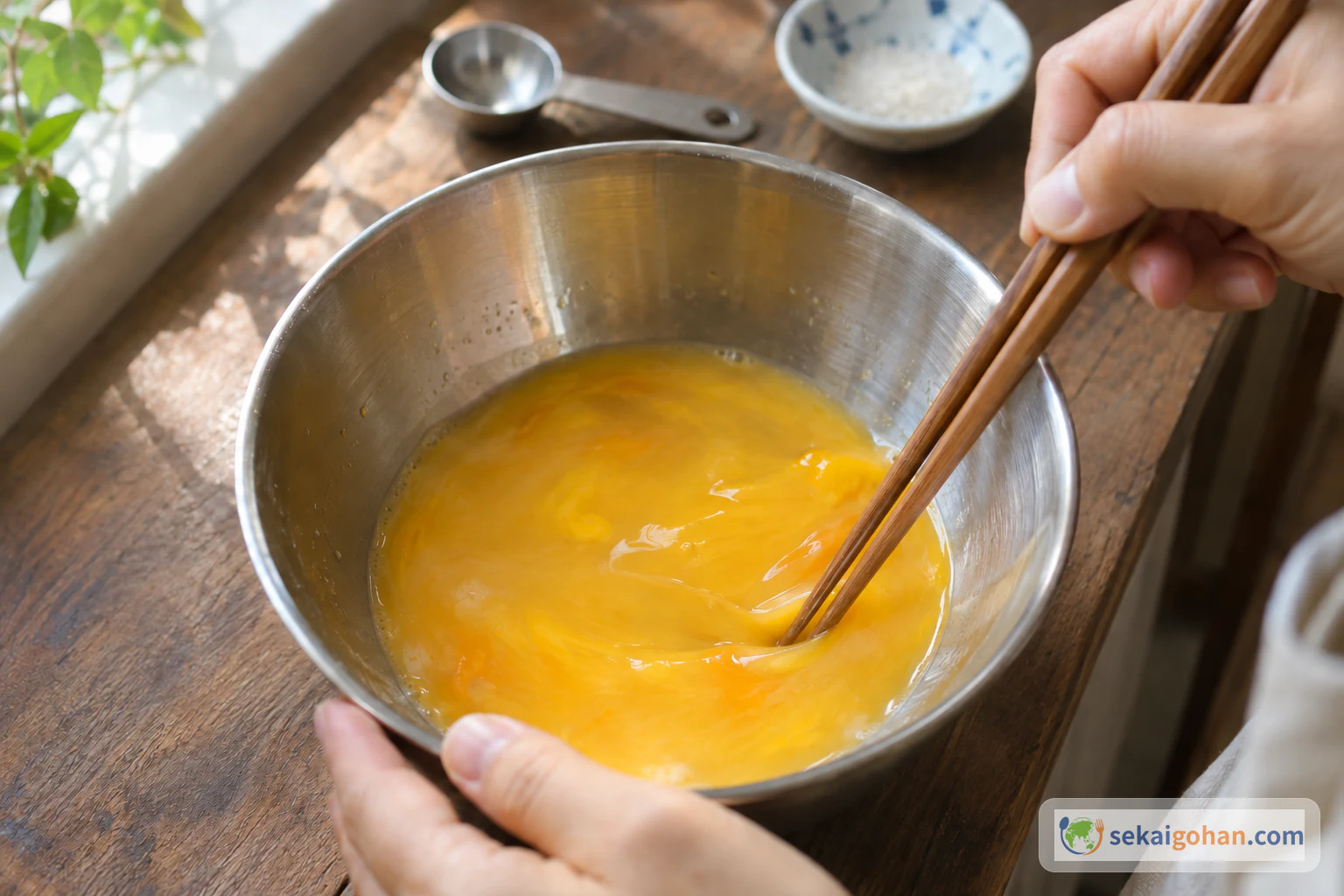
| Holes show between the layers | Bubbles were left to set, or the egg was whipped | Pop every bubble as it rises, and mix with a cutting motion |
| The sheet cracks as you fold it | The top dried before rolling | Roll while the surface still shines |
| The outside scorches | The heat is too high or the pan has run dry of oil | Drop to medium, lift the pan off the heat to roll, and wipe away burnt bits with paper towel before the next pour |
| The dashi leaks out and the roll crumbles | The starch was left out or clumped | Use the full 2 tsp of starch, dissolved first in cold dashi if it lumps |
Serving, Variations and Storage
At the table
Serve the slices with grated daikon and a little soy sauce. The cool, sharp daikon cuts the sweetness of the egg. Tamagoyaki works on a breakfast table, beside rice at dinner, or as a small plate with a drink. Its natural home is the lunch box, where it sits next to the rice.
Variations
Keep the egg liquid exactly as it is and roll in only a small amount of filling. Lay it on the second or third sheet before you roll.
- Green shiso leaf. Lay one leaf on the sheet before rolling. A green line runs through the slice, and each bite carries a fresh herbal note.
- Green onion or nori. Scatter chopped green onion or lay a sheet of toasted nori on the egg. The nori adds a sea flavor and a dark spiral in the cut face.
- Mentaiko. Set a line of spicy cod roe at the center of the roll for salt and heat. Make a plain roll for children.
- Eel or Kujo green onion. These are Kyoto's seasonal fillings.
Storage
Let the roll cool to just warm, then put it in a clean, covered container and refrigerate it promptly. Eat it soon. To reheat, warm it in the microwave and check it often. Some flavor fades, but it is still good.
Frequently asked questions
Can I leave out the potato starch?
The starch holds the dashi inside the egg as it cooks. Without it, dashi seeps out and the roll is harder to roll and keep together. Kudzu starch is the other choice that works in its place. Amounts for a starch-free version have not been worked out.
I don't have a rectangular pan. Can I use a round frying pan?
A round pan cooks the egg, but the curved sides make it hard to roll layers of even width and get a neat log. The square pan is what made tamagoyaki an easy everyday dish at home. If you plan to make it often, a tamagoyaki pan is worth buying.
What if I have no bamboo mat?
Wrap the warm roll in aluminum foil and press it into shape the same way. Foil also tidies a roll that came out a little broken. Let it cool before slicing.
Can I make it less sweet?
The sugar and mirin give this roll its sweet-savory, eastern-leaning character. For a less sweet egg, the Kansai-style dashimaki is the dish to look for. It is seasoned with dashi, light soy sauce, mirin and salt, with no sugar, and cooked without browning. That makes it a different mix and a different roll.