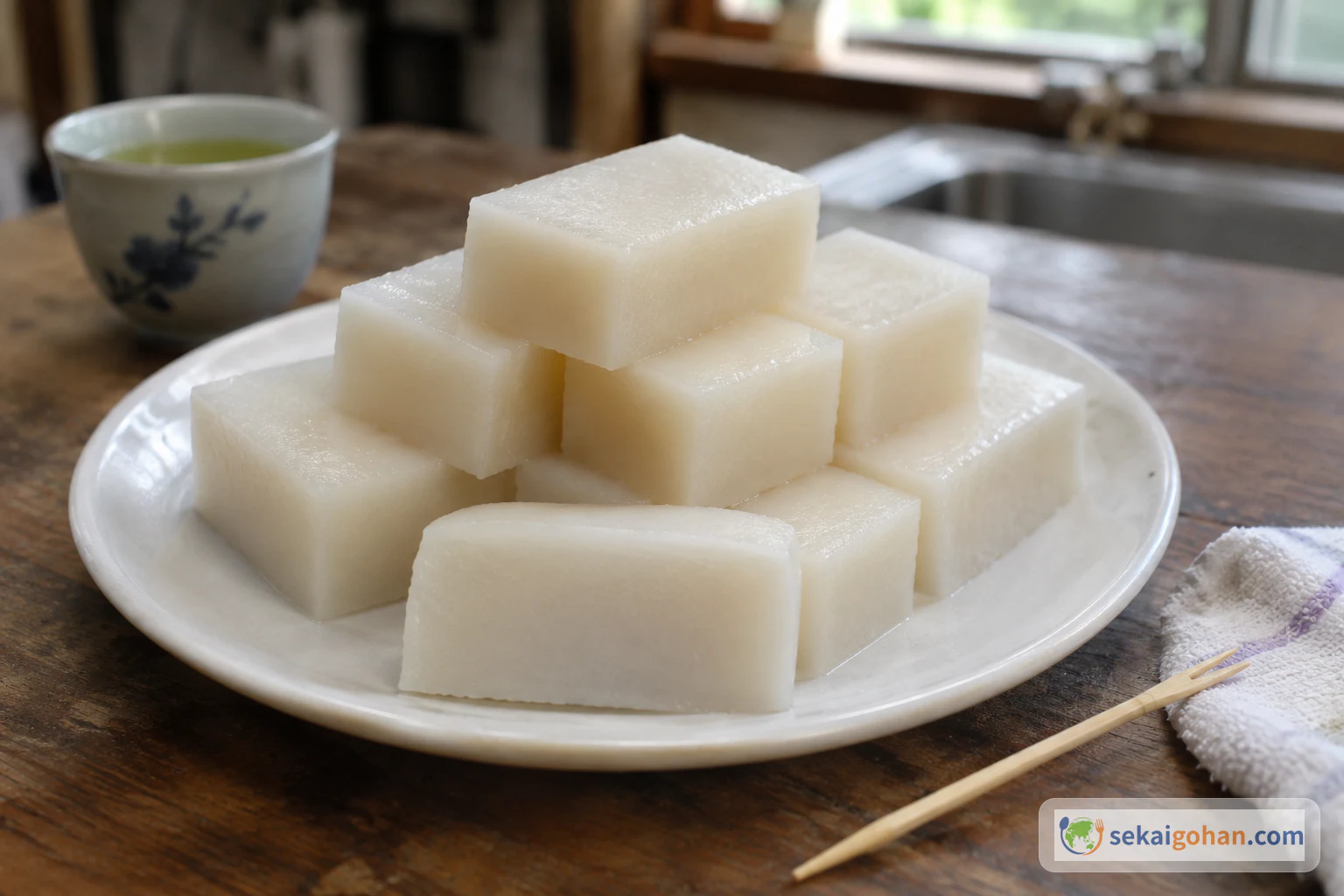
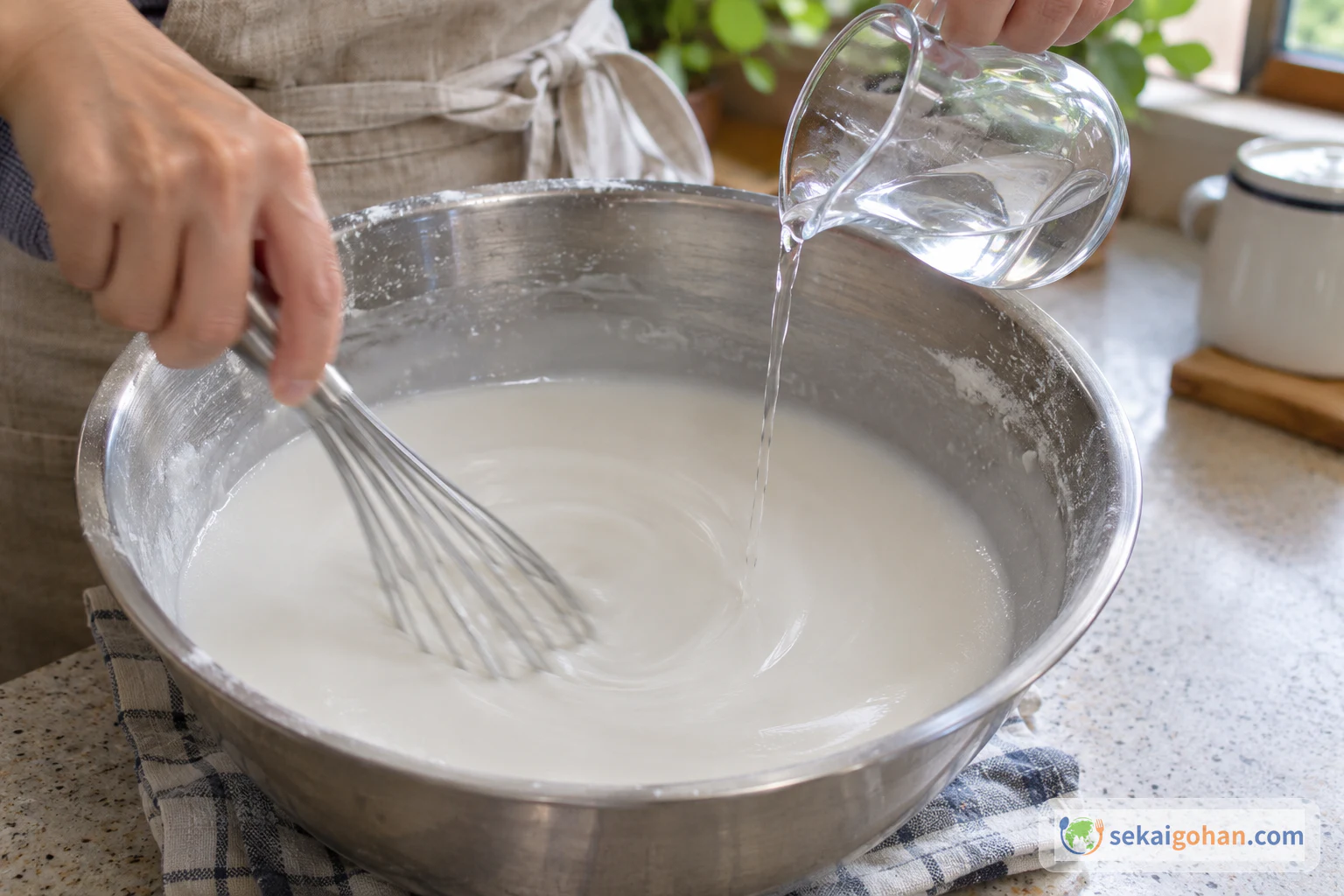
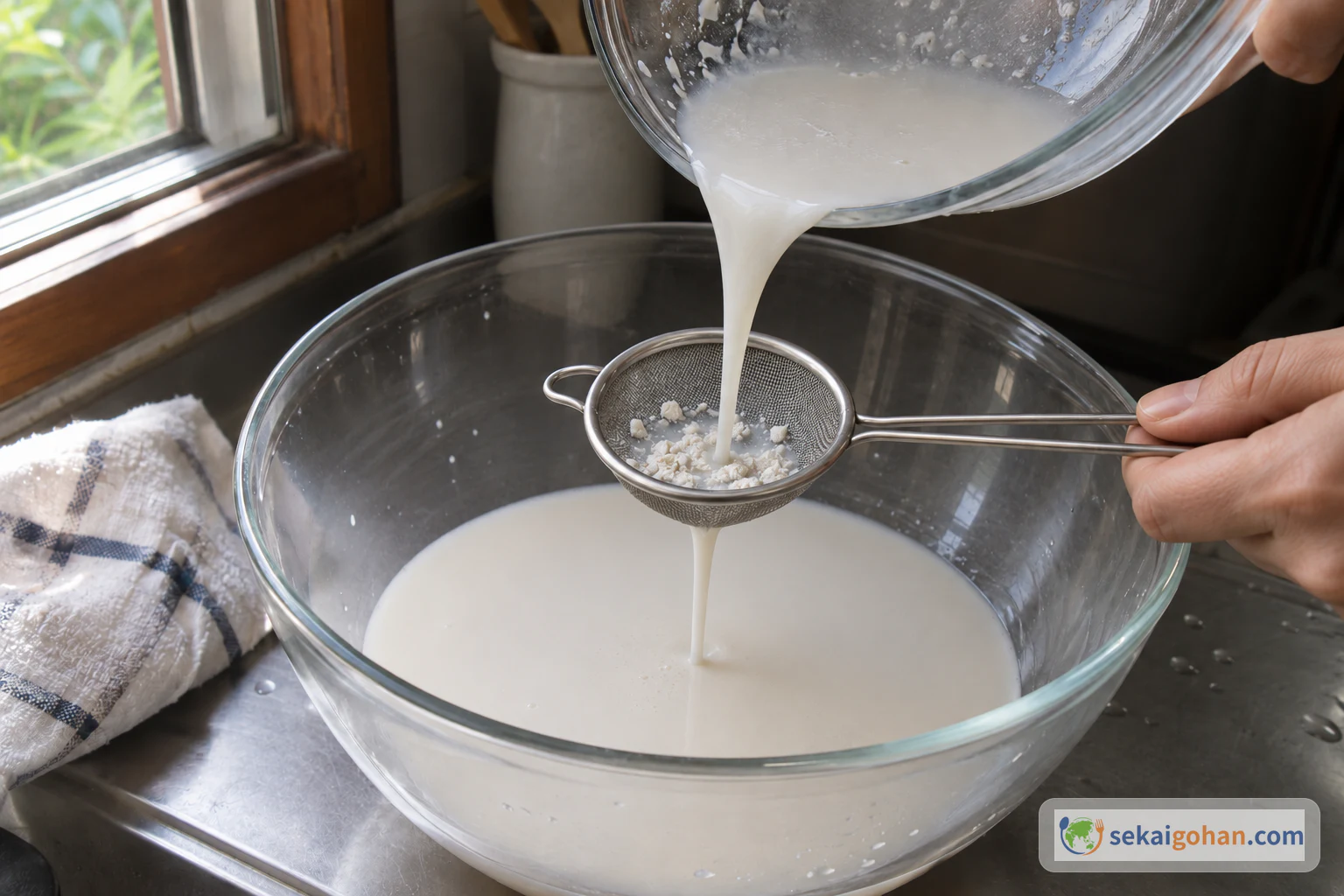
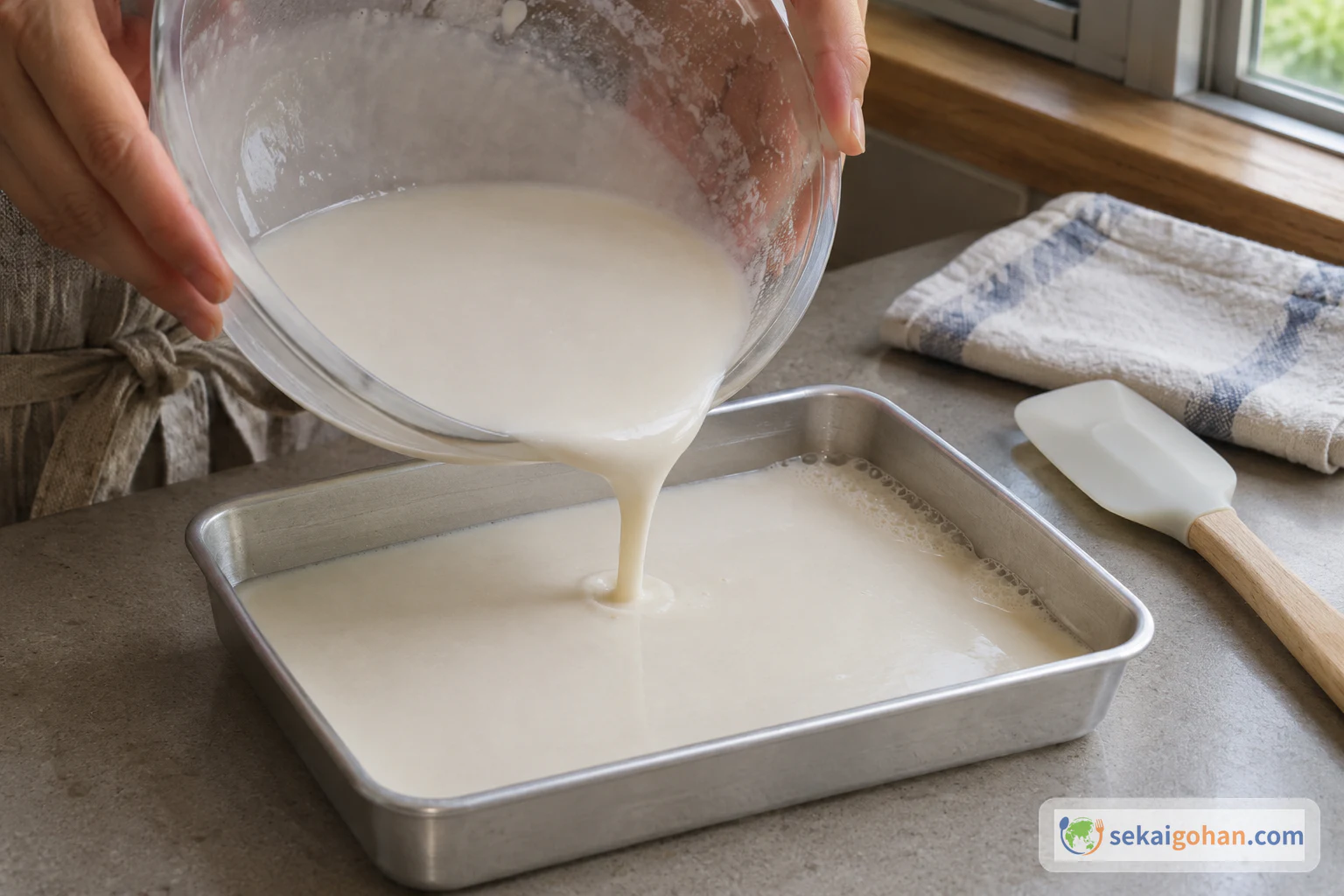
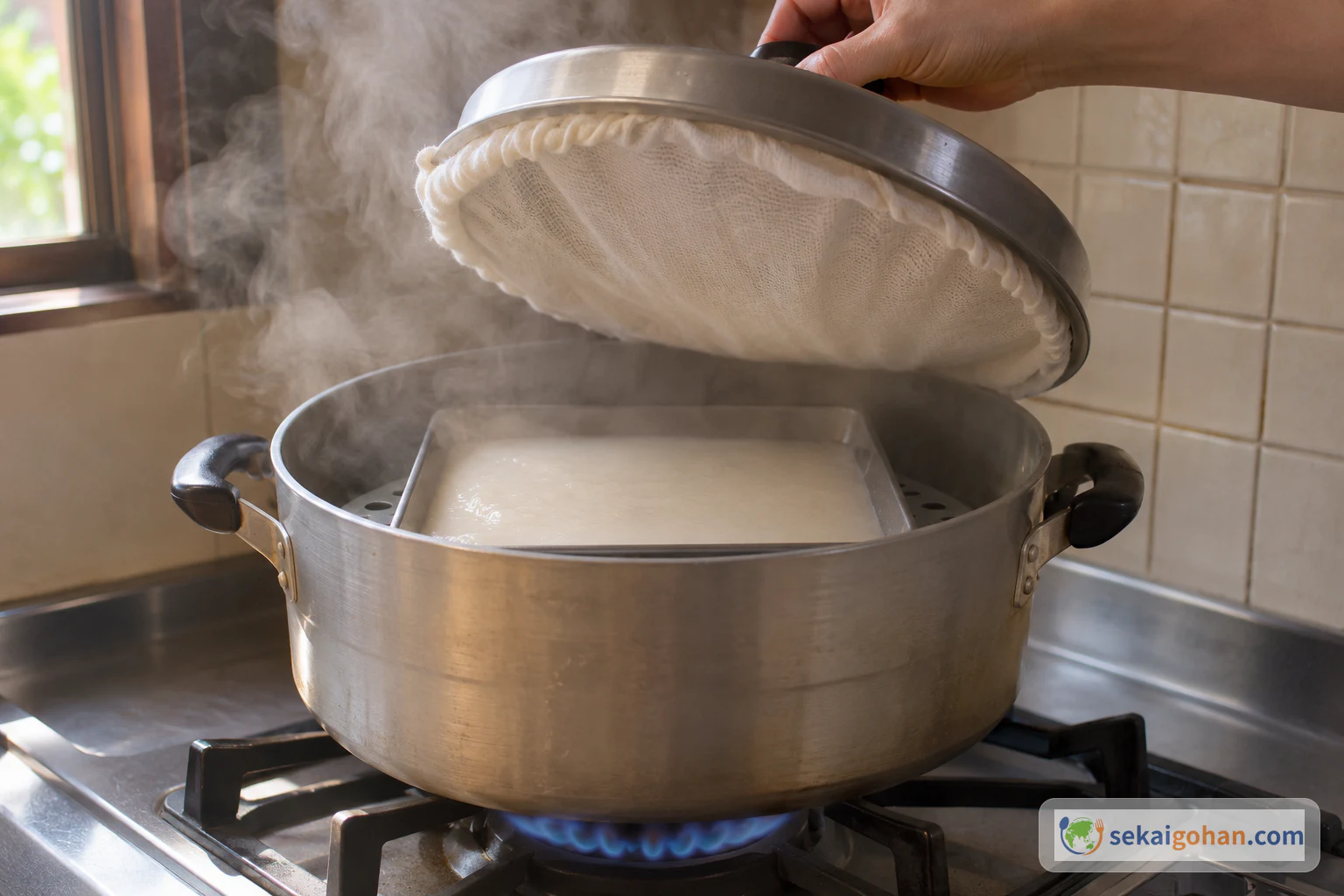
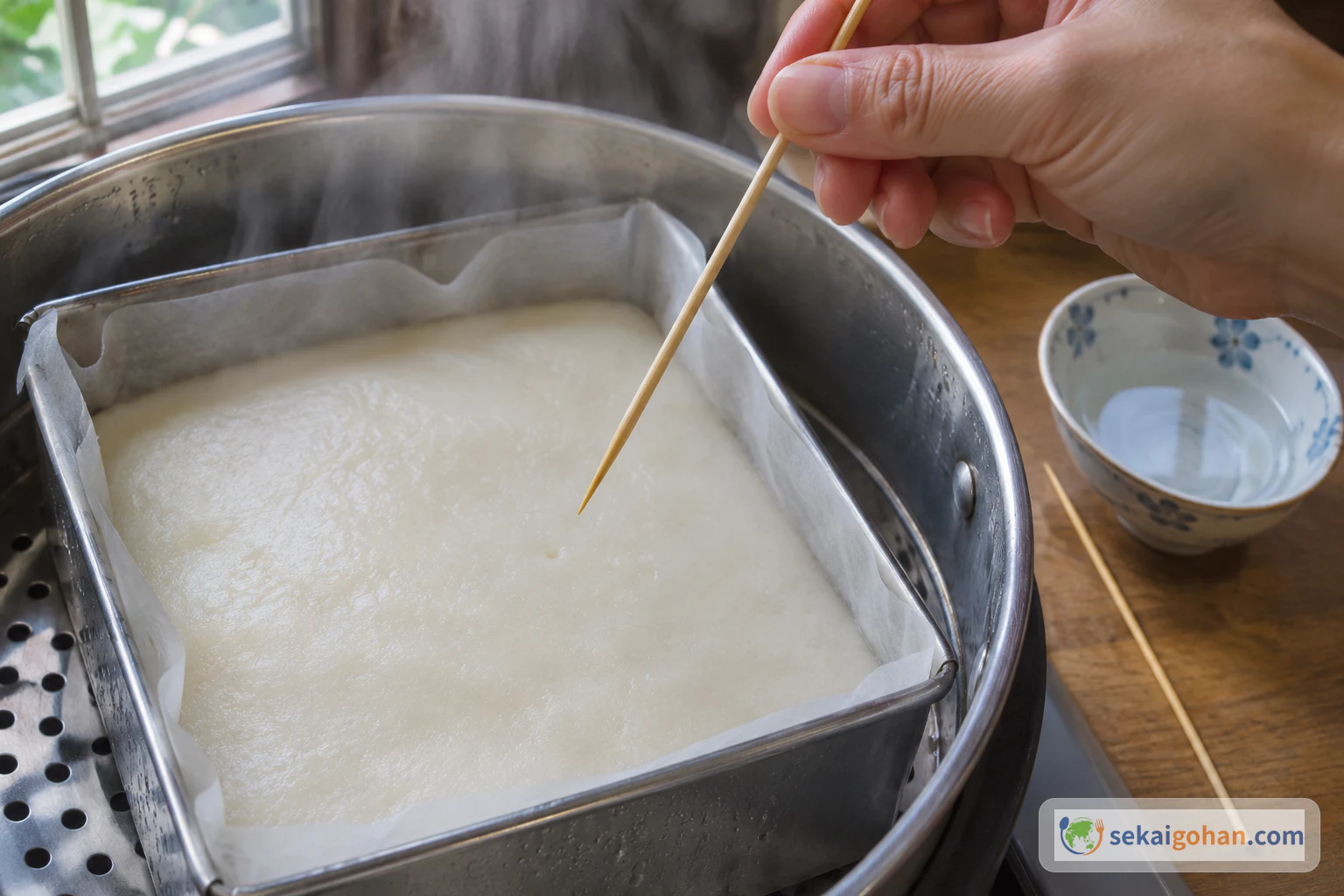
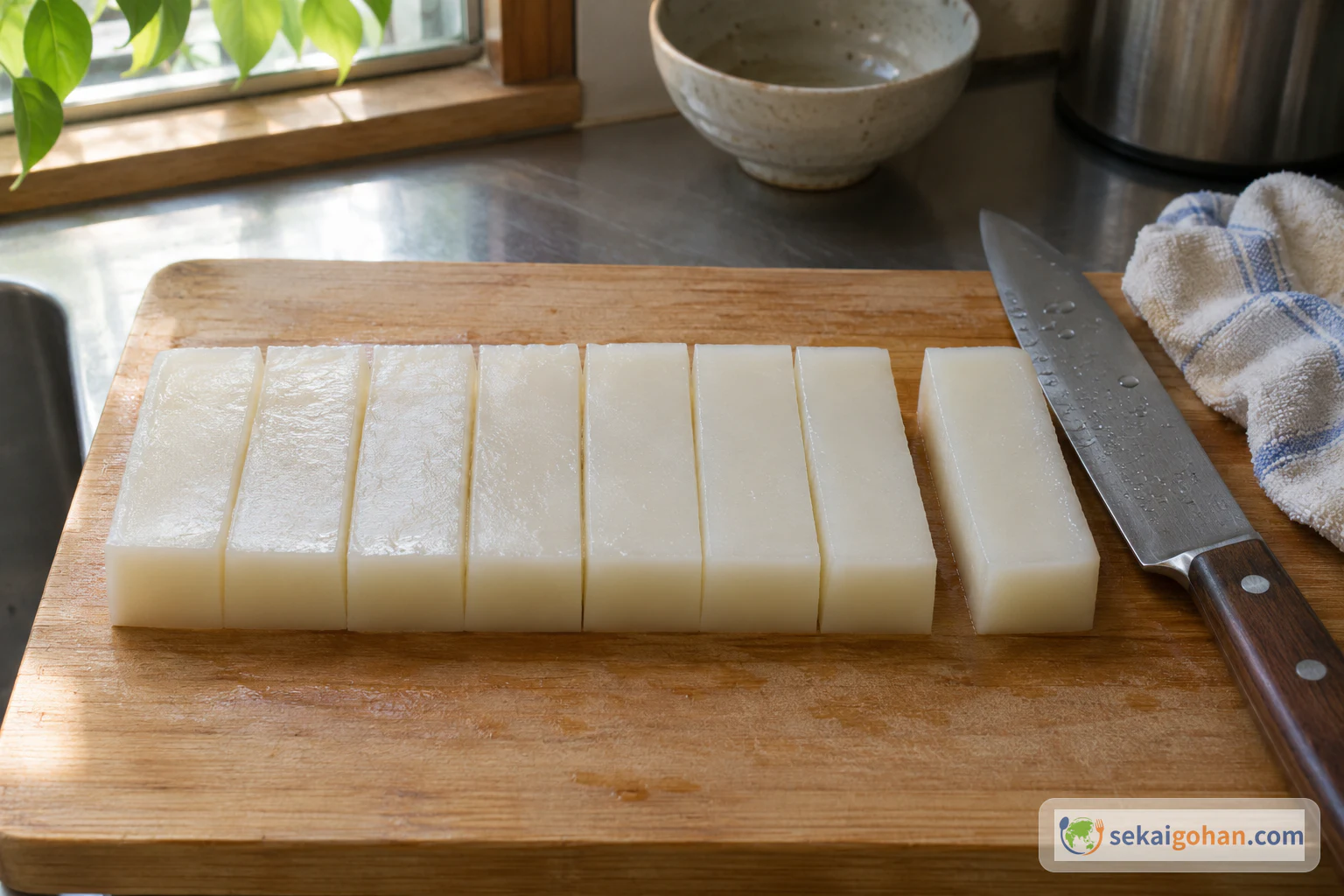
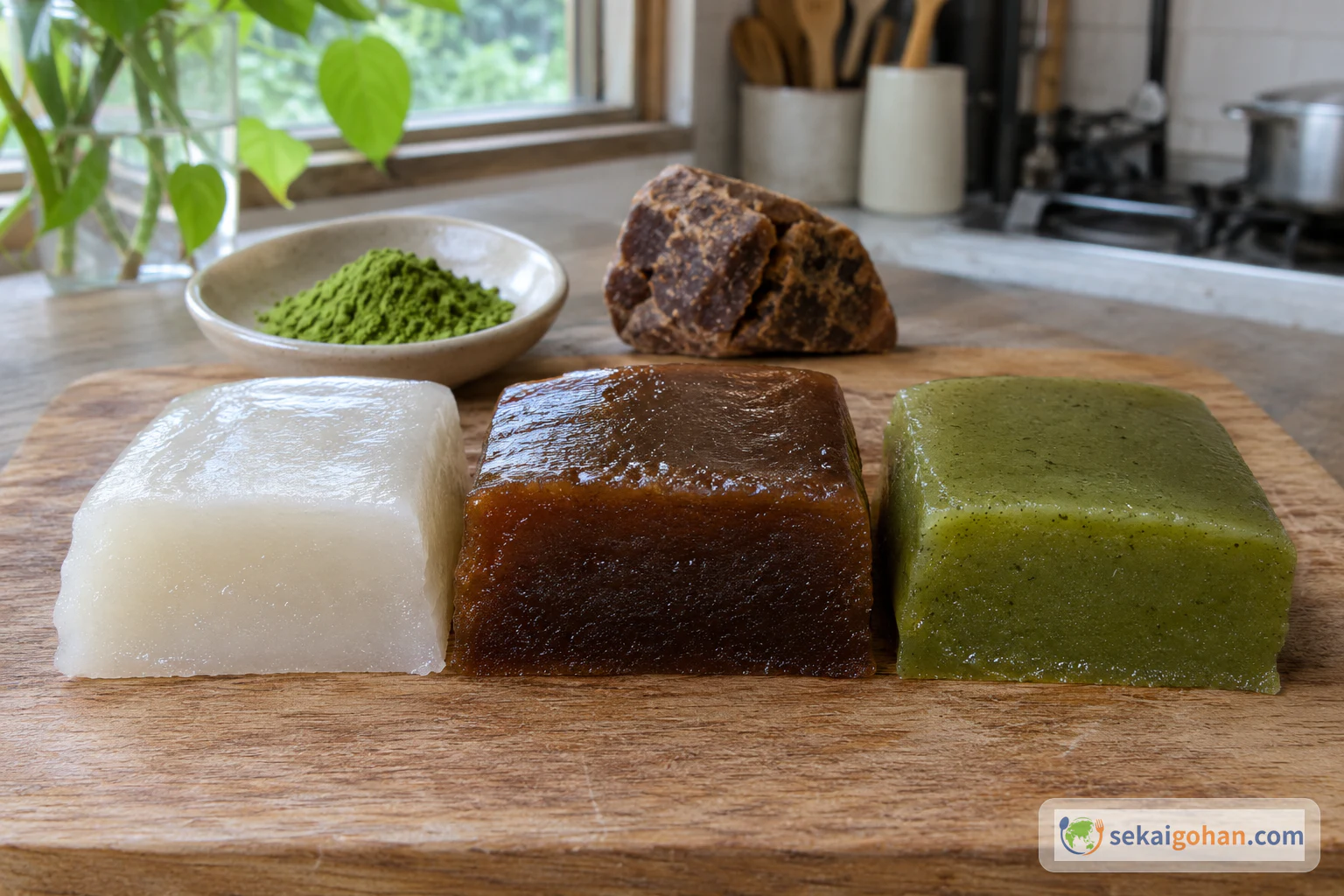
The batter goes into the steamer thin, milky and loose. When you lift the cloth-wrapped lid, it has become a single block, set and matte on top. A wet bamboo skewer slides into the middle and comes out clean. Cut it, and the faces are smooth and faintly translucent, with a dense, springy chew close to mochi and a mild, clean sweetness that suits a cup of green tea. This is uirō, the steamed rice flour sweet that Nagoya is known for. It takes four ingredients: rice flour, sugar, water and a pinch of salt.
A Sweet Named After a Medicine
Uirō is made from grain flour, sugar and water. The batter is poured into a pan, steamed until it sets into a bar, then cut into pieces. It is written 外郎 or 外良, and in some places it is simply called uiro. On a plate it looks a lot like yōkan, but the two are made in different ways. Yōkan is red bean paste set with agar. Uirō is a batter that is steamed. It sits with the other wagashi of Japan, the sweets served with tea.
From an official's title to a medicine to a sweet
The name started out as a job title. A man of the Chen family had held the post of reibu-ingairō at the Yuan court in China. In 1368 he fled to Hakata, called himself Chin Gairō, and had gairō read as "uirō" in the Chinese-derived Tō-on pronunciation. His family made a household medicine called tōchinkō, and people came to call the medicine "uirō" after the family. Family tradition says the sweet came later, from the family's second head, who made it to entertain foreign envoys. Refined sugar was not yet produced then, so he kneaded brown sugar into rice flour and steamed it. The most widely accepted explanation for how the sweet got the same name is its colour: the dark sweet looked like the dark medicine. The medicine and the sweet share a name but are separate things. The sweet is simply something to eat. In 1504 the family's fifth head moved to Odawara, and the house there still makes both.
In 1718, Ichikawa Danjūrō II first performed Uirō-uri, "The Uirō Seller," in which a peddler advertises the medicine in a long, breakneck patter. It became one of the Kabuki Jūhachiban, the eighteen signature plays. The speech is still used to practise clear, fast speaking. By 1802 the mix-up between medicine and sweet was a joke in a comic tale of the Tōkaidō road: a scene at an Odawara inn has the medicine eaten by mistake for the sweet.
Older uirō could look quite different. A version recorded in 1689 used flour ground from seven measures of ordinary rice and three of glutinous rice, coloured yellow with gardenia, layered with dried persimmon and steamed in a seiro. How Nagoya got its uirō is not settled. The first seller in Aichi was Mizutani Bunzō of the shop Mochibun. One account puts his first sales in 1864, and another puts them in 1658 or 1659.
Same name, different flour
Three styles are known as Japan's three great uirō: Nagoya, Yamaguchi and Awa in Tokushima. The flour changes the texture more than anything else.
| Style | Flour | Sweetness and extras | Texture and occasion |
|---|---|---|---|
| Nagoya | Rice flour | Sugar; white, brown sugar, matcha, sakura and chestnut are the usual kinds | Dense and weighty, with a springy chew close to mochi |
| Yamaguchi | Bracken starch (warabi-ko); some shops also use wheat flour | Sugar and bean paste; versions with matcha, azuki, chestnut or yuzu | Wobbly and smooth, called ottori (gentle) locally; enjoyed since the Muromachi period by tradition and served in school lunches |
| Awa (Tokushima) | Jōshinko rice flour, with mochi flour | Bean paste, Awa wasanbon sugar or plain sugar, salt | Chewy, with the plain sweetness of the bean paste; eaten at the old-calendar March 3 festival |
| Odawara | Rice flour | Sugar | A bar sweet made by the same house that makes the medicine |
There are several explanations for Yamaguchi's bracken starch. One is that rice was precious and rice flour hard to get, while good bracken starch was produced in quantity. In Awa, uirō is said to have been made to celebrate the completion of Awa wasanbon sugar. It was offered at the doll festival, and until the Shōwa era children packed it into small lacquered yusan-bako boxes for spring outings. In Kyoto, uirō cut into triangles and topped with azuki beans becomes minazuki. Wrapped in bamboo leaves, it becomes uirō chimaki. The recipe below is the Nagoya style: rice flour and sugar, steamed into a dense bar.
Ingredients
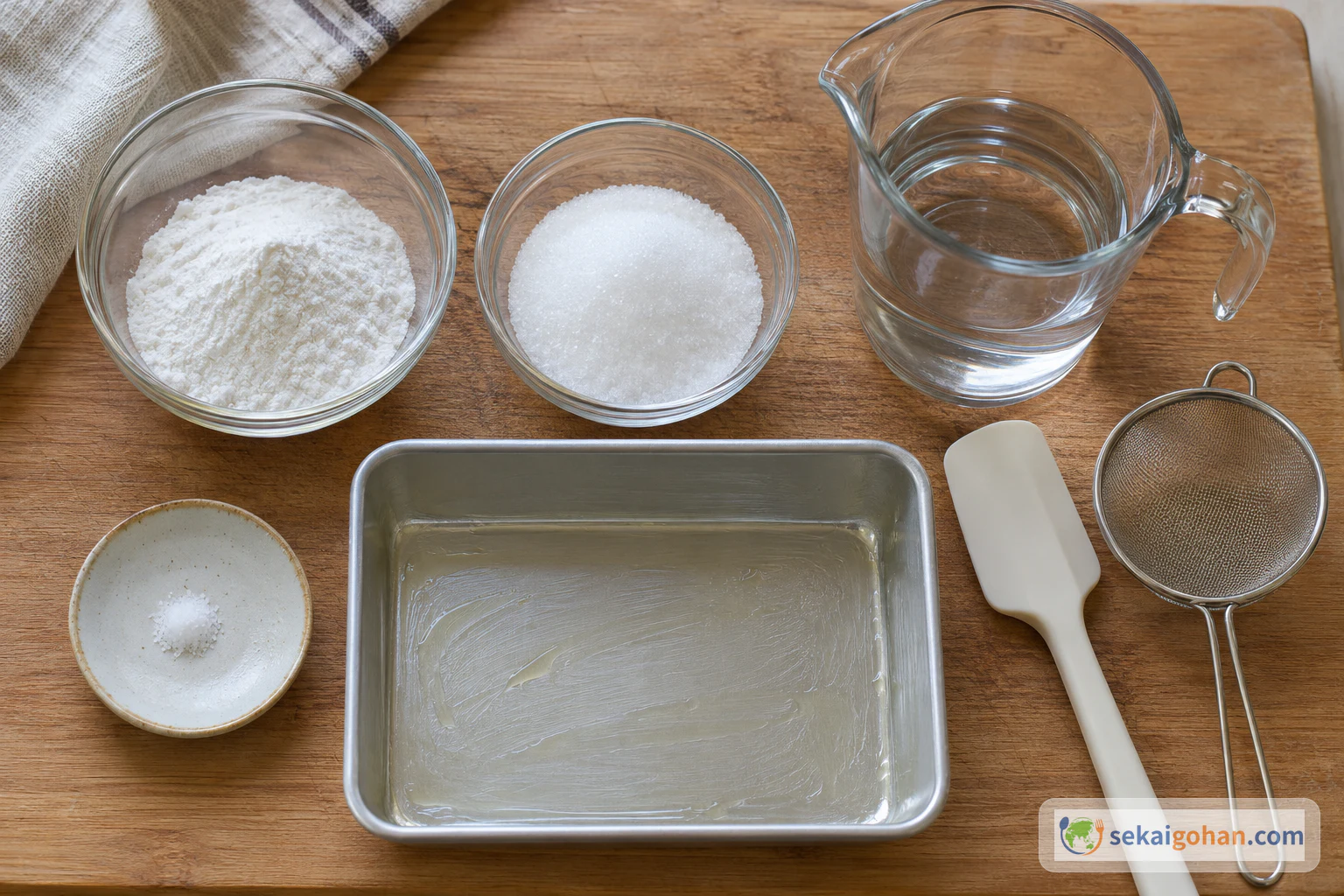
You also need a little neutral oil to brush the pan. It is not part of the batter.
These ingredients contain no wheat, egg, milk or peanut. Rice flour can be milled on lines that also handle wheat, so check the package. If you add brown sugar, matcha or bean paste, check each label too. Some uirō, in shops and in other recipes, is made with wheat flour, so the same name does not always mean the same ingredients.
Equipment
- Small nagashikan pan (rectangular mould), about 4¼ × 5½ inches (11 × 14 cm) and 1½–2 inches (4–5 cm) deep
- Steamer or seiro (bamboo steamer) wide enough to hold the pan, with a lid
- Clean cotton kitchen cloth, for the lid
- Two bowls
- Whisk or rubber spatula
- Fine-mesh tea strainer
- Kitchen scale
- Bamboo skewer and a small bowl of water
- Knife and cutting board
- Parchment paper (optional, instead of oil)
Choosing the Flour and Sugar
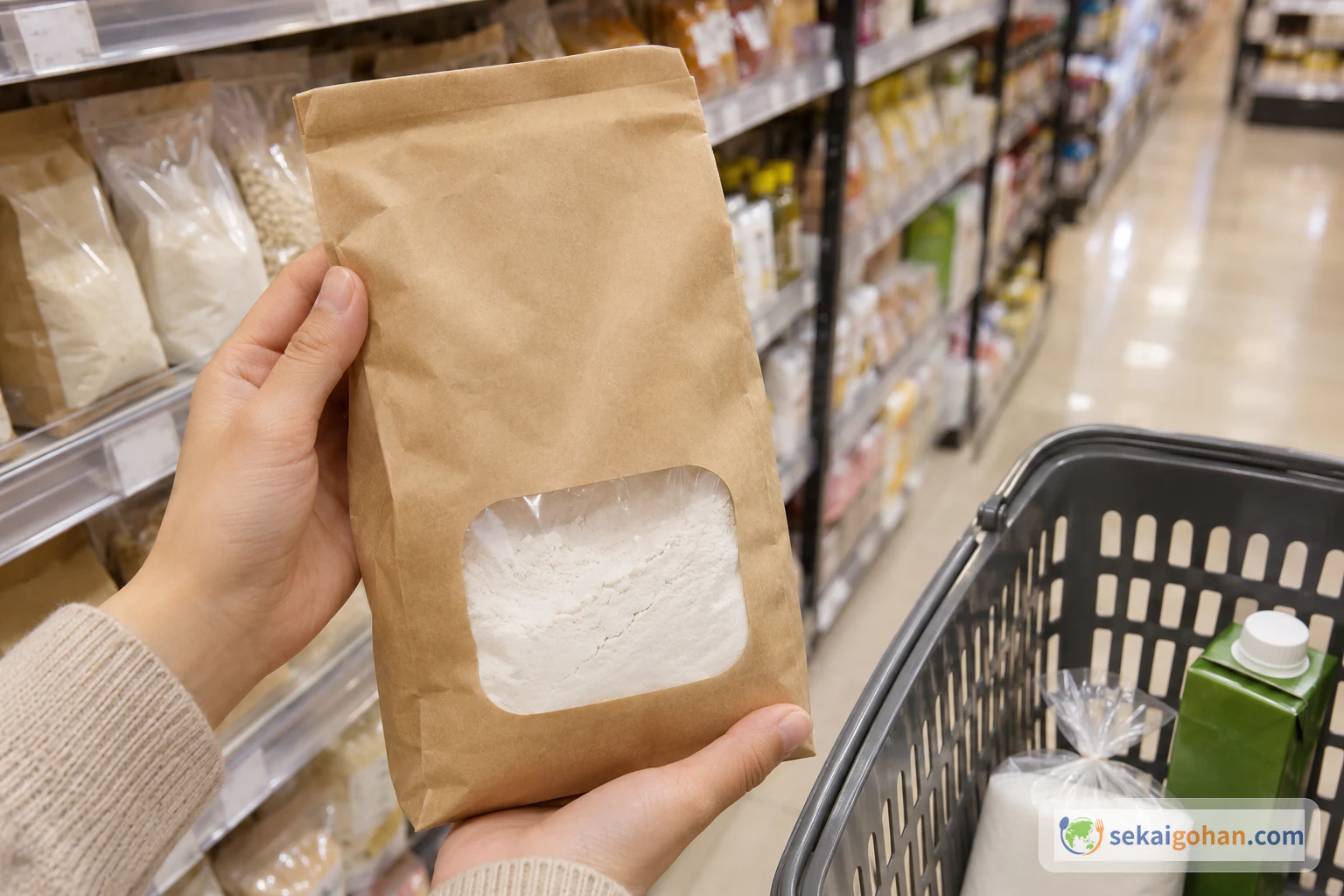
The flour decides the texture, so it is the one thing worth tracking down at a Japanese grocer or online. Look for rice flour labelled for confectionery (seika-yō komeko). It is finely milled and steams up smooth. Jōshinko is ground from the same non-glutinous rice but is coarser, so the texture changes. Shiratamako and mochiko come from glutinous rice and make a stretchier sweet. Treat each of these as a different sweet, not a swap that gives the same result.
For the sugar, plain white sugar (Japanese jōhakutō or ordinary white sugar) keeps the uirō white. If you want the brown-sugar kind, powdered kokutō dissolves easily into the batter. Use a neutral oil with no strong smell for the pan, or line the pan with parchment and leave the oil out.
Sugar does more than sweeten. It slows the starch from going hard. Cut it back and the uirō turns firm much sooner, often by the next day.
Method
Get the steamer going before you mix. If the batter sits waiting at room temperature, the flour sinks, and the top and bottom set with different textures. The steaming needs no work from you, but stay near the stove the whole time to watch the water. Then let the block cool so it cuts cleanly.
When It Goes Wrong
| What you see | Why | What to do |
|---|---|---|
| Lumps or a gritty, floury cut face | The water went in all at once, or the batter was undermixed | Add the water a little at a time and always strain |
| Holes and watery patches on top | Condensation dripped from the lid | Stretch a cloth across the underside of the lid |
| Raw centre | The pan was deeper, the batch was bigger, or it was not steamed long enough | Steam 5 minutes more and test with the wet skewer again; a deeper pan needs longer |
| Block sticks in the pan | Not enough oil, or no liner | Brush a thin film of oil over the whole inside, or line with parchment |
| Hard the next day | The starch firmed up; refrigeration speeds this, and so does using less sugar | Eat it the day it is made, freeze anything left over, and keep the full amount of sugar |
| Steamer runs dry | The water boiled away | Keep the base 50 to 70 percent full and top it up while steaming |
Serving, Variations and Storage
Serving
Uirō is a sweet for the afternoon tea break. Set out a few pieces on a small plate with a bamboo pick and a cup of green tea. The plain white kind is good on its own. A dusting of kinako (roasted soybean flour) or ground black sesame adds a toasty note.
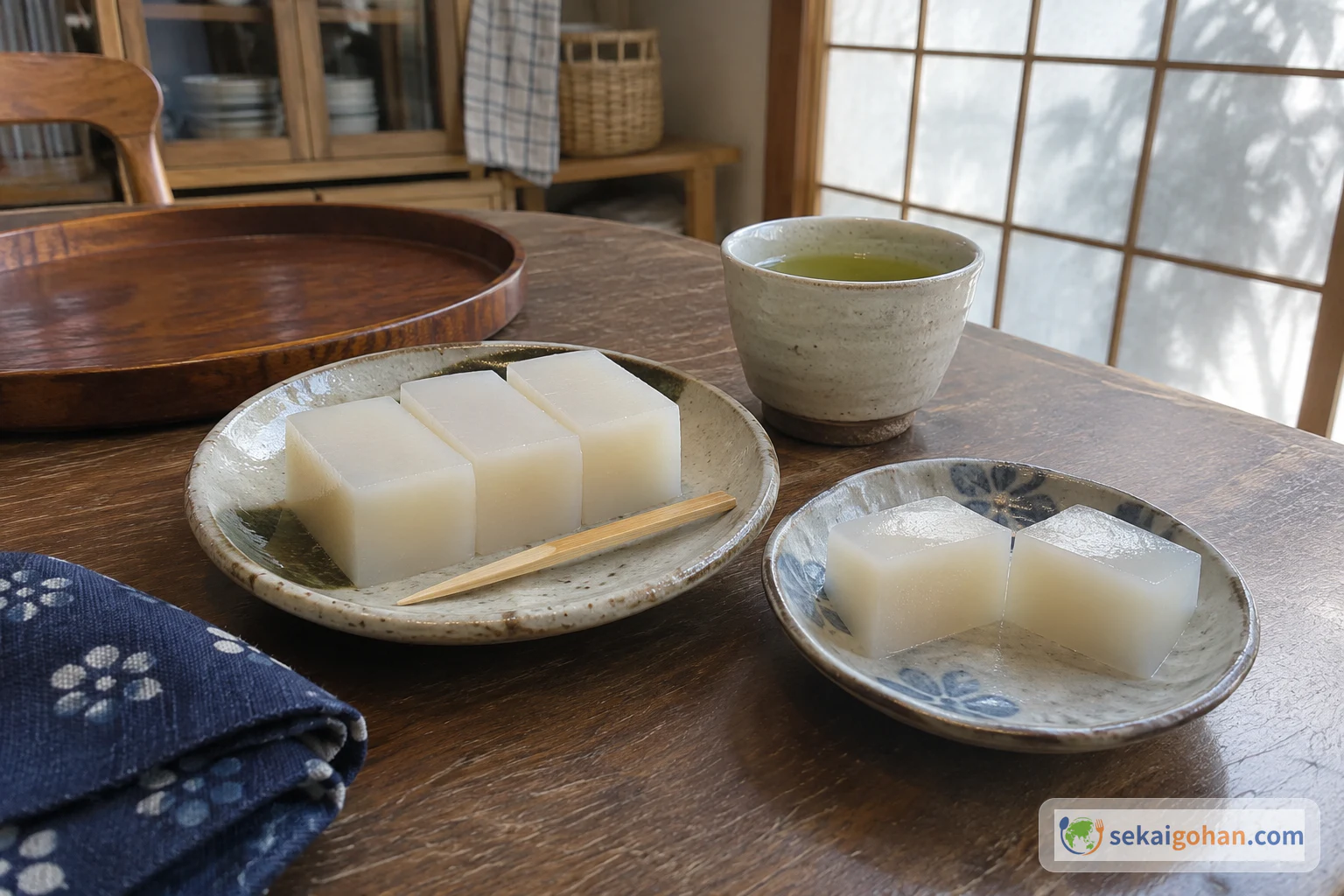
Uirō is chewy and hard to bite through. For children and older people, cut it into smaller, thinner pieces.
Variations
Brown sugar uirō. Replace about 30 percent of the white sugar with kokutō. It turns brown and tastes deeper. If you swap all the sugar, the colour gets much darker and the flavour much stronger.
Matcha uirō. Mix matcha powder into the flour, to taste, before adding the water. The block turns a muted green with a light bitterness.
Small cups. Pour the batter into small cups instead of one pan and steam them for 15–20 minutes. You get single bite-sized pieces that need no cutting.
Minazuki style. Cut the block into triangles instead of rectangles and top them with azuki beans. This is the Kyoto shape.
Storage
Keep uirō at room temperature and eat it the same day. Do not store it in the refrigerator, because cold makes the starch go hard. To keep it longer, wrap each piece in plastic wrap and freeze for up to 2 weeks. To eat, warm a frozen piece in a 600-watt microwave for 20–30 seconds. Warming also brings back a soft, mochi-like chew.
Frequently Asked Questions
Can I cook it in a microwave instead of a steamer?
A Ministry of Agriculture page on Yamaguchi uirō says a home cook may use a microwave instead of a steamer, but it gives no time or power. This recipe therefore offers no microwave method; steam it as described above and go by the wet skewer.
Can I make a double batch?
Multiply every ingredient by the same amount and use a pan with a larger surface, so the batter stays 1–1¼ inches (2.5–3 cm) deep. If you pour a double batch into the same small pan, the centre will not set in the usual steaming time. A deeper layer always needs longer, so go by the skewer.
Mine is dense and heavy, not wobbly. Did something go wrong?
No. Rice flour uirō is meant to be dense and weighty, with a mochi-like spring. The wobbly, jelly-like kind is Yamaguchi uirō, made with bracken starch to a different recipe. If yours is smooth inside and the skewer came out clean, it turned out the way Nagoya uirō should.