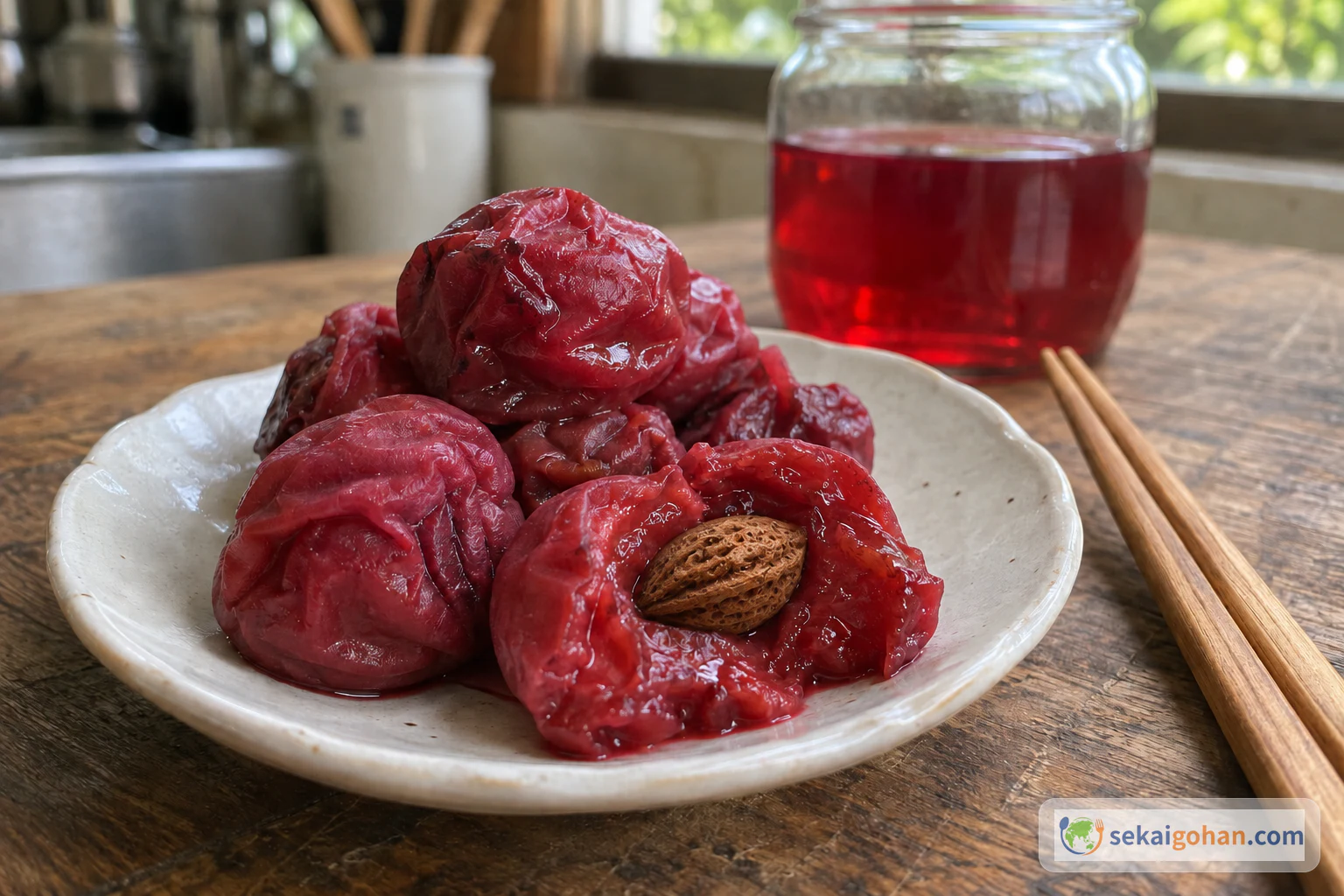
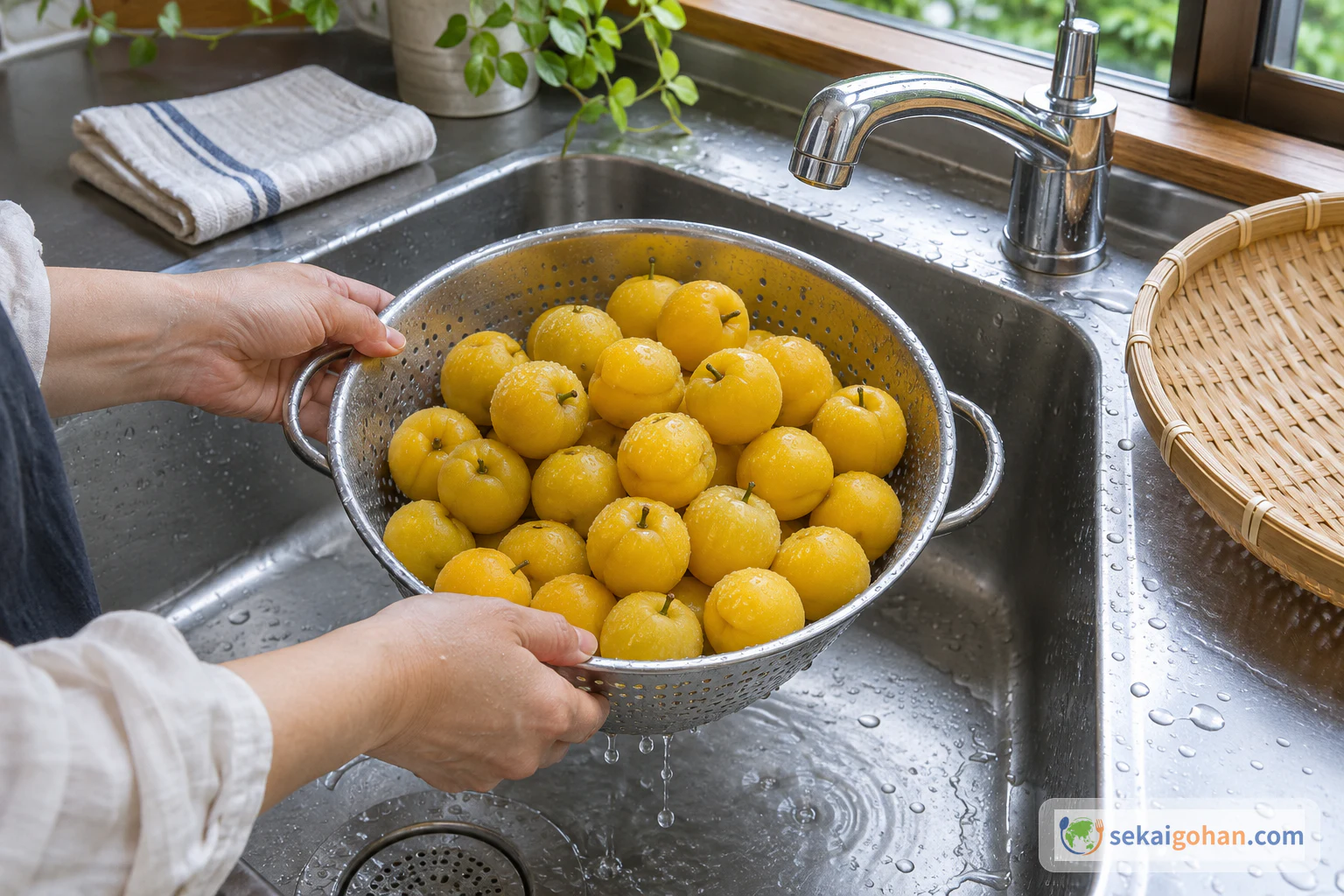
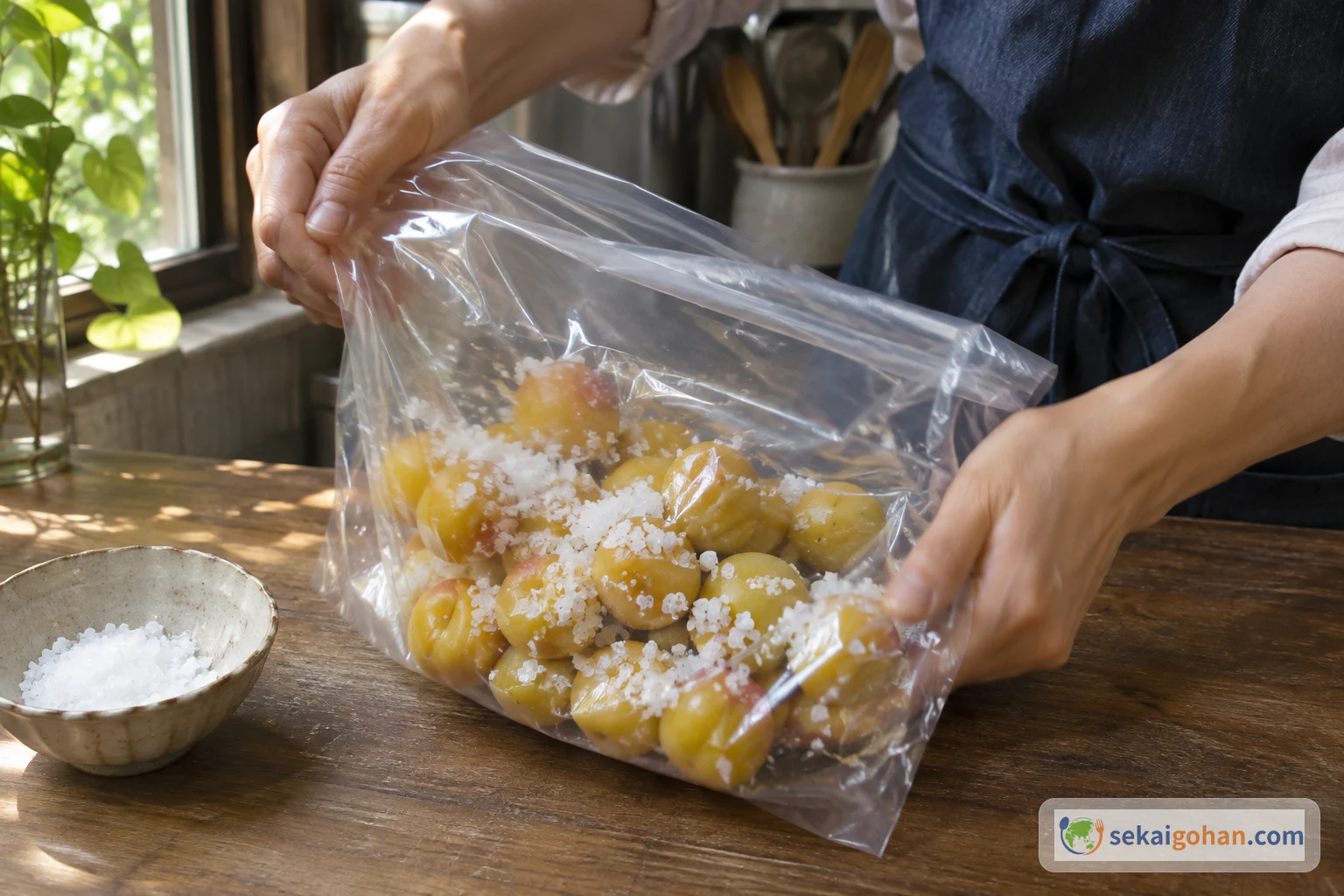
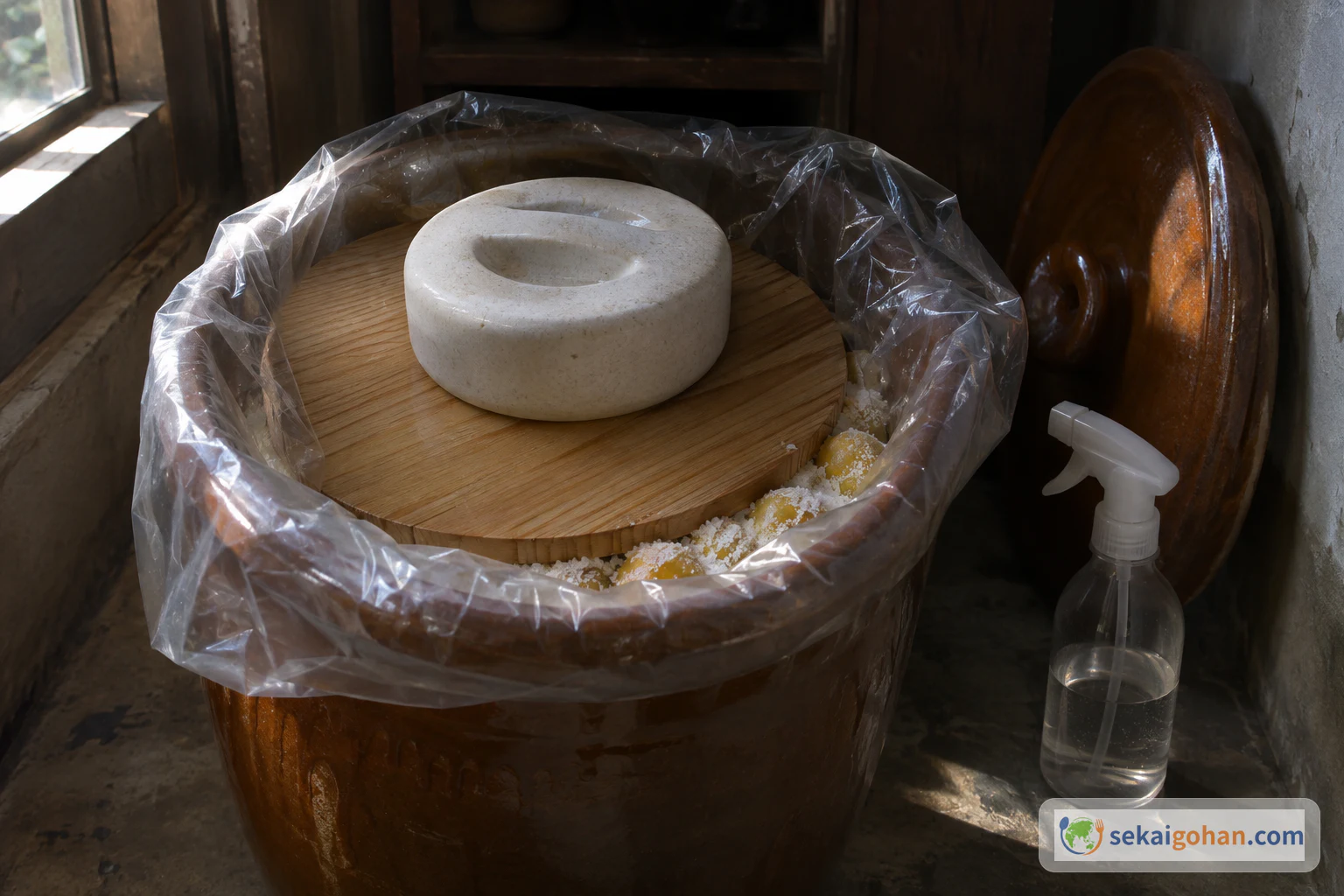
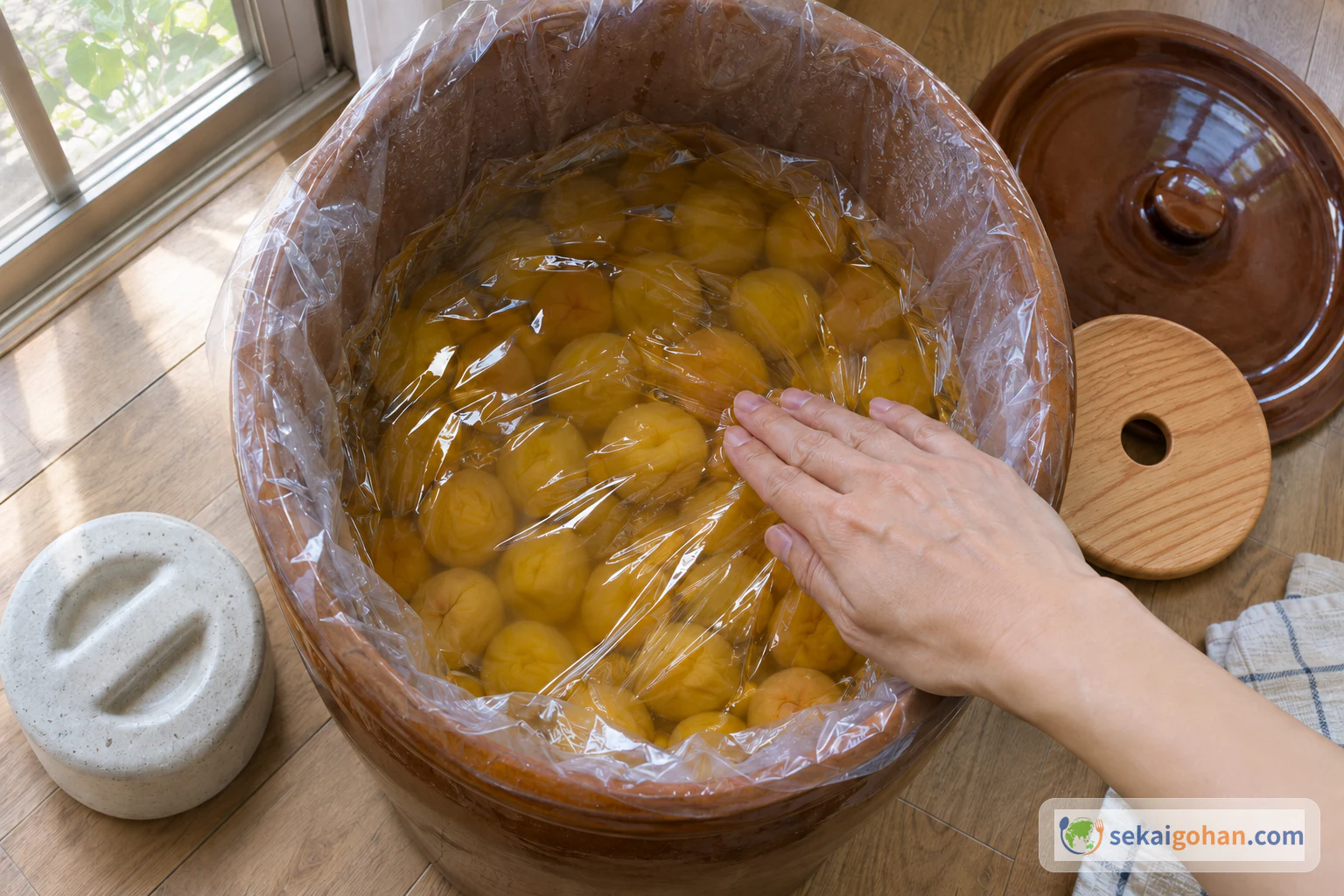
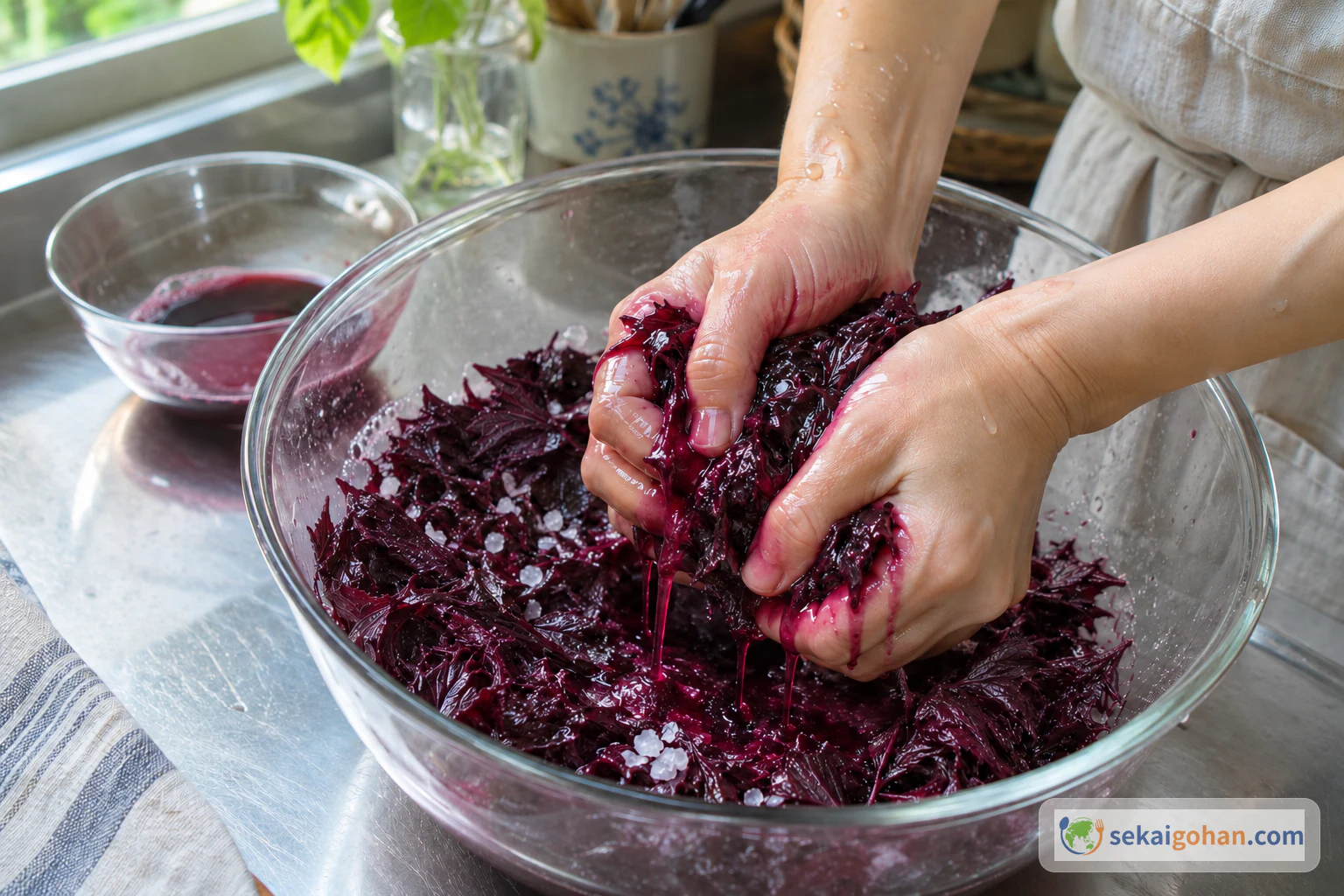
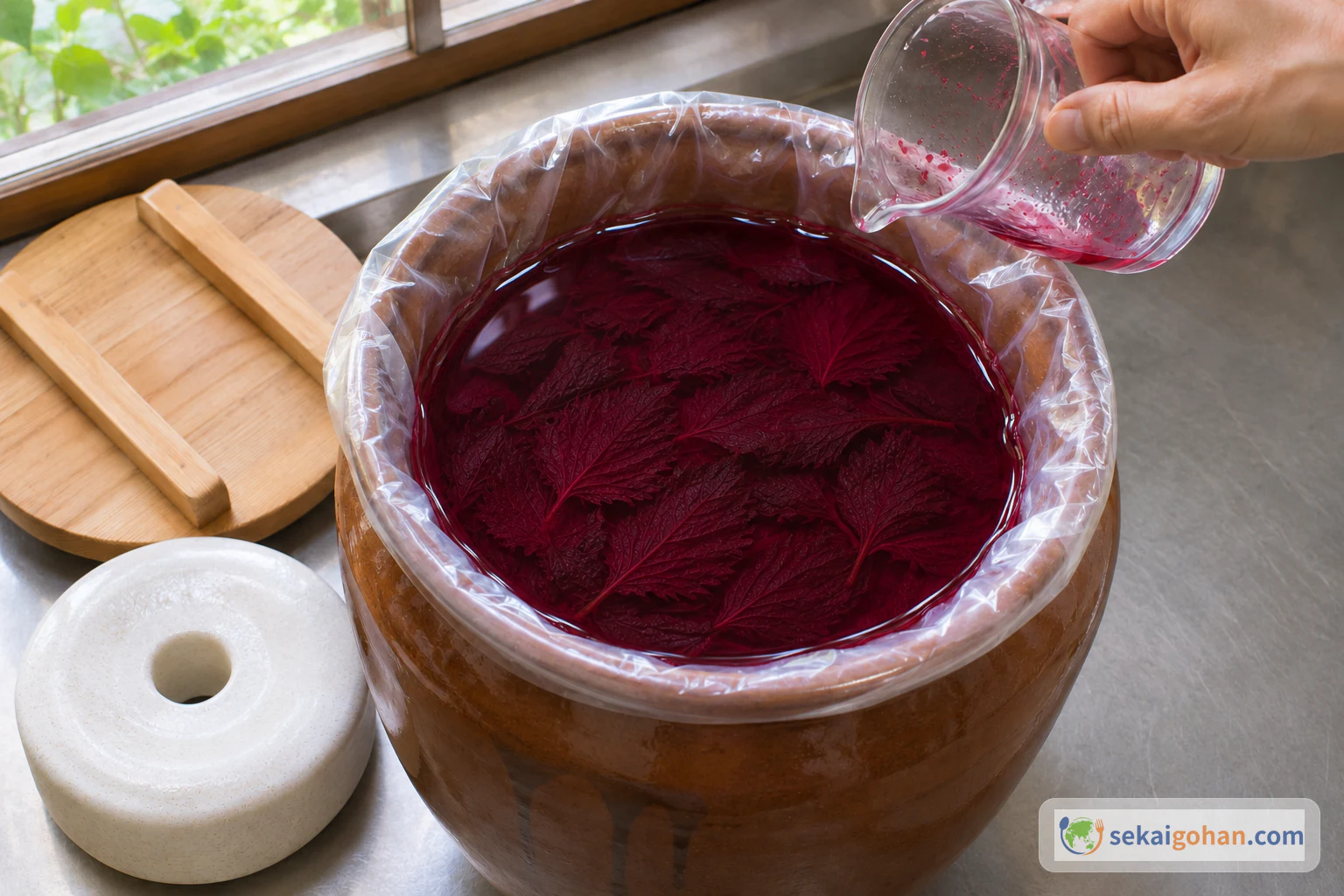
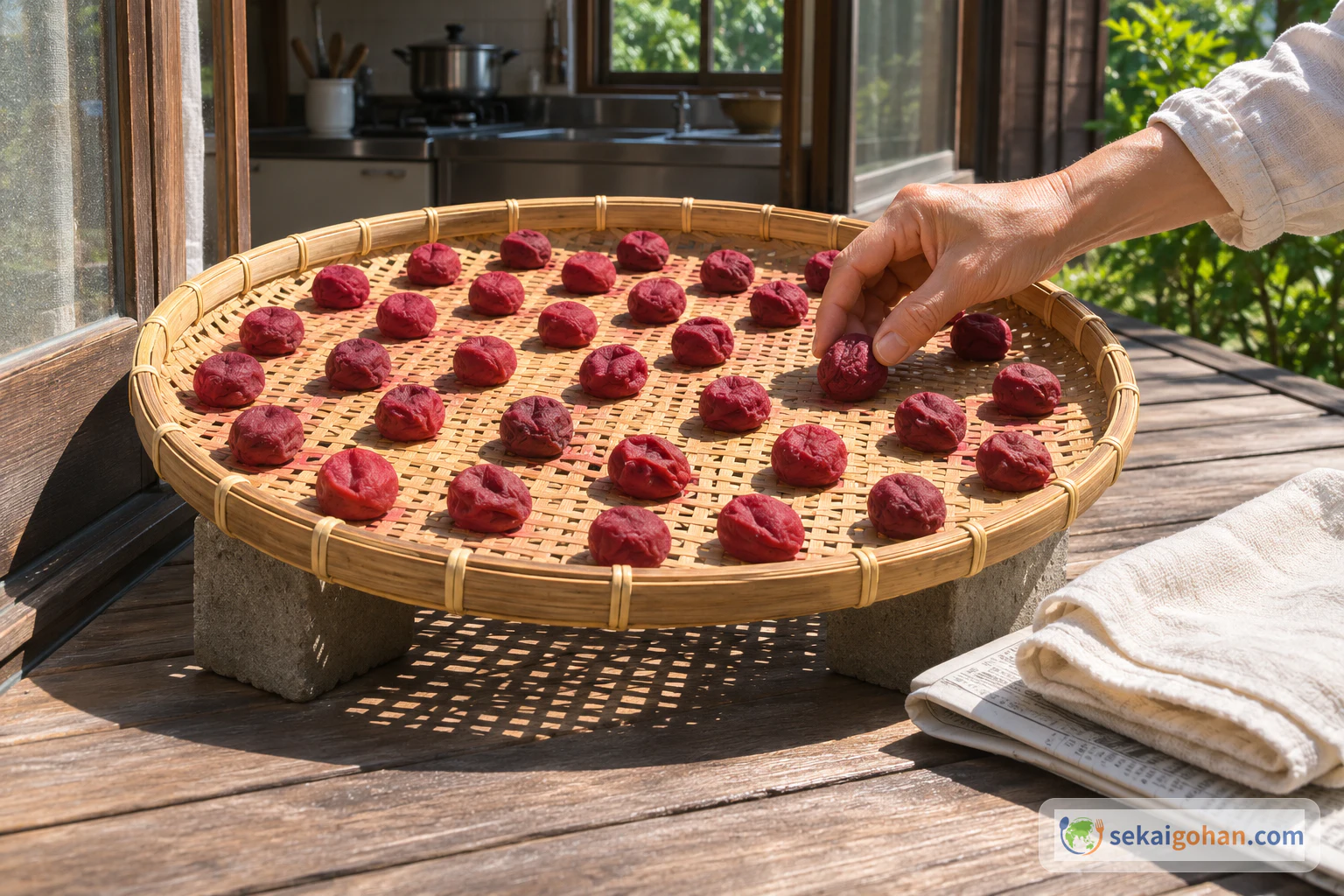
In June the ume arrive heavy and yellow, with a faint blush. They get a quick rinse, a roll in coarse salt and a weight on top, and within a couple of days clear, sour brine rises around them. A month later, after red shiso leaves have turned that brine deep magenta, the plums come out onto a bamboo basket in the midsummer sun. They shrink and wrinkle there until the flesh slips loose from the skin. Umeboshi are the result: intensely salty and sharply sour Japanese preserved plums, and a single one is enough to flavor a whole bowl of white rice.
Salt, Sun and the Ume Calendar of Kishu
The method follows the season. Small koume are picked from mid to late May, and the larger Nanko ume from early June to early July. Both are salted as soon as they are picked. The plums go out to dry once the rainy season ends, and that lands in the summer doyo, the stretch from late July to early August. That is why the drying has its own name, doyo-boshi. Any spell of three or four sunny days works just as well, so the calendar sets the mood more than the deadline.
The same fruit gives several different preserves. Ripe yellow ume salted and dried with nothing else become shiraboshi, the plain white-dried umeboshi. Layering salted red shiso over the plums before drying gives the red, fragrant shiso-zuke umeboshi made here. Green, unripe ume salted and left in their brine without drying are umezuke, a separate preserve with its own uses. In the growing districts the work is split. Farmers salt and dry the plain shiraboshi, and companies turn those into reduced-salt, honey or sweet-seasoned umeboshi.
The hillsides of Minabe and Tanabe
The best-known ume country is Minabe and Tanabe in Wakayama Prefecture. The orchards there sit on gravelly, nutrient-poor slopes, and stands of ubame oak were kept around them for firewood and charcoal. Those woods hold water and stop the slopes from slipping, and ubame oak is also the wood behind Kishu binchotan, the dense, hard white charcoal. Japanese honeybees live in the same woods and pollinate the ume, and the trees in turn feed the bees from February, when little else is flowering. Seven in ten local workers make their living from ume in some way. In December 2015 the whole arrangement was recognized as a Globally Important Agricultural Heritage System, the Minabe-Tanabe Ume System.
Umeboshi are also an everyday pantry staple in Japan, kept as an old-fashioned food that stores well at home. The whole method depends on salt: keep it at 20 percent of the plums' weight and they keep for a very long time. More of Japan's home cooking sits around the same rice bowl, from a weeknight Japanese curry to slow-cooked broths. For a very different cabbage dish from far away, there is Bayrisch Kraut from Bavaria.
Doyo is the stretch of high summer from late July into early August. The ume salted in June are ready to dry right then, so the drying took the name of the season: doyo-boshi, "doyo drying."
Ingredients (for 2.2 lb / 1 kg of ume)
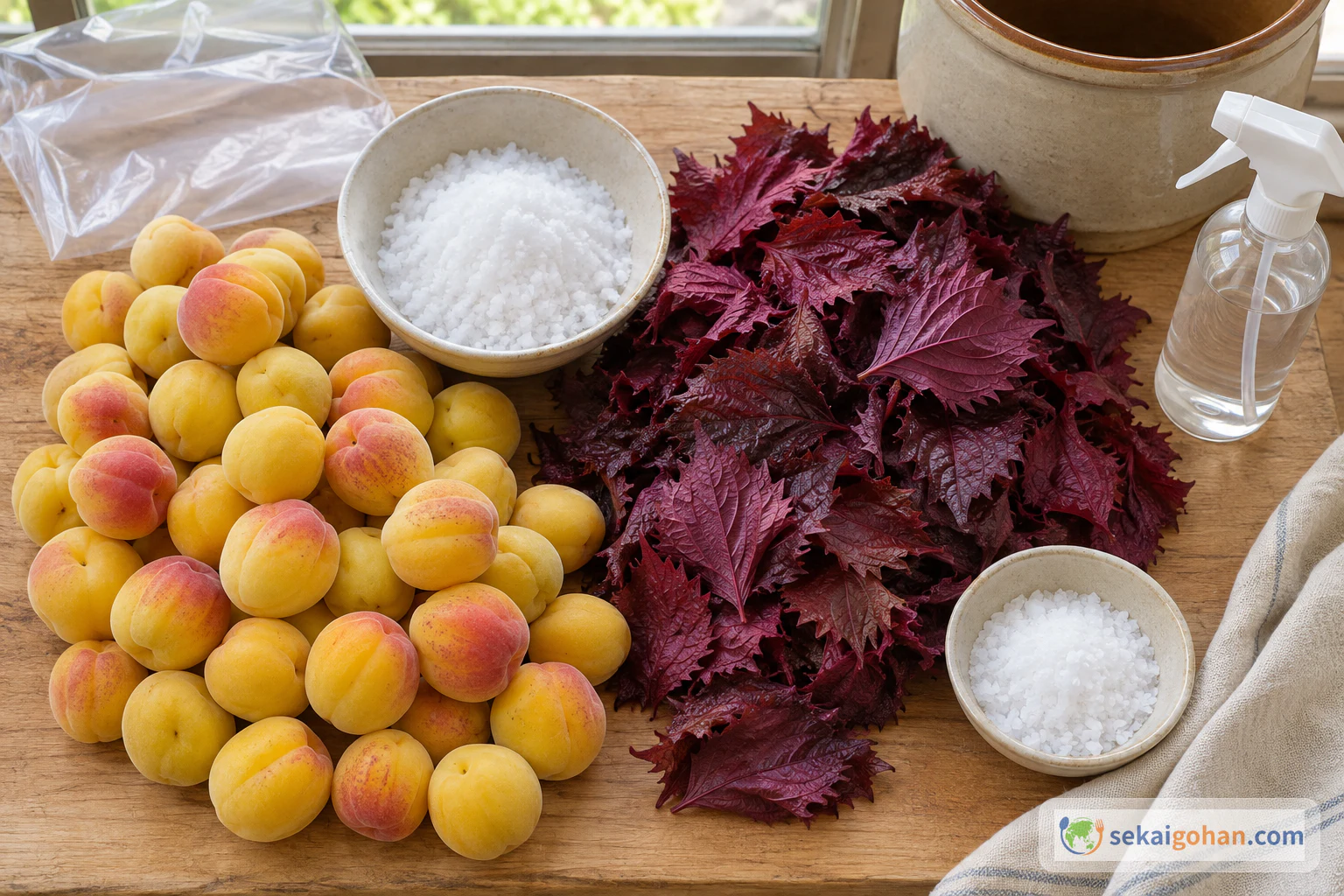
The only ingredients are ume, salt, red shiso and a spray of shochu. None of them contain wheat, egg, milk, peanut or soy. If you use ready-salted shiso from a shop, read its ingredient label for preservatives, colorings or other salted vegetables.
Weigh the salt to the gram. At 20 percent the plums give up their brine and resist mold. Below that, mold sets in easily. If you want milder umeboshi, pack them at full strength and desalt them before eating.
Equipment
- Pickling crock with a lid and a wooden drop lid, or a thick food-grade plastic bag at least 0.03 mm (about 1.2 mil) thick
- Pickling weight equal to the weight of the plums: 2.2 lb (1 kg) here. A water-filled plastic bottle works too
- Spray bottle for the shochu
- Wide bowl for working the shiso, and a second bowl for the discarded juice
- Shallow round bamboo drying basket large enough to hold the plums in one layer, plus two blocks to raise it
- Clean cotton cloth or newspaper to cover the plums at night
- Kitchen scale that reads in 1 g steps
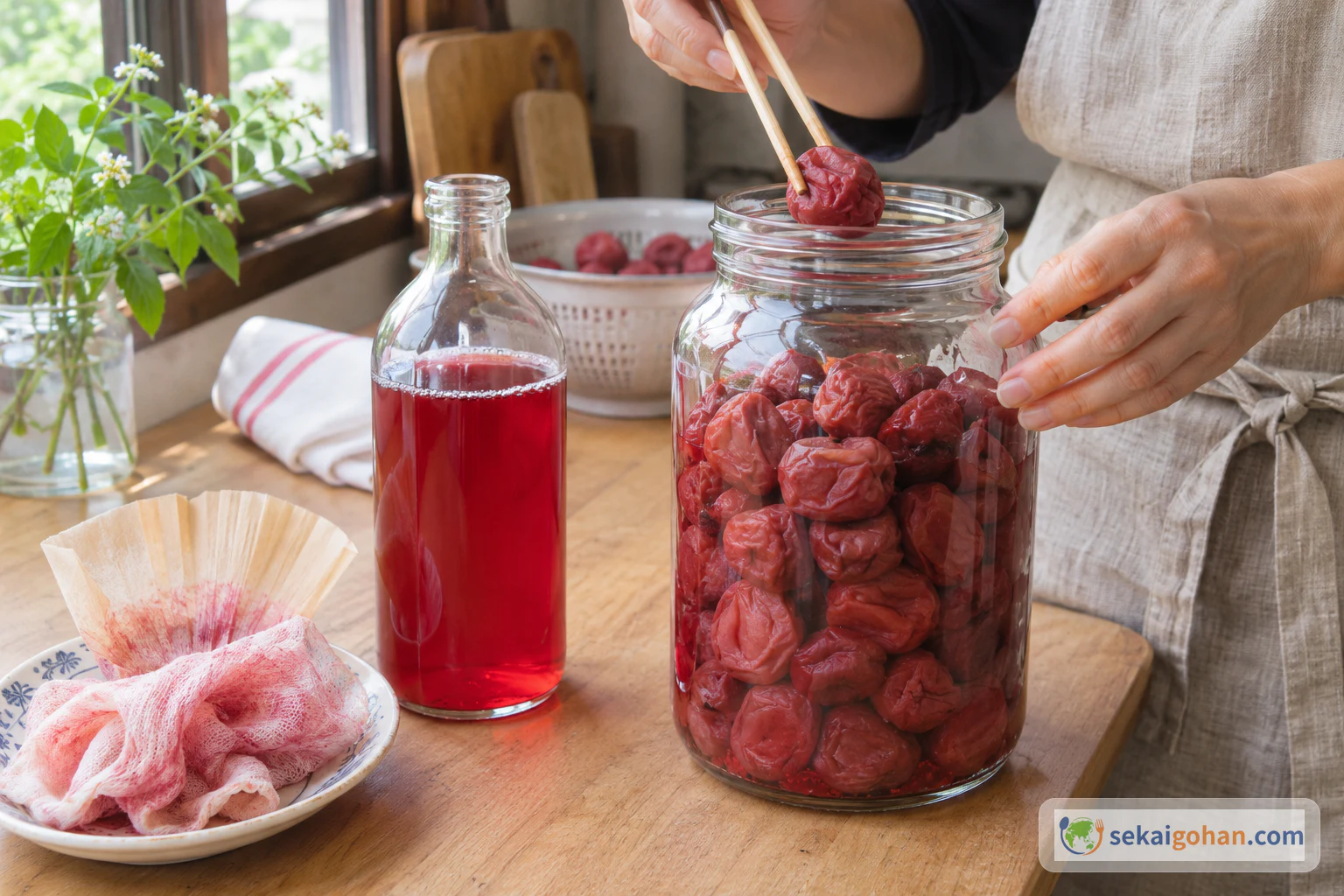
- Glass or plastic jars with tight lids: one for the plums, one for the brine
- Clean cloth or coffee filter for straining the brine
Before you start, sanitize everything. Pour boiling water over ceramic or glass and let it dry. Boiling water warps polyethylene, so wipe plastic containers with a paper towel dampened with vinegar instead.
Choosing Plums, Salt and Shiso
Ripeness decides the brine. Choose ume that have turned yellow all over. If a batch ripens unevenly, sort it by ripeness. Let the greener ones sit for 2–3 days until they color, then pickle them as a second batch with their own 20 percent salt. Green ume belong to umezuke and are wrong for this recipe. Nanko and small koume are the varieties suited to umeboshi, and some other varieties do not work well. Koume can follow the same method with 18 percent salt (6⅓ oz / 180 g per 2.2 lb / 1 kg) and two days of drying.
Use coarse salt that still carries its minerals, sold as coarse, sea or sun-dried salt. Refined table salt makes the brine slow to rise, so it is not a substitute here. For the shiso, pick large leaves that are purple-red on both faces. Crinkled-leaf red shiso is the usual type, and it comes into season in early July. If you cannot find fresh red shiso, ready-salted shiso leaves from a shop do the same job. Leave the shiso out entirely and you get plain white-dried umeboshi, which are still umeboshi, only golden and without the shiso perfume. The spirit only needs to be 35 percent alcohol or stronger. Plain shochu or white liquor sold for fruit liqueurs is ideal.
Method
The work comes in short sessions spread over about two months. Salting the plums in June takes an hour at most. After that, check the brine at 2–3 days, then wait for the red shiso to appear in early July. The longest stretch is a month of quiet pickling in a cool, dark place, followed by three days in the sun. Pick that cool, dark spot before you start: somewhere indoors, dark, cool and with as little temperature change as possible.
When It Goes Wrong
| What you see | Why | What to do |
|---|---|---|
| The brine will not rise | Underripe plums, refined salt, or the wrong salt ratio | Put on a heavier weight. If the ratio was wrong, pack the plums again at the correct ratio |
| Mold on the brine surface | Plums or shiso exposed to air | If the brine below is clear and not cloudy, lift off the surface mold and carry on. Then press plastic wrap onto the brine surface |
| The whole brine has turned cloudy | Bacteria have taken hold | Rinse the plums under running water, then wash them in vinegar. Bring the brine to a boil, let it cool and pickle the plums in it again. Scald the crock with boiling water |
| Rain arrives partway through drying | No sun to finish the plums | Put the plums in a plastic bag and refrigerate them until the sun returns. They do not need to go back into the brine. A bag left out at room temperature grows mold |
| A clump of mold in the bag | Mold has colonized the batch | Throw the clump away. The undamaged plums in the same bag are contaminated too, and the mold keeps spreading |
| White powder on the drying plums | Salt crystallizing on the skin | Nothing to fix. It is salt, not mold |
Over-dried plums turn hard and cannot be softened again, so start weighing them early on the last day of drying. If plums mold after being packed with less salt, go back to 20 percent next time and desalt after drying.
Green, unripe ume and the kernel inside the stone contain amygdalin, which can break down into hydrogen cyanide and cause poisoning. Amygdalin disappears as the fruit ripens, and pickling plums into umeboshi speeds its breakdown, so eating umeboshi in normal amounts is not a concern. Do not eat green ume raw, and do not crack the stone to eat the kernel.
Serving, Variations and Storage
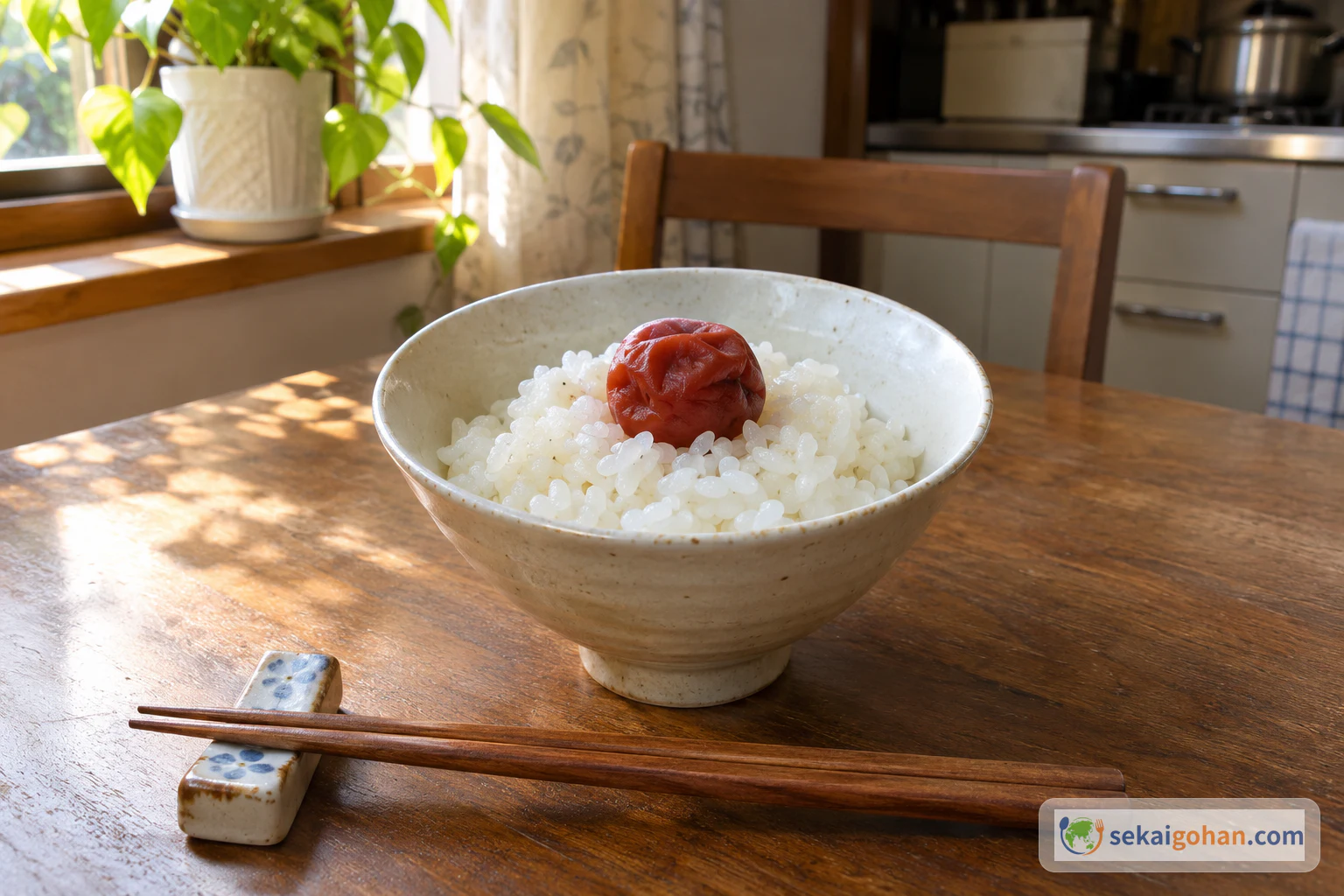
At the table
Place one plum on a bowl of hot white rice and eat the two together, a little of the plum with each mouthful. Shiso-pickled umeboshi made at 20 percent are very salty. Put out one at a time, and desalt them first if you want them milder. Keep the strained red brine next to the soy sauce and vinegar and use it as a seasoning: in dressings, in quick pickles and for curing mackerel. It is salty, so add it a little at a time.
Variations
- Three days and three nights. On each of three sunny days, dry the plums on the basket for 3–4 hours and return them to the brine at night. For the next three days, set them outside at night to catch the dew and return them to the brine in the morning. Six days in all gives softer, mellower umeboshi than drying them straight through. Treat it as a different finish: both methods work, but do not mix the two.
- Yukari. Spread the spent shiso from the crock in the sun for 2–3 days, then grind it fine in a mortar. The result is a red, salty shiso powder for sprinkling over rice.
- Honey ume. Mix 1½ oz (40 g) sugar, 2⅔ tbsp (40 ml) mirin, 2⅔ tbsp (40 ml) honey, 2⅔ tbsp (40 ml) vinegar and 4½ tbsp (70 ml) water. Pour it over 7 oz (200 g) desalted umeboshi with no cooking. Leave the container in a cool, dark place for about a week and tilt it once a day so the sugar does not settle. Afterward, keep it in the refrigerator and eat within a week. Never give honey to infants under one year old.
- Sweet soy ume. Bring 1½ oz (40 g) sugar, a little over 1 tsp soy sauce, 2 tsp mirin, a little powdered dashi and a generous ½ cup (140 ml) water to a boil, let it cool and stir in 2⅔ tbsp (40 ml) vinegar. Soak 7 oz (200 g) desalted umeboshi in it for 7–10 days for a rounder, savory-sweet plum.
Storage and desalting
Umeboshi packed at 20 percent salt keep more or less indefinitely in a sealed container in a cool, dark place, as long as you keep them from drying out. Umeboshi made at about 10 percent salt mold more easily. Refrigerate those and use them within about a year. Desalted umeboshi go in the refrigerator, and they need to be eaten within about 7 days.
To desalt, put 7 oz (200 g) umeboshi in a wide, shallow container with about 1 quart (1 L) of water. Lukewarm water at 86–104°F (30–40°C) draws the salt out faster. Soak for 30 minutes to a few hours, depending on how mild you want them, then drain in a colander for 1–2 hours. An overnight soak of about 8 hours brings the plums to roughly 14 percent salt. For about 5–10 percent, soak 12 hours, change the water and soak another 12 hours.
Frequently asked questions
Can I skip the drying?
Yes. Move the pickled plums to a crock or sealed jar, still covered in their red brine, and keep them in a cool, dark place. Plums that are never dried stay plump and juicy rather than wrinkled. Plain umezuke, made from green ume and never dried, is a different preserve again.
How do I scale the recipe up?
Multiply every amount by the same factor. For 4.4 lb (2 kg) of plums, use 14 oz (400 g) of plum salt, 2.2 lb (1 kg) of red shiso and 7 oz (200 g) of shiso salt. The weight does not grow with the batch: anything from 4.4 lb (2 kg) up to 22 lb (10 kg) of plums takes a 4.4 lb (2 kg) weight.
When are they ready to eat?
They are finished as soon as they come off the drying basket and have cooled. Plums lifted from the crock before drying can be eaten too, but they have the softer, wetter texture of plums that were never dried.
Can I make umeboshi in a plastic bag instead of a crock?
Yes. Use a food bag at least 0.03 mm (about 1.2 mil) thick, mist its inside with shochu and follow the same steps, with a water-filled bottle as the weight. Thin bags tear under the weight and the salt. The salt ratio and timings do not change.