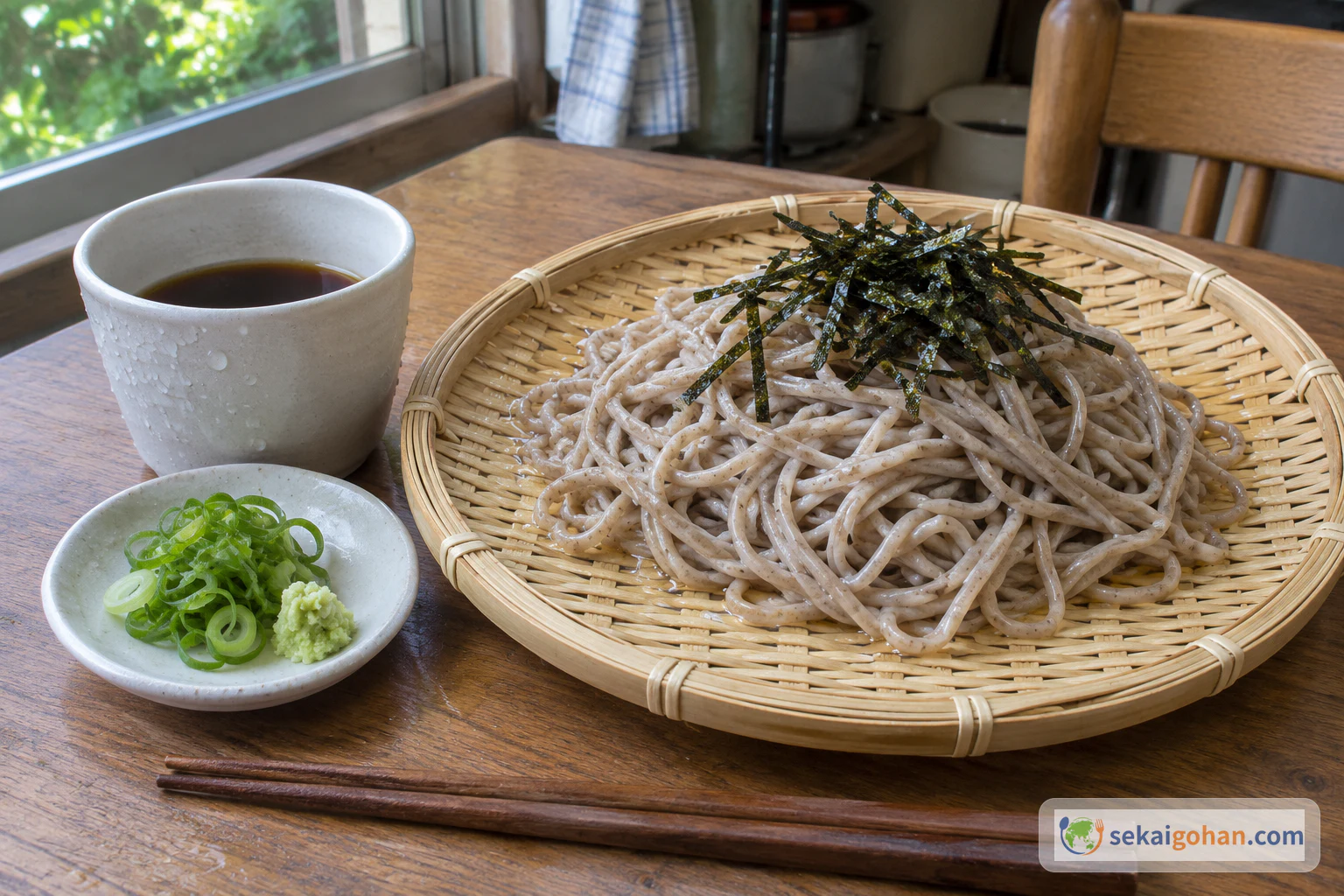
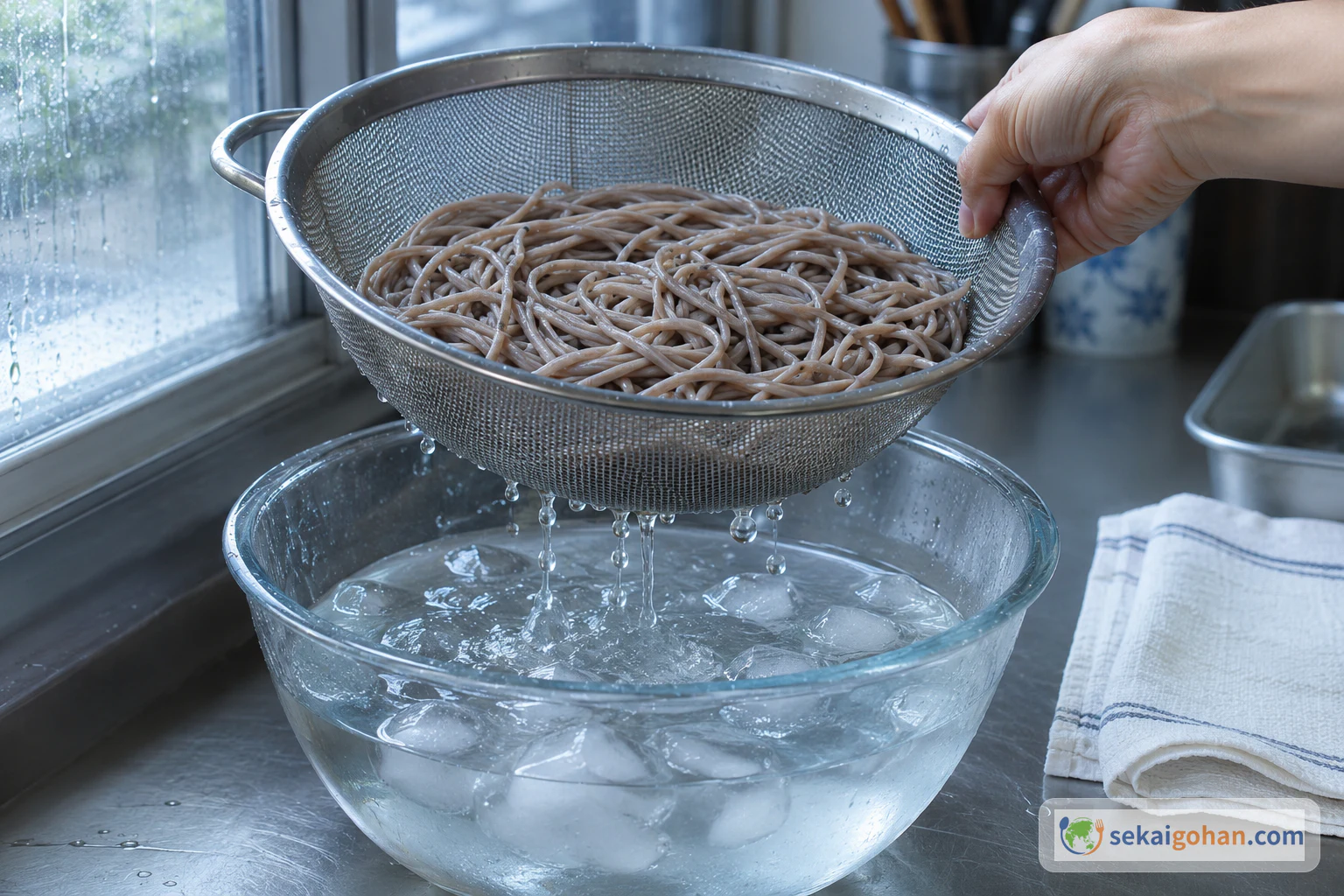
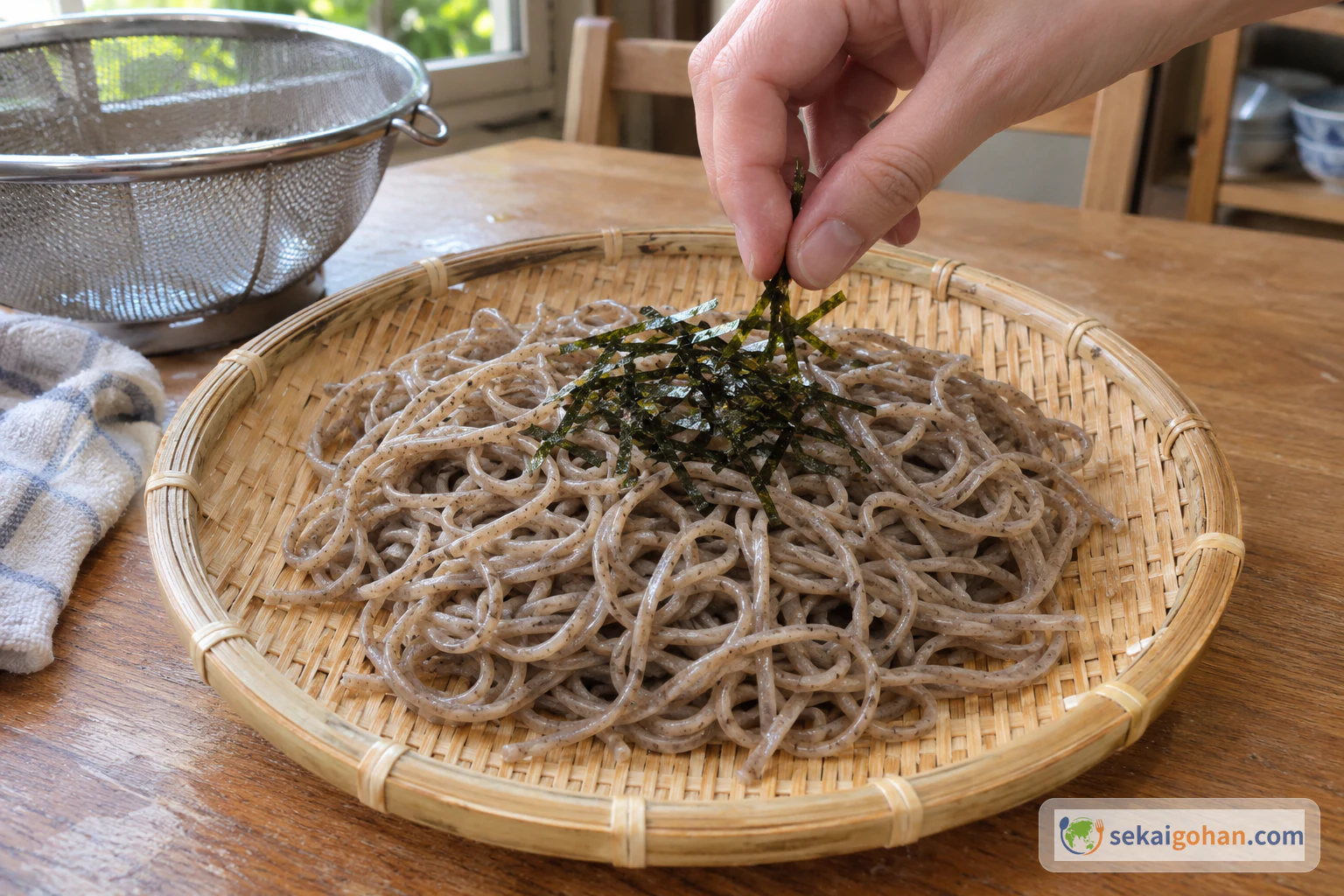
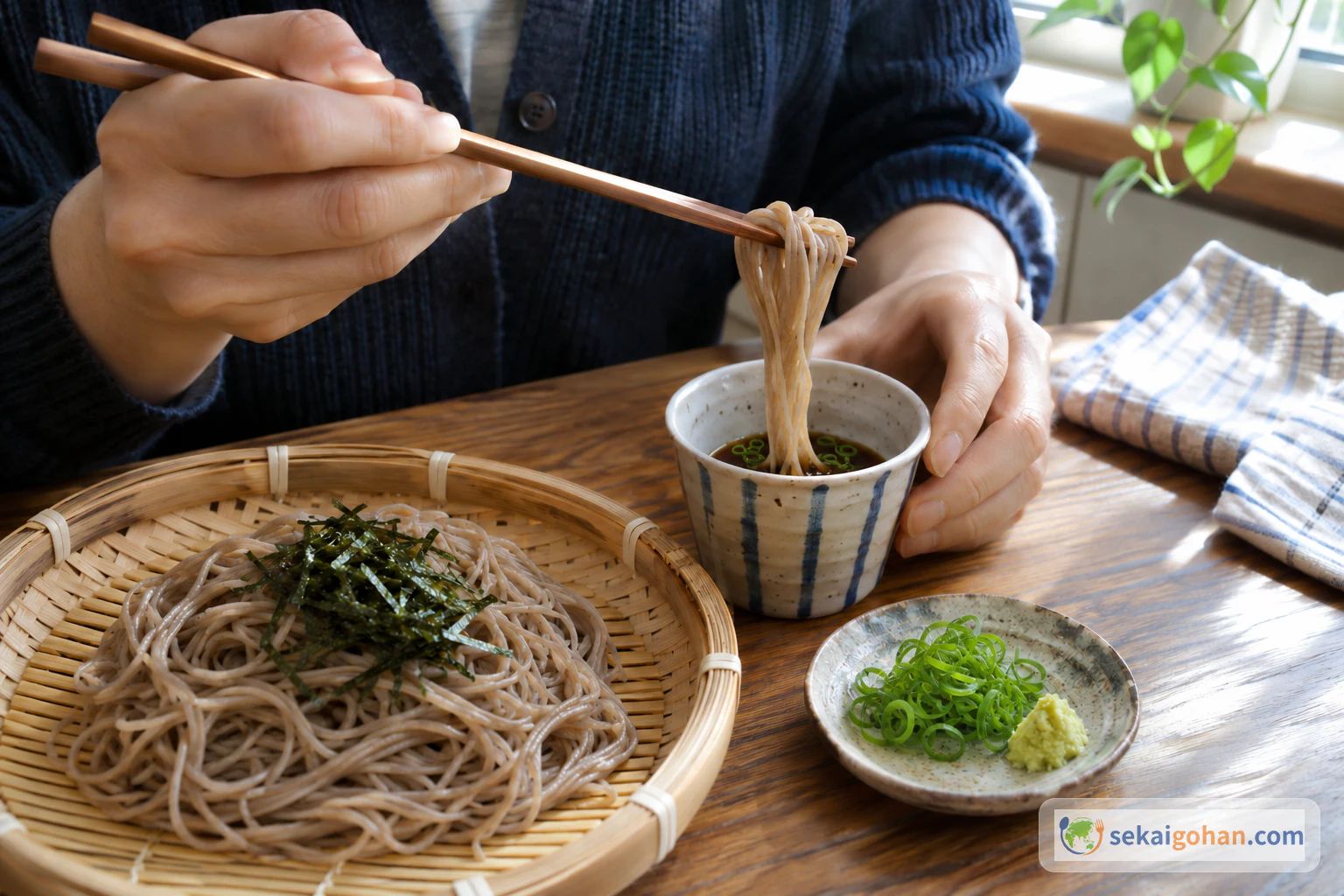
The noodles come out of the ice water firm and cold, and they land on the bamboo tray with a soft, dry rustle as the last drops run through the weave. A pinch of shredded nori goes on top, and beside it sits a small cup of dark, glossy sauce with beads of water forming on the rim. Zaru soba is Japan's chilled buckwheat noodle in its plainest form: grey-brown speckled strands, a dipping sauce built on soy sauce, mirin and bonito, a little green onion and wasabi. You lift a small bundle with chopsticks, dip just the ends, and eat. The noodles taste nutty and clean, the sauce is strong, a little sweet and smoky, and the contrast between the two is the whole pleasure of the dish.
From Edo soba shops to a bamboo tray
Soba belongs to the east of Japan in a way that a single phrase still captures: "udon in the west, soba in the east." Buckwheat was eaten long before it was a noodle, kneaded into a dough and grilled or steamed. When it first took noodle form is not settled. One account places it around the sixteenth century; another describes soba-kiri, cut buckwheat noodles, being served at temples in the early Edo period and then sold in the streets of Edo beside wheat udon. Edo townspeople took to soba over udon, and it spread from kendon soba shops down to street stalls. As dashi and soy sauce came into wide use during the Edo period, a proper soba sauce took shape, and soba's popularity grew with it.
Mori, zaru and seiro
By the late Edo period, soba shop menus listed mori soba alongside hanamaki soba, tempura soba, arare soba, shippoku soba and kamo nanban. Dipping cold noodles into a separate sauce was already the everyday way to eat them. One account of the name mori says that some diners found dipping a bother, so shops began pouring the sauce straight over the noodles as bukkake soba, and the dipped version was called mori to tell the two apart.
Zaru soba came later. In the middle of the Edo period, a shop looking to stand out served its soba piled on a bamboo zaru, and the idea caught on. Which shop it was, and where, is not known. At first the only difference from mori soba was the tray. Around the Meiji era, zaru soba moved upmarket: its dipping sauce was made with mirin, which was costly then, and the noodles used the inner part of the buckwheat seed. Shredded nori was scattered on top to mark the difference.
Most soba shops today tell mori and zaru apart by the nori alone, and the noodles and sauce are usually the same. Seiro soba is named for the seiro, a wooden steaming frame; one account traces it to "mori seiro," early soba-kiri steamed and served in the frame. Today the word refers only to the vessel. Usage also shifts with age and region: younger people often say zaru soba even when no nori is in sight, and in western Japan many people use zaru for all of it.
Soba through the year
Soba runs through Japanese life well beyond the cold tray. People eat toshikoshi soba on New Year's Eve, bring hikkoshi soba to new neighbours after moving house, and stand at station counters for a quick bowl. Tokyo's old soba houses are often grouped as the three great lineages, each tied to a look: Sunaba for thin white noodles, Sarashina for noodles with a translucent sheen, and Yabu for a greenish tint from the inner husk of the seed. Zaru soba is the version you make at home on a hot day, when the kitchen is warm and something cold and quick is the only thing that sounds good.
Ingredients (serves 2 to 3)
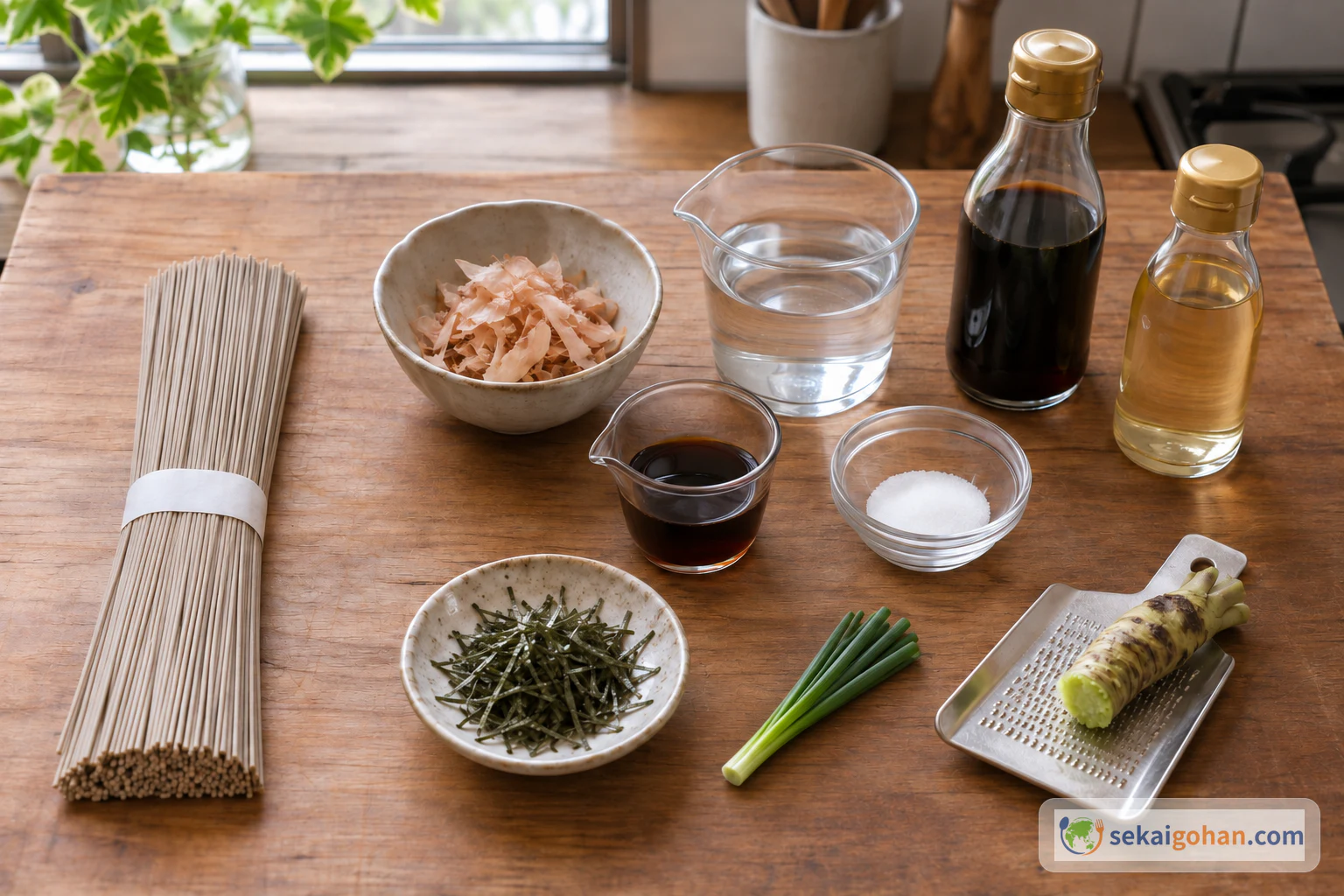
Dried soba is sold in bundles, and the weight of a bundle differs from brand to brand. Check the net weight on the package and measure out 7 oz (200 g) so the noodles match the amount of sauce.
Buckwheat (soba) is one of Japan's mandatory-labeling allergens. As of April 2026, that list is shrimp, cashew, crab, walnut, wheat, buckwheat, egg, milk and peanut. Most dried soba also contains wheat, which is on the same list. Soy sauce contains soy, and the sauce contains bonito (fish); the topping is seaweed. If someone at the table has a buckwheat allergy, cook their food in a separate pot with a separate colander and chopsticks, because shared tools carry buckwheat. Allergic reactions range from itching, hives, swollen lips or eyelids, vomiting and wheezing to anaphylaxis with loss of consciousness or a drop in blood pressure. If symptoms appear, get medical help.
Equipment
- A small saucepan for the dipping sauce
- A fine-mesh strainer set over a bowl
- A large, deep pot that holds plenty of water
- Long cooking chopsticks
- A colander
- Two large bowls: one of water for rinsing, one of water with ice for chilling
- A knife, a small cutting board and a small bowl of water for the green onion
- A fine grater for fresh wasabi
- A flat bamboo zaru tray
- Small soba cups (soba choko) for the sauce
Choosing noodles and swaps
Any form of soba works here: dried, fresh, pre-boiled or frozen. Cook each the way its package says. The flour ratio printed on the package tells you more about the noodle than the brand does. Ni-hachi, also called uchi-ni, is 8 parts buckwheat to 2 parts wheat flour, and it keeps the buckwheat flavor while slipping down easily. Soto-ni adds 2 parts wheat to 10 parts buckwheat and eats much the same. Soto-ichi and ku-ichi go lighter on the wheat still. Wheat helps the dough hold together in long, thin strands, makes the noodles supple, and keeps them from breaking as they sit. Juwari, all buckwheat, has the most buckwheat flavor and the least of that binding.
Fresh soba is sold as nama soba. Nama here means uncooked, and the noodles are always boiled before eating. Nothing in this dish is eaten raw.
The sauce is where swaps change the most. Each line below says what happens.
| Ingredient | Swap | What changes |
|---|---|---|
| Soy sauce (koikuchi) | Light (usukuchi), white (shiro) or low-sodium soy sauce | Color and saltiness shift; low-sodium soy sauce changes the taste |
| Mirin | Mirin-style seasoning | Different alcohol and sugar make-up; it is a poor one-to-one swap |
| Bonito flakes | Thick-cut flakes or other bonito | The dashi comes out differently and the flakes strain differently |
| Fresh wasabi | Prepared wasabi paste | Works well; fresh grated wasabi has a softer, more fragrant heat |
What keeps the dish tasting Japanese is the full-strength dipping sauce and noodles chilled hard in ice water. Bamboo tray, nori and fresh wasabi can be let go abroad; the sauce strength and the icing cannot.
Method
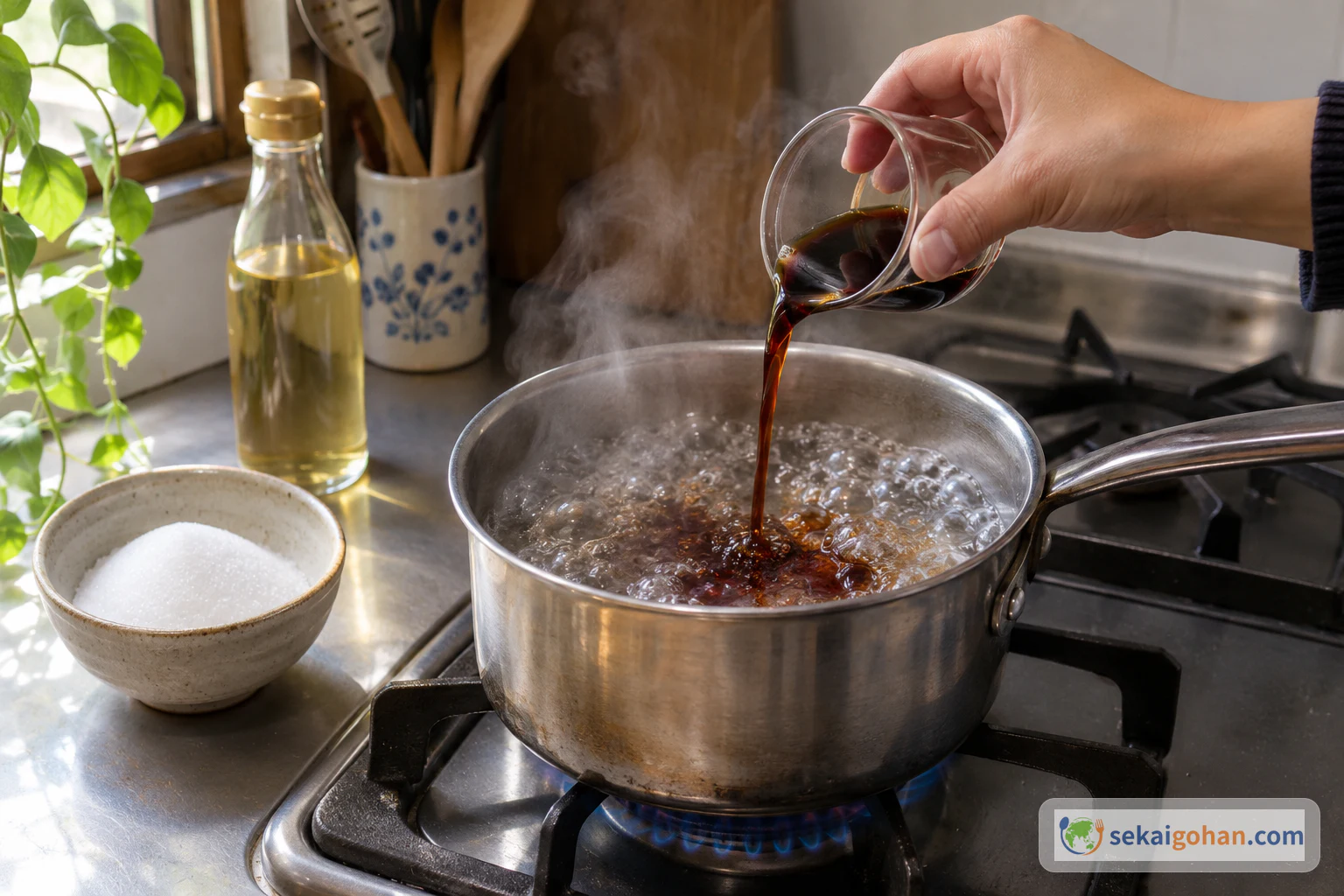
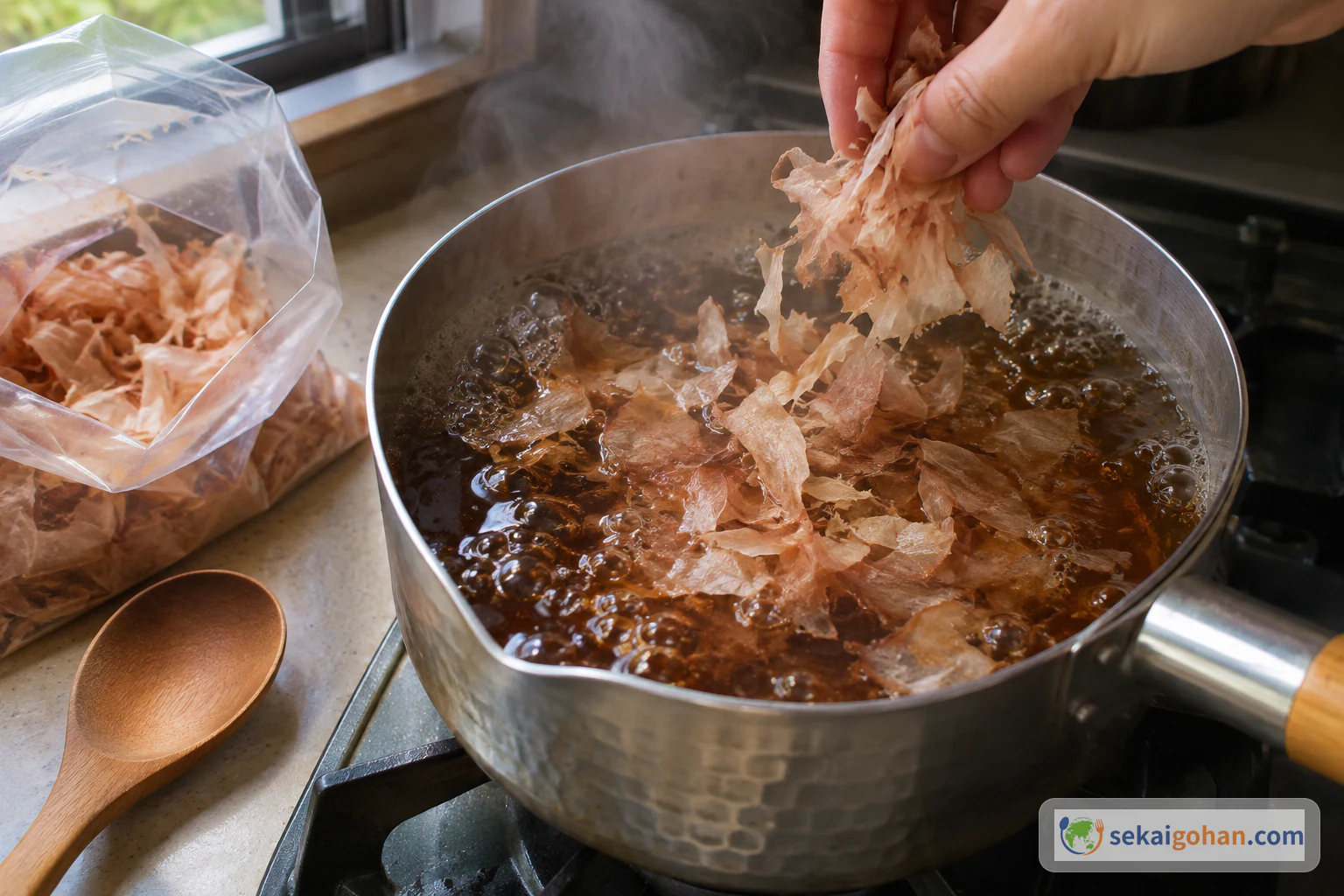
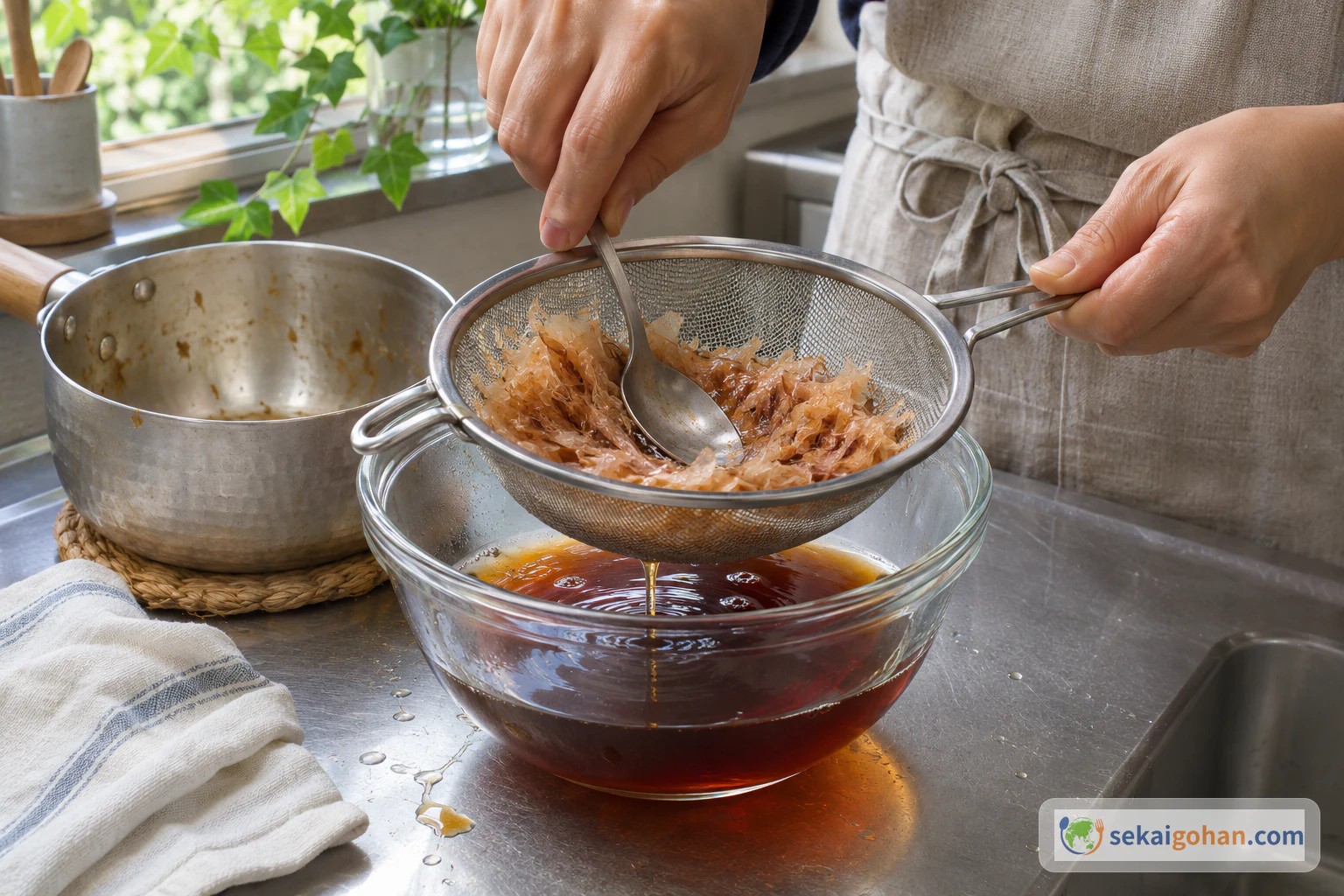
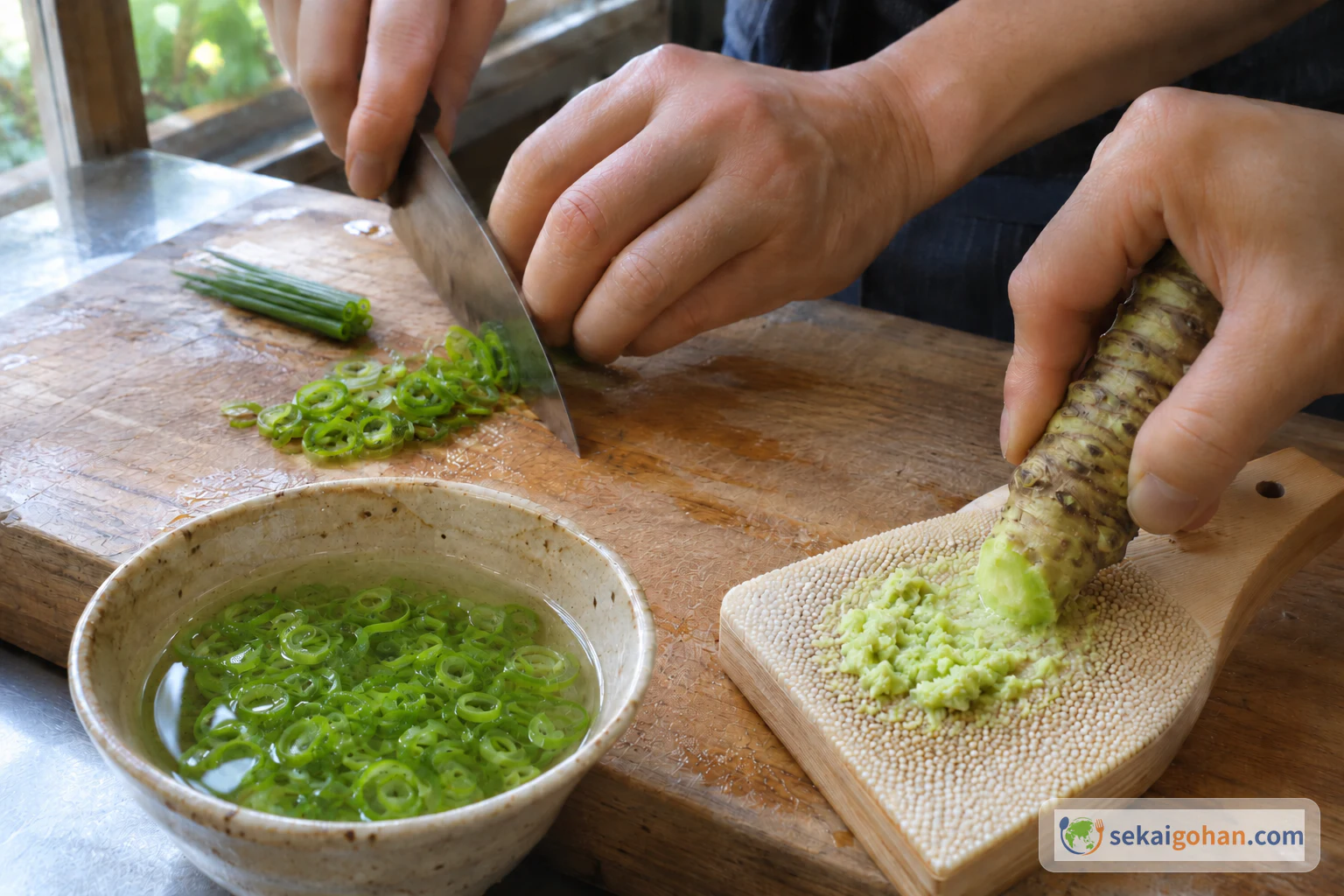
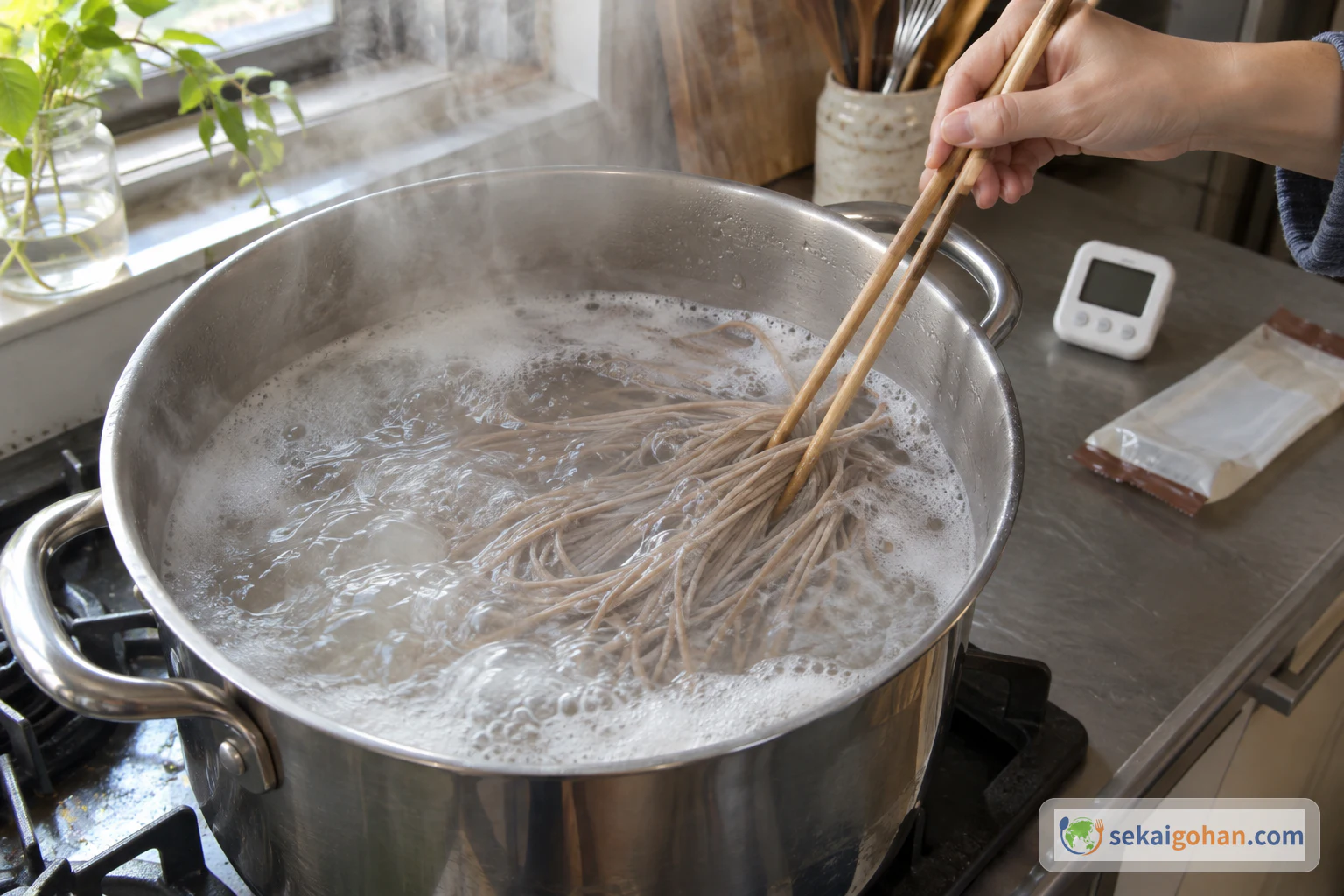
Make the sauce first. It has to cool completely, and that cooling is your hands-off time: slice the green onion, grate the wasabi and set out the bowls while it sits. The noodles go in the pot last, because they soften as they wait, and the rest of the meal moves fast once they are drained.
Lift the noodles out of the boiling pot with care, keeping your face and hands clear of the steam, and set the hot pot well back on the stove. Ice water numbs fingers fast. If children help, keep them away from the pot and let them do the plating and the nori.
When it goes wrong
| What you see | Why | What to do |
|---|---|---|
| Noodles stuck together in clumps | Too little water, or not stirred right after going in | Use a large pot with plenty of water and separate the noodles with chopsticks as soon as they go in |
| Short, broken noodles | Stirred too hard, or too many noodles at once | Stir gently; cook one or two servings at a time |
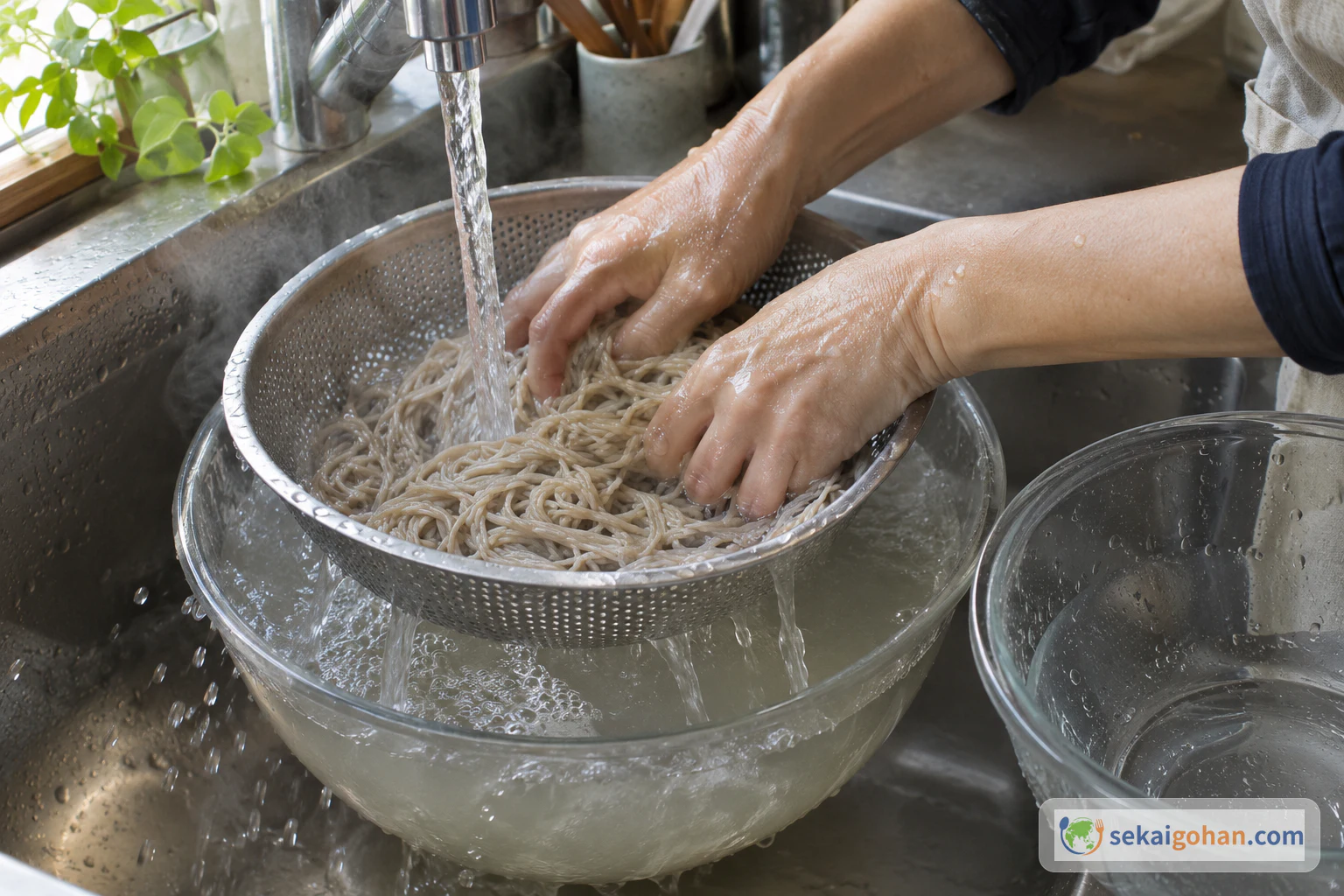
| A slick, floury coating | Not enough rinsing | Rub gently in fresh water, changing it as it warms |
| Foam boiling over | Surface flour in too little water | Use a bigger pot; add a small splash of cold water without stopping the boil |
| Every bite tastes too salty | Noodles dunked in the sauce | Dip only the ends; the sauce is meant to be strong |
| Noodles soft and limp | They sat too long after cooking | Boil just before eating and serve right away |
Serving, variations and storage
At the table
Zaru soba is a meal on its own for a hot day, with each person getting a tray, a cup of sauce and their own condiments. Leave off the nori and the same plate is mori soba.
Variations
- More condiments. Grated daikon, myoga or shiso add freshness. Serve them alongside the green onion and wasabi.
- Sudachi. Sudachi juice or zest gives a sharp citrus lift; go lighter on the wasabi so the two do not compete.
- Ten-zaru. Tempura served alongside turns this into a bigger meal. It means heating a pot of frying oil, so treat it as its own project.
- Tororo. Grated yam over or beside the noodles makes the sauce cling, so use less sauce.
- Cold bukkake. Pouring the sauce over the noodles is a different way to eat them. Poured at full strength the sauce is far too salty, so dilute it first.
- Walnut sauce. Ground walnuts stirred into the sauce make it rich and nutty. Walnut is one of Japan's mandatory-labeling allergens; warn anyone at the table.
Storage
Boiled soba keeps only until the end of the day: refrigerate it and eat it the same day. Cold noodles from the refrigerator are best rinsed again in a colander, or warmed in a hot broth for a different dish. Store any extra sauce in a clean, covered container in the refrigerator and use it up soon.
Frequently asked questions
Can I eat these noodles hot instead?
Yes. Even for hot soba, chill the noodles in ice water first, then warm them through in hot broth. That chilling sets the texture, and the noodles stay springy in the bowl. Dilute the sauce for a hot broth; at dipping strength it is far too salty.
Do I need a bamboo zaru?
A flat plate works. The bamboo weave lets the last of the water drain away, so the noodles stay firm and the sauce stays at full strength when you dip. On a plate, drain the noodles longer, until they no longer drip.
How do I split 7 oz (200 g) of noodles between two or three people?
For two people, that is 3½ oz (100 g) each, a generous serving. For three, it is about 2⅓ oz (67 g) each, a lighter one that suits a side of tempura or another dish. The sauce is enough for either.
Can I use low-sodium soy sauce?
You can, and the sauce will taste different, with less of the deep, salty edge that the light dip depends on. Keep the dip light all the same. Regular Japanese soy sauce gives the flavor this dish is built around.