Layer the Saltiness of Fermented Dairy over Roasted Eggplant
After roasting the eggplant, put the peeled flesh in a sieve and a faintly clear liquid drips out little by little. Rush this, and water floats up on the plate after serving. Stir kashk into well-drained eggplant instead, and the sour white dairy gets into the sweetness of the eggplant, with the aroma of mint oil and fried onion staying on top.
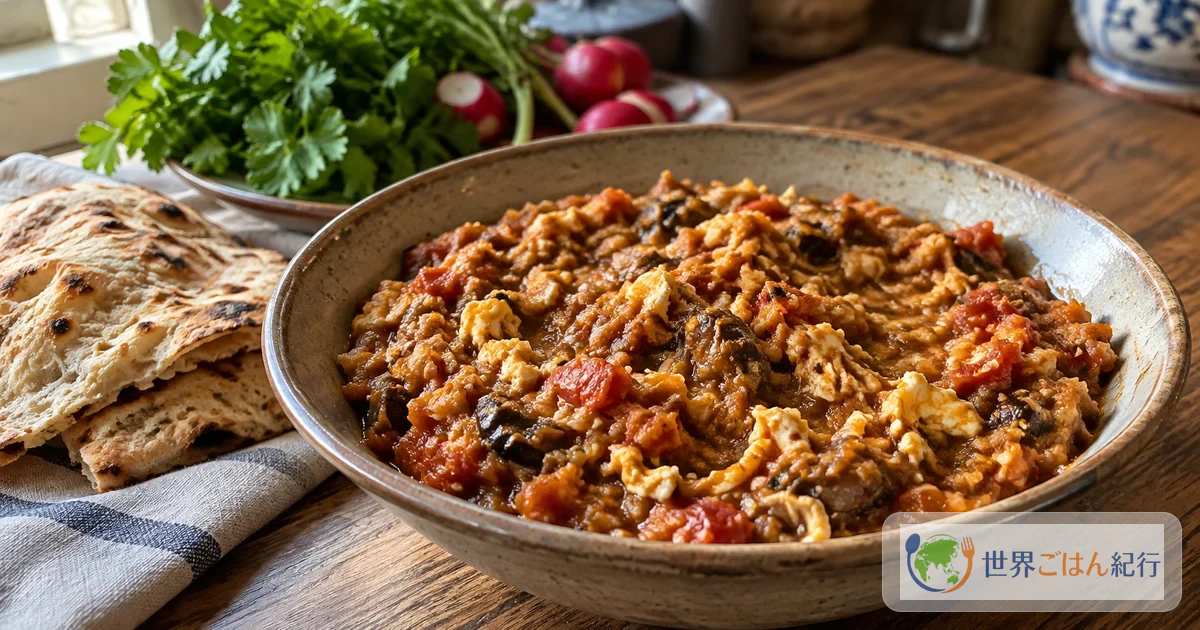
Kashk-e bademjan (Kashk-e bademjan / کشک بادمجان) is an eggplant and kashk dish that often appears in Iran as an appetizer or a small home dish. As the name says, the core is kashk and bademjan: kashk, a fermented whey product, and eggplant. Where Lebanon's Baba ghanoush comes together with tahini and lemon, this is a warm dip eaten with dairy tang, saltiness, fried onion, and dried mint.
The hard part of making it at home is how to handle the kashk. If you can get local liquid kashk it is closest, but even import grocery stores don't always stock it. So this article uses a version with liquid kashk as the base and also gives a substitute using Greek yogurt and feta to approximate it. It won't taste exactly the same, but it is built by adding saltiness, acidity, and dairy weight so it doesn't become "just roasted eggplant yogurt."
If you have already made Borani, it is interesting to be aware of the difference. Borani is a small dish where cold yogurt receives roasted eggplant. Kashk-e bademjan is a dish where the eggplant is sautéed and simmered, blended with kashk, and eaten warm with fried onion and mint oil. Set beside Chelow kabab, it lightens the fat of the meat, and on a day of a rich stew like Fesenjan, serving a little on bread as an appetizer loosens the heaviness of the table.
In English it is written Kashk-e bademjan, Kashke bademjan, Kashk bademjoon, and other ways. In Persian, bademjan is eggplant, and kashk is a fermented dairy ingredient whose form varies by region: liquid, dried, or powdered.
This recipe uses dairy and walnuts. If you have a dairy allergy or a nut allergy, avoid it. If you serve bread such as lavash, pita, or naan, it contains wheat. Imported kashk and spices may be processed on lines that handle other allergens, so check the product labels.
Ingredients | Separate the Roles of Eggplant, Kashk, and Mint Oil

Thick eggplants keep their sweetness after roasting. They hold a lot of water, so prepare plenty on the assumption that you will drain them after roasting. Half the onion is cooked into the dish, and the rest goes toward a fried-onion-style finish. Dried mint turns bitter if it scorches, so treat it not as something to cook for long but as something whose aroma comes out in the residual heat of the oil.
When using liquid kashk, warm it once in a separate pot if the product label calls for it. If you use dried kashk or qurut, crush it finely and rehydrate with water, then strain through a tea strainer if grittiness remains. For a first batch, liquid kashk or the substitute is less likely to go wrong.
For the substitute, mix 150 g Greek yogurt, 30 g finely crumbled feta, 2 tsp lemon juice, and 2 tbsp water well. If the feta pieces are large the mouthfeel is gritty, so crush them with the back of a spoon. Don't add salt until the end; decide at the final taste.
Sourcing | What Is Worth Seeking Out Is What Decides the Aroma
Eggplant, onion, garlic, yogurt, and feta are fine from any grocery store. Kashk is something to choose at an import grocery or a store that carries Middle Eastern and Central Asian foods, reading whether the label says liquid, dried, or powdered. What is worth seeking out for other Iranian dishes too is turmeric, unsalted walnuts with little rancid smell, and sumac to add sourness at the table.
Turmeric gives color and a slight bitterness in a small amount. It is also used in Ghormeh sabzi and Tahchin, so keeping a small jar makes Iranian cooking more consistent.
Walnuts are used both mixed in and as a finish. With only eggplant and kashk the flavor is soft, so the fat and bits of walnut give a feeling of satisfaction when it sits on bread.
Sumac is not essential, but sprinkling a little on red onion and setting it alongside cuts the dairy weight and makes it easier to keep eating. If you keep making Middle Eastern mezze, you can also use it in Musakhan and in sumac onion side dishes.
Method | Make the Eggplant Light, and Don't Boil the Kashk Hard
Kashk-e bademjan flows like this: roast the eggplant, drain its liquid, color the onion, sauté-simmer the eggplant, combine with kashk, and finish. The steps look many, but there are only two key points: draw the water out of the eggplant, and don't boil the kashk hard.
What to Keep and What to Change in a Home Kitchen
What makes it kashk-e bademjan is sweetly roasted eggplant, the sourness and saltiness of dairy coming through, and the finishing aroma left on top. Conversely, the type of bread, whether to use red onion, and the size of the walnut pieces can be adjusted at home.
| Decision | Why to keep it | How far you can substitute |
|---|---|---|
| The tang and saltiness of kashk | The core of the dish's very name. With yogurt alone it leans toward borani | If you have no liquid kashk, approximate it with Greek yogurt, feta, and lemon |
| Draining the eggplant | If water floats up, the kashk thins out and it is hard to put on bread | The eggplant can be roasted in an oven, under a broiler, or on a grill over open flame |
| Dried mint oil | Lightens the warm dairy's aroma | If you have no dried mint, chop fresh mint at the end. The aroma will be different |
| Fried onion | Builds a layer of sweetness and toastiness | Store-bought fried onions work, but check the salt and reduce the finishing salt |
| Walnuts | Add bits and fat to the softness of only dairy and eggplant | If avoiding nuts, leave them out. Don't force another nut as a replacement |
When using feta as the kashk substitute, it is important not to add too much. With a lot of feta it leans toward a Greek-style cheese dip, and the aroma of eggplant and mint oil recedes. Start with just 30 g, and if it is lacking, adjust at the end 1 tsp at a time.
How to Eat It | A Small Dish to Scoop with Bread, an Appetizer for Rice Dishes
To eat it local-style, scooping with thin lavash is the most natural. Pita, thin naan, or a tortilla lightly warmed in a skillet is plenty. Put on thick sandwich bread, the sweetness of the bread wins out, so choose a thin bread at first.
To fit it into dinner, serve it small as an appetizer for a meat dish. Served before Chelow kabab, it brings the dairy tang into a table of grilled meat and rice. On a day of a rich stew like Fesenjan, keep the kashk-e bademjan to a small amount and serve plenty of sumac onion, and it won't feel heavy. To widen the thread of preserved dairy, compare it with Tajikistan's Qurutob, and you can see how dried dairy is used from Central Asia to the Iran region.
Where It Easily Goes Wrong and How to Fix It
| State | Cause | Fix |
|---|---|---|
| Watery | Eggplant not drained enough, or not simmered enough | If before adding kashk, reduce 5 minutes over medium-low. If after, stir over low heat and cool slightly, on the premise of putting it on bread |
| Too sour | The kashk's saltiness and tang are strong, or too much lemon in the substitute | Adding more roasted eggplant is best. For a quick fix, add 10 g more walnuts and mix in 2 tsp olive oil |
| Mint oil is bitter | Dried mint was cooked too long | Don't use bitter oil. Wash the small pot and remake it over low heat in just 20 seconds |
| Garlic scorched | Garlic went in before the onion, or heat was too high | Scorched garlic can't be undone. Remaking is better than removing the brown bits and adding a little raw garlic at the end |
| Close to just roasted eggplant yogurt | The saltiness and tang of the kashk substitute are weak | Mix in 5 g feta, 1/2 tsp lemon juice, and a pinch of salt, adding a little at a time |
Storage and Making Ahead
Once finished, let the heat go, store in an airtight container, and finish within about 2 days refrigerated. It contains dairy, so don't leave it at room temperature for long. To reheat, put in a small pot and warm 3 to 4 minutes over low heat, stirring the bottom. In a microwave, check every 40 seconds at 600 W and don't let it boil hard.
To make ahead, make only through the sautéed eggplant before the kashk goes in and refrigerate it, then combine with the kashk and mint oil on the day you eat, and the aroma stays better. Freezing is possible for about 2 weeks at the sautéed-eggplant stage. If you freeze the finished dish, the dairy tends to turn grainy when thawed.
FAQ
I can't get kashk. Can I make it with yogurt alone?
You can, but the impression leans toward borani. To get closer, mix 30 g feta, 2 tsp lemon juice, and 2 tbsp water into 150 g Greek yogurt. Adding saltiness and dairy weight moves it in the direction of kashk.
Is frying the eggplant closer to the authentic version?
There is a fried version too. Eggplant that has absorbed plenty of oil is rich and looks good, but at home it tends to be heavy. This article roasts and then sauté-simmers, adding aroma with finishing oil and mint oil. For a first batch, the roasted-eggplant version is better for learning how to adjust the water.
Can I leave out the dried mint?
You can, but the heaviness of dairy and eggplant remains. Chopping fresh mint over the finish is fine, but it is different from the aroma of dried mint hitting the oil. If you keep making Middle Eastern food, it is worth keeping a small bag.
Can I make it without walnuts?
If you have a nut allergy, don't include them. The texture is softer, but making a little more fried onion and serving sumac onion or herbs alongside keeps it from being monotonous. Rather than forcing in another nut, making it without comes together better.
Can I eat it cold?
You can, but kashk-e bademjan brings out the eggplant's sweetness and the mint oil better warm. Reheat refrigerated dip briefly over low heat. Boiling makes the dairy grainy, so stop just before it bubbles.
Sources (local and overseas references consulted)
- Kashk bademjan - Wikipedia (Checked the dish name, main ingredients, and spellings)
- KAŠK - Encyclopaedia Iranica (Checked kashk's standing as an ingredient)
- PersianGood: Kashke Bademjan (Cross-checked the steps for eggplant, kashk, mint, walnuts, and turmeric)
- Epicurious: Kashk Bademjoon (Cross-checked the English-language ingredient explanation and way of eating)