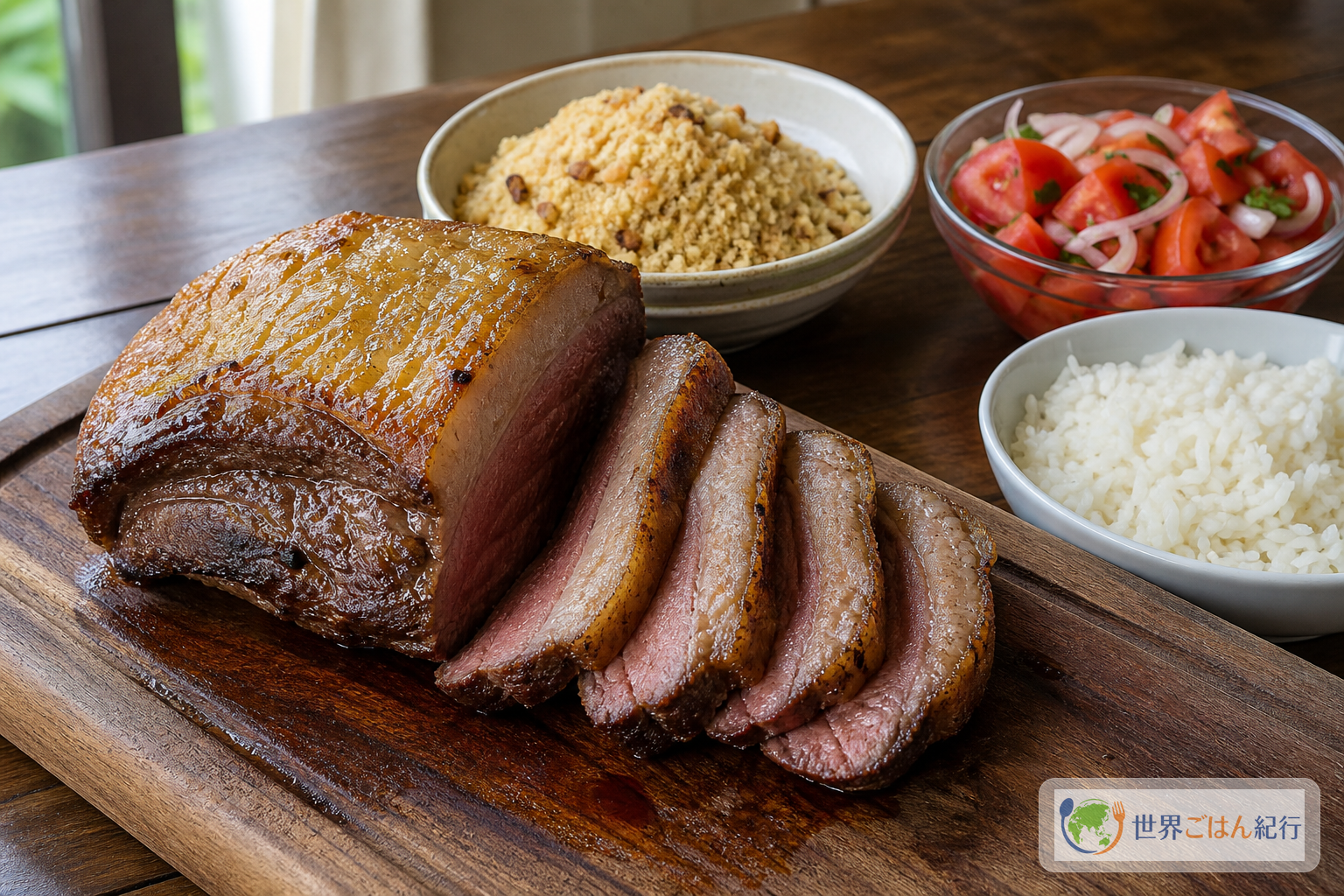
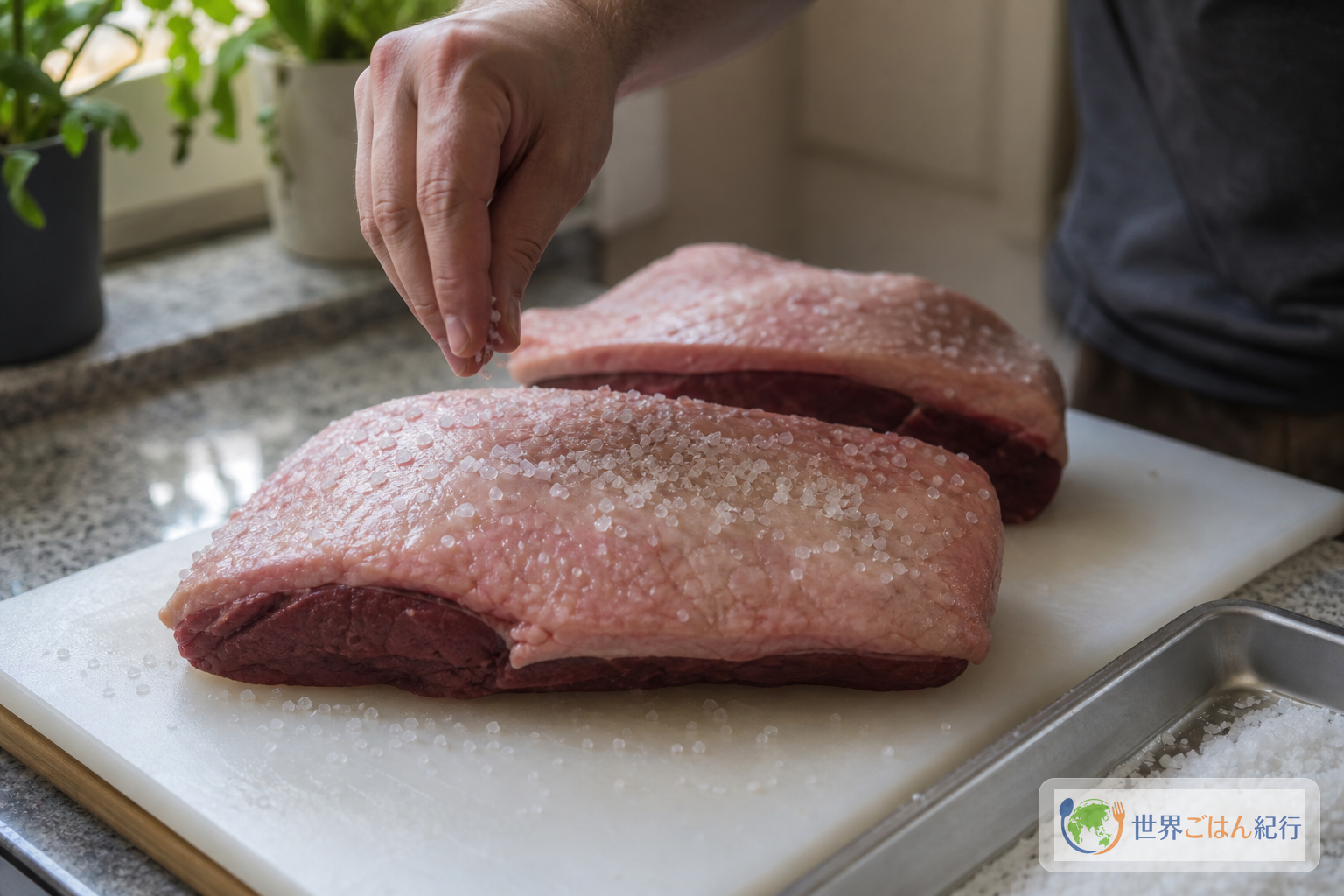
A slab of beef sits on the cutting board, its layer of white fat more prominent than the red meat. Most home cooks would trim that fat off without a second thought. With Brazilian picanha, the fat stays on and goes to the fire first. The cut is grilled with its fat cap, carved into thin slices and eaten with toasted manioc flour and a vinegary vinagrete, so the salt and the rendered fat carry the flavor.
Picanha and the Brazilian churrasco table
Picanha is a triangular cut from the rump end of the animal, known in English as the sirloin cap or coulotte: the triangular muscle that covers the top sirloin. At the meat counter you may see it labeled top sirloin cap, rump cap or coulotte, but butchers don't all draw the boundaries of the cut the same way.
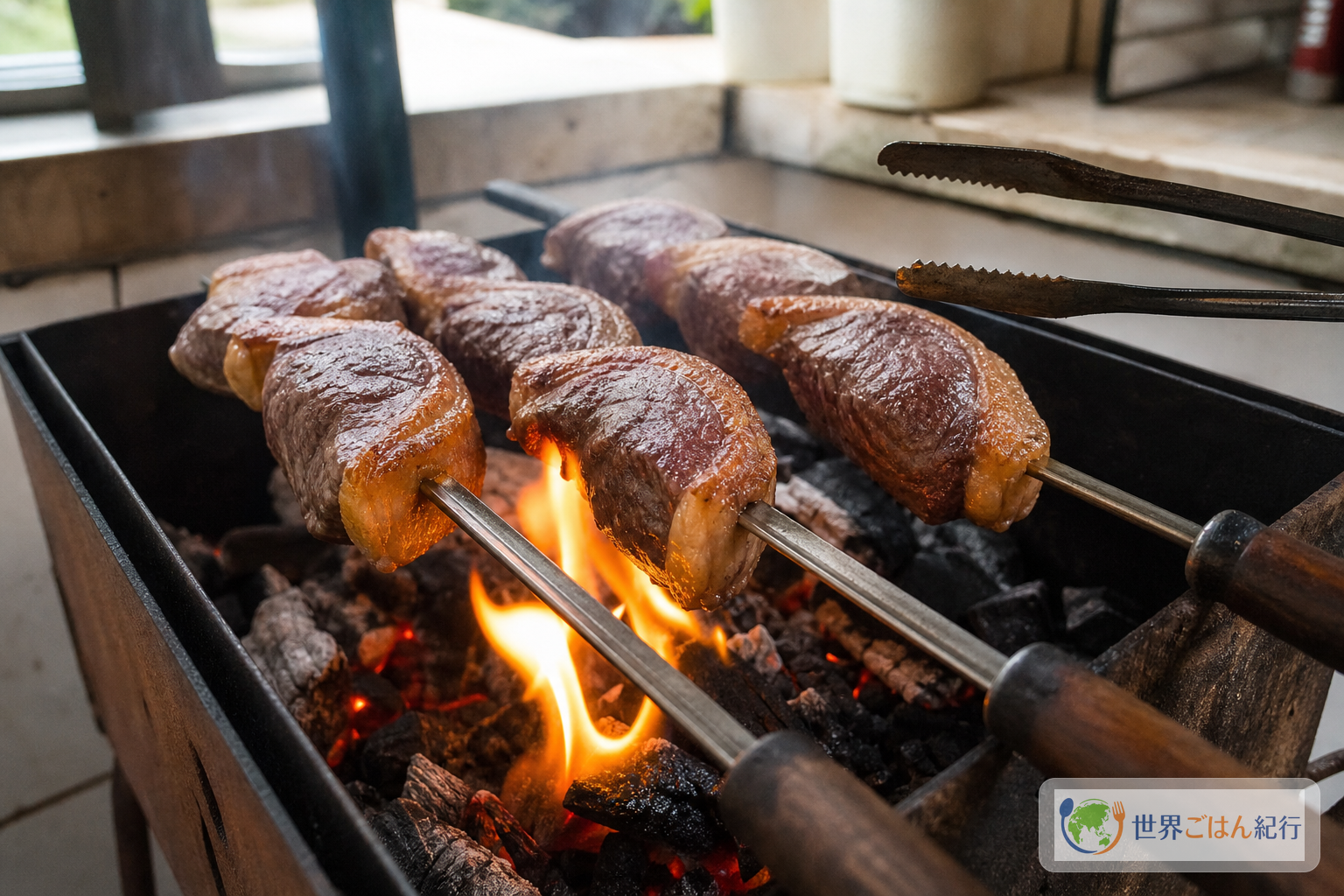
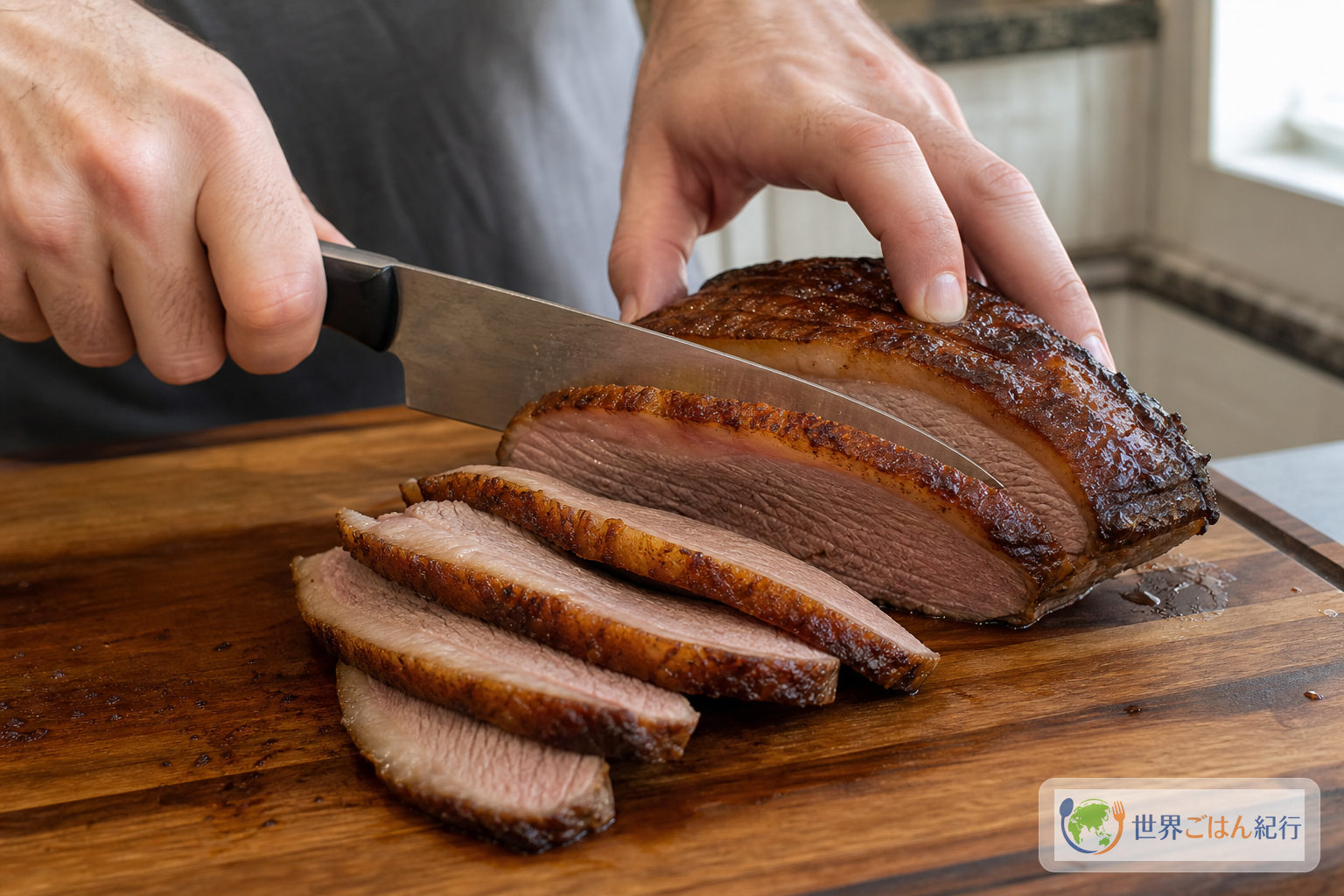
In Brazil you carve thin slices off the outside, then send the rest of the piece back to the fire. Only the cooked part moves on to the next plate, so the meat never goes cold. Picanha is less a steak you grill once and serve than a dish that shuttles between the fire and the plates right beside the table.
Regional tables and grilling styles
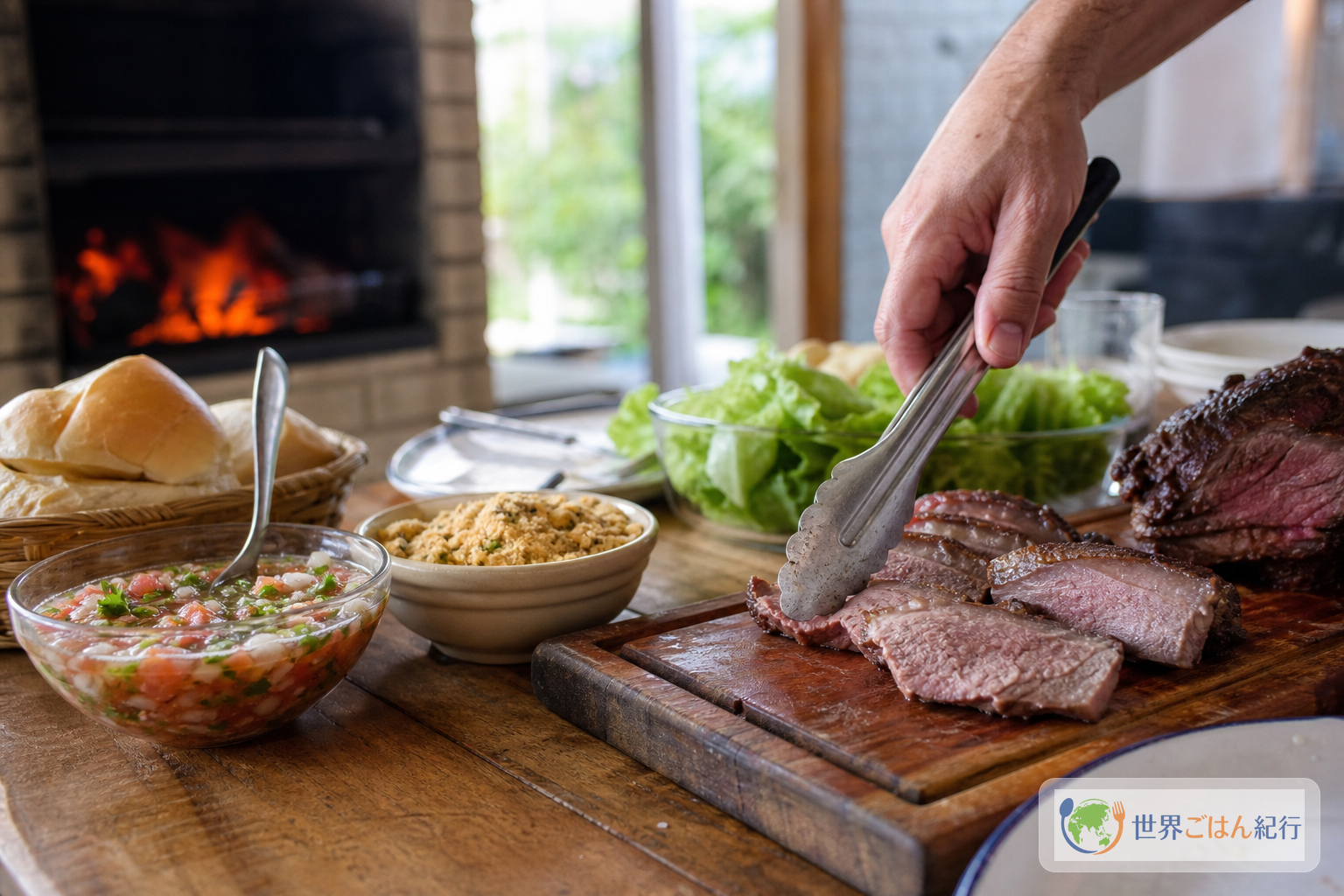
Churrasco tables differ from region to region and from family to family. In the South and Southeast, they feature charcoal-grilled meats and sausages, white rice, toasted manioc flour, salads and bread. In the North and Northeast, cassava itself and its flour run deep through everyday cooking. The regional breakdowns show a meal built by pairing the meat with flour and tangy vegetables, rather than treating picanha as a dish on its own.
There's range in how it's grilled, too. One approach skewers the whole piece and carves slices off the outside; another bends thick steaks so the fat faces outward. In the classic coarse-salt picanha, the meat is coated in coarse salt, rested, skewered, sliced thinly after grilling and returned to the grill, then served with farofa and white rice. Farofa itself is a dry side dish long eaten in Brazil, made by toasting manioc flour in fat.
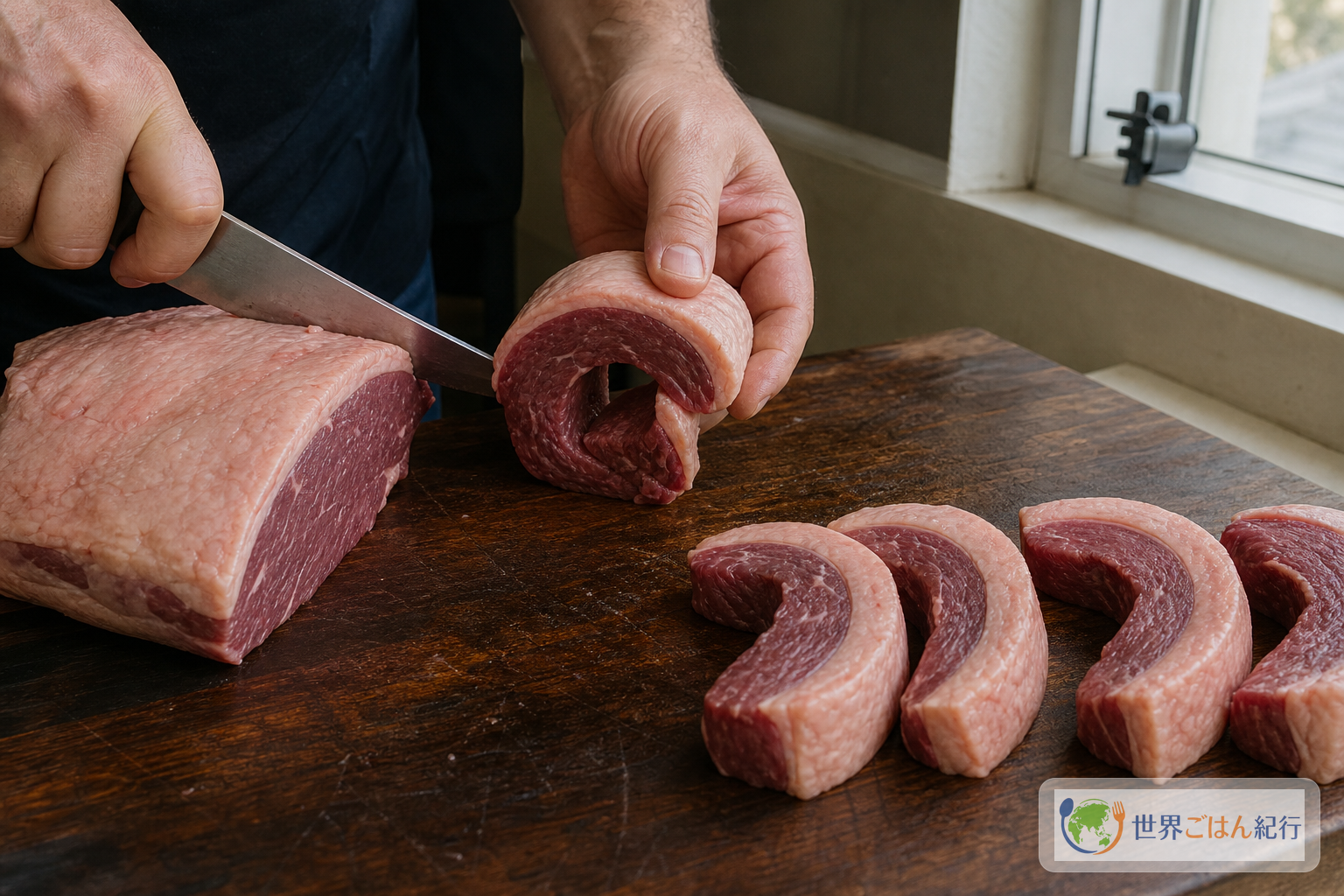
Here, a 900 g (about 2 lb) piece is cut into thick steaks, about 4 cm (1 1/2 in) each, and each one is curved into a C shape. That's much easier to manage in a home kitchen than turning a large skewer. The fat stays on the outside and you still slice off the cooked surface, so the thickness and fat handling stay true to the original even without the charcoal aroma.
Ingredients (serves 4)
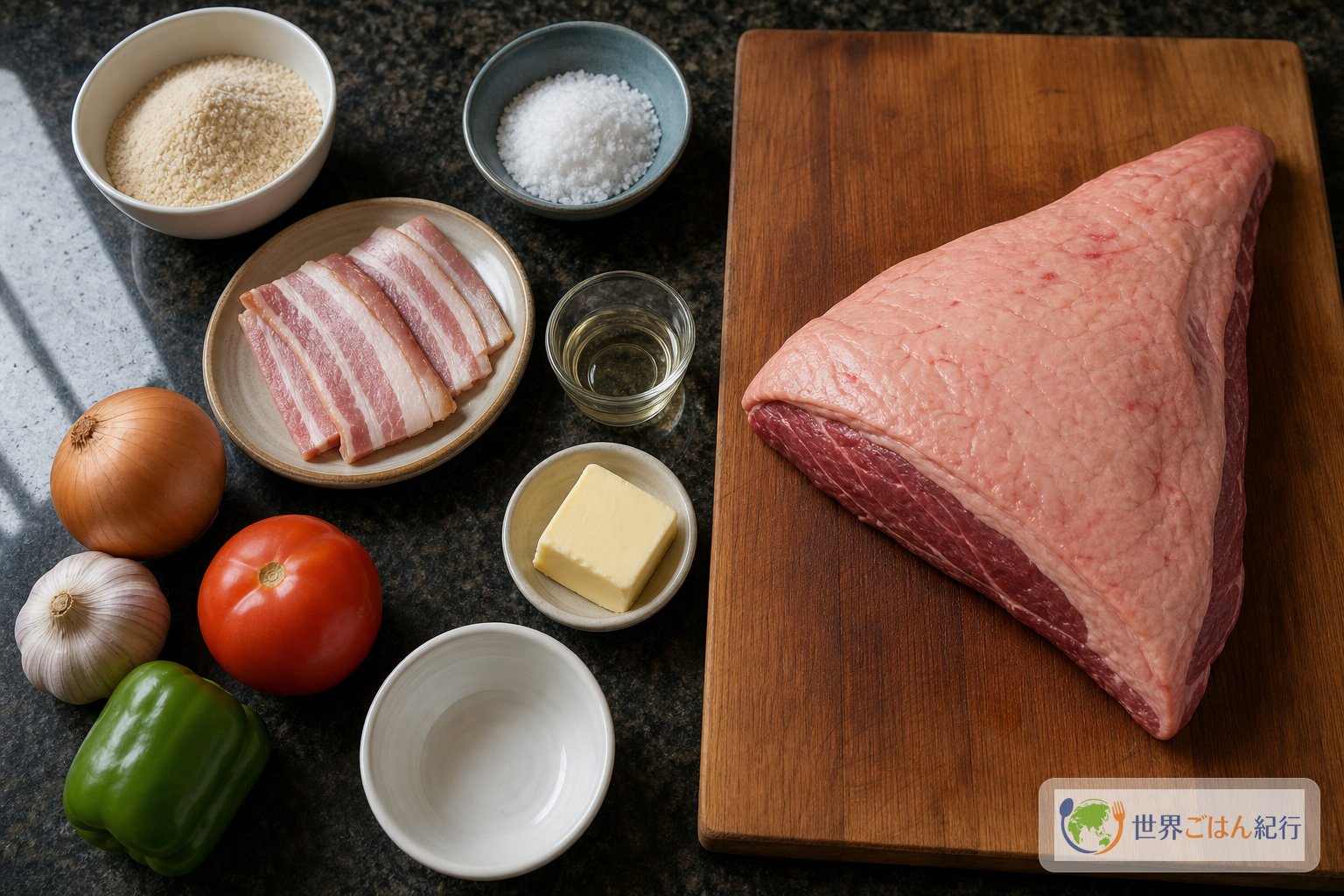
This recipe uses beef, pork and dairy. Check the labels on the bacon, butter and cassava flour, and if you use a product with different ingredients, review its allergen information too. Don't use the cutting board or tongs that held raw meat for cooked meat or raw vegetables without washing them.
Choosing picanha, cassava flour and a grill
If you can find picanha, make the fat cap the backbone of the flavor. If not, a fat-on piece of rump cap or rump works as a substitute. Lean beef with almost no fat won't give you the same texture, so keep it thick, grill it quickly rather than oiling it first, and slice across the grain.
At home, leave about 0.5 inches (1–1.5 cm) of fat and apply the coarse salt just before grilling. That fat cap is what melts into the meat and crisps on the fire.
For the farofa, look for a product labeled farinha de mandioca, manioc flour or cassava flour, and don't confuse it with tapioca starch or potato starch. Latin American grocery stores and online shops are good places to look. If you'll make farofa more than once, it's handy to keep a bag on hand. It's good sprinkled over fried eggs or rice and beans too, so it won't be a one-time purchase.
Charcoal or a griddle
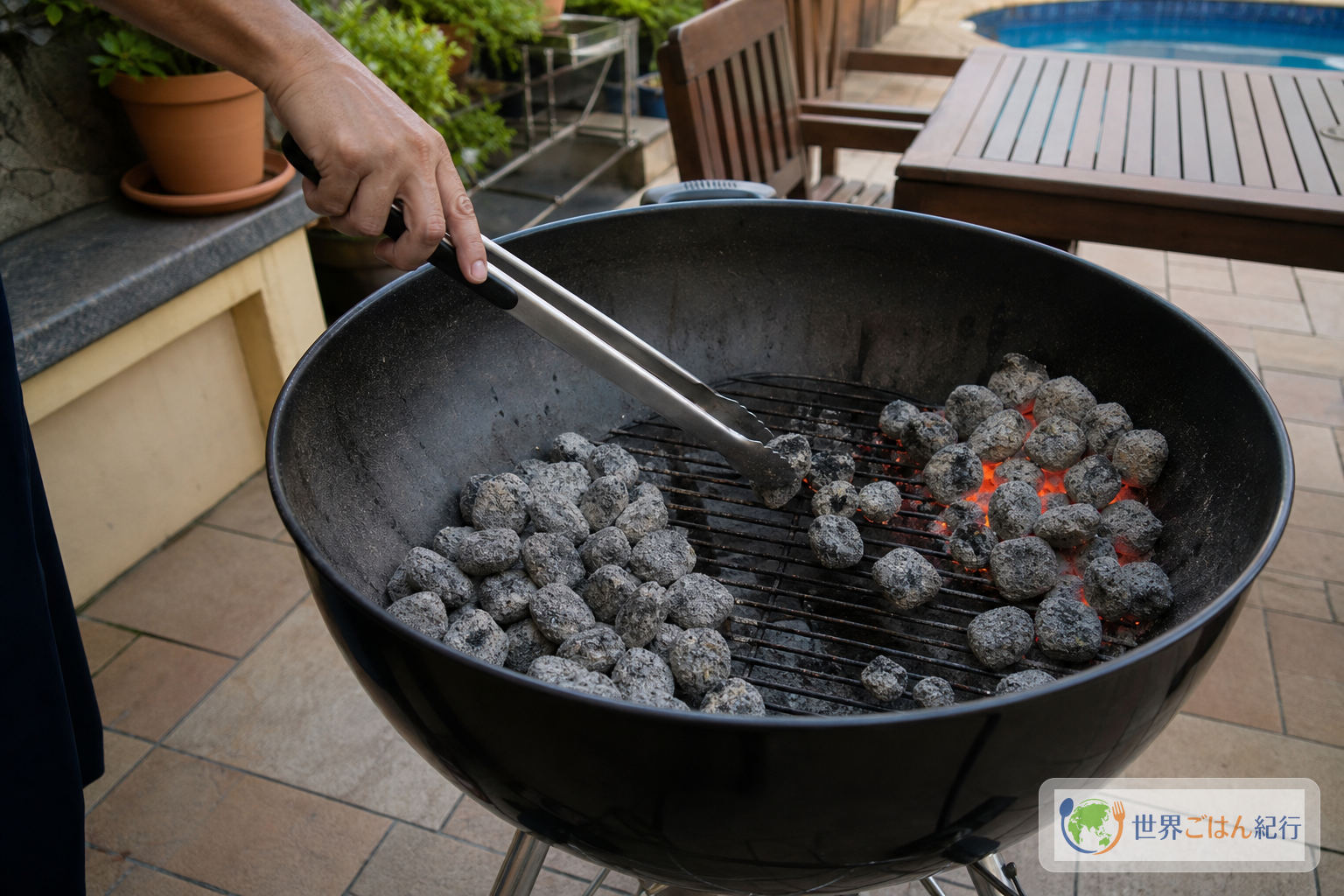
If you can use charcoal outdoors, that's the first choice. Push coals that have ashed over to one side to create a cooler place where you can move the meat when fat drips. In a yard or on a balcony where sparks can fly, check your building rules and ventilation, and have water ready for putting out a fire before you start.
Indoors, use a heavy griddle or cast-iron skillet and handle browning and cooking through as separate jobs. You lose the open-fire aroma, but you keep the technique of searing the fat first and then moving the red meat onto the hot surface. Searing fat hard makes smoke, so run the range hood, and check the size of the griddle and which heat sources it works with. If you already own a cast-iron skillet or griddle big enough for thick steaks, that's all you need.
Method
Grilling time changes with the thickness of the meat, the amount of charcoal and the wind. Treat the times as a starting point and make the final call by internal temperature and the look of the surface. Cook beef steaks and roasts to 63°C (145°F) at the center, then rest for 3 minutes. For the full chart, see safe minimum internal temperatures. Don't judge doneness by color alone.
Starting with the fat side lets the melting fat baste the meat and gives the surface a deep, savory crust. Don't trim away too much: leaving 0.5 inches (1–1.5 cm) of fat is the surest route to true picanha.
Picanha doneness problems and fixes
If the fat is still white, turn the fat side back to the hot zone. Grilling the meat side further will toughen it all the way to the center, so hit only the fat side briefly, and if needed, slice first and then reheat.
If the center is close to raw and the temperature is too low, don't eat it anyway; return the slices to the cool zone. If instead the crust has gotten too dark, rest the meat away from the fire before slicing, and balance the heaviness of the plate with the acidity of the vinagrete and the toastiness of the farofa.
Serving picanha with farofa and vinagrete
Farofa
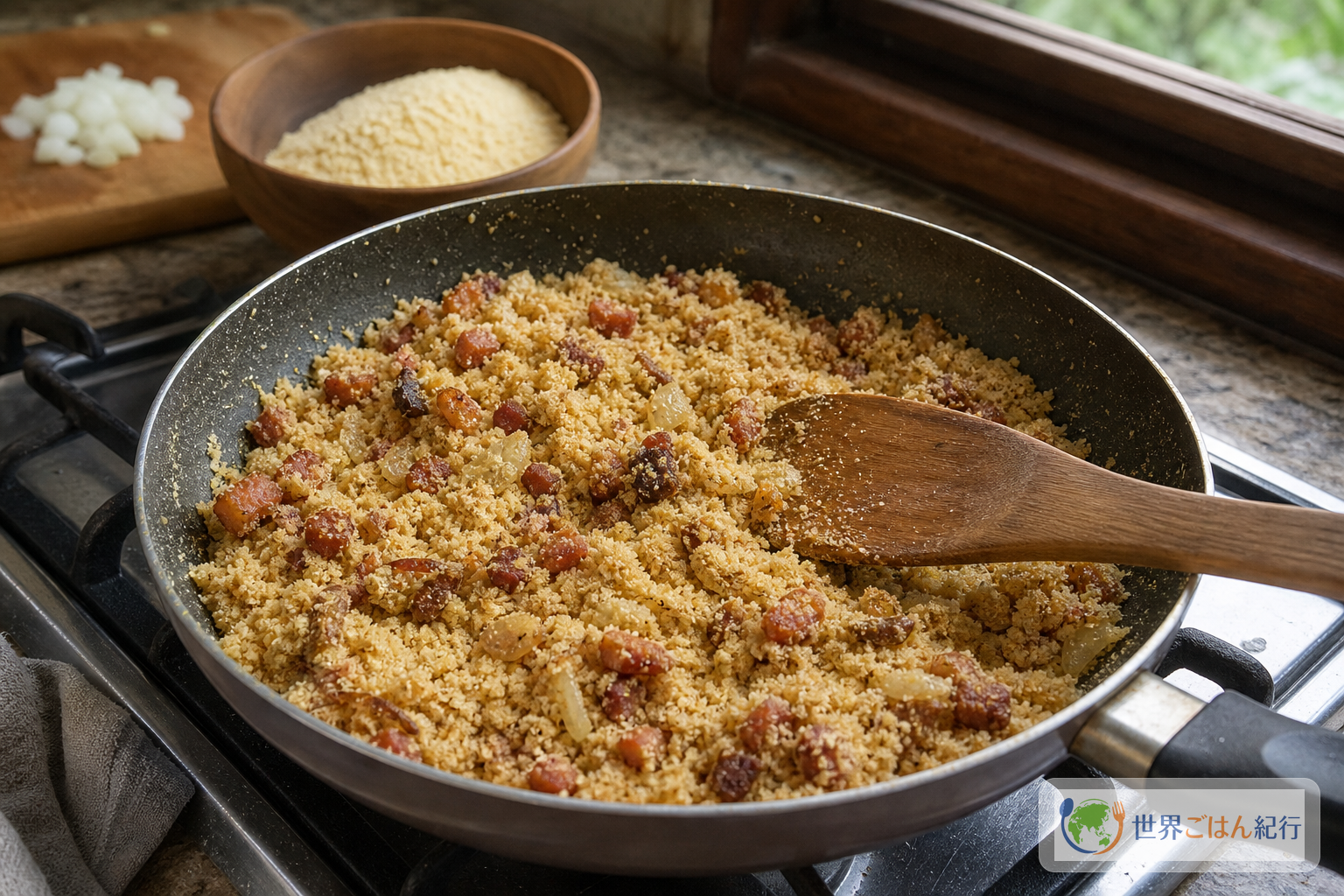
Cassava flour's grains soak up meat juices and add a light crunch to a plate of red meat. Put the bacon in a frying pan and cook over medium heat for 4–5 minutes. When the fat has rendered and the edges are crisp, add the butter, onion and garlic and cook for 2–3 minutes, until the edges of the onion turn translucent.
Add the cassava flour and stir over medium-low heat for 5–7 minutes. When the flour is no longer in damp clumps, falls back loose as you move the spatula, and the whole thing turns light golden, turn off the heat. It keeps coloring from the residual heat, so move it to a plate before it gets too dark.
Vinagrete
Dice the tomato, onion and bell pepper into even 0.25 inch (5 mm) pieces and mix with the vinegar, olive oil, salt and parsley. After 15 minutes the bite of the onion mellows a little, leaving an acidity that stands up to the fatty meat. If you use the board you cut the meat on, always wash it before cutting the vegetables.
How to eat it
Spoon hot farofa on one side of the plate, layer slices of picanha over it and add a little vinagrete. Eat the first slice with just the salt and the aroma of the fat, the next with a little flour on top, and the last with the acidity added; you'll quickly learn which sides you really needed. Smothering everything in sauce hides the grilled fat, so don't mix it all together from the start.
Leftovers
Wrap leftover meat airtight in thick pieces, cool it quickly and refrigerate. Cooked leftovers keep 3–4 days in the refrigerator and 3–4 months in the freezer. Don't keep anything that has sat at room temperature for a long time, and reheat portions until hot all the way through; see the leftovers food safety guide for details.
Meat with congealed fat turns tough if reheated over high heat for a long time, so warm it gently and give only the surface a quick sear at the end. The next day, tuck thin slices into bread with a little vinagrete for lunch.
Frequently asked questions
What should I buy if I can't find picanha?
Look for a piece sold as sirloin cap, rump cap or coulotte that still has its fat layer. Picanha is the cap of rump, a fat-on cut suited to skewers and the grill. For a broader look at beef cuts, see the cut chart.
Are you supposed to eat all the fat?
No. The fat stays on for grilling, and each person can trim it off on their plate. If the fat is too thick, trim only the white layer and leave the meat alone. If there's a tough silvery membrane under the fat, remove just that, shallowly.
Can I use regular salt if I don't have coarse salt?
Yes, but not the same weight. Fine salt clings to the surface more readily, so start with about half the amount. After grilling, taste a cut slice, and if it needs more, add a little at a time just before eating. If you can, choose a large-grain sea salt and go back to the proper method of brushing off the excess grains before grilling.
Is it safe to eat if the center is pink?
Don't judge by color alone. Measure the internal temperature and meet the standard of reaching 63°C (145°F) followed by a 3-minute rest. If older adults, pregnant people, young children or anyone with a weakened immune system will be eating, also check with their doctor, and cook it more thoroughly.
Can I use breadcrumbs instead of cassava flour for farofa?
Yes. Dry breadcrumbs toasted with bacon and butter make a crunchy side that soaks up the meat juices, and they're fine on a day you don't want to hunt down unusual ingredients. You won't get the gritty texture of cassava flour or the flavor of manioc, though, so if you plan to make picanha again, cassava flour is worth buying.
More Brazilian dishes
- Churrasco (in Japanese) - when you want to add more cuts and expand to a full charcoal spread.
- Farofa (in Japanese) - when you want more ways to use cassava flour.
- Baião de dois (in Japanese) - when you want to turn the side into a one-plate dish of rice and beans.