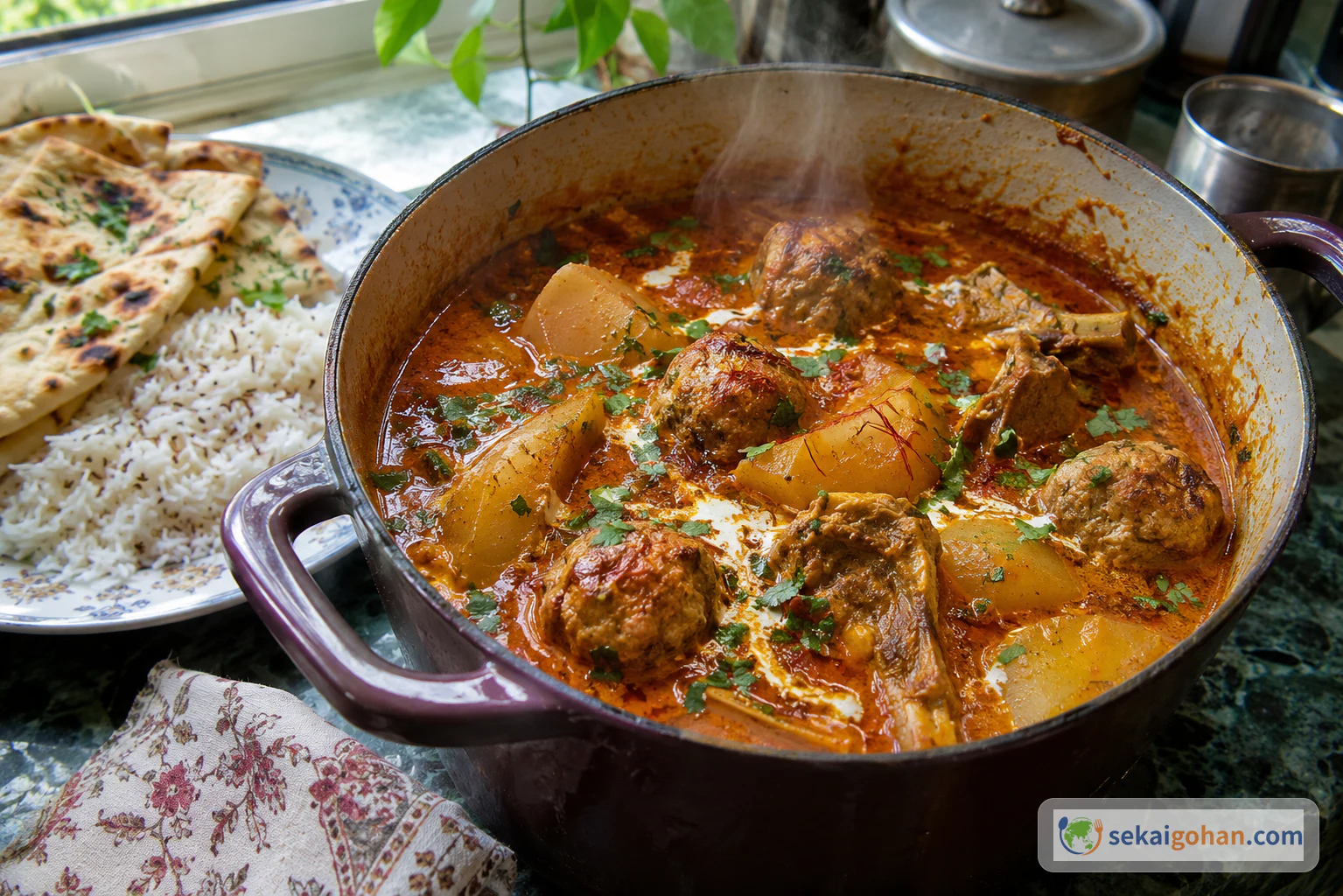
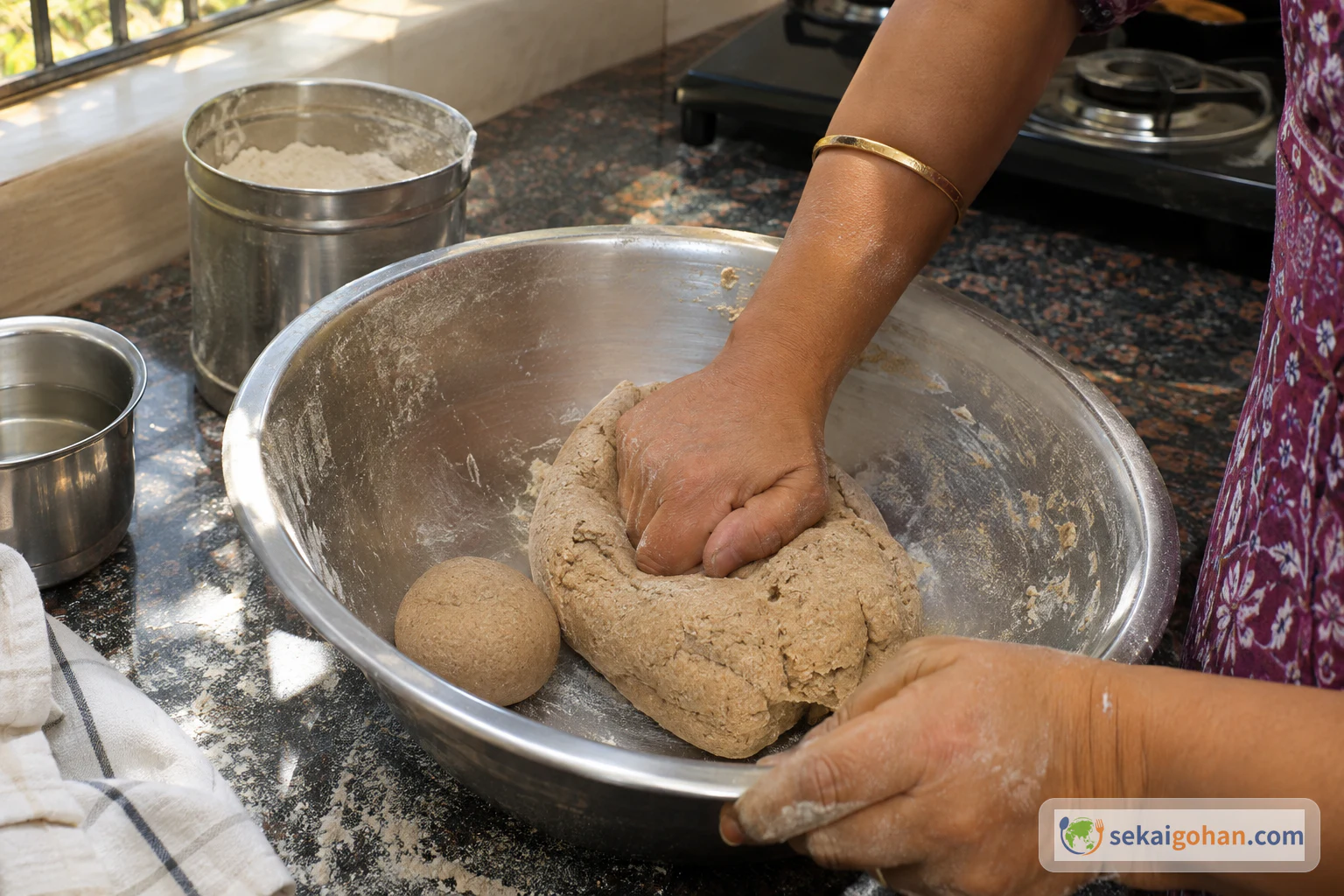
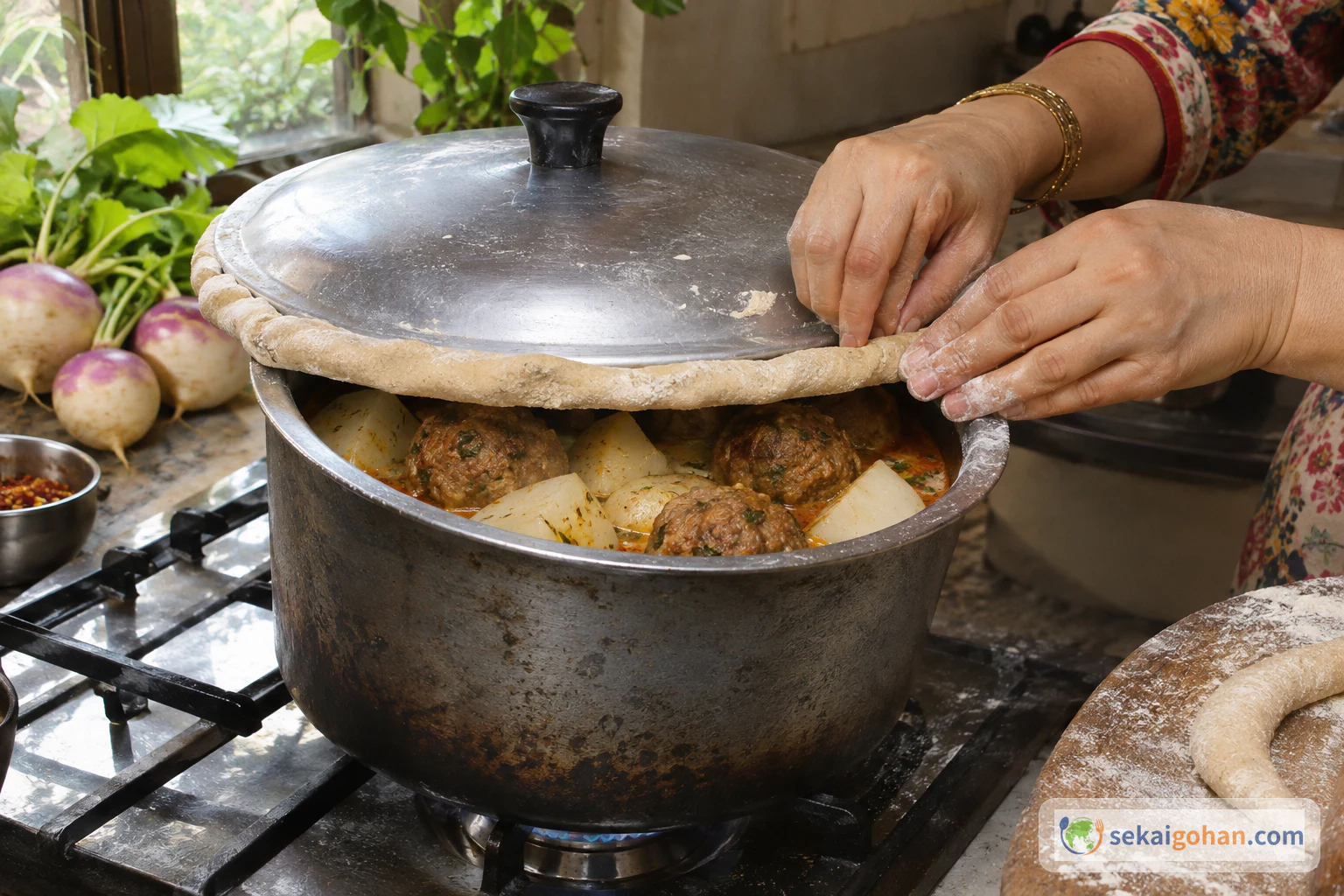
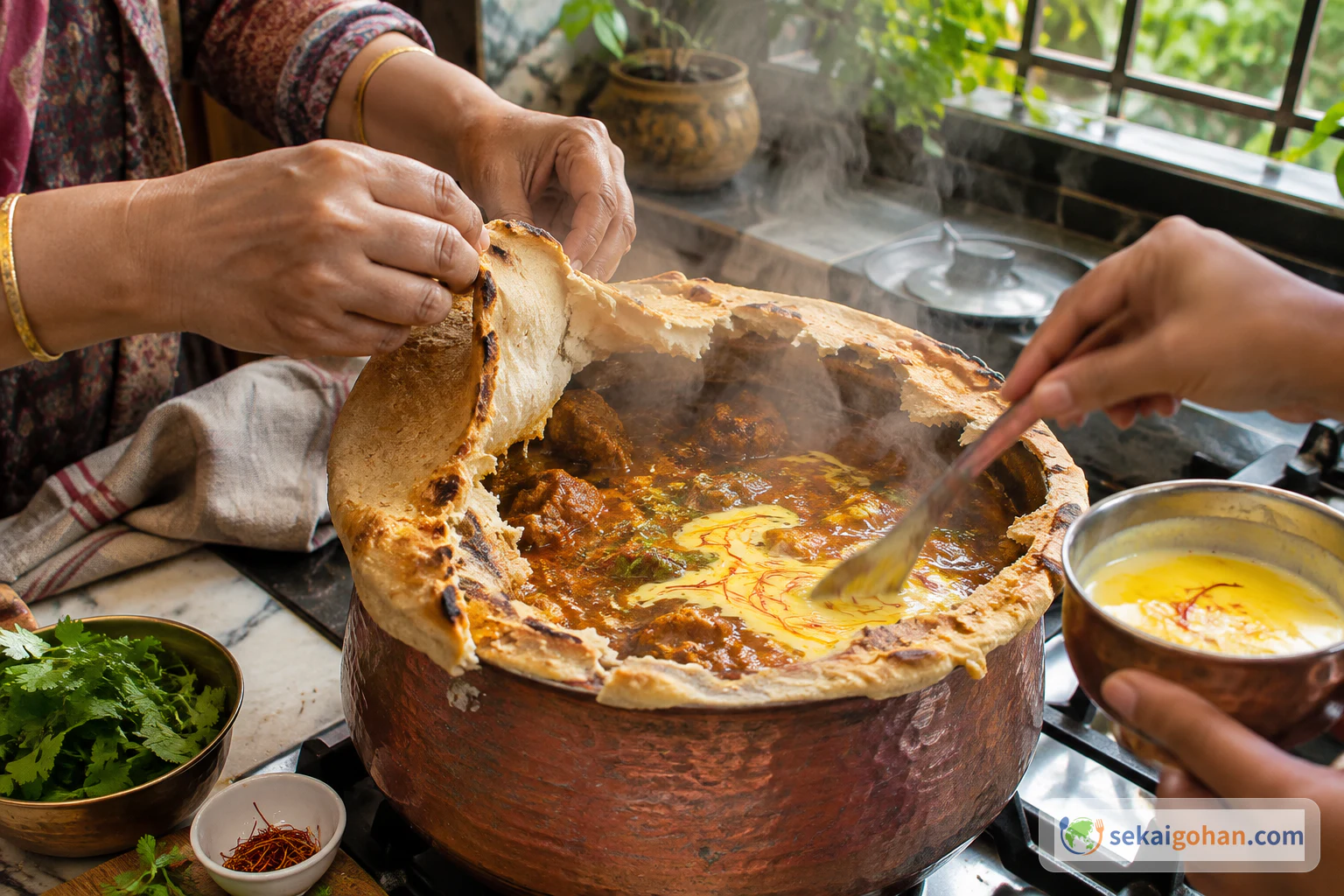
The lid has been shut behind a rope of baked dough for two hours. When you crack that crust, steam rushes out, and below it lie turnips gone soft and golden, mutton koftas, and a gravy that turns orange the moment the saffron milk goes in. Shab deg is a pot of mutton and turnips from the Kashmir Valley, slow-cooked in yogurt with cardamom, cloves, fennel and mild Kashmiri chilli. It tastes of sweet turnip, tangy yogurt and warm spice rather than heat, and the lamb comes out deep and gentle.
A pot meant for the night
The name says how it is cooked. Shab means night and deg means pot, both from Persian. In the old way, the deg, often a heavy copper vessel, was filled, sealed shut and left to cook slowly through the night, and the stew was eaten the next day. It is usually described as Mughlai in origin and belongs to the Kashmir Valley; how far back it goes is not settled.
Feast food for deep winter
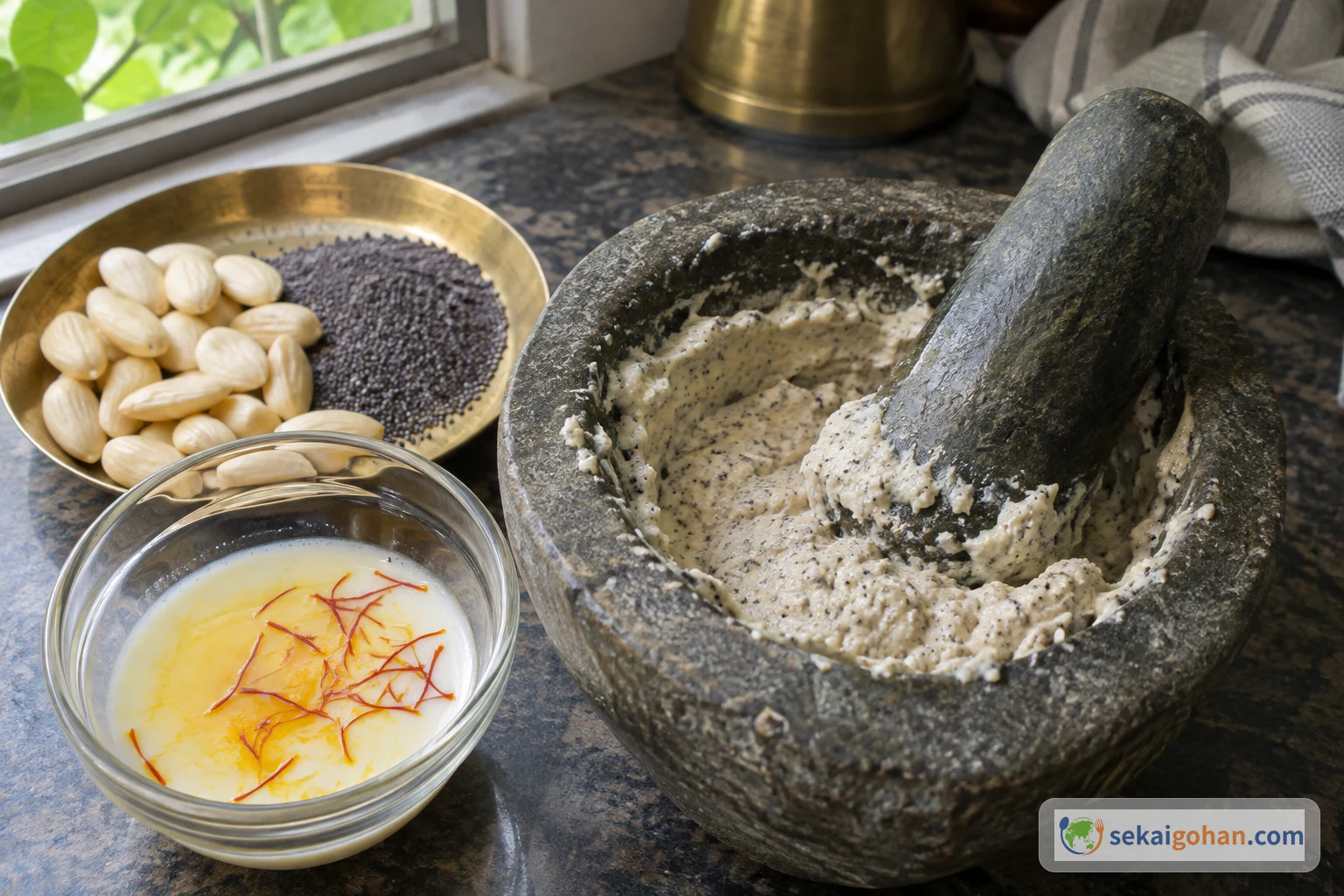
Shab deg was never weeknight cooking. It is a celebration dish, costly and labour-heavy, made once in the deep of winter when people gathered around one great pot. Meat, saffron, almonds and a whole night of slow heat all went into it. The almond and poppy seed pastes and the saffron soaked in milk were prepared ahead, so the pot itself could be filled in one go and left alone.
That same labour is why it has grown rare. Everyday Kashmiri cooking has drifted away from a dish that ties up a pot and a cook for so long, and today it is rarely made and turns up mostly in home kitchens. The version here keeps the sealed pot but fits the cooking into one afternoon: an hour of covered simmering for the mutton, then two hours sealed over the lowest flame once the turnips and koftas go in.
How it differs from its neighbours
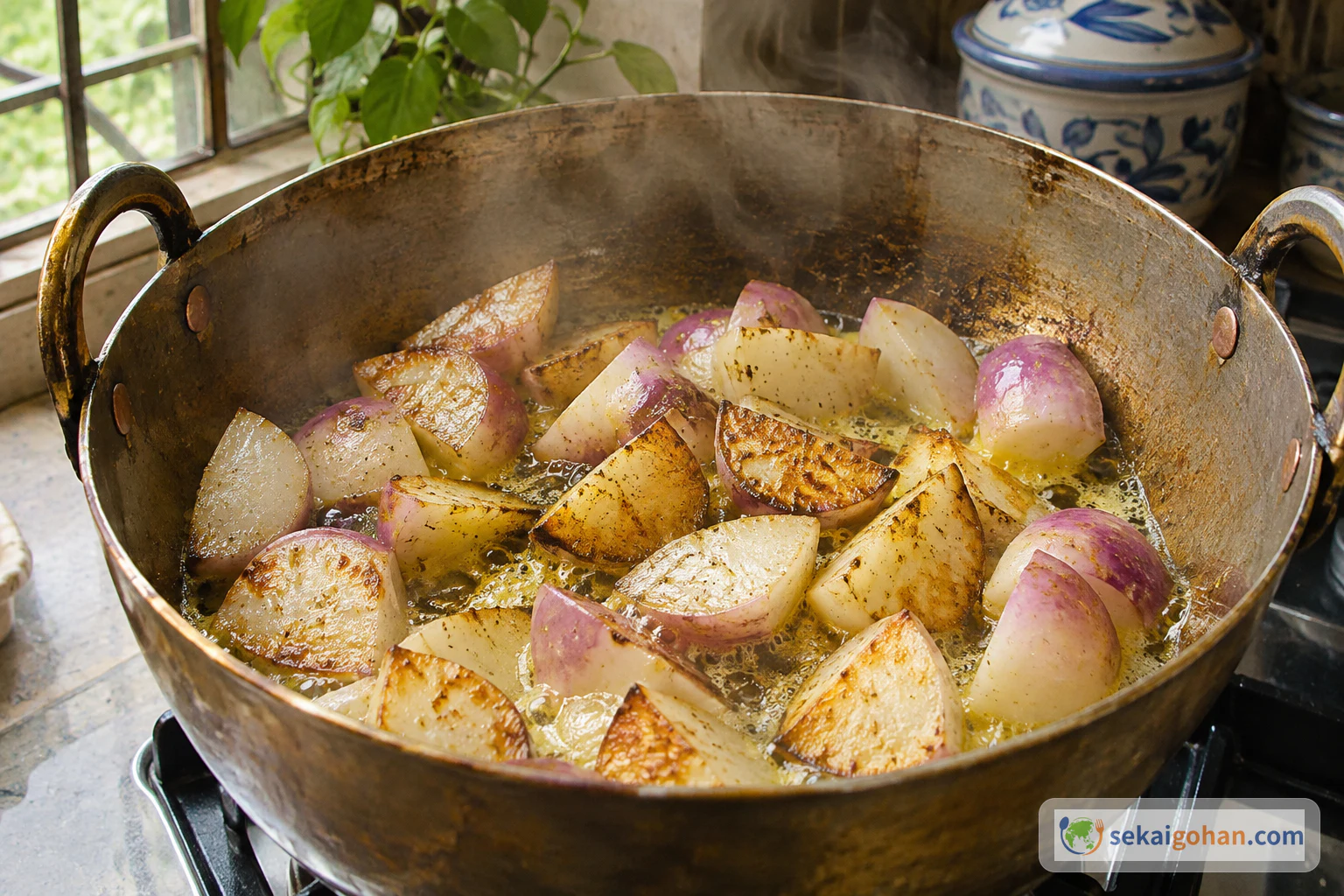
Shab deg also comes in two broad shapes. One builds the stew on koftas and pieces of mutton with turnips in a spiced yogurt gravy, the one cooked below. The other starts from a yakhni, a meat broth, finished with cream and almond paste and simmered far longer. Next to rogan josh, with its red, oil-bright gravy, shab deg is paler and milder, its sweetness coming from turnip and saffron. And where Kashmiri dum aloo puts potatoes at the centre, here the vegetable is the turnip, browned first so it holds through hours of heat.
Across Kashmiri cooking, Pandit households generally reach for asafoetida (hing), while Muslim households cook with onion and garlic. The fried onions and ginger-garlic paste in this pot sit on the onion-and-garlic side.
Ingredients (serves 4)
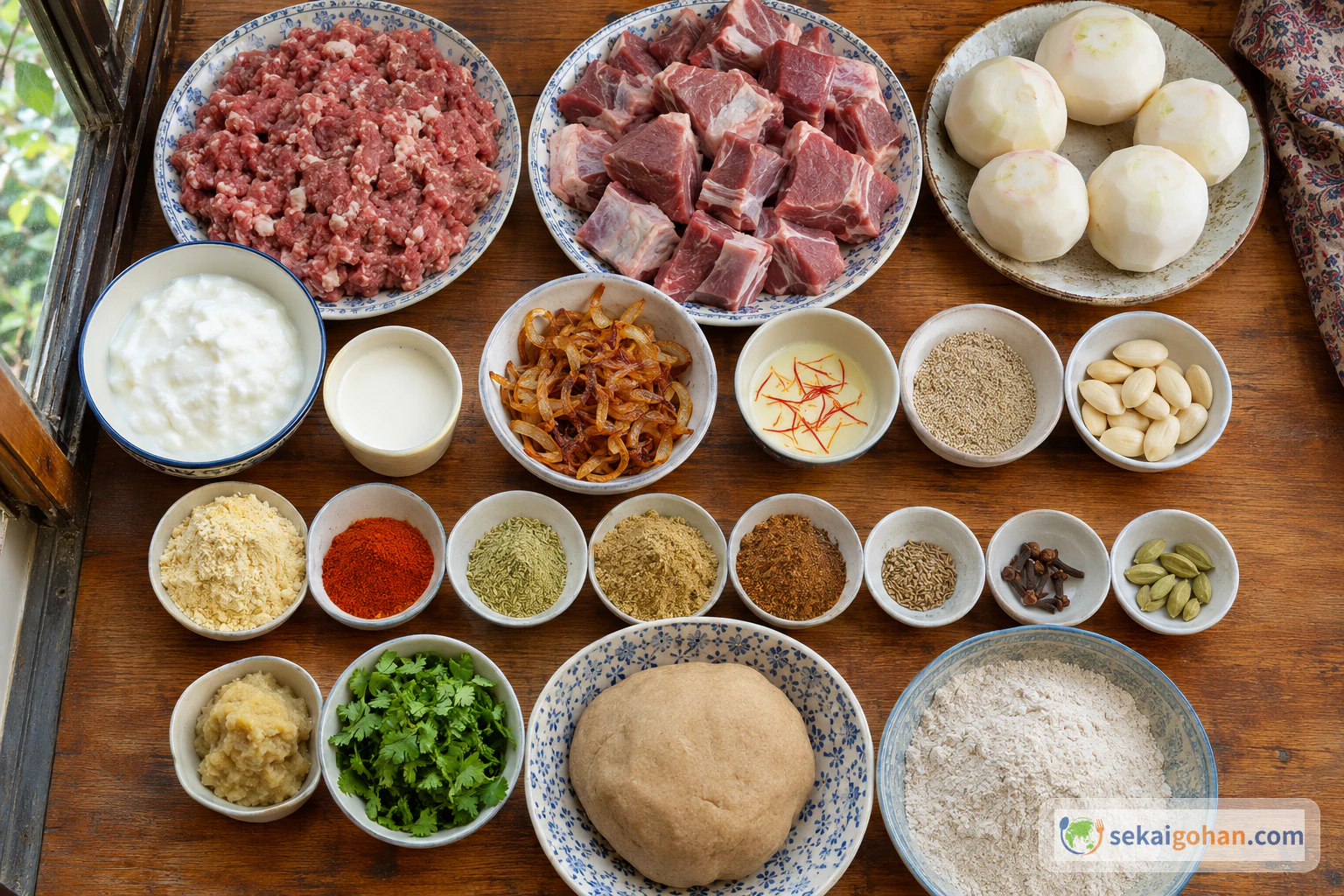
This dish contains milk (yogurt, cream, milk, ghee), tree nuts (almonds), wheat (in the sealing dough), poppy seeds and chickpea flour (besan). Check spice blends and ready-made fried onions for added ingredients.
Equipment
- A heavy-bottomed pot (deg) with a tight-fitting lid
- A mortar and pestle or small grinder
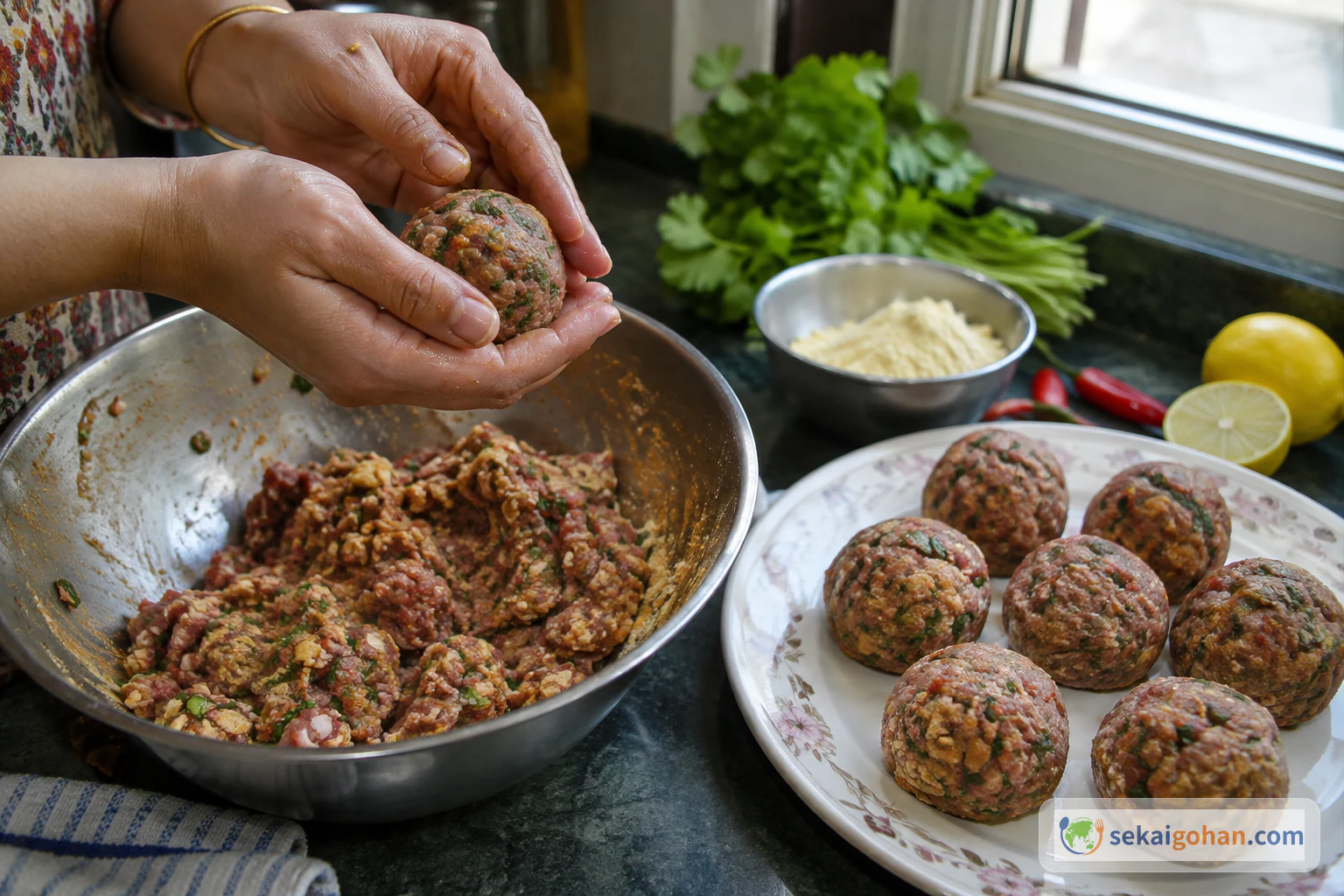
- Mixing bowls for the dough and the koftas
- A small bowl for the saffron milk
- A cutting board and knife
- A slotted spoon
Choosing and substituting
The two things that make this pot taste of Kashmir are mild Kashmiri chilli and real saffron. Kashmiri red chilli powder gives the gravy its red-gold colour with very little heat, and it is worth buying from an Indian grocer or online along with besan, ajwain, saffron and ghee. If you cannot find it, a mild chilli powder leaning towards paprika keeps the colour, though the warmth changes.
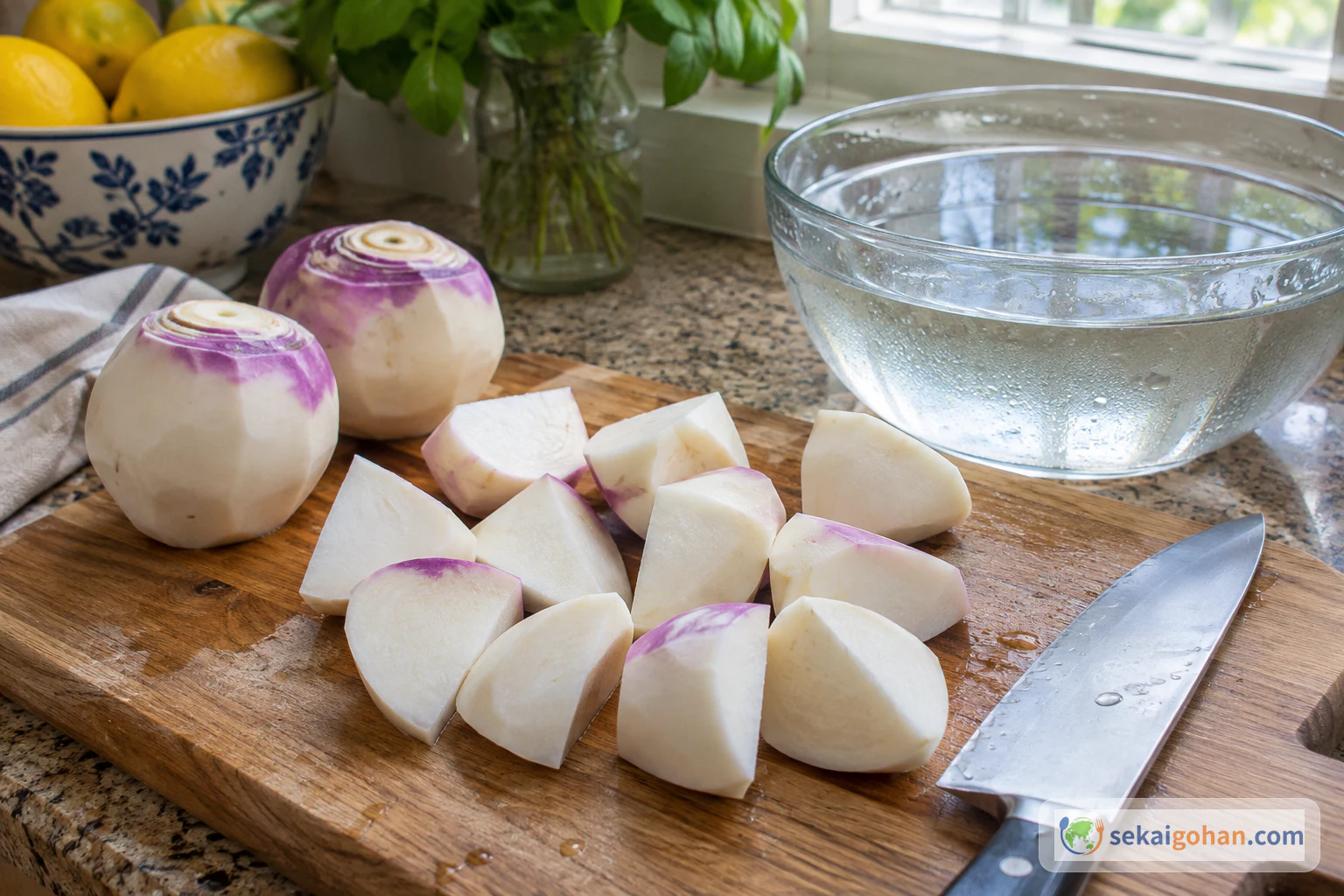
Mutton is hard to find in many places. Lamb mince for the koftas and lamb for the gravy work well; lamb is milder than mutton, so the browning and spicing carry a little less weight. For the turnips, small turnips or larger ones both work. Cut larger turnips into more pieces so every piece is about the same size as the others.
Besan is chickpea flour, toasted dry in a pan before it goes into the koftas. Cornstarch and other starches are no stand-in, because the toasted flour brings a nutty flavour as well as binding. Ginger-garlic paste can be replaced with equal amounts of grated ginger and grated garlic. If poppy seeds are hard to get, leave them out; the gravy will be a little thinner and less rich.
Toast the besan in a dry pan, stirring, until it smells nutty, and let it cool before mixing it into the meat. Raw gram flour tastes raw in the finished koftas.
Method
All the preparation comes first: the sealing dough, the pastes, the saffron milk, the turnips and the koftas. Then the cooking runs in two stages in one pot. The mutton simmers covered for an hour, and after the turnips and koftas go in, the sealed pot cooks on its own for two more hours. That second stretch is hands-off.
Saffron soaked in milk in the refrigerator gives a deeper colour. Stirred in at the very end, it keeps its perfume instead of cooking away in the long simmer.
When it goes wrong
| What you see | Why | What to do |
|---|---|---|
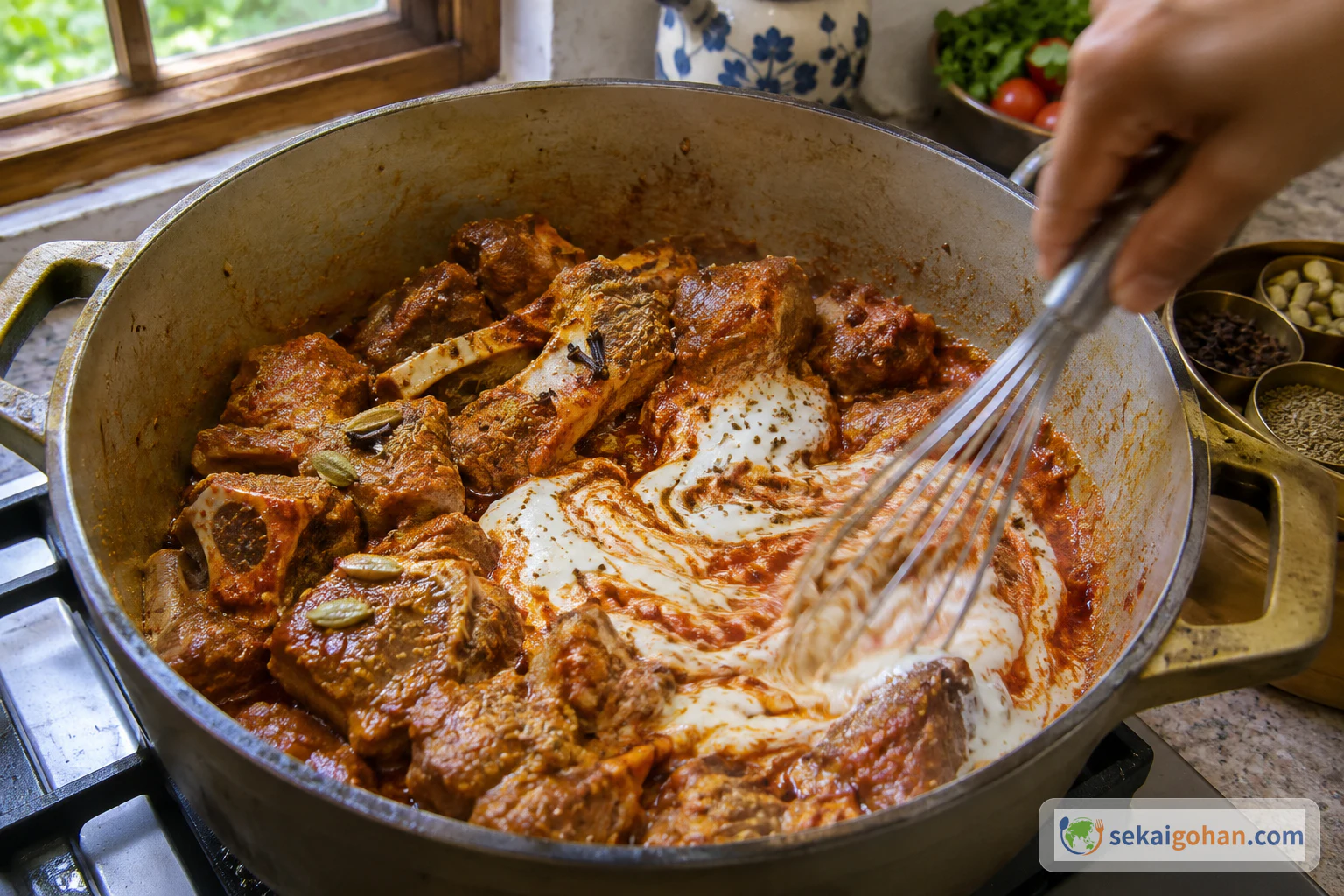
| The yogurt has split into white curds | It went in unwhisked or sat without stirring | Whisk the yogurt smooth first and stir constantly as it goes in; keep stirring over low heat until the sauce comes back together |
| The bottom catches and smells scorched | Too little water or a flame that is too high for the sealed stage | Add warm water a little at a time before sealing and use the lowest flame; a heavy pot spreads the heat |
| The koftas crumble in the gravy | A wet mix or stirring after they go in | Keep the gram flour in the mix to bind it, roll the balls firm and slide them in without stirring |
| The turnips have fallen apart | They went in without browning | Fry every side golden before the long cook so the surface holds |
| The gravy tastes flat | Salt not adjusted before sealing | Taste and correct salt when the turnips and koftas go in; after opening, adjust again |
| A pale, dull finish | Saffron soaked only briefly or warm | Soak the saffron in milk in the refrigerator during preparation and stir it in at the end |
Serving, variations and storage
On the table
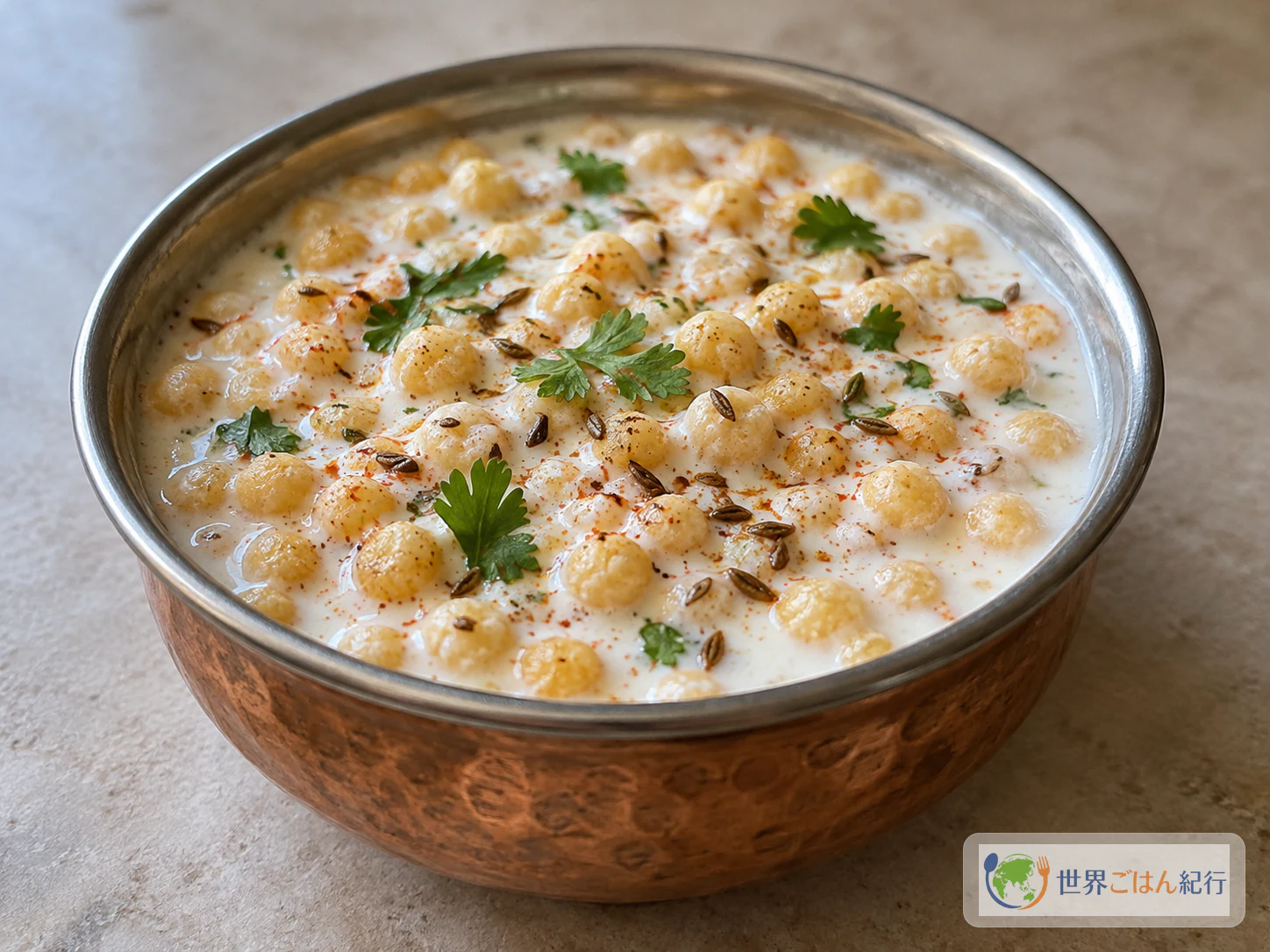
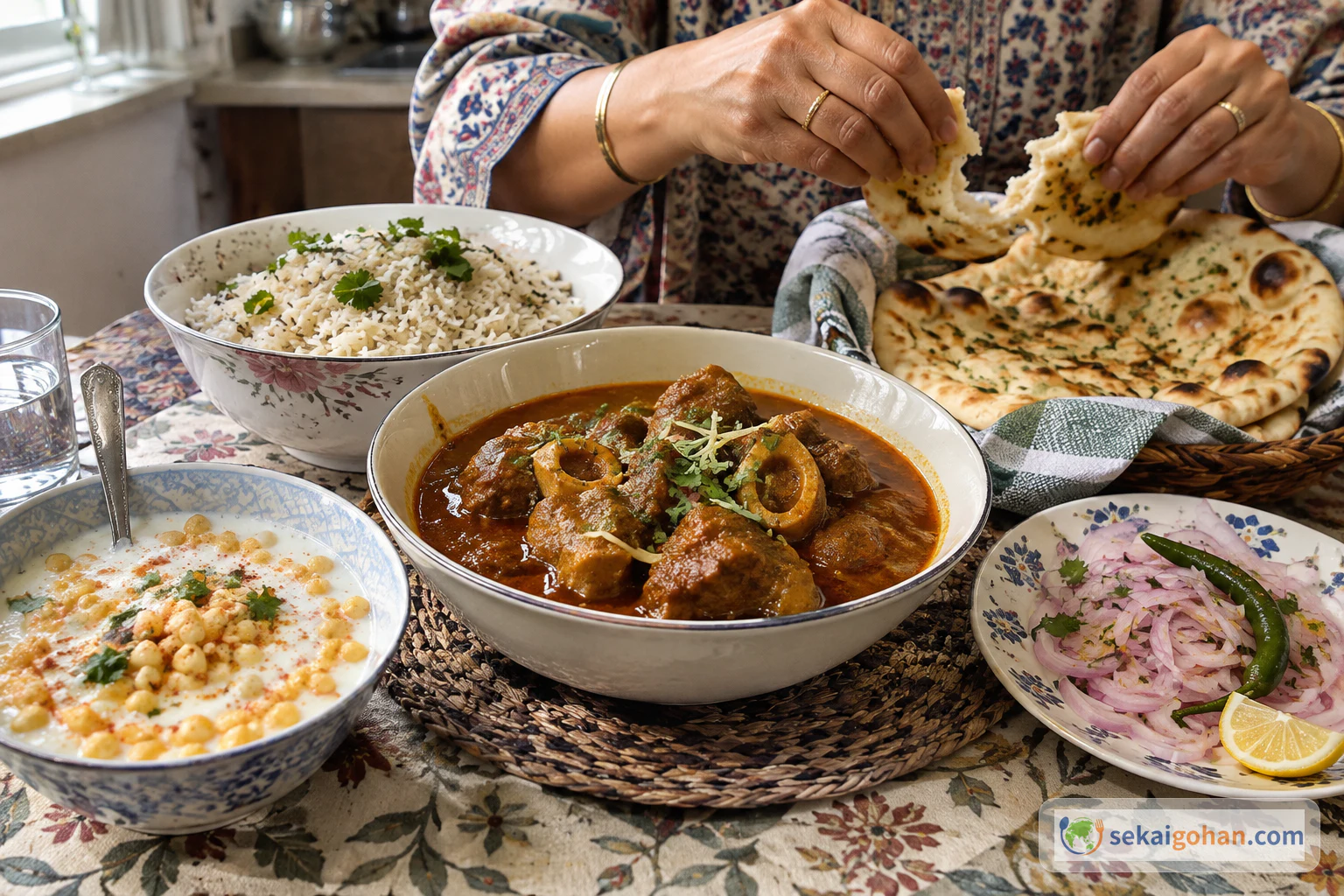
Bring the pot to the table and serve shab deg with jeera rice or naan, a bowl of boondi raita and a plate of sliced onion salad. The rice soaks up the saffron gravy; the raita and the sharp raw onion cut through the richness of the cream and ghee. It is a dish for a gathering, cooked in one large pot and shared. For more of the country's cooking, browse dishes from India.
Variations
- The yakhni version. Build the stew on a meat broth instead of the yogurt gravy and finish it with cream, almond paste and kewra, simmering for much longer. The result is paler, silkier and more perfumed, with the turnips cooked almost to melting.
- Kasuri methi finish. Scatter dried fenugreek leaves instead of fresh coriander at the end. The finish turns faintly bitter and savoury, a good contrast to the sweet turnip.
Storage and reheating
Shab deg was traditionally eaten the day after it was cooked, so it keeps its character as leftovers. Let what remains cool, then put it in a covered container and refrigerate it promptly. Reheat it until it is steaming hot all the way through, koftas included, adding a splash of water if the gravy has thickened.
Frequently asked questions
Do I have to cook it overnight?
The overnight cook belongs to the traditional pot over slow embers. At a home stove, an hour of covered simmering followed by two hours sealed over the lowest flame gives you tender mutton, soft turnips and koftas cooked through. Keep the seal and the gentle heat and the pot does the slow work in an afternoon.
Is ajwain the same as caraway?
They are different seeds. Ajwain has a sharp, thyme-like bite, while caraway is sweeter and anise-like. Use ajwain in the tempering for the right aroma.
Is shab deg spicy?
It is mild. Kashmiri chilli is chosen for its colour more than its heat, and the yogurt, cream and turnips soften the spice further. What you taste first is cardamom, cloves, fennel and saffron.