Mala Hot Pot: Sichuan Beef Tallow Broth in a Divided Pot

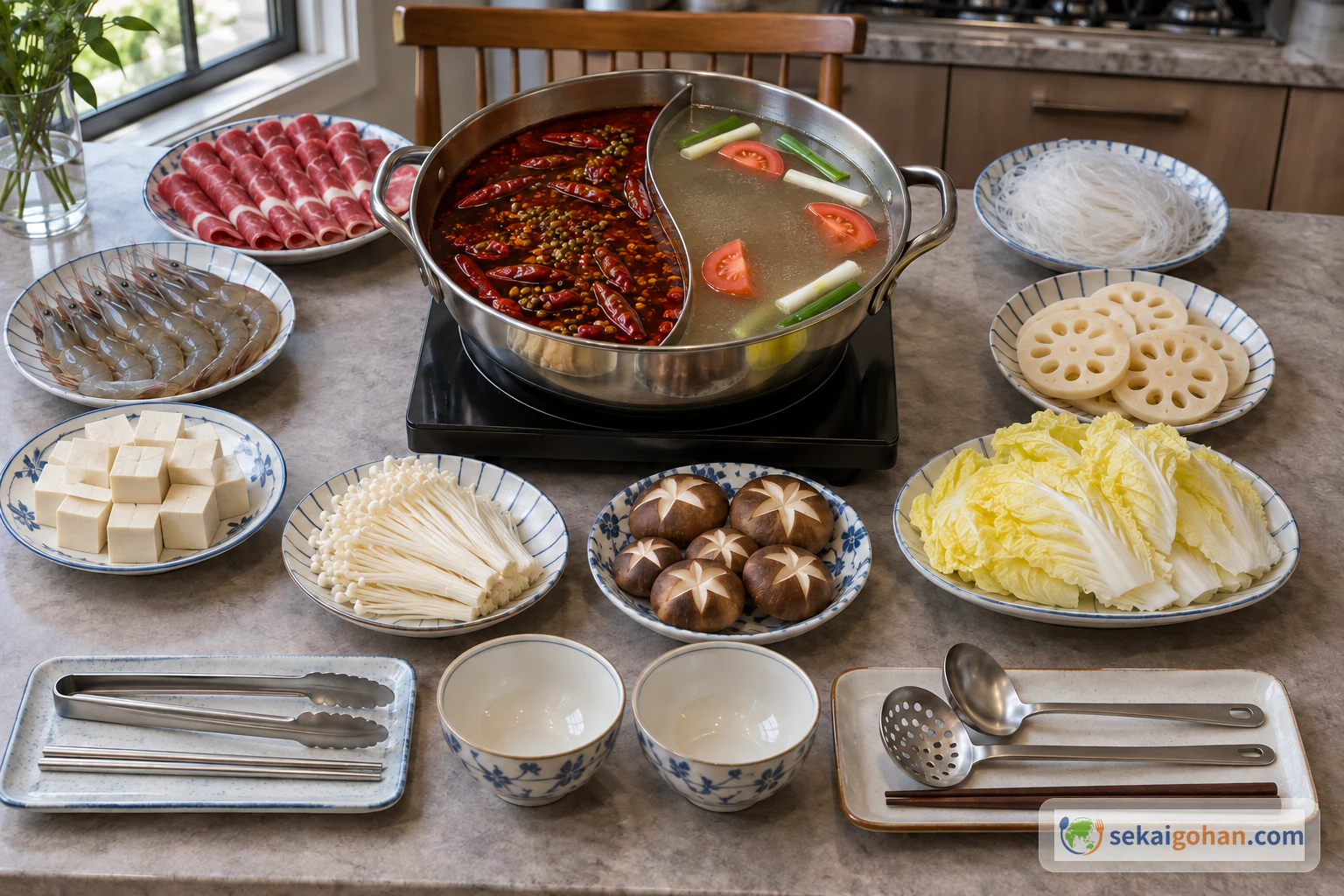
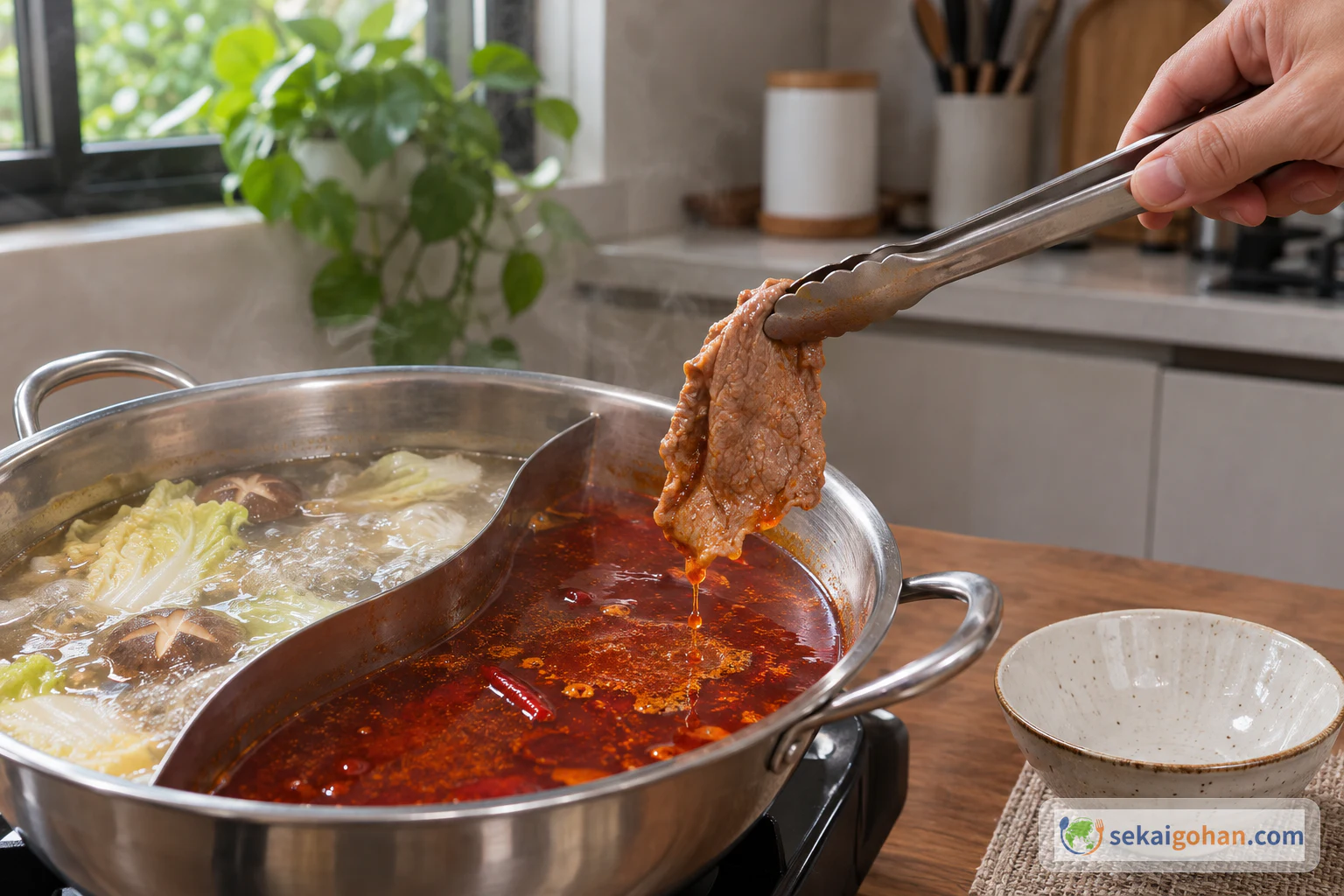
A divided hot pot on a home table, one side a deep red mala broth and the other a clear mild broth, both simmering
Level
Intermediate
Cuisine
Chinese (Sichuan and Chongqing)

Mala hot pot from Sichuan and Chongqing, made from scratch with beef tallow, peppercorn and chili. How to build the broth, split the pot and eat safely.

Cooking flow

Cooking steps

STEP 1 1 / 10

Soften and chop the chilies

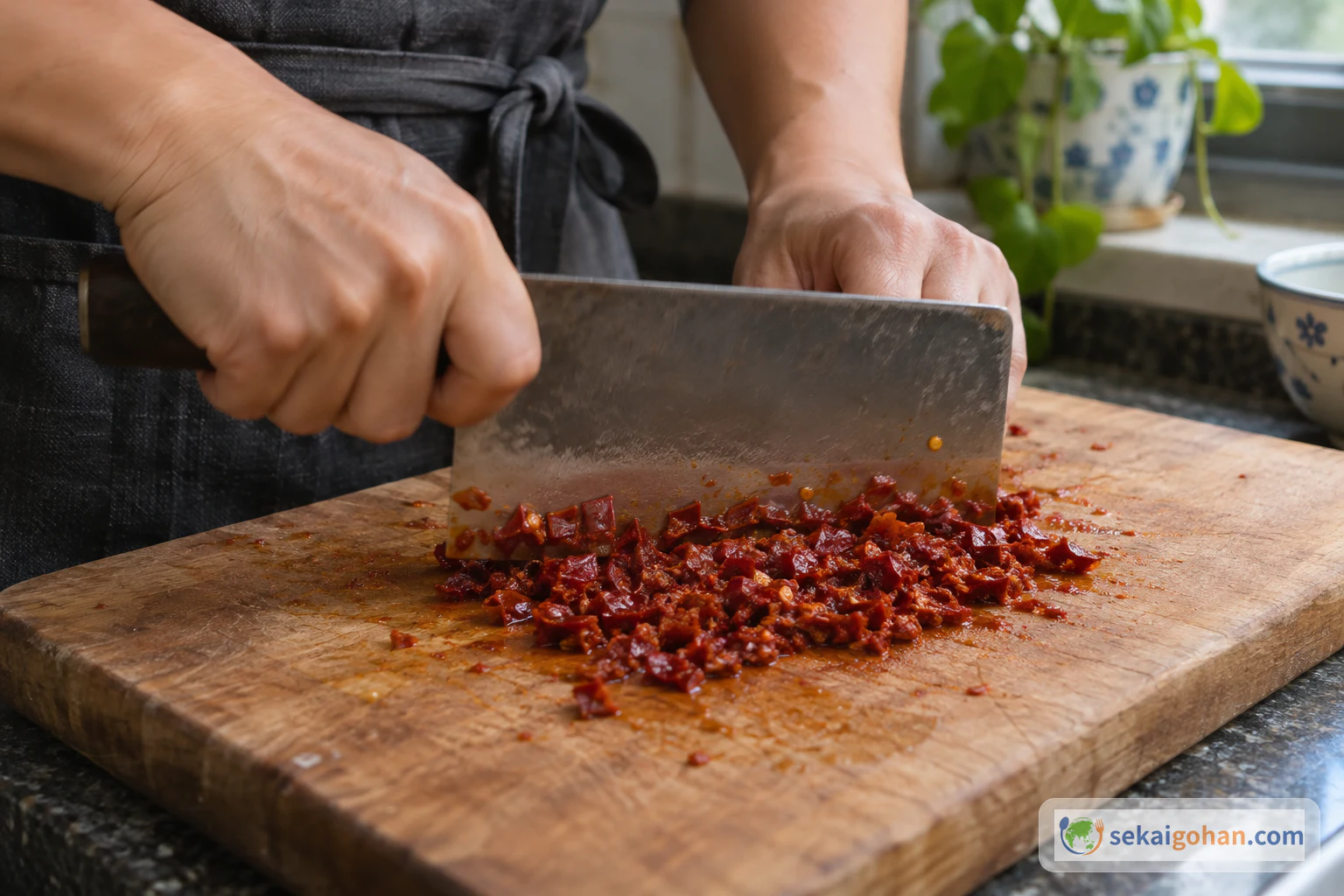
Softened dried chilies being chopped into a paste
Once the chilies are fully softened, the stems pull away cleanly

Put the dried chilies in a small pot, cover them with water and boil for 5 minutes. Turn off the heat and leave them in the water for at least 30 minutes. Lift them out, pull off the stems, and chop the chilies on a board until they come together. They are ready when every pod is soft and pliable and the knife turns them into a coarse, damp red paste.

Let the chilies drink first

Chop the chilies only after they have soaked up water. Soaked chilies blend into the oil and broth later.

STEP 2 2 / 10

Grind and soak the spices

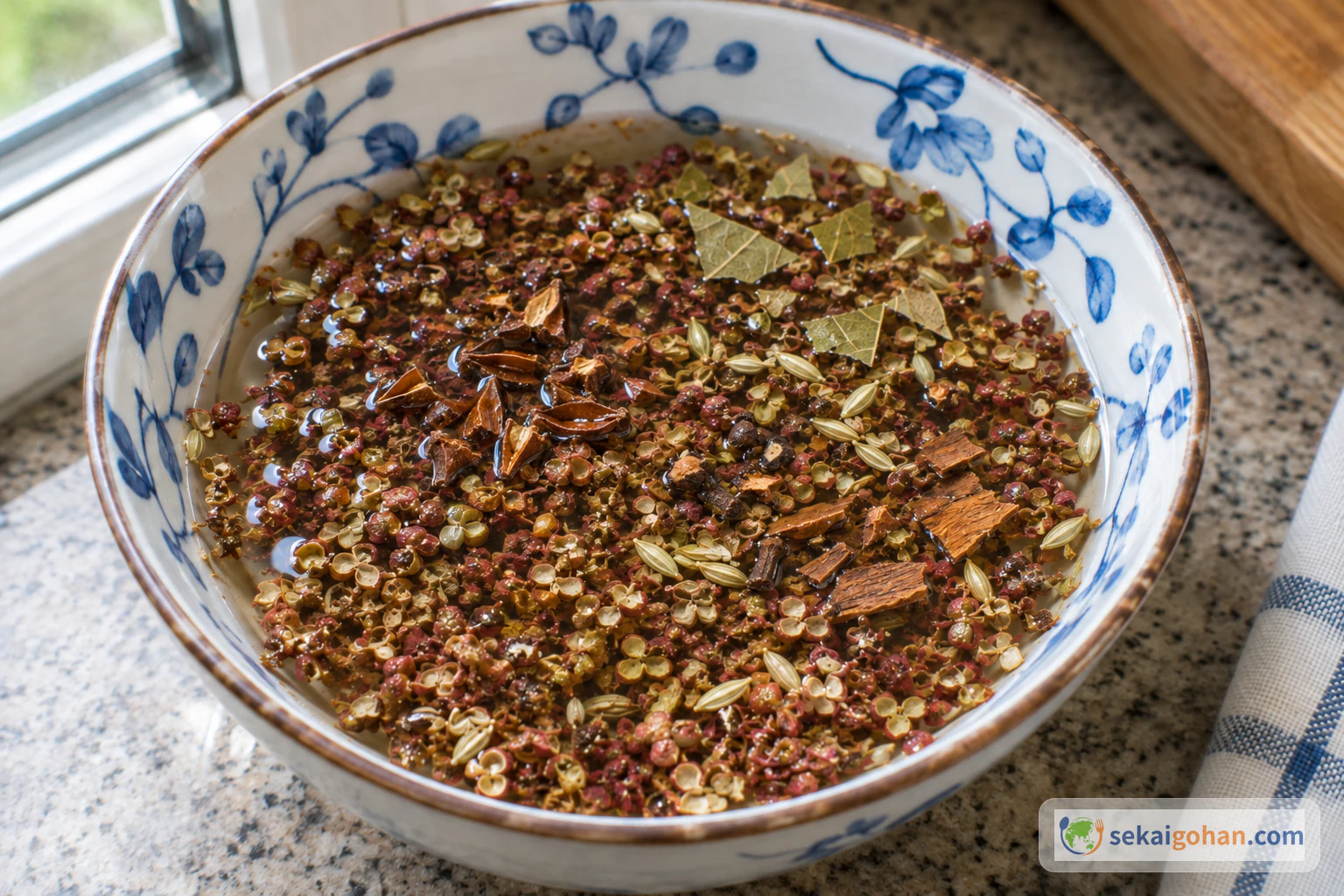
Coarsely ground peppercorns and spices soaking in water
Grind coarsely, so you can still see bits of star anise and cassia

Coarsely grind the red and green Sichuan peppercorns (2 tbsp of each) with the handful of whole spices. Put them in a small bowl and pour in enough water to cover. Leave them for about 15 minutes while the chilies finish soaking. Keep the water, because it all goes into the broth. The spices are ready when they are broken into rough pieces, still far from a fine powder, and fully wet.

STEP 3 3 / 10

Flavour the oil and melt the tallow

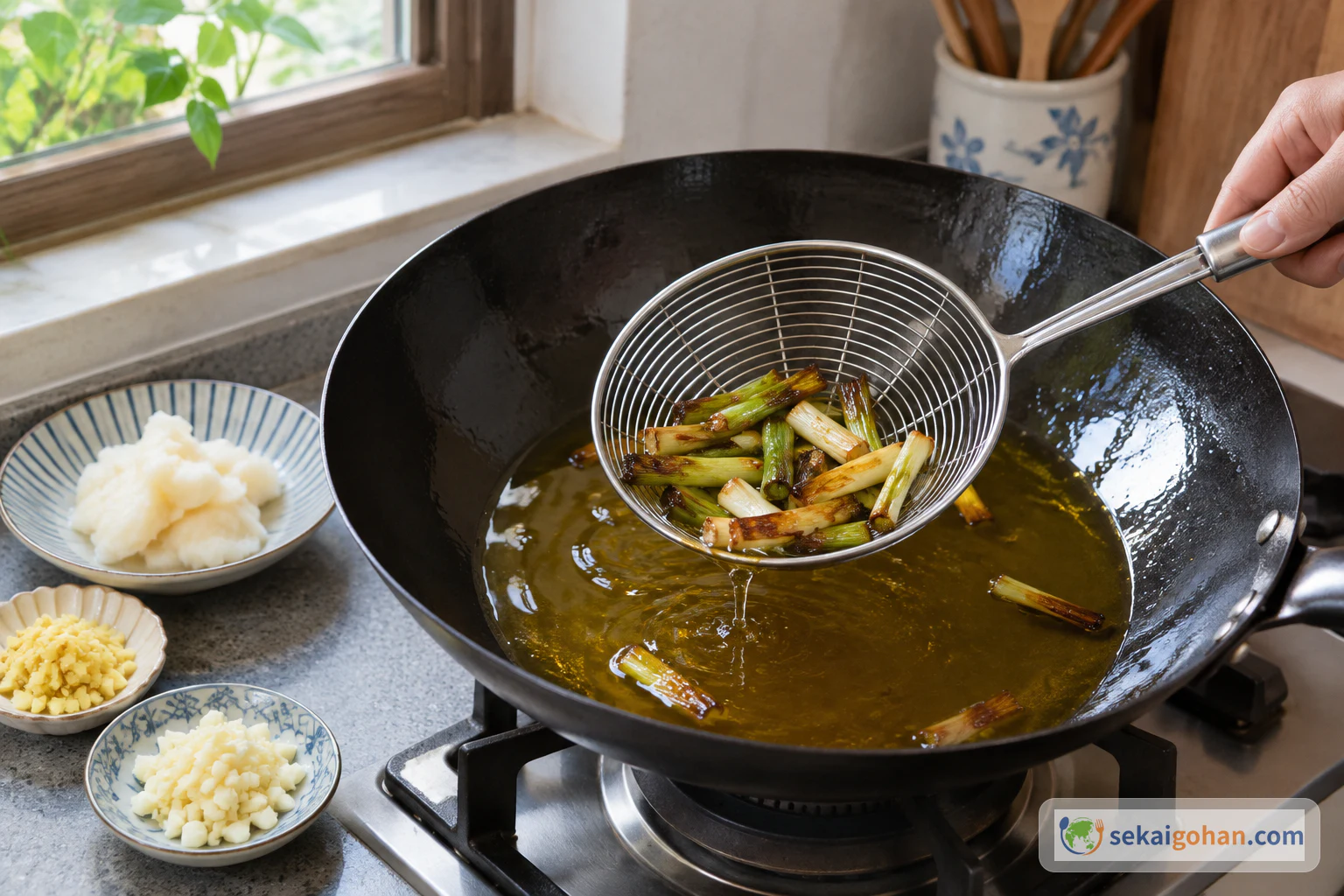
Browned scallions lifted out of hot oil as tallow melts with ginger and garlic
Gentle bubbles and no smoke: that is the heat you want once the tallow goes in

Heat the rapeseed oil in a wok over medium heat. Fry the scallion halves until they are browned, then lift them out. Add the tallow, ginger and garlic, and stir as the tallow melts. Cook them for their fragrance and keep them from colouring. The oil is ready when the tallow has melted clear, the garlic is still pale, and the wok smells sweet and savoury.

Hot oil

Wipe your hands completely dry before working at the wok, and keep water away from the hot oil. Add the wet chili paste in the next step carefully, at arm's length.

STEP 4 4 / 10

Fry the pastes and add the stock

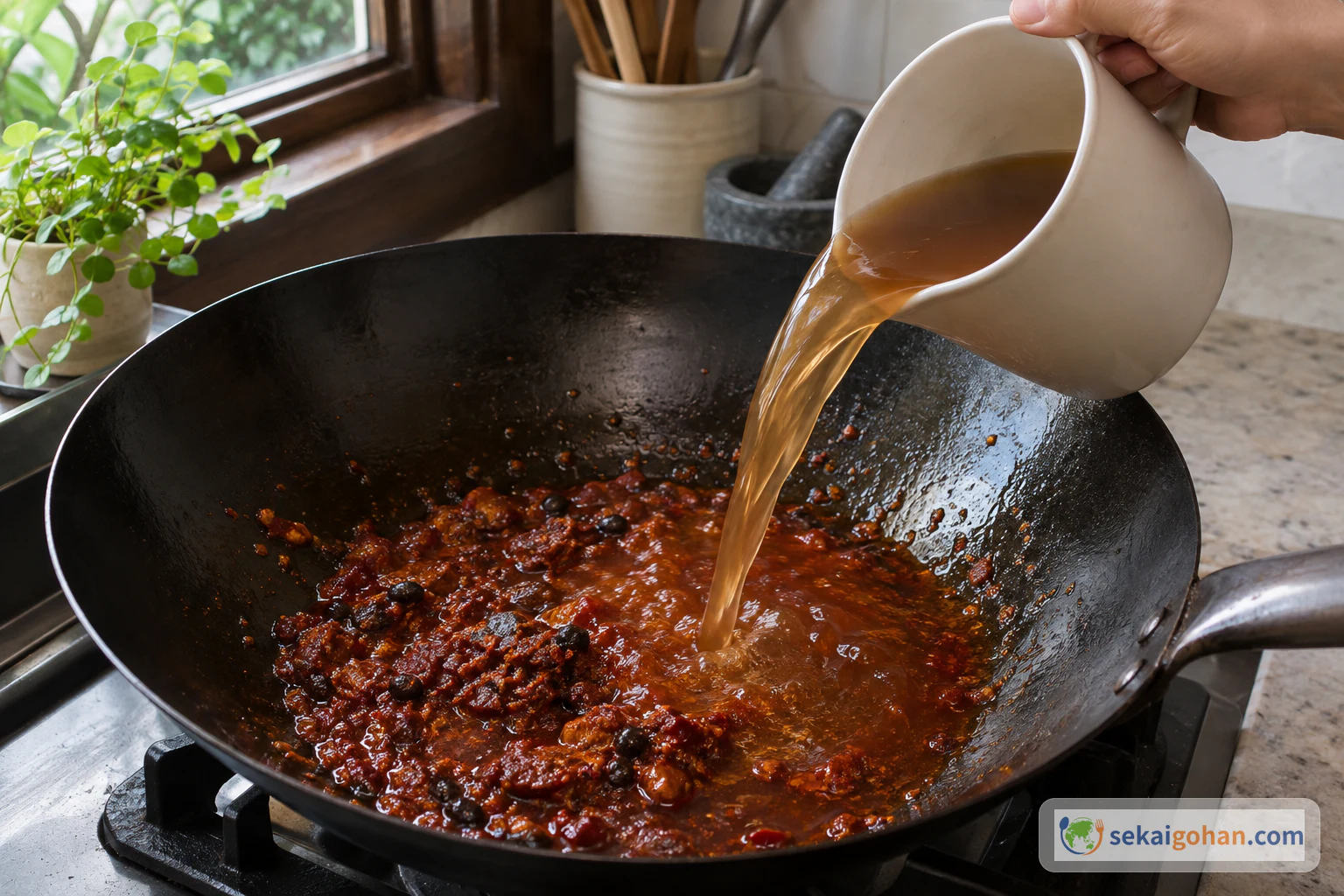
Bean paste, douchi and chili paste frying in red oil as stock is poured in
Pour the stock in once the oil has gone deep red

Add the chili paste, mashed doubanjiang, mashed douchi and ground chilies to the oil. Stir-fry for a few minutes, scraping the bottom so nothing catches. When the oil turns a deep red and smells strongly of chili and fermented bean, pour in the 2 quarts (1.9 L) of stock. Bring it to a boil. The broth is ready for the next step when it is rolling and the red oil has risen to the surface.

STEP 5 5 / 10

Simmer with the spices, then rest

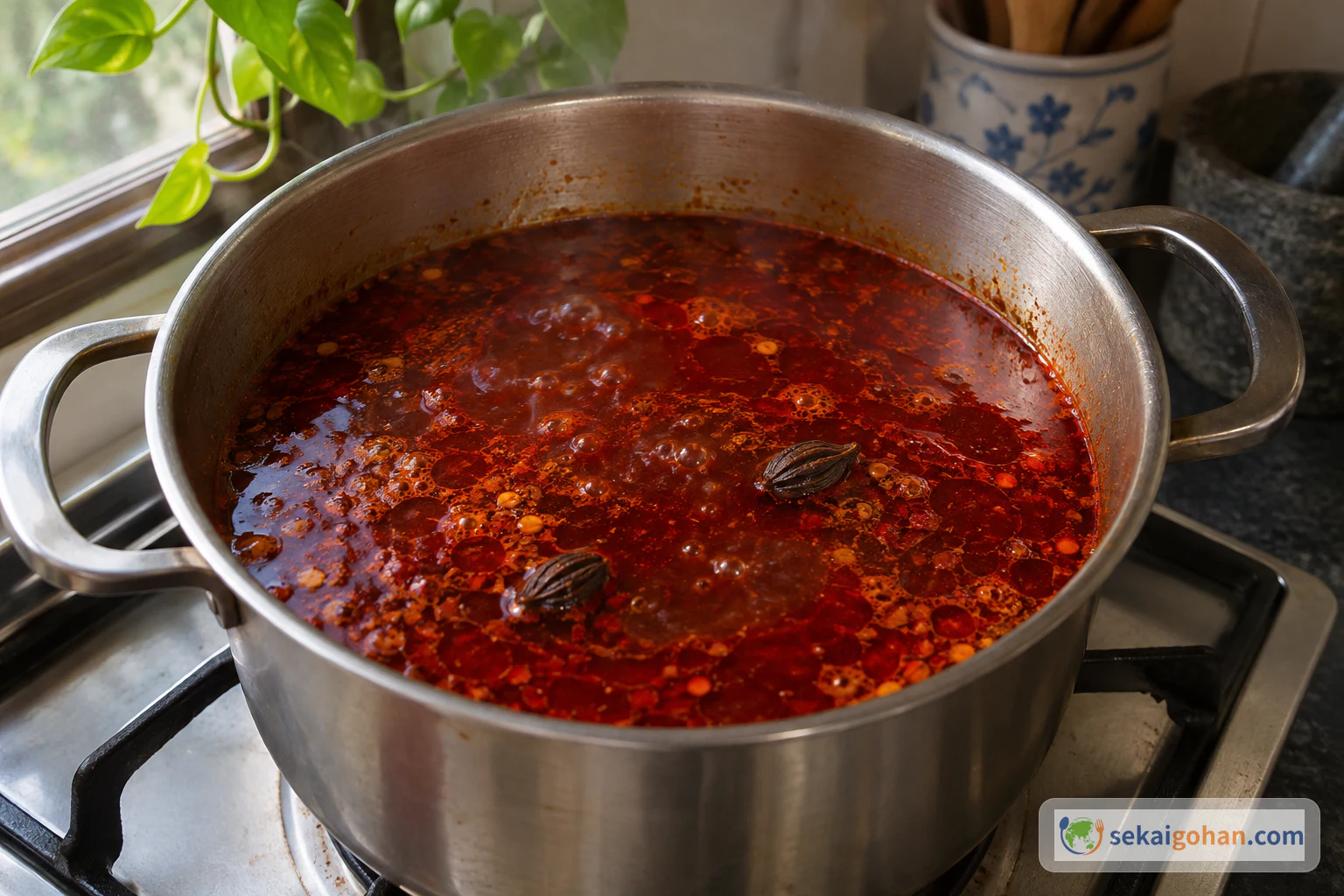
Deep red broth at a low simmer with spices and black cardamom
Keep it at a lazy bubble, with the surface barely moving under the oil

Add the soaked spices with their water, the ½ cup (120 ml) of Shaoxing wine, the black cardamom, sugar and MSG or mushroom powder. Lower the heat until the broth barely bubbles, and simmer for 10 minutes. Turn off the heat and let it stand for at least 30 minutes. It is ready when a thick layer of red oil covers the surface and the kitchen smells of peppercorn and spice.

STEP 6 6 / 10

Slice and plate the dippers

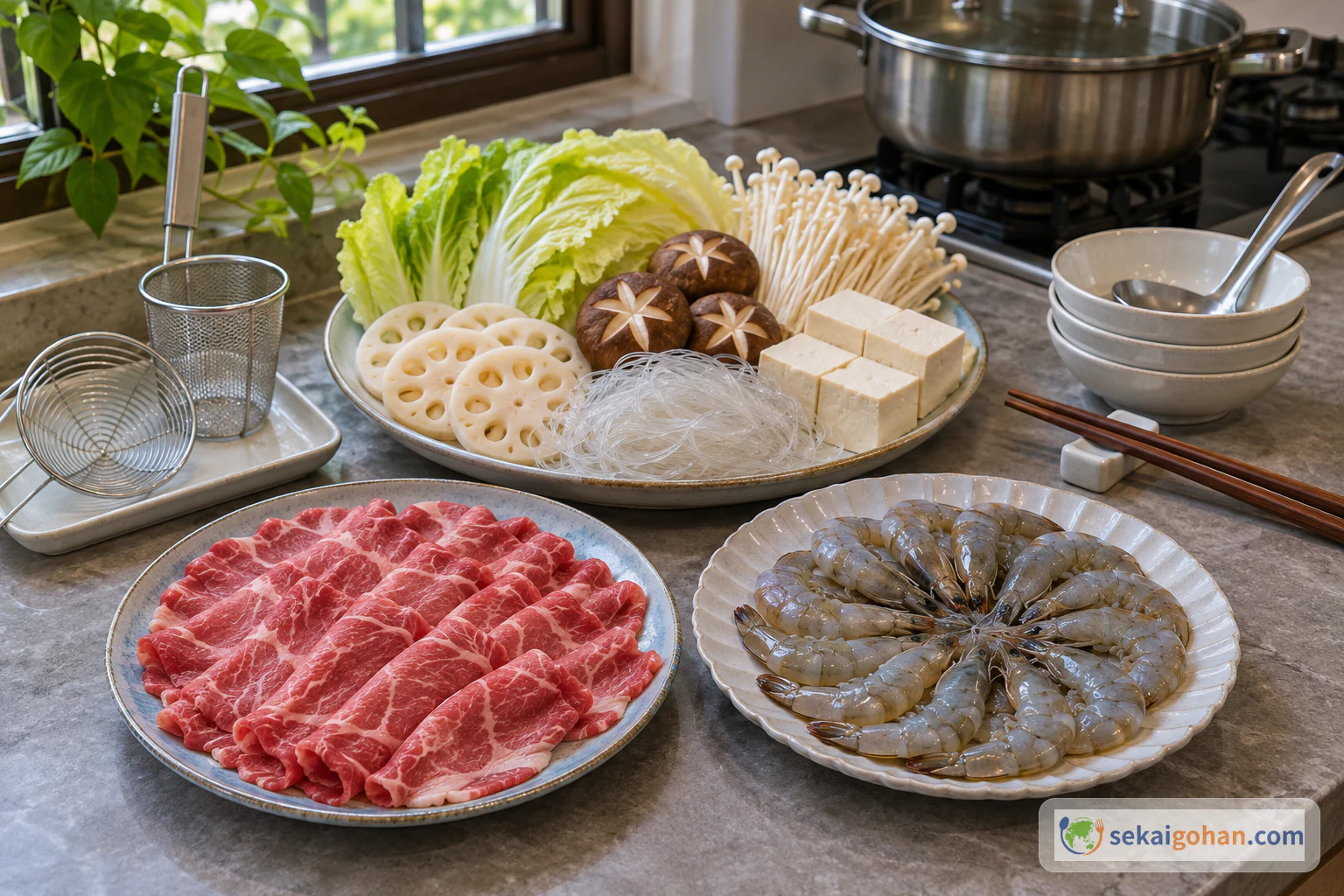
Thinly sliced beef and arranged plates of vegetables, with the raw meat plate kept apart
The raw meat plate gets its own chopsticks from the start

While the broth rests, slice the meat thinly and cut the vegetables, tofu and mushrooms into pieces that cook quickly. Put raw meat and seafood on their own plates, apart from the vegetables. Thaw anything frozen in the refrigerator or the microwave, and wash your hands after handling raw meat. The table is ready when every plate holds thin, even pieces and the raw plates sit apart, each with its own chopsticks.

STEP 7 7 / 10

Fill the divided pot

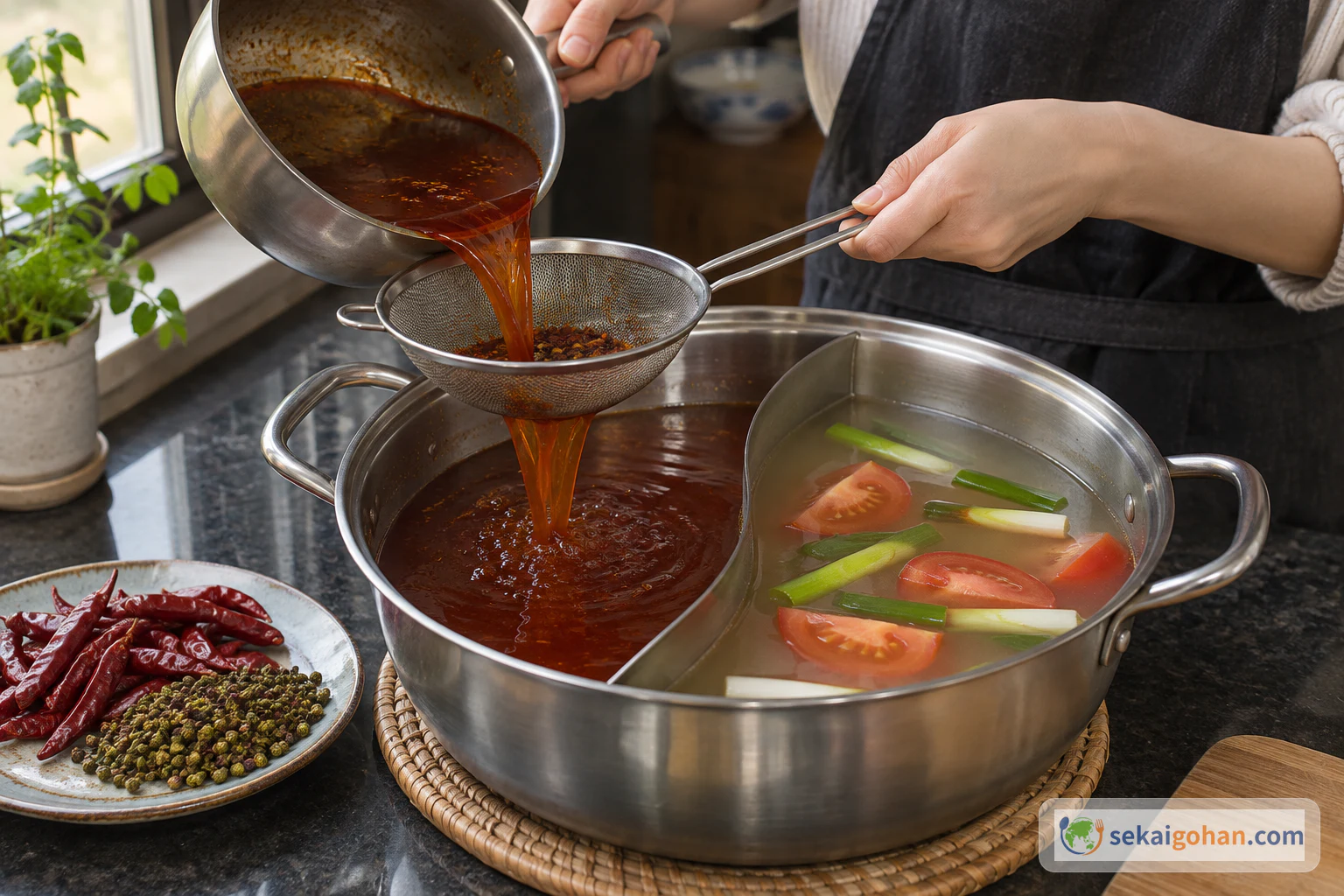
Spicy broth poured through a strainer into one side of a divided pot
Straining out the sediment keeps the red side smooth through the meal

Pour the mild broth ingredients into one side of the cold divided pot: the stock, ¼ cup (60 ml) of Shaoxing wine, the scallion chunks, and the tomato or jujubes if you are using them. Pour the spicy broth into the other side through a strainer, leaving most of the sediment behind. Float the few dried chilies and the 2 tbsp of whole green peppercorns on top. The pot is ready when one side is clear and pale and the other is red and glossy under its oil.

Strain the red side

Straining leaves most of the sediment behind, so the red side stays smoother through the meal.

STEP 8 8 / 10

Bring it to a boil and mix the sauce

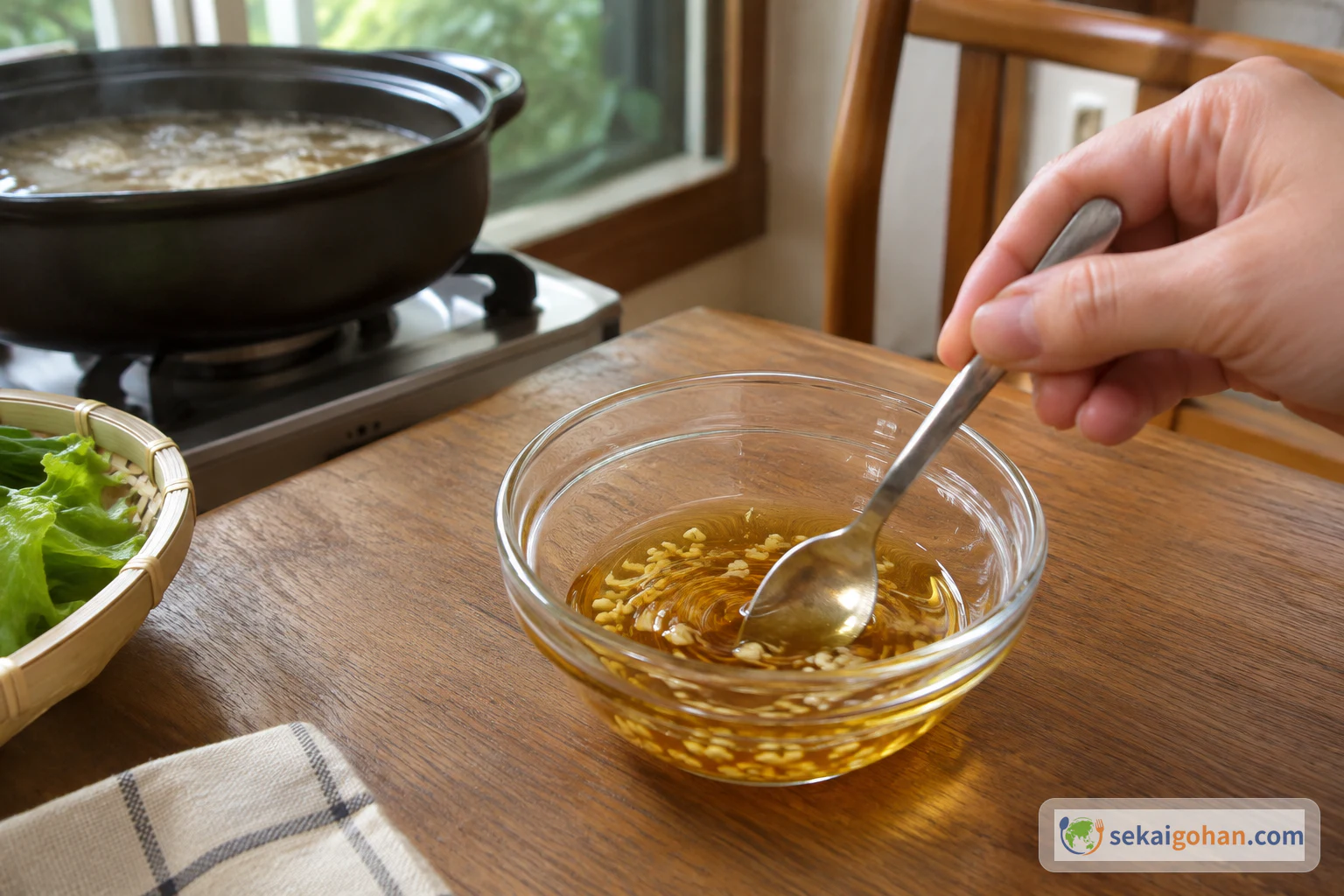
A bowl of sesame oil, canola oil and garlic dipping sauce being stirred
One bowl per person, mixed while the pot heats

Set an electric pot to high, or light the gas under the pot. It takes 5 to 10 minutes to come to a gentle boil. Meanwhile, give each diner a bowl of toasted sesame oil mixed with canola oil and minced garlic, with the soy sauce, black vinegar, oyster sauce, sesame paste, scallion and cilantro set out to add as they like. Nothing raw goes in until both sides are at a gentle boil.

STEP 9 9 / 10

Cook a little at a time

Chopsticks lifting a slice of beef from the red broth into sesame-garlic sauce
The sesame-garlic sauce takes the edge off the heat on the way to your mouth

Add a few pieces at a time instead of tipping in a whole plate. Swish thin slices and seafood in a ladle or wire strainer so they don't get lost. Use the raw-food chopsticks to put food in, and your own chopsticks only for cooked food. Cook meat and seafood all the way through, then dip each piece in your sauce and eat.

STEP 10 10 / 10

Top up and keep it boiling

As the broth cooks down, add boiling water to keep the level up. Let the pot come back to a boil before the next batch of raw food goes in. Don't sip the broth or eat from the pot just after raw food has been added. Wait until it is boiling again. Glass noodles and dumplings go in toward the end.

Ingredients

Ingredients

1 / 4

Spicy (mala) broth

Ingredient Amount Role
Dried chilies (facing-heaven, xiaomila or lantern chilies) 2–3 cups (480–720 ml) Heat and colour. Softened, stemmed and chopped to a paste
Red Sichuan peppercorns, whole 2 tbsp Numbing and aroma
Green Sichuan peppercorns, whole 2 tbsp A sharper, citrusy numbing
Whole spices (star anise, fennel seed, cassia bark, clove, bay leaf, sand ginger) 1 handful The base aroma. Choose from what you have
Toasted rapeseed oil (caiziyou), or Chinese peanut oil 1 cup (240 ml) Fries the scallions and carries their aroma
Scallions 5, halved Flavours the oil, then lifted out
Beef tallow, or more oil 1 cup (240 ml) Richness and the oily film of a mala pot
Ginger 3 inches (7.5 cm), peeled and roughly chopped Cuts strong meaty smells
Garlic 5–6 cloves, roughly chopped Aromatic base
Pixian doubanjiang (fermented broad bean chili paste) ⅓ cup (80 ml), mashed Salt and fermented depth
Douchi (fermented black beans) 4 tbsp, mashed Savoury depth
Fragrant Sichuan ground chilies 6 tbsp Colour and aroma
Stock (beef, pork or chicken) 2 quarts (1.9 L) The body of the broth
Shaoxing wine ½ cup (120 ml) Flavour
Black cardamom (optional) 2 pods Smoky aroma
Sugar 2 tbsp Rounds off sharp edges
MSG, or mushroom powder (optional) 1 tsp MSG, or 1 tbsp mushroom powder Savoury depth
Green Sichuan peppercorns, whole, for the top 2 tbsp Floated on the broth in the pot
Dried chilies, for the top A few Floated on the broth in the pot
2 / 4

Mild broth

Ingredient Amount Role
Stock 2 quarts (1.9 L) The clear side of the pot
Shaoxing wine ¼ cup (60 ml) Flavour
Scallions 3, cut in chunks Gentle aroma
Tomato, or Chinese jujubes (red dates) (optional) 1 tomato in wedges, or a handful of jujubes A soft sweetness or acidity
3 / 4

Dipping sauce

Ingredient Amount Role
Toasted sesame oil To taste The base of each bowl. Cools and coats hot slices
Canola oil To taste Lightens the sesame oil
Garlic, minced To taste Sharpness
Soy sauce, black vinegar, oyster sauce (optional) To taste Salt, acidity, savoury depth
Sesame paste thinned with water (optional) To taste A creamy coating
Scallion and cilantro, chopped (optional) To taste Freshness
4 / 4

To cook in the pot

Ingredient Amount Role
Thinly sliced meat (beef, pork belly) As needed Cooks in moments in the broth
Seafood (such as shrimp) As needed Sweetness against the heat
Offal (such as tripe) As needed The pot's oldest companion
Tofu (firm and fried) As needed Soaks up the broth
Mushrooms (enoki, shiitake) As needed Texture and savoury depth
Leafy and root vegetables (napa cabbage, lotus root, potato) As needed Relief from the richness
Noodles (glass noodles) and dumplings As needed Fill out the meal

On one side of the pot the broth is red and glossy under a layer of oil. Whole dried chilies and green Sichuan peppercorns roll on the surface as it bubbles. On the other side a clear, pale broth simmers quietly with scallion. Everyone at the table drops a slice of beef into the red side and pulls it out a moment later, and first comes the heat of the chili, then a buzzing on the lips that is a separate feeling altogether. That pairing of numbing and hot is mala hot pot, the tallow-rich broth of Sichuan and Chongqing. You cook it at the table and share it, and building the broth yourself from bean paste, peppercorns and chilies shows you exactly what goes into that taste.

Numbing and Hot: Where Mala Hot Pot Comes From

The name

Mala joins two characters. Ma (麻) is the tingling, numbing feeling of Sichuan peppercorn. La (辣) is the burn of chili. The two together are the backbone of the broth.

Sichuan peppercorn and dried chili are the two main players, and they do different jobs. The peppercorn makes your lips and tongue tingle and brings a floral, citrusy smell. The chili brings heat and that deep red colour. Beef tallow melted into the broth gives it body and the thick, shining film of oil that marks the Sichuan and Chongqing style.

Docks, rivers and cheap cuts

Where the dish began is not settled. One story puts it on the docks of Jiangbei in Chongqing in the 1920s, with peddlers selling to the people working there. Another credits the labourers along the Yangtze River. Both stories share the same picture. Cheap cuts were cooked in a fiery broth, and the broth was said to keep out the cold and cover strong smells. Over time a workers' meal became a pot that a whole table sits around.

How it changes away from home

The tallow-based mala pot belongs to Sichuan and Chongqing, and it changed as it travelled. In Taiwan the broth tends to be a little sweeter, with seafood and taro in the pot. In Japan it picked up habits from shabu-shabu, with enoki and udon common on the table. Thailand and Korea have their own versions too. Malatang shares the name and some of the flavour, but it is a separate dish, and it is better kept apart from this one.

The divided pot is the most practical part of the setup. With a mild broth beside the spicy one, anyone who finds the mala side too strong can still share the same pot, and the hottest eaters can rest their mouths between bites. The same pantry runs through the rest of Sichuan cooking. You will recognise the bean paste and peppercorn from mapo tofu, the chili-and-oil broth from shuizhu niurou and shuizhu yu, and the peppercorn tingle from dandan mian. You can find more dishes from the same table in our Chinese recipes.


Ingredients
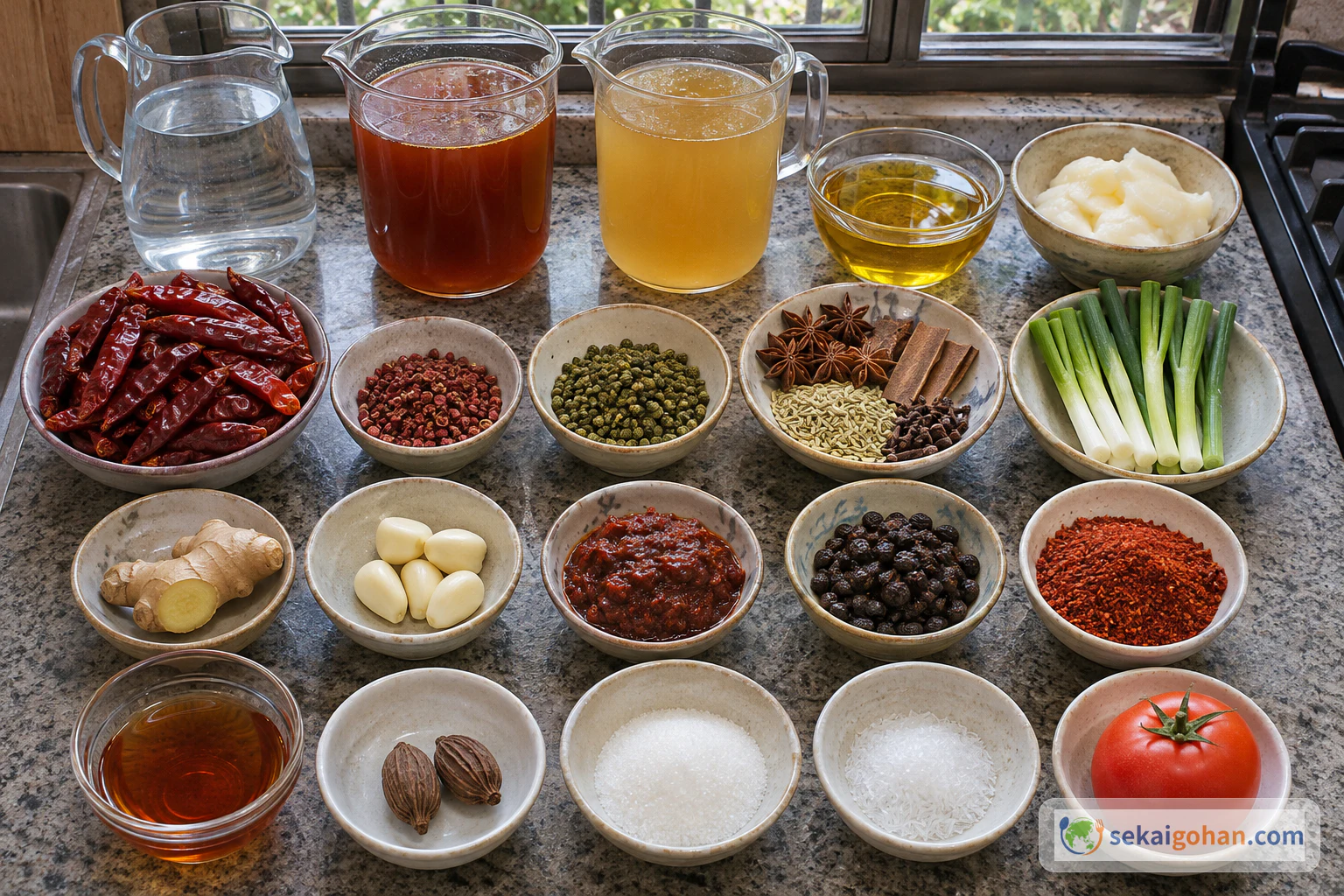
The ingredients for the mala broth laid out in separate bowls and piles
Group everything by step before you start: the chilies, the spice mix, the fats and aromatics, then the pastes

The spicy broth has the most parts. The mild broth and the dipping sauce take only minutes. The chili amount is your heat dial: use the lower end of the range for a gentler pot.
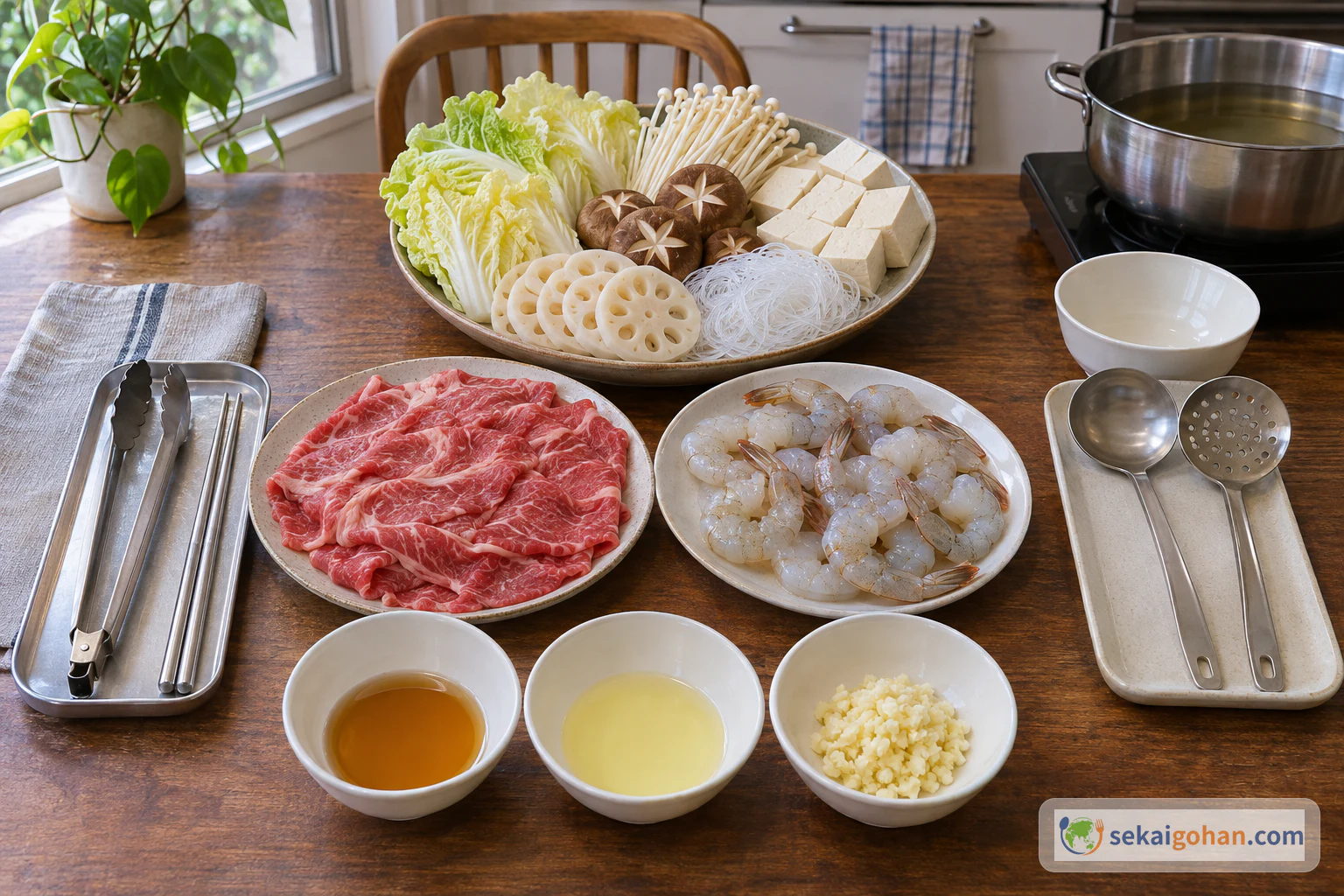
Plates of sliced meat, tofu, mushrooms and vegetables with dipping sauce bowls
Keep raw meat and seafood on their own plates, away from the vegetables and the sauce bowls
Allergen information

Doubanjiang, douchi and soy sauce contain soy. Soy sauce, Shaoxing wine and many bean pastes contain wheat, so check the labels. Sesame oil and sesame paste are sesame. Shrimp and oyster sauce are shellfish. Tell your guests what is in the pot, because everything cooks in the same broth.

Equipment

  • Divided hot pot (electric, or a pot for a tabletop gas burner)
  • Wok or large pot for building the spicy broth
  • Small pot for softening the chilies
  • Spice grinder or mortar and pestle
  • Fine strainer
  • Ladles, plus a slotted ladle or wire strainer for the table
  • A separate pair of chopsticks or tongs for raw food, and serving spoons
  • Cutting board, cleaver or sharp knife, and plates for the dippers
  • A small bowl for each diner's sauce

Choosing and Substituting

Most of the spicy broth comes from a Chinese grocery or an online specialty shop: Pixian doubanjiang, douchi, red and green Sichuan peppercorns, facing-heaven or other Sichuan dried chilies, fragrant Sichuan ground chilies, toasted rapeseed oil, rendered beef tallow, black cardamom and sand ginger. The meat, vegetables, tofu and stock come from any supermarket.

Look for "Pixian" on the doubanjiang label. A generic chili bean paste tastes different, with a different saltiness and a weaker fermented depth. Fragrant Sichuan ground chilies give both colour and smell. A plain single-chili powder changes both. Small hot dried chilies such as bird's eye can stand in for the Sichuan ones, but use fewer, and expect a sharper heat and less fragrance.

For the tallow, use a rendered beef tallow you buy ready-made. If you cannot get one, use oil in its place. The broth will be lighter, with less body and a thinner oily film. Use the tallow alongside the rapeseed oil, never on its own, because tallow by itself leaves a strong smell in the kitchen and on your clothes.

Keep for the local taste Fine to let go abroad
The numbing of red and green Sichuan peppercorns The exact whole spices in the handful
The fermented salt of Pixian doubanjiang Black cardamom and MSG or mushroom powder
Douchi for depth Tallow, which can become all oil
Dried chilies softened into a paste Tomato or jujubes in the mild broth, and which dippers you choose

Method

Start with the two soaks. The chilies need their boil and at least half an hour in the water, and the spices go into their water during that time. Building the broth in the wok goes quickly once both are ready. Then the broth rests off the heat for at least 30 minutes, and that is when you slice the dippers and set the table. You will have about 8 cups (2 L) of each broth.

At the table

Keep separate chopsticks or tongs for raw food and for eating. Use serving spoons, and don't share dipping sauce bowls. Boil the broth before any food goes in, slice meat and fish thinly, and don't crowd the pot. Right after raw food goes in, leave the broth and the pot alone until it boils again.

When It Goes Wrong

What you see Why What to do
The chilies won't chop into a paste and fly around the board They didn't soak long enough Return them to hot water and give them the full soak until every pod bends without cracking
The garlic browns and the oil smells bitter The heat was too high after the tallow went in Keep the wok at medium. The aromatics should give off scent and stay pale
The kitchen and your clothes smell heavily of tallow Too much tallow and too little rapeseed oil Keep both fats in the amounts given. Next time you can swap part or all of the tallow for oil
The pot stops bubbling after food goes in Too much went in at once Wait for the boil to return, and add smaller batches from then on
The red side tastes harsh and salty late in the meal The broth has reduced Top up with boiling water and bring it back to a boil

Serving and Variations

Mala hot pot is the whole meal. The pot sits in the middle of the table and everyone cooks their own food. The mild side and the sesame-garlic sauce let you pace yourself, so nobody tires of the heat halfway through. Put the vegetables and tofu out with the meat so the table always has something lighter to reach for.

Variations

  • Gentler heat. Use 2 cups (480 ml) of dried chilies rather than 3. The broth stays fragrant and red with less burn.
  • No tallow. Replace the tallow with oil. The broth tastes lighter and cleaner, with less body and a thinner film on top.
  • One broth only. Make only the spicy broth for a table of heat lovers, or only the mild broth for a table that wants none.
  • Tomato or jujube mild side. Tomato wedges give the clear broth a soft acidity. Jujubes give it a gentle sweetness.
  • Finish with noodles. End the meal with glass noodles cooked in whichever broth is left, after everyone has eaten their fill of meat and vegetables.

Frequently Asked Questions

What if the numbing is too much for me?

Eat mostly from the mild side, and put each bite from the red side through the sesame oil and garlic sauce. You can also leave the whole green peppercorns off the top of the spicy broth. They float there to make the tingling stronger.

How does it compare with a store-bought hot pot base?

Chongqing restaurants cook their bases in huge batches with tallow, rapeseed oil, lard, chili, bean paste, peppercorn and many spices, and the base sets solid when it cools. The usage guide for such a base is to dilute it at about 7–10½ oz (200–300 g) per quart (1 L) of liquid. Making the broth at home shows you each layer, and you decide how much chili and tallow goes in.

Is malatang the same thing?

No. Malatang has a similar flavour and a similar name, but it is a separate dish. The tallow broth, divided pot and cook-it-yourself table here belong to mala hot pot.
Enjoyed this recipe?

0 likes

Sources