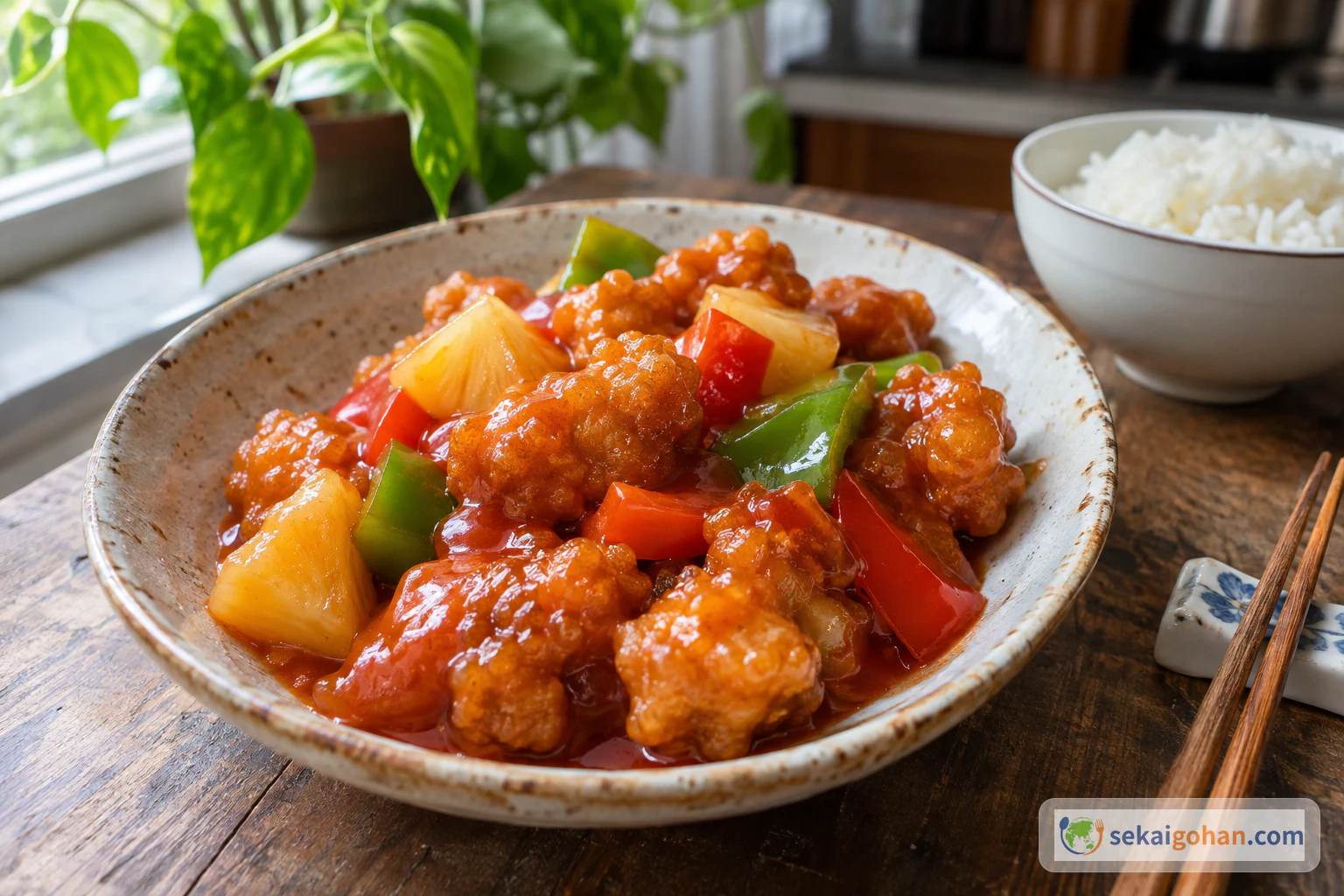
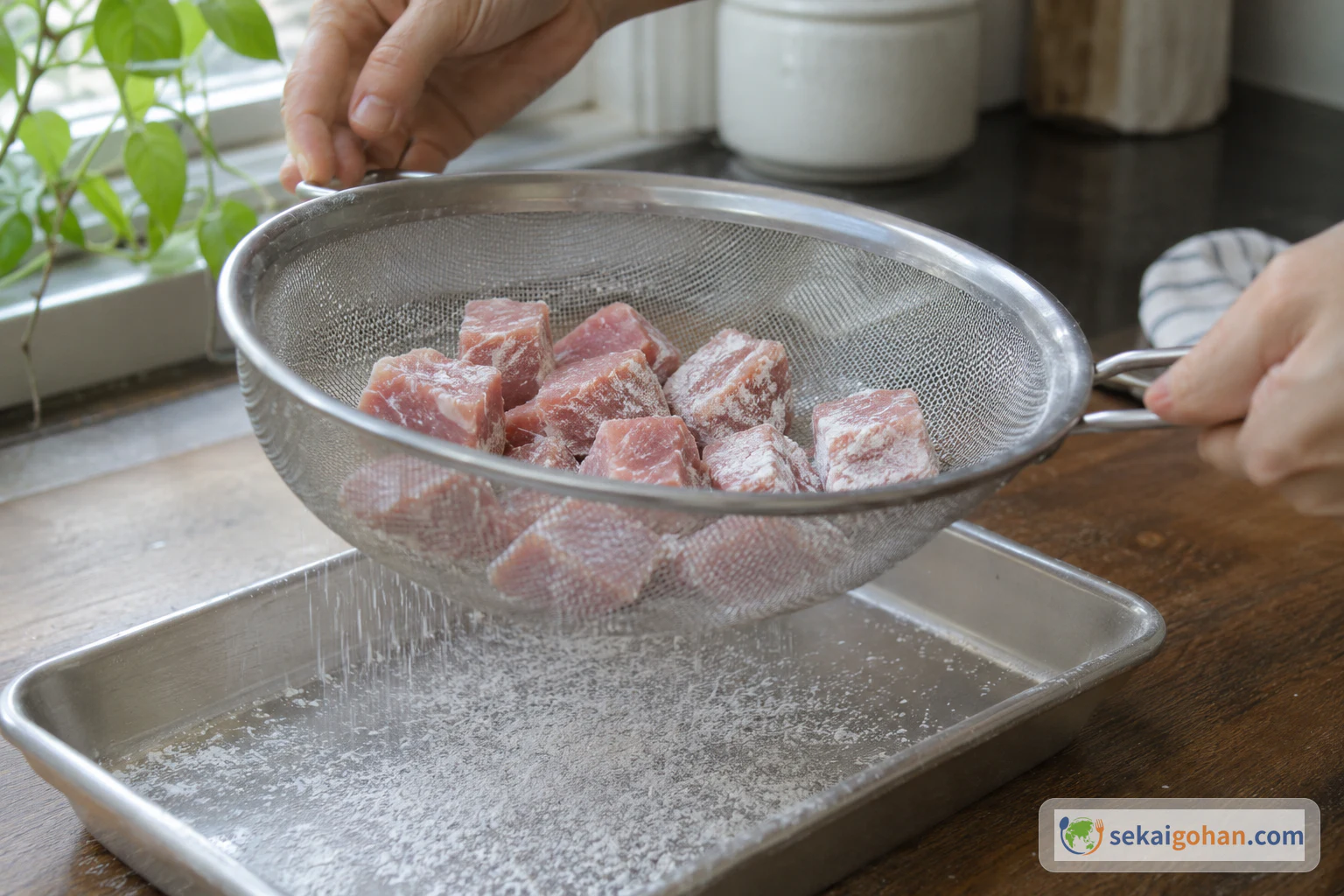
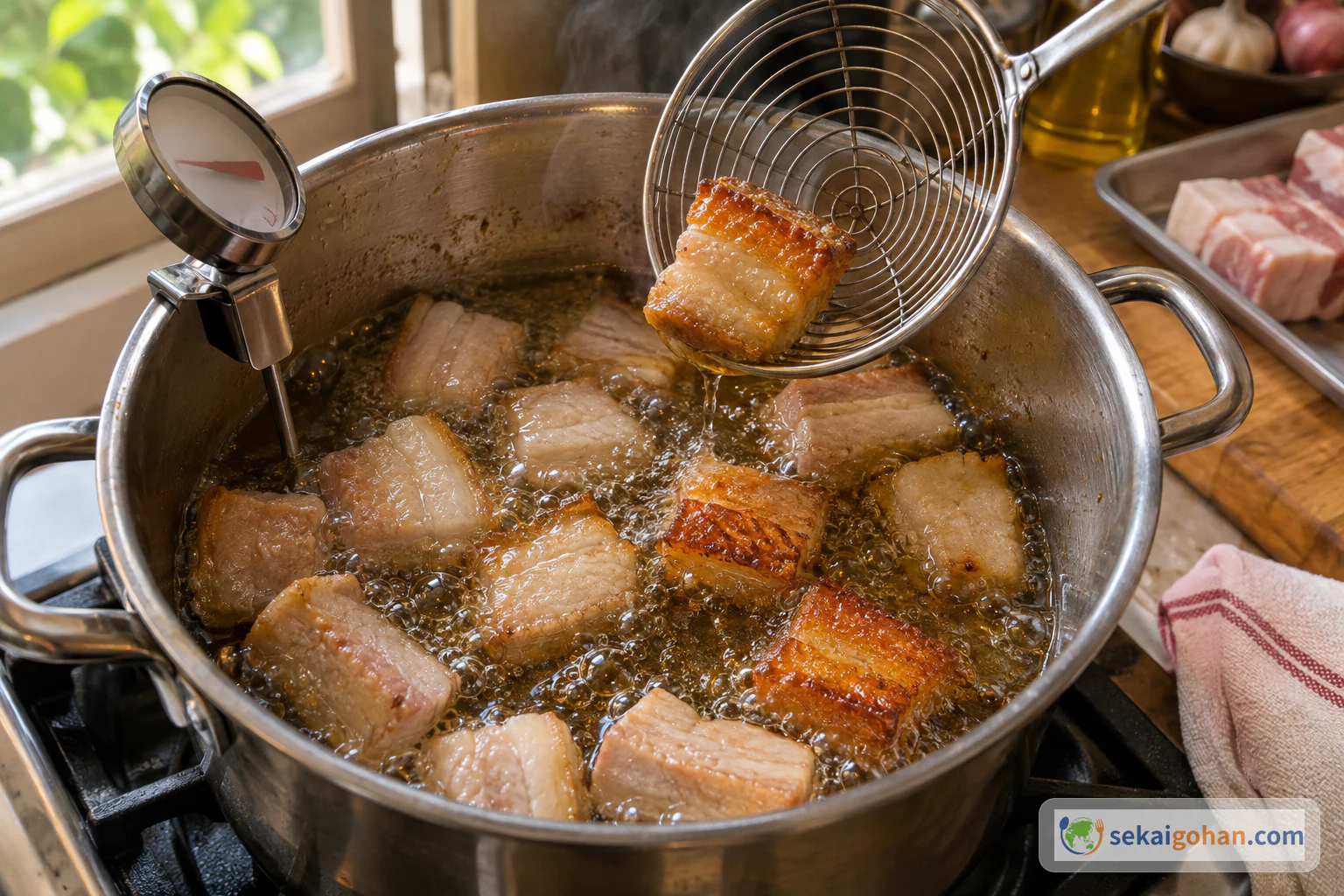
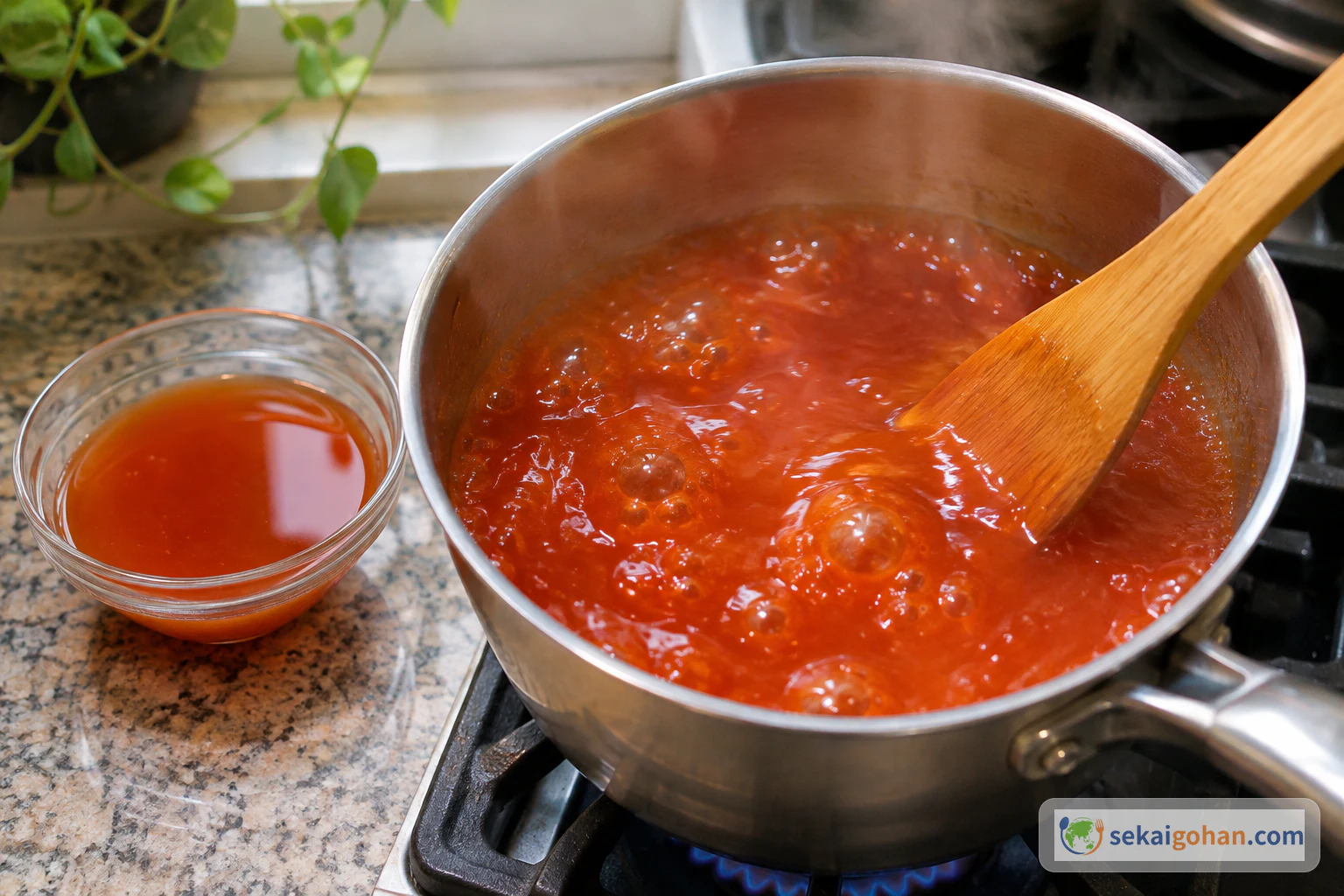
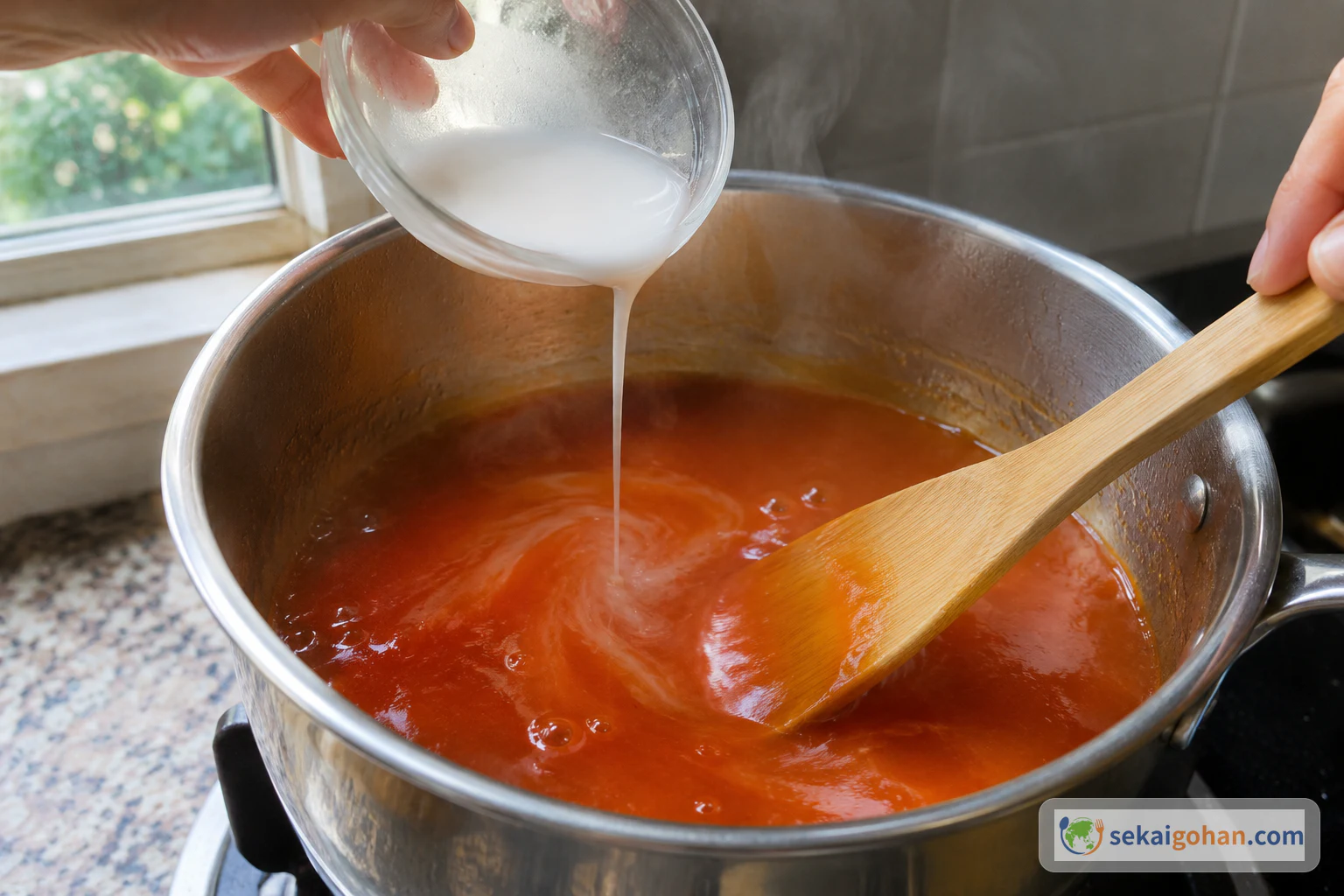
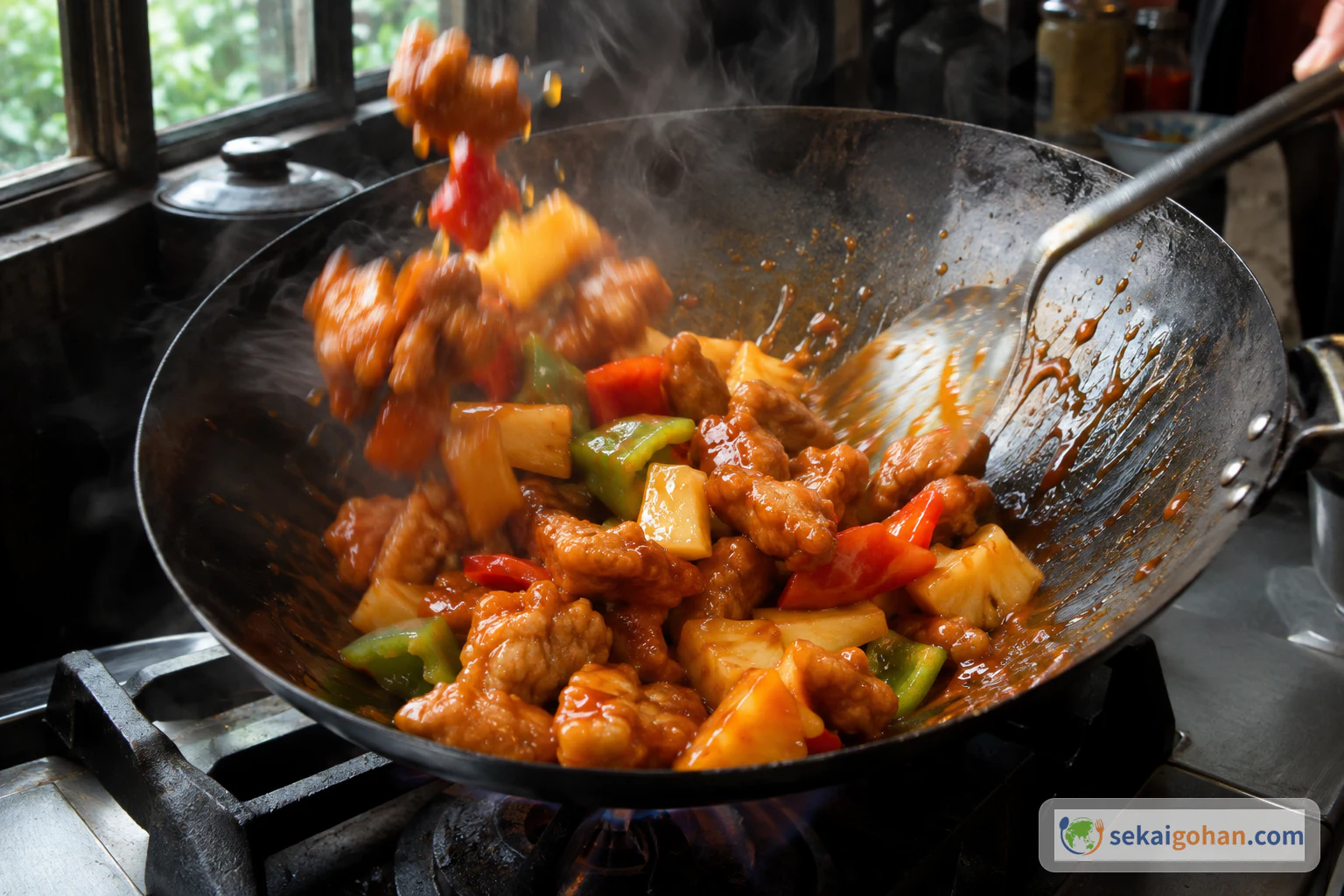
The sauce tells you when it is time. Ketchup, rice vinegar and soy sauce hit a dry, hot pan, the surface breaks into fat orange bubbles, and the moment the starch slurry goes in it turns glossy and slow on the spatula. Golden cubes of fried pork go in next, then pale pineapple and squares of green and red pepper, and a few fast turns of the pan coat everything in shine. This is gu lou juk (咕嚕肉), the Cantonese dish the English-speaking world knows as sweet and sour pork.
The coating is thin and crisp. The sauce is bright with tomato and vinegar, and the pineapple adds a fruity sharpness that cuts through the fried pork. It belongs on the table the minute it leaves the pan, next to a bowl of white rice.
Gu Lou Juk: A Missing Bone, Two Names and a Dish That Travelled
Why the bone came out
The dish is traced to Guangzhou in the Qing dynasty, when Europeans and Americans were among the first outsiders to meet Cantonese cooking. They liked sweet and sour spare ribs (糖醋排骨), an older dish, but they did not like picking bones out of their mouths at the table. Cantonese cooks answered with boneless pork bound with seasoning and starch, fried, then coated in the same sweet and sour sauce. The reworked dish came to be called gu lou juk (古老肉), and later also 咕嚕肉. Both names are still in use, and both describe the same plate.
It travelled with the people who cooked it. Cantonese emigrants were among the first Chinese to settle in Europe and North America, and many of them opened restaurants serving the food of home. That is why gu lou juk turns up in Chinatown restaurants around the world. In the United States it is described as one of the most popular Chinese dishes. One food writer recalls that the upstate New York restaurant where their father worked listed it as "sweet and pungent pork", a name that let the kitchen charge more for the same plate.
One story says the sweet-sour smell of the dish makes people swallow, gulu gulu, before the plate even lands. The other says foreign diners mispronounced 古老肉, "old pork", and the sound drifted into 咕嚕肉. Both are folk explanations, and neither is settled.
Pineapple, peppers and the Cantonese plate
What you find in Guangdong today is the version with canned pineapple, sometimes written 菠蘿咕嚕肉 with the word for pineapple in front. The Cantonese style pairs the pork with vegetables and fruit and uses ketchup for a fruity, rounded sourness. Where pineapple first joined the dish is not settled; Qing-era Hong Kong and Shanghai are both named. The pork itself is lean tenderloin in this recipe, the same cut that keeps the cubes tender in a few minutes of frying. Cantonese kitchens have other pork classics with an entirely different character, from the lacquered sweetness of char siu to the fierce heat of Sichuan's mapo tofu further west in China.
Same name, different plates
Several dishes share the name, and they are separate dishes rather than variations of one.
| Style | What makes it different |
|---|---|
| Cantonese gu lou juk (this recipe) | Tenderloin cubes, egg and wheat-flour coating, a ketchup, rice vinegar, sugar and water sauce, pineapple and peppers |
| Hong Kong restaurant style | Black pork belly, dried pineapple and fig; the pork is fried, dipped in boiling water, then fried again; hawthorn goes into the sauce |
| American Chinese takeout | A double coating of flour, cornstarch and egg, a second fry just before serving, and a thick sauce cooked down without water |
| Northern and Shanghai tángcù lǐjī (糖醋里脊) | Tenderloin cut into matchsticks, an egg and starch coating, shallow-fried in a little oil; ketchup with apple cider vinegar; found on menus all over China |
| Shanghai tángcù ròu (糖醋肉) | Pork alone or with onion, seasoned only with vinegar, sugar and soy sauce |
| Japanese subuta (酢豚) | Built on the Cantonese style, usually without pineapple |
The Hong Kong cooks who reach for dried pineapple do it for control. Fresh pineapple can push the sauce too sweet or too sour, and dried fruit is easier to balance. The American takeout plate leans on its double fry and syrupy sauce; the Cantonese plate keeps its sauce loose with water and its coating light.
Ingredients
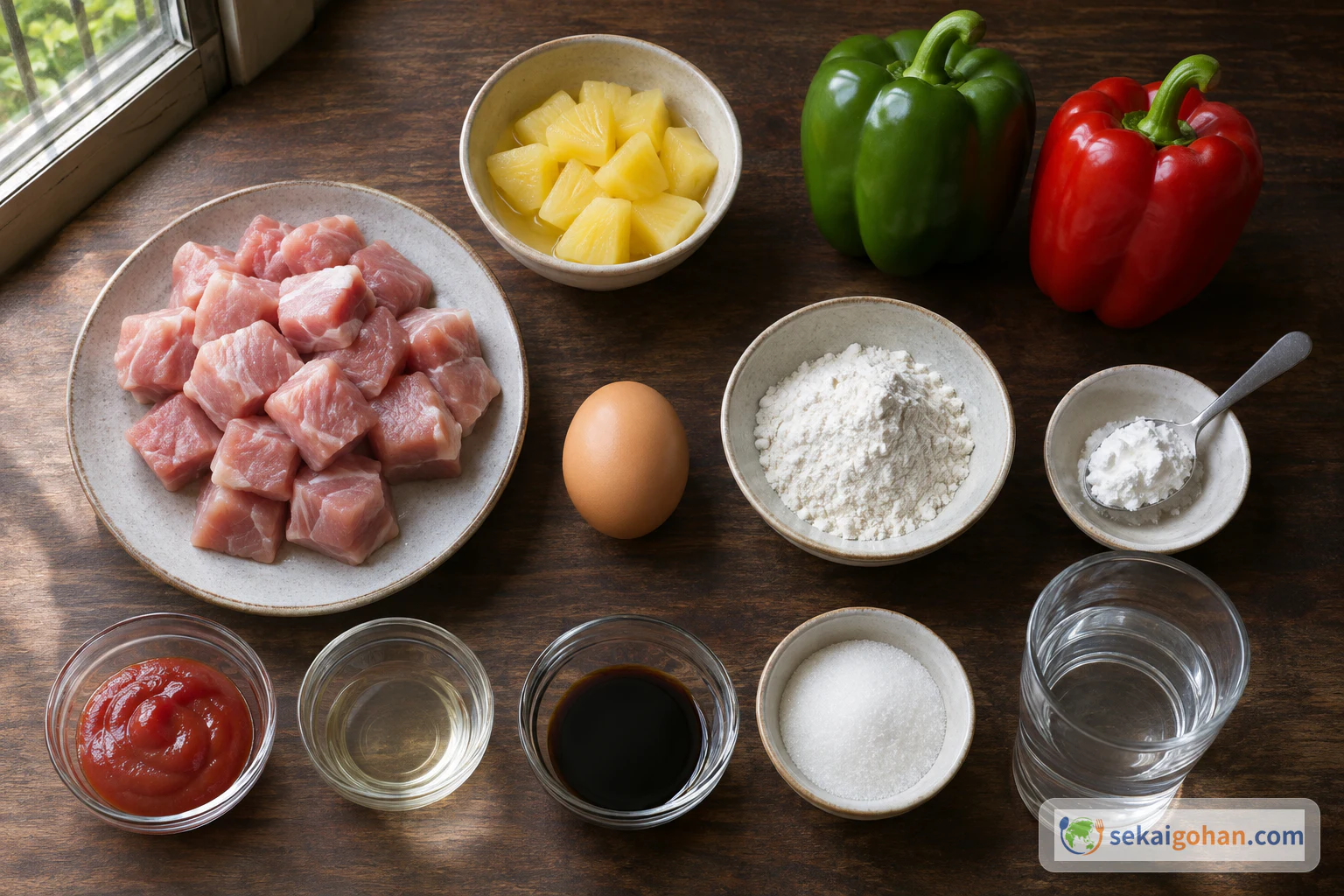
This dish contains wheat (flour), egg, soy (light soy sauce) and pineapple. Ketchup and soy sauce vary by brand, so check each label for allergens and additives.
Equipment
- Wok or deep pan, 10–11 inches (26–28 cm), for frying and tossing
- Small saucepan for the sauce
- Instant-read food thermometer
- Fine-mesh sieve and a shallow tray for the flour
- Spider skimmer or slotted spoon
- Wire rack set over a tray for draining
- Mixing bowls and paper towels
Choosing and Substituting
Light soy sauce (生抽) is the one bottle worth a trip to an Asian grocer. It is pale and thin, seasoning the pork and sauce without darkening them. An all-purpose soy sauce works in a pinch, but the sauce turns browner and the saltiness lands differently.
Chinese rice vinegar gives the sharpness this sauce is built on. Japanese rice vinegar is a close swap with slightly different acidity and sweetness. Zhenjiang black vinegar is a different product with a deep, malty flavor, so it is not a like-for-like swap here.
Canned pineapple keeps the sweetness steady from one batch to the next. Fresh pineapple is brighter and more acidic and can tip the sauce one way or the other. For the pork, tenderloin gives lean, tender cubes; pork shoulder brings more savory flavor and takes longer to cook through. Potato starch or cornstarch both work for the marinade and the slurry. Ordinary tomato ketchup does the job, though brands differ in sweetness and acidity.
| Keep for the Cantonese taste | Fine to adjust abroad |
|---|---|
| A wheat-flour coating; a starch-only coating changes the texture | Japanese rice vinegar for Chinese rice vinegar |
| A sauce loosened with water and lightly thickened with slurry | All-purpose soy sauce for light soy sauce |
| Pineapple and peppers tossed in at the very end | Fresh pineapple for canned, drained well |
Method
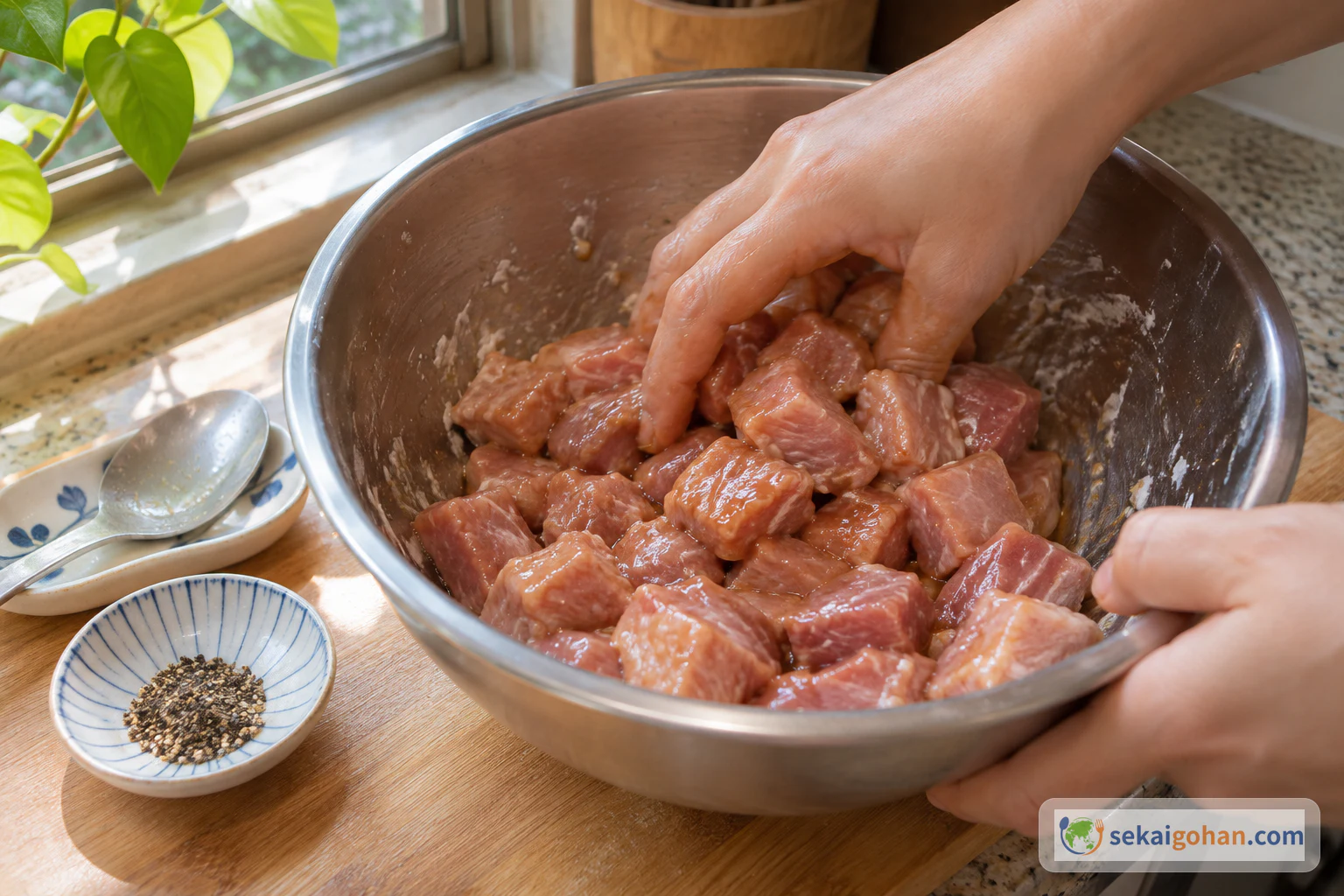
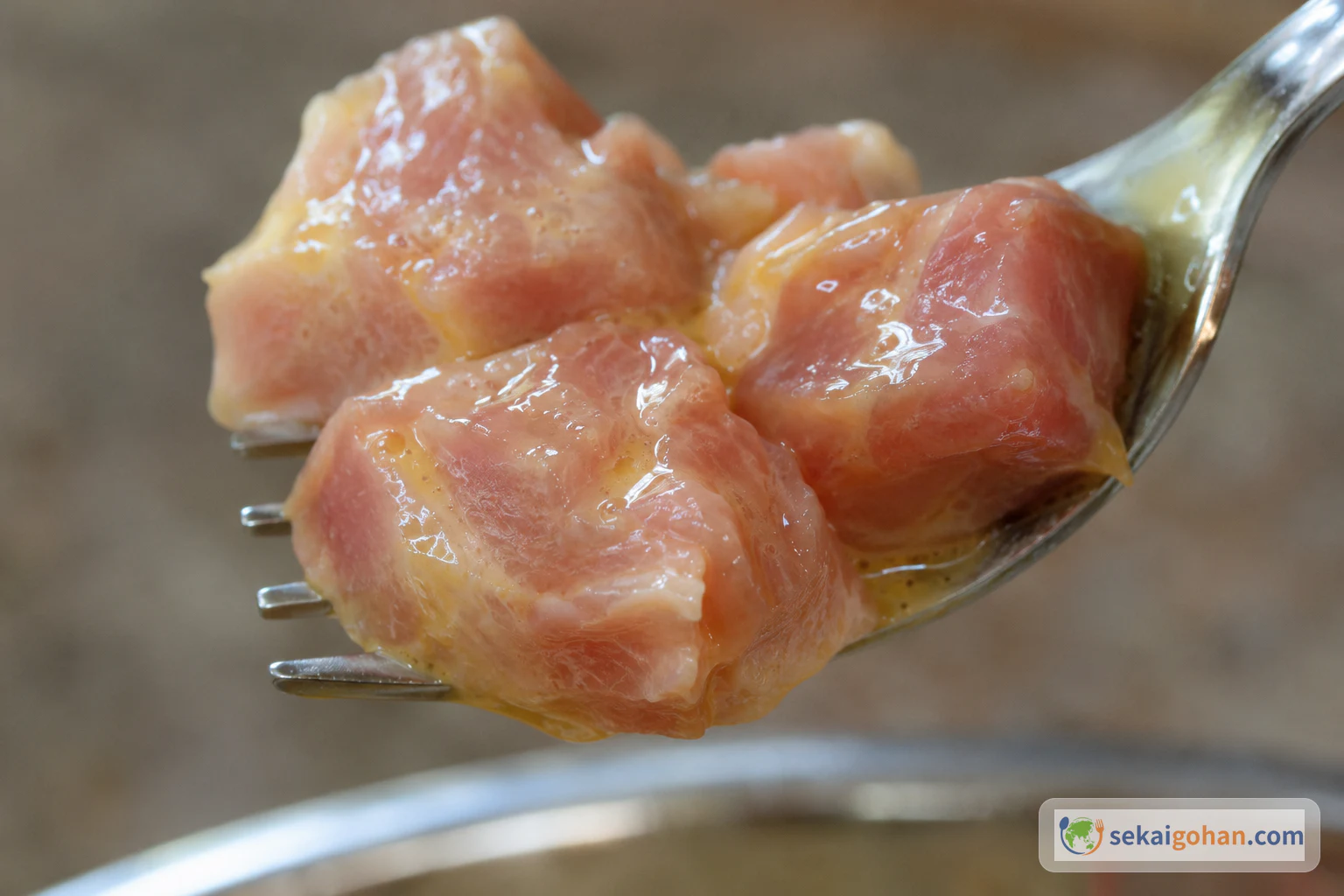
Start the pork first: it needs 30 minutes in its marinade, and that is your window to cut the pineapple and peppers, mix the sauce and set out the flour tray and draining rack. Once the oil is hot, the work runs without a break, frying in batches, then sauce, then a fast toss, so have everything within reach.
When It Goes Wrong
| What you see | Why | What to do |
|---|---|---|
| The coating is greasy and soft | The oil was too cool, the pork was wet, or too many cubes went in at once | Pat the pork dry before marinating, fry small batches, and watch the oil with a thermometer |
| The coating peels off | The flour was too thin, or too much egg was left on the pork | Dust the flour evenly and let excess egg drip off before dredging |
| The pork is dry and tough | Cubes cut too small, or fried too long | Keep to ⅝-inch (1.5 cm) cubes and lift them out as soon as the center reaches 167°F (75°C) |
| The sauce is too sweet | Extra ketchup or sugar, or the sauce was cooked down | Keep to the amounts, and thicken with slurry instead of reducing |
| The sauce is thin and runny | Too little slurry, or the sauce was not boiling when it went in | Bring the sauce back to a boil and add slurry a little at a time |
| The sauce is gluey | Too much slurry | Next time, add half the slurry first and judge the rest by eye |
| The whole dish turns watery | Pineapple or peppers went in wet, or the toss went on too long | Drain the pineapple well and toss only until the pieces are coated |
Serving, Variations and Storage
At the table
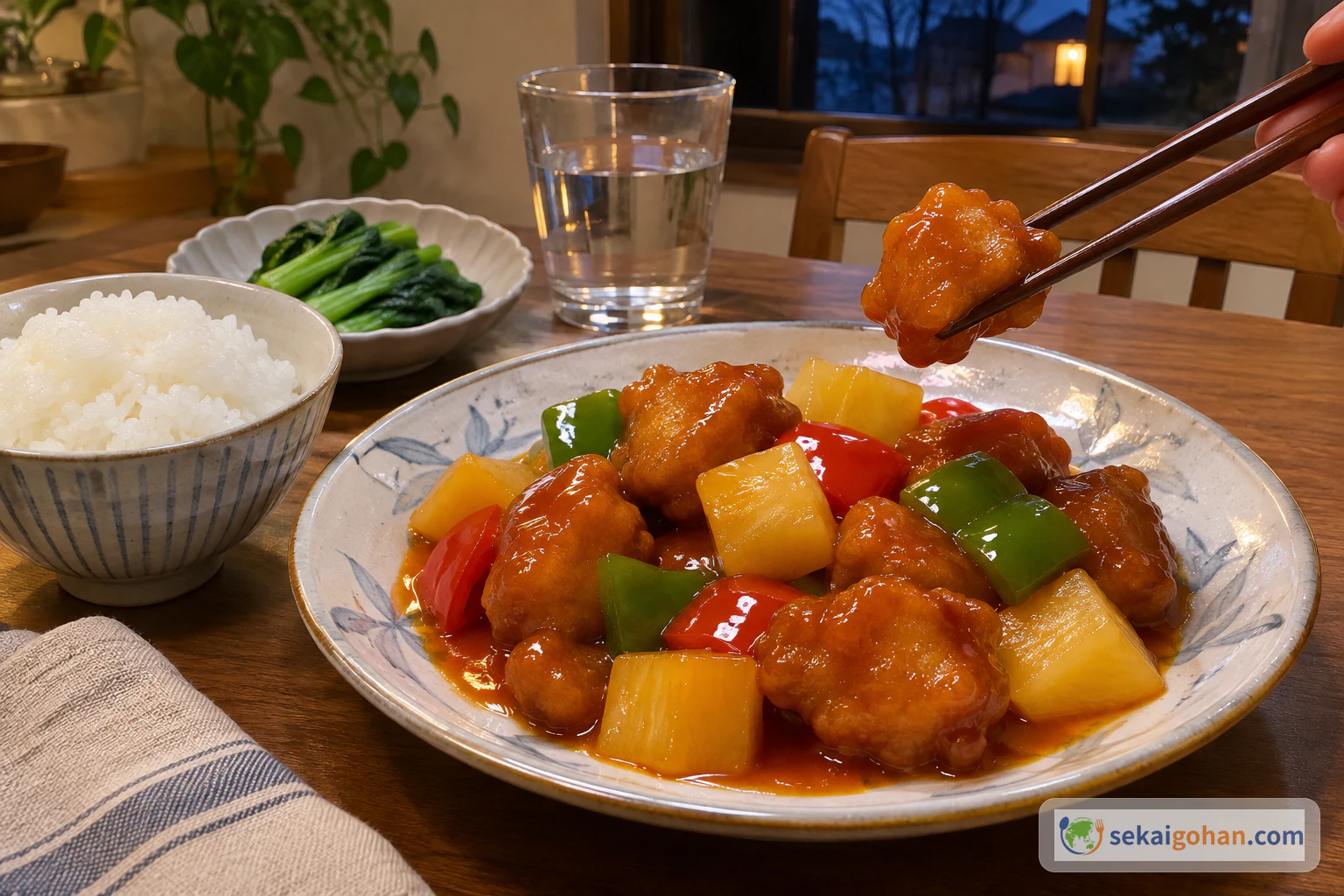
Gu lou juk is a dish for eating the moment it is plated, while the coating still crunches. A bowl of steamed white rice soaks up the extra sauce, and a plate of simply blanched greens balances the sweetness and the fried pork. For a fuller spread, put it beside fried rice, or set it against the savory, chili-driven twice-cooked pork for two very different pork dishes on one table.
Variations
- Pork belly. Use the same weight of belly in place of tenderloin. The fat adds sweetness and richness, and the coating feels heavier. Fry by the thermometer, not by a longer time.
- No pineapple. Leave out the pineapple and keep both peppers. The sauce loses its fruity acidity and some of its sweetness, and the dish leans toward the simpler sweet and sour plates of other regions.
- Double fry. Just before tossing, fry the drained pork a second time, briefly, in hotter oil. The coating holds its crunch longer under the sauce, the way restaurant kitchens do it.
- Sauce on the side. Serve the sauce in a bowl and let everyone spoon it over at the table. The coating stays crisp to the last piece, at the cost of the glossy all-in-one look.
Storage and reheating
Cool leftovers quickly, then refrigerate them promptly in a covered container, and finish them by the next day. Keep them out of 46–145°F (8–63°C), the range where bacteria multiply, for as little time as possible. Reheat in a frying pan or the oven until the center reaches 167°F (75°C). The microwave softens the coating further, and the crunch does not come back however you reheat it. Freezing is a poor fit: the moisture in the coating and sauce ruins the texture.
Frequently Asked Questions
Why does the pineapple go in at the very end?
The pineapple only needs warming, and longer heat dulls both its texture and its fragrance. Fresh pineapple contains a protein-breaking enzyme that stops working above 140°F (60°C). Canned pineapple is heated during canning, so its enzyme is already inactive, and the fruit is there for flavor alone.
Can I use only cornstarch for the coating?
You can, but the texture changes. The Cantonese coating is egg and wheat flour, which fries to a golden, crisp shell. Starch belongs in the marinade, where it holds moisture and helps the flour cling.
What if I don't have a thermometer?
Cut open the largest cube from the batch. The center should be cooked through with no pink, and any juices should run clear. A thermometer is still the dependable check for 167°F (75°C), and it is worth buying for any fried or roasted pork.
What do I do with leftover sauce?
Pour it into a covered container and refrigerate it promptly, then use it by the next day. Bring it back to a boil and use it on freshly fried pork or other dishes, heated through to 167°F (75°C).