At a celebration, you pour the clear soup first
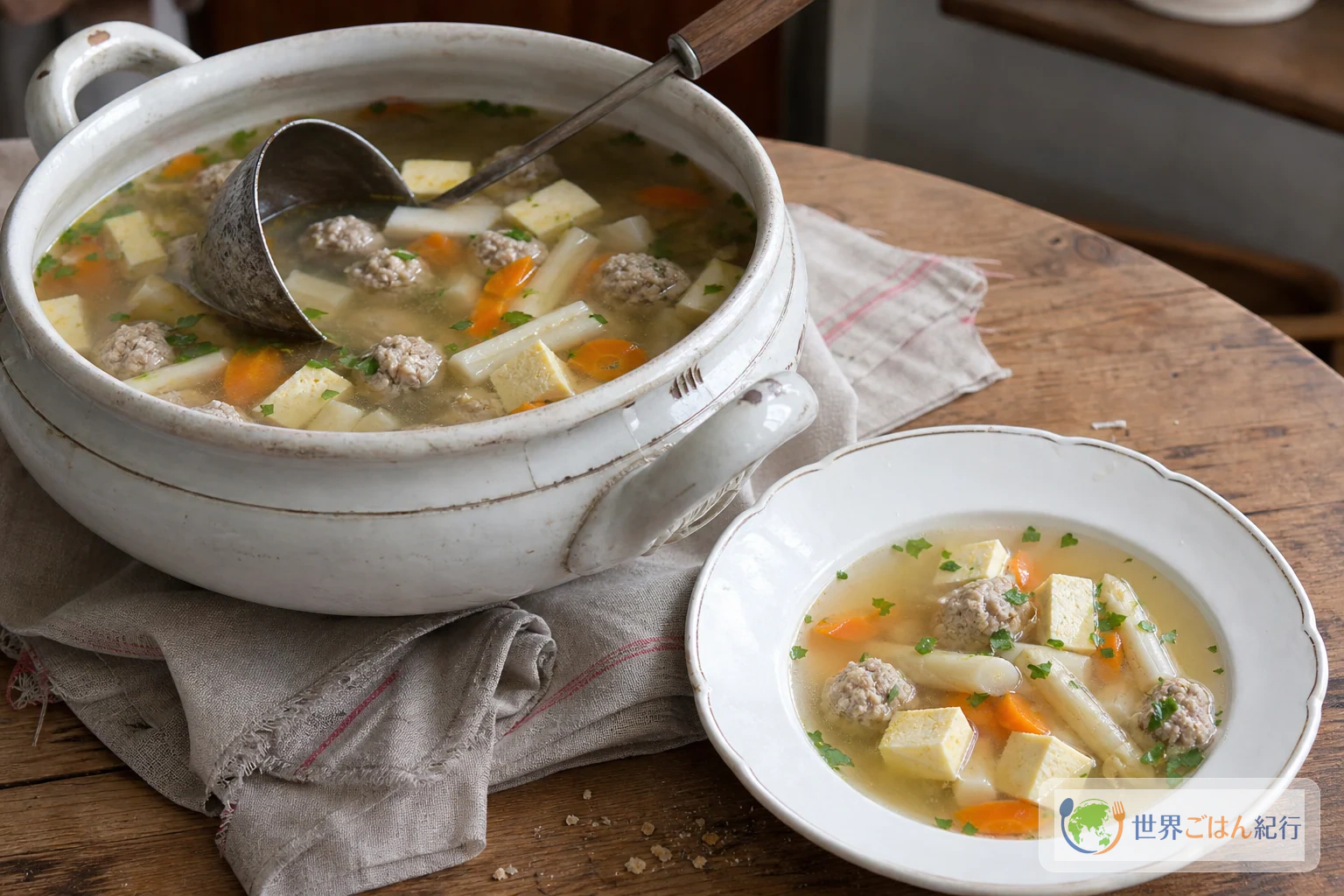
Lift the lid of a big white soup tureen and, before the meat, a round aroma of beef and chicken quietly simmered rises. Each time the ladle goes to the bottom, small meatballs, pale yellow egg and white asparagus come up together. It is a modest first bowl that settles the table for a long day.
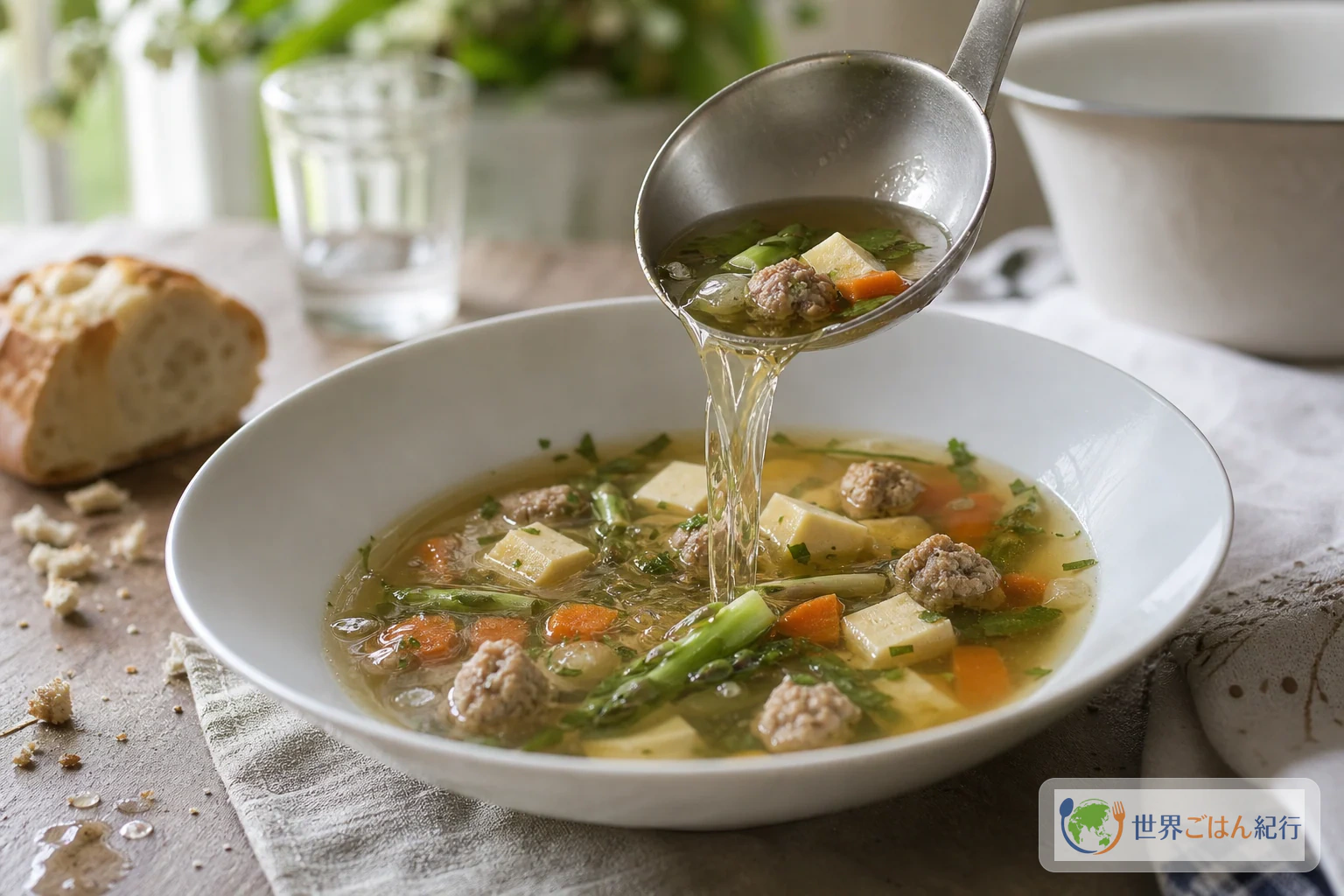
Hochzeitssuppe literally means "wedding soup" in German. The name spreads from northern to southern Germany and on to the region where the Sorbs live, but the contents are not one thing. What they share is a clear meat broth layered with fitting festive additions: meatballs, a set egg custard, seasonal vegetables, noodles or rice. The contents of the pot change from household to household and from banquet hall to banquet hall.
Here we take as our axis the Wendland composition presented by the Lower Saxony tourism board. A broth is made with beef shank and chicken wings, and combined with small meatballs called Fleischklößchen, an egg custard called Eierstich, and white asparagus. Eierstich may look like Japanese chawanmushi, but here it is not the star; it is an ingredient for placing yellow cubes in the clear soup.
It takes effort, but not every difficult technique hits you at once. Finish the broth, meatballs, egg and vegetables separately, and put them back into one pot just before eating. The kitchen gets a few more small pots and cups, but in this order you avoid cloudiness and things falling apart. The sense of quietly drawing a beef broth in a home pot also connects to the Gaisburger Marsch of Swabia.
Hochzeit means "wedding" and Suppe means "soup." The regional name Wendländische Hochzeitssuppe means "wedding soup of the Wendland region."
What the wedding pot shows about North German celebration
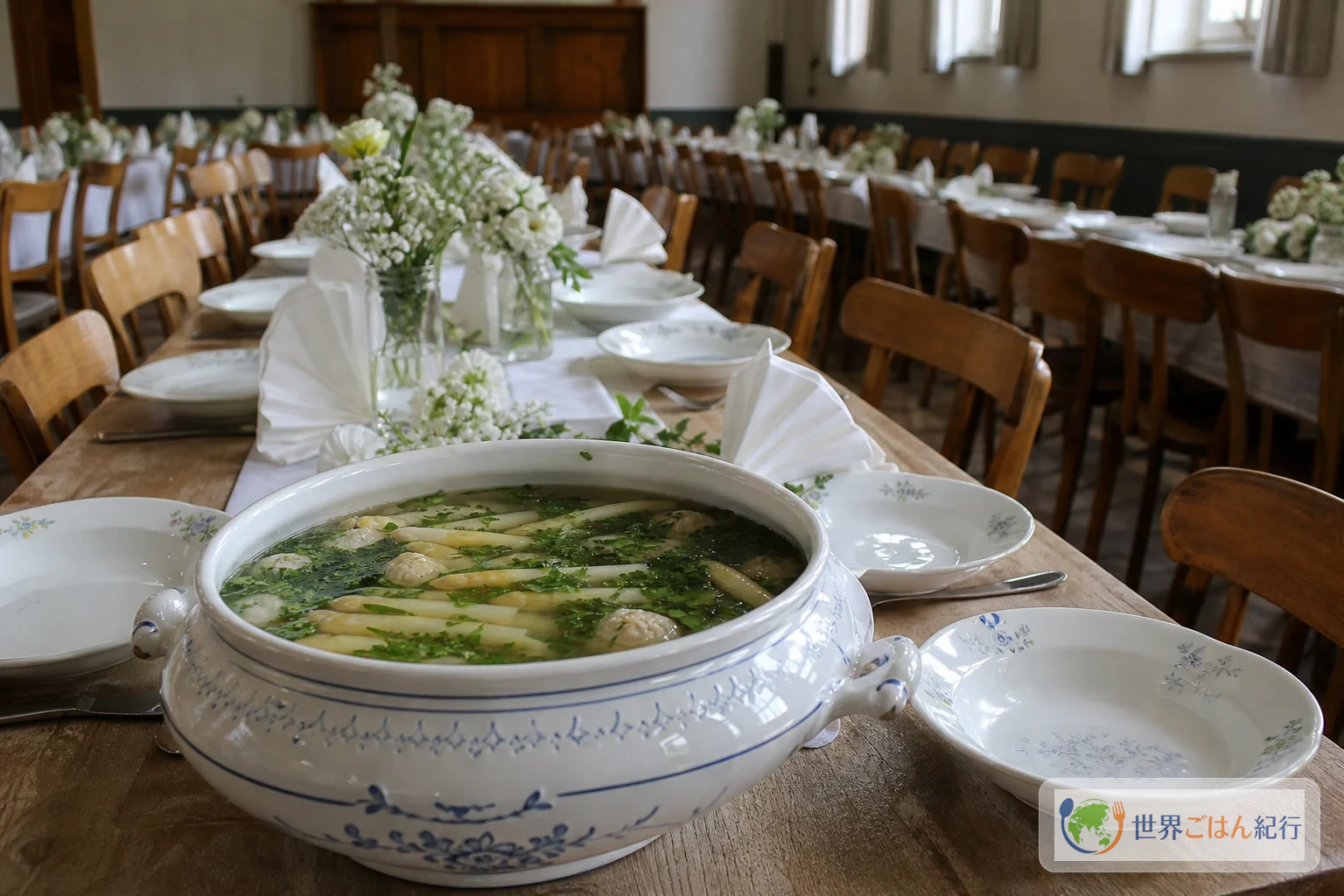
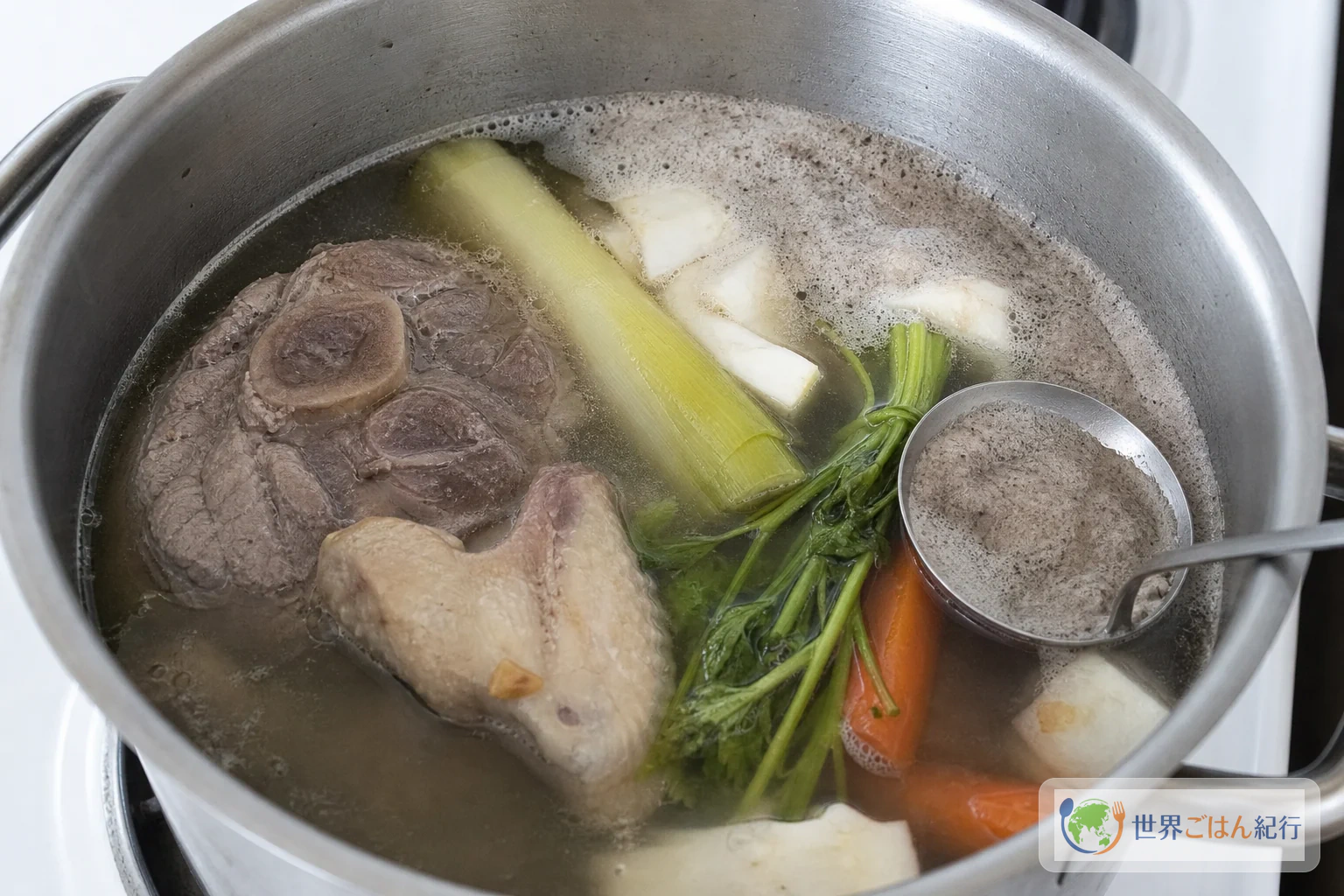
The Wendland recipe from the Lower Saxony tourism board is, from the start, for 10 to 12 servings. Beef shank, beef bones, a whole chicken, celeriac and leeks go into 5 L of water and simmer for 2 hours to make the broth. The meatballs are made from 750 g of ground meat and there is 800 g of white asparagus. These are amounts for a pot to welcome people, not a family dinner. The same page also introduces it as "indispensable at a good feast." Both amounts and steps are built to serve the first plate to a good number of people from one big pot.
Looking into the pot, no single expensive ingredient lords it over the others. Beef-and-chicken broth, meatballs, egg, white asparagus: ingredients each prepared differently fit into one ladle. One person can roll the meatballs while another cuts the Eierstich and another trims the asparagus, so work is easy to divide even in a banquet kitchen. Returned to the big pot, the same combination can be served at every seat. The abundance of ingredients has some practicality of a festive day mixed in.
When the region changes, the contents under the same name move. In Land Hadeln, between the Elbe and Weser rivers, Hadler Hochzeitssuppe is known, with meatballs, rice, cauliflower and asparagus. An official introduction to Sorbian culture from the state of Saxony gives the Sorbian name as kwasna poliwka and describes a homely version using beef and vegetable broth, noodles, carrots, celeriac, Eierstich and meatballs. There is also an account of using liver dumplings traditionally, so even the meatball itself differs by region.
The story in the REWE recipe about "which of the bride and groom puts in the spoon first" is best read as a small piece of table lore that remains. After the ceremony, everyone sits in front of the same steam. When you make it at home, too, rather than adding decoration, clearing the soup and serving from a large bowl lets you feel the origin of the dish's name at the table.
Ingredients: building a pot for six
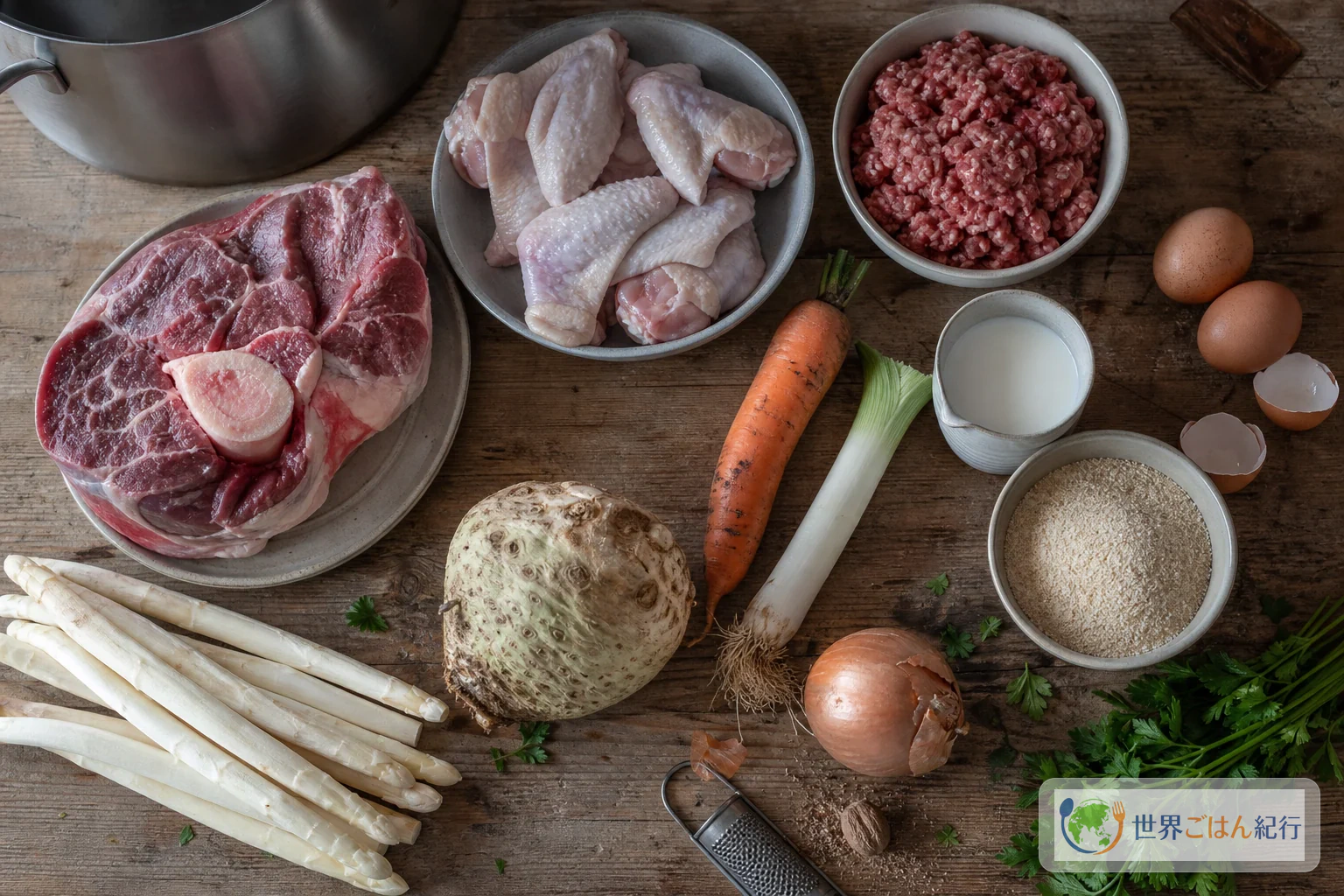
The finished amount is about 2.1 L. As a starter it serves 6, as a light lunch about 4. White asparagus can be used fresh or from a jar. If you use jarred, it is salty, so go easy on the broth's salt until the end.
Clear broth
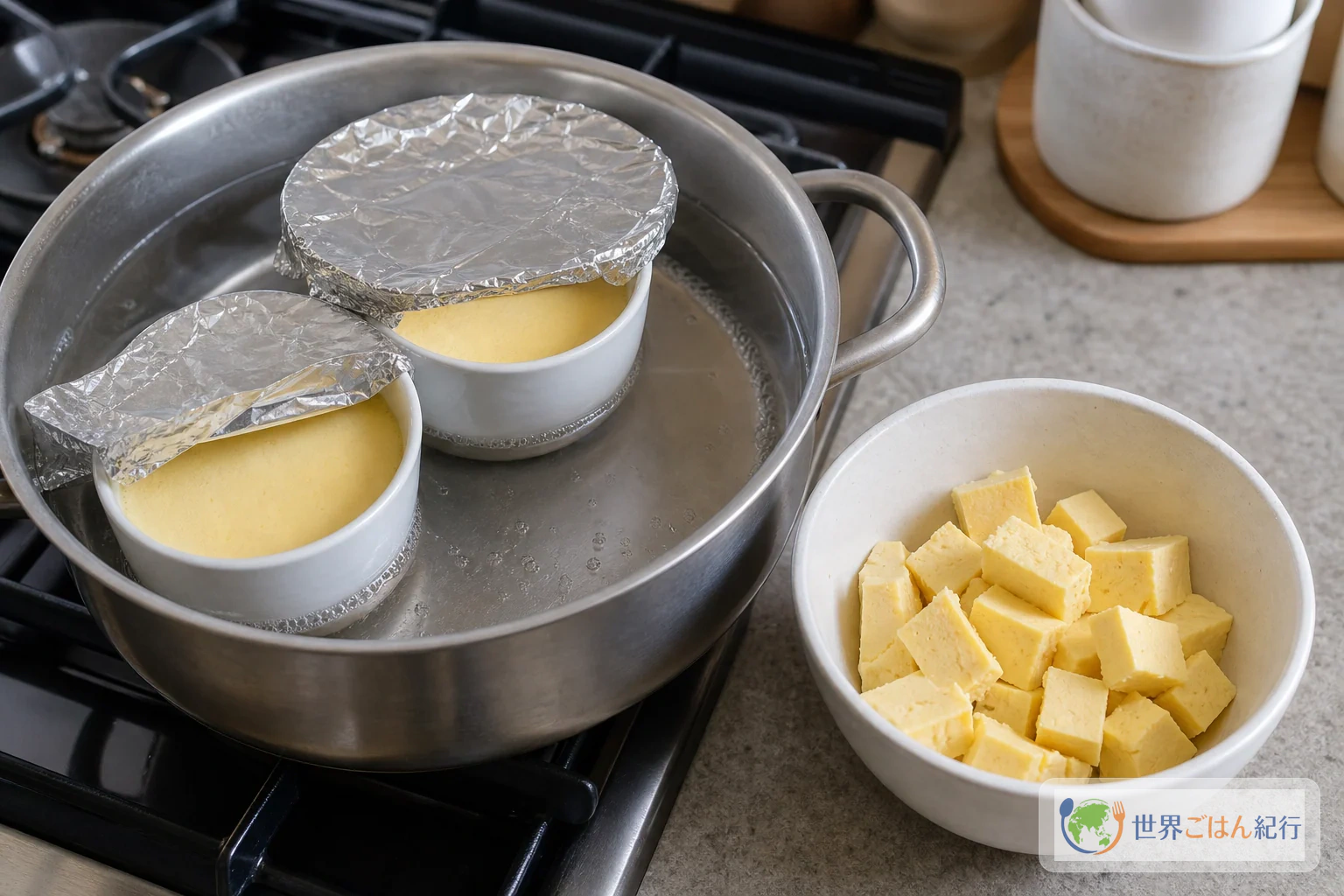
Eierstich (egg custard)
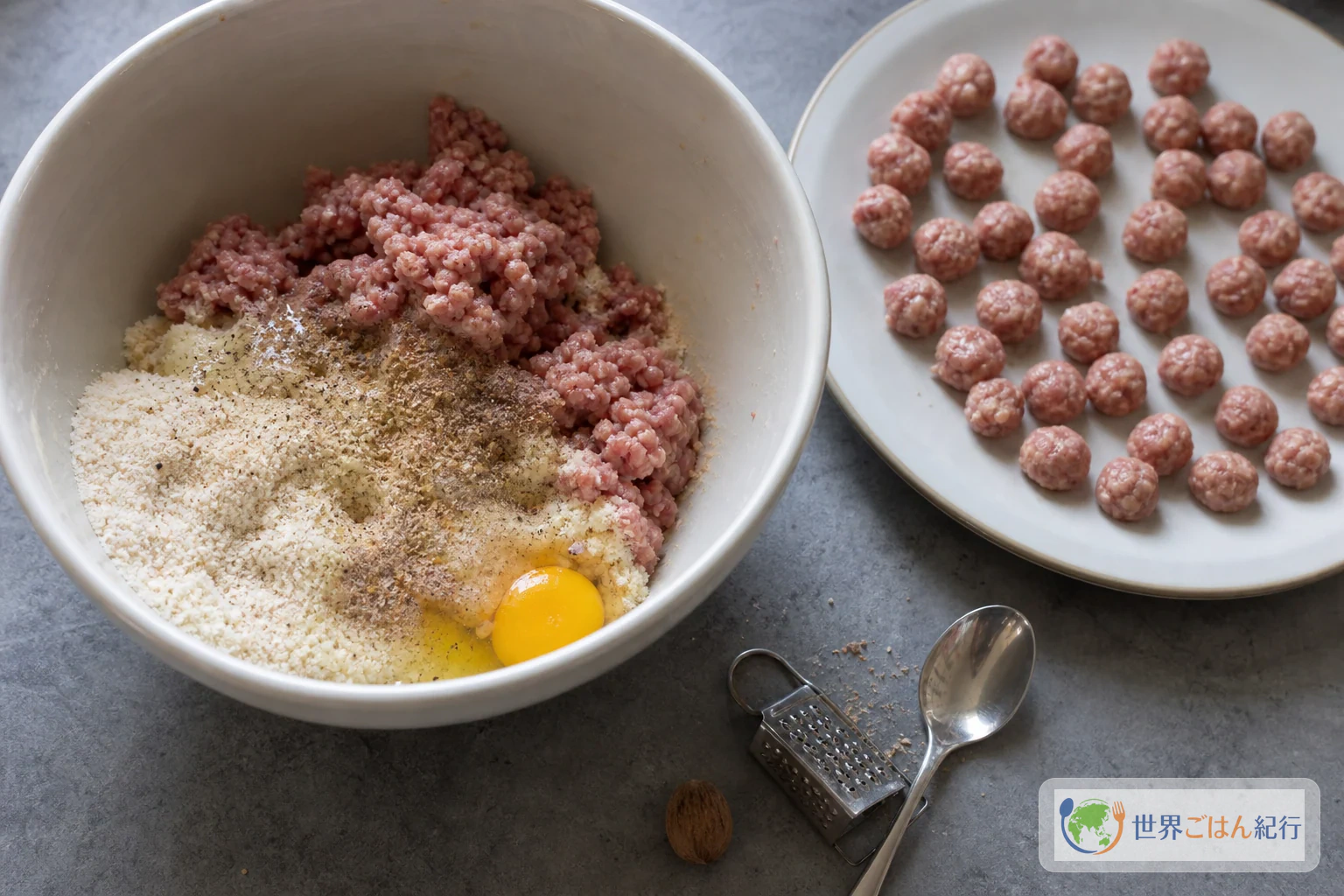
Fleischklößchen (small meatballs)
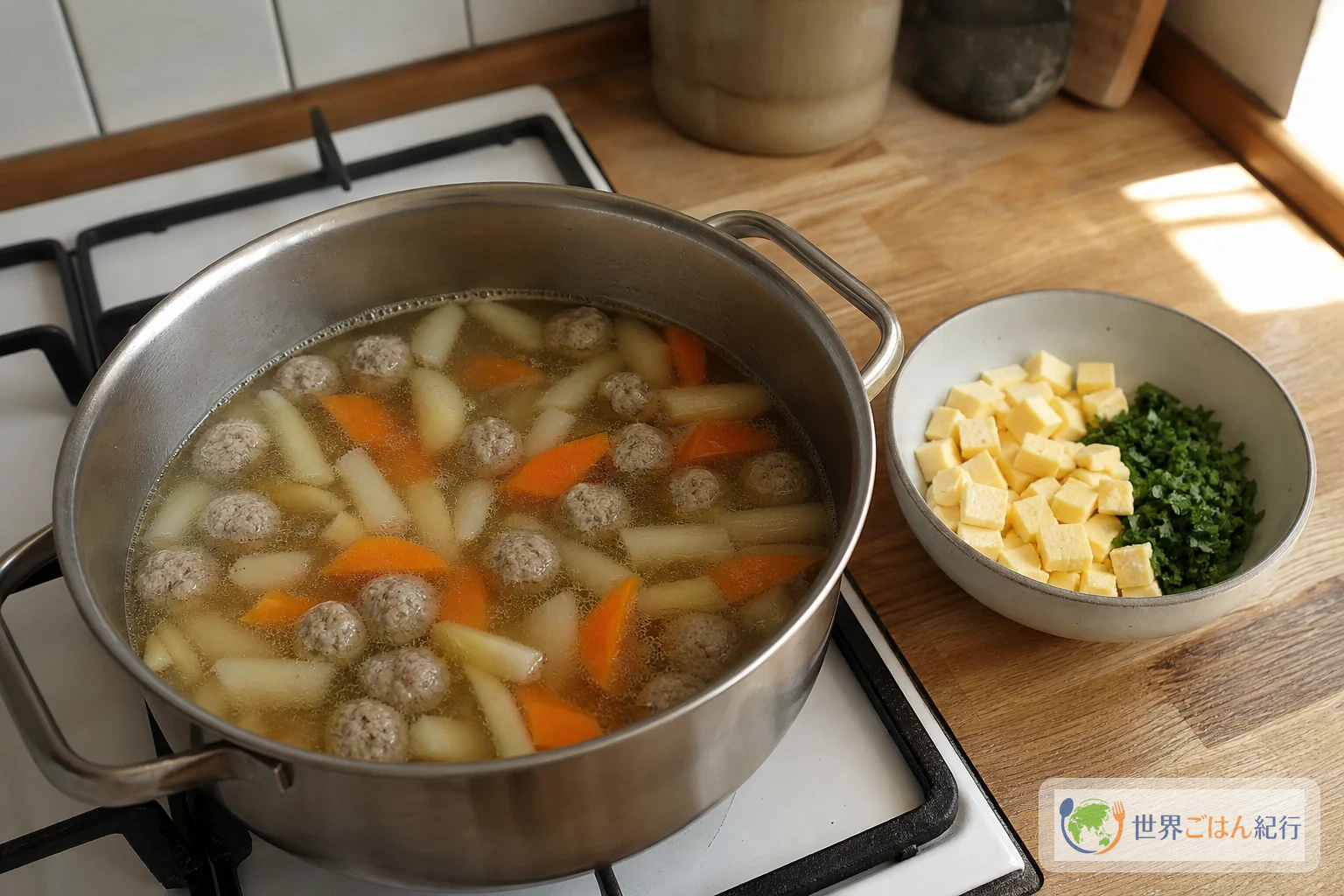
Finishing ingredients
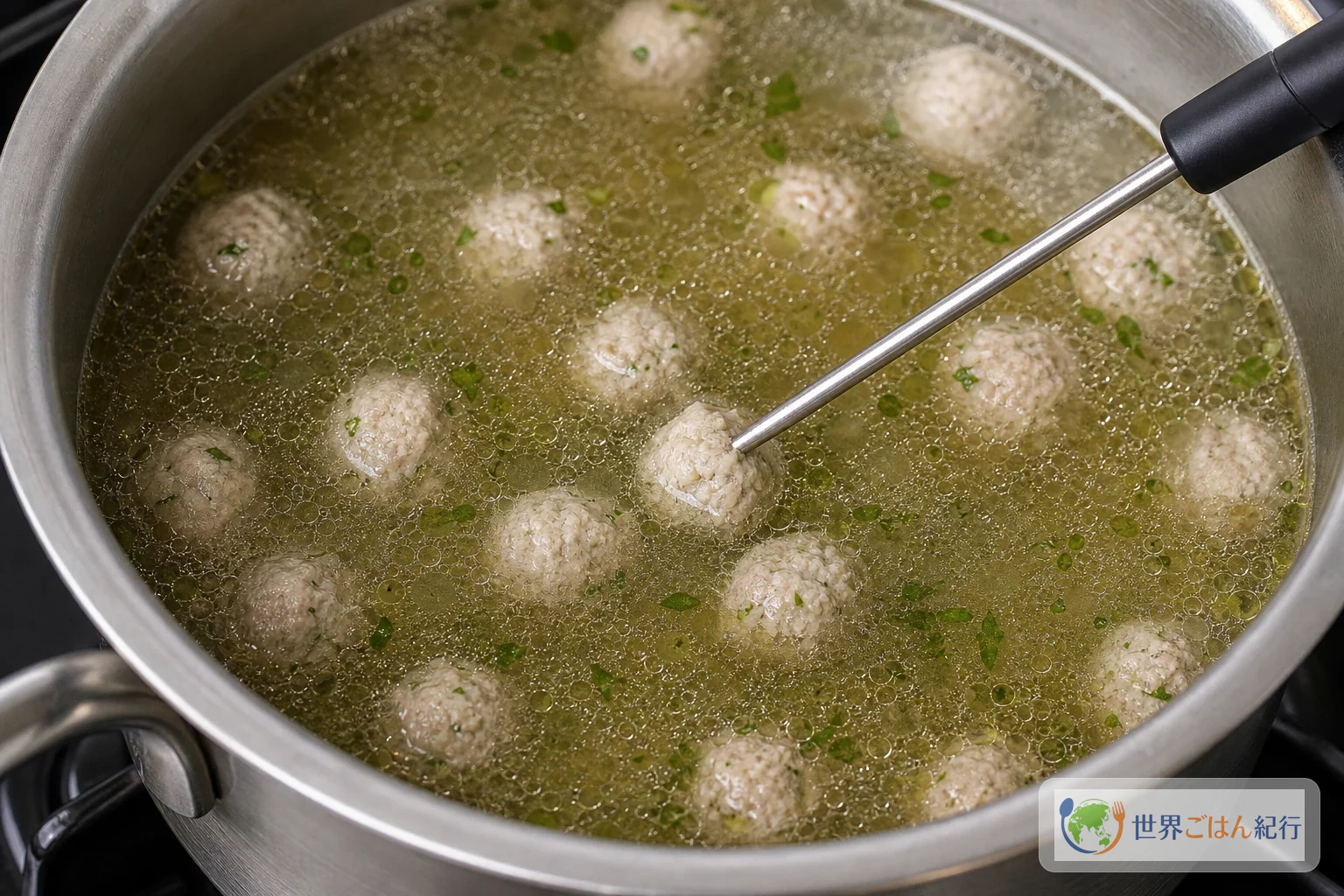
This uses beef, chicken, pork, eggs, dairy and wheat. Also check the allergen labeling on each product. For the meatballs, use 71°C in the center of the largest one as the guide, and 71°C in the center of the Eierstich as well. Under the standards of the U.S. FoodSafety.gov, both ground meat and egg dishes are 71°C. Don't judge safety by color or by whether they float; check with a thermometer.
Shopping: tools for watching the heat, rather than rare spices
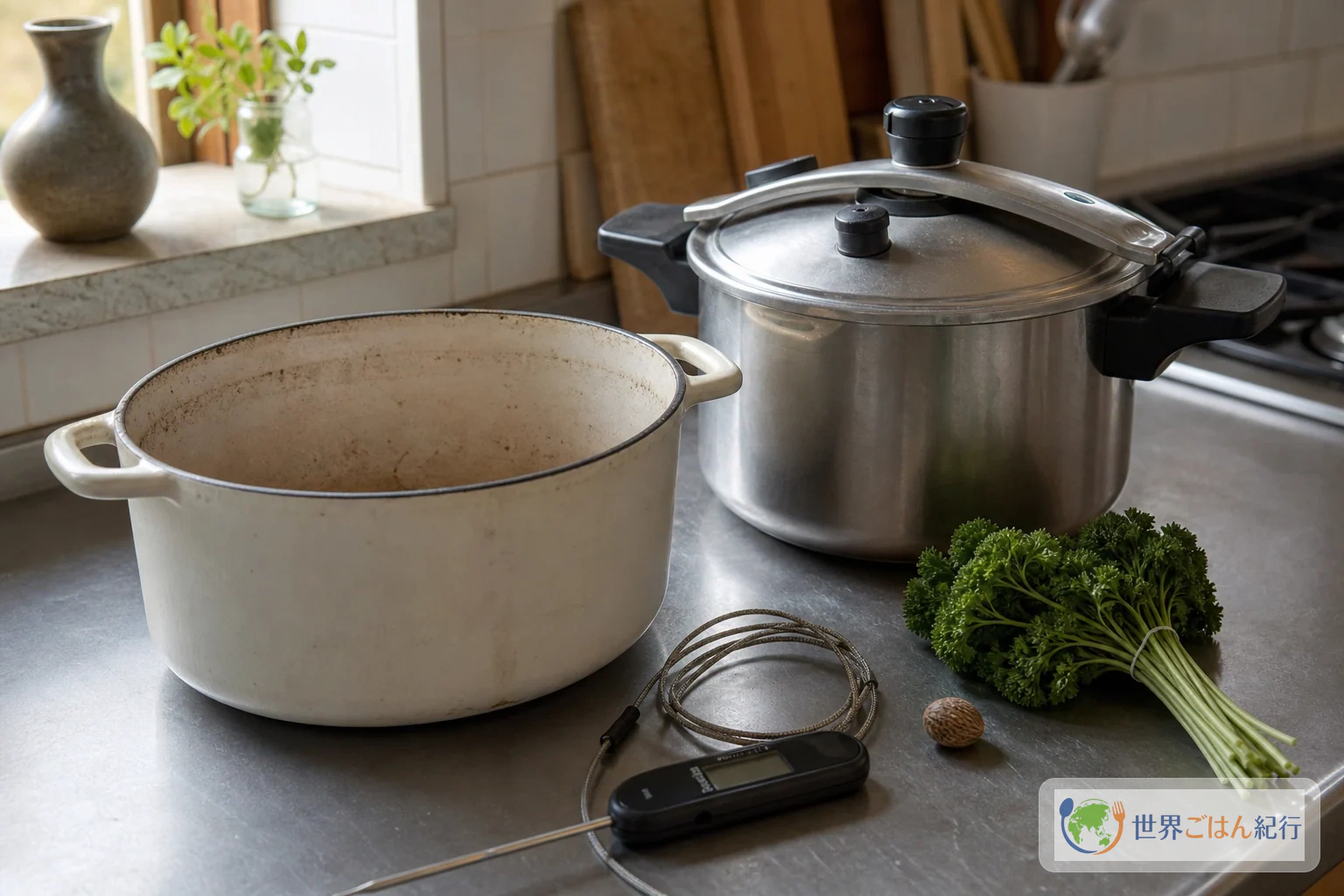
What to buy locally is beef shank, chicken wings, ground meat, eggs and root vegetables. There's no need to shop for ordinary meat and dairy online. What makes the difference is a heavy pot that keeps 2 L or more of broth quiet, a thermometer to check the center of the meatballs, and a pressure cooker to shorten the long broth-making.
A thin pot isn't bad, but even after dropping to low heat only the bottom boils hard and scum scatters through the soup. A pot of 4 L or more with a thick bottom keeps the movement of the surface small more easily.
The meatballs floating is the sign that they have started to cook. Simmered quietly in a heavy pot, the surface is less likely to break and the clarity of the soup is easier to keep.
If you make it only for a celebration day, an ordinary pot is enough. If you'll make it several times in the cold season, separating the step of warming a small amount of broth in a saucepan to adjust the seasoning lets you finish without breaking up the ingredients.
Method: finish the parts separately and bring them together at the end
Not boiling the broth too hard, and finishing the meatballs, egg and asparagus separately: these two points change the look a great deal. Cooking everything in one pot looks quicker, but the corners of the egg break down, the fat of the meatballs floats and the asparagus gets too soft.
Decisions for bringing it toward a clear bowl in a home kitchen
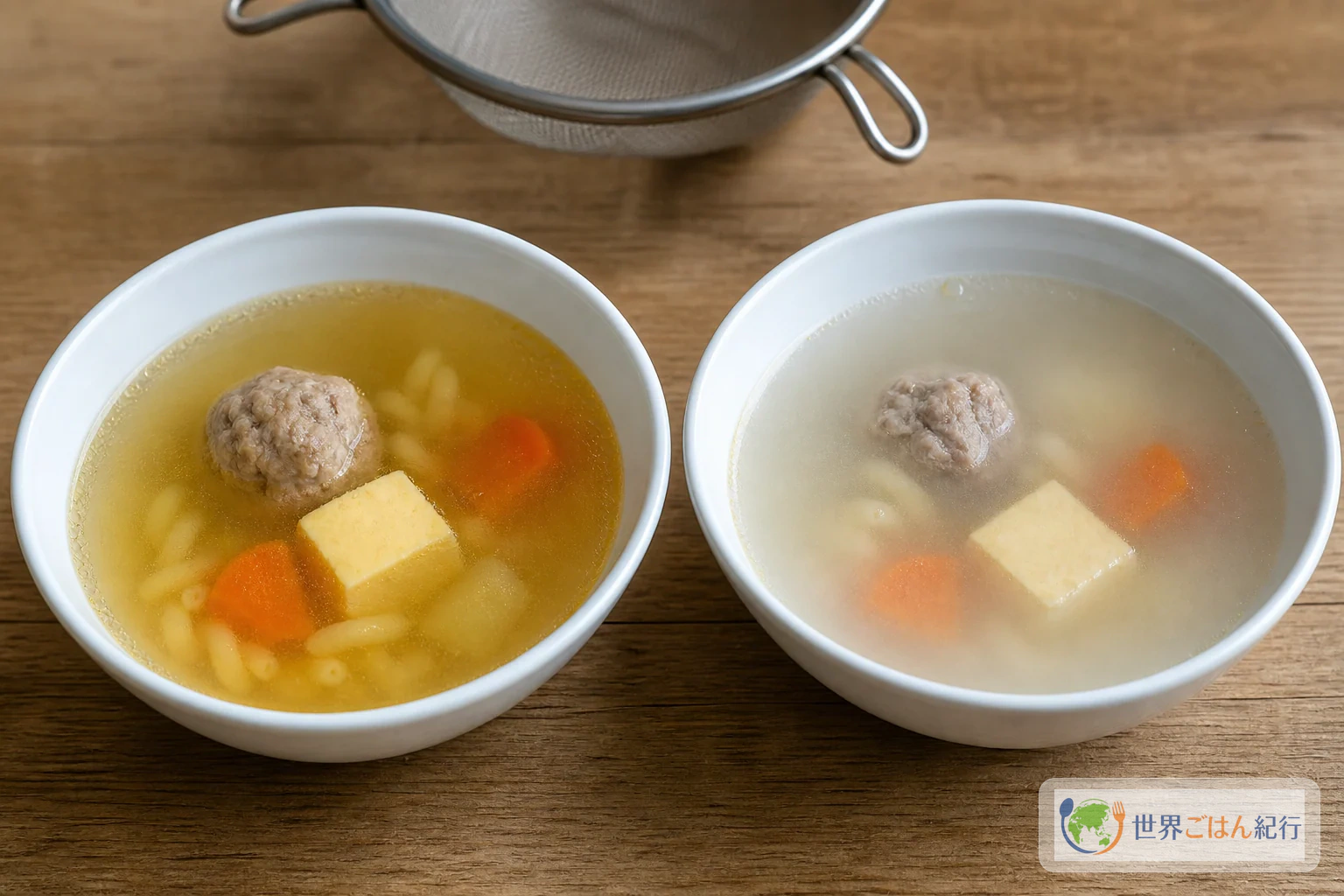
What stops you at the market is beef bones, celeriac and white asparagus. You needn't hunt for all three at specialty shops. Keep this combination: a layered beef and chicken broth, meatballs and Eierstich, and the order of finishing the ingredients separately, and the impression when you eat it won't depart much.
| Ingredient or step that gives pause | Why keep it | Realistic answer |
|---|---|---|
| Bone-in beef shank | Beef aroma and gelatin | Use 400 g boneless beef shank and 450 g chicken wings |
| Celeriac | Sweetness and earthy aroma of root vegetables | Combine 1 celery stalk and 100 g small turnip |
| White asparagus | A spring ingredient of northern Germany | Drain jarred asparagus and warm it at the end |
| Green asparagus | Stronger color and green aroma | If substituting, cut into 4 cm lengths and simmer only the last 3 minutes |
| Eierstich | Yellow cubes and a soft mouthfeel | Set with milk and eggs, without adding dashi as for chawanmushi |
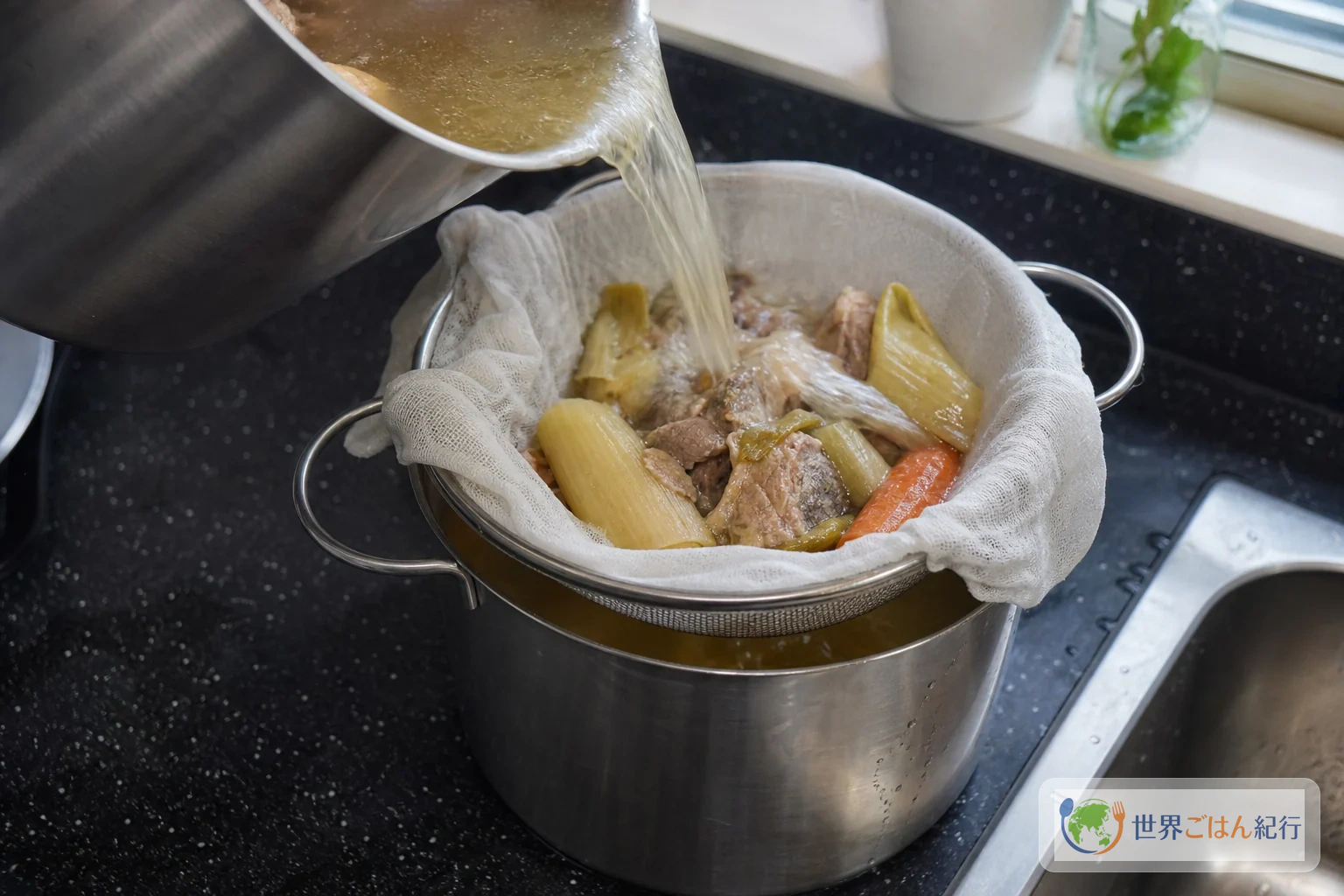
| Clear broth | The lightness of a celebration's first plate | Don't boil, and strain without pressing the solids |
A cloudy broth is still edible. Forcing a clarification with egg white adds work and, at home, tends to thin the flavor too. On a day it clouds, strain once through a cloth and serve after adjusting the salt and the meat aroma rather than the clarity. Next time, it is easier to correct if you remember "stop the boil" before "skim the foam."
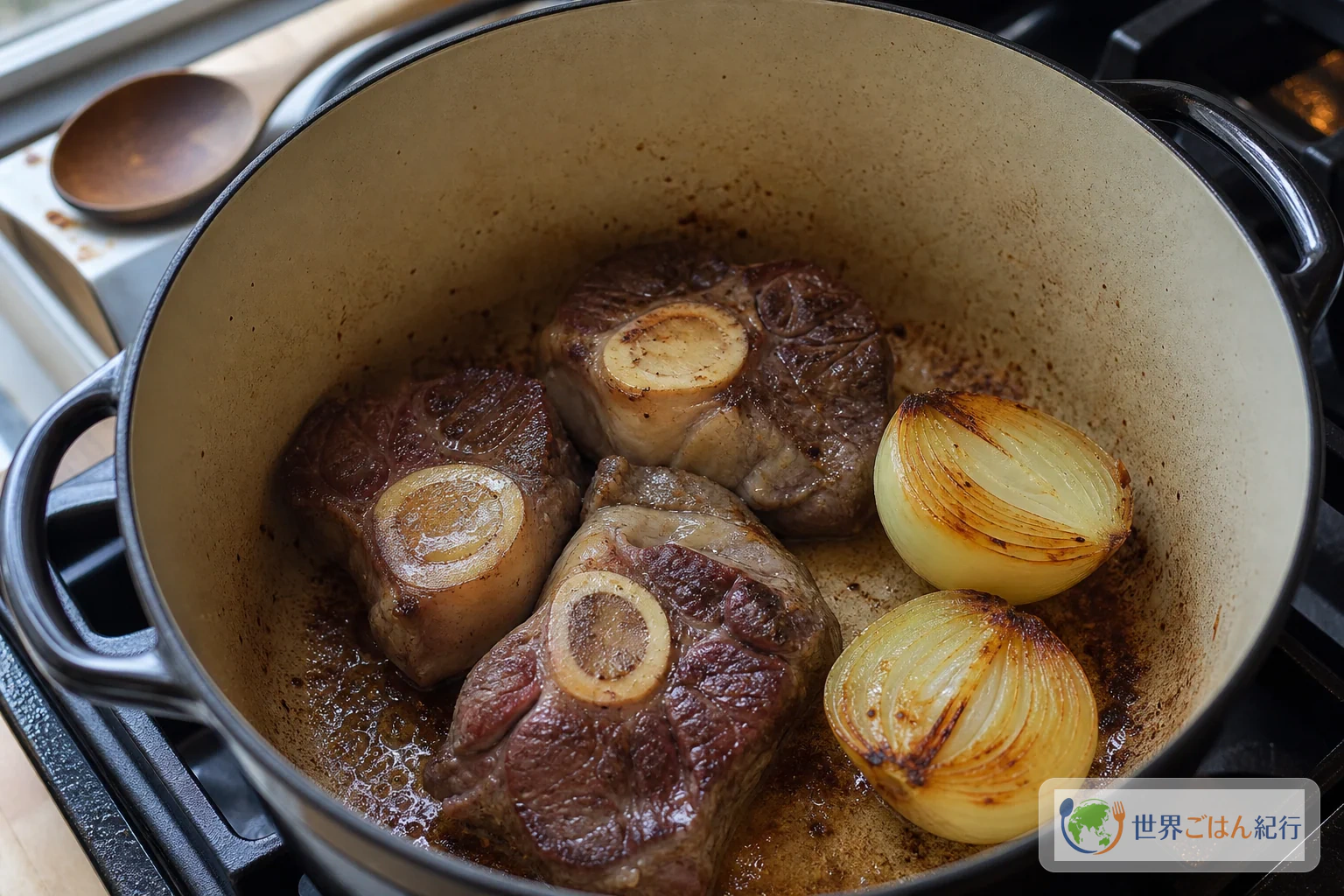
For a shortened pressure cooker version, put in the seared beef shank, chicken wings, aromatics and 2.5 L water, cook at high pressure 25 minutes and release the pressure naturally for 20 minutes. After straining, move to an ordinary pot and finish the meatballs, Eierstich and asparagus separately as usual. Don't cook the meatballs or egg in the pressure cooker. Separate the place where you go fast from the place where you protect the shape.
Regional differences: the same name, different pots
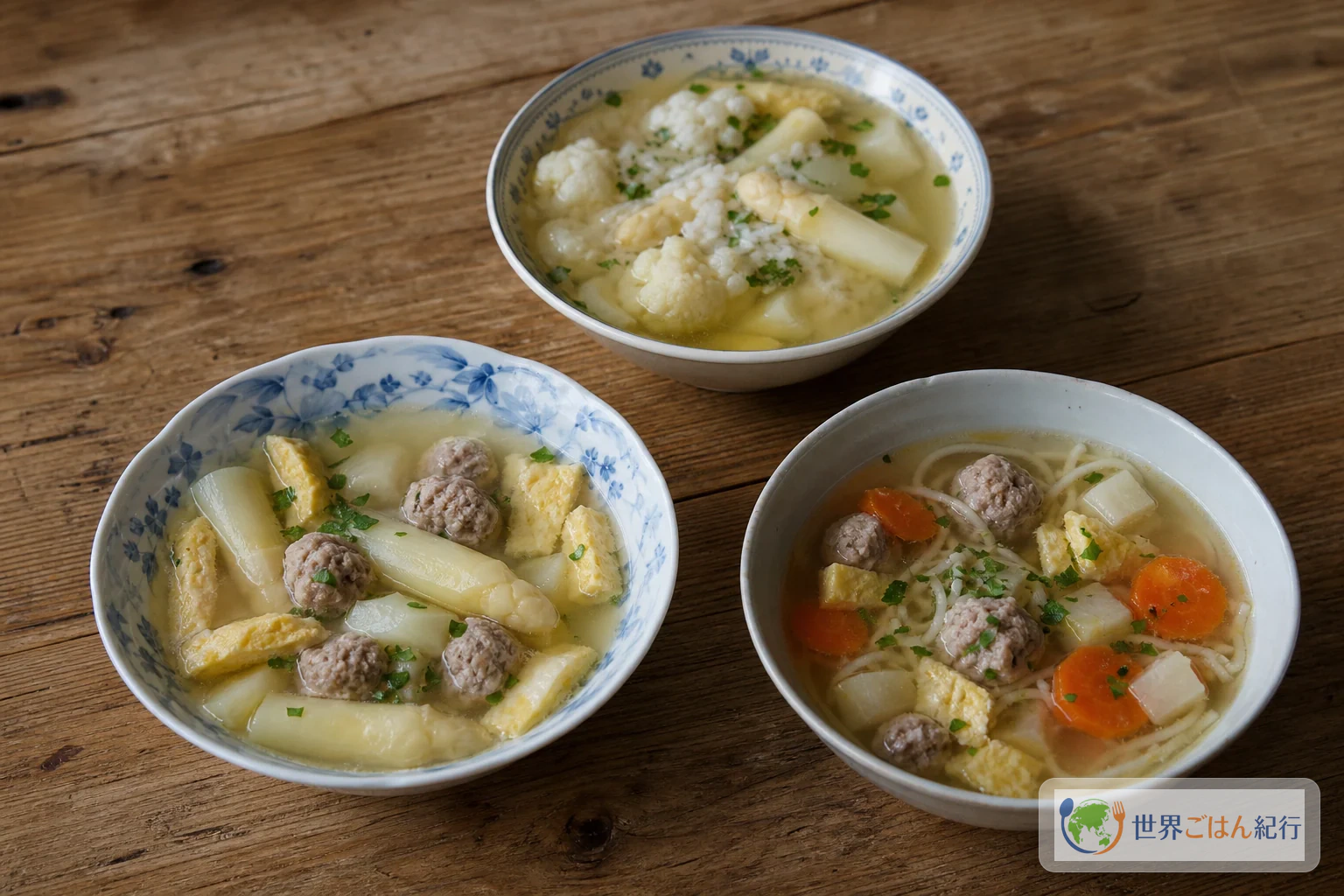
The ingredients of Hochzeitssuppe are not fixed across the country. The occasion of a wedding comes first, and the local meat, vegetables, noodles and rice gather in the pot.
| Region or name | Main ingredients | Character at the table |
|---|---|---|
| Wendland, Lower Saxony | Beef and chicken broth, meatballs, Eierstich, white asparagus | For large feasts. Parts made separately and combined in a big pot |
| Land Hadeln, Hadler Hochzeitssuppe | Beef broth, meatballs, rice, cauliflower, white asparagus | With rice, a slightly more filling bowl |
| Sorbian region, kwasna poliwka | Beef and vegetable broth, meatballs or liver dumplings, noodles, root vegetables, Eierstich | Served from a large tureen, home-style |
| Southern German versions | Flädle, Grießnockerl, Brätspätzle and so on | More starchy ingredients, putting local noodle culture forward |
That white asparagus appears in both the Wendland and Hadeln versions is not unrelated to the seasons of northern Germany. The Lower Saxony tourism board gives the state's white asparagus season as April to the end of June. At a spring or early summer wedding, the season of the fields goes straight into the celebration pot. Fresh white asparagus can be expensive in some places, so choose fresh only when you find it at a reasonable price in season, and otherwise use jarred; it is less strained. You keep the white color and can make the same composition out of season.
For a first time, the Wendland version is easiest to make. Without rice or noodles, you can concentrate on how clear the broth is and on the four ingredients. If you have room the second time, add 20 g of cooked rice per person in the Hadeln style, or a small amount of thin egg noodles in the Sorbian style. If you know where you're changing it, regional differences can be enjoyed as differences of place rather than as arrangements.
Comparing roles, it contrasts with France's garbure, where ingredients and beans pile up into a one-dish main course, and Finland's lohikeitto, finished white with salmon and dairy. Even with many ingredients, wedding soup is a clear entrance that welcomes the next plate. That's also why you hold back on how much goes into the bowl.
How to eat it and storage: from a large bowl, the first plate
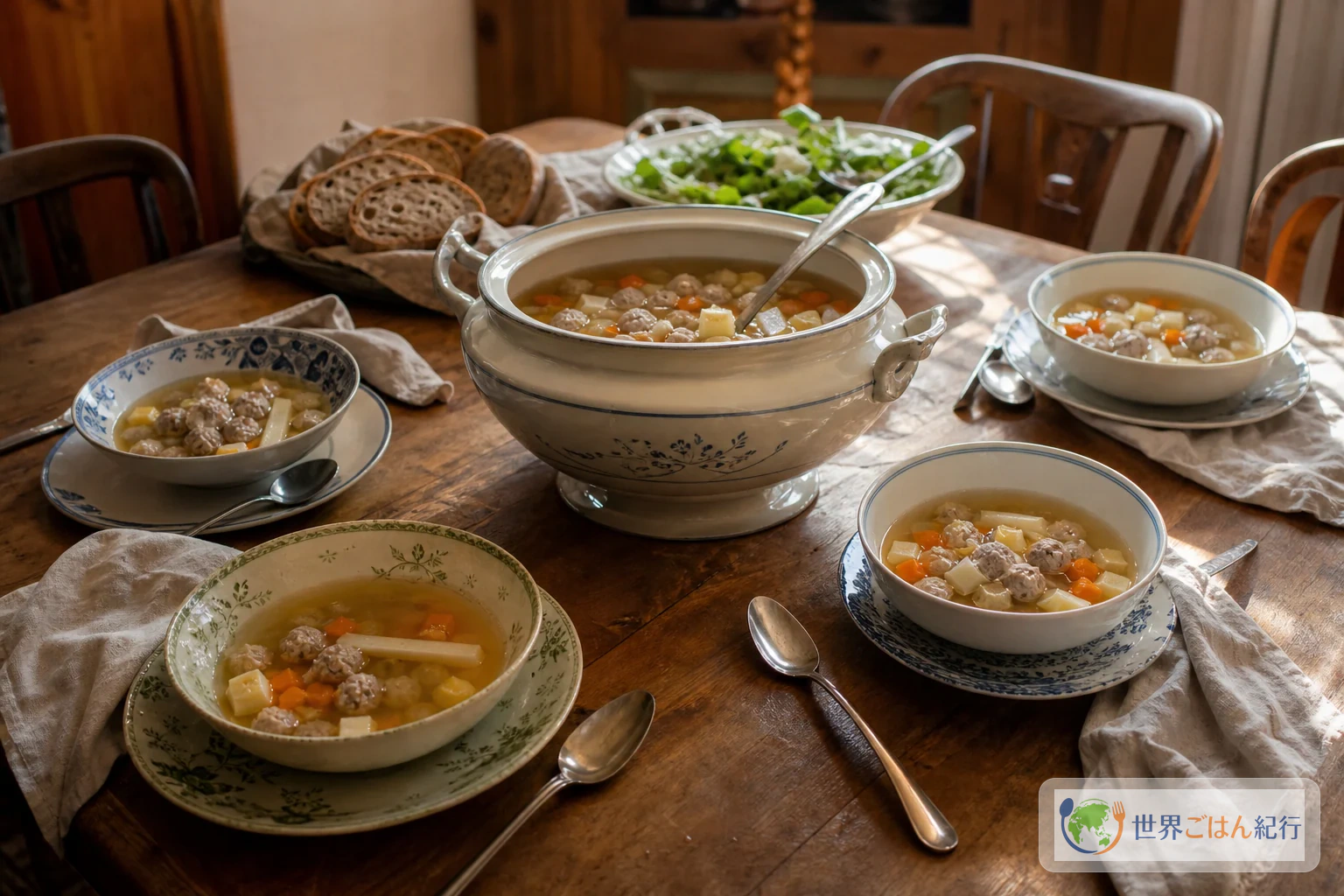
To serve it like a wedding menu, pour 250 ml to 300 ml per person into a deep plate. Put in 5 to 6 meatballs and about 4 pieces of Eierstich. If you get greedy with the ingredients, it looks more like a stew than a clear soup. Put a large tureen or deep bowl on the table and each serving differs a little, one plate with more meatballs and another with more asparagus, which is itself the character of a home big pot.
The plates that follow are better kept light. To connect to a German table, serve sweet-and-sour Bavarian-style red cabbage as a side and a small portion of Käsespätzle in place of a main. Rather than stacking a larger meat dish after a meat soup, giving yourself an escape in acidity or starch makes it easier to eat to the end.
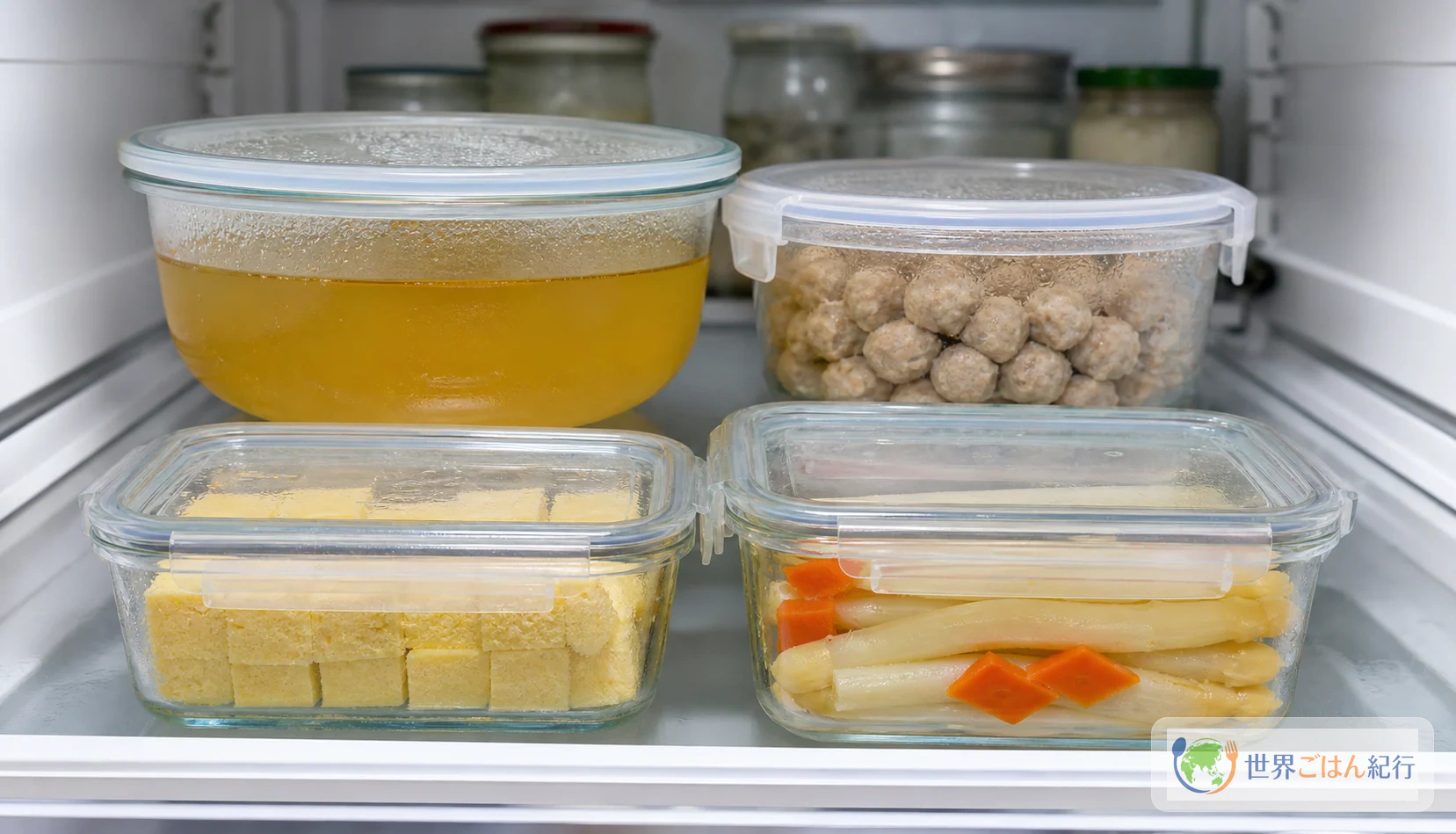
For storage, keep the broth, meatballs, Eierstich and asparagus separate. Move them to shallow containers, cover once the steam settles, and refrigerate quickly. USDA FSIS gives 3 to 4 days in the refrigerator for cooked leftovers. In this article, prioritizing texture, the guide is 3 days refrigerated for broth and meatballs and 2 days refrigerated for Eierstich and asparagus. To reheat, warm the broth and meatballs first to 74°C and add the Eierstich and asparagus only for the last 2 minutes.
For freezing, keep only the broth and meatballs, separately, for 1 month. Eierstich gets watery and pocked, and asparagus gets soft in the fibers, so don't freeze them. Thaw overnight in the refrigerator, or warm directly in a pot over low heat.
For another dish that doesn't hurry the fire, try Sweden's tjälknöl. Putting frozen meat into a low oven, it looks nothing alike, but the decision not to try to win back time with high heat is shared.
Frequently asked questions
How far ahead can I make it the day before?
You can make the broth, meatballs and Eierstich. Chill them all in separate shallow containers and refrigerate. On the day, warm the broth and meatballs first, cook the asparagus and carrot, and return the Eierstich last. If you combine everything in one pot the day before, the egg breaks down from the corners and the asparagus gets soft.
What if I can't find white asparagus?
Jarred is easiest to handle and keeps the local white look. Drain it, cut it into 4 cm lengths and warm it only for the last 2 minutes. You can also make it with green asparagus, but the green aroma is stronger and the color gives a different impression. If you use it, simmer it only the last 3 minutes and don't let it get too soft.
My Eierstich has holes. Can I fix it?
They are no problem for eating. Large holes tend to come from whipping the egg mixture or boiling the water bath. Next time, strain the egg mixture through a tea strainer and set it in 80–85°C water. For this batch, cutting it a little smaller than 1.5 cm makes the holes in the cross-section less noticeable.
Will it have flavor if I can't get beef bones?
Yes. Use 400 g boneless beef shank and 450 g chicken wings and simmer quietly for the same time. The bones and skin of the chicken wings make up the gelatin. Adding commercial bouillon from the start makes the salt and aroma strong, so use up to 1/2 tsp only if the flavor is weak after straining.
Can I make the meatballs with beef only?
Yes. Switch to 300 g ground beef and increase the cold water to 40 ml. Leaving out the pork lowers the fat, so they tend to firm up a little. Keep the mixing to within 1 minute and the cooking on low heat. The standard of 71°C in the center does not change.
How do I bring back frozen soup?
Thaw overnight in the refrigerator, or put it into a pot frozen and warm on low heat. Don't keep boiling it; once it has completely melted, add the meatballs and reheat everything to 74°C. Don't freeze the Eierstich and asparagus; preparing them the same day or the day before keeps the texture.
Sources consulted
- Reiseland Niedersachsen: Wendländische Hochzeitssuppe - checked the Wendland composition: beef shank, beef bones, chicken, Eierstich, meatballs about 1 cm in diameter and white asparagus, for 10 to 12 servings.
- Reiseland Niedersachsen: Wendländische Hochzeitssuppe PDF - checked the step of simmering the broth about 2 hours and the cooking order in a big pot.
- Reiseland Niedersachsen: Spargel aus Niedersachsen - checked that the white asparagus season in Lower Saxony runs from April to the end of June.
- Sorbisch? Na klar.: Die perfekte Sorbische Hochzeitssuppe - checked the Sorbian name kwasna poliwka, noodles, root vegetables, Eierstich, meatballs, traditional liver dumplings and serving in a tureen.
- REWE: Hochzeitssuppe - checked that ingredients differ by region and an example of a home-style recipe using white asparagus, Eierstich and Flädle.
- FoodSafety.gov: Safe Minimum Internal Temperature Chart - checked the center temperature of 71°C for ground meat and egg dishes and 74°C for reheating leftovers.
- USDA FSIS: Leftovers and Food Safety - checked the storage guideline of 3 to 4 days in the refrigerator for cooked leftovers.
Finally, shake the pot gently, and turn off the heat when the corners of the egg haven't broken and golden broth shows between the meatballs. Carry the large bowl to the table and ladle meatballs and egg up together. Handing out that bowl is the finish of Hochzeitssuppe.