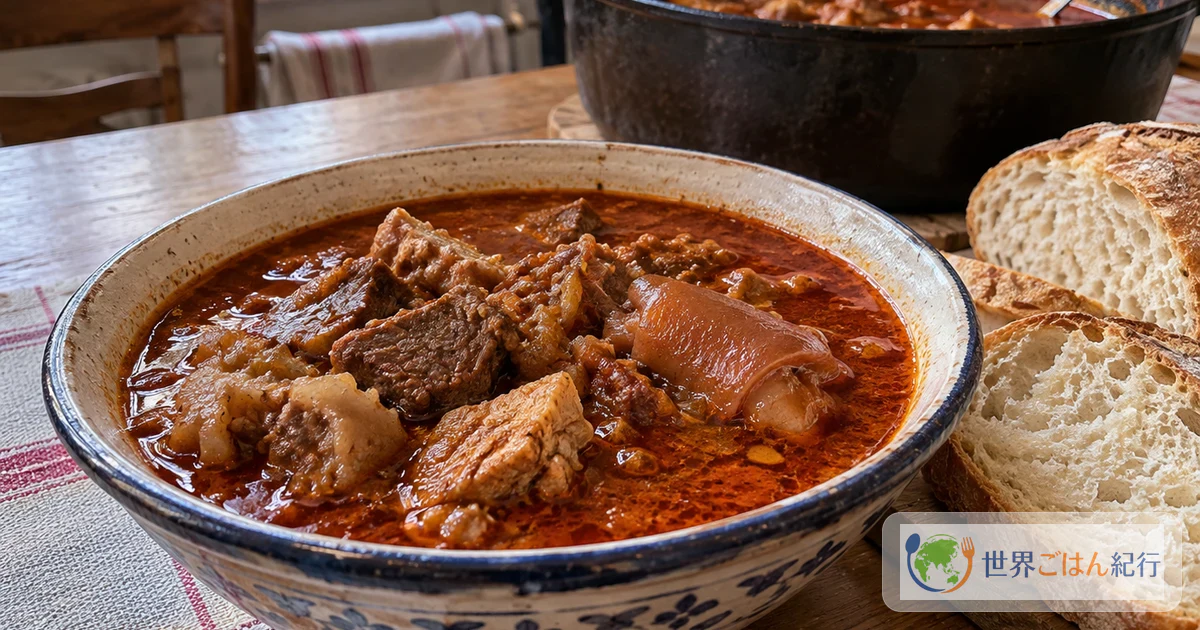
A feast of white beans for a cold midday
Beans tremble at the edge of the pot, and the red oil of the chorizo slowly rises. Fabada asturiana is a dish that does not hurry that time. It is a white bean stew eaten in the cold season in Asturias in northern Spain, and locally it is served as the main event of lunch.
When people think of Spanish cooking, many picture the light colors of Paella Valenciana (in Japanese) or Gazpacho. Fabada is on the opposite side. White beans, cured pork products, saffron, a little onion. The ingredients are few, but eating it has the weight of a midday meal at a mountain inn.
Asturias lies between the sea and mountains in northern Spain, and if you go imagining the sunny tourist south, the damp air and the way winter chills are a little different. That is why it makes more sense to see fabada not as a light tapa for late at night, but as a dish you eat solidly at midday and then want to rest afterward. A pot where the red oil of chorizo slowly moves into the whiteness of the beans is not showy, but it can fill the center of the table.
The local backbone is the combination of large white beans called fabes and the pork products called compango. Compango includes chorizo, morcilla, lacón and panceta. Because it can be hard to gather all of that outside Spain, this article is designed around great northern beans or cannellini, paprika chorizo and bacon, with morcilla added only when you can get it.
If Cocido Madrileño (in Japanese) is a big pot eaten in three acts, fabada is a stew that closes all the savor into one pot. Even among bean dishes, it has more fat and smoky aroma than Greece's Fasolada, and is quieter in seasoning than Brazil's Feijoada. The most important thing is to keep the beans whole and let the aroma of the meat transfer to them gradually.
Fabada and compango at the local table
Fabada is the signature stew of the Asturias region. The official Spain.info recipe, for four servings, uses 400 g of fabes, Asturian chorizo, dried smoked morcilla, lacón, bacon, saffron and salt, soaking the beans overnight and cooking them in a wide earthenware pot.
The recipe on the official Asturias tourism site also lists beans, morcilla, chorizo, garlic, bay leaf, bacon, onion and paprika as ingredients, and its steps include blanching the meat to remove impurities and adding saffron at the end. Seeing it not as a dish where beans and meat are simply boiled, but as one that protects a clear broth and the shape of the beans, makes the meaning of the heat control easier to understand.
What is interesting about this dish is that although it uses rich ingredients, the hand with seasoning is quite quiet. It is not made sweet-sour with tomato or hot with chili. You wait while the soaking water of the beans, the saltiness from the meat, the red oil of the chorizo and the aroma of saffron gradually become one in a low-heat pot. So when making it elsewhere too, adjusting the size of the beans, the saltiness of the meat and the heat is a shorter path than filling in missing flavor with sauces.
Locally, the meat is sometimes cooked whole and cut before eating, or served on a separate plate from the beans. In a home kitchen, cutting it small from the start looks easier to eat, but cutting too finely beforehand breaks up the chorizo and morcilla and leaves fat and a floury texture in the broth. The reason this recipe takes the meat out partway and slices it is not only for looks. It is to separate the time of quietly simmering the beans from the timing of cutting the meat to an easy size.
| What to look at | What matters in fabada | Compromise in a home kitchen |
|---|---|---|
| Local name | Fabada asturiana, an Asturian bean stew using fabes | Written "fabada" in the article, with the local name alongside in the text |
| Beans | Originally the large white beans of Faba Asturiana PGI | Substitute great northern beans, white runner beans or cannellini. Canned beans are the time-saving version |
| Meat | Compango: chorizo, morcilla, lacón, panceta | Approximate with paprika chorizo, bacon and pork shoulder |
| Aroma | Saffron, smoked meat, the red oil of paprika | Fill out the outline with a little saffron and smoked paprika |
| How it is eaten | A heavy midday plate. The meat is sometimes sliced and served separately | Serve with bread, a green salad and the acidity of apple cider vinegar |
The PGI Faba Asturiana is a scheme that treats the traditional variety Granja Asturiana of Phaseolus vulgaris as a dried bean. It is hard to buy the same bean every time elsewhere, so rather than an exact match, choose "a large bean that holds up to simmering and turns creamy when cooked." You can make it with smaller white beans, but the generous, comfortable heft that is typical of fabada is a little weaker.
Ingredients (serves 4)
These are basic amounts starting from dried beans. When using canned beans, use 800 g of cooked beans instead of 400 g of dried beans, and shorten the simmer to around 45 minutes. However, canned beans break up easily, so stir the pot less often.

This dish contains pork and sausages. Chorizo and bacon may contain dairy, wheat or soy depending on the product, so check the labels. Salt comes from the cured meats, so do not add much from the start and adjust at the end in teaspoon-fraction increments.
What is worth seeking out are the beans, chorizo, saffron and smoked paprika. Buying ordinary onion, garlic and bacon nearby and sourcing only the items that decide the aroma from a specialty shop or online makes for fewer wasted purchases.
How to make it
If you boil the beans hard, the skins split and the broth turns cloudy. Think of it not as a dish where you stir the pot to even out the flavor, but one where you shake the pot to move the beans.
Where it goes wrong and how to recover

The most common failure with fabada is not weak flavor but split beans. When beans split, the broth suddenly turns heavy, takes in too much of the meat's fat and goes dull. Before making the flavor stronger, revisit the heat and the water level.
| State | Cause | Recovery |
|---|---|---|
| Bean skins are split | Boiled hard, or stirred with a spatula | Turn off the heat and rest for 10 minutes, then keep it low. Treat the broken beans as thickening for the broth |
| Beans have a core | Under-soaked, old beans, too little water | Add 100 ml water, not boiling water, and extend by 30 minutes over low heat |
| Too salty | The chorizo or bacon is very salty | Add 200 g cooked white beans or 150 g potatoes and simmer 15 minutes |
| Broth is watery | Too much water added, beans still hard | Remove the lid and simmer over low heat for 15 minutes to cook off liquid |
| Meat is tough | Boiled hard after blanching | Take out only the meat, slice thinly and rewarm in the beans for 10 minutes |
The "moving the pot" in the local recipes is a motion to circulate the broth without crushing the beans. In a home kitchen, using oven mitts and rocking 2–3 cm side to side is enough. Shaking the pot widely makes hot broth splash, so do not overdo it.
How far to lean toward the local version elsewhere
The order of priority to protect in substitutions for fabada is beans, chorizo, fatty pork and saffron. Morcilla builds depth of flavor, but it is hard to find in many places, and some people are not used to the smell of blood. Rather than hunting for it the first time, put priority on using paprika chorizo and bacon well and not breaking the beans.
Great northern beans are easy to handle. White runner beans are large and look impressive, but their skin is a little thick and they take longer to simmer. Cannellini are easy to find and give a lighter result. Canned beans suit weekdays, but the sense of the pot "growing" in fabada is weaker.
Chorizo differs between fresh Mexican-style chorizo and dried or semi-dried Spanish-style chorizo. What suits fabada is the type with paprika aroma that holds its shape when simmered. If you only have fresh chorizo, do not blanch it; add it in the last 30 minutes. If added early it breaks up and the broth turns into a red ground-meat soup.
A little saffron is enough. If you dislike the aroma or want to hold down cost, you can omit it. However, substituting turmeric gives an aroma in a different direction, so there is no need to add it just to chase the color. Smoked paprika is an aid when the chorizo is mild. Too much brings only the smoky taste forward.
When unsure while shopping, decide in an order that does not break the dish's skeleton rather than trying to gather everything. In particular, beans and heat are hard to make up for with substitutes, and getting them wrong gives you a "Spanish-style bean soup" but moves away from the weight of real fabada.
| What you're unsure about | Priority | Guide to deciding |
|---|---|---|
| Large dried white beans | High | Rehydrating from dried naturally thickens the broth. With canned beans, accept it as the short version |
| Paprika chorizo | High | Creates the red oil and smoky aroma of the whole dish. Choose one with paprika aroma over heat |
| Morcilla | Medium | Gives depth if you have it, but is fine to skip the first time. Don't force a substitute with another blood-based food |
| Saffron | Medium | A little brings it closer to the local aroma. If the budget is tight, skip it and don't add yellow with turmeric |
| Earthenware pot or cazuela | Low | A heavy pot is enough. What matters is a wide bottom and the ability to hold a steady low heat |
On the other hand, the three things best left unchanged are "do not boil hard," "do not stir the beans," and "decide the salt last." Even if the ingredients differ a little, if you keep these three, the beans become creamy while keeping their shape, and only the saltiness of the cured meats settles without turning sharp.
How to eat it, menus and storage
In Asturias, fabada is eaten warm as a heavy midday meal. If you serve it as dinner, it is easy to eat if you do not add too much starch and add bread, a green salad and a little apple cider vinegar or pickles. You can also pair it with rice, but beans and meat alone are filling enough.

If you build the menu from Spanish dishes, a cold Gazpacho as a starter, and Tortilla Española if you want to add a little egg dish, go well. On days you do not want to pile up heavy dishes, putting a tart salad first, rather than fideuà or paella, makes the meal easier.
For storage, the guide is 3 days refrigerated and 3 weeks frozen. Take off about 20 minutes of heat, move it to a shallow container and then refrigerate. If you refrigerate the whole big pot, the center is slow to cool and the flavor is heavy the next day. To reheat, move only the portion you will eat to a small pot, add 2 tbsp water and warm over low heat for 8–10 minutes. In a microwave, warm at 600 W for 2 minutes, rock the bowl without stirring, and warm for 1 more minute.
The next day you can also stretch the broth a little into a soup. If the beans have broken up, they suit being eaten on bread. If chorizo is left over, mince it and cook it with egg like a tortilla for the next morning's table.
Frequently asked questions
Q1. Can I make it with only canned beans?
Yes. Use 800 g cooked white beans and simmer for around 45 minutes. If you simmer them for a long time with the meat from the start, the beans fall apart, so simmer the meat, onion and garlic for 30 minutes, then add the cooked beans and let them meld on low heat for 15 minutes. It comes out lighter than with dried beans, but it is enough to recreate on a weekday.
Q2. I don't have morcilla. Is it a different dish without it?
It does not become a different dish, but the depth of flavor changes a little. Morcilla adds the richness of blood and a smoky aroma. If leaving it out, add 40 g more bacon and use 1/2 tsp smoked paprika. Trying to add dark richness with soy sauce takes it away from Spanish cooking, so if you add it, keep it to 1 tsp.
Q3. Is saffron essential?
It is not essential. The official Spain.info recipe includes saffron, but at home, omitting it still makes a bean and meat stew. When you want the aroma closer to the local version, use just 6 threads, bring out the color in hot water and add them in the last 15 minutes. Turmeric has a similar color but a different aroma, so it is a different variation rather than a substitute.
Q4. Can I add baking soda to soften the beans faster?
When cooking old beans or using hard water, one method is to add a pinch of baking soda to the soaking water. However, too much weakens the bean skins and makes them break down easily. This recipe uses none as the basic approach; for beans that are truly hard, add just 0.5 g when soaking and change the water before cooking.
Q5. What can I eat it with so it doesn't get too heavy?
Bread, a salad of green leaves, apple cider vinegar and pickles go well. In Asturias there is also a context of pairing it with cider, but sparkling water or a dry white wine can also cut the fat. Adding a rice dish or something fried on the same day makes it heavy, so leaning toward cold vegetables for the starter keeps the weight of the beans and cured meat easy to eat to the end.
Q6. Is it better made the day before?
It becomes much better. While the heat is off and it cools, the beans absorb the broth and the saltiness of the meat settles. If serving the next day, do not put the refrigerated pot straight onto high heat; move only the portion you will eat to a small pot, add 2–3 tbsp water and warm over low heat. Rushing over high heat splits the beans at the bottom of the pot.
Sources
- Spain.info "Recipe: 'Fabada' (Asturian bean stew). Spanish cuisine", accessed May 2026
- Turismo Asturias "Asturian Fabada", accessed May 2026
- Faba Asturiana IGP "La faba de Asturias", accessed May 2026
- Wikipedia "Fabada asturiana", accessed May 2026