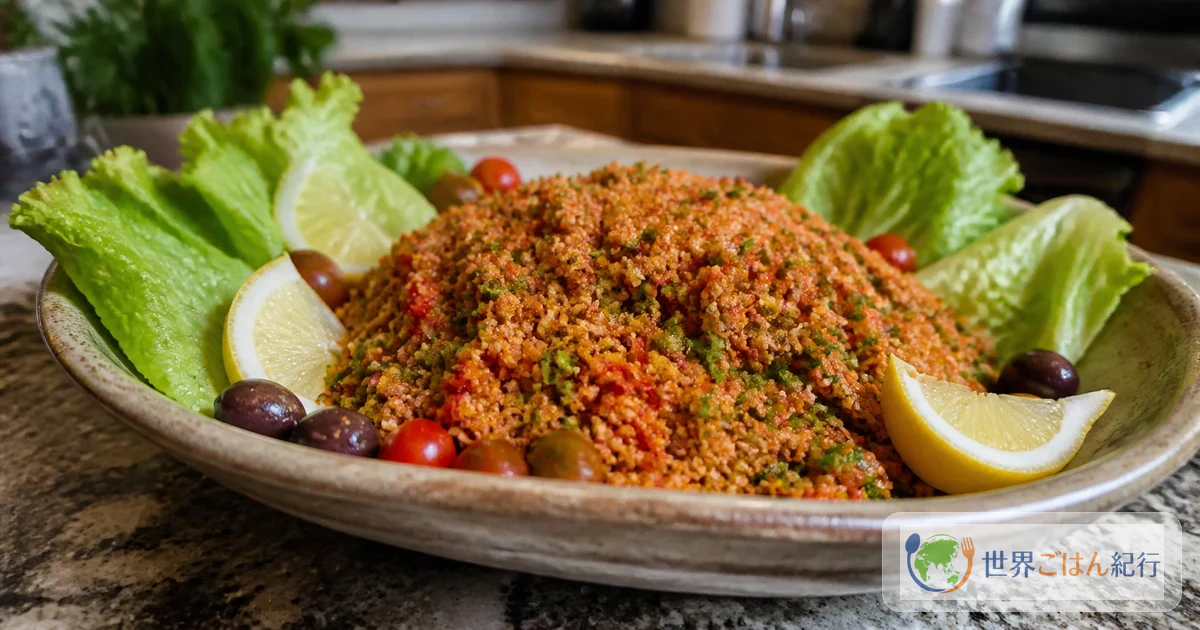
Fried liver under a heap of red onion
Picture a Turkish meyhane with its meze plates lined up: the white of yogurt, the purple of eggplant, the brown of beans, and then a small dish of liver wearing red onion. Arnavut ciğeri is a dish of cubed liver lightly coated in flour, fried briefly and eaten with onions dusted with sumac.

When people think of liver dishes, they tend toward simmering it sweet and salty, eating grilled chicken liver with sauce, or soaking it in milk to remove the smell. Arnavut ciğeri is a little different. Rather than erasing the aroma entirely with milk, you remove the blood vessels and membrane, drain it well, fry it briefly in hot oil and catch it at the end with sour onions.
Arnavut in the name means "Albanian" in Turkish, and ciğer is liver. At today's table, however, it is easier to see it not as Albanian cooking itself but as a dish familiar as a meze in Istanbul and across Turkey. Turkish-language recipes often describe it as a combination of lamb or calf liver, flour, red pepper, sumac onions and potatoes.
If Turkish kofte and kebab lead with the aroma of grilled meat, arnavut ciğeri is decided by oil temperature and draining. Do not make the coating thick, do not overfry, and do not skimp on the onions. Keep to these three and even people who dislike liver may find a plate that is "lighter than I expected."
What arnavut ciğeri is

In Turkish cuisine, arnavut ciğeri is treated as a hot meze or a light main dish. The basics are cubed liver lightly dusted with flour and a red-pepper powder and fried briefly in oil. On the plate, sumac onions, parsley, lemon and fried potatoes often sit alongside.
What home cooks tend to be unsure about is the kind of liver. Locally, lamb or calf liver is sometimes used, but the easiest to find in a supermarket is beef or chicken liver. You can make it with chicken liver, but it breaks easily and moves a little away from the cubed texture of arnavut ciğeri. For the first time, choose a block of beef liver and cut it into 2 cm cubes for easy handling.
To come closer to the local plate, there are four things to protect.
| Element | Role | How to settle it at home |
|---|---|---|
| Liver | The star. Do not make the inside tough; only the outside lightly toasty | Cut a block of beef liver into 2 cm cubes |
| Coating | Stops moisture, reduces oil spatter and sets the surface thinly | Thin all-purpose flour. Do not add too much cornstarch |
| Sumac onions | Cut the iron note and fat of the liver with acidity | Red onion, sumac, lemon, parsley |
| Potatoes | Give the meze plate volume and soften the pungency | Cut into cubes and fry first |
Without sumac you can still eat it with lemon alone, but with the dry acidity of the red powder it suddenly feels like a Turkish meze. Sumac onions play the role of absorbing meat fat in musakhan (in Japanese) and lula kebab too, so a bag of it keeps its uses.
Ingredients (serves 4)

Freshness of liver goes straight into flavor. Cook it the day you buy it, or use it by the next day at the latest. Avoid liver that looks dull in color or has a lot of drip, and choose pieces with a taut surface.
This dish uses wheat. Liver is organ meat, so cook it through to the center, not just the surface. Wash the cutting board, knife and colander used for prep right after use, and keep them apart from the finished plate and tongs.
Spices and tools you may hesitate over
The likely missing item at a nearby supermarket for arnavut ciğeri is sumac. Cumin is easy to get in a small jar, but if you will use it again and again for liver, kebab and bean dishes, a slightly larger one is convenient. You can judge oil temperature by feel, but liver is a short-time game, so a thermometer reduces failure.
Sumac is a spice for the onions. Rather than mixing a lot of it into the liver itself, dusting thin onion slices and combining them at the table keeps the aroma from getting muddy. Use cumin only in a small amount in the coating. Too much pushes it toward Middle Eastern kebab, so start with 1/2 tsp.
A frying thermometer is also useful for other fried food such as falafel (in Japanese) and samosa. If you are anxious about organ meat, a thin probe thermometer that can check the core temperature gives reassurance.
| What to buy | Priority | Why | Substitute |
|---|---|---|---|
| Sumac | High | Makes the acidity and red aroma of the onions | A little red shiso seasoning and lemon, though the aroma is different |
| Ground cumin | Medium | Adds meaty depth to the coating | Slightly more black pepper |
| Thermometer | Medium | Lets you check 170 to 180 degrees C oil and the doneness at the center | Judge the oil by bubbles on a chopstick |
How to make it: drain well and fry briefly
The longer liver is heated, the tougher it gets. Spend your time on prep, and have the onions, potatoes and plates ready beforehand so you do not hesitate once it is in the oil.
What goes wrong and how to fix it

Failures of arnavut ciğeri look as if they come from the ingredient, but nearly all happen in the prep and the oil temperature. If the smell bothers you, review the membrane, vessels and moisture before you soak it in milk for a long time.
| Symptom | Cause | Fix |
|---|---|---|
| Strong smell | Membrane, vessels or drip left | Remove thick sinew, rinse briefly in cold water and press with paper |
| Coating comes off | Surface is wet, flour is thick | Drain longer and shake off flour in a colander |
| Raw in the middle | Cubes too big, oil temperature dropped | Cut into 2 cm cubes and fry in small batches |
| Gets tough | Fried too long, left too long in residual heat | Check at 2 1/2 to 3 minutes and rest briefly on a rack |
| Flavor is heavy | Too few onions, not enough acidity | Double the sumac onions and add lemon |
Soaking in milk can be used as a way to soften a strong smell. But soaking beyond 30 minutes makes the surface watery and the flour coating cling poorly. If you use it, soak in milk for only 15 minutes and then dry thoroughly. With fresh liver, put draining and short cooking ahead of milk.
How to eat it, storage, and where to go next

To eat, put 2 to 3 pieces of liver, plenty of sumac onions and a little lemon on a piece of flatbread and wrap it. Keep eating hot liver alone and the iron note stands up, but with onions and bread between, the flavor rounds out. It goes with beer or sparkling water too, and a red lentil soup such as mercimek corbasi on the side makes it a meal.
To keep cooking Turkish food, move to kofte, where meat is rolled; lahmacun, baked on thin dough; and dolma, where vegetables are stuffed, and you can reuse the cumin, paprika and parsley. For a second dish on a fried-food day, a cold, sour side such as baba ghanoush (in Japanese) or tabbouleh suits.
To store it, keep the liver, onions, potatoes and bread separate. Cool the liver a little and, in an airtight container, count on 1 day in the refrigerator. The aroma tends to get strong from the next day on, so it is not a dish to keep long. To reheat, 3 to 4 minutes in a 180 degrees C toaster oven. With a microwave alone the coating easily turns damp, so warm it only 20 seconds at 600 W and move it to the toaster oven to bring it back.
Frequently asked questions

Can I make it with chicken liver?
Yes, but the handling changes a little as the same dish. Chicken liver is soft and breaks easily when cut into 2 cm cubes, so separate it into bite-size pieces, dry them, coat thinly with flour and fry. Cook through to the center and adjust the frying time by size. Put doneness and draining ahead of a neat shape.
Should I soak the liver in milk?
For strongly scented liver, soaking for 15 minutes is fine. But if you do not dry it thoroughly afterward, the flour coating gets thick and the oil spatters more. For fresh beef liver, removing membrane and vessels, rinsing briefly in cold water and pressing with paper is enough.
What do I do without sumac?
A perfect substitute is hard, but mixing thin onion slices with 1 tbsp lemon juice, 1/2 tsp dried red shiso powder and a pinch of salt brings you closer in acidity and red color. Pickled plum pushes it too far toward Japanese flavor, so keep it to a small amount.
Can I pan-fry instead of deep-frying?
Yes. Heat about 3 tbsp oil over medium heat, lay out the liver and cook about 1 1/2 minutes per side. But the flour coating does not set evenly, and the lightness of arnavut ciğeri gets a little weaker. Rather than cutting the oil, not putting too much in at once is less likely to fail.
Is it too hot for children?
This recipe is not strongly spiced. The paprika is for color and aroma, with almost no heat. Adults who want heat are best sprinkling a little red pepper flakes on the plate, which makes it easy for the family to eat different levels.
What can I do with leftover sumac onions?
They go with grilled chicken, kebab, canned mackerel and chickpea salad. They are also good on hummus and add acidity in a sandwich the next day. But they release water, so finish them within the next day in the refrigerator.
Sources
- Wikipedia contributors. "Arnavut ciğeri." Wikipedia. https://en.wikipedia.org/wiki/Arnavut_ci%C4%9Feri (accessed 2026)
- Turkish Food & Recipes. "Fried Liver Cubes (Arnavut Cigeri)." https://www.turkishfoodandrecipes.com/2009/02/fried-liver-cubes-arnavut-cigeri.html (accessed 2026)
- Cooking Gorgeous. "Arnavut Cigeri - Turkish Liver and Onions." https://cookingorgeous.com/blog/arnavut-cigeri-turkish-liver-and-onions/ (accessed 2026)
- Ozlem's Turkish Table. "Arnavut Cigeri, Pan Fried Liver with Onions, Parsley and Sumac." https://ozlemsturkishtable.com/ (accessed 2026)
- Tureng Dictionary. "ciğer / Arnavut ciğeri." https://tureng.com/ (accessed 2026)