
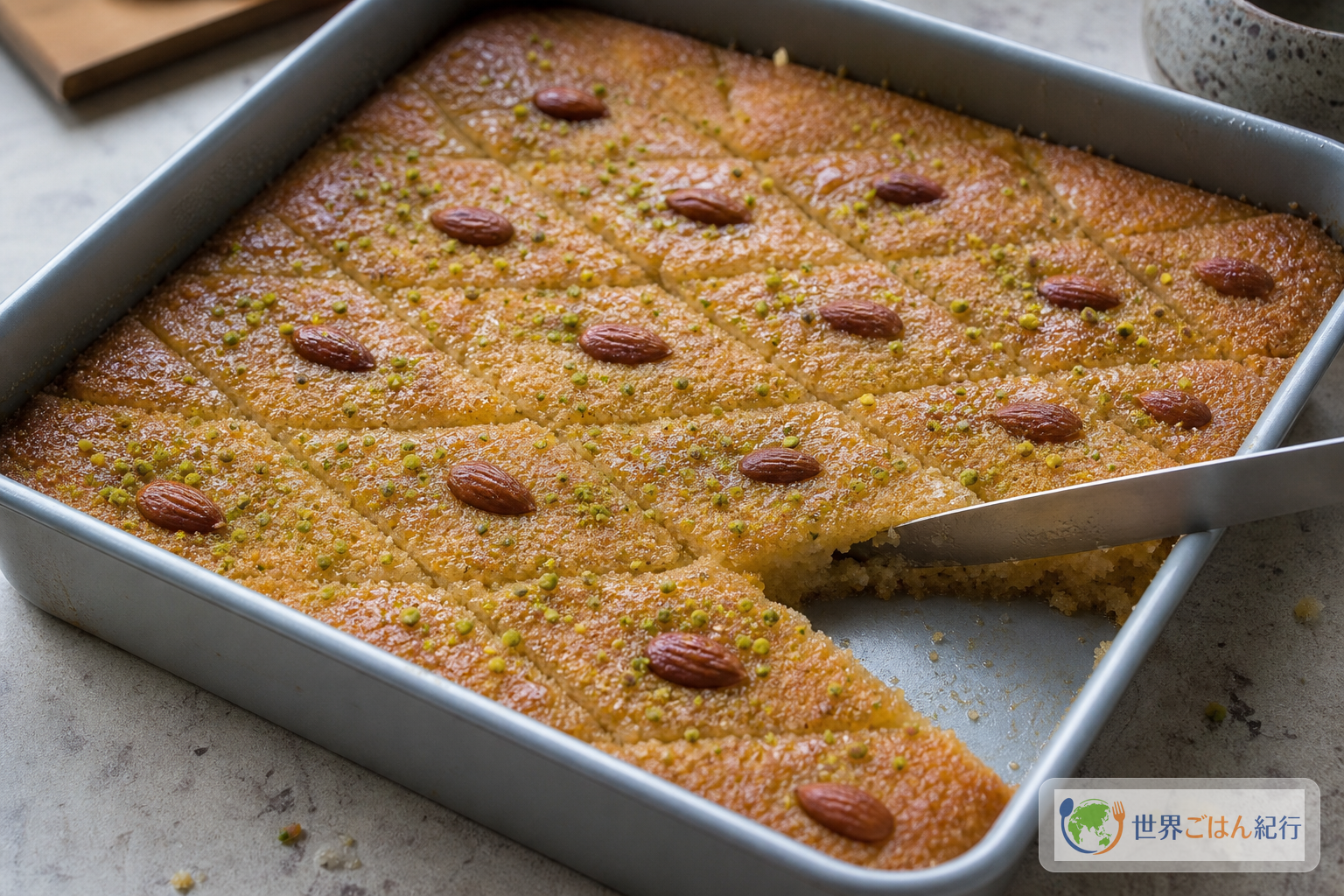
Hot syrup sinks into baked semolina
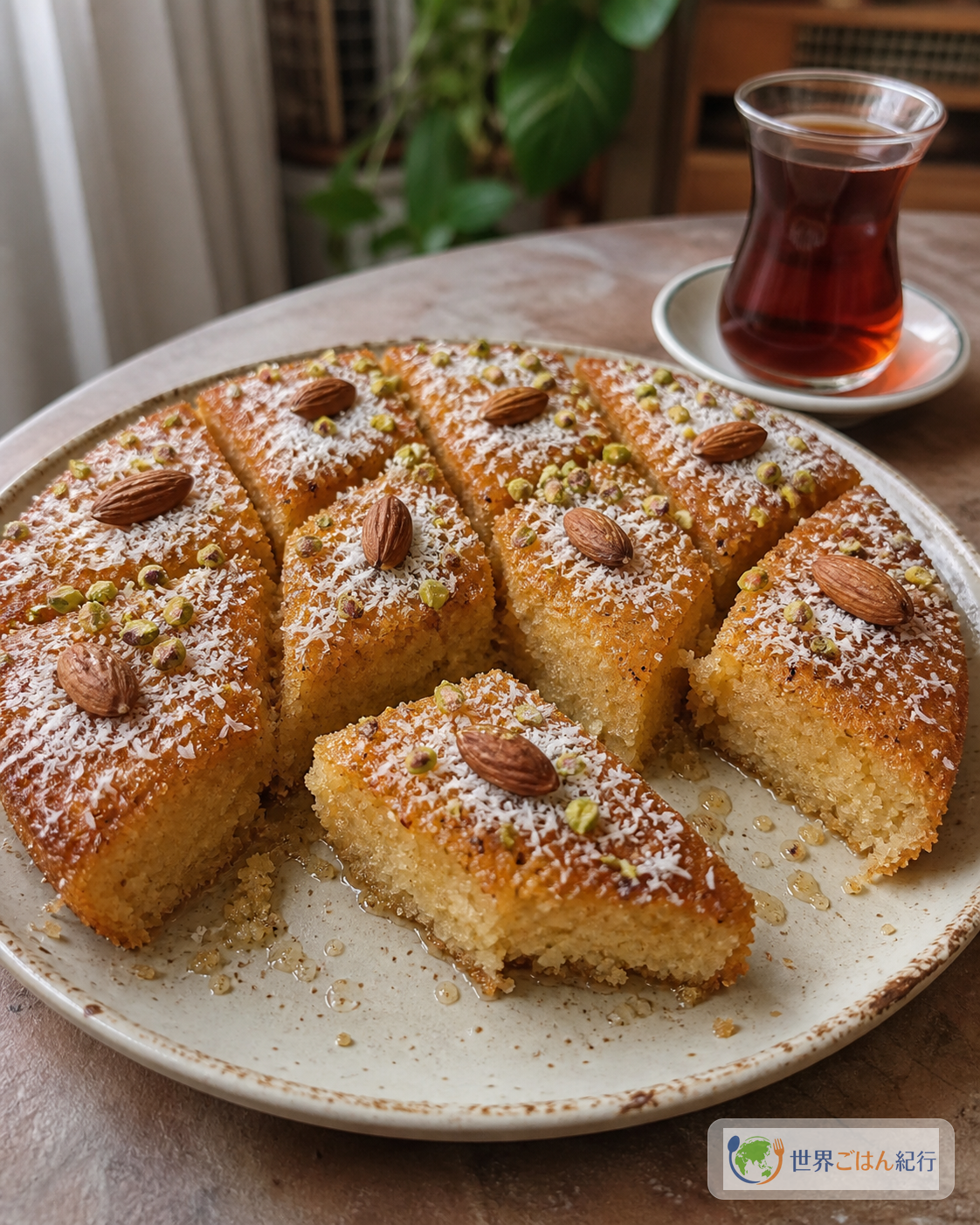
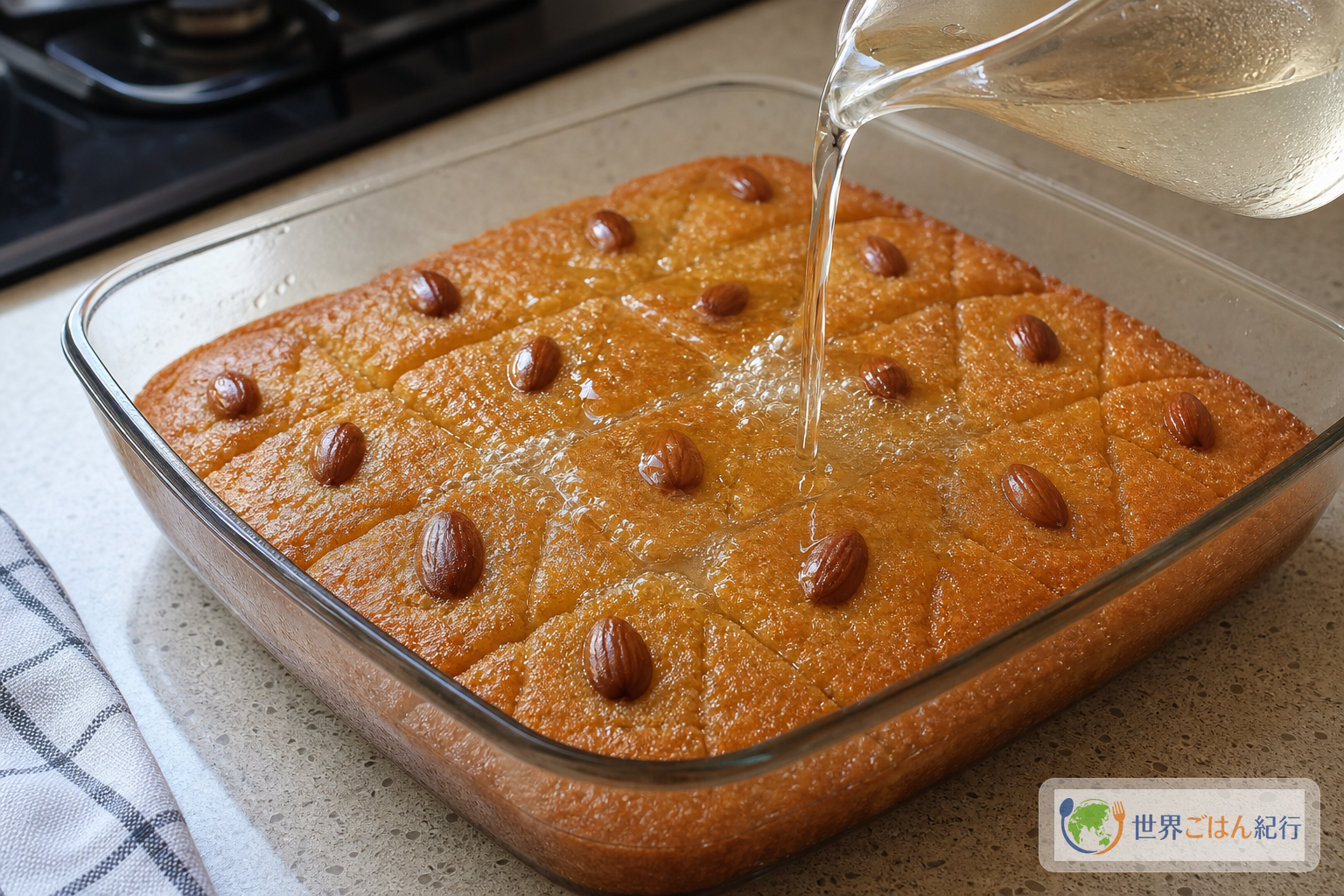
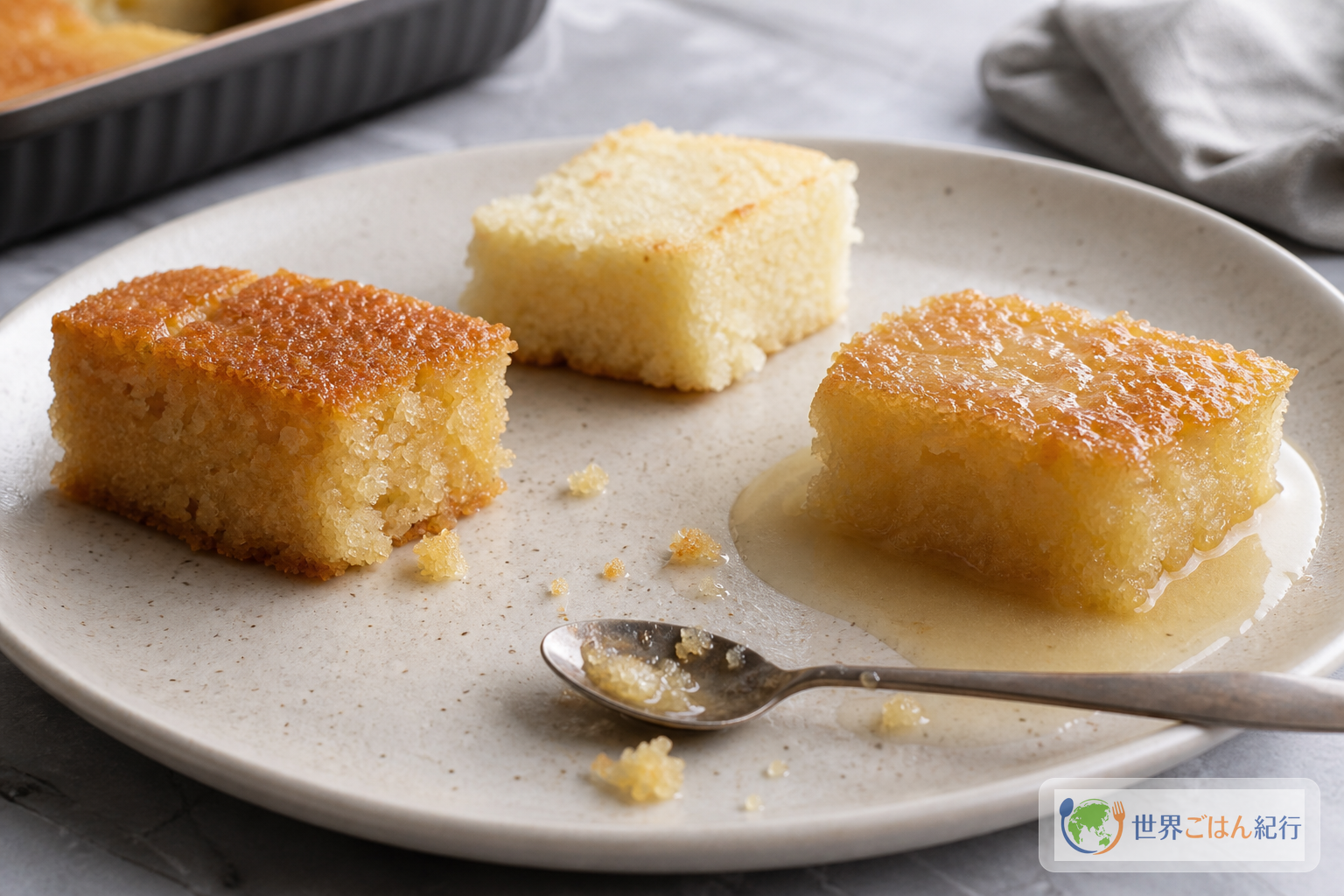
Basbousa is an Egyptian sweet made by soaking baked semolina in hot syrup. Pour the syrup over the pan fresh from the oven and tiny bubbles form on the surface as the coarse wheat grains slowly drink in the sweetness. Rather than rising like a sponge cake, it aims for a moist, grainy crumb. Set a small piece beside black tea or strong coffee and the end of the meal moves straight into a Middle Eastern pastry shop.
What trips people up at home is the coarseness of the semolina, the water in the yogurt, and the temperature of the syrup. Mix it thoroughly as you would a cake made with plain flour and it turns too tight; fear the syrup and use too little, and it is dry and crumbly. Pour it all in at once and only the bottom turns heavy. This recipe fits one 20 cm square pan: rest the coarse semolina, start the oven at 190°C and drop to 180°C, and add the hot syrup a little at a time.
Among syrup sweets, Levantine knafeh stars kadayif pastry and cheese, and Turkish baklava stars thin phyllo and nuts. Basbousa is plainer, and the star is the semolina itself. In an Egyptian meal, serving a small piece after koshari or ful medames ends a table of beans and rice on a sweet note.
In Arabic it is written بسبوسة, and in English the spelling varies: basbousa, basboosa. Related sweets go by names such as namoura, harissa, and revani depending on the region. This article uses "basbousa," the name common in Egypt.
Ingredients (one 20 cm square pan, 8 pieces)
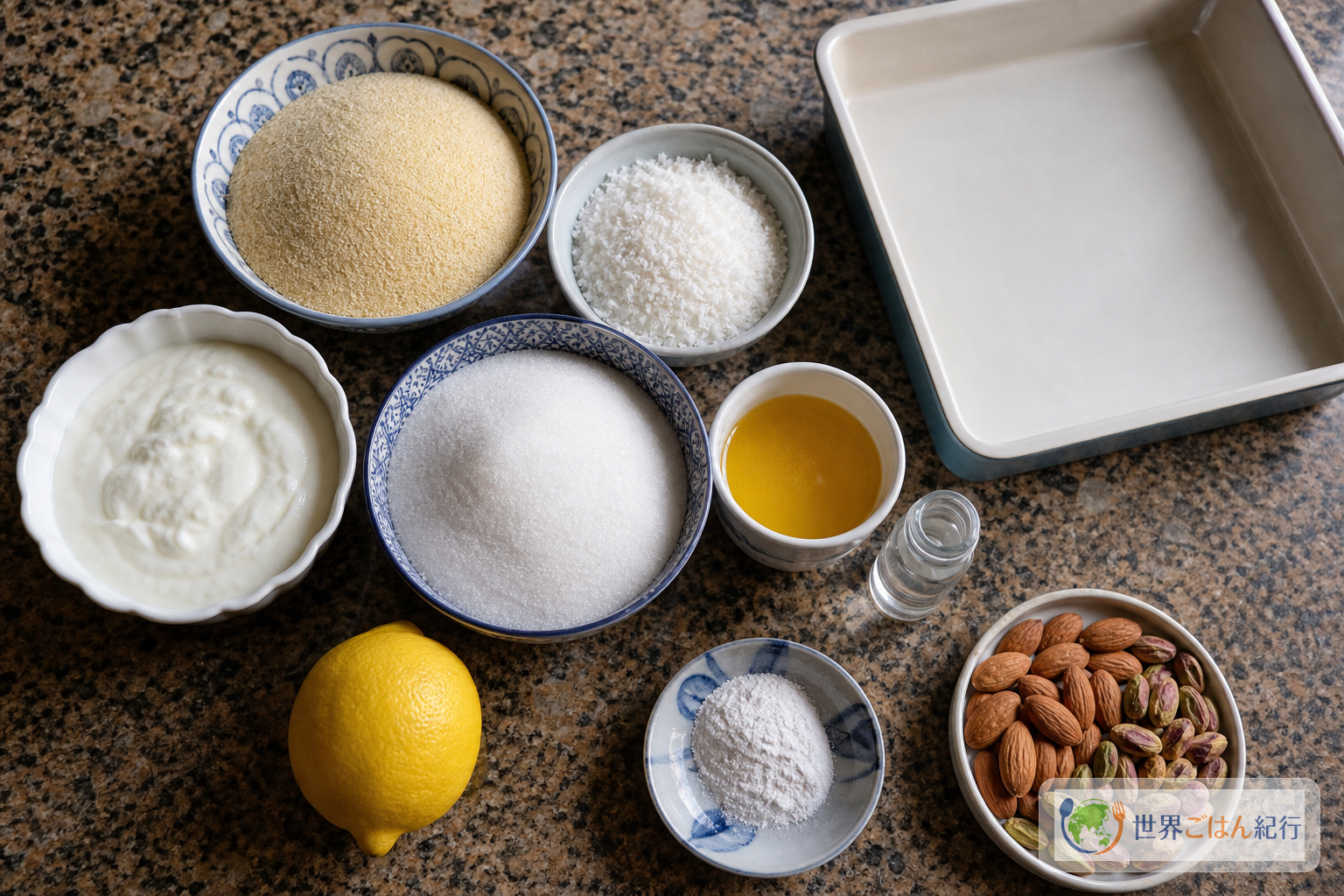
A square pan of about 20 cm is easy to work with. Spread thin in a large pan it dries out; packed thick in a small one the center turns heavy. For a first batch, aim for a thickness of about 2.5 cm.
This recipe uses wheat, dairy, and nuts. Semolina comes from wheat, and the yogurt and ghee contain milk. Even if you leave out the nuts, some products are made on equipment that also handles nuts.
What to look for when shopping
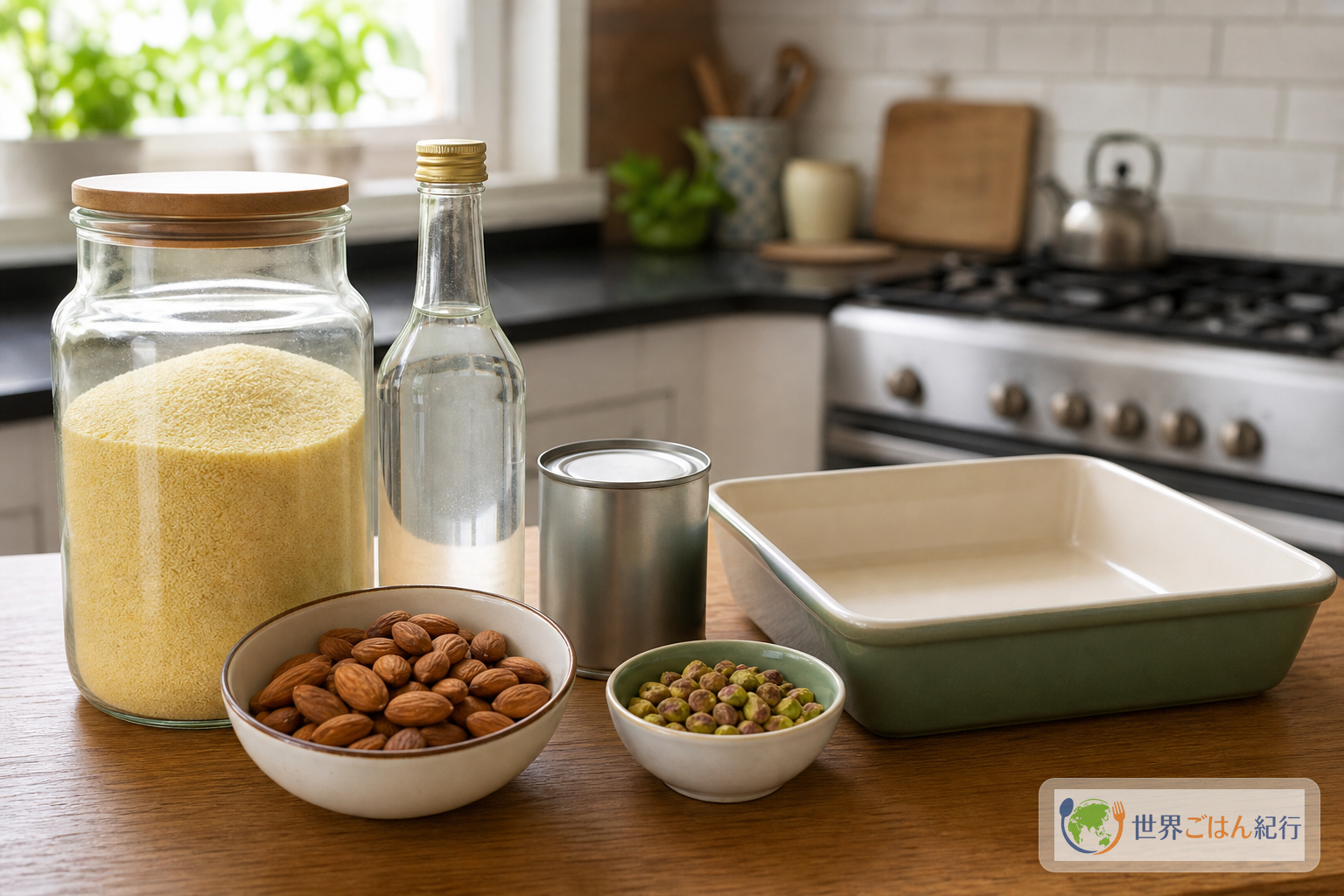
For basbousa, what is worth hunting for beyond an ordinary supermarket is the aroma and the tool that keeps the baked thickness even. Yogurt, sugar, lemon, and almonds are all easy at the supermarket. Look for semolina first at baking-supply or Middle Eastern grocery stores, and if you cannot find it, fine-ground durum flour gets you close.
You use only a little orange blossom water, but it changes the outline of the syrup a great deal. It also goes into knafeh and baklava, so if you keep making Middle Eastern sweets, a bottle is handy to have.
Coconut milk is not essential, but if your shredded coconut is very dry, adding 40 ml keeps the center of the semolina from staying hard. Use any leftover in curries or rice dishes.
A square pan of about 20 cm cuts down mistakes when baking basbousa in a home oven. The thickness stays even, and the syrup enters the scored lines more uniformly.
Method: do not overmix, and soak while it is hot
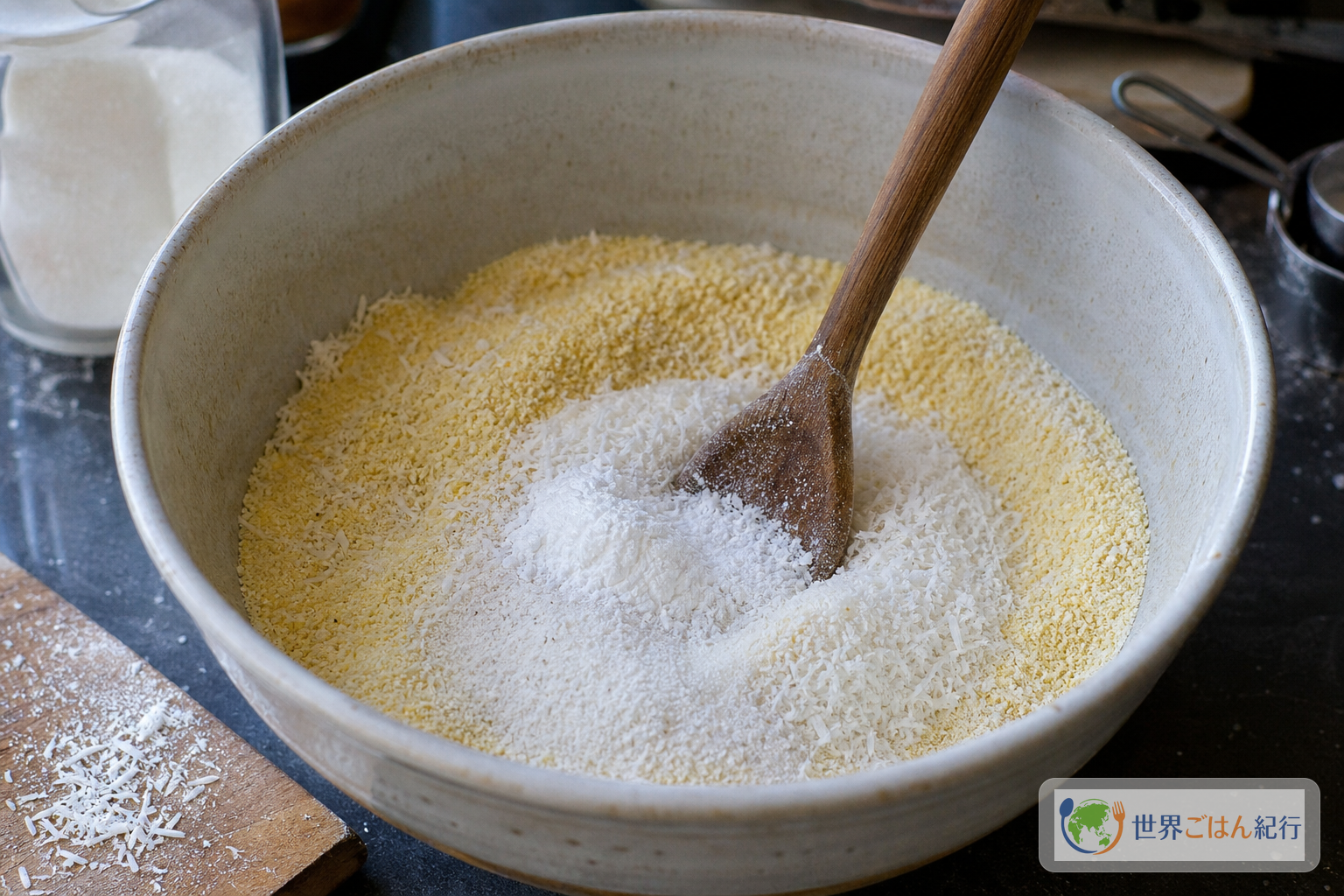
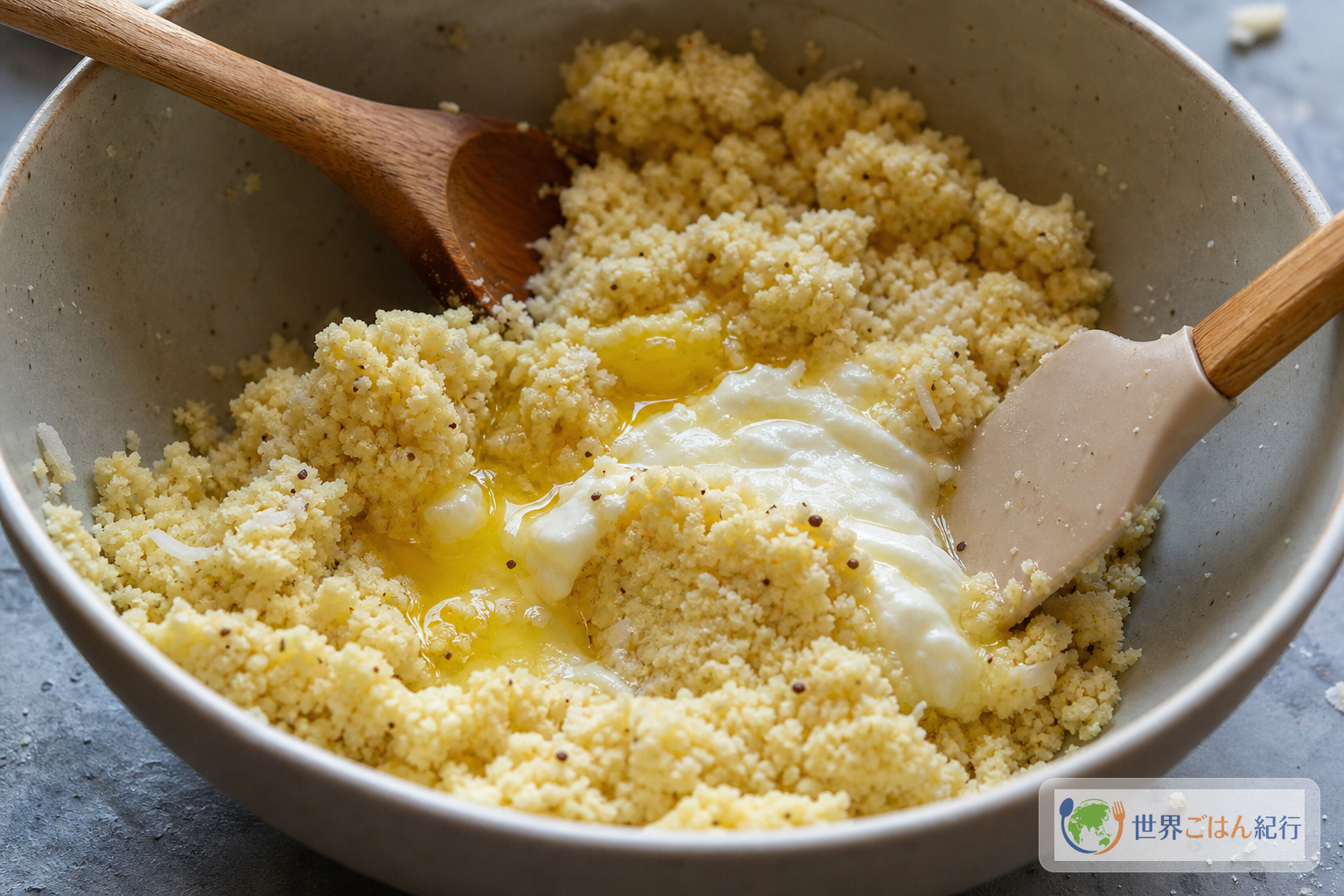
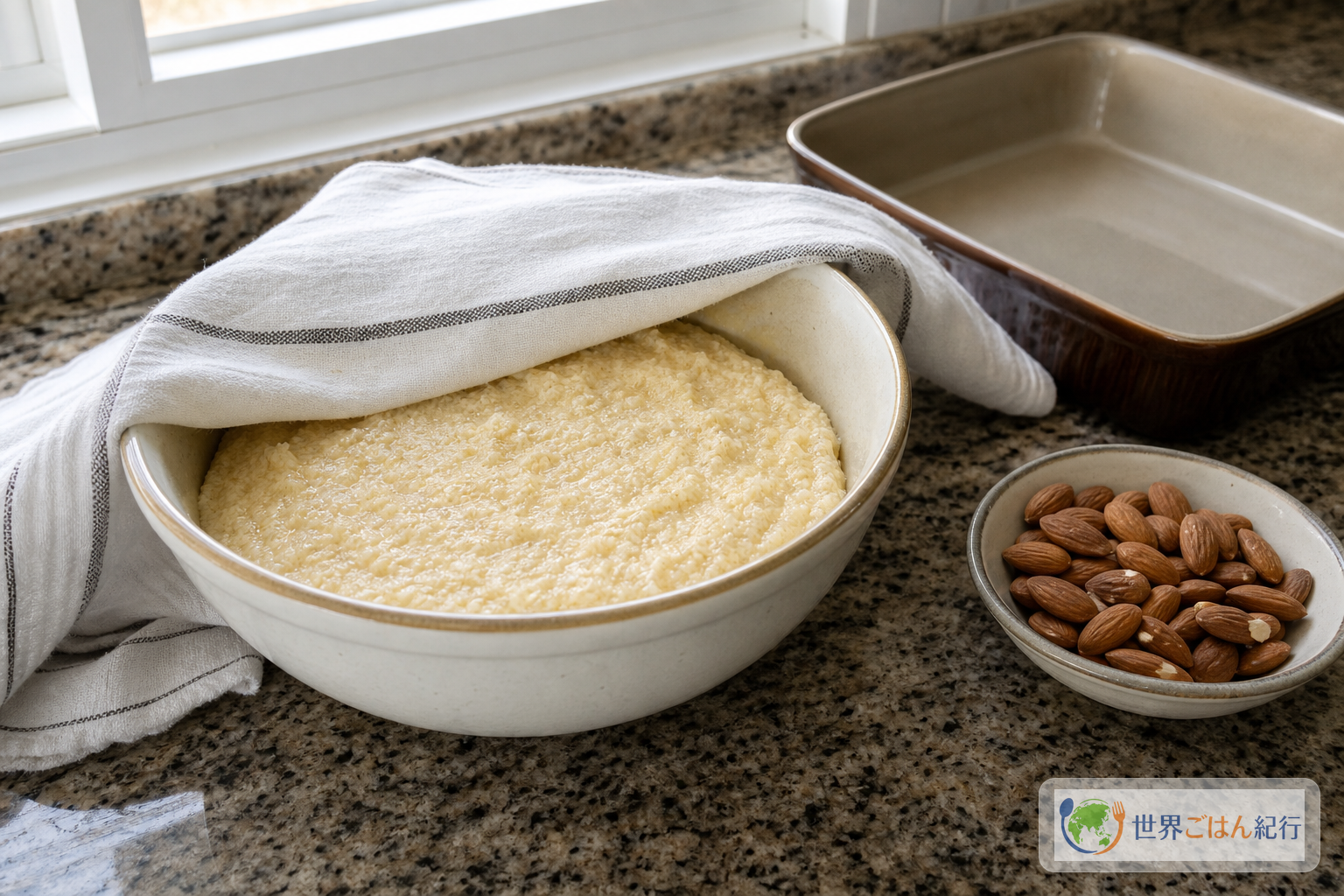
In basbousa, it is the resting time, not the mixing time, that builds the texture. Coat the semolina in fat, bring it together with yogurt, and wait for the semolina to absorb the moisture. Adding the syrup after baking is part of the same process.
Background: Egyptian sweet shops and syrup culture
It would be a little unfair to close basbousa's origin off inside the borders of a single country. The food culture group Asif traces the family of sweets in which semolina is rubbed with fat and soaked in sweet syrup to medieval Arab cookbooks and the reach of the Ottoman Empire. It says that a baked semolina sweet leading toward today's basbousa already appears in a 14th-century Egyptian cookbook. In other words, Egyptian basbousa is not a cake that appeared suddenly; it is hospitality from an era when flour, fat, and sugar were expensive, carried on in sweet shops and home kitchens.
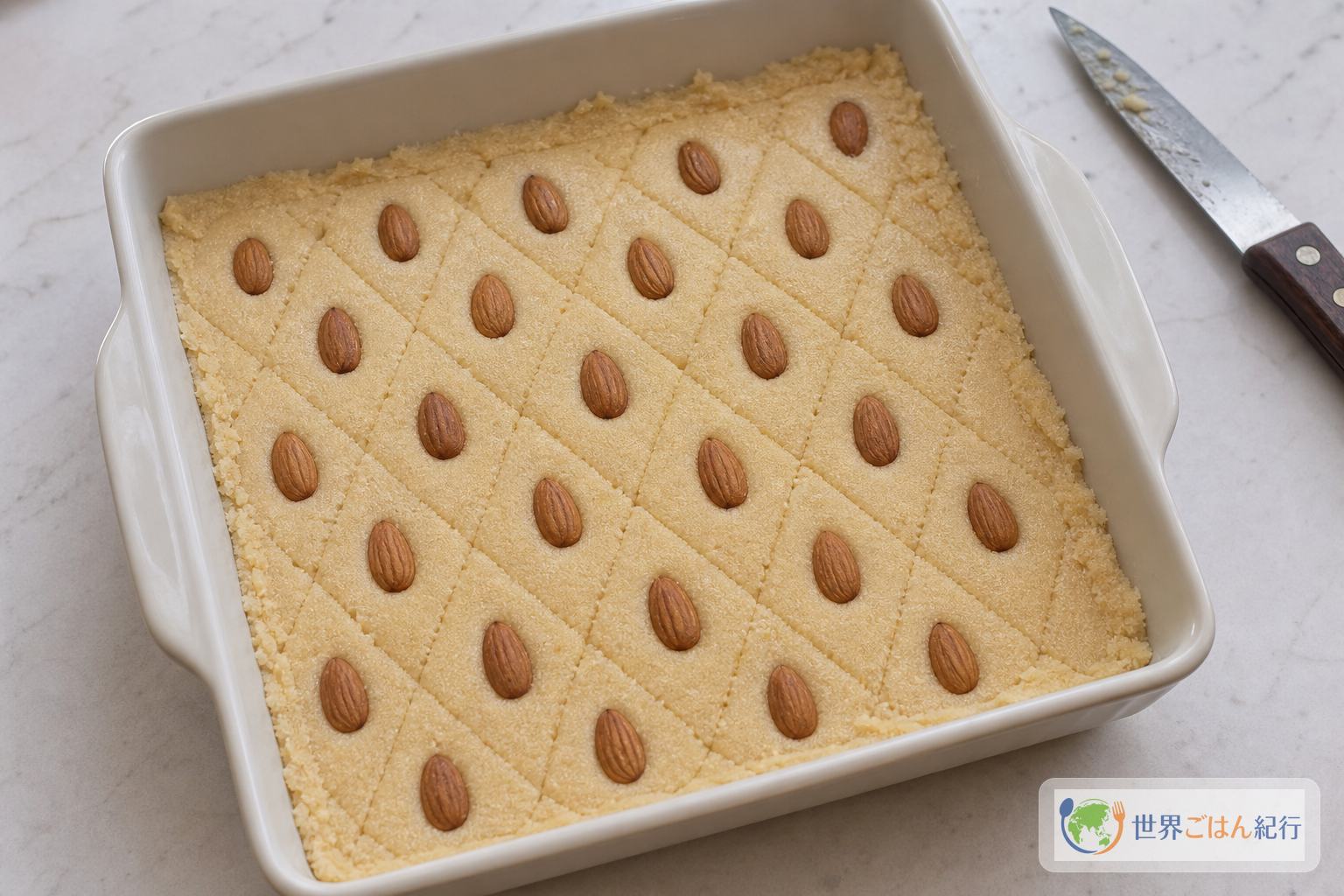
Seen in the setting of daily life in Egypt, basbousa is not a special-occasion sweet. It sits in the shops, and it appears at family gatherings, celebrations, and the breaking of the Ramadan fast. The Egyptian-born writer at The Mediterranean Dish describes basbousa as the sweet that was always there at celebrations in childhood. It is baked in a large tray, cut into diamonds or squares, and given a nut in the center. Picture a big tray in a shop from which pieces are cut, rather than one piece taken onto a plate, and the weight and sweetness of this sweet make more sense.
Regional differences are clear too. Close relatives include basbousa in Egypt, namoura in Lebanon, harissa around Syria, and revani in Greece and Turkey, and the texture changes depending on whether egg or coconut goes in and whether flower water goes into the syrup. Amira's Pantry notes that even within Egypt, harissa-style semolina sweets take several forms depending on the region.
When you recreate it in a home kitchen, it is safer to keep the Egyptian framework than to pin down a region. Do not drift toward a sponge made with plain flour; keep the grain of the semolina. Rather than browning plain butter, coat the flour in ghee or clarified butter. Do not be afraid of the syrup, but do not pour it all at once; let it soak in through the cuts. When you want less sweetness, rather than cutting the sugar sharply, cut small pieces of about 3 cm and serve them with unsweetened tea or strong coffee, which keeps the character of a basbousa table.
| Local element | How to approximate it at home | Why it is worth keeping |
|---|---|---|
| Grain of the semolina | Use coarse or medium semolina and do not knead | Makes it a sweet whose grains absorb the syrup, not a wheat cake |
| Aroma of ghee | Melt unsalted butter and use the clear top | Avoids the burnt-milk smell and lets only the fat coat the flour |
| Floral aroma | Keep orange blossom water to 1 tsp | You want the aroma, but too much takes over the whole sweet |
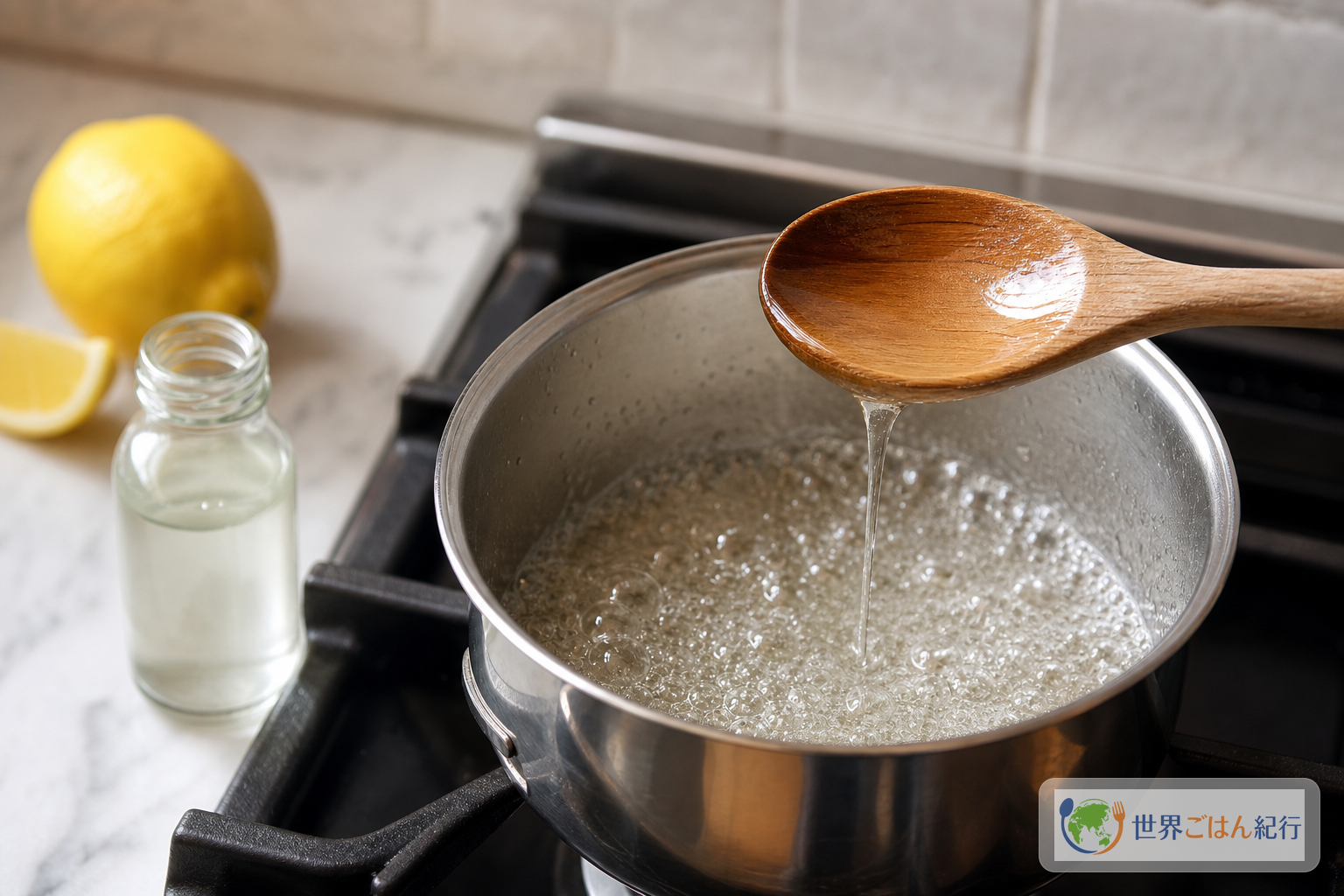
| Hot syrup | Pour it in little by little within 3 minutes of baking | Puts sweetness into the center while keeping the browned surface |
| Diamond cuts | Score shallowly before baking and cut again after | They are not only decoration; they are the path for the syrup |
Ordinary supermarket yogurt tends to be on the watery side. Here, adding a little coconut milk and resting the batter aims for the space between dry, floury crumb and a sticky bottom. Greek yogurt is too thick, so if you use it, split it into 120 g of yogurt and 30 ml of water or milk, which is easier to mix.
You could lean toward revani-style sweets that include egg, but this recipe does not. Egg adds rise and spring and makes an easier syrup cake to eat. In exchange, the coarse graininess that makes it basbousa, and the way it crumbles gently when cut, become weaker. For a first batch, bake it without egg and get a feel for how semolina, fat, and syrup relate; it will then be easier to try regional variations next.
The same reasoning explains why we do not cut the sweetness much. The syrup in basbousa is not just sugar water; it works almost like glue that holds the baked semolina together as one sweet. If the sweetness bothers you, rather than halving the syrup, cut the pieces from 4 cm down to 3 cm and pair them with strong black tea or unsweetened coffee, which makes it easier to eat while keeping the texture.
Why it goes wrong, and how to fix it
| Problem | Main cause | Fix |
|---|---|---|
| Floury and crumbly | Too little rest, too little syrup, overbaking | Rest the batter 20 minutes, and always add at least 70% of the syrup |
| Only the bottom is sticky | Syrup poured in all at once, browning too light | Pour a little at a time along the cuts and bake until the edges are golden |
| Hard and tight | Batter was kneaded, or Greek yogurt was used as is | Stop when the floury look is gone, and thin thick yogurt with water |
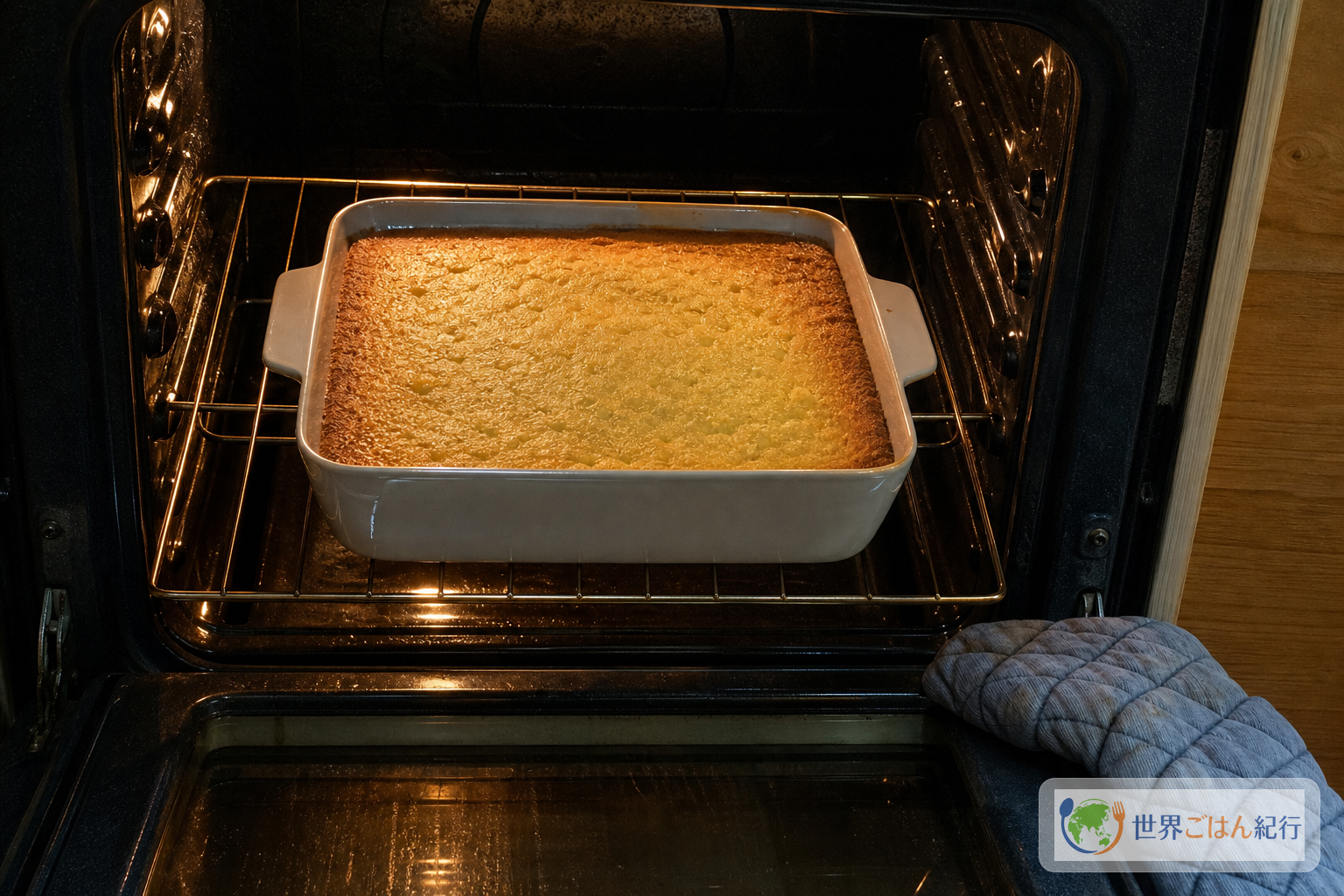
| Only the surface burns | Top heat too strong, pan too shallow | Drop to 180°C partway; if it colors fast, use 170°C and foil |
| Aroma too strong | Flower water boiled or too much used | Add it after turning off the heat, up to 1 tsp. Rose at 1/3 tsp or less |
| Almonds sink | Batter is loose or pressed in too far | Place them after the 20-minute rest, only about halfway into the surface |
The browning is the easiest thing to fix. Add syrup while the cake is pale and the surface cannot hold it, so it runs down to the bottom. Bake it too dark, on the other hand, and the edges stay hard even after taking in syrup. Deep golden edges and a light golden center: stop when you can see that difference, and the texture stays steady even in a home oven.
Serving, storing, and making ahead
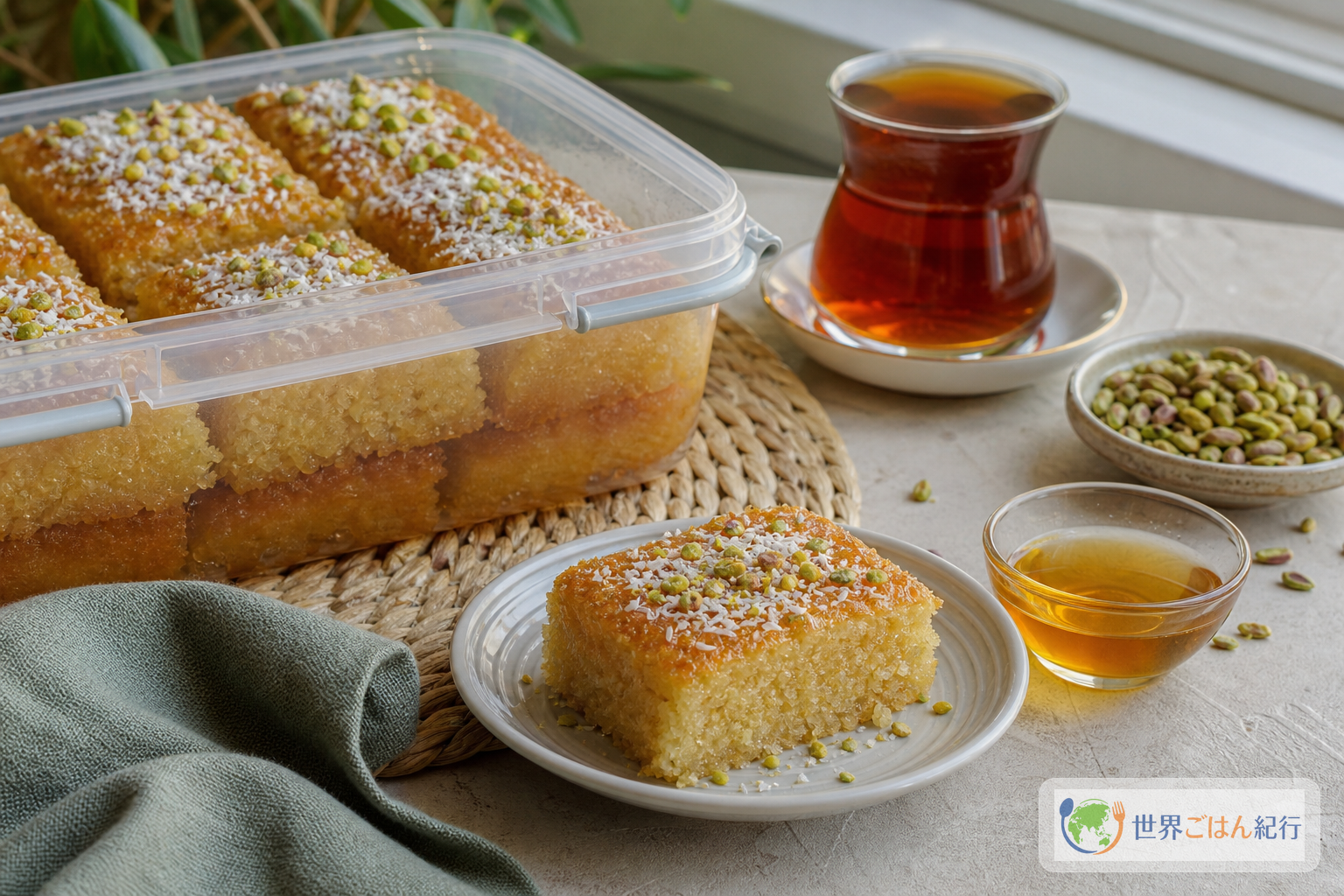
Basbousa can be eaten warm or at room temperature. Some Egyptian sweet shops make it very sweet, but at home, cut small pieces and pair them with unsweetened black tea or strong coffee and it is just right. After koshari or a bean dish, serving half a piece is satisfying enough.
| State | How to store | When eating |
|---|---|---|
| Same day | Room temperature, within 6 hours | As is. If it dries out, add 1 tsp of the remaining syrup |
| Next day to 3 days | Refrigerate in an airtight container | Leave at room temperature for 15 minutes. If it is too cold, the fat's aroma stays closed |
| Frozen | Wrap pieces individually, up to 2 weeks | Thaw in the refrigerator, then 4 minutes in a toaster oven at 150°C |
If you are making it ahead, it is easier not to add all the syrup on day one. Put 70% into the cake and keep the rest in a small jar in the refrigerator. When you eat it the next day, add about 1 tsp for just that portion, and the surface does not get too heavy.
Frequently asked questions
What do I do if I have no semolina?
First look for flour labeled "semolina" or "durum wheat" at baking-supply or Middle Eastern grocery stores. Fine-ground durum flour also works, but the coarse graininess is weaker. Couscous grains are large and tend to leave a hard core in a quick-baked sweet, so this recipe does not use them.
Can I make it without ghee?
Yes. Melt 100 g of unsalted butter, let it stand for a few minutes, and use 90 g of the clear top, leaving out the white sediment as much as possible. You can bake with the full amount of ordinary melted butter, but the milk solids burn easily and the aroma comes out a little more cake-like.
Is orange blossom water essential?
It is not essential. Without it, you can build the aroma with a little vanilla and the zest of 1/2 lemon. But just 1 tsp of orange blossom water gives the outline typical of Middle Eastern sweets. Rose water is stronger still, so for a first batch leave it out or use no more than 1/3 tsp.
Can I cut the sugar a lot?
I do not recommend cutting it to half. The syrup is not only sweetness; it also binds the semolina into a moist cake. If you want less, keep the batter sugar to 70 g and the syrup sugar to 160 g, and cut smaller pieces, which protects the texture better.
What should I serve with it?
In the flow of an Egyptian meal, it is natural to serve a small piece with strong black tea after ful medames or koshari. To lean toward a Levantine table, put it after hummus, tabbouleh, and baba ghanoush, which leads from salt and sourness into a sweet syrup dessert.
Sources
- Wikipedia contributors, "Basbousa", accessed 24 May 2026, https://en.wikipedia.org/wiki/Basbousa
- Asif, "Back to Basbousa Basics", accessed 17 July 2026, https://asif.org/en/back-to-basbousa-basics/
- The Mediterranean Dish, "Basbousa (Egyptian Semolina Cake)", accessed 17 July 2026, https://www.themediterraneandish.com/basbousa-almond-coconut-semolina-cake/
- Egyptian Streets, "Basbousa: The Classic Egyptian Semolina Cake You Need to Try", accessed 17 July 2026, https://egyptianstreets.com/2025/02/15/basbousa-the-classic-egyptian-semolina-cake-you-need-to-try/
- King Arthur Baking, "Basbousa (Syrup-Soaked Semolina Cake)", accessed 24 May 2026, https://www.kingarthurbaking.com/recipes/basbousa-syrup-soaked-semolina-cake-recipe
- Amira's Pantry, "Basbousa (semolina cake)", accessed 24 May 2026, https://amiraspantry.com/basbousa/
- Amira's Pantry, "Egyptian Harissa", accessed 17 July 2026, https://amiraspantry.com/the-alexandrian-harissa/



