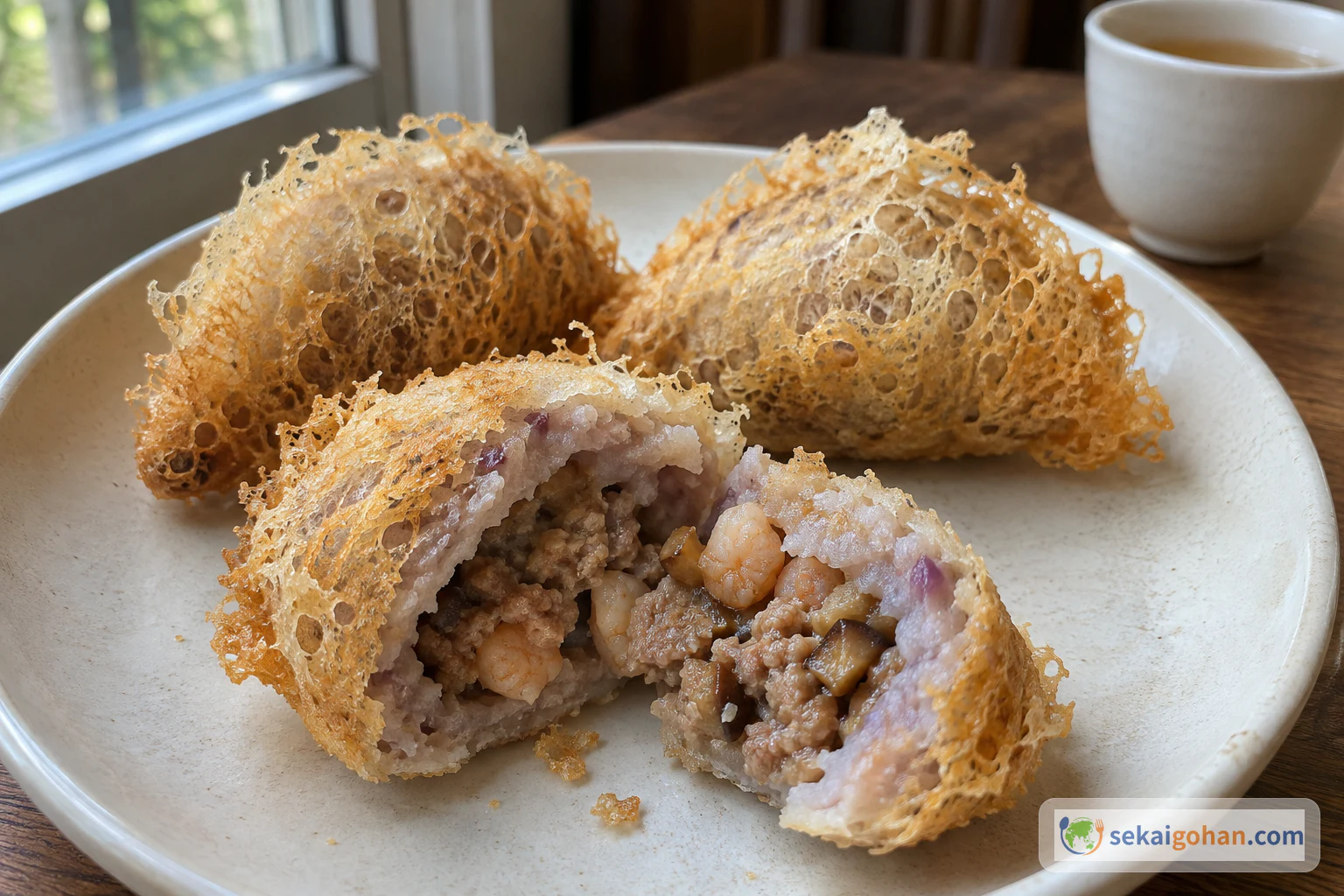
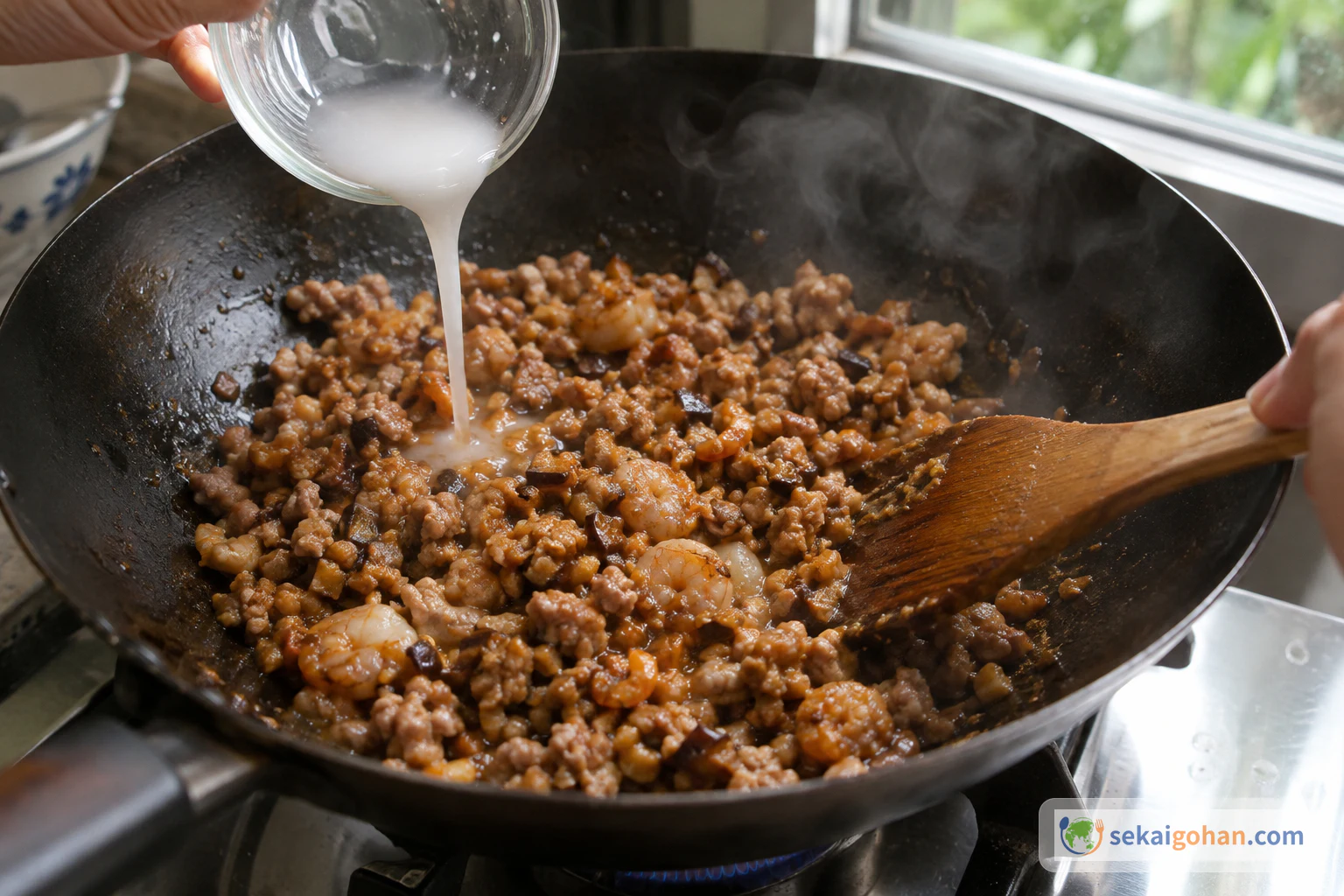
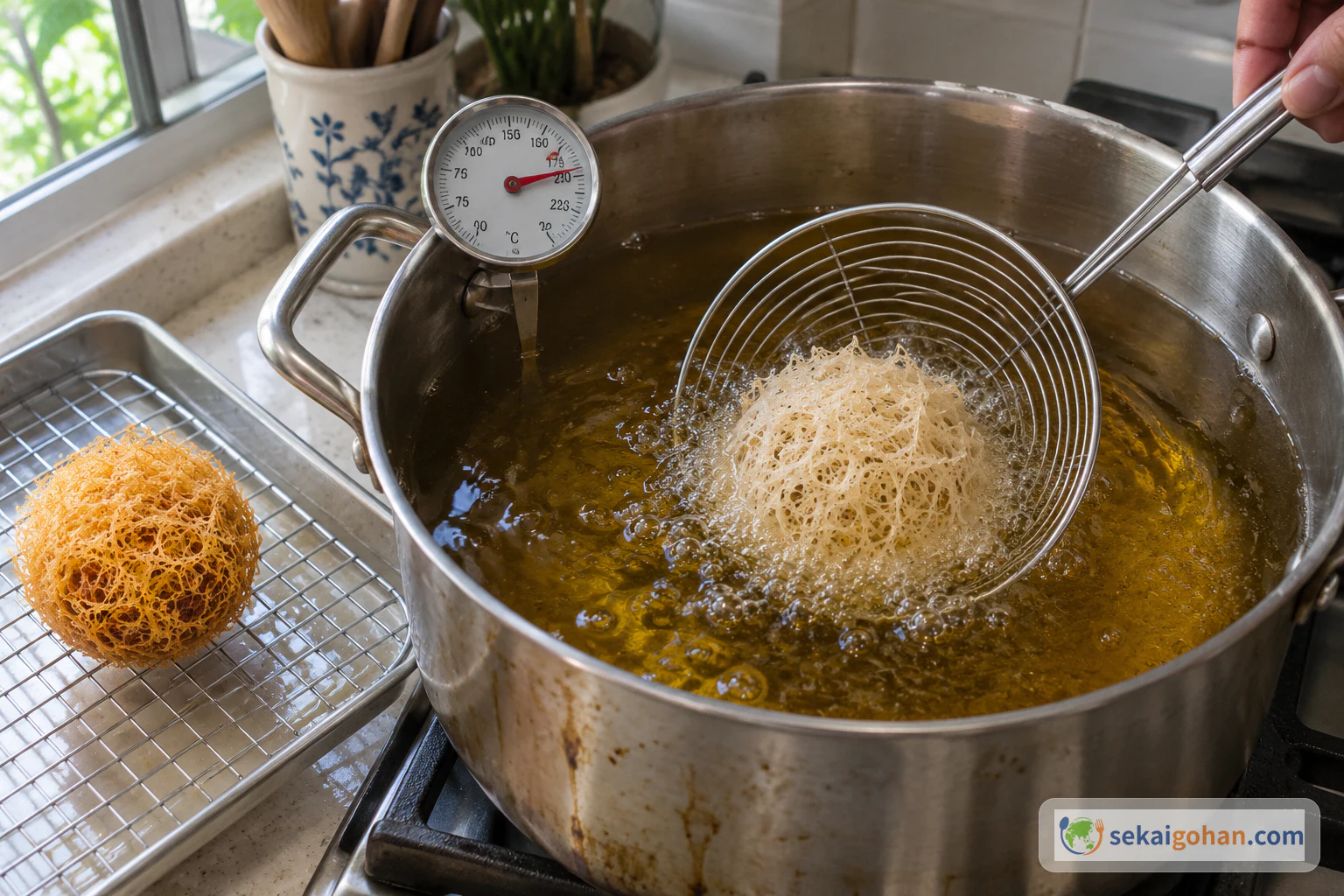
Lower a raw wu gok into hot oil on a spider, and soon its pale taro surface starts to bloom. Fine threads rise from it and set into a golden lace that looks ready to lift off the dumpling. Under that lace is a thin layer of soft, creamy mashed taro scented with five-spice. Inside sits a glossy, savory filling of pork, shrimp, dried shrimp and shiitake. Wu gok is the fried dim sum of Guangzhou and Hong Kong, the crisp plate among the bamboo steamers at yum cha. At home, two things decide whether it works: how you cook the wheat starch and how steady you keep the oil.
Wu Gok in the Teahouses of Guangzhou and Hong Kong
Honeycomb taro in Guangzhou
In Guangzhou, wu gok counts among the most traditional and representative Cantonese dim sum. There it goes by fung chau wu gok, "honeycomb taro dumpling", and it is wrapped into triangles. The taro is sliced thin and steamed, then mashed with wheat starch, lard, sugar, salt and pepper. Cooks fry the dumplings in oil at 355°F (180°C) or hotter so the shape sets first, and then keep frying until the color comes. The filling is bound with a thickening called furong qian, and no other savory dim sum uses it. A Guangzhou food writer quoted in the local press says the crust is where a dim sum chef's skill shows: it should puff up so high that it looks about to fly off. A crisp outside against a soft filling coated in sauce is the contrast everyone is after.
At Lunar New Year 2024, a Guangzhou restaurant presented honeycomb wu gok as a "hidden" dim sum said to date from the Republican era. When it was first made is not settled. Cantonese dim sum has grown to more than 4,000 kinds, built on 23 types of wrapper in four families and 47 fillings in three. The fiddly kinds turn up less often now, and that Lunar New Year menu was one of the revival efforts.
The Hong Kong teahouse table
In Hong Kong, wu gok belongs to the teahouse, the place for yat jung leung gin. Competition in the 1920s pushed teahouses to offer "weekly specials", and the range of dim sum and the skill behind it grew quickly. Dim sum chefs start preparing two hours before the doors open, and they work in four methods: steaming, baking, pan-frying and deep-frying. Wu gok is one of the deep-fried ones. Dim sum used to rely on lard. Cooks have cut back on it for health reasons, and more teahouses now buy from central factories or use frozen imports rather than making their own. Teahouse dim sum-making is on Hong Kong's intangible cultural heritage inventory as a whole craft; wu gok itself is not listed separately. Fried dim sum like this has long been stacked in glass cases and wheeled round on carts. Outside China, wu gok is a dim sum restaurant standard, and Chinatown bakeries sell it as a Chinese pastry.
Yat jung leung gin (一盅兩件) means "one pot, two pieces": a pot of tea and two plates of dim sum. It is the old shorthand for what a teahouse is for, and it is still the rhythm of a yum cha morning.
Its neighbours on the menu
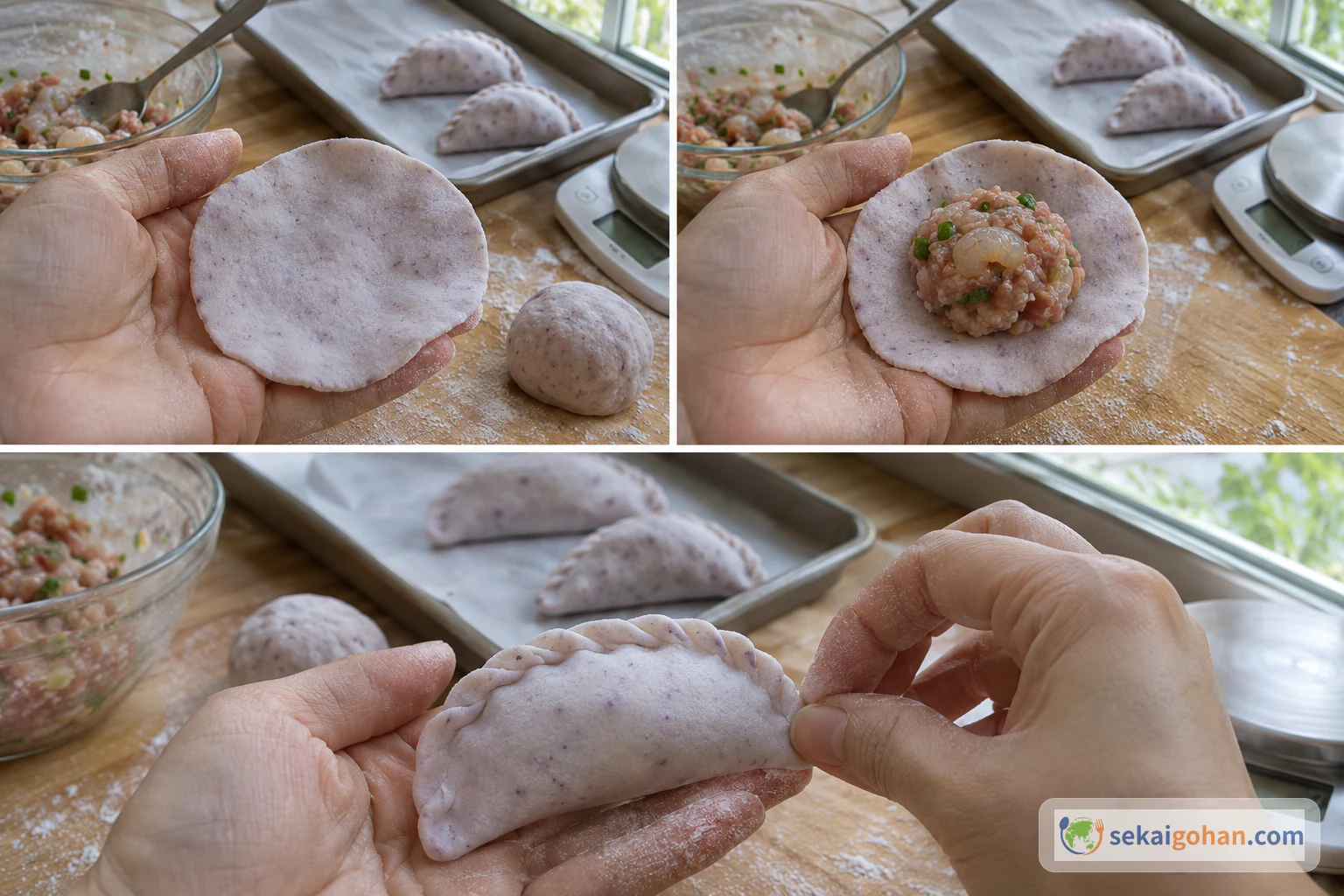
Two dishes get mixed up with wu gok. Ham sui gok is also a fried dumpling, but its shell is glutinous rice flour, with no taro in it. Taro cake is a steamed block cut into slices. The sweet taro balls of Taiwan and the sweet taro paste of Chaozhou come from another line of taro cooking altogether. Compared with the thin, pleated wheat skin of a steamed xiaolongbao, the wu gok shell is thick, soft and rich with fat, and the fryer gives it its texture. Shapes change from cook to cook: half-moons at home, half-moons pushed into a boat shape, or the triangles of Guangzhou. This recipe uses the half-moon.
The Cantonese name is 芋角 (Jyutping wu6 gok3, also written woo kok). In standard Chinese script it is 芋頭角, yùtóu jiǎo. Guangzhou calls it 蜂巢芋角, honeycomb taro dumpling. English menus say taro dumpling, taro puff or taro croquette.
Ingredients
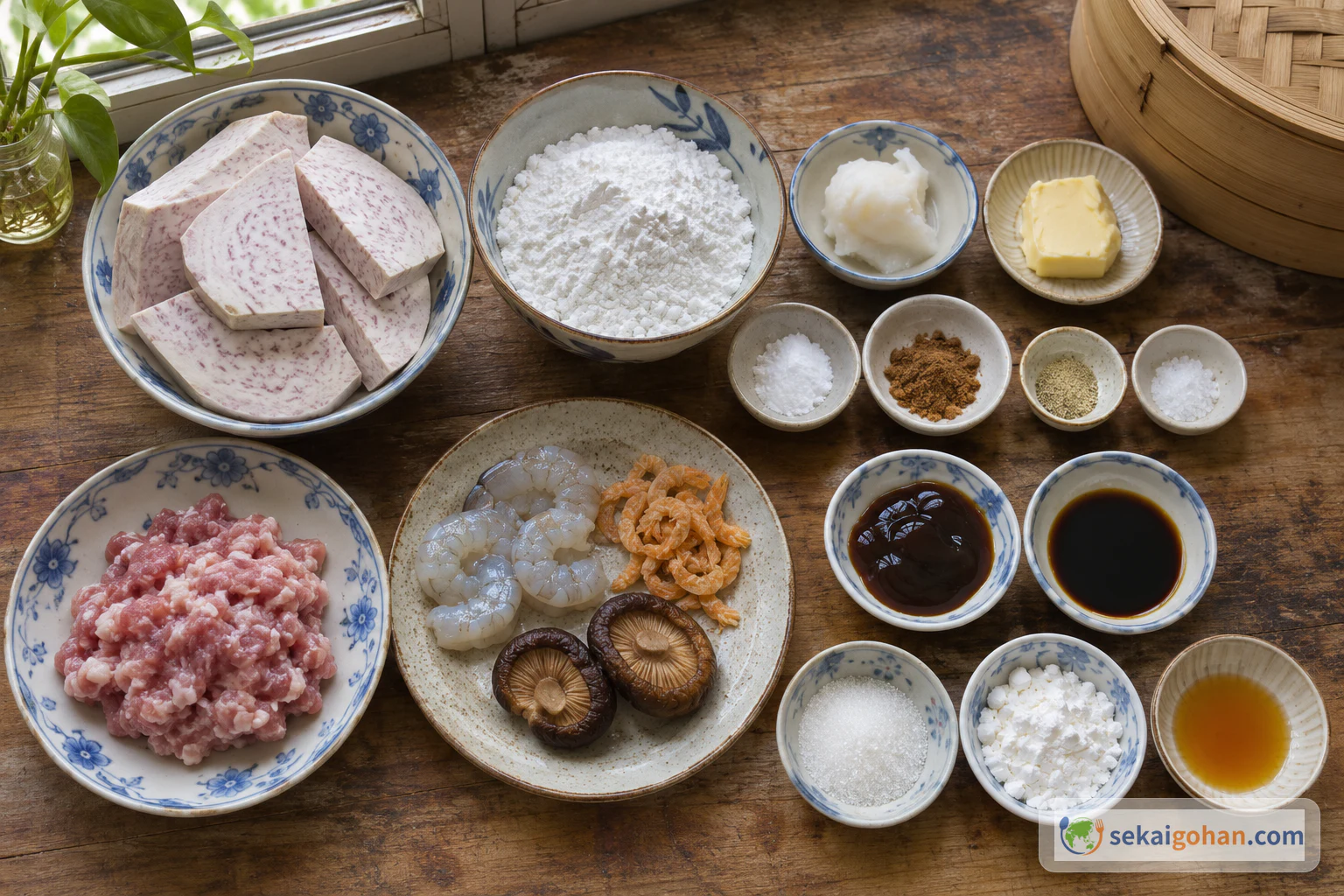
This makes 15 dumplings, each with 1½ oz (40 g) of dough wrapped around ½ oz (15 g) of filling.
The 10½ oz (300 g) is peeled weight. Taro roots vary a lot in size, so buy more than you need and weigh after peeling. Counting roots throws off the ratio of taro to starch, and that ratio decides whether the shell holds together.
Wu gok contains wheat (wheat starch), shrimp, milk (butter), soy (dark soy sauce, oyster sauce), shellfish (oyster sauce is made from oysters), sesame (sesame oil) and pork. Read the labels on sauces and dried shrimp for other allergens.
Equipment
- Deep-fry thermometer
- Deep pot or wok that holds enough oil to submerge a dumpling
- Bamboo steamer, or a steaming rack, over a pot
- Spider strainer (wire skimmer)
- Thin kitchen gloves for peeling taro
- Kitchen scale that reads in small increments
- Heatproof bowl and chopsticks
- Potato masher or sieve
- Wire rack for draining
Choosing and Substituting
Wheat starch is the one ingredient you cannot replace. Look for it at a Chinese grocer as 澄粉 (tang mien) or "wheat starch". Potato starch, glutinous rice flour, rice flour and cornstarch are different starches. They cook and expand differently in hot oil, and they will not give you the honeycomb.
Frozen peeled taro from a Chinese or Southeast Asian grocer is the closest thing to the taro used in Guangzhou, and you can weigh it straight from the bag. The smaller Japanese-style taro (satoimo, eddoe) also works. It is wetter and stickier, so the dough is softer and harder to shape. Weigh it, mash it very smooth, and let it cool before it meets the starch. If you peel satoimo, you can rub it with salt and blanch it briefly to cut the sliminess.
| Ingredient | Swap | What changes |
|---|---|---|
| Dark soy sauce | Regular soy sauce, same amount | Paler filling; dark soy is a different product, made mainly for color |
| Butter | Lard or shortening | Richer, more savory shell, and the dough is dairy-free when you use lard |
| Lard | Butter or shortening | A different flavor, and the lace forms differently |
| Dried shiitake | Fresh shiitake | Less aroma and more water in the filling |
| Pork shoulder | Chicken breast | Leaner, milder filling |
| Dried shrimp | Leave out | The filling loses much of its savory depth |
| Vegetable oil for frying | Rice bran or canola | No change; strongly flavored oils such as sesame oil pass their flavor to the crust |
Never eat taro or satoimo raw. Both contain needle-shaped crystals of calcium oxalate, which irritate the mouth and throat and make skin itch. Cooking breaks them down. Wear thin gloves to peel, and wash knives and boards afterwards.
Method
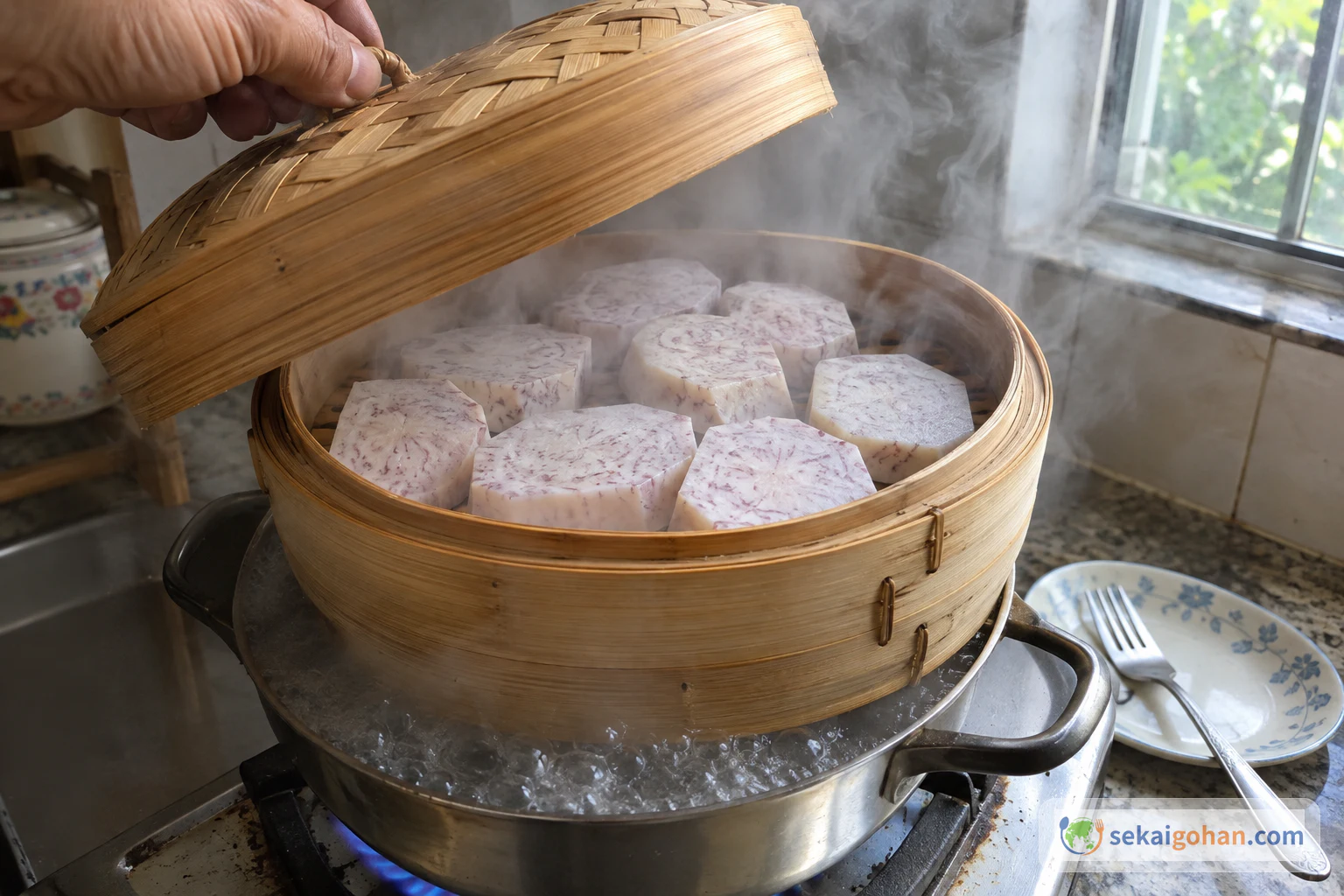
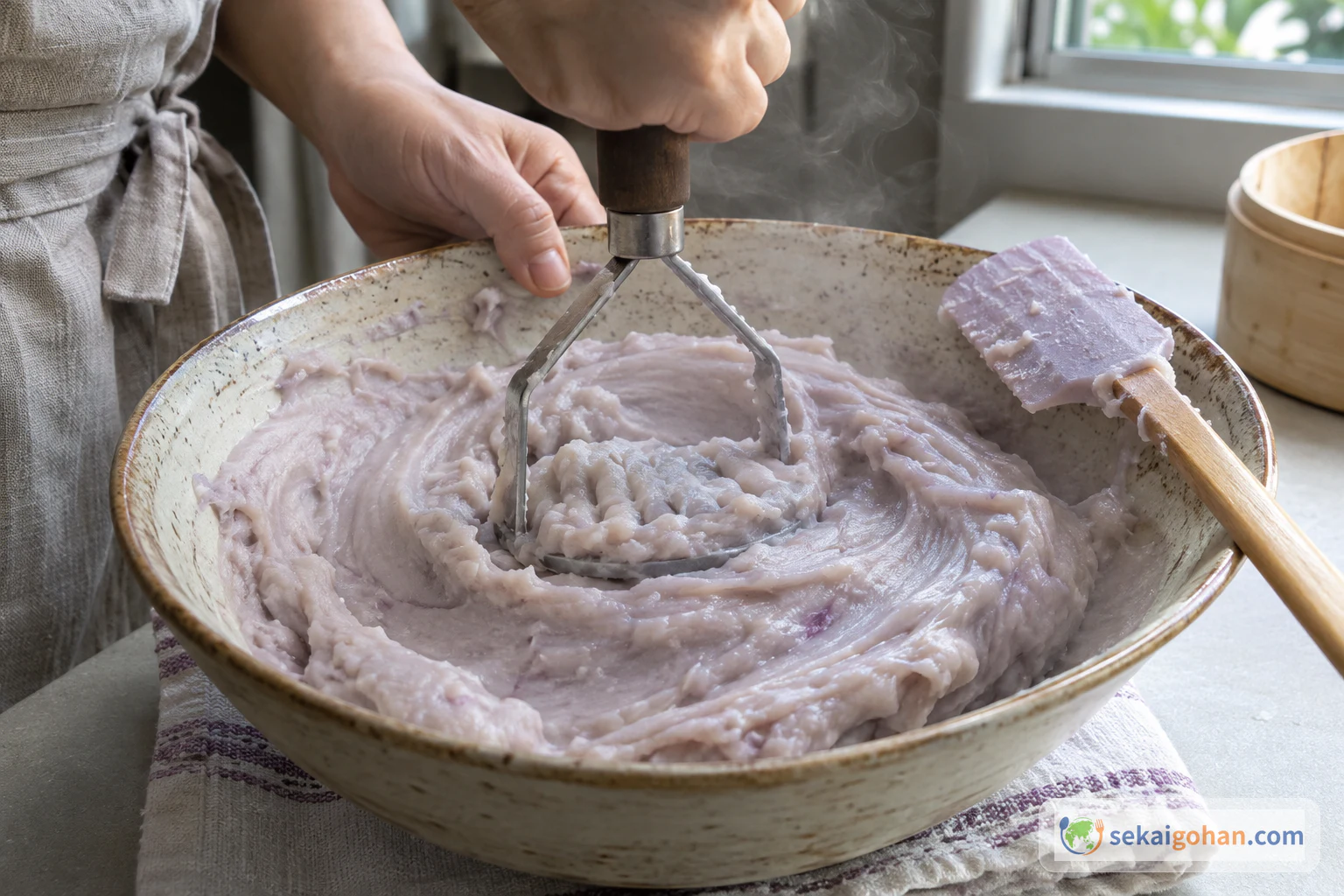
Make the filling first, because it needs 3 hours in the fridge. You can also make it the day before. While it chills, steam the taro and mix the dough, which then needs its own 2 hours of chilling. Shaping and frying come last, once both are cold. Fry right before you eat: wu gok is at its best within minutes of leaving the oil.
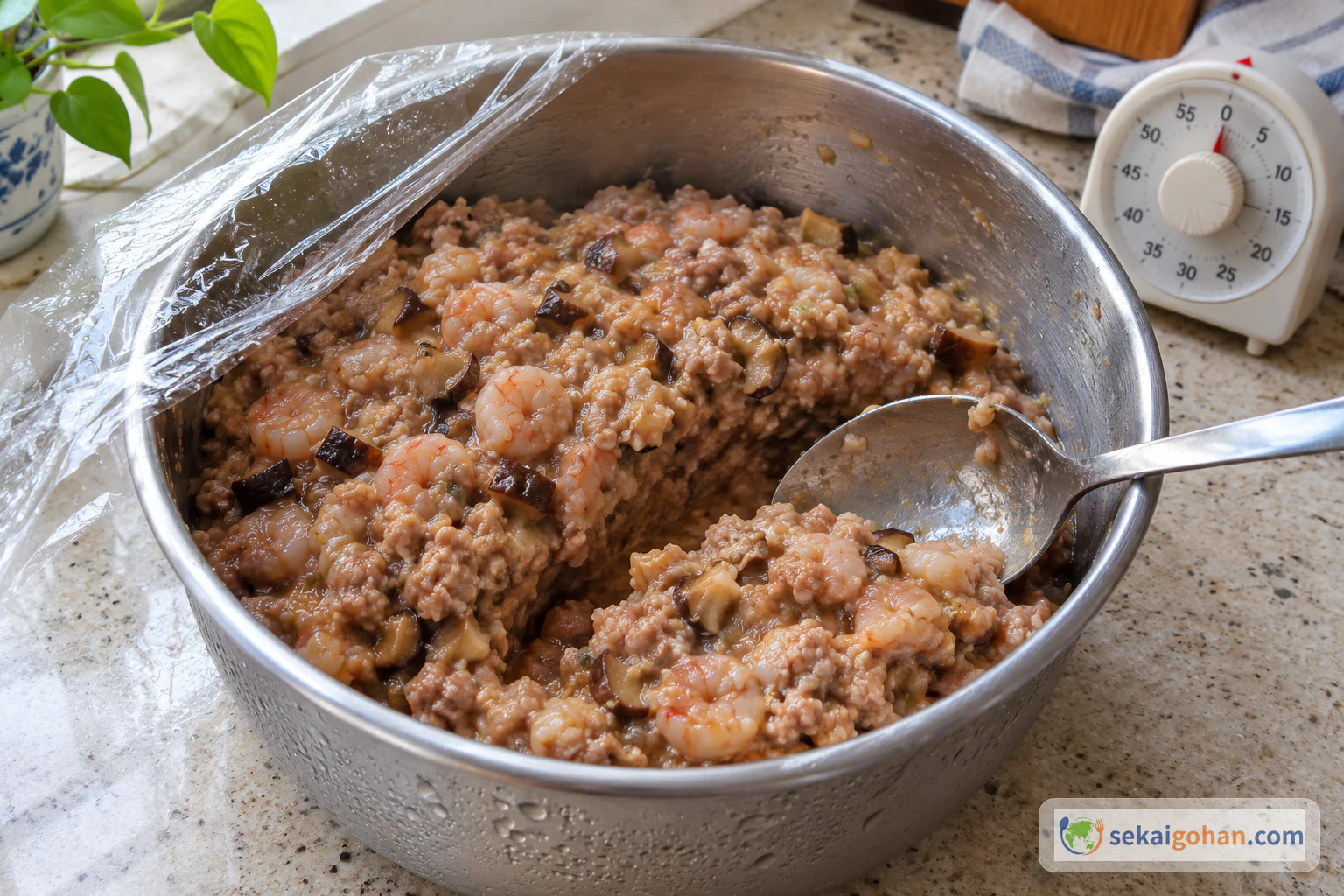
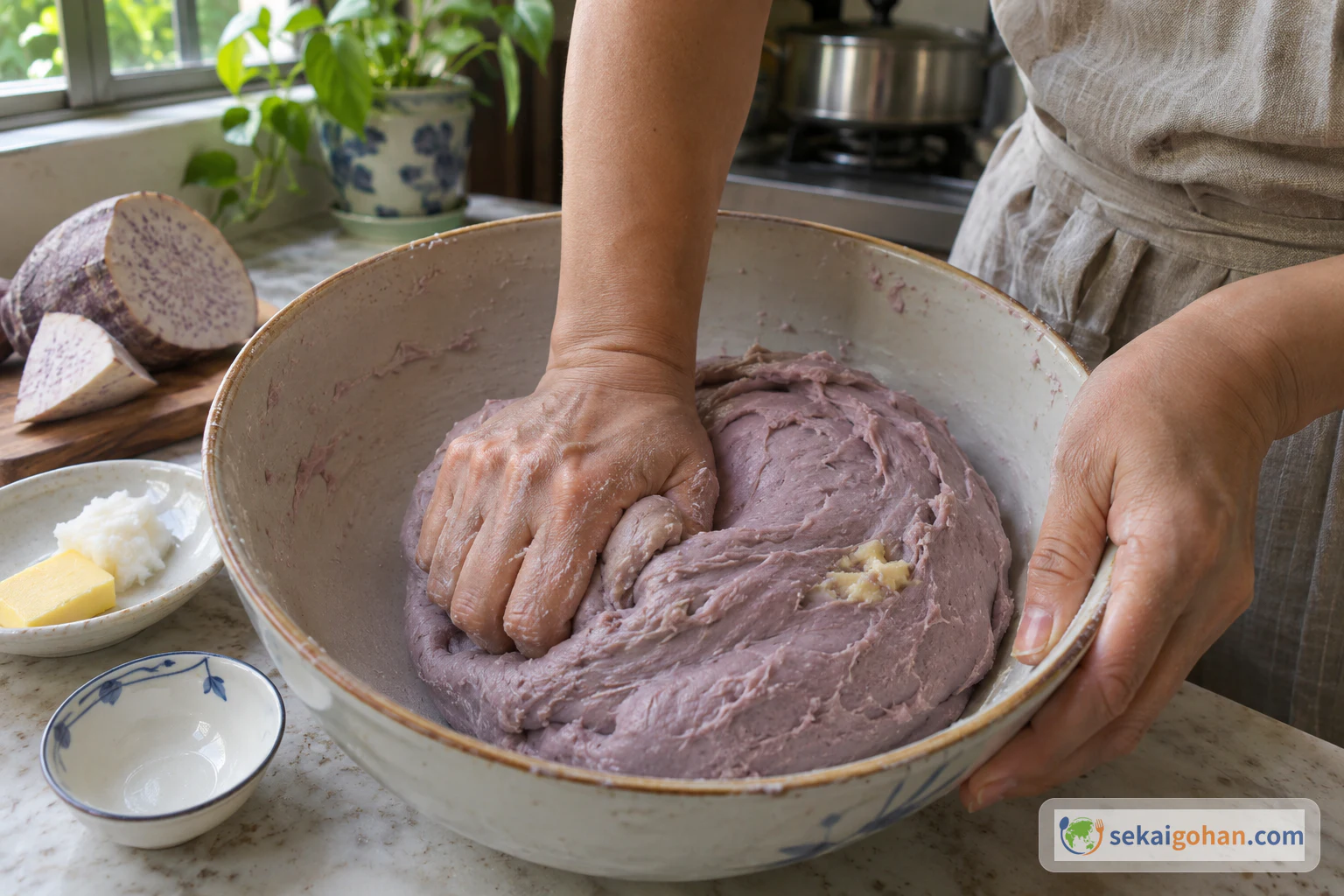
A wet filling tears the shell, and a warm filling melts the lard in the dough so the dumpling slumps. Cook the filling until it is thick enough to hold its shape, then chill the filling and the dough fully before you shape anything.
Household frying oil can catch fire at around 645–700°F (340–370°C). Stay at the stove the whole time the oil is on the heat. A small amount of oil heats very fast, and a stove's overheat sensor may not react in time. Never pour water on overheated or burning oil, because it throws the oil out and spreads the fire. Turn off the heat and cover the pot instead. Use a deep pot and keep children and pets away.
Oil that is too cool lets the shell soften and slide off the filling before it sets. Oil that is too hot browns the surface before the lace can form. Shops and cooks fry anywhere from 330°F (165°C) to about 375°F (190°C), and Guangzhou chefs start at 355°F (180°C) or above. At home, 340°F (170°C) gives you time to watch the lace bloom.
When It Goes Wrong
| What you see | Why | What to do |
|---|---|---|
| The shell slides off or the dumpling falls apart in the oil | Oil too cool, dough too soft, filling too wet, or seams not sealed | Keep the oil at 340°F (170°C), chill the filling and the dough fully, and pinch every edge shut |
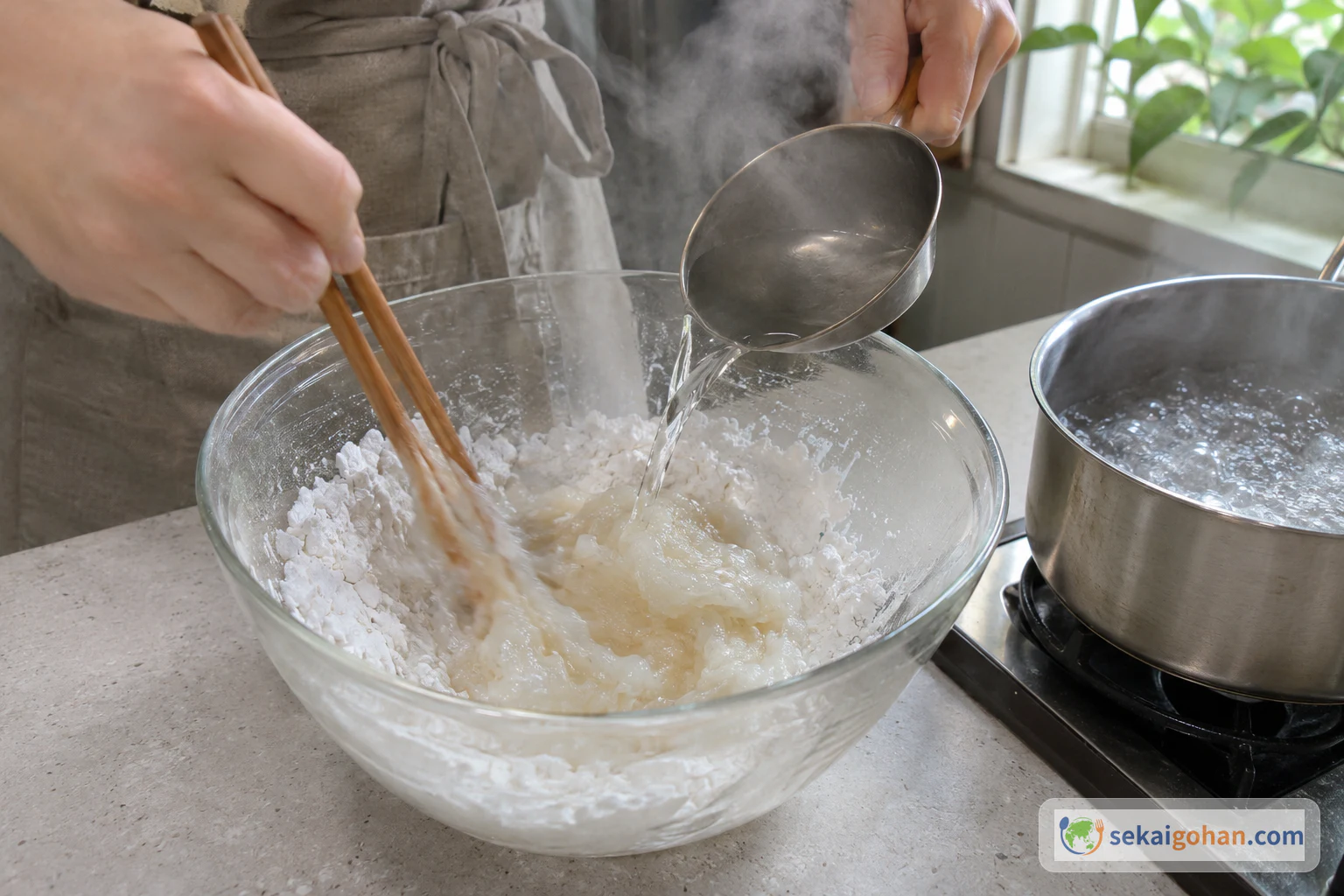
| A plain brown crust with no honeycomb | Oil too hot, or the starch never cooked | Use water at a full boil for the starch and stir until translucent; bring the oil back down to temperature |
| Greasy, heavy dumplings | Oil too cool, often from frying too many at once | Fry one at a time and wait for the oil to recover between dumplings |
| The dumpling bursts and spits | A gap in the seam let oil inside | Press each seam closed before frying; reseal any that crack |
| The dough is too stiff to fold | Chilled hard | Leave it out a few minutes until it softens enough to shape |
Serving, Variations and Storage
At the table
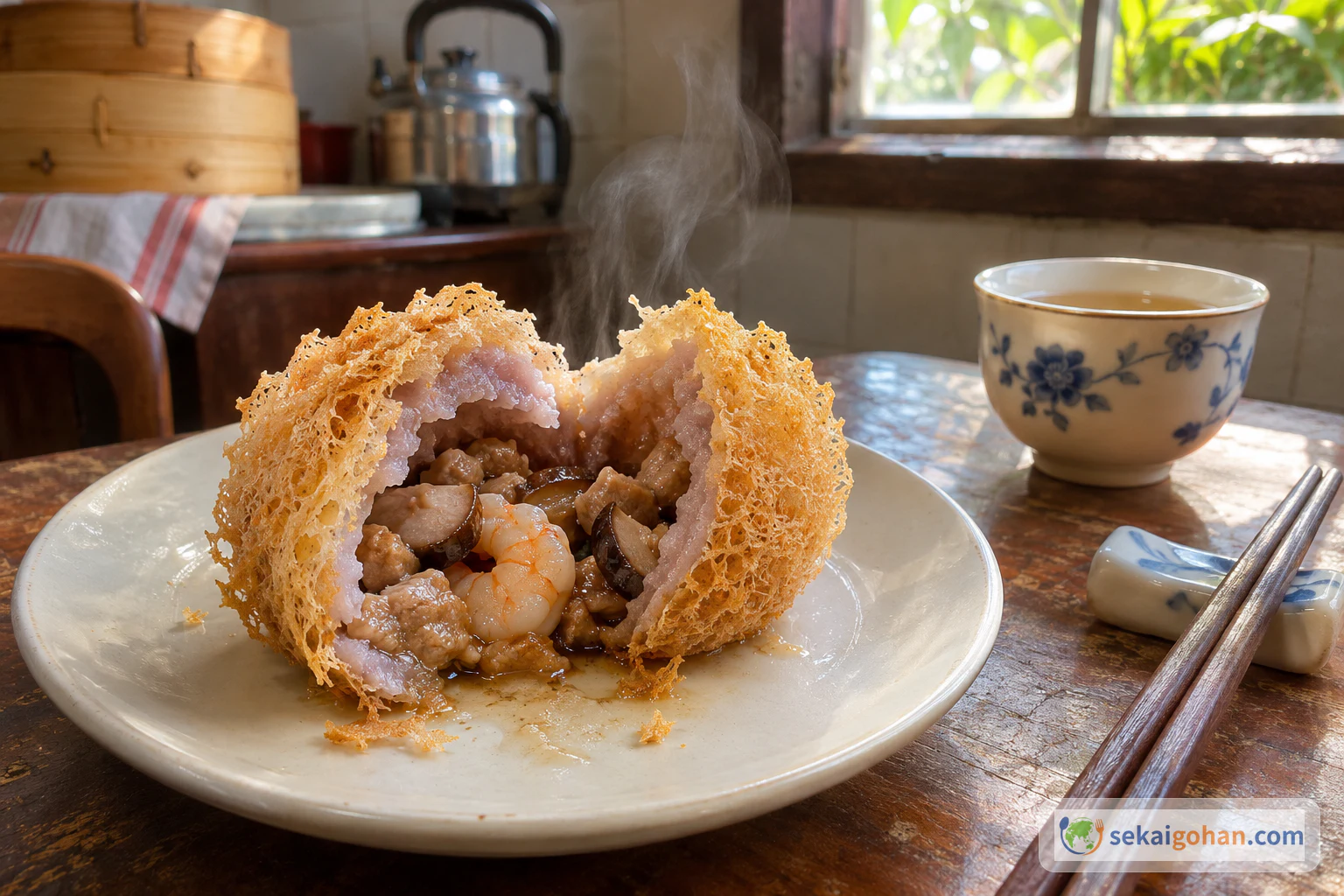
Serve wu gok straight off the rack, with a pot of tea, the way a teahouse does. It is rich, so set it beside something steamed and lean, such as steamed spare ribs with black bean sauce, and let everyone take one or two. Eat it with your fingers or chopsticks and break it in half: the crust shatters, the taro is soft as cream, and the glossy filling steams. You will have a little filling left over once all 15 are wrapped. Spoon it over rice or stir-fried greens.
Variations
- Guangzhou triangles or Hong Kong boats. Use the same dough and filling and change only the fold. Triangles have more seams, so pinch each one again just before frying. Half-moons are the easiest to seal for a first batch.
- Chicken filling. Use chicken breast instead of pork. The filling is leaner and milder, and the dumpling feels lighter.
- More mushroom, less meat. Use more shiitake and less pork for an earthier filling. Mushrooms add water, so cook the filling until it is dry before you chill it.
- Dairy-free shell. Use lard in place of the butter. The shell becomes more savory and keeps the teahouse richness.
Storage and making ahead
Shaped, unfried dumplings freeze for up to 1 month. Freeze them on a tray until hard, then pack them into a bag. Fry them straight from the freezer, a little longer than fresh ones, so the center heats through. Fried wu gok are best eaten at once. To keep leftovers, let them cool, cover them and refrigerate for no more than 1 day. Reheat them in a 350°F (about 177°C) oven for 15 to 20 minutes until the crust is crisp again.
Frequently asked questions
Can I bake or air-fry wu gok?
No. The honeycomb forms because the cooked starch expands suddenly in hot oil, and dry heat cannot do that. Baked or air-fried dumplings do not give the same result. Wu gok has to be deep-fried.
Do I need baker's ammonia for the honeycomb?
Some traditional recipes add a little ammonium bicarbonate (baker's ammonia) to make the honeycomb stronger. It is optional, and baking soda does the same job here. Baker's ammonia can also be hard to find.
Can I make the filling the day before?
Yes. Cook it, let it cool, cover it and keep it in the fridge overnight. It counts as fully chilled the next day, so you can steam the taro and make the dough in the morning.
Why not reheat leftovers in the microwave?
The microwave softens the crust, and the lace goes limp. A hot oven dries the surface and brings the crispness back.