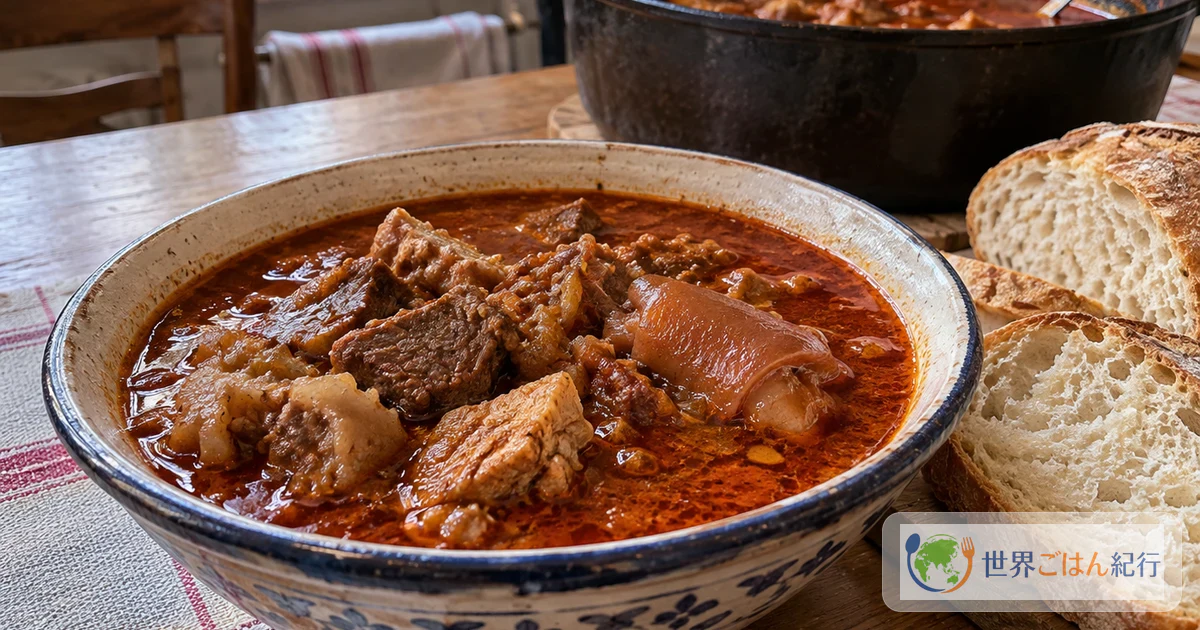
Madrid's Pride: A Stew in Three Acts
Winter in Madrid. You have ducked out of the cold wind sweeping the cobbled lanes into a tavern, and first a bowl of hot broth arrives at the counter. Next comes a plate of chickpeas and vegetables. And last, a big platter of meat: chorizo, morcilla (blood sausage), beef and chicken lined up. This three-act structure is the proper way to eat cocido madrileño, the dish Madrid is proudest of.
Cocido madrileño is Madrid's classic stew, built on dried chickpeas simmered slowly in one big pot with several kinds of meat, bone marrow, vegetables and sausages, and eaten in three stages (the tres vuelcos). "Vuelco" means "turning over," from the act of turning the pot's contents out onto a plate.
Cocido is Spanish for "something cooked," and every part of Spain has its own local cocido. The Madrid version is the best known, and its origin is said to lie in the medieval Sephardic Jewish Sabbath dish adafina. It was originally a kosher dish without pork, and is said to have taken its present form with the addition of pork, chorizo and morcilla after the Reconquista. Where Greek fasolada is a vegetarian white bean soup, cocido is a hearty feast of chickpeas and meat.
English-language sources do cover this dish. Culinary Backstreets has published a detailed recipe as Madrid chef Juanjo López's "cocido in seven acts," and spain.info, the Spanish tourism board, carries an official recipe. This article reproduces the traditional style served in Madrid's dining rooms, and explains in detail how to stand in for ingredients that are hard to find.
Ingredients (serves 6)
Look for Spanish chorizo at delis and specialty food stores. It is not the same as Mexican chorizo (a fresh sausage), so be careful: Spanish chorizo is a dried or semi-dried sausage colored red with paprika. Morcilla can be hard to find, but frozen packs are sometimes available from online shops. You can still make a very good cocido without it. Marrow bones and a ham bone can be ordered from butchers and halal food shops.

Cooking Tips
When the water level falls during simmering, adding cold water causes what is called "asustar" (frightening), which toughens the chickpea skins. Always add boiling water. Keeping a separate small pot of water simmering beside the main pot to top up as needed makes this easy.
The marrow from beef shin bones is the foundation of cocido's flavor. As it melts into the broth it adds a gelatinous richness and depth. It may be hard to find in ordinary supermarkets, but you can ask a butcher to order it, or buy beef bones online. With and without marrow, the quality of the broth is quite different.
Putting cabbage straight into the cocido pot clouds the broth green and carries a cabbage smell into the meat and chickpeas. Parboiling it 5 minutes in a separate pot before adding it keeps the broth clear and leaves the cabbage tender and sweet.
Like Greek fasolada, cocido tastes better the next day. The chickpeas soak up still more of the broth's savor and the meat fibers loosen and soften. Making a big pot on Sunday and eating it again for Monday's lunch is a common home pattern.

Variations
Cocido andaluz (Andalusian style)
The cocido of Andalusia in southern Spain is characterized by using white beans together with chickpeas and adding pumpkin. It also has a higher proportion of vegetables than meat, and finishes with a hit of cumin and paprika.
Escudella i carn d'olla (Catalan version)
Catalonia's "escudella i carn d'olla" is a relative of cocido, characterized by a large meatball (pilota). Instead of pasta, galets (large Catalan pasta shells) go into the broth. It is also a traditional Christmas dish.
Pressure-cooker shortcut
Put the soaked chickpeas, all the meats, the whole onion and garlic in a pressure cooker, pour in 2 liters of water and cook 45 minutes at high pressure. After natural release, open the lid, add the vegetables and sausages, and simmer 20 minutes in the open pot. It cuts the cooking time to a third, though keeping the broth clear is somewhat harder.
Ropa vieja-style remake
Shred the leftover meat from the next day's cocido and sauté it with tomato sauce and paprika to make ropa vieja ("old clothes"). Cuban ropa vieja is said to be this Spanish leftover dish carried across the Atlantic. Leftover chickpeas are also good mixed into a salad.

Background
From Sephardic adafina to cocido
The history of cocido is said to go back to the Sephardic Jewish communities of medieval Iberia. Because cooking with fire is forbidden on the Sabbath (Shabbat), a dish called adafina arose: all the ingredients went into a pot before sunset on Friday and simmered slowly through the night on the remaining embers. It is said that adafina with pork came to be made, which became cocido and in time rose to be a staple of all Spain. Ironically, religious persecution is said to have helped produce one great dish.
Madrid's food culture and the three vuelcos
The "tres vuelcos" of eating in three stages is not merely etiquette but an expression of the logic of drawing three different dishes from one pot. Broth warms the body, chickpeas and vegetables fill the stomach, and the meat maximizes satisfaction. This structure is rooted in the medieval "aesthetic of thrift" that wastes no ingredient.
These days cocido is eaten in Madrid mainly as a winter Sunday lunch. The scene of a big pot of cocido served in three stages at the family table on Sunday is a symbol of Madrid's food culture.

Read Alongside
Cocido is one of the peaks of Europe's "big pot stew" culture. Do try the stews of neighboring countries too.
- Fasolada (Greece): a white bean soup with olive oil
- Goulash (Hungary): the classic paprika stew
- Fårikål (Norway) (in Japanese): a simple pot of lamb and cabbage
- Caldo verde (Portugal) (in Japanese): a soup of kale and potato
And the descendants of cocido that crossed the Atlantic.
- Ropa vieja (Cuba): a cocido remake that crossed the Atlantic
- Feijoada (Brazil): a stew of black beans and pork
- Locro (Argentina) (in Japanese): a stew of corn and meat
More Dishes to Cook Alongside
- Gazpacho (in Japanese): continue the same country's table.
- Paella (in Japanese): continue the same country's table.
- Tortilla española (in Japanese): continue the same country's table.
- Carcamusas: unlike Madrid's big pot, a small-dish stew from Toledo with a rich taste of pork and tomato.
Frequently Asked Questions
What if I can't get chorizo or morcilla?
In place of chorizo you can use a coarse-ground sausage rubbed with paprika. Dust two frankfurters with 2 tsp paprika and 1 clove grated garlic and leave 30 minutes for a quick chorizo-style stand-in. You can skip the morcilla without trouble.
Can I make it in a pressure cooker?
Yes. Put the soaked chickpeas and all the meats in a pressure cooker and cook 45 minutes at high pressure. After natural release, add the vegetables and sausages and simmer 20 minutes with the lid off. The broth is somewhat less clear, but the flavor is not inferior.
How do I store leftover cocido?
Store the broth, the chickpeas plus vegetables, and the meat separately in containers; it keeps 3 days in the refrigerator or 1 month in the freezer. For the next day's lunch, just reheating is plenty good, and many people actually prefer "second-day cocido." Shredding leftover meat as a croquette filling is a common way to reuse it.
Nutrition (one serving of 6)
Cocido is a nutrient-dense meal that combines the plant protein and fiber of chickpeas with animal protein from several meats. Where Lebanese mujaddara rounds out protein with beans and grain, cocido secures an overwhelming quantity of protein from both beans and meat.
| Nutrient | Amount |
|---|---|
| Energy | 680 kcal |
| Protein | 42 g |
| Fat | 28 g |
| Carbohydrate | 62 g |
| Fiber | 14 g |
| Sodium | 720 mg |
| Iron | 6.8 mg |
| Calcium | 120 mg |
Sources
- López, J. (2023). "Cocido madrileño in seven acts." Culinary Backstreets, Madrid.
- Spain.info (2024). "Recipe: Madrid 'cocido'." Spanish Tourism Board.
- The Spanish Cuisine (2024). "Cocido Madrileño – Spanish Stew." The Spanish Cuisine. (A recipe by a Spanish food blogger.)