

Why Ethiopian food, and why now
Ethiopia, in the northeast of Africa, has a population of more than 120 million, the second largest on the continent. It is also home to one of Africa's most distinctive food cultures.
Ethiopia is one of the few African countries never colonized by a European power (it was occupied by Italy from 1936 to 1941). Over its long history as a kingdom, its cooking developed in its own way, apart from its neighbors. Using the fermented flatbread injera as a plate and eating with your hands is a style seldom seen elsewhere.
In cities with large Ethiopian and Eritrean communities, such as the Washington, D.C., area and London, Ethiopian restaurants cluster together and have long been a familiar way to eat out.
Even so, it can be hard to find guides that go beyond a handful of dishes to explain the food culture and the thinking behind the cooking.
This guide brings together what you need to start cooking Ethiopian food: its history and religious background, the essential spices and seasonings, and 10 classic dishes you can make at home.
Use this beginner's guide to get the big picture of Ethiopian food, then move on to the individual recipe pages for the dishes that catch your interest. Detailed methods are on the linked pages.
Some Ethiopian dishes use wheat (some injera), dairy (niter kibbeh, ayib), or sesame (tahini-style dips). Berbere may also contain nuts. If you have food allergies, check each recipe's ingredients before you cook.

A short food history: shaped by civilization and faith
The Aksumite Kingdom and ancient foodways
From around the first century CE, the Kingdom of Aksum flourished in northern Ethiopia. A hub of Red Sea trade linked to the Roman Empire, India, and the Arabian Peninsula, Aksum was a land where spices and goods changed hands.
Teff (Eragrostis tef) is a grain native to the Ethiopian highlands, known for its tiny seeds, about 1 mm across. It has been grown in Ethiopia since ancient times and still underpins the diet. Teff is gluten-free and contains iron and calcium, and in recent years it has drawn attention in the health-food markets of Europe and North America.
Ethiopia is also known as the birthplace of the coffee plant (Coffea arabica). The legend of Kaldi, the goatherd who noticed the energizing effect of coffee berries, is famous, but it is a story told much later. Coffee remains one of Ethiopia's leading exports and supports both daily life and the economy.
The Ethiopian Orthodox Church and fasting
To understand Ethiopian food, you need to understand the fasting culture of the Ethiopian Orthodox Church. The church calendar has many fasting days (tsom), including Wednesdays and Fridays and the long period before Easter. There are about 250 fasting days a year, of which about 180 are expected to be observed by ordinary believers. On fasting days, people avoid meat, dairy, and eggs.
This fasting culture drove a remarkable development of legume and vegetable dishes. Long before plant-based eating became a global trend, Ethiopia had an established system for building satisfying meals from nothing but legumes, grains, and vegetables. Shiro wot (chickpea-flour stew), misir wot (lentil stew), gomen (braised greens), and many more: the fasting-day repertoire alone could fill a cookbook.
About 40 percent of Ethiopians today belong to the Ethiopian Orthodox Church, and this fasting cuisine is central to the country's food identity. It is no surprise that vegan restaurants abroad increasingly look to Ethiopian food for inspiration: its dishes have been refined over a long history.
Gursha: what eating by hand means
At an Ethiopian meal, you tear off a piece of injera with your right hand, wrap it around a bite of food, and bring it to your mouth. This utensil-free style means more than tradition alone.
In the custom called gursha, you wrap a bite with your own hand and place it directly in someone else's mouth. At the Ethiopian table it is known as a gesture of affection and respect, and it is one of the things that surprises first-time visitors to Ethiopian restaurants.
Traditionally, meals are eaten around a mesob, a woven basket table shaped like a cylinder. A large injera is spread on top, and the meal begins after the head of the household says a prayer. Eating together from one shared platter reflects the same spirit of sharing food found in the Middle Eastern meze tradition.
The left hand is considered unclean and isn't used for eating; eat with your right hand only. Tear the injera into small pieces, wrap them around the food, and eat each in one bite. The injera spread underneath the dishes, soaked with their juices, is eaten at the end too.
The essential spices and seasonings
Ethiopian flavor rests on complex spice combinations. Blends of ten or more spices are common, but for home cooking, these five are the ones to get first.
Berbere: the soul of Ethiopian cooking
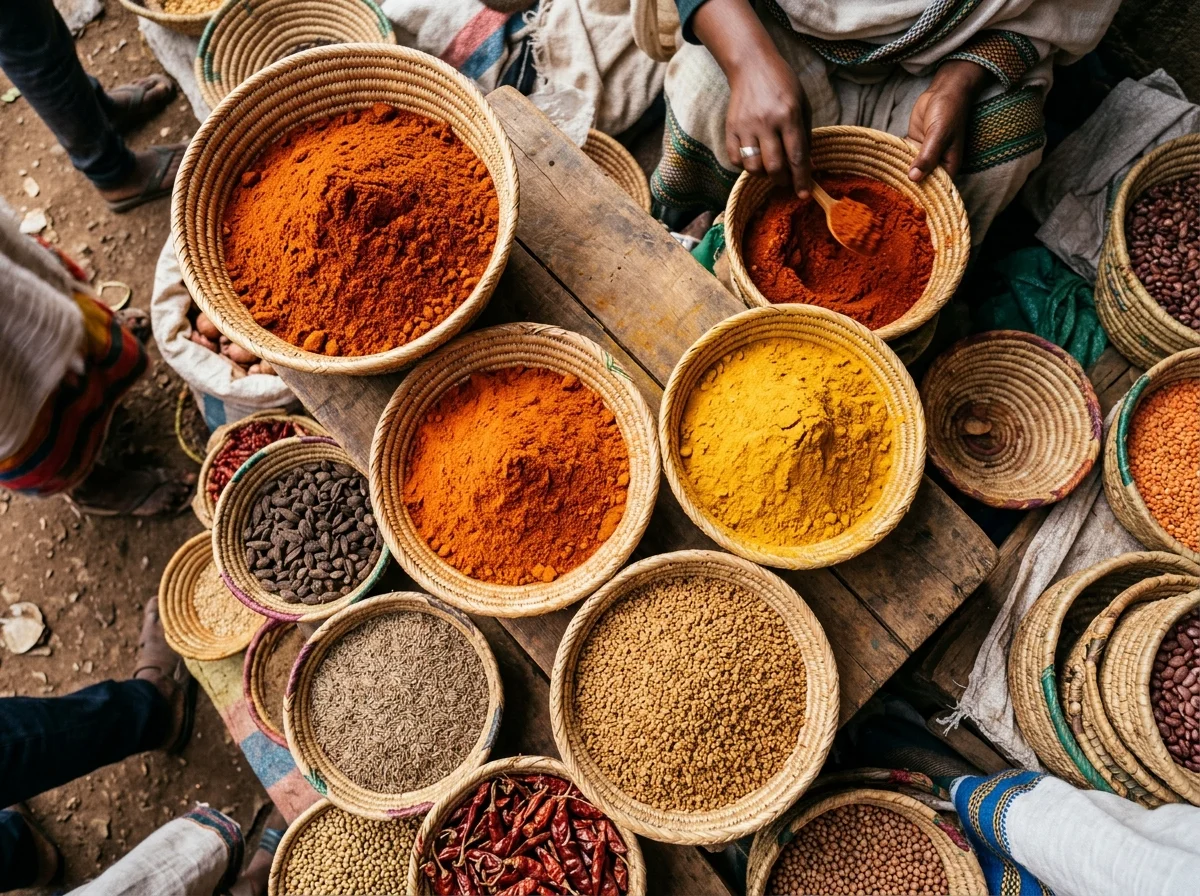
Berbere is the most important spice blend in Ethiopian cooking. It is a red powder built on chili and blended from 10–15 spices such as fenugreek, coriander, cardamom, cloves, allspice, cinnamon, and ginger. It goes into nearly every wot (stew), starting with doro wot.
Every family's blend is different, passed down as a household flavor.
Ready-made berbere is sold at African and Middle Eastern grocers and online. If you want to go further, gather the following spices and try making your own blend.
| Spice | Where to find it | What it does |
|---|---|---|
| Chili powder (coarse Korean chili flakes work well) | Asian grocers, online | The base of berbere |
| Fenugreek | Indian and Middle Eastern grocers, online | A distinctive, sweet aroma |
| Cardamom | Supermarket spice aisle, specialty grocers | A cool, fresh aroma |
| Coriander seed | Supermarket spice aisle | Bright, citrusy notes |
| Cumin seed | Supermarket spice aisle | A warm, earthy aroma |
If you can't find berbere, mix 2 tbsp chili powder, 1 tbsp paprika, 2 tsp garam masala, 1 tsp ground ginger, and 1/2 tsp cinnamon for a simple version. It isn't the real thing, but it works well as an introduction to Ethiopian cooking.
Mitmita: berbere's fiery little sibling
Mitmita is hotter than berbere and a simpler blend: bird's eye chili with cardamom, cloves, and salt. It is sprinkled over kitfo (raw beef tartare) and tibs (sautéed meat). Think of berbere as the "stewing spice" and mitmita as the "finishing spice," and you'll know when to use each.
Niter kibbeh: golden spiced butter
Niter kibbeh is Ethiopia's clarified butter. Butter is heated slowly to remove the water and milk solids while spices such as turmeric, fenugreek, cardamom, and coriander are added to infuse it. It resembles Indian ghee, but niter kibbeh is far more aromatic.
It's easy to make: melt 250 g unsalted butter slowly over low heat for 20–30 minutes, add the spices to draw out their aroma, and strain it through cloth. It keeps for more than a month in the refrigerator, so make a batch and have it ready whenever you cook Ethiopian food.
Awaze: an all-purpose chili paste
Awaze is a paste made from berbere mixed with wine (or tej, honey wine) and garlic. It is used to marinate tibs and as a dip spread directly on injera. At home, mixing berbere with a splash of wine and grated garlic gets you close.
10 classic dishes to know
Ethiopian food rests on three pillars: stews called wot, sautéed dishes called tibs, and injera, the fermented flatbread. Know these 10 dishes and an Ethiopian restaurant menu will hold no mysteries.
1. Injera: the foundation of every meal

Injera is the fermented flatbread at the base of every Ethiopian meal. Teff flour is mixed with water, left to ferment naturally for 2–3 days, and cooked like a large crepe. With its distinctive sourness and spongy spring, it serves as a plate for the food and is torn off and used to scoop it up.
Because teff is rarely grown outside Ethiopia, recipes abroad often substitute buckwheat or rice flour. Our injera recipe (in Japanese) explains how to make it with widely available ingredients.
According to USDA food composition data, 100 g of uncooked teff contains about 13 g protein, about 7.6 mg iron, and about 180 mg calcium.
2. Doro wot: the national chicken stew
The best-known Ethiopian dish, and a must on holidays, is this red chicken stew. Doro means chicken and wot means stew. A large amount of onion is cooked slowly without oil for 45 minutes or more to drive off its moisture, then simmered with berbere and niter kibbeh. Hard-boiled eggs are added at the end, scored with a cross so the spices soak in.
At Ethiopian Christmas (Genna, January 7), doro wot is on nearly every family's table. It is also served at weddings, and for Ethiopians it is "the taste of life's milestones." For a full method, see our doro wot recipe (in Japanese).
3. Kitfo: Ethiopian steak tartare
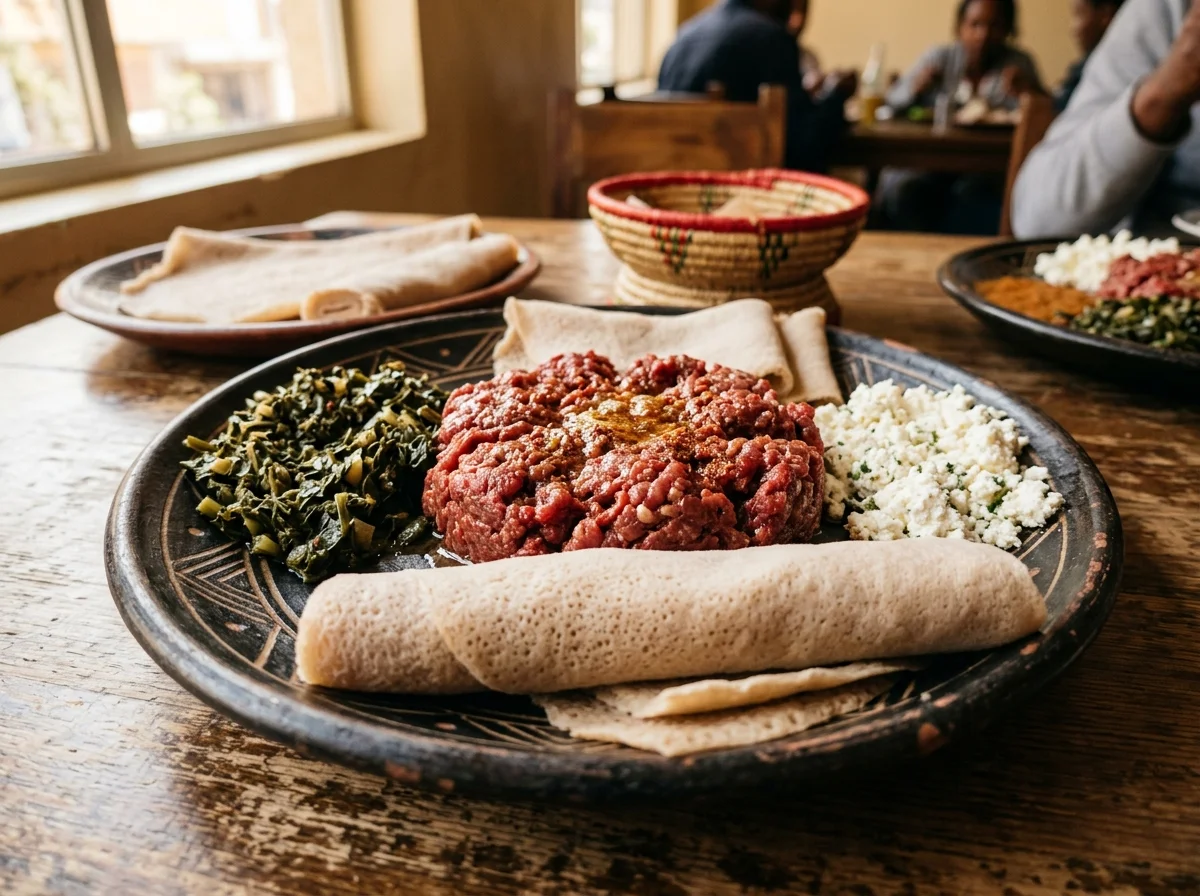
Kitfo is fresh minced beef dressed with mitmita and niter kibbeh. Eaten raw it is the classic version, but it can also be ordered lightly warmed (leb leb) or fully cooked (yebesele). Raw minced beef carries a risk of food poisoning, so when making it at home, cook it thoroughly to the center.
Kitfo originated as a traditional dish of the Gurage people of southern Ethiopia and is now enjoyed across the country as a special-occasion dish. It pairs beautifully with gomen (sautéed collard greens) and ayib (Ethiopian fresh cheese), bringing together the rich flavor of the beef and the aroma of the spiced butter.
At home, use very fresh lean beef meant for eating raw, chop it finely with a knife, and toss it with mitmita and butter. If you're wary of raw meat, warm it briefly in a skillet, leb leb style.
4. Shiro wot: the star of fasting days

Shiro wot is a thick stew made from chickpea flour (or fava bean flour). It is the vegan dish most often eaten on fasting days and the ultimate Ethiopian comfort food.
It's surprisingly simple: sauté onion and garlic, add berbere, stir in chickpea flour mixed with water, and simmer until thick. Ready in about 15 minutes, it's a staple for students and people living alone in Ethiopia. Chickpea flour (besan) is easy to find at Indian grocers and online.
5. Misir wot: spiced red lentils
Misir wot is a spicy stew of red lentils simmered with berbere. Along with shiro wot it is a fasting-day staple. Red lentils cook quickly and need no soaking, so it's ready in about 30 minutes.
Red lentils are sold in most supermarkets. Green lentils work if that's all you have, but they take about twice as long to cook. Adjust the heat with the amount of berbere; if you don't like spicy food, use less and add a little more turmeric.
6. Tibs: Ethiopian sautéed meat
Tibs is a general name for meat and vegetables sautéed with spices. It can be made with beef, lamb, or chicken and is cooked quickly over high heat. With the toasty appeal of grilled meat, it's the easiest entry point into Ethiopian cooking.
Meat marinated in awaze (chili paste) is seared over high heat, then onion, tomato, and jalapeño are added and tossed briefly. A sprig of rosemary on top is the Ethiopian touch. Thinly sliced beef from the supermarket works perfectly well.

7. Gomen: Ethiopian collard greens
Gomen is collard greens braised with garlic and ginger. Other sturdy greens or spinach can stand in, and cooking them in niter kibbeh gives a deep, distinctly Ethiopian flavor. Because it is also eaten on fasting days, it is often paired with misir wot or shiro wot.
8. Ayib: Ethiopian fresh cheese
Ayib is a fresh cheese made by curdling milk (or buttermilk) with acid. With a texture like cottage cheese, it is an essential cooling foil for spicy wots. At home, heat milk to 70°C (158°F) or above, add lemon juice (or vinegar), and strain the curds through cloth. It works just like homemade ricotta and is ready in about 15 minutes.
9. Firfir: injera breakfast scramble
Firfir is a breakfast dish of leftover injera torn into small pieces and sautéed with berbere and niter kibbeh. A homey leftovers dish, it grew out of the everyday wisdom of not wasting the previous night's injera. Some versions add egg to make a scramble, and it's a practical dish to make quickly on a busy morning.
10. Tej: Ethiopian honey wine
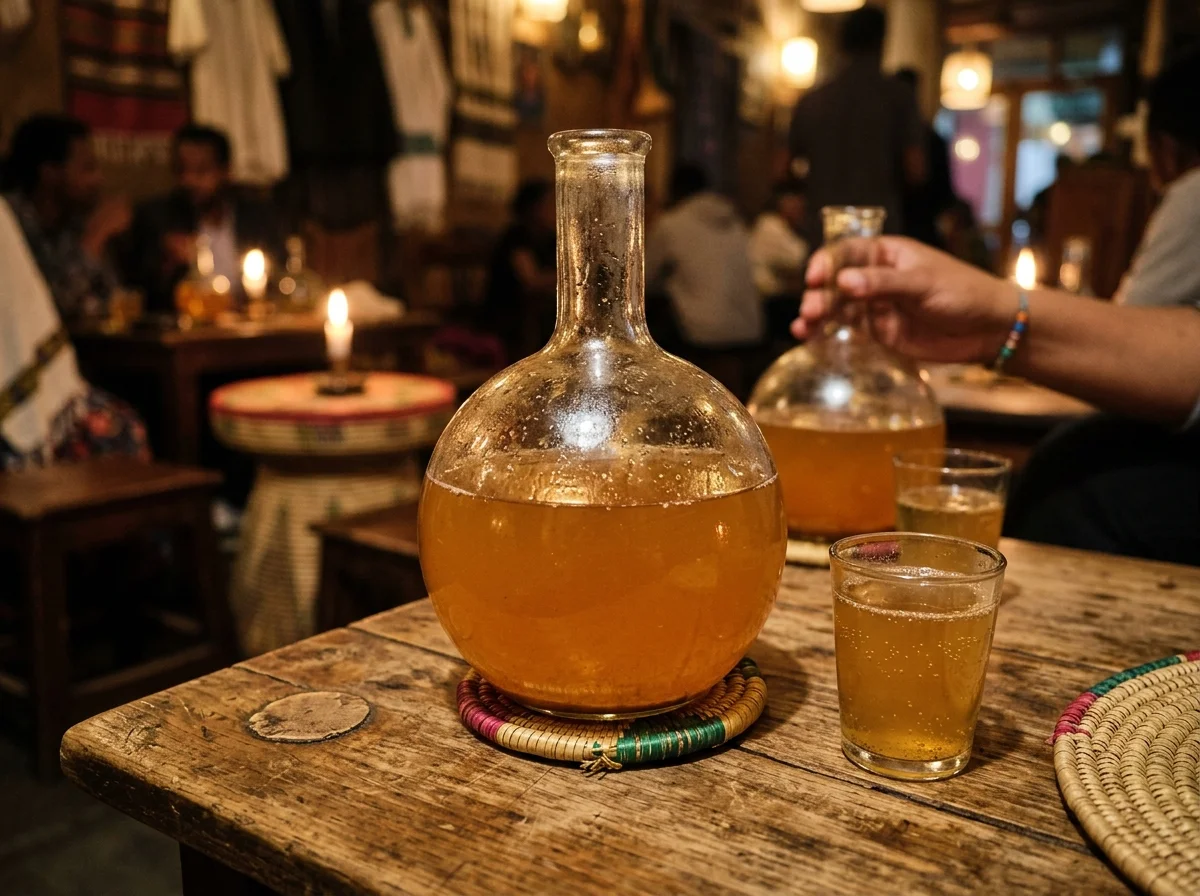
Tej is Ethiopian mead, fermented from honey and water. It is distinguished by the stems and leaves of a plant called gesho, which are added during fermentation and give it a gentle bitterness that balances the sweetness of the honey. Its alcohol content ranges widely, from 6 to 14 percent, and each household makes it to taste, from sweet to dry.
It is traditionally served in a berele, a distinctive round-bottomed glass shaped like a flask, and in Ethiopian restaurants tej is often enjoyed alongside the food. At home you can make a simple honey wine with honey, water, and dry yeast.
The coffee ceremony: a ritual of the heart
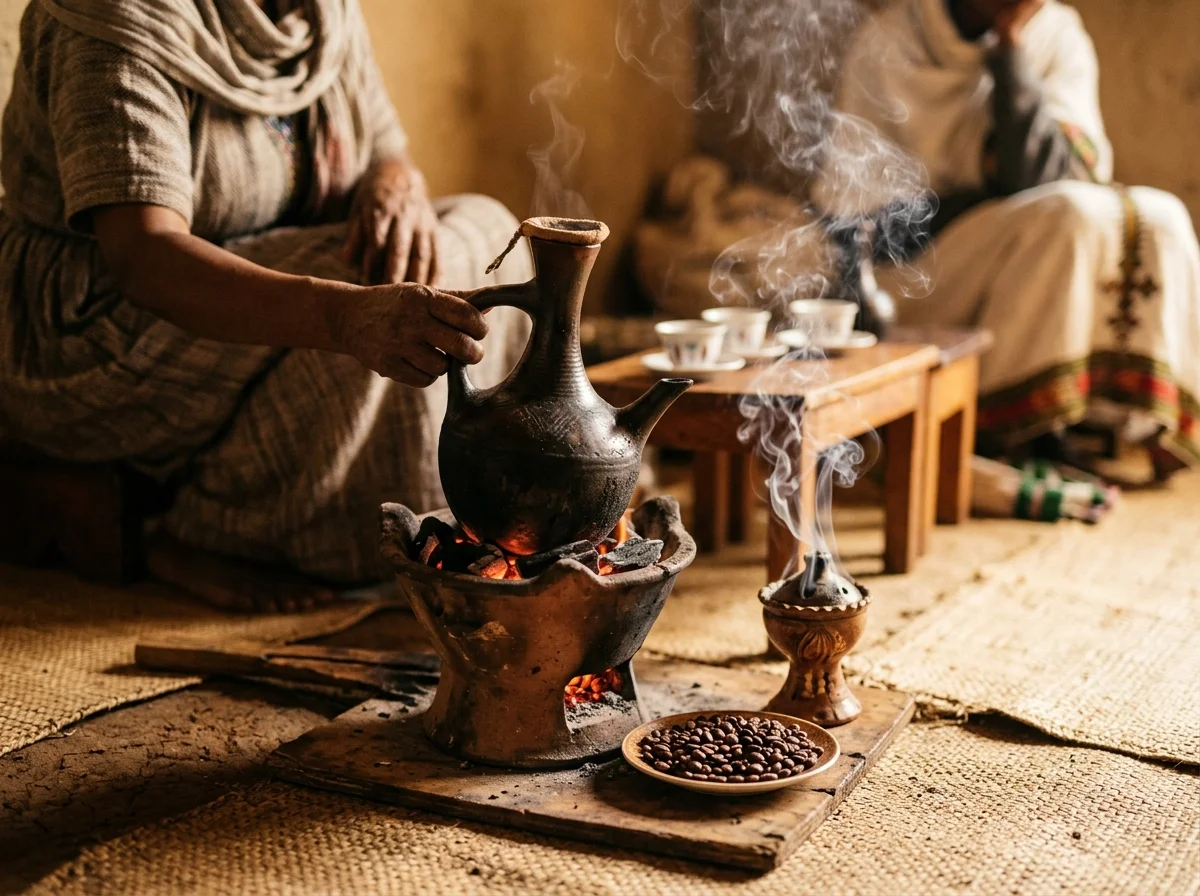
No account of Ethiopian food culture is complete without the coffee ceremony (buna maflat). In Ethiopia, the birthplace of coffee, it is not just a drink but a symbol of sociability and spirit.
The ceremony proceeds like this. First, raw green coffee beans are roasted in a small iron pan. The freshly roasted beans are carried around so every guest can enjoy the aroma (a sign of hospitality in itself). The beans are then crushed with a mortar and pestle and boiled in a clay pot called a jebena.
Each ceremony serves three cups. The first is abol (the strongest), the second tona (medium), and the third baraka (the lightest, meaning "blessing"). It is good manners to stay for all three, and leaving partway through is considered rude. The whole ceremony can take 1–2 hours, and it has a contemplative quality reminiscent of the Japanese tea ceremony.
The coffee ceremony is also a time for socializing, when family and neighbors gather to talk. The custom is to take your time and not rush until all three cups are finished.
Some Ethiopian restaurants offer a coffee ceremony. It often requires a reservation, so check ahead.
Cooking Ethiopian food at home
Basic ingredients and where to find them
The biggest hurdle to cooking Ethiopian food at home is finding the spices. In practice, though, a regular supermarket plus a specialty grocer or online shop will cover almost everything.
From the supermarket: Onions (lots of them), garlic, ginger, canned tomatoes, red lentils, unsalted butter, boneless chicken thighs, lean beef, eggs, lemons, and collard greens (or another sturdy green)
From a well-stocked spice aisle or specialty grocer: Cumin seed, coriander seed, cardamom, fenugreek, turmeric, paprika
From African, Indian, or Middle Eastern grocers, or online: Berbere (ready-made), teff flour, besan (chickpea flour)
Substitutes:
| Ethiopian ingredient | Substitute | Notes |
|---|---|---|
| Teff flour | A 7:3 blend of buckwheat flour and rice flour | Hard to match teff's tang, but the texture comes close |
| Collard greens | Other sturdy greens, spinach | Greens with thicker stems are closer in texture |
| Niter kibbeh | Ghee + turmeric + cardamom | Adding spices to ghee makes a good substitute |
| Gesho (for tej) | Hop pellets | Brewing hops can stand in for the bitterness |
| Awaze | Berbere + wine + garlic | Make it into a paste; keeps 1 week in the refrigerator |
Three golden rules
Ethiopian cooking uses a few distinctive techniques.
Rule 1: Cook the onions without oil Doro wot and shiro wot start with finely chopped onions cooked slowly over medium heat with no oil, for 30–45 minutes, until all their moisture is gone and they turn brown. If liquid comes out along the way, just let it evaporate. This step creates the deep savoriness of a wot; skip it and the flavor turns thin.
Rule 2: Heat spices low and slow Berbere turns bitter if it scorches. Once you add it to the onions, lower the heat and cook for about 5 minutes, stirring constantly, to draw out the aroma. When making niter kibbeh, always heat the butter over low heat too.
Rule 3: Don't begrudge the time Ethiopian food generally takes time: about 2 hours for doro wot, 3 days to ferment injera. The complex flavor that this time creates is the heart of Ethiopian cooking. A practical approach is to spend half a weekend day cooking in bulk and freezing. Wots keep about a month in the freezer.
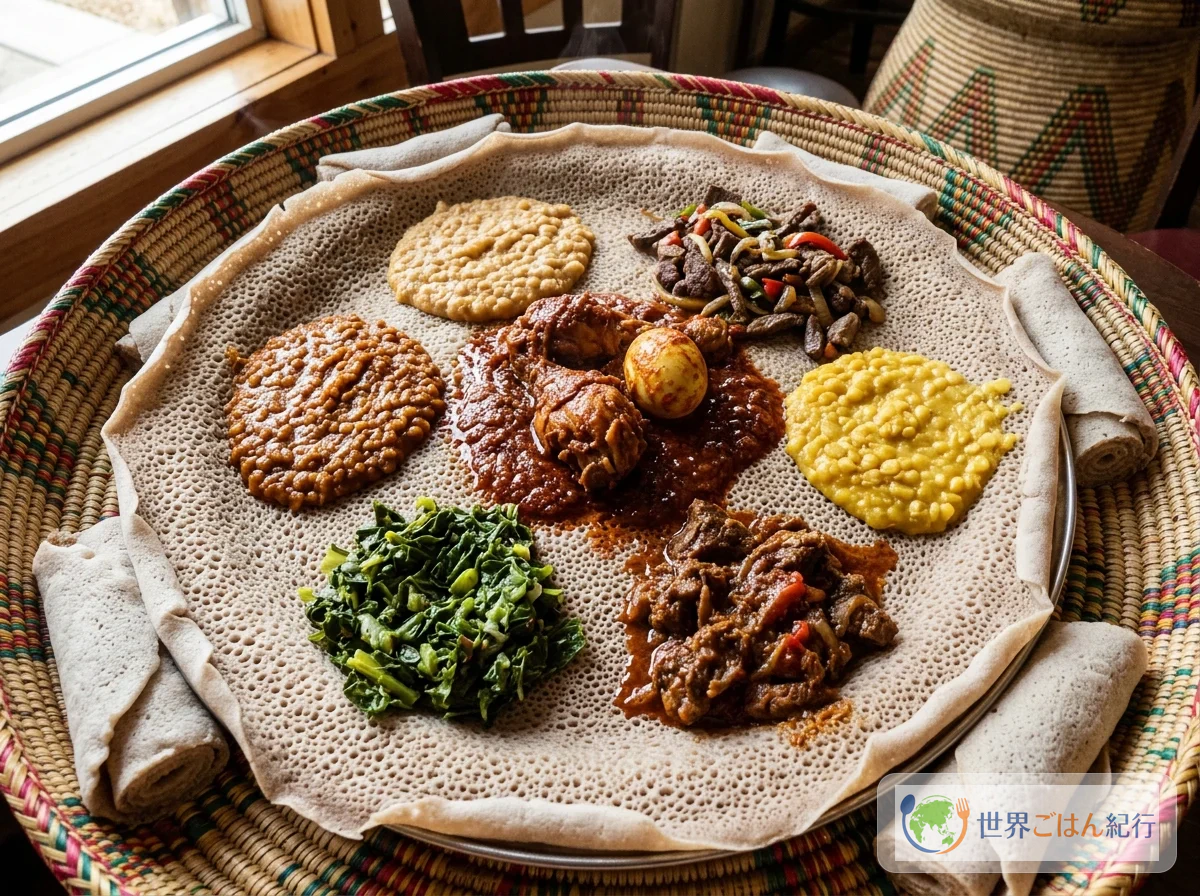
Beyaynetu: a feast for fasting days
Ethiopia's vegan platter is called beyaynetu and developed as a fasting-day meal. Small portions of 6–8 vegan dishes are arranged on one large injera.

A typical beyaynetu looks like this.
At the center are the main stews: misir wot (spicy red lentil stew) and shiro wot (thick chickpea-flour stew). Vegetable sides add color: gomen (braised collard greens), atakilt wat (spiced cabbage and carrots), and tikil gomen (cabbage with turmeric). Cold salads such as azifa (lentil salad) round it out, for a contrast of warm and cold.
With so many dishes it looks like a feast, but most of them take only 20–30 minutes each to make. Prep them on the weekend and you can enjoy them easily on weeknights.
Protein comes from lentils and chickpeas, carbohydrates from injera. This combination of legumes and grains is what makes a fasting-day meal so satisfying.
Ethiopian food is one of the most vegan-friendly cuisines in the world. Fasting-day dishes (beyaynetu) are made entirely from plant foods. Niter kibbeh (spiced butter), however, is dairy, so for a fully vegan version replace it with coconut oil or olive oil.
FAQ
Q: Is Ethiopian food spicy? A: Dishes made with berbere (doro wot, misir wot, and so on) range from medium-hot to hot. But there are plenty of dishes made without berbere, such as gomen. If you don't like heat, start with the mild wots called alicha. Alicha is turmeric-based, yellow in color, and gentle in flavor because it uses no berbere.
Q: I don't like injera's sourness. Can I use another bread? A: Naan, pita, or tortillas will work. Still, Ethiopian dishes are designed to be at their best with injera. If the sourness bothers you, shorten the fermentation to 1 day for a milder tang. Our injera recipe (in Japanese) explains how the flavor changes with fermentation time.
Q: What should I drink with Ethiopian food? A: Cold beer is the classic match for spicy wots, and a crisp lager goes especially well. For wine, a red with moderate tannins (such as Merlot) works. For something non-alcoholic, follow Ethiopian tradition with ginger tea or lemon water sweetened with honey.
Q: Are there Ethiopian dishes kids can eat? A: Gomen (braised greens), ayib (fresh cheese), and atakilt (spiced cabbage) are easy for children to enjoy if you go light on the spices. If injera's sourness is a problem, try a sweet version, like a crepe spread with honey and butter. Do not give honey to infants under 1 year old.
Q: Can I make a big batch of berbere? A: Stored in an airtight container in a cool, dark place, it keeps its flavor for six months to a year. Niter kibbeh keeps about 1 month in the refrigerator and 3 months in the freezer. Wots such as doro wot and misir wot also freeze well and taste good for about a month.
Berbere and mitmita deteriorate with light and air, so store them in dark glass jars or zip-top bags in a cool, dark place. Once opened, whole spices keep their flavor longer in the freezer.
Culture and history: where Ethiopian food meets the world
Ethiopian food is not an isolated cuisine; it has many points of contact with cooking inside and outside Africa.
North Africa's tagine (in Japanese), the Moroccan spiced braise, and the Ethiopian wot have something in common: both are long-simmered dishes generous with spices. Both grew out of dry-climate traditions of preserved foods and are full of know-how for drawing deep flavor from limited ingredients.
Middle Eastern hummus (in Japanese) and falafel (in Japanese) share chickpeas as a main ingredient with Ethiopian shiro wot. Ethiopia and the Arabian Peninsula lie just across the Red Sea, and spices and food cultures have moved between them through trade since ancient times. The heavy use of fenugreek and cumin in Ethiopian cooking is a legacy of that trade.
The links to South Asia are striking, too. Niter kibbeh, like Indian ghee, is a seasoning built on the idea of clarifying butter so it keeps longer. And Ethiopia's fermented injera and India's dosa share some similarities in technique: fermenting a grain, teff or rice, into a batter and cooking it on a griddle.

Wrapping up: start cooking Ethiopian food
Ethiopian food is a culture in which a long history, plant-based dishes refined by religious fasting, deep spice traditions, and the spirit of sharing food all come together.
Step 1: Buy a jar of berbere or make your own. It's the starting point for all Ethiopian cooking. Step 2: Make misir wot (red lentil stew). It's ready in 30 minutes and teaches you how berbere behaves. Step 3: Start a batch of injera (in Japanese), cook it like crepes three days later, and serve it with doro wot (in Japanese) for a true Ethiopian table.
Try it once and you'll likely be drawn in by its distinctive flavors. Enjoy bringing Ethiopian kitchen wisdom to life in your own kitchen.
Sekai Gohan Kiko covers signature dishes from many other regions, too. To explore the whole African continent, browse the African recipes, from jollof rice and tagine to fufu and thieboudienne. Our guide to Middle Eastern food (in Japanese) covers ten dishes including hummus and falafel (in Japanese), and our guide to South American food (in Japanese) introduces ceviche (in Japanese) and feijoada. From Eastern Europe there are khachapuri (in Japanese) and borscht (in Japanese), and from Southeast Asia pad kra pao (in Japanese) and pad thai (in Japanese).
African recipes by region

Here are more dishes from across the African continent to try after Ethiopian food. Part of the fun of African food is how clearly flavors differ by region: West, North, East, and Southern Africa.
West Africa
West Africa is known for tomato-based stews paired with grains. Jollof rice, red rice cooked with tomatoes and spices, is so beloved that Nigeria and Ghana argue over who makes it best. Ghana's fufu is a pounded, dough-like staple of cassava or yam, eaten by hand with rich soups. Senegal's national dish thieboudienne (in Japanese) is rice cooked with fish and vegetables, a taste of West Africa's fishing-village culture. Cameroon's ndolé (in Japanese) is a stew of bitter leaves and peanuts with a deep, distinctive flavor. Côte d'Ivoire's attiéké (in Japanese) is a couscous-like staple of fermented cassava, served with fish or meat.
North, East, and Southern Africa
North Africa delights with vibrant spiced dishes shaped by the Arab world. Egypt's koshari (in Japanese) is a national dish of rice, pasta, and lentils, accented with tomato sauce and crispy fried onions. Algeria's chorba frik is a nourishing soup made with freekeh (green wheat) and a Ramadan staple. And Morocco's tagine (in Japanese), mentioned above, is a masterpiece of spiced braising.
From East Africa, we recommend Eritrea's zigni (in Japanese), a red stew close to Ethiopian doro wot but with Eritrea's own way with spices. Tanzania's ugali is a cornmeal staple that anchors the East African table. Representing Southern Africa, South Africa's bobotie (in Japanese) is a curry-spiced meatloaf topped with an egg custard, strongly shaped by Cape Malay culture.
Sources
This article draws on the following books and resources.
Books and reference data:
- Samuelsson, Marcus. "The Soul of a New Cuisine: A Discovery of the Foods and Flavors of Africa." Wiley, 2006
- USDA FoodData Central. "Teff, uncooked." (https://fdc.nal.usda.gov/) checked 22 October 2026
Web sources:
- Wikipedia. "Ethiopian cuisine" (https://en.wikipedia.org/wiki/Ethiopian_cuisine) checked 22 October 2026
- Wikipedia. "Ethiopian Orthodox Tewahedo Church" (https://en.wikipedia.org/wiki/Ethiopian_Orthodox_Tewahedo_Church) checked 22 October 2026



