Georgia is a small country of about 3.7 million people on the southern slopes of the Caucasus Mountains, yet its food has a depth and character you would never guess from its size. The flavors rest on walnuts, fresh herbs and spices, with wine poured through every meal. Khachapuri is often called one of the world's best cheese dishes, and restaurants serving Georgian food are opening in cities around the world. Interest has grown especially fast in the English-speaking world since 2017, when Georgia's traditional qvevri winemaking method was added to the Intangible Cultural Heritage list.

Georgian food and its history
A crossroads of the Caucasus

Georgia lies between the Black Sea and the Caspian Sea, and since ancient times trade routes between east and west have crossed it. Branches of the Silk Road ran through the land, bringing influences from Persia, Turkey, Russia and the Arab world. Georgians kept their cultural independence through all of it and made these borrowed elements their own.
That independence runs deep. Georgia has its own script, and Georgian belongs to the Kartvelian languages, not the Indo-European family. You can taste the same distinctiveness in the food: a way with spices, a cheese culture and a wine culture unlike either Turkish or Russian cooking.
The ties to both neighbors are still strong. Georgian cuisine has had a great influence on Russian cooking, and Georgia shares many dishes with Turkey, such as lavash (thin flatbread), dolma (stuffed grape leaves) and baklava (a layered sweet). Even where the names match, the seasoning differs: Georgia leans heavily on walnuts and fresh herbs, while Turkey tends to build on olive oil and tomato.
Wine and the qvevri

At sites in eastern Georgia, pottery fragments from around 6000 BC have been found with traces of organic acids from grapes, evidence that supports Georgia as a "birthplace of wine." The qvevri method has continued without a break for 8,000 years, making it the oldest winemaking method in the world.
A qvevri is a huge clay vessel holding 800 to 3,500 liters, buried in the ground up to its neck. Grape juice, skins, seeds and sometimes stems go in together, the vessel is sealed with beeswax, and the wine ferments and ages for about six months. White grapes fermented on their skins this way turn amber, and the result, orange wine (amber wine), is a category of its own, neither white nor red.
Orange wine has traveled far. In the 1990s winemakers in Italy's Friuli region and in Slovenia took up Georgian techniques, which then spread through Europe, and by the 2010s orange wine was a regular on the menus of natural wine bars in many cities. It is now seen as a forerunner of the natural wine boom.
At home in Georgia, wine has long been a sacred drink, inseparable from religion. After Georgia adopted Christianity as its state religion in the 4th century, a cross made of vine became a symbol of faith, and monasteries became centers of winemaking. The country grows around 500 indigenous grape varieties; Saperavi (red) and Rkatsiteli (white) are the best known, but many farm households take pride in a family variety of their own.
The supra feast
You cannot talk about Georgian food without the supra, a Georgian feast that is less a dinner party than a ritual with strict etiquette. At its center is the host, the tamada, who leads the toasts and sets a theme for each one. Traditionally the first toast is to God, the second to the homeland, the third to the memory of the dead, and then come family, friendship, peace and love.
Between toasts the tamada gives an improvised speech, and guests take it up in turn in the form of "alaverdi." Since the glass is traditionally drained at each toast, a good deal of wine goes down over one evening. The point, though, is not to get drunk but to strengthen the bonds between the people at the table.

If you are invited to a Georgian table, always respond to the tamada's toasts. If you cannot drink wine, touch the glass to your lips. Leaving while there is still food on the table is considered rude, so arrive with plenty of time to spare.
Georgian seasonings and spices
Georgian flavor stands on three pillars: walnuts, herbs and spices. Middle Eastern cooking is built on olive oil and chickpeas; Georgian cooking is built on walnuts and fresh herbs.
Khmeli suneli

Khmeli suneli is Georgia's all-purpose spice blend, a yellow-green powder based on coriander, blue fenugreek and marigold petals. Basil, savory, parsley, dill, mint and black pepper join them, and the blend turns up in almost every Georgian dish.
The distinctive element is blue fenugreek (utskho suneli). Unlike the fenugreek seeds sold elsewhere, it is made from dried, ground leaves and flowers, with a nutty, sweet aroma and a faint bitterness. Look for it online or at import spice shops. If you want to build the aroma yourself, grinding whole coriander seed gets you closer to a khmeli suneli-style scent.
| Spice or seasoning | Where to find it | Use |
|---|---|---|
| Coriander seed | Supermarket spice aisle | General |
| Blue fenugreek | Online, import grocery stores | The core of khmeli suneli |
| Marigold petals | Herb shops, online | Yellow color (substitute: turmeric) |
| Savory | Spice shops, online | The essential herb for lobio |
For a simple version, mix 1 tablespoon of coriander powder, 1 teaspoon of garam masala, 1/2 teaspoon of turmeric, and 1/2 teaspoon of dried basil. A small amount of ordinary fenugreek seed can stand in for blue fenugreek.
Walnuts
Walnuts hold the place in Georgian cooking that butter holds in French cooking or soy sauce in Japanese. Ground to a paste with garlic, spices and vinegar, they become bazhe, an all-purpose sauce for meat, fish and vegetables. Pkhali, satsivi and badrijani all depend on walnuts, and honestly, it is harder to find a Georgian dish without them. Plain shelled walnuts from an ordinary supermarket are all you need.
Many Georgian dishes rely on wheat (bread, dumpling wrappers), dairy (cheese, butter, yogurt), eggs (khachapuri), and walnuts (pkhali, satsivi). If you have a nut allergy, take special care.
Adjika and tkemali
Adjika is a paste of red chili, garlic, walnuts, coriander and fenugreek pounded together. Its heat and savoriness are so concentrated that a small spoonful on grilled meat or stirred into a soup at the end changes the whole dish.
Tkemali is Georgia's sour sauce, made by cooking down unripe plums (cherry plums). It works something like ponzu, cutting through fatty meat and potato dishes with a bright sourness. If you can't get it, a paste of sour plums with a little garlic and dill comes close.
Ten representative Georgian dishes
Georgian dishes fall broadly into bread and cheese, meat, vegetables and beans, and soups. Know these ten and a Georgian restaurant menu will hold no surprises.
1. Khachapuri

Khachapuri (ხაჭაპური / Khachapuri) is the national dish of Georgia and its best-known dish worldwide: bread dough baked around plenty of cheese. The shape changes by region, and there are six main variations.
The most famous is the boat-shaped Adjarian, with cheese, an egg yolk and butter in the center, stirred together at the table. The round Imeretian is the most home-style, cut into wedges like pizza. For the full method, see the complete khachapuri recipe.
2. Khinkali
Khinkali (ხინკალი / Khinkali) are Georgia's big boiled dumplings, as juicy as Chinese soup dumplings. They began as portable food for shepherds in the Caucasus mountains: a thick wrapper around ground meat, cumin, coriander, onion and a lot of liquid.
There are rules for eating them. Hold one by the knot on top, bite a small hole at the edge, slurp the broth, then eat the rest. The knot (kudi) stays on the plate, and Georgians count how many they have eaten by the knots left behind. For the full method, see the complete khinkali recipe.
3. Lobio

Lobio is a stew of red kidney beans simmered with spices and herbs, classic Georgian comfort food. It is seasoned with khmeli suneli, walnuts, cilantro and garlic and finished with pomegranate seeds.
It looks plain, but the warmth of the spices and the freshness of the cilantro give it real depth. With canned red kidney beans it is ready in 30 minutes, which is why it is the dish I most recommend as a first taste of Georgian cooking.
4. Satsivi
Satsivi is a cold dish of chicken simmered in a rich sauce of walnuts, garlic, cinnamon, fenugreek and saffron. It is indispensable at Georgian Christmas and New Year, traditionally made the day before, chilled overnight and eaten the next day.
The smooth walnut sauce melts into the chicken, and the sweet scent of cinnamon and fenugreek drifts up as you eat. Cold is the original way, but it is good warmed, too. See the satsivi recipe.
5. Pkhali

Pkhali is a cold appetizer of boiled vegetables mixed with walnut paste. It changes with the seasons, made with spinach, beet, cabbage or green beans, and at a supra three or four kinds are lined up on small plates.
Grind walnuts fine in a food processor, work them into a paste with garlic, coriander, fenugreek and vinegar, and toss with the boiled vegetables. Shape into rounds and garnish with pomegranate seeds for a beautiful appetizer. If you have ever made spinach dressed with sesame, it will feel familiar.
6. Chakhokhbili
Chakhokhbili is a spiced stew of chicken and tomato. It began as a hunters' dish made with pheasant (khokhobi in Georgian); chicken is the norm now. Plenty of onion and tomato go in, seasoned with khmeli suneli and fresh herbs, and it is one of the most approachable Georgian dishes, familiar even on the first bite.
For a chicken dish led by garlic and dairy, try shkmeruli: browned chicken in a light sauce of garlic and milk or cream, and a good sign of how wide Georgian home cooking ranges.
7. Badrijani
Badrijani is an appetizer of sliced, fried eggplant rolled around a paste of walnuts, garlic, fenugreek and vinegar, garnished with pomegranate seeds and cilantro. A staple at the supra, it is pretty enough to make for guests at home.
8. Mtsvadi
Mtsvadi is Georgian grilled meat, known in Russian-speaking countries as shashlik. Traditionally pork, beef or lamb is grilled over grapevine cuttings, and the smoke from the vines gives the meat its distinctive flavor. The seasoning is just salt and onion. A barbecue or grill pan works at home, and a finish of tkemali brings it close to the local taste.
9. Churchkhela

Churchkhela is made by threading walnuts on a string, dipping them again and again in grape juice thickened with flour (tatara), and drying them. Its candle-like look has earned it the nickname "Georgian Snickers." It is made in quantity at the autumn harvest and hung to dry as a winter preserve.
The roasted walnuts and the natural sweetness of the grapes melt together in your mouth, with no sugar added. You will find it at every Georgian market and winery as a souvenir.
10. Kharcho
Kharcho is a rich winter soup of beef, walnuts, rice, tomato and plum sauce (tkemali), spicy enough to warm you to the core. Sourness from tkemali, heat from adjika, richness from walnuts and savoriness from beef broth: all of Georgian flavor in one bowl.
Cooking Georgian food at home
Georgian ingredients and substitutes
Georgian cooking is easier to take on than Ethiopian cuisine. Most of the main ingredients are at an ordinary supermarket, and the seasonings are mostly versatile ones.
Available at supermarkets: walnuts, garlic, onion, canned tomatoes, cilantro, red kidney beans (canned), chicken thighs, beef shank, bread flour, mozzarella and feta (as cheese substitutes), butter, eggs, red wine vinegar
Available at spice shops or specialty grocers: coriander seed, fenugreek seed, savory, paprika powder
| Georgian ingredient | Substitute | Notes on substituting |
|---|---|---|
| Sulguni cheese | 7 parts mozzarella to 3 parts feta | Balances saltiness and stretch. String cheese also works |
| Tkemali sauce | Sour plum paste + garlic + dill | Different sourness, same role |
| Blue fenugreek | Ordinary fenugreek (a little) | Strong aroma, so go easy |
| Adjika | Chili bean paste + garlic + coriander | Different heat, but it can stand in |

Three rules for Georgian cooking
Rule 1: Crush the walnuts thoroughly Walnut paste is the foundation, so work the nuts in a mortar or food processor until smooth, or pound them in a plastic bag with a rolling pin. Coarse pieces leave the sauce rough on the tongue, and the flavor never comes together.
Rule 2: Be generous with cilantro Georgian cooks use cilantro (coriander leaf) by the handful, so finish with a heaping pile, as locals do. If you dislike cilantro, Italian parsley works, though the flavor changes considerably.
Rule 3: Finish with pomegranate Scatter pomegranate seeds over pkhali, badrijani and lobio. The sweet-sour pop and the ruby color lift the whole dish. Fresh pomegranates are in season in autumn and winter; the rest of the year, frozen seeds will do.
Where to start with Georgian food
Step 1: Gather walnuts, cilantro and garlic and make lobio, the easiest way to taste the basics of Georgian flavor. Step 2: Try khachapuri, the melting cheese bread. Step 3: Wrap khinkali and taste that little pocket of broth. A good weekend project.

More regional cuisines
We also introduce the representative dishes of other regions. The roundup of Middle Eastern cuisine covers ten dishes including hummus and shakshuka, and the roundup of South American cuisine introduces ceviche and empanadas. Closer to Georgia there is borscht, and for African cooking, the roundup of Ethiopian cuisine.
Dishes of the Caucasus and Eastern Europe
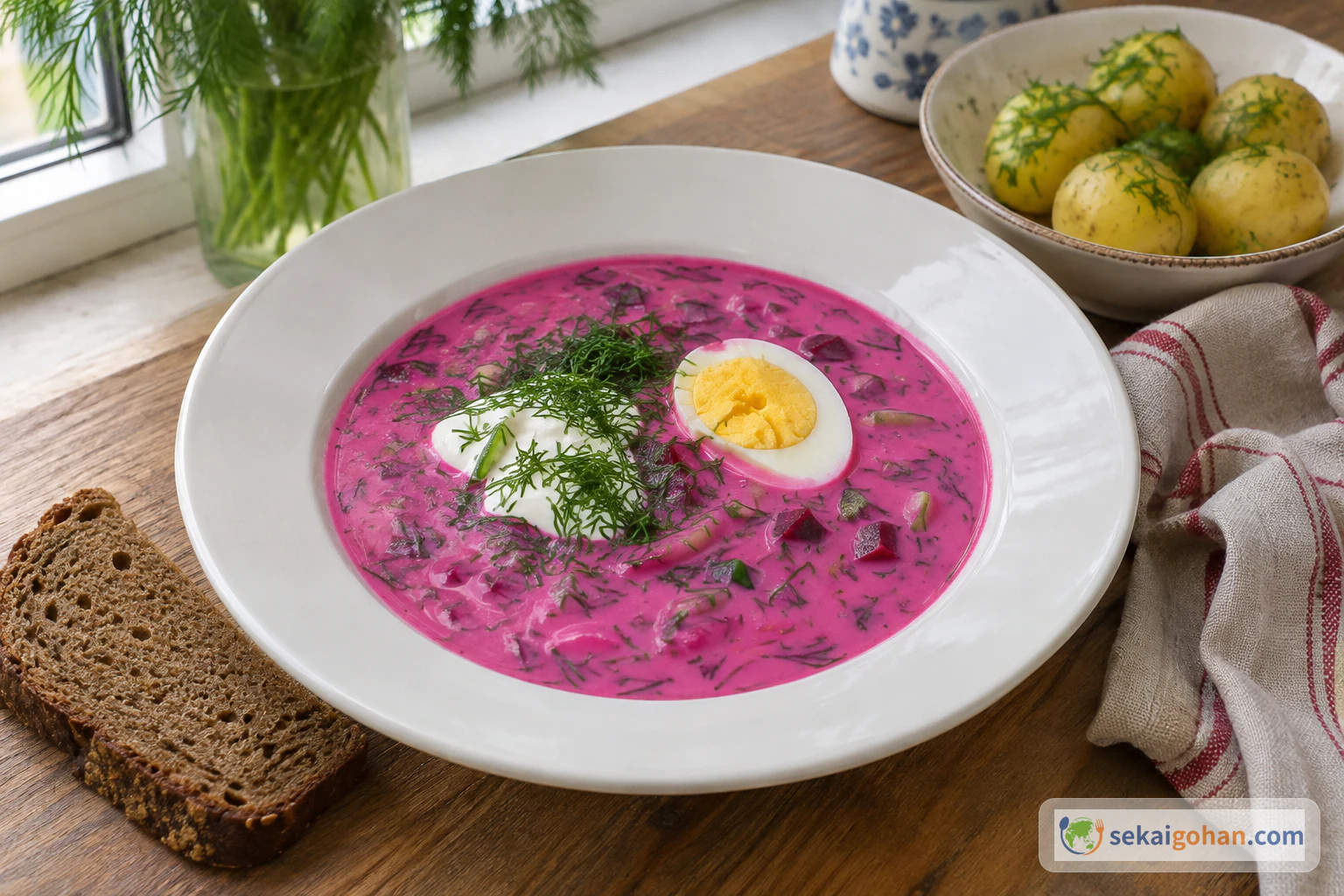
Ukraine's borscht recipe is a stew-soup colored deep red by beets, traditionally eaten with sour cream. Poland's pierogi recipe gives you dumplings filled with potato or cheese, eaten with butter and sour cream. Bosnia's burek recipe is thin phyllo rolled around meat or cheese, a classic Balkan street food.
Romania's placinta recipe is a plain pie of cheese or vegetables wrapped in thinly rolled dough, a taste of Eastern European snack culture. North Macedonia's tavce gravce recipe is the national dish of white beans baked in the oven with paprika and spices.
Dishes of Central Asia
Central Asian cooking grew up along the same Silk Road trade routes. Uzbekistan's plov recipe is a celebration rice dish with lamb and carrots, the biryani of Central Asia, and its manti recipe makes large steamed dumplings eaten with yogurt sauce. Kazakhstan's beshbarmak recipe is boiled meat and noodles whose name means "five fingers," still full of nomadic hospitality.
Kyrgyzstan's lagman recipe is hand-pulled noodles under stir-fried vegetables, where Chinese pulled noodles meet the Silk Road. Tajikistan's qurutob recipe is a salad of yogurt and flatbread, simple but nourishing home food.
Frequently asked questions

Q: Is Georgian food spicy? A: Mostly no. Some dishes use adjika (chili paste), but the base of Georgian cooking is the sweetness of walnuts and the freshness of herbs. It is much milder than Middle Eastern or Ethiopian cuisine.
Q: What can I use in place of the cheese in khachapuri? A: In Georgia they use sulguni (close to a very salty mozzarella) and Imeretian cheese (a fresh type). A 7:3 mix of mozzarella and feta comes closest, and pulled-apart string cheese is popular in the English-speaking world. See the complete khachapuri recipe for details.
Q: Can I buy Georgian wine? A: It is getting easier. Larger wine shops carry Saperavi and Rkatsiteli, and orange wine (amber wine) is available at natural wine shops and online.
Q: How many pleats should a khinkali have? A: Traditionally at least 19. At home the count matters less than sealing the wrapper with no gaps so the broth stays inside. See the complete khinkali recipe for details.
Q: I have a walnut allergy. Is there a substitute? A: Cashews or pine nuts can substitute, though the flavor changes considerably. Khachapuri, khinkali, chakhokhbili and mtsvadi use no walnuts, and they alone give you plenty of the pleasure of Georgian food.
Sources
This article is based mainly on the following English-language books, academic papers, and specialist sites. I checked the original sources for information on Georgian food that is hard to obtain in Japanese.
Books and academic papers:
- Goldstein, Darra. "The Georgian Feast: The Vibrant Culture and Savory Food of the Republic of Georgia." University of California Press, 2013
- McGovern, Patrick E. et al. "Early Neolithic wine of Georgia in the South Caucasus." Proceedings of the National Academy of Sciences (https://www.pnas.org/doi/10.1073/pnas.1714728114), consulted 2017
Web sources:
- TasteAtlas. "Georgian Cuisine: Best Dishes and Restaurants" (https://www.tasteatlas.com/georgia), consulted 2025
- UNESCO. "Ancient Georgian traditional Qvevri wine-making method" (https://ich.unesco.org/en/RL/ancient-georgian-traditional-qvevri-wine-making-method-00870), consulted 2024
- Serious Eats. "An Introduction to Georgian Food" (https://www.seriouseats.com/introduction-to-georgian-food), consulted 2024