
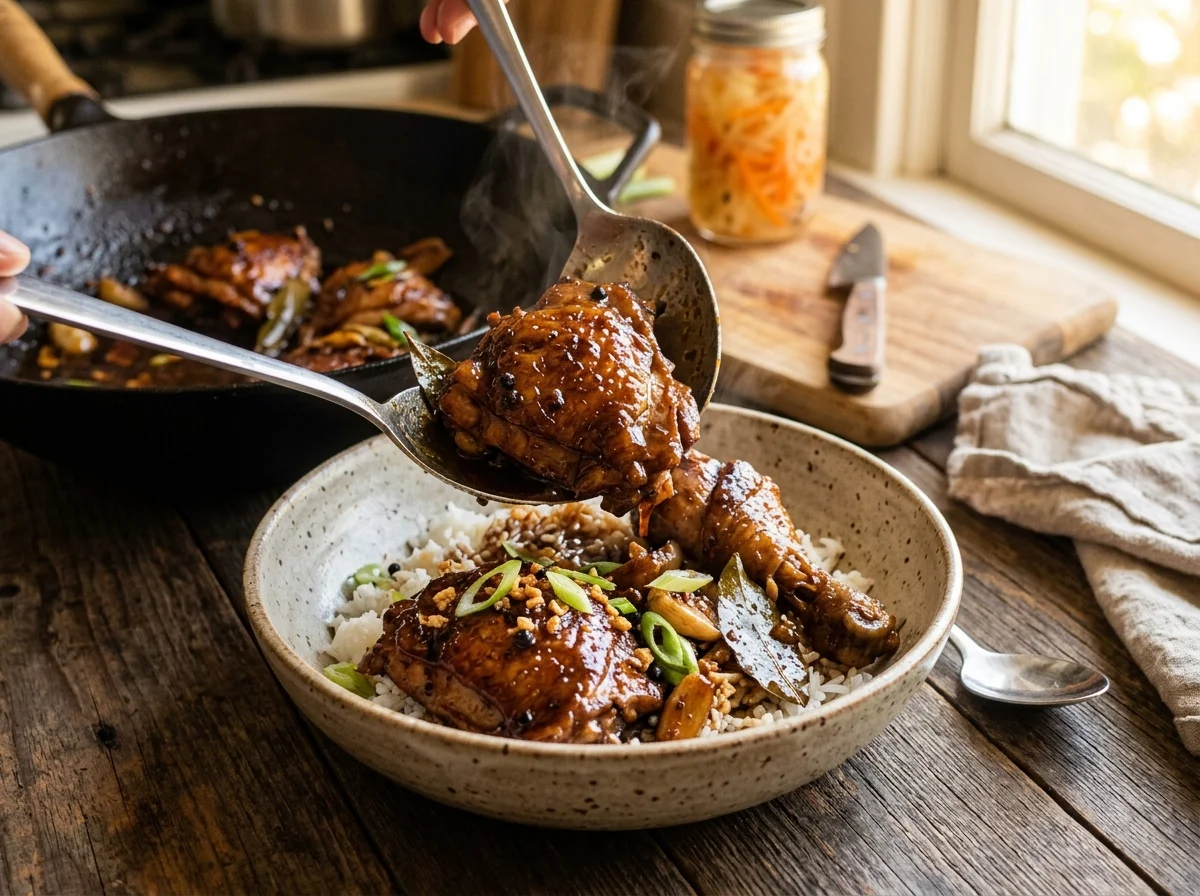
Lift the Lid and the Garlic Reaches You Before the Vinegar
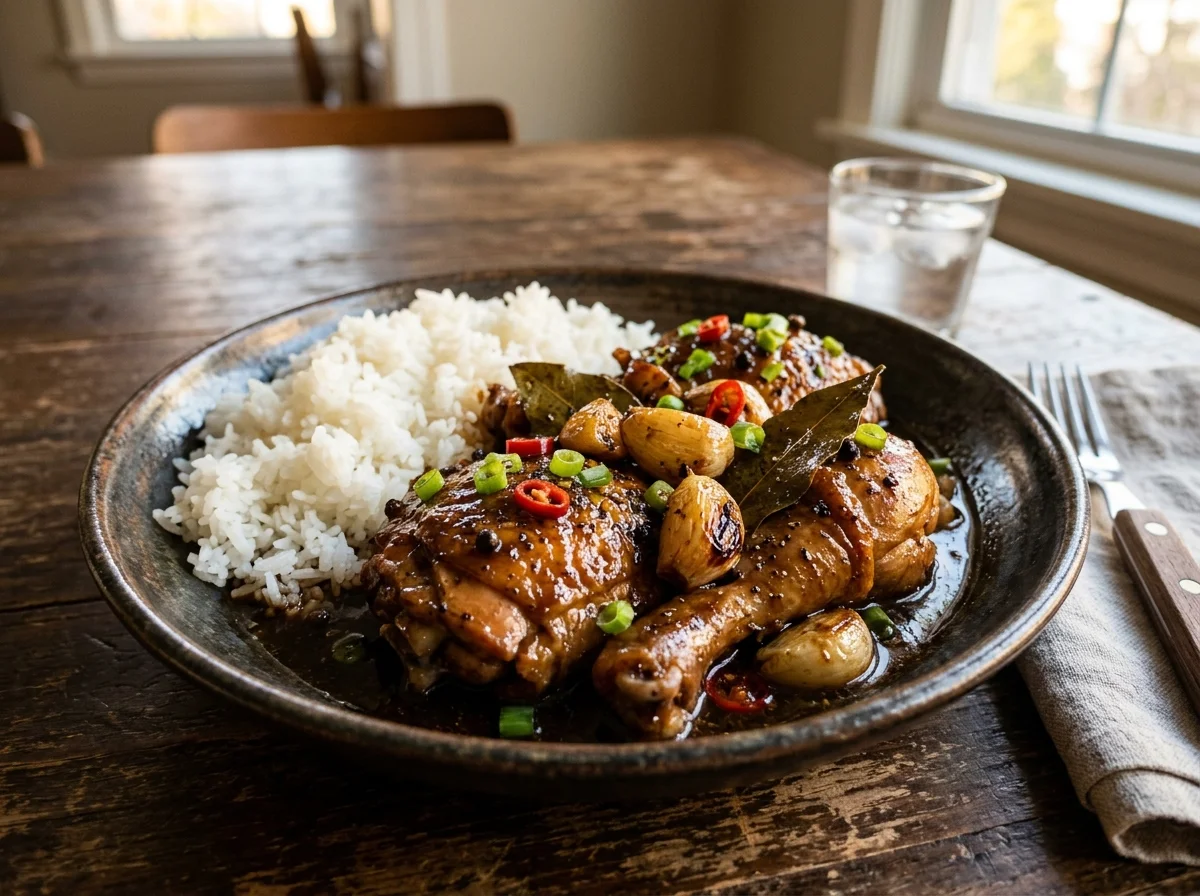
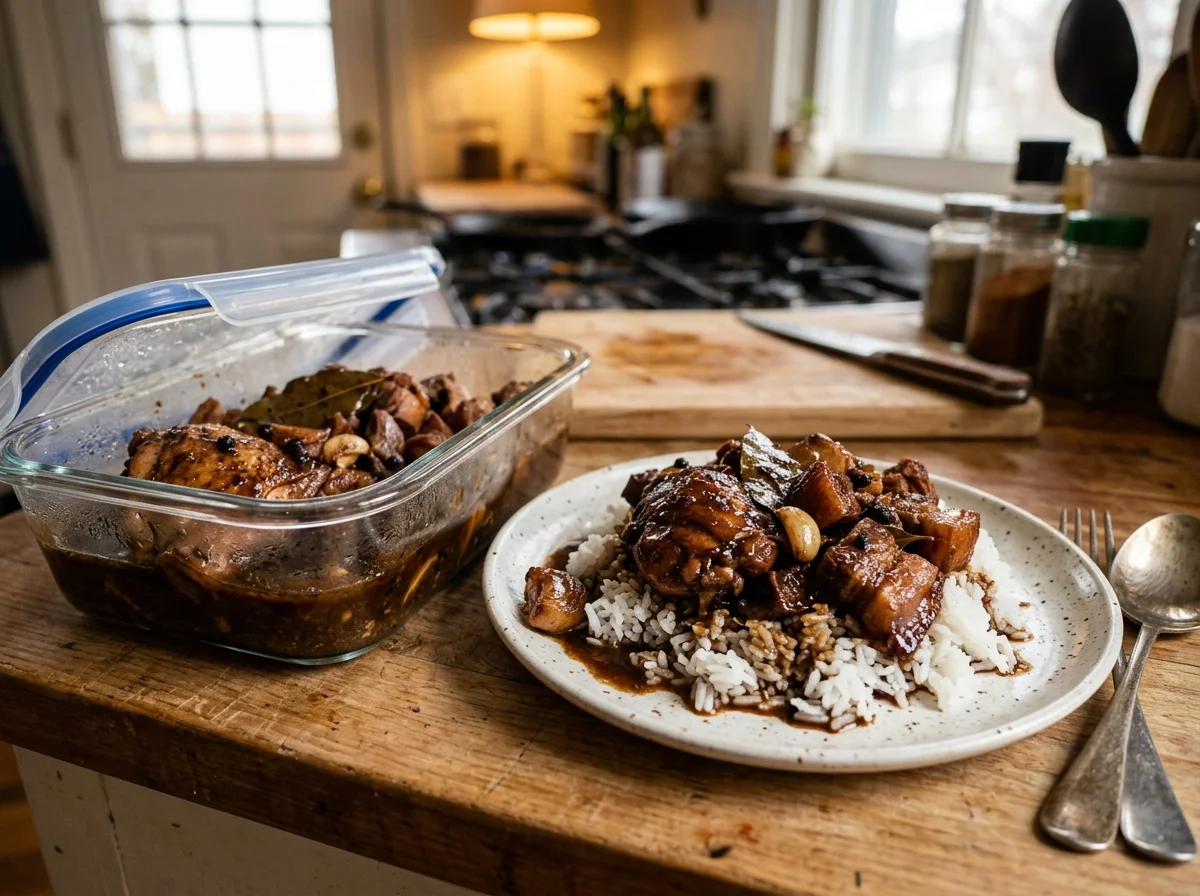
Picture the moment you lift the lid of the pot. What rises first is not only the sharpness of vinegar but a scent of garlic that has soaked up the liquid, black pepper and chicken-skin fat all blended together. If you plan to put the chicken over white rice, leave the sauce loose. If you want the meat coated in a deep glaze, take the lid off and cook off a little more liquid.
Adobo is not a dish that is settled automatically by using equal parts vinegar and soy sauce. How long you boil the vinegar once, how long you cook the meat over low heat, and how much liquid you leave at the end change how sourness and saltiness are felt.
This recipe is based on 800 g of bone-in chicken thighs, and gives the states that are easy to judge in a home pot in numbers and in appearance. Whether to look for Filipino cane vinegar, start with rice vinegar, or add coconut milk to lean toward the Bicol region can also be decided before you reduce the sauce.
For a first batch, make the basic version with ordinary soy sauce and rice vinegar, and you will grasp the difference made by heat more easily than the difference made by the kind of vinegar. It is not too late to try cane vinegar or coconut milk in the next pot, once you have confirmed the basic flavor.
Culture, the Origin of Adobo, and Differences from Table to Table
The Philippines' National Nutrition Council presents adobo as one of the representative dishes, and explains that the ingredients and methods change from household to household and region to region. The form of braising chicken or pork in vinegar, garlic, black pepper and so on is widely known, but there are also adobo puti, which uses no soy sauce, adobo sa gata, which adds coconut milk, and versions with beef or water spinach (kangkong).
The origin of the dish's name is not closed off by a single explanation. While some explanations link it to a foreign word, the cooking foundation of using vinegar and garlic cannot be explained all at once by the origin of the name alone. When the Bureau of Philippine Standards of the Department of Trade and Industry advanced standardization of representative dishes including adobo in 2021, it did not try to bring home pots into one formula, but considered regional differences, including bay leaves, black pepper, soy sauce, vinegar, coconut milk and atsuete (annatto).
The food culture introduced by the Philippine Department of Agriculture likewise does not separate dishes from region, season and available ingredients. At a table where a main dish is eaten with white rice and served with vinegar or a dipping sauce, how much of the adobo braising liquid you leave connects directly to how it is eaten. Meat is increased or decreased to match what goes on the table, and the sauce is either spooned over or coated onto the meat, so differences between households are not errors in the formula but also differences in how the dish is used. The direction of layering coconut milk and heat also connects to Bicol Express (in Japanese), and the idea of combining vegetables with vinegar or fermented seasonings is easier to see by comparing with pinakbet and laing. Line up monggo, which makes beans the star, and you can also see that braised meat alone cannot stand for the Filipino table. Including embutido, a baked pork roll, shows that even with the same meat, the role at the table changes depending on whether it is braised in vinegar or bound with vegetables and egg.
Soy sauce also differs by region. Toyo, used in the Philippines, is one of the sauces added for flavor at the table, combined with vinegar, calamansi and garlic, and some products taste darker and saltier than Japanese soy sauce. When using standard dark soy sauce, do not expect the same taste as a Filipino product from the start; it is easier to handle by starting with 50 ml and tasting the braising liquid before adding more. When choosing commercial toyo, check the ingredients and allergen labeling as well as the volume. Many soy sauces list soybeans and wheat among their ingredients, so even when you switch soy sauces, you cannot skip the label.
| Style | How flavor and ingredients move | How to approach it at home |
|---|---|---|
| Basic chicken or pork | Vinegar, garlic, black pepper and bay leaf, with the saltiness of toyo or soy sauce layered on | Make it with rice vinegar and regular soy sauce, and adjust the final reduction |
| Adobo puti | No soy sauce; the meat finishes pale | Leave out the soy sauce and taste starting from 1/2 tsp salt. Treat a pale color and a weak flavor as separate things |
| Adobo sa gata | Coconut milk wraps the edges of the acidity and fat | After making the basic version, combine 150 ml of the braising liquid with 200 ml coconut milk |
| Versions with vegetables | Water spinach or banana blossom combined with the meat | Add water spinach in the last 3 minutes to keep the texture of the leaves |
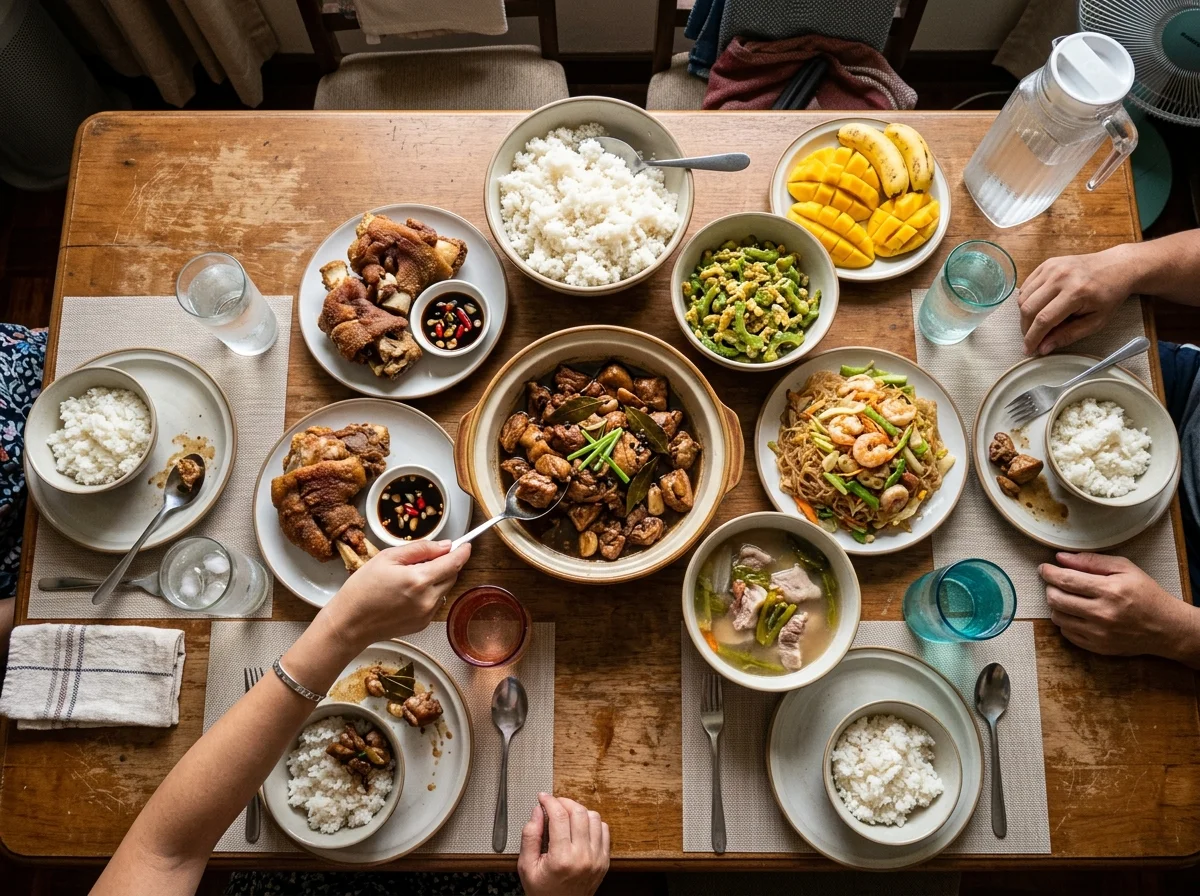
Adobo is not complete with meat alone; it sits on the table with rice and a sour condiment.
When you cook it at home, rather than fixing one "original" form of the name, choosing your starting point by where you place sourness, saltiness, fat and the amount of sauce to pour over rice makes the reasons for substitutions easier to understand.
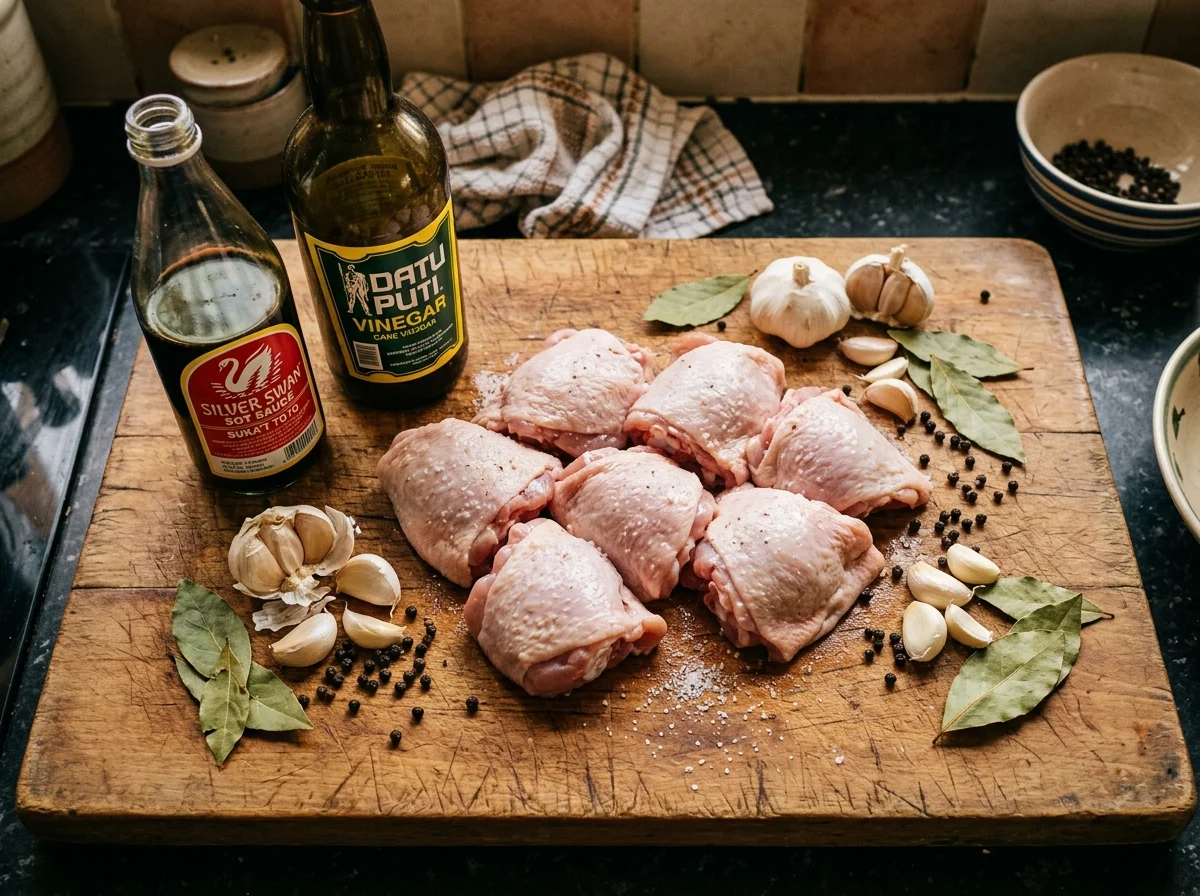
Ingredients (serves 4)
This amount is a starting point with soy sauce and vinegar at close to 1 to 1. Filipino cane vinegar is, in many products, rounder in aroma than rice vinegar. If you cannot find it, make it with rice vinegar, and only when using distilled grain vinegar increase the water to 200 ml and check the acidity after reducing. Sugar is not in the basic version. If you want to add sweetness, add just 1 tsp right before finishing, and you can adjust while keeping the aroma of the vinegar.
Some soy sauces contain soy and wheat. If you have an allergy, check the label and switch to a wheat-free tamari or similar. Tamari can be strong in saltiness and color, so start with 50 ml and add after tasting the braising liquid.
Cane vinegar is worth buying when you have made adobo a few times and want to confirm a rounder acidity than rice vinegar. If you make the basic version with rice vinegar you can get nearby, you do not lose the judgment in the steps even without hunting for a special vinegar.
If you pile fried lumpia Shanghai or the noodle dishes pancit bihon and pancit canton onto a main dish served with sauce over white rice, strongly flavored dishes follow one after another. On the day adobo is the center, serving a vegetable or a soup rather than lining up such dishes all at once keeps the acidity of the braising liquid easier to preserve.
Keep the Acidity, or Make the Braising Liquid Richer
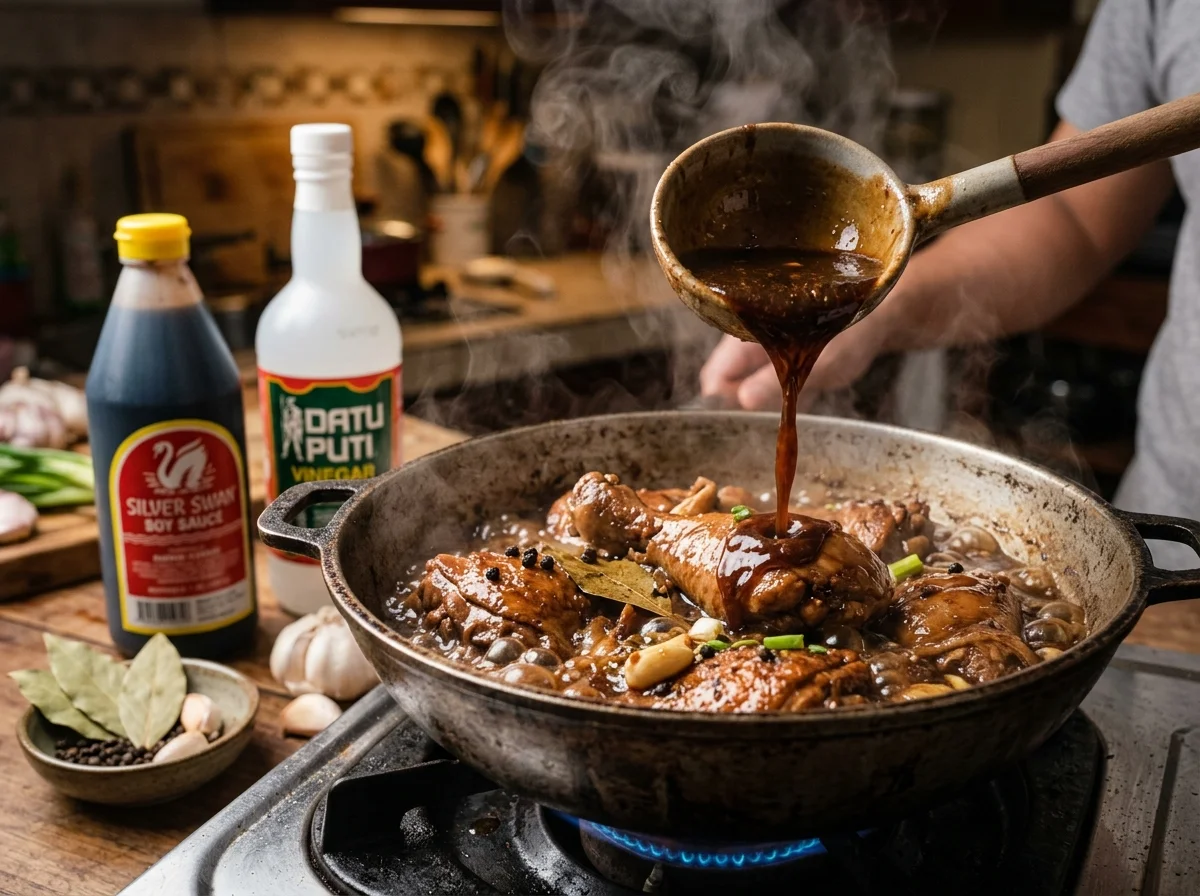
The outline of adobo changes in the last few minutes. With the lid on, an acidic braising liquid stays around the meat; reduce it with the lid off and the saltiness of the soy sauce and the fat of the chicken come forward. On the days you pour plenty over white rice, stop where the liquid flows loosely. On the days you want the sauce to coat the meat, reduce to a thickness where the bottom of the pot shows for a moment when you draw a spatula through it.
You do not have to cook off all the sharpness of the vinegar. Even if the sharpness has left the steam, if a brief sourness remains in the mouth, the fat of the chicken skin is less likely to feel heavy. When you want to compare sour dishes at the table, it helps to think of dishes that place the acidity in the soup, like sinigang, separately from dishes that infuse it into the meat, like adobo. If the tasted liquid is too salty, take out the chicken and then add water; if the acidity is sharp, adjust with a little sugar and water. If you reduce for long with the chicken still in, it easily loses even the moisture of the meat.
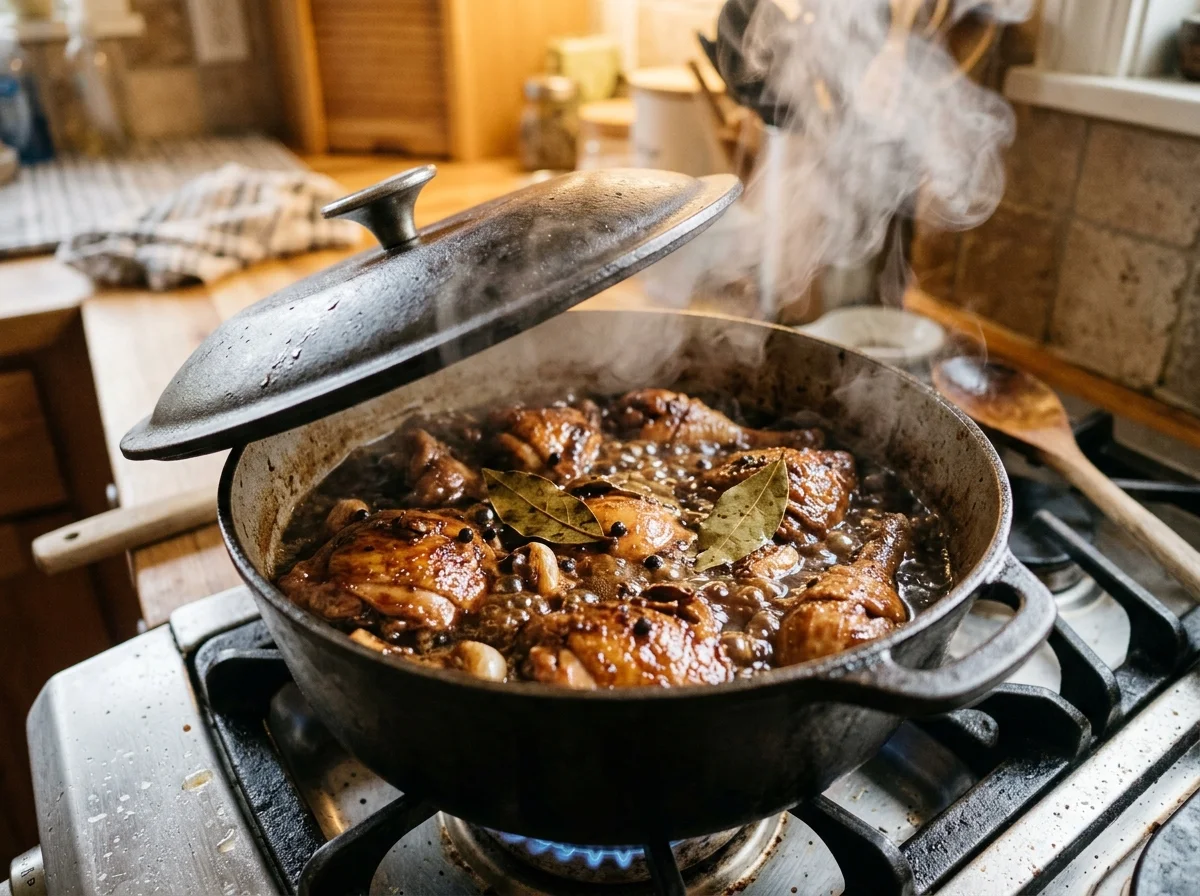
Black pepper, simmered whole, releases its aroma slowly. Crushing it coarsely with the flat of a knife or in a mortar makes it easier to create an aroma that rises together with the garlic. For a direction in which pork is braised in vinegar and soy sauce to get a glaze, comparing how flavors layer with humba makes the point of leaving braising liquid in adobo easier to see. If you crush the pepper in a mortar, a mortar deep enough to crush the peppercorns coarsely, large enough to hold the garlic in one go, and with a pestle is enough. If a knife is already enough for you, or you do not want to add storage space, you do not need one.
Knowing the Regional Differences Sets How Far You Adjust
The regional differences in adobo are not a list for squeezing different dishes into one plate. They are a map for knowing what moves among acidity, fat and saltiness when you add something.
Adobo puti, without soy sauce
A form that braises mainly with vinegar, garlic, black pepper and bay leaves. The color is pale, but the flavor is not necessarily weak. Since you cannot build the outline with the saltiness of soy sauce, do not over-reduce the liquid, and keep the aroma of vinegar and the fat of the chicken. If you only leave the soy sauce out of the basic formula here, start with 1/2 tsp salt and taste at the end.
Adobo sa gata, with coconut milk
A form known as a dish of the Bicol region, in which coconut milk wraps the edges of the vinegar and the chicken fat. After making basic adobo once, combine 150 ml of the braising liquid with 200 ml coconut milk in a separate pot, return the chicken and simmer over low heat for 8–10 minutes, and it is easier to compare flavors. If you put in all 400 ml from the start, the acidity becomes hard to judge.
Coconut milk has a reason to be bought by those trying Bicol style. On the other hand, someone making adobo for the first time or who dislikes the scent of coconut can make the basic version first. The one point to check on the can is the 400 ml volume, and that it is a cooking product whose ingredients are coconut milk, water and citric acid.
When changing the meat or vegetables
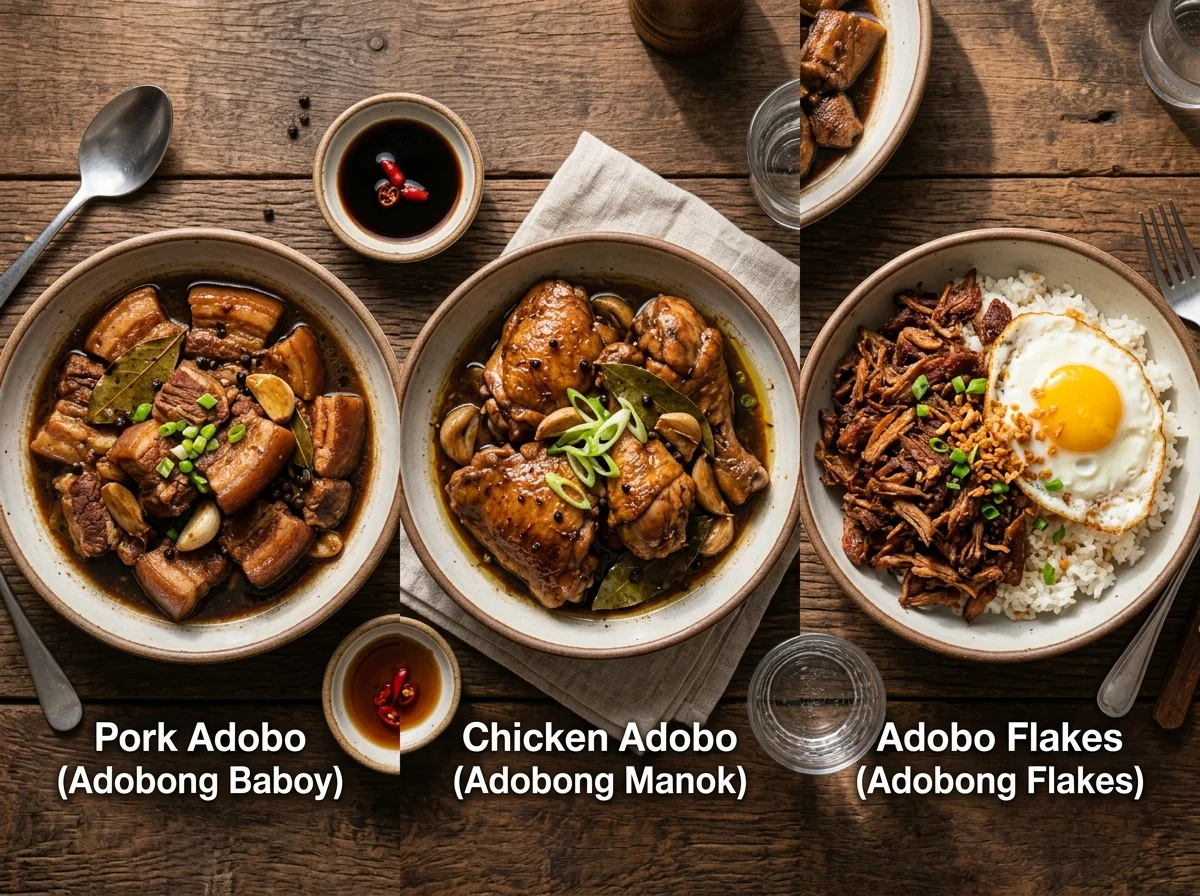
For pork, cut 700 g of pork shoulder into 5 cm cubes and braise 10–15 minutes longer than chicken. If there is a lot of fat, skim a little of the fat that floats at the end. Beef adobo takes time for the braising liquid to get into the meat, so do not simply swap it into this 60-minute recipe. To add pork braises, compare with pochero and lechon; to try beef, dishes where the relation between broth and meat is different, such as kare-kare and bulalo, are also useful references. Extending to the aroma of offal uses a different cooking method, as in bopis (in Japanese), so do not carry over the amount and time for chicken as they are.
There are also regional versions that add water spinach or banana blossom. If you try it at home, add the water spinach for just the last 3 minutes. Braised from the start, the leaves fall apart and easily lose their bright color and bite.
When Storing, Watch Temperature, Not Vinegar
Adobo tends to settle in flavor the next day. But that does not mean "it contains vinegar, so it can sit at room temperature."
When you finish eating, do not keep leaving it in the pot at room temperature; move it to a shallow storage container. Do not let the cooling time run too long, and refrigerate within 2 hours of cooking as a guide. Eat refrigerated adobo within 3–4 days as a guide. When reheating, heat it thoroughly to the center, and warm only what you will eat. If you plan to shred leftover chicken the next day, apart from arroz caldo, which takes it in soft rice, and sopas, eaten as a soup, leaving a small amount of braising liquid keeps the richness that is characteristic of adobo.
Cold braising liquid sets with white fat and tastes saltier. Warm it slowly over low heat and the fat melts and the aroma of vinegar returns. If the liquid has reduced the next day, add just 1–2 tablespoons of water before warming.
Washing raw chicken can spread splashed water around the surroundings. Do not wash the chicken; wipe off the moisture and use it. Use separate cutting boards and knives for raw meat and for food eaten as is, and wash your hands with soap before and after cooking. Check the internal temperature of the chicken, with 74°C (165°F) as the guide.
Frequently Asked Questions
Are vinegar and soy sauce really equal?
Equal amounts are easy to handle as a first formula. But the kind of vinegar, the saltiness of the soy sauce and how far you reduce change the result. If you want to keep the acidity, leave more braising liquid; if you want a deep glaze, take the lid off at the end and reduce briefly.
Does it still count as Filipino food with rice vinegar?
Yes. Rice vinegar is milder than cane vinegar, so start from 60 ml in the basic formula. If you use distilled grain vinegar, increase the water by 20 ml and check the acidity at the end. Changing the kind of vinegar is not a failure that makes the dish something else; it is a choice that adjusts the acidity of the table.
Can I make it with chicken breast?
You can, but shorten the braising time compared with bone-in thighs. Use 600–700 g, and check the internal temperature after 18–22 minutes over low heat. Keep the reducing time short too, and taking the meat out and reducing only the sauce makes it less likely to dry out.
Is it a spicy dish?
The basic version has no chili. If you add heat, add just one red chili to the braising liquid. Even when you want to pair it with the sweet aroma of coconut milk, do not put in several from the start; keep it so people can add at the table.
What goes well as a side dish for adobo?
White rice that catches the acidity and saltiness is the center. For a light soup, the idea of sinigang, a Filipino sour dish, is a useful reference. If you set out one more meat dish, rather than piling on chicken, such as the smoky grilled chicken inasal, choosing a watery small plate like leafy greens or cucumber lets the adobo braising liquid shine. On a day you want to enjoy the strength of pork fat and garlic, keep to adding a small amount of sisig.
When choosing a side, do not stack another fatty meat like adobo; place one thing that catches the sauce, such as white rice, leafy greens or cucumber, and the flavors of the table are less likely to scatter.
For the Day You Make Adobo Again
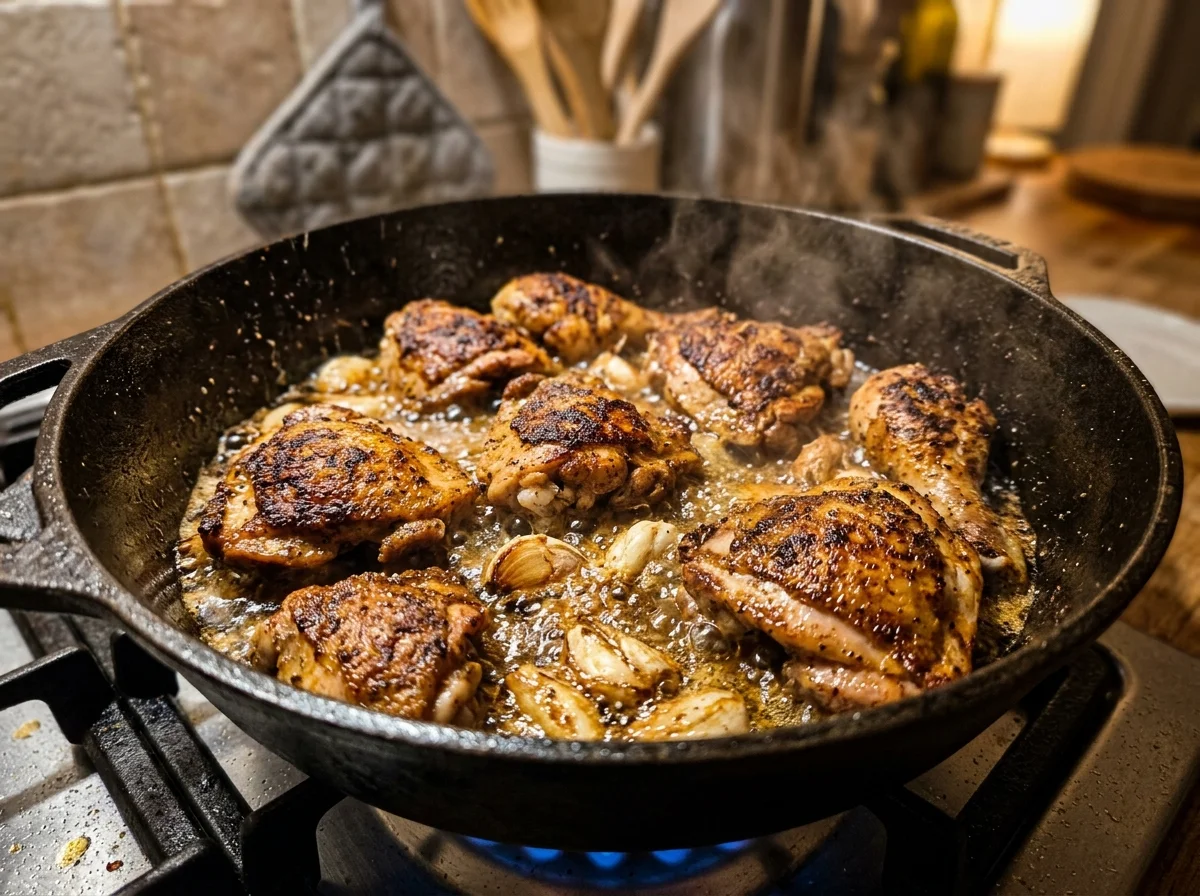
The key to making adobo is not only keeping the numbers for vinegar and soy sauce. Brown the chicken skin, boil the liquid once, and cook through to the center over low heat. After that, the time with the lid off decides whether you get "braising liquid to pour over rice" or "a glaze that coats the meat."
For a first batch, make the basic version with regular soy sauce and rice vinegar. Those who want to keep the aroma of vinegar clearly can look for cane vinegar, and those who want to try the round acidity of Bicol style can add just 200 ml coconut milk. Even when you add special ingredients, if you keep one pot of the basic version, you can compare which aroma and which richness changed. Adobo is not a foreign dish you reproduce once and finish; it is a braise you can return to, according to the amount of white rice and how you want to eat that day. For a light side dish, pair it with tortang talong, and for soup with chicken tinola, and the acidic braising liquid is less likely to overlap. On days you continue with meat dishes, keeping adobo as the main dish rather than adding longganisa or dinuguan makes it easier to keep the axis of flavor.
Next time, move only one of the two, either the kind of vinegar or the amount of braising liquid you leave, and you will get closer to the adobo you like.
Sources
- Philippine National Nutrition Council, "What makes an Adobo dish an Adobo?", https://nnc.gov.ph/mindanao-region/what-makes-an-adobo-dish-an-adobo/ (accessed and checked 2026-08-11)
- Department of Trade and Industry, Bureau of Philippine Standards, "Standardization of famous Filipino dishes advances", 2021-07-12, https://bps.dti.gov.ph/press-releases/283-standardization-of-famous-filipino-dishes-advances (accessed and checked 2026-08-11)
- Department of Agriculture, "#PreserveFilipinoFood: DA leads Filipino Food Month 2023 celebration", 2023-03-22, https://www.da.gov.ph/preservefilipinofood-da-leads-filipino-food-month-2023-celebration/ (accessed and checked 2026-08-11)
- The Washington Post, G. Daniela Galarza, "Adobo", 2021-12-08, https://www.washingtonpost.com/recipes/adobo/ (accessed and checked 2026-08-11)
- Centers for Disease Control and Prevention, "Chicken and Food Poisoning", 2024-04-29, https://www.cdc.gov/food-safety/foods/chicken.html (accessed and checked 2026-08-11)
- Kikkoman Institute for International Food Culture, "Soy Sauces of Asia", https://www.kikkoman.com/en/kiifc/journal/pdf_25/e_014_021.pdf (accessed and checked 2026-08-11)



